Model-Agnostic by Design: Big AI Bets Without Vendor Lock-In

AI vendor lock-in happens when your work is built so tightly around one AI model that changing it takes months. Avoid it by owning four things: the code and rules around the model, your prompts, a set of real test cases, and your data. Rent only the model, behind one door.
Then a swap takes weeks.
AI vendor lock-in is an architecture choice, not a vendor trick
The email lands on a Tuesday. The AI model under your lead-scoring workflow is being retired. You have a few months.
One team reads it, swaps in the new model, runs its tests and is done by Friday. Another team starts a project that eats a whole quarter.
Same vendor. Same email. The difference is what each team owns.
That difference has a name: AI vendor lock-in. It means your work is built so tightly around one model that changing it costs months.
Being model-agnostic is the cure. It does not mean using every model. It means you can swap the main one in weeks without rewriting your workflows.
Nobody traps you into lock-in. You move in, one handy feature at a time: the vendor's memory, its hosted agents, its file store.
Each one is small. Together they tie you to one vendor. Call it a contract you never signed.
Just picking your first AI tool? Start with AI marketing workflows and come back when one runs every day.

Lock-in comes from how you build, not from which vendor you pick
| Built straight on one vendor | Built behind your own door |
|---|---|
| Prompts live in the vendor's console | Prompts live in your files, with versions |
| Every app holds a vendor key | Every app calls one internal door |
| Customer memory sits in the vendor's tool | Data and logs sit in systems you own |
| No test set, so every change is a guess | A golden set checks every change |
| A model retirement means a project | A model retirement means a test run |
Our rule, set out in this guide.
You will change models even if you never change vendors
Most teams think lock-in only matters if they leave their vendor. That is the wrong worry.
A market survey by Menlo Ventures found only 11 percent of teams changed model providers in a year. But 66 percent moved to a newer model from the vendor they already had.
Every one of those upgrades is a swap. New model, same prompts. And a real chance that what worked last month now works a little differently.
Then there is the calendar. Vendors publish model retirement policies, and every model has an end date.
Loyalty does not save you. The calendar decides.
Sometimes nobody even sends the email. Chip Huyen warns in AI Engineering that a vendor can update the model behind an unchanged name, without telling you.
Your prompts drift off course, and you have no idea why. She calls building on these models riding a bullet train. You do not pick the stops.
Few teams leave their vendor, but two in three changed models within a year
- Changed model providers 11
- Moved to a newer model from the same vendor 66
- Made no change at all 23
Source: Menlo Ventures, 2025 Mid-Year LLM Market Update, July 2025. Share of surveyed teams, past year.
The Swap Test is our quarterly check of AI vendor lock-in. Pick one live workflow, route it through your one internal door, and run its golden set (20 to 100 real cases with known good answers) on your current model and one candidate. Time it from start to decision.
Under two weeks means you are portable. Over a quarter means a layer you should own (the harness, the prompts, the golden set or the data) has slipped to the vendor, so pull that layer back first.
The same model update can help one company and hurt another
Here is the part most advice skips. You cannot borrow anyone else's test results.
Huyen's book reports one update, from an older version of a model to its newer version. It cut one company's intent sorting by 10 percent. It improved another company's support chatbot.
Same update. Opposite results.
Outside researchers saw the same pattern. Two releases of one popular model, three months apart, scored very differently on the same tests.
The model is not the only moving part, either. The same model served by two providers can score differently, because each one tunes it for speed and cost.
So what does a leaderboard tell you? Which model is good on average. Not which one is good at your job.
Your tests tell you, or your customers do. Pick one.
The same model change can help one team and hurt another
| What changed | What happened | How sure |
|---|---|---|
| One model, older version to newer version | One company's intent sorting fell 10 percent | Company-reported, cited in AI Engineering |
| The same update | Another company's support chatbot improved | Company-reported, cited in AI Engineering |
| Two releases of one model, three months apart | Scores differed notably on the same tests | Peer study, Chen, Zaharia and Zou |
| One model, served by different providers | Benchmark scores differed by provider | Provider benchmarks, cited in AI Engineering |
Sources: Chip Huyen, AI Engineering (chapters 4, 9 and 10); Chen, Zaharia and Zou, arXiv 2307.09009 (2023).
Own four things and rent the model
Own four things. Rent one. That is the whole strategy.
Own the harness. The harness is the code and rules around the model: tools, permissions, checks and recovery steps. Write it against your own interface, so the model is a part you can pull out.
More on that layer in what an agent harness is.
Own the prompts. Keep them in your own files with version numbers, like code. Not inside a vendor's console.
Huyen argues that secret prompts are a burden, not a moat. Every model change means updating them. So we put the value in the system around them.
Own the golden set. A golden set is a list of real cases with known good answers. It is what makes switching cheap.
Own the data. Your documents, search index and logs live in systems you control. If your data sits in ten tools, start with one company brain.
Say you cut your documents into chunks with one model's token counter, its own way of splitting text. Switch models, and you rebuild the whole index. Small choice, big bill.
Rent the intelligence. The model is the part you pay for by use, so keep it cheap to leave. On purpose.
Cheap for you to leave. Expensive for the vendor to lose. That is where you want to sit at renewal time.
Own everything that knows your business; rent the model underneath
| Layer | What it holds | If the vendor holds it |
|---|---|---|
| Harness (own) | Tools, permissions, checks, recovery steps | Every swap means rebuilding the workflow |
| Prompts (own) | Versioned prompt files | Prompts drift or vanish inside a console |
| Golden set (own) | Real cases with known good answers | No way to tell if a new model is better |
| Data (own) | Documents, search index, logs | A switch means re-indexing or losing history |
| Model (rent) | The intelligence, paid by use | Fine. This is the part built to change |
Our split. The re-indexing risk is described in Chip Huyen, AI Engineering, chapter 6.
Put one door in front of every model
The door is one internal gateway. Every AI call in the company goes through it. Nobody calls a vendor directly.
What does the door do? First, it gives every workflow one way to call any model. When a vendor changes its interface, you fix the door once, not every app.
It holds the keys. Staff get access to the door, not copies of the company's vendor keys scattered across laptops.
It sets limits per person and per app, and it logs every call. When one vendor is down or slow, it sends the request to a backup model.
Software teams know this shape. In Team Topologies, Matthew Skelton and Manuel Pais describe a platform that can be one thin layer over a vendor's product. They expect platform teams to swap parts for better outside options as the market moves.
The Accelerate research team found a related rule in software delivery. The biggest driver of fast, safe releases was whether a team could change and test its own system without waiting on other teams.
They also called the which-tool debate the wrong question. We read the AI version the same way. The model you pick matters less than whether you can swap it alone, on a normal workday.
Tool connections can use an open standard like the Model Context Protocol instead of one vendor's format. That is cheap portability.
One internal door does five jobs for every AI call
- One interface Every workflow calls the door. A vendor change means one fix, not one per app.
- Key holder Staff get access to the door, never copies of vendor keys.
- Limits Spending and usage caps per person and per app.
- Log Every call, the model used, and what it cost.
- Backup route When one vendor is down or slow, calls go to a tested backup model.
Gateway functions as described in Chip Huyen, AI Engineering, chapter 10. Wording ours.
Direct vendor calls turn every change into many changes
| Each app calls the vendor directly | Every app calls one door |
|---|---|
| A vendor change means editing every app | A vendor change means editing the door |
| Keys copied into many places | Keys held in one place |
| No single record of use or cost | One log of every call |
| An outage stops the workflow | An outage sends calls to the backup |
Our rule, set out in this guide.
One door: every workflow points to a model slot with a tested backup
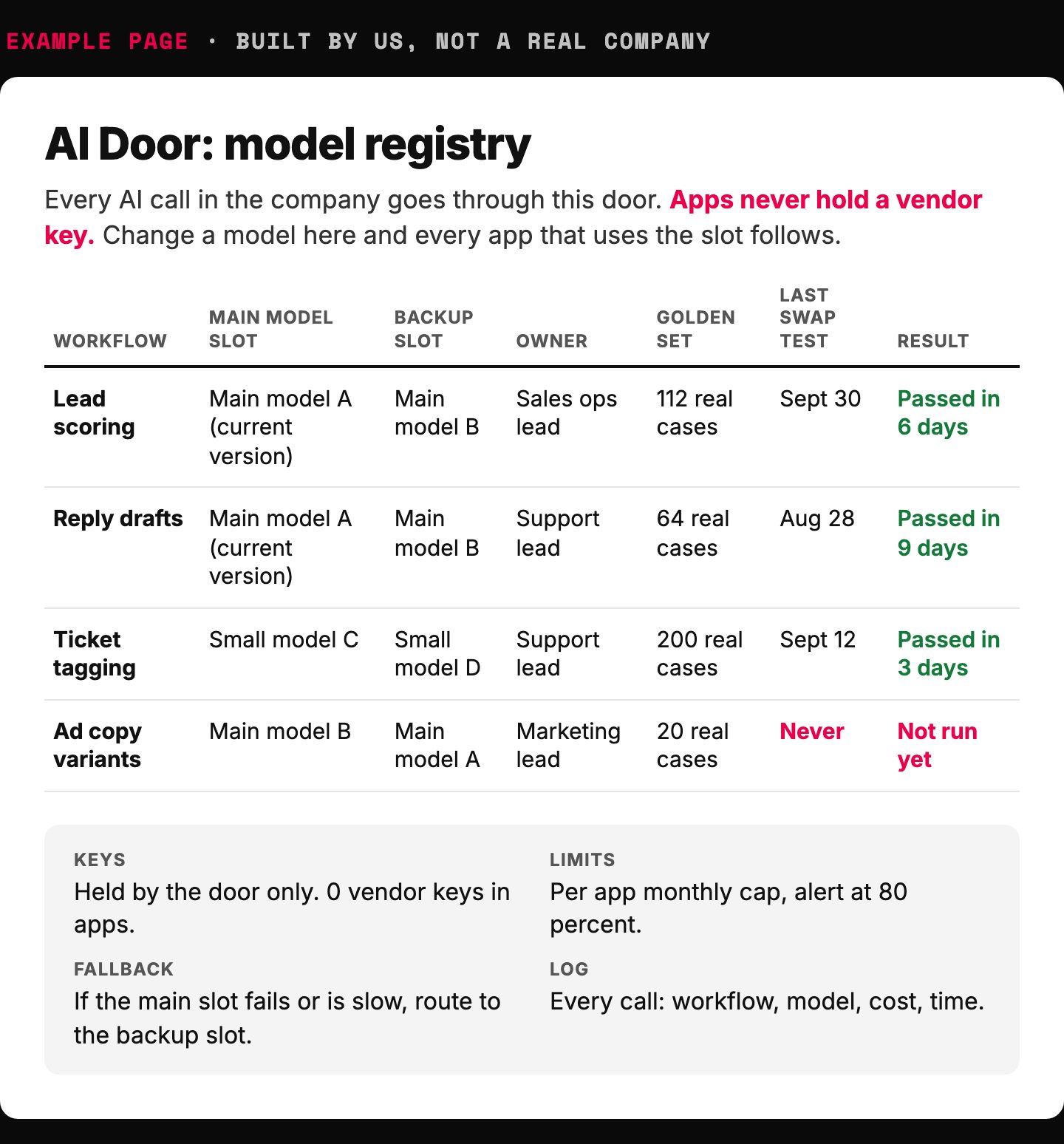
- Staff and apps get the door, never copies of vendor keys.
- Workflows point to a slot, not a vendor. Swap the slot once.
- A tested backup for every workflow that matters.
- The golden set: real cases with known good answers.
- No Swap Test yet. This is the workflow to test first.
Example page built for this article with a made-up brand. Model names are deliberately generic. Door functions from Chip Huyen, AI Engineering, chapter 10; the layout and numbers are illustrative.
How do you know a swap is safe? Build the golden set first
A swap is safe when your own tests say so. Not the vendor's launch post. Not a leaderboard.
John Berryman and Albert Ziegler, in Prompt Engineering for LLMs, describe a product team whose very first code was its test suite. Before the prompts. Before the screens.
That suite told them whether each later change helped, hurt or did nothing. It set the pace for everything after.
Start small. Pull 20 real cases from last month: real leads, real tickets, real briefs. Write down what a good answer looks like for each one.
For a model swap, test the whole workflow, start to finish. A new model touches every step, so a regression test across the full chain catches what breaks between steps.
How many cases is enough? It depends on the gap you want to see. A rough rule in Huyen's book: each time the gap shrinks by three, you need ten times the cases.
So 20 cases catch a big, obvious break. Trusting a 10-point difference takes about 100.
One trap. Never let your current model write the test cases. Berryman and Ziegler warn that tests made by model A tend to favor model A.
No golden set? Then model-agnostic is a slogan, not a plan. Our guide to evaluating AI agents shows how to grade the answers.
Smaller differences need far more test cases
| Score difference you want to detect | Test cases needed (rough) |
|---|---|
| 30 percent | About 10 |
| 10 percent | About 100 |
| 3 percent | About 1,000 |
| 1 percent | About 10,000 |
Source: rough estimate for 95 percent confidence, Table 4-7 in Chip Huyen, AI Engineering (values the book credits to a model vendor).
Build a golden set from real work, never from the model
- Pull 20 real cases Last month's leads, tickets or briefs. Real inputs, not made-up ones.
- Write the good answer One sentence on what a good output looks like for each case.
- Add the hard ones Cases that broke before, messy typos, and off-topic requests.
- Keep the model out Tests written by one model tend to favor that model.
- Run it on every change Save each run, so every change shows what moved.
Our method. The small starter suite and the same-model bias come from Berryman and Ziegler, Prompt Engineering for LLMs.
Multi-model means a tested backup, not a collection
A good multi-model setup is boring. Boring on purpose.
One main model does most of the work. One backup stays warm, tested against your golden set every month. Small, cheap models handle high-volume, low-stakes jobs like tagging and sorting.
Routing rules send each job by cost and stakes. Keep the router itself small and cheap, or it eats the savings.
Big companies are piling on models anyway. In an Andreessen Horowitz survey of 100 enterprise tech leaders, 37 percent used five or more models, up from 29 percent a year before.
The same survey found switching was getting harder as AI took on longer, more complex work. More models. Harder exits.
How to lock yourself in, in four easy steps:
1. Paste your prompts straight into the vendor's console. Never save a copy.
2. Give every team its own copy of the vendor key.
3. Use the vendor's built-in memory as your only customer record.
4. Skip the tests, because the new model is surely better. Then ask customers what the hell changed.
Collecting models is a hobby. Routing them is a business. An alternative you have never tested is a slide, not a strategy.
More large companies now run five or more models
Share of surveyed enterprise tech leaders using five or more models
- Prior year 29
- Latest survey 37
Source: Andreessen Horowitz, How 100 Enterprise CIOs Are Building and Buying Gen AI in 2025 (June 2025).
Route each job by how often it runs and what a mistake costs
- Main model, human approves Contracts, refunds, anything new going to a customer.
- Main model, spot-checked Customer replies at volume. Review a sample every day.
- Cheapest model that passes Internal drafts and one-off research.
- Small, cheap model Tagging, sorting, routing. Back it up with a second small model.
Our rule, set out in this guide.
Sign vendor contracts as short as the market moves
Write vendor deals so you can walk away. Annual terms, not five years. Then get three things in writing.
One, your data is not used for training. Two, you can delete it. Three, prices are set per unit of use, not tied to exclusivity.
Put those terms in your AI governance rules so nobody signs around them.
Why so short? Because the leader changes. In the Menlo survey, the vendor with half of enterprise usage at the end of 2023 held a quarter by mid-2025, and a rival had taken first place.
Nobody signing a long deal back then saw that coming. So do not try to call it. Plan to be wrong about who is best.
Take partner credits when they are free. Turn them down when they tie your build to one vendor's format.
Free credits are fine. Free handcuffs are still handcuffs.
Clayton Christensen's team gives the deeper reason in Competing Against Luck. The job a customer needs done barely changes, while the ways of doing it keep changing.
This next part is our reading, not theirs. Write down the job each workflow does. Treat the model as today's tool for that job.
The enterprise leader lost half its share in about 18 months
Share of enterprise model usage held by the end-2023 leader
- End of 2023 50
- Mid-2025 25
Source: Menlo Ventures, 2025 Mid-Year LLM Market Update, July 2025. A rival led with 32 percent by mid-2025.
Run the Swap Test once a quarter
The Swap Test is our quarterly check of AI vendor lock-in. It turns a vague worry into a number of weeks.
Pick one live workflow. Route it through the door. Run the golden set on your current model and on one candidate, then compare the answers.
Time the whole thing, from start to decision. Under two weeks means you are portable.
Over a quarter means you are locked in. Something you should own has slipped into the vendor's hands.
Then find the layer that slipped: the harness, the prompts, the golden set or the data. Pull that one back first.
Each quarter, also ask three drift questions. Did our prompt change without anyone noticing? Did users change how they ask?
Did the vendor change the model under the same name? Rerun the golden set every month and you will know.
Is this extra work? Some.
But the swap is coming either way. The test just lets you pick the date.
One workflow, two models, one clock
- 1. Pick one live workflow The one that would hurt most to lose.
- 2. Route it through the door No direct vendor calls left in the workflow.
- 3. Run the golden set twice Current model and one candidate, same cases.
- 4. Time it Start to decision. Under two weeks: portable. Over a quarter: locked in.
- 5. Fix the layer that slipped Harness, prompts, golden set or data. Pull it back first.
Our rule, set out in this guide.
Three changes that break AI work without an error message
| What changed | How to catch it |
|---|---|
| Your prompt (a template update, a quiet typo fix) | Compare today's prompt file to last month's version |
| How users ask | Read a sample of real requests every month |
| The model under the same name | Rerun the golden set monthly, even when nothing changed on your side |
Drift types from Chip Huyen, AI Engineering, chapter 10. The checks are ours.
The clock, not the vendor, tells you how locked in you are
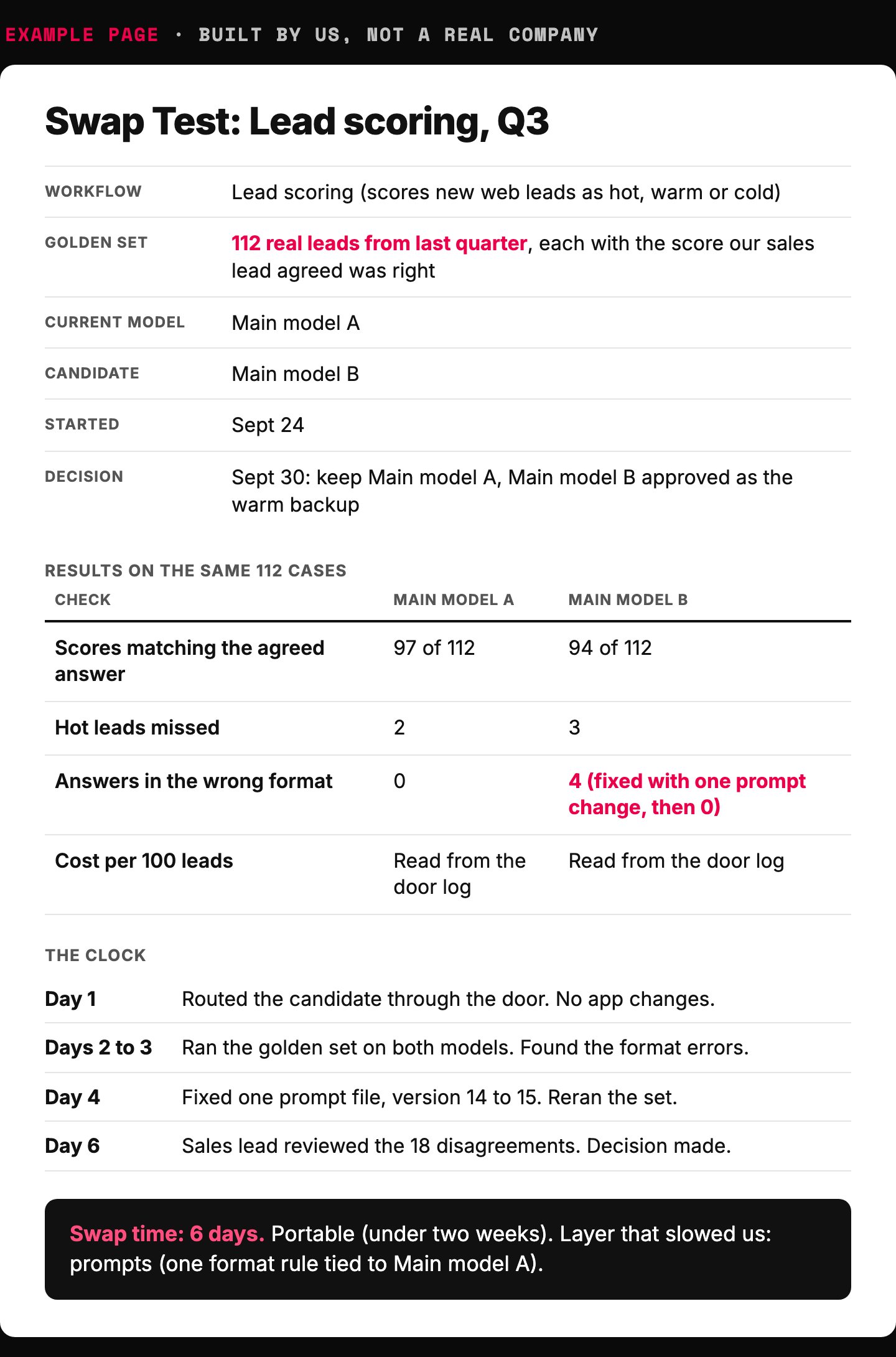
- Real cases, never written by the model being tested.
- Same cases, same rules, one candidate.
- Owned, versioned prompts turn a break into a one-file fix.
- Under two weeks means portable. Over a quarter means locked in.
Example page built for this article with a made-up brand. Results are illustrative; the two-week and one-quarter thresholds are our Swap Test rules. About 100 cases to trust a 10-point difference: Chip Huyen, AI Engineering, Table 4-7.
Run the Swap Test with AI: the copy-paste prompt
Paste the prompt below into your preferred AI. It asks six questions about one workflow.
Then it scores each owned layer and plans your first Swap Test. It never invents numbers.
You bring the facts. It brings the method.
Paste into your preferred AI. It asks six questions about one workflow, then scores each layer and plans the test.
Act as an AI systems advisor. Help me measure AI vendor lock-in on one workflow and plan a Swap Test.

Ask me these one at a time, with the example.
1. Which workflow, and what job does it do? (Example: scores new web leads as hot, warm or cold)
2. Which model and vendor does it use, and which vendor-only features? (Example: a hosted assistant with built-in memory)
3. Where do the prompts live? (Example: pasted in the vendor's web console, no copies)
4. Does every AI call go through one internal gateway, or straight to the vendor? (Example: straight to the vendor)
5. Do you have a golden set, meaning real cases with known good answers? How many? (Example: none yet)
6. Where do the documents, search index and logs live? (Example: in the vendor's file store)

Rules:
- Score four owned layers as owned, partly owned or rented: harness (the code and rules around the model), prompts, golden set, data.
- A golden set starts at 20 real cases. About 100 are needed to trust a 10-point difference.
- Never let the current model write the test cases. Use real records.
- For a model swap, test the whole workflow, start to finish.
- Portable: a swap takes under two weeks from start to decision. Locked in: over a quarter.
- Retirement notice periods change. If you can browse, check the vendor's current retirement page; if not, ask me.
- Never invent numbers, dates or prices. Ask me.

Answer in this format:
Lock-in score: [each layer: owned, partly or rented, one line why]
Biggest risk: [one line]
Golden set plan: [size, source, what a good answer means]
Swap Test plan: [candidate model type, steps, who runs it, target date]
Swap time: [weeks, with the math from my answers] or "need more facts"
Next three actions: 1. 2. 3.
What to do this week
1. List every AI workflow you run, with the model and the vendor-only features each one uses.
2. Pick the one that would hurt most to lose. Pull 20 real cases and write the good answer for each.
3. Put that workflow behind one door. Run its first Swap Test against one other model.
Back to that Tuesday email. Next time it lands, you forward it to whoever owns the door and go to lunch.
More models bring a bigger bill, so read how to control AI token spend next. Then decide who owns AI, including the door.
Marry the job. Rent the model.

Filip Kovacevic is the founder of Anar Agency in Phoenix. He spent five years running SEO, Meta ads, email, and content for medical practices across the United States, and now does the same work for healthcare, home-service, legal, and professional-service businesses, alongside AI implementation. More from Filip →
Talk it through in 15 minutes
Bring one question from this article. We will tell you what we would do, whether or not you hire us.
Book a 15-Min Chat →