The One-Page AI Governance Framework (Even in Regulated Industries)

An AI governance framework is the short set of written rules for how your company uses AI. Make it five decisions on one page: what data may go into which tools, who may use what, how output gets checked, how much may be spent, and which named person answers for each result. Review it every quarter.
What is an AI governance framework? Five decisions on one page
Picture a fifty-page AI policy landing in every inbox on a Monday. By Friday, a sales rep pastes a customer list into a free chatbot to tidy it up. The rule against that sat on page 31.
Nobody read page 31. Nobody ever does.
An AI governance framework is the short set of written rules for how your company uses AI. Ours fits on one page and holds five decisions. This guide shows you how to write it, test it and keep it alive.
Long policies feel safe to the people who write them. Our take: most are written to protect the author, not to guide the reader.
A one-page policy gets read; a fifty-page one gets filed
| The fifty-page policy | The Five-Decision Page |
|---|---|
| Tries to list every risk | Makes five decisions once |
| Rules buried on page 31 | Every rule visible on one screen |
| A committee approves each use | One reviewer and a log approve each change |
| Risks scored as colors | Risks scored as a chance and a cost |
| Written once, then forgotten | Dated, owned, reviewed every quarter |
Our comparison.
Write five decisions, not fifty pages
Governance is five decisions. Make each one once, in plain words, and most future questions answer themselves.
Data decides what may go into which tool. We sort it into three colors, covered next.
Access decides which roles use which tools. Our default: read widely, write narrowly, log every write. A write is any action that sends, posts, edits, deletes or spends.
Checks means every AI workflow that touches a customer names its check and how often it runs. No check, no customers.
Spend is a cap per team and per workflow, seen every week. A runaway bill is a governance problem before it is a finance problem.
Owner means a named person answers for every AI output. No orphan automations.
Why one page? A list people actually use has to be short.
Atul Gawande reports aviation's rules for checklists in The Checklist Manifesto, and they fit here. Five to nine items. Plain words in the reader's own language, on one page.
Aircraft makers also print a date on every checklist, because each one is expected to change. Your page needs one too.
Fifty pages is not thorough. It is unread.
Five decisions answer almost every AI question your team will ask
- 1. Data What may go into which tool: green, yellow or red.
- 2. Access Which roles use which tools. Read widely, write narrowly, log every write.
- 3. Checks Every customer-facing workflow names its check and how often it runs.
- 4. Spend A cap per team and per workflow, seen every week.
- 5. Owner A named person for every AI output. No orphan automations.
The Five-Decision Page, our framework.
A complete AI governance framework fits on one page: five headings, a date and an owner
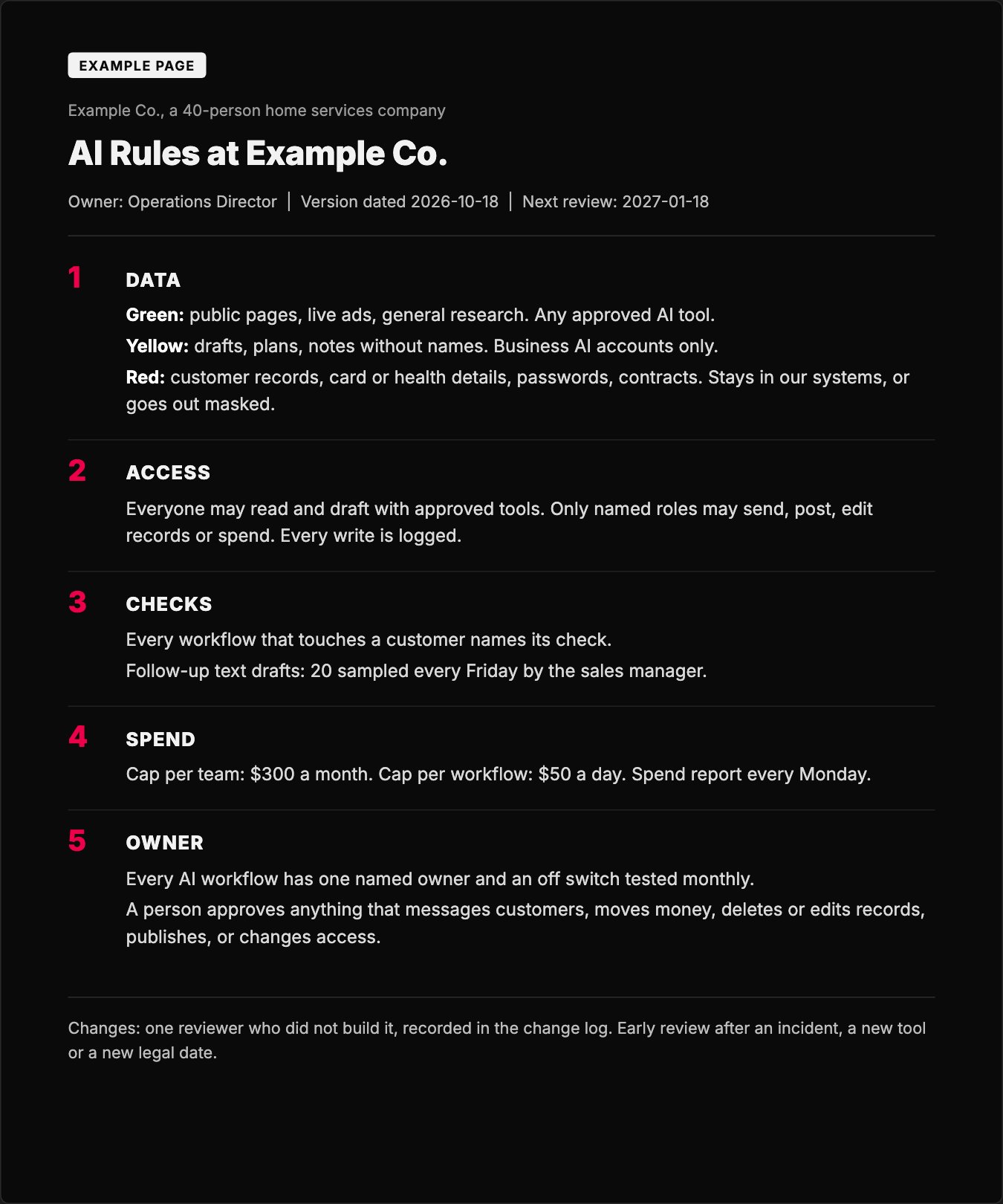
- Dated like an airline checklist, with the next review already set.
- Strict rules only where red data lives.
- A check is specific: who, how many, how often.
- No committee: one reviewer and a log.
Example page built for this article with a made-up brand. Structure from the Five-Decision Page; company, caps, dates and workflow are made up.
The Five-Decision Page is a one-page AI governance framework: Data (green, yellow, red), Access (read widely, write narrowly, log writes), Checks (every customer-facing workflow names its check), Spend (caps per team and workflow, seen weekly) and Owner (a named human for every output). Risks get a 12-month chance and a cost range, not a color. Changes get one reviewer and a log, not a committee.
Each workflow carries four lines: scope, limits, check, owner and off switch. The page is dated and reviewed every quarter, or sooner after an incident, a new tool or a new legal date.
Sort your data into three colors, and keep strict rules where red data lives
Data comes first. Every other rule on the page leans on it.
Green is anything you would print on a flyer: public pages, live ads, general research. Any approved AI tool may use it.
Yellow is internal: drafts, plans, sales notes without names. It goes only into business AI accounts whose contract keeps your data out of training.
Red is data that can hurt a person or break a law if it gets out. Customer names with health, money or card details, passwords, contracts. It stays in systems you control, or it goes out masked.
Masking means swapping the sensitive part for a placeholder before it leaves. The tool sends [PHONE NUMBER] instead of the number. When the answer comes back, it swaps the real one in.
Chip Huyen lays out this pattern in AI Engineering. She also names the three ordinary ways private data reaches an outside model.
Someone pastes it into a prompt. A builder writes it into an app's standing instructions. Or a connected tool pulls it from a database and hands it over.
Pasting is the famous one. Samsung staff put company secrets into a public chatbot, and the company banned the tool. A ban is what you get when nobody wrote the colors down first.
Strict rules belong only where red data lives. The Team Topologies authors make this case for software. Card-data rules should cover the one part that handles cards, not the whole system.
Splitting that part off shrinks what auditors must inspect. We apply the same logic to AI work. Fence the red workflows tightly and let the green ones move.
One color for everything puts red rules on green work. People will route around that by lunch.
Three data colors decide which AI tools may touch what
| Color | What it is | Examples | Where it may go |
|---|---|---|---|
| Green | Public already | Website pages, live ads, general research | Any approved AI tool |
| Yellow | Internal, no personal details | Drafts, plans, sales notes without names | Business AI accounts that keep your data out of training |
| Red | Could hurt a person or break a law | Customer records with health, money or card details, passwords, contracts | Your own systems, or out only when masked |
Our framework. Masking pattern from Chip Huyen, AI Engineering.
Private data reaches an outside AI model in three ordinary ways
- 1. A person pastes it A customer list or secret goes straight into a prompt.
- 2. A builder writes it in Internal policies or data go into an app's standing instructions.
- 3. A tool pulls it A connected tool fetches private records from a database and adds them to the request.
Chip Huyen, AI Engineering, chapter 10.
Replace the AI risk heat map with ten numbers
Most AI governance templates include a risk heat map: likelihood 1 to 5, impact 1 to 5, a colored grid. It looks rigorous. It isn't.
Douglas Hubbard and Richard Seiersen collect the evidence in How to Measure Anything in Cybersecurity Risk. In one study, people read the phrase "very likely" as anything from 43 to 99 percent. Even with written definitions, 58 percent of answers broke the guideline.
Scores bunch up, too. In about 2,000 risk scores from five companies, 76 percent landed on a 3 or a 4. The five-by-five grid was really a two-by-two.
The grid also distorts what it shows. One study gave risk matrix designs a distortion score, and the average was above 100. For scale, the chart Edward Tufte famously called a whopping lie scored only 14.8.
So what goes in its place? Ten rows, each with two numbers.
For each AI risk, write the chance it happens at least once in the next 12 months. Then write a cost range: a low number you are 95 percent sure the cost will exceed, and a high number you are 95 percent sure it will stay under.
Now compute the expected yearly loss. The book's shortcut: chance times (0.65 times the low plus 0.35 times the high). Sort the rows by it and fix the top ones first.
For example, say there is a 30 percent chance a staff member pastes customer data into an unapproved tool. The cost would run $20,000 to $400,000. That row's expected loss is $45,900 a year.
Controls earn their place with the same math. Return on control is the loss a control removes, divided by its cost, minus one.
Example: say business AI accounts plus masking cut that 30 percent chance in half, for $5,000 a year. The return is 359 percent. Not bad for $5,000.
Overkill? The book puts a first pass at an hour or two. The heat map took a meeting and told you nothing.
The same risk word meant very different odds to different people
| Phrase | Official meaning | Lowest reading | Highest reading | Answers that broke the guideline |
|---|---|---|---|---|
| Very likely | More than 90% | 43% | 99% | 58% |
| Likely | 66% to 90% | 45% | 84% | 46% |
| Unlikely | 10% to 33% | 8% | 66% | 43% |
| Very unlikely | Less than 10% | 3% | 75% | 67% |
Budescu's study of 223 students and faculty reading IPCC phrases, as reported in Hubbard and Seiersen, How to Measure Anything in Cybersecurity Risk, 2nd ed., Table 5.2.
Scores bunch in the middle, and the grid distorts what it shows
- Of about 2,000 risk scores landed on a 3 or 4 of 5 76
- Average distortion score across risk matrix designs 100
- Score of the chart Tufte called a whopping lie 14.8
Hubbard and Seiersen, How to Measure Anything in Cybersecurity Risk, 2nd ed., chapter 5 (Hubbard's five-company data; Thomas, Bratvold and Bickel).
Example: four AI risks, ranked by expected yearly loss
Chance in 12 months x (0.65 x low cost + 0.35 x high cost)
- Customer data pasted into an unapproved tool (30%, $20K to $400K) 45900
- Made-up claim published in an ad (15%, $10K to $250K) 14100
- AI sends a wrong offer to a list (10%, $5K to $150K) 5575
- A looping automation runs up the bill (20%, $2K to $40K) 3060
Worked example. Inputs are made up for the example; the formula is from Hubbard and Seiersen. The math is ours.
Approve AI changes with a second person and a log, not a committee
The reflex in a nervous company is an AI review board. Every new use waits for the monthly meeting.
The Accelerate research team compared approval styles across the software teams in their surveys. When an outside body approved every change, teams shipped slower and recovered from outages slower. The approvals did not lower the share of changes that broke something.
Slower, and no safer. Peer review did better. That finding is about software; applying it to AI is our reading.
Need separation of duties for an auditor? The same team describes two mechanisms that satisfy it. First, someone who did not build the change reviews it and records the approval in a system of record.
Second, changes reach the live system only through one logged path. For an AI workflow, the record can be a ticket, a pull request or the change log on the page itself.
The auditor sees who changed what, when, and who said yes. No meeting required.
A few actions still need a human click every time, like a database command that deletes records. Our list: anything that messages customers, moves money, deletes or edits records, publishes in public, or changes who has access.
How to build an AI policy nobody follows, in four easy steps:
1. Form a committee that meets once a month.
2. Write fifty pages so every risk is covered somewhere.
3. Score every risk red, amber or green, then argue about amber.
4. Ban the tools. Act surprised when people switch to personal accounts.
The research team has a name for this: risk management theater. Boxes get ticked so someone can say they followed the process. It feels safe, and it is bullshit with a calendar invite.
An outside approver slowed software teams and caught nothing extra
| How changes got approved | What happened to delivery |
|---|---|
| An outside body (a manager or a board) approves every change | Lower performance: slower shipping and slower recovery, no drop in changes that broke things |
| Approval only for high-risk changes | No link to performance either way |
| Peer review | Higher performance |
| No formal approval | Higher performance |
Forsgren, Humble and Kim, Accelerate, chapter 7. Software delivery teams; applying it to AI workflows is our reading.
Five kinds of AI action wait for a person every time
| Action | Example |
|---|---|
| Messages customers | An agent emails or texts a lead list |
| Moves money | Refunds, payments, ad budget increases |
| Deletes or edits records | A database command that removes or changes rows |
| Publishes in public | A post, an ad, a page going live |
| Changes access | New users, new permissions, new connected tools |
Our list. The database example is from Chip Huyen, AI Engineering.
Govern each AI workflow with four lines that live next to it
The page governs the company. Each automation needs its own copy of the rules, written where it runs.
Picture an automation that runs at 3 in the morning. "A human owns every output" means nothing to it unless the owner's name sits in its file.
This is what people mean by AI workflow governance, or governance as code. Four lines at the top of every workflow:
Scope says what starts it, which data color it may touch, and what it may never touch.
Limits are the spend cap, rate limit and blocked actions. They are enforced outside the AI model, so they hold even when the model misbehaves.
Check says how output is reviewed, and how often. A sampled review every Friday counts; "we look at it sometimes" does not.
Owner and off switch means one named person, and a way to stop it in under a minute. Someone has actually practiced pressing it.
Then track two numbers on every guardrail. The violation rate is the share of bad requests that got through. The false refusal rate is the share of fine requests it blocked.
Why both? A guardrail that refuses everything scores zero violations and helps nobody. We score every guardrail this way.
The four lines live in the agent harness, the code that runs the workflow. See also how to evaluate AI agents and how to control AI spend.
A rule that is not in the file does not exist at 3 in the morning.
Four lines sit at the top of every AI workflow
| Line | What it says | Example: an AI that drafts follow-up texts |
|---|---|---|
| Scope | What starts it, what data it may touch, what it may never touch | New web lead; yellow data only; never card or health details |
| Limits | Caps and blocks enforced outside the model | $50 a day cap; 200 texts a day; no sending without approval |
| Check | How output is reviewed, and how often | 20 drafts sampled every Friday |
| Owner and off switch | A named person, and a stop that takes under a minute | Sales manager; pause button tested monthly |
Our framework. The example workflow and its numbers are made up for the example.
A good guardrail blocks bad requests and lets fine ones through
- Too tight Safe on paper. People route around it.
- Broken Blocks the work and still lets harm through.
- Where you want it Low violation rate, low false refusal rate.
- Too loose Easy to use. Harm gets out.
Violation rate and false refusal rate as defined in Chip Huyen, AI Engineering. The four labels are ours.
How do regulated industries govern AI without stalling?
They start where no regulated data lives, and they reuse the controls they already have.
Healthcare, finance, insurance and law flip the question. Not "can we use AI?" but "which workflows hold no regulated data at all?"
Marketing drafts and research summaries usually qualify. That green zone needs no regulator conversation.
For the red zone, your compliance machinery is the asset. The access controls, logs and reviews that govern people extend to machine work.
Regulated firms are not doomed to be slow, either. In the Accelerate data, highly regulated companies showed up among high, medium and low performers alike.
Build controls into the platform once. A small US government team called 18F built a hosting platform that covered 269 of the 325 security controls a moderate-impact federal system needs. Systems on it went live in weeks instead of months.
Then govern like a building inspector. Gawande describes inspectors who do not redo the engineering. They have builders sign that the right checks are in place, then spend their own time on the riskiest work.
For AI, each team signs off on its four lines. The page owner spends review time on the side projects nobody approved. More on AI in law and accounting firms.
One rule holds everywhere: a named human owns every consequential output, and the log can prove who.
The NIST AI Risk Management Framework sorts the work into govern, map, measure and manage. The EU AI Act sorts AI uses by risk and puts most of its duties on a short list of high-risk uses. Dates and details change, so they live in the box below.
Regulators do not ask that AI be absent. They ask that accountability be present.
One platform covered most federal security controls up front
- Controls handled by the platform itself 269
- Controls a moderate-impact federal system needs 325
- Share handled by the platform, not by each team 83
18F cloud.gov, as reported in Forsgren, Humble and Kim, Accelerate, chapter 6. Share computed by us: 269 / 325.
Most AI sits in the bottom tier, and the high-risk duties are logs, documents and human oversight
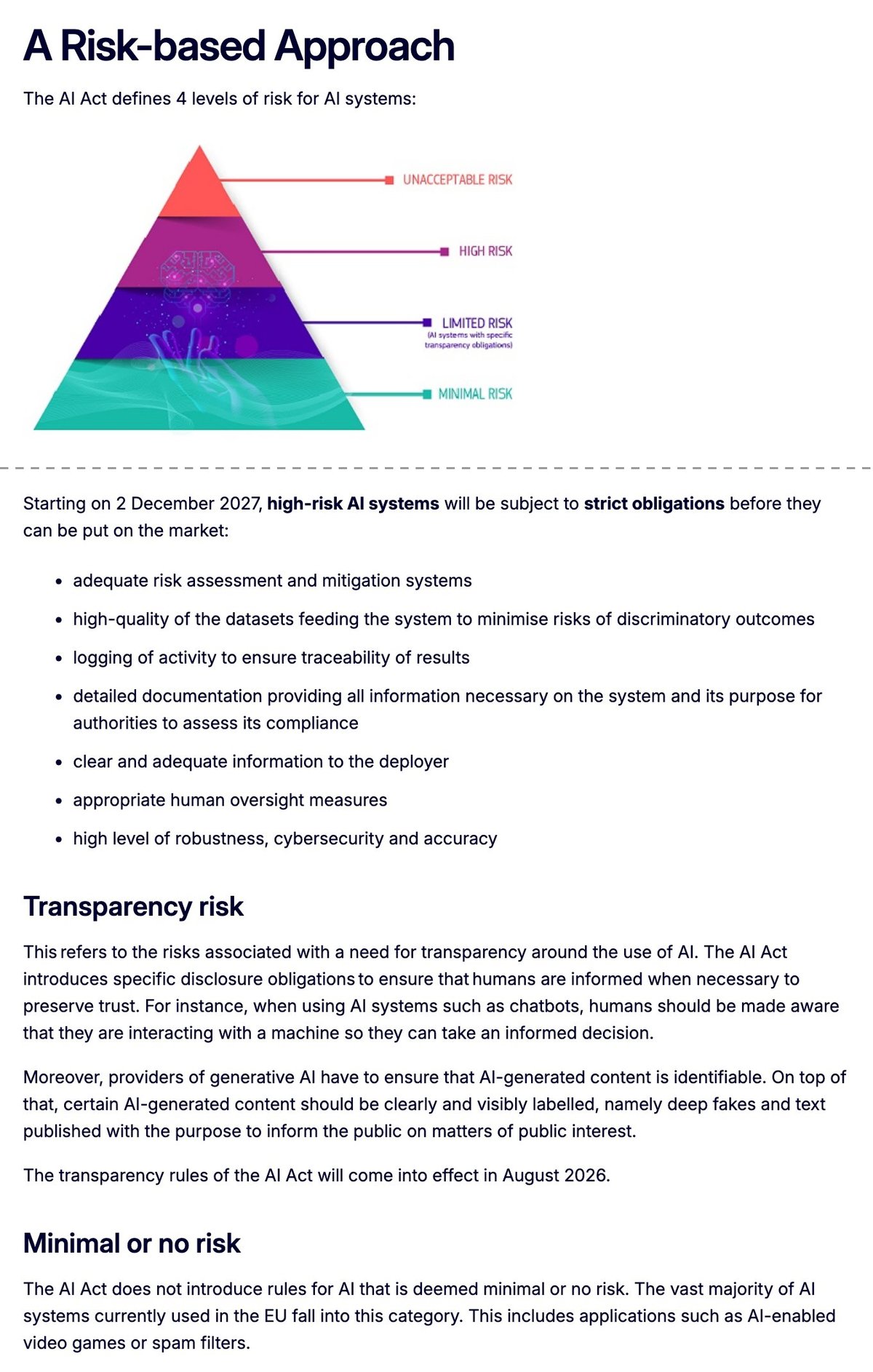
- Four tiers. Most business uses sit in the bottom one.
- Logs that prove who did what: the Owner decision.
- A named human in the loop: the Checks and Owner decisions.
- Minimal risk: no new rules under the Act.
Screenshot of the European Commission AI Act page (Shaping Europe's digital future), taken 2026-10-18. Two parts of the page, joined at the dashed line
Review the page every quarter, and sooner when the evidence changes
A governance page that never changes is already wrong. The tools change every few months.
In Thinking in Systems, Donella Meadows holds up the Montreal Protocol as a rule built to learn. Signed in 1987 to protect the ozone layer, it set targets for cutting the worst chemicals. It also required monitoring and a meeting to revise the schedule.
The damage turned out worse than anyone expected. So in 1990, three years later, that meeting sped up the schedule and added chemicals.
Copy that shape. Our page carries a review date, an owner, and three triggers for an early review: an incident, a new tool or data connection, or a new legal deadline.
When people work around a rule, treat it as feedback, not defiance. A rule everyone dodges is usually a bad rule.
Publish the page. Name the owner. Date it.
If staff already use AI on personal accounts, start with guardrails for shadow AI. If nobody can say who the owner is, read who should own AI.
The Montreal Protocol set targets, then tightened them when the evidence changed
- Signed 1987 Targets for cutting the most damaging chemicals, plus required monitoring and a meeting to revise the schedule.
- Tightened 1990 Damage was worse than expected, so the schedule sped up and more chemicals were added.
- Reviewed Your page, every quarter Same shape: a date, an owner, and early review after an incident, a new tool or a new legal deadline.
Donella Meadows, Thinking in Systems, part three. The last row is our rule.
Write your one-page AI governance framework with AI
Paste the prompt below into your preferred AI. It asks about your company, your data, your tools and your rules, one question at a time.
It drafts the five decisions, the three colors, a ten-row risk list and the four lines for your riskiest workflow. It never invents a chance or a cost. It asks you.
It is not legal advice. If you build a high-risk system under the EU rules, take the draft to counsel.
Paste into your preferred AI. It asks about your company, data, tools and rules, then drafts the page, a risk table and the four lines for your riskiest workflow.
Act as an AI governance advisor. Help me write a one-page AI governance framework, the Five-Decision Page.

Ask me one at a time, with the example:
1. What do we do, and how many people use AI? (Example: 40-person home services company)
2. Which AI tools do we use? Which are business accounts that keep our data out of training? (Example: two business, some personal)
3. What data do we handle? (Example: customer names, addresses, card payments through a processor)
4. Which AI workflows touch customers, money or public content? (Example: AI drafts follow-up texts to leads)
5. Which rules apply to us? (Example: card rules, state privacy laws, some EU customers)
6. Who will own the page? (Example: the operations director)

Rules:
- Five decisions only: Data, Access, Checks, Spend, Owner.
- Data colors. Green: public, any approved tool. Yellow: internal, business accounts only. Red: personal, financial, health, secrets; stays in our systems or goes out masked. Strict controls only on red workflows.
- Risks: up to 10. For each, ask me the chance it happens in 12 months and a low and high cost (95 percent sure above the low, 95 percent sure below the high). Never invent these. Expected yearly loss = chance x (0.65 x low + 0.35 x high). Sort by it. No 1 to 5 scores or color grids.
- Approvals: one reviewer who did not build the change, logged. No committee. A human approves anything that messages customers, moves money, deletes or edits records, publishes, or changes access.
- Each customer-facing workflow gets four lines: scope, limits enforced outside the model, check, owner and off switch.
- Review quarterly, and early after an incident, a new tool or a new legal date.
- If you can browse, check the official EU AI Act and NIST AI RMF pages for current dates and say what you found; if not, tell me to. Not legal advice.

Output:
The page (five headings, under 400 words)
Risk table: risk, chance, low, high, expected loss
Four lines for the riskiest workflow
Review date and triggers
Next three actions: 1. 2. 3.
Do three things this week
1. Run the prompt and print the page.
2. Pick the one workflow that touches red data. Write its four lines and name its owner.
3. Retire the heat map. Give each risk a chance and a cost range instead.
Next, give each workflow a written brief with an AI agent job spec. Rolling out coding tools? Read AI coding agents for enterprise teams.
Remember page 31? On a one-page policy, there is no page 31.
Fifty pages is a filing cabinet. One page people read is a seatbelt.

Filip Kovacevic is the founder of Anar Agency in Phoenix. He spent five years running SEO, Meta ads, email, and content for medical practices across the United States, and now does the same work for healthcare, home-service, legal, and professional-service businesses, alongside AI implementation. More from Filip →
Talk it through in 15 minutes
Bring one question from this article. We will tell you what we would do, whether or not you hire us.
Book a 15-Min Chat →