AI for Law Firms and CPA Firms: Where It Pays First
AI pays first in a law or accounting firm where the work sits furthest from professional judgment. Start with intake and scheduling, then chasing client documents, then first drafts from your own files. Research comes last, with every citation opened and read by a professional.
Test each step on past work before clients see it.
AI for law firms and CPA firms: start where the judgment isn't
A lawyer asks a chatbot for court cases that help his client. It gives him six.
He asks if they are real. It says yes, you can find them in the big legal databases.
He files them. None of them exist.
The court fined the lawyers and their firm $5,000. It also made them write to every judge the chatbot had named as an author. That is the 2023 Avianca case in New York.
Most talk about AI for law firms and CPA firms starts with research. That is backwards. The money is at the front desk and in the paperwork, where nobody needs a license.
The judge was not against the tool, either. His opinion says there is nothing improper about using a reliable AI tool for help. The rules still make the lawyer check what gets filed.
Six invented cases ended in a $5,000 sanction and letters to real judges
- A chatbot supplies the cases The research Six court decisions, with quotes and citations, none of them real.
- The lawyer asks the chatbot The check Are these real? It says yes, findable in the big legal databases.
- Nobody can find them The filing Not the airline's lawyers. Not the judge.
- Sanctions June 22, 2023 $5,000 on the lawyers and firm, plus a letter to each judge falsely named as an author.
Source: Mata v Avianca, 678 F Supp 3d 443 (SDNY 2023), sanctions opinion of June 22, 2023
Where does AI pay first in a firm? In the work furthest from judgment
Pick the work where a wrong answer is cheap to catch. That is the whole idea.
The First-Pay Map is the order we use to bring AI into a law or accounting firm. Four rungs, lowest first. You climb one rung only when the rung below passes its check.
Rung 1, intake and scheduling. Answer every enquiry, collect the facts, book the meeting. No advice.
Rung 2, the paperwork chase. Remind clients what is missing and sort what arrives. A human still owns every deadline.
Rung 3, first drafts from your own files. Engagement letters, routine letters and summaries of documents you supply.
Rung 4, research and analysis. Last, and only with every source opened and read by a professional.
Why this order? Each rung moves closer to the advice clients pay for. Each one needs a tighter check.
How to get your firm quoted in a court opinion, in four easy steps:
1. Skip the boring front-desk work. Start with legal research.
2. Use a free chatbot on a personal account, with client names pasted in.
3. When unsure, ask the chatbot if it was right.
4. Sign the filing. Read it later.
Every step on that list happens somewhere. Usually in a hurry. Always for a damn good reason at the time.

Climb from the front desk to research, one checked rung at a time
- 1. Intake and scheduling Answer, collect facts, book. No advice. Lowest risk.
- 2. The paperwork chase Remind and sort. A human owns every deadline.
- 3. First drafts from your files Letters and summaries checked line by line against the source.
- 4. Research and analysis Every citation opened and read by a professional. Highest risk.
The First-Pay Map, our framework.
The First-Pay Map is the order for bringing AI into a law or accounting firm: intake and scheduling first, then the paperwork chase, then first drafts from the firm's own files, then research with every citation opened and read. Each rung goes live only after it passes a test on 20 past examples against a pass mark set in advance. Checks happen at the cheapest stage, review stays full until 20 outputs in a row pass and returns to full after any error, and anything filed with a court or a tax authority is always read in full.
One named partner owns the list of approved tools.
Rung one: answer the phone, book the meeting, give no advice
Intake is the safest first job because the AI never has to be right about the law. It only has to be fast and polite.
Think about what happens to an enquiry at 7 at night. Voicemail.
A callback tomorrow. By then the person has called two other firms.
An AI front desk can answer at any hour. It takes the caller's name, the other parties, the deadline they are worried about and a good time to talk. Then it books the meeting.
Two lines it never crosses. It gives no advice, and it never clears a conflict of interest. The names go to a person who runs the conflict check before anyone accepts the matter.
Speed matters more than polish here. We cover why in speed to lead, and what a phone agent costs in AI receptionists for small business.
A missed call is not a lead. It is a gift to the firm down the street.
An AI front desk collects and books; people decide
- 1. Answer at any hour Every call, form and email gets a reply within minutes.
- 2. Collect the facts Name, other parties, the deadline worrying them, a good time to talk.
- 3. Hand off the names A person runs the conflict check. The AI never clears one.
- 4. Book the meeting Into a real calendar slot, with a confirmation. No advice given.
Our method.
Rung two: chase the paperwork, because most malpractice starts with clerical misses
Rung two is the boring one: reminders, checklists and sorting what arrives. Boring is exactly where firms get hurt.
Atul Gawande reports in The Checklist Manifesto that lawsuits against lawyers rose 36 percent from 2004 to 2007. The most common causes were simple administrative errors, like missed calendar dates.
So who does what? The AI chases and sorts. It sends the third reminder for the missing bank statement and files what arrives under the right client.
A person enters every deadline into the calendar, and a second person checks it. AI drafts the reminder. It never owns the date.
Keep the client checklist short. Gawande passes on aviation's rule of thumb: five to nine killer items, the steps most dangerous to skip.
Leave out the steps your staff never miss. A list of everything gets ignored, just like a policy nobody reads.
Lawsuits against lawyers rose 36 percent in three years, mostly over clerical errors
- Rise in lawsuits against attorneys, 2004 to 2007 36
- Among the most common causes, with clerical errors Missed dates
American Bar Association data as reported in Atul Gawande, The Checklist Manifesto, introduction.
AI chases the paperwork; a person owns the dates
| Task | Who does it | Check |
|---|---|---|
| Reminders for missing documents | AI | Sampled weekly |
| Sorting what arrives into the right file | AI | Sampled weekly |
| Entering court and filing deadlines | A person | A second person confirms every one |
| Client checklist of what to send | A person writes it, AI sends it | Five to nine killer items, reviewed each season |
Our rule. The five-to-nine item guide is aviation's rule of thumb as reported in The Checklist Manifesto.
Rung three: draft from your own files, not from the model's memory
A first draft is safe when every fact in it comes from a document you supplied. It is risky when the facts come from the model's memory.
That is the most useful split in Chip Huyen's AI Engineering. When a model fails because it lacks facts, you give it the right documents to read. Training it on your style fixes tone and format, not facts.
Her test for this kind of work is local factual consistency. In plain words: does every sentence in the summary match the file it came from?
Do you need your own legal AI model? Almost never. Bloomberg built a finance model with 50 billion parameters, at an estimated $1.3 million to $2.6 million in computing alone.
A general model released the same month beat it on two finance tests. That is an expensive way to lose.
The book's advice: be wary of the claim that only a custom model can handle your field.
So feed the model your engagement letter templates, your past letters and the client's own documents. Ask for a draft, then check it against the file. If your files live in six places, start with one company brain.
A general model beat a custom finance model the same month it launched
| Finance test | General model, no extra training | Bloomberg's custom finance model |
|---|---|---|
| Sentiment of finance text (weighted F1) | 87.15 | 75.07 |
| Questions over financial tables (accuracy) | 76.48 | 43.41 |
Chip Huyen, AI Engineering, chapter 7, Table 7-1 (Li et al., 2023). The custom model cost an estimated $1.3 million to $2.6 million in computing.
Facts from your files beat facts from the model's memory
| Draft from the model's memory | Draft from your own files |
|---|---|
| Facts come from training data | Facts come from the documents you supply |
| Nothing to check each line against | Every line checks against its source file |
| Wrong facts sound just as sure | A wrong fact shows up as a mismatch |
| Tempting fix: build a custom model | Real fix: give it the right documents |
Our comparison, built on the facts-versus-format split in Chip Huyen, AI Engineering.
Rung four: research comes last, and every citation gets opened
Research is the top rung because a citation looks the same whether it is real or invented.
A language model writes text that fits the pattern of an answer. When it lacks the fact, it can still produce something shaped like an answer. A case name, a court, a year and a page number are easy shapes to copy.
Asking the tool whether it was right proves nothing. The Avianca lawyer asked. The tool said its cases were real.
Our rule is plain. Every authority gets opened in a trusted database, read at the cited page, and confirmed as still good law. A professional signs off.
Tools built for the profession on verified case databases are safer than general chatbots. Safer is not the same as checked.
Signing a filing means you read it. No tool changes that.
Four checks stand between an AI citation and a signed filing
- 1. Open it Pull the authority in a trusted legal database, not from the AI's answer.
- 2. Read it Go to the cited page and confirm the quote and the point are there.
- 3. Confirm it still stands Check it has not been reversed or overruled.
- 4. Sign it A professional who did steps 1 to 3 signs. Asking the AI does not count.
Our rule. The duty to check what is filed comes from the court rules in the box below.
How do you know an AI workflow is safe? Set the pass mark before you build
You decide what good looks like before the tool goes live, not after the first complaint.
Huyen calls evaluation the biggest bottleneck to AI adoption. Her example fits a firm well: an AI that summarizes a legal contract. She grades it four ways.
Does it understand contracts? Is the summary faithful to the contract?
Does it follow your format and length? What does it cost, and how long does it take?
Then you tie the grade to the business. Her illustration: a support bot that gets the facts right 80 percent of the time can handle 30 percent of requests. At 98 percent, it can handle 90 percent.
Here is the test we run. Take 20 finished matters or returns from last quarter. Run the new workflow on them and grade every output against what your team actually did.
Set the pass mark first, in writing. If it misses, the tool stays a helper and a person does the work.
The ABA said something close to this in its 2024 ethics opinion. A lawyer who tested a summary tool by hand on a smaller set of contracts may not need to reread every document later.
Then move it up slowly. Huyen describes Microsoft's Crawl-Walk-Run model, where AI talks to customers only after its drafts prove themselves with staff. One example bar: staff send 95 percent of its drafts word for word.
Measure how usable the drafts are before you take the human out. Patience here is cheap. A bad client email is not.
An AI contract summary gets graded on four things before anyone trusts it
| What you grade | The question | How a firm checks it |
|---|---|---|
| Subject knowledge | Does it understand contracts? | A lawyer grades 20 past summaries |
| Faithfulness | Does every line match the contract? | Line-by-line check against the source |
| Instructions | Right format and length? | Your template, your word limit |
| Cost and time | What does each one cost, and how long? | Compare with the hours it replaces |
Four buckets from Chip Huyen, AI Engineering, chapter 4. The firm checks are ours.
AI talks to clients only after staff use its drafts almost unchanged
- Crawl A person reviews every output. AI only suggests.
- Walk AI works directly with your staff, still inside the firm.
- Run AI handles simple client requests once its drafts prove out, for example 95 percent used word for word by staff.
Microsoft's Crawl-Walk-Run, as described in Chip Huyen, AI Engineering, chapter 1.
Check AI output early, and check more after a mistake
Catch errors at the cheapest point. Andy Grove's rule in High Output Management is to find a problem at the lowest-value stage possible.
In a firm, that means reviewing the outline before the full draft. Check the list of facts the AI pulled before it writes the letter.
Grove also describes variable inspection. When weeks go by with no problems, you check less often. When problems start, you check more until quality returns.
Our version: review every output until 20 in a row pass. Then sample one in five. Any error sends the workflow back to full review.
Trust climbs slowly and falls fast. That is the point.
One kind of work never gets sampled. Grove says never let a defect through when it could cause total failure for the customer. For a firm, that is anything filed with a court or a tax authority, so it gets read in full every time.
Which workflow should you hand to AI first? Grove's answer for delegation works here too: the one you know best, because you can tell when it goes wrong. For the tests themselves, see how to evaluate AI agents.
Review falls as quality holds and jumps back after any error
| Situation | How much a person reviews |
|---|---|
| New workflow | Every output |
| 20 outputs in a row pass | 1 in 5, picked at random |
| Any error found | Back to every output for the next 20 |
| Anything filed with a court or a tax authority | Every output, always |
Our rule, built on variable inspection and the reliability exception in Andy Grove, High Output Management, chapter 1.
One card holds the first workflow, its pass mark, its check rule and its owner
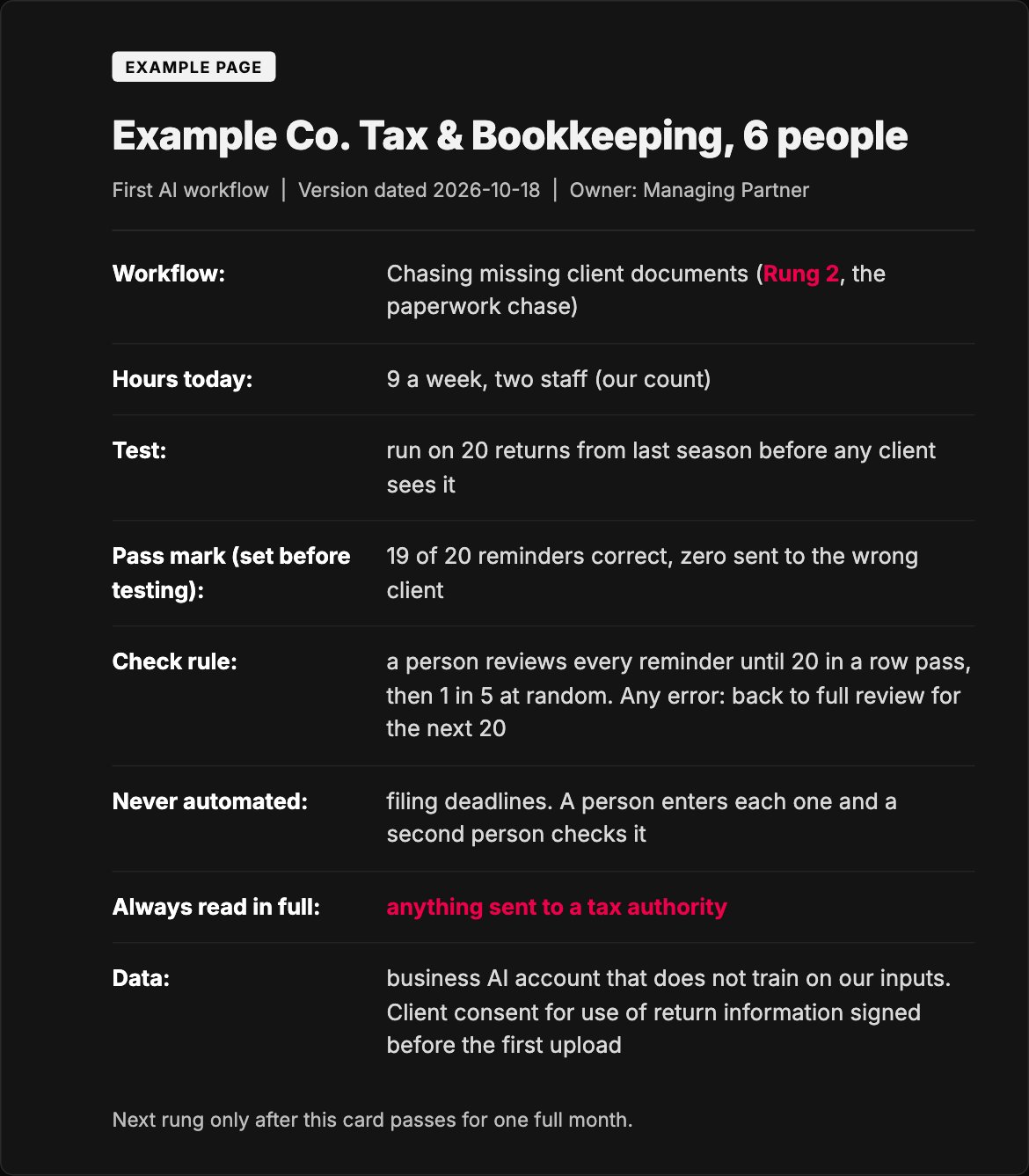
- The pass mark is written down before the test, not after.
- Review drops when quality holds and jumps back after any error.
- AI drafts the reminder. A person owns the date.
- Consent first, upload second.
Example page built for this article with a made-up brand.
What do the bar and the IRS require? Four duties that stay the same
The tools change every few months. The duties do not.
Competence. The ABA's Formal Opinion 512 says using AI output without the right amount of checking can break the duty of competence. The comment to Model Rule 1.1 already asks lawyers to know the benefits and risks of relevant technology.
Confidentiality. Know where client data goes before it enters any tool. For tools that may learn from what you type, the same opinion requires the client's informed consent first.
A general line in the engagement letter is not enough.
Honest fees. If a three-hour task now takes thirty minutes, hourly bills must show the time actually spent. You may bill the time to give the tool its inputs and the time to review the draft.
Tax return information. Section 7216 of the Internal Revenue Code limits how preparers use and disclose what clients give them for a return.
Sending a return to an outside AI tool is a consent question. Settle it before the first upload.
Accountants have their own professional guidance too, through the AICPA and state boards. The current rules, penalties and dates sit in the box below. Write yours into one page with our AI governance framework.
The tools change; the duties stay the same
| Duty | What it means for AI | Where it comes from |
|---|---|---|
| Competence | Check AI output in proportion to the task | ABA Model Rule 1.1 and Formal Opinion 512 |
| Confidentiality | Informed consent before client data enters a tool that may learn from it | ABA Model Rule 1.6 and Formal Opinion 512 |
| Honest fees | Hourly bills show actual time spent | ABA Model Rule 1.5 and Formal Opinion 512 |
| Tax return information | Use and disclosure limited without the client's consent | Internal Revenue Code Section 7216 |
ABA Formal Opinion 512 (July 29, 2024); 26 U.S.C. 7216. Read 2026-10-18.
"Our clients pay for judgment. Should we use AI at all?"
Yes, on everything except the judgment. Clients pay for your advice, not your paperwork.
Mike Michalowicz wrote Clockwork for owners who say their work is too special. He says doctors and lawyers ask him this most. His answer is a painter.
Sir Peter Lely, the 17th-century portrait painter, painted only the faces. Assistants painted the dresses and props from numbered poses. He finished thousands of portraits while his rivals managed about a hundred.
In a firm, the face is the advice. The intake notes, the reminders and the first drafts are the dress.
Paint the faces. Hand off the dress.
Does the work really shrink that much? One large study of AI and jobs put tax preparers among the jobs where AI could cut the time on nearly every task by at least half.
In Competing Against Luck, Clayton Christensen's team notes that accountants hire tax software to save time on returns. That time goes to more clients or to a life outside work.
One caution from Grove: a junior's learning should never be paid for by the customer. The same goes for a new AI workflow. It learns on last quarter's files, not on a live client.
Staff will use these tools with or without a policy. A firm with no rules has not avoided the risk. It just cannot see it, which we cover in shadow AI.
Keep the judgment, move the process
| Keep with your professionals | Move to AI, with checks |
|---|---|
| The advice itself | Answering and booking enquiries |
| Clearing conflicts | Collecting names for the conflict check |
| Signing filings and returns | Chasing missing documents |
| Choosing the argument | First drafts from your templates |
| The client conversation | Summaries of documents you supply |
Our split. The painter's version is Sir Peter Lely, in Mike Michalowicz, Clockwork.
Map your firm's first AI workflow with this prompt
Paste the prompt below into your preferred AI. It asks about your firm, your enquiries, your busiest tasks and your tools, one question at a time.
It places each task on a rung, picks your first workflow and writes the test and the check rule. It never invents your numbers. It asks.
It is not legal advice. Check your own bar or board before anything touches a client. Our service pages go deeper: AI for law firms and AI for accounting firms.
Paste into your preferred AI. It asks about your firm one question at a time, then picks your first workflow, the test and the check rule.
Act as an operations advisor to a law or accounting firm. Help me pick our firm's first AI workflow with the First-Pay Map, and set the check that makes it safe.

Ask me one question at a time, with the example:
1. What kind of firm are we, and how many people? (Example: 6-person tax and bookkeeping practice)
2. What happens to enquiries after hours or when nobody picks up? (Example: voicemail, called back next day)
3. Name our three most repetitive tasks and the hours each takes a week. (Example: chasing missing tax documents, 9 hours)
4. Which AI tools do we use, on business or personal accounts, and do they train on what we type? (Example: one business account, not sure about training)
5. Where do we practice, and do we prepare tax returns? (Example: Ohio, yes)

Rules:
- Four rungs, lowest first: 1) intake and scheduling, no advice; 2) document chase and sorting, a human dockets every deadline; 3) first drafts from our own templates and files; 4) research and analysis, every citation opened and read by a professional. Never start at rung 4.
- Pick the first workflow from the lowest rung with real hours behind it.
- Test plan: run it on 20 past examples before any client sees it. Set the pass mark first. Name one owner.
- Check rule: review every output until 20 in a row pass, then sample 1 in 5. Any error sends it back to full review. Anything filed with a court or a tax authority is always reviewed in full.
- No client information goes into a tool that may train on it without the client's informed consent. If we prepare returns, flag the federal consent rules for return information. Hourly bills reflect actual time.
- Never invent a number. Ask me. If you can browse, check ABA Formal Opinion 512, my state bar or board of accountancy, and the IRS Section 7216 page, and say what you found. Not legal advice.

Output:
Chosen workflow and rung
Hours it should return each week (my numbers)
Test plan and pass mark
Check rule and owner
Data and consent line
Next three actions: 1. 2. 3.
Do three things this week
1. Run the prompt and pick one workflow from rung one or two.
2. Pull 20 past examples and set the pass mark before you test.
3. Name one partner who owns the list of approved tools. We explain why in who owns AI.
The Avianca lawyers were not sunk by a chatbot. They were sunk by a filing nobody had read.
That rule is older than any software. AI can carry the files. It cannot carry your signature.

Filip Kovacevic is the founder of Anar Agency in Phoenix. He spent five years running SEO, Meta ads, email, and content for medical practices across the United States, and now does the same work for healthcare, home-service, legal, and professional-service businesses, alongside AI implementation. More from Filip →
Talk it through in 15 minutes
Bring one question from this article. We will tell you what we would do, whether or not you hire us.
Book a 15-Min Chat →