AI Receptionist for Small Business: When It Pays and How to Set It Up
An AI receptionist is software that answers your business phone in plain speech, at any hour. It takes messages, answers routine questions, books appointments and hands callers to a person. It pays when the jobs from calls you would have missed are worth more than its monthly fee.
Count last month's missed calls first.
An AI receptionist for small business answers the calls you miss
A plumber is lying under a sink with both hands full. His phone rings. Then it rings again.
On the third ring it goes to voicemail. The caller hangs up and dials the next plumber on the list. Nobody leaves a message for a burst pipe.
A mortgage company founder in Gino Wickman's Traction gave every employee one number to hit. His receptionist's number was two. Two rings good, three rings bad.
An AI receptionist is software that answers your phone in plain speech, at any hour. It takes a message, answers common questions, books a time, or passes the call to a person.
Is it worth it? For most small firms, the answer is sitting in last month's call log.
Voicemail sends the caller to a rival; an AI receptionist keeps the call
| Voicemail | AI receptionist |
|---|---|
| Picks up after the third ring, if at all | Picks up on the first or second ring |
| The caller hangs up and dials the next name | The caller gets booked or a named callback time |
| You hear about it tomorrow, if ever | You get a text summary within a minute |
| Covers none of the 128 off hours | Covers all 168 hours |
Anar's comparison.
Count the calls you miss before you buy anything
The whole business case is one number: calls that rang out or hit voicemail last month. Your phone provider can export them by hour of day. Start there, not with a demo.
Why by hour? A week has 168 hours. One full-time receptionist covers 40 of them, about 24 percent.
The other 128 hours belong to voicemail. So do lunch breaks, sick days and the second call that arrives during the first.
Answered calls have a cost too. In Clockwork, Mike Michalowicz's assistant tracked her time and found over 68 percent of her day went to handling his schedule, much of it back and forth. She was so productive that nobody had noticed.
Much of that work moved to scheduling software. The same book has a curtain maker who lost about fifteen minutes getting back to work after every interruption.
We think phones work the same way. That part is our reading, not the book's. Each call you take mid-job costs the call, plus the climb back into the work.
Voicemail is not a plan. It is a polite way to send work to a rival.

One full-time receptionist covers 40 of the 168 hours in a week
- Hours in a week 168
- One full-time receptionist 40
- Left to voicemail 128
Arithmetic: 24 hours x 7 days, and a 40-hour work week.
One busy assistant spent over two thirds of her day on scheduling
- of one assistant's workday went to handling her boss's schedule 68
- roughly, to get back to work after each interruption, in a second case 15
Source: Mike Michalowicz, Clockwork (revised and expanded edition). Two cases told in the book.
One export from your phone provider is the whole business case
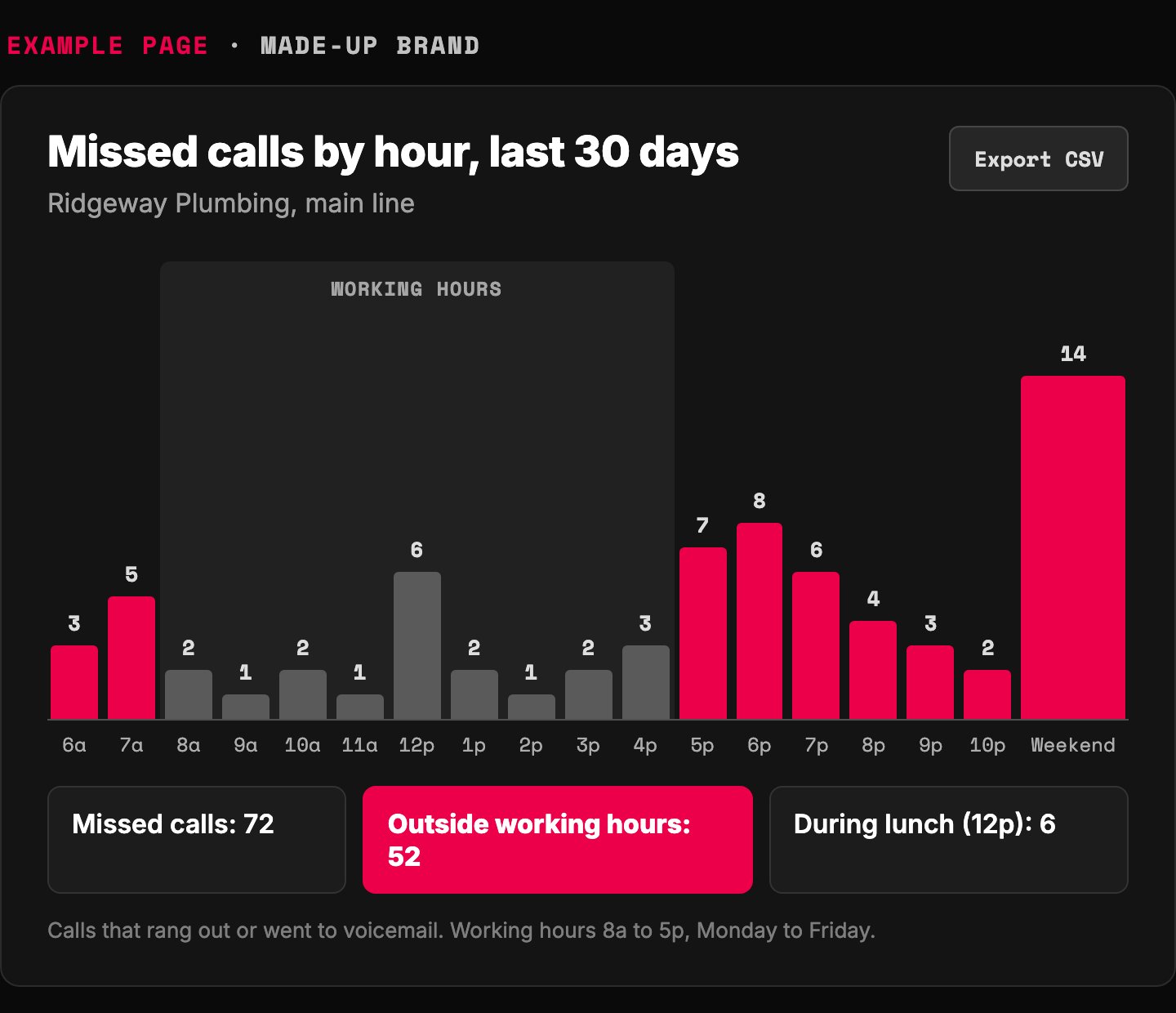
- Ask your phone provider for this one report.
- Weekends often hold the biggest pile.
- Lunch counts too: one person, one phone.
- These are the calls an AI receptionist catches first.
- Paste the export into the prompt at the end.
Example page built for this article with a made-up brand. Made-up numbers; our arithmetic: 72 missed, 20 in working hours, 52 outside.
Five steps for an AI receptionist. Count: export last month's missed calls by hour and divide the monthly fee by what one answered caller is worth. Ask: four first questions (used us before, what you need, anything urgent, when by) that route each caller to a booking, a named callback time, or a human now.
Answer: only from your written list of standard answers and must-hear facts; never quote, diagnose or promise. Hand off: by rule when the caller asks, in an emergency, on a money dispute, or after two failed tries. Listen: ten calls a week, five numbers each Friday, and widen its job one step only after 19 of 20 clean summaries.
Disclose that it is automated and announce recording on every call.
How much does an AI receptionist cost, and when does it pay?
An AI receptionist pays when the jobs from caught calls are worth more than its fee. Plans charge per minute, per caller, or a flat monthly fee. Current published prices sit in the dated box further down.
The break-even sum is one line. Divide the monthly fee by what one answered caller is worth to you.
One answered caller is worth the share of callers who book, times the value of a first job. Use your own rates, the same ones as in book-a-call math, never the vendor's.
Say the fee is $150 a month. Half your callers book, and a first job is worth $300. Each answered caller is then worth $150.
So the receptionist must catch one missed call a month to pay for itself. One. If your log shows five missed calls a week, the sum is not close.
When does it not pay? When the phone rarely rings, or most callers are suppliers and sales pitches. Count only the people who could buy.
We use it to cover the hours around people, never to replace them. A human fixes problems and calms angry customers. The software covers the other 128 hours.
Divide the fee by what one answered caller is worth
- Value of one caller Share of callers who book, times what a first job is worth.
- Calls needed Monthly fee divided by the value of one caller.
- Compare Calls needed against missed calls in last month's log.
Anar's method.
Example: at $150 a month, one caught call covers the fee
| Line | Example |
|---|---|
| Monthly fee | $150 |
| Share of callers who book | 50% |
| What a first job is worth | $300 |
| Value of one answered caller | $150 |
| Missed calls it must catch a month | 1 |
Example. Made-up inputs; our arithmetic.
Write the four questions it asks first
The first questions an AI receptionist asks should sort the caller by situation. The sort decides what happens next: book it, take a message, or get a human.
Bob Moesta shows why in Demand-Side Sales 101. A medical provider found three kinds of urgent care patients. Some knew what they had, some wanted reassurance, and some had a complicated history.
So the provider added a short intake form. It asked if the patient had this before, knew what it was, had other complications, and had records on file.
Time with a doctor fell from eighteen minutes to five for most patients. Satisfaction rose from 28 percent to 78 percent, by the book's account.
We moved those questions to the phone. Here they are, in order.
Have you used us before? A returning customer's details are already on file. The receptionist looks them up instead of asking again.
What do you need, in one sentence? A caller who knows the job can be booked on the spot.
Is anything urgent or unusual? A gas smell, a flooded room or a child in pain goes to a human now. No menu, no message.
When do you need it done by? A real deadline is the clearest sign a caller is ready to buy. More on reading that signal is in how to qualify a lead before the call.
Four answers, three paths. Booked, called back at a named time, or passed to a person.
Four questions sort every caller before anything else happens
| Question | What it sorts | What happens next |
|---|---|---|
| Have you used us before? | Returning or new | Look up their file, or take full details |
| What do you need, in one sentence? | Knows the job, or unsure | Book it, or take a message |
| Is anything urgent or unusual? | Safety or emergency | A human now |
| When do you need it done by? | Real deadline or browsing | Sets booking priority |
Anar's adaptation of the urgent care intake in Demand-Side Sales 101 (Moesta).
Urgency and certainty decide where each call goes
- A human now Something is wrong and they cannot say what.
- A human now Or the soonest slot, booked on the call.
- Message and callback Take details, name a callback time.
- Book it Into the calendar before the call ends.
Anar's routing rule.
Give it standard answers, and list what every caller must hear
An AI receptionist should answer only the questions you have written answers for. Most callers ask the same handful: hours, area, published prices, whether you do a given job.
Andy Grove made this point about managers in High Output Management. The same questions keep coming back, so prepare standard answers. Then less experienced people can handle them.
Grove also tells of a restaurant where a new hire took his booking by phone. She never told him the restaurant had lost its liquor license. He and his wife ate dinner without wine, and the maitre d' apologized to every table that night.
Nobody had told the new hire. An AI receptionist is that new hire on every call. It knows only what you write down.
So write two lists. First, the standard answers. Second, what every caller must hear: a call-out fee, a closed day, the edge of your service area.
Everything else gets one polite stock reply and a callback. It never quotes a price you did not give it, diagnoses a problem, or promises an arrival time.
A guess in a confident voice is still a guess. Writing these lists is the same skill as writing a job spec for an AI agent.
It answers from your list and says nothing that is not on it
| It says | It never says |
|---|---|
| Your hours and service area | A price you did not write down |
| Prices you publish | What is wrong with the boiler |
| The fee every caller must hear | An arrival time nobody confirmed |
| "Someone will call you by 9 a.m." | "It is probably nothing" |
Anar's rule, after the standard-answers idea in High Output Management (Grove).
When should an AI receptionist hand the call to a human?
An AI receptionist should hand off by written rule. It hands off when the caller asks, when it is urgent, when money is disputed, or when the call goes in circles.
Chip Huyen lists the same patterns for support chatbots in AI Engineering. One team passes a chat to a person when it detects anger. Another passes it after a set number of turns, so nobody gets stuck in a loop.
In her routing example, a billing mistake always goes to a human. We keep that rule for every money question.
Our rule for a small firm: two failed tries to understand the caller, then a human or a promised callback. Never a third try.
What if nobody is free? Then it names who will call back and when. It texts you the summary at once.
Then keep the promise. A callback time that slips is worse than voicemail.
Five triggers send a call to a person, every time
| Trigger | What the receptionist does |
|---|---|
| The caller asks for a person | Transfers, or names a callback time |
| Emergency or safety words | Transfers now, then texts the owner |
| A billing dispute or complaint | Passes it to a person, always |
| Two failed tries to understand | A person, or a named callback time |
| A question it has no answer for | One stock reply, then back to the call |
Anar's rules, after the routing patterns in AI Engineering (Huyen).
A good hand-off is sorted, honest, and names a callback time someone will keep
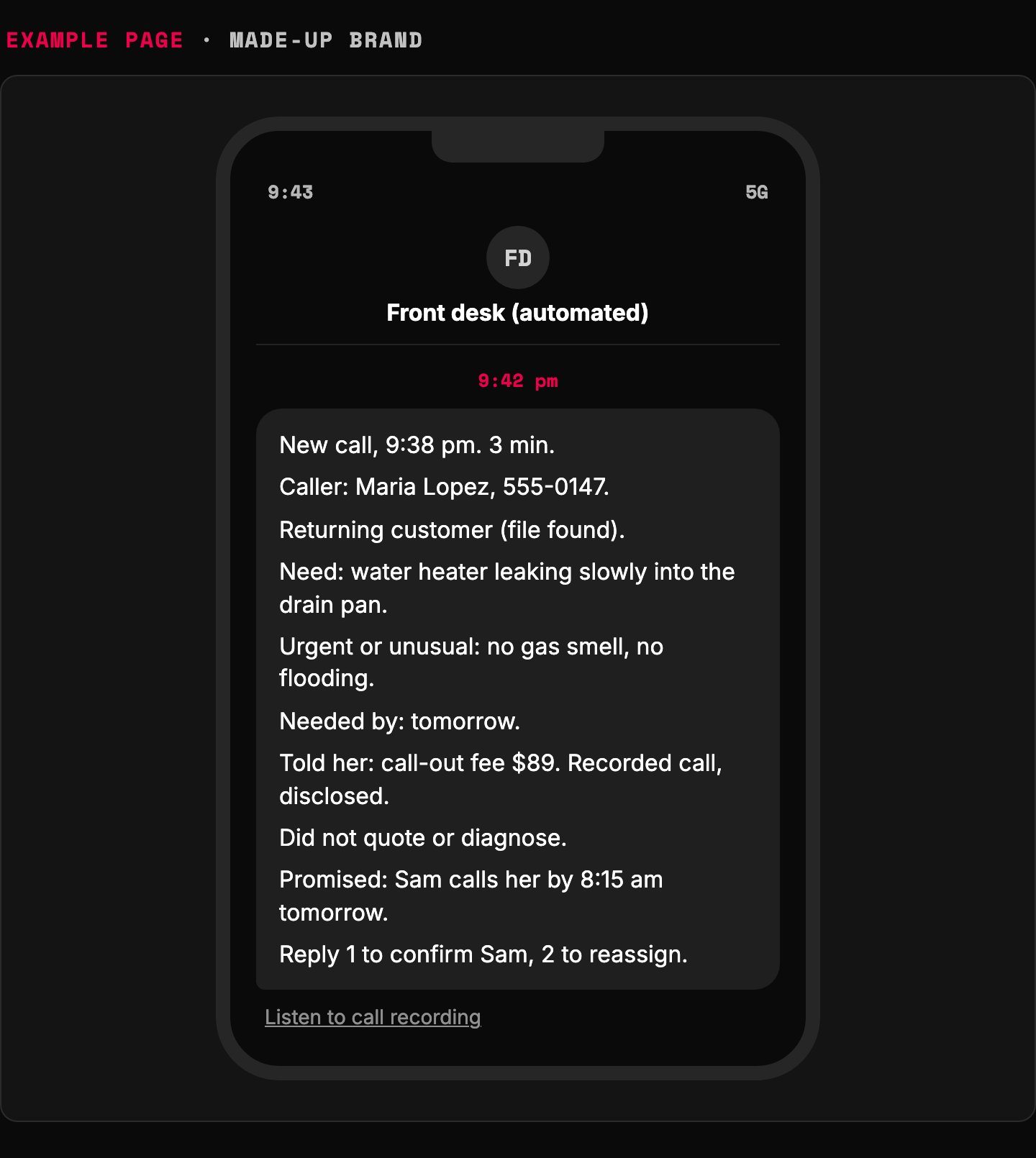
- Question one: used us before? It looked her up.
- Not urgent, so a callback, not a transfer.
- It says only what is on your list.
- A named person and a time. Now keep it.
- Ten of these a week, with a pen.
Example page built for this article with a made-up brand. Names, fee and the 555 number are made up.
Start with messages, then let it earn each step up
Give an AI receptionist the smallest job first, and widen it only when its record earns it. Rookies earn their minutes. So does software.
Huyen describes a ladder from Microsoft called Crawl-Walk-Run. First a human checks everything. Then the AI works with staff, and only then with customers.
Her example trigger for moving up: staff send 95 percent of the AI's suggested replies word for word.
We use the same idea on the phone. Week one, it takes after-hours messages only. Then it books, then it answers common questions, then it covers busy hours.
Our step-up test: in the weekly review, at least 19 of 20 call summaries need no fix. Miss it, and it stays on the current step.
Why start after hours? Every call it catches there was going to voicemail anyway. Nothing that already works gets touched.
Widen its job one step at a time, after 19 of 20 clean summaries
- After-hours messages Takes details and texts you a summary.
- After-hours bookings Books into your calendar from your rules.
- After-hours answers Answers from your standard list.
- Busy-hour overflow Picks up when every line is in use.
Anar's ladder, adapted from the Crawl-Walk-Run framework described in AI Engineering (Huyen).
"Will callers hate talking to a machine?"
Some will. The fix is honesty and speed, not a better fake human.
People hate being fooled, then being stuck. So say in the first line that it is an automated assistant.
It costs nothing. And a stumble from an honest machine lands softer than one from a fake person.
Speed works differently on the phone. A pause that is fine in a chat window sounds like a dropped call. Call your own number before launch and listen for it.
How to make callers hate your AI receptionist, in four easy steps:
1) Give it a human name and let callers think it is a person.
2) Make it recite your company history before it asks why they called.
3) Hide the exit, so asking for a human gets a menu.
4) Let it guess at prices so it sounds helpful.
That is not a receptionist. That is a damn good way to teach callers to hang up.
The first ten seconds say what it is, that it records, and how to leave
- Who answers Line 1 Thanks for calling. This is the automated assistant.
- Recording Line 2 This call is recorded so we get it right.
- The exit Line 3 Say 'person' at any time to reach the team.
- First question Line 4 Have you used us before?
Anar's script.
Is it legal to record calls and use an AI voice?
Answering your own phone with an AI is allowed in most places. The rules bite in three spots: recording, disclosure, and calling people back.
Recording rules differ by place. US federal law allows recording when one party to the call consents. Some states, such as California, need every party's consent.
Our rule is simple. Announce the recording on every call, wherever the caller is.
Disclosure is moving into law. The EU's AI Act requires AI systems that talk directly with people to say so, unless it is obvious.
Calling or texting people back is stricter than answering. The US regulator ruled that AI-generated voices count as artificial voices under the federal robocall law, which needs prior consent.
Texting rules for follow-ups are in our speed-to-lead guide. The dated box below holds the details. Check the rules where you operate, or ask a lawyer.
Listen to ten calls a week for the first month
The fastest way to improve an AI receptionist is to listen to its calls every week, with a pen.
General Motors' OnStar team learned what its customers wanted this way, in a story from Competing Against Luck. The head of OnStar made all 300 team members spend an hour listening to real calls. They heard crashes and frightened drivers, and it changed what they built.
You will hear smaller things. A question it fumbles, a caller it should have passed on, a pause that ran too long.
Each one becomes a new line in its instructions. Then read five numbers each Friday.
Calls answered within two rings. Calls booked, calls passed to a human, callbacks kept on time, and complaints.
Ask the vendor one more thing before you sign. What happens to calls when the system is down? The answer should be: they ring through to a human phone.
A receptionist nobody checks is just a fancier voicemail.
Five numbers tell you if the receptionist is working
| Number | What good looks like | Why it matters |
|---|---|---|
| Calls answered within two rings | Every call | The phone is the front door |
| Calls booked | Rising week to week | The job you bought it for |
| Calls passed to a human | Falling, never zero | Zero means the rules are not firing |
| Callbacks kept on time | All of them | A missed promise is worse than voicemail |
| Complaints | Read every one | Each is a line to fix |
Anar's weekly review.
Build your Speed-to-Lead Agent with AI this week
The Speed-to-Lead Agent is our five-step setup for an AI receptionist: count, ask, answer, hand off, listen. It is the phone side of the instant reply in our speed-to-lead guide.
The prompt below writes your receptionist's instructions in your preferred AI. It asks about your calls, prices and hours, and never invents a number.
This week, do three things. Today, export last month's missed calls by hour and run the break-even sum. Tomorrow, paste the prompt and answer its questions.
Next week, switch it on for after-hours messages only, and listen to ten calls by Friday. To compare vendors, use how to evaluate AI agents.
More local-business systems are in marketing engineering for local businesses. If you would rather we set it up, see our AI receptionist service.
Remember the plumber under the sink? He does not need a better voicemail greeting. He needs a phone that picks up by the second ring while his hands stay on the pipe.
Two rings good. Three rings bad. Still true.
Paste into your preferred AI. It asks seven questions, then writes your break-even sum, receptionist instructions, hand-off rules and weekly review.
Act as a setup planner for a small business AI receptionist. Use the Speed-to-Lead Agent method: count, ask, answer, hand off, listen.

Ask me these one at a time, with the example shown. If I answer several at once, skip ahead.
1. What my business does, and where. (Example: "plumbing, north side of the city")
2. Missed calls last month, by hour if I have them. If I do not know, tell me to export them from my phone provider first.
3. The share of callers who book, and what a first job is worth. (Example: "about half; $300")
4. The monthly fee of the plan I am looking at.
5. My standard answers: hours, service area, prices I publish, jobs I do not do.
6. What every caller must hear. (Example: "$89 call-out fee, closed Sundays")
7. Who takes handed-off calls, and when.

Then build:
1. Break-even: value of one answered caller = share who book x first-job value. Calls needed a month = fee / that value. Compare with my missed calls and say plainly if it pays.
2. Opening lines: it is an automated assistant, the call is recorded, and how to reach a person.
3. Four first questions: used us before, what you need in one sentence, anything urgent or unusual, when you need it done by. Map each answer to: book it, message with a named callback time, or a human now.
4. Standard answers, using only what I gave you, plus one stock reply for anything else.
5. Hand-off rules: the caller asks, emergency words, a billing dispute or complaint, two failed tries to understand.
6. A weekly review: five numbers and ten calls to listen to.

Rules:
- Never invent a price, policy or fact about my business. Write [CONFIRM: what you need].
- The receptionist never quotes, diagnoses or promises an arrival time.
- Tell me to check recording and AI disclosure rules where I and my callers are. If you can browse, check the current rules and name your source.

Output: the break-even sum, the full receptionist instructions, the hand-off table, the weekly review, and my next three actions.
Listen, fix, widen, count, then do it again
- Listen Ten calls a week, with a pen.
- Fix Each stumble becomes one line in its instructions.
- Widen One step up after 19 of 20 clean summaries.
- Count Missed calls and bookings, every Friday.
Anar's weekly loop.

Filip Kovacevic is the founder of Anar Agency in Phoenix. He spent five years running SEO, Meta ads, email, and content for medical practices across the United States, and now does the same work for healthcare, home-service, legal, and professional-service businesses, alongside AI implementation. More from Filip →
Talk it through in 15 minutes
Bring one question from this article. We will tell you what we would do, whether or not you hire us.
Book a 15-Min Chat →