Quiz Funnels That Make the Visitor Feel the Problem
A quiz funnel is an ad that leads to a short quiz, then a result page that sells the next step. The quizzes that sell ask questions in a set order: easy and positive first, then facts about the situation, then statements where the taker admits the problem. The result page opens with that bad news, then shows the fix.
Your quiz sorts people. A good one changes them
A visitor clicks your ad and answers nine questions. She gets a result: "You are a Planner." She sees a Book a Call button, shrugs and closes the tab.
She was curious when she started. She was just as curious when she left.
That quiz funnel sorted her. It never changed her. A good quiz does both, and most of the difference is the order of the questions.
A sorter quiz asks about facts and hands back a label. A changer quiz walks her from easy questions to an honest admission. By the result page, she has named the problem in her own clicks.
The traffic and the quiz tool stay the same. Only the order changes.

A sorter quiz hands back a label. A changer quiz hands back a decision
| Sorter quiz | Changer quiz |
|---|---|
| Asks about facts: income, size, title. | Moves from wins, to her situation, to the problem. |
| Feels like an interview. | Feels like a good consultation. |
| Ends on a label and a button. | Ends on bad news she already agreed to, then the fix. |
| She leaves as curious as she came. | She leaves having named the problem herself. |
Anar's framing.
What is a quiz funnel, and why do most of them fall flat?
A quiz funnel is an ad that leads to a short quiz, then a result page that sells the next step. The quiz does the work a long sales page would do, in clicks instead of paragraphs.
Most quizzes fall flat because they read like a job interview. How much do you make? How many staff do you have, and what is your title?
People feel the ask behind every one of those questions. They get guarded and leave after a few screens.
How to build a quiz nobody finishes, in four easy steps:
1) Ask for a name and email before the first question.
2) Ask how much money they make.
3) Ask twelve more questions about facts you could have guessed.
4) End on a label and a button that says Learn More.
That is not a quiz. That is a tax form with a progress bar.
The fix is a path with six stops, each with one job. The ad starts it by promising a result she wants to know, like the ads in the Three-Layer Ad.
Six stops, and each one has a single job
- 1. The ad Promise a result she wants to know about herself.
- 2. Positive questions Give before you ask: wins and strengths.
- 3. Neutral questions Her situation, in plain facts.
- 4. The admission She picks the problem, how long, and what she tried.
- 5. The result page Comfort, label, bad news, cause, good news.
- 6. One next step A call, a product or a free start. One offer.
The Felt-Problem Quiz.
Eight to ten questions, one per screen, in three blocks: positive questions about wins, neutral questions about the situation, then admission statements she can choose or skip, including how long it has lasted and what she tried. A true reason under every question. A result page that opens with comfort, a label and the bad news from her last answers, names the cause, then shows the fix and one next step.
Every problem real, every number from her answers.
Order the questions: positive, then neutral, then the admission
The order of your questions matters more than the questions. Run three blocks, in this order.
Block 1, positive (questions 1 and 2). Give her something first. Ask what she is good at, or which win she wants most.
These questions are about the business, not her flaws. Nothing stings yet.
Block 2, neutral (the middle 3 or 4). Ask about her situation: team size, how she tracks money, how often she checks the numbers. Facts, no judgment.
Block 3, the admission (the last 3 or 4). Now she describes the problem in "I have" and "I am" statements. She also says how long it has gone on and what she already tried.
Why save the hard part for last? People remember the end of a list best, a pattern called the recency effect. Your result page picks up right where her memory is strongest.
By question five she has also put in time and effort. Small yeses make a bigger one easier, which psychologists call the foot-in-the-door effect.
Do not jump from happy to heavy in one click. That jolt feels like a trap. Let the neutral questions ease her from one to the other.
Three blocks, from easy at the bottom to honest at the top
- Positive: questions 1 and 2 What are you best at? Which win would mean the most?
- Neutral: the middle 3 or 4 How many staff? How do you track money today?
- Admission: the last 3 or 4 "I have put off my books for months." How long? What have you tried?
The Felt-Problem Quiz.
A ten-question quiz for a bookkeeping service, block by block
| # | Block | Question |
|---|---|---|
| 1 | Positive | What are you best at in your business? |
| 2 | Positive | Which win would mean the most to you? |
| 3 | Neutral | How many people work in your business? |
| 4 | Neutral | How do you track money in and out today? |
| 5 | Neutral | How often do you look at your numbers? |
| 6 | Neutral | Who does your taxes? |
| 7 | Admission | Which sounds most like you? (I have put off my books for months...) |
| 8 | Admission | How long has it been this way? |
| 9 | Admission | What have you already tried? |
| 10 | Admission | The thing I worry about most is... |
Example quiz for a made-up bookkeeping service.
Write the admission so she chooses it, not so you accuse her
The admission block is where most quizzes go wrong. Some never ask about the problem at all. Others accuse.
A loaded question assumes something she never agreed to: "Why do you keep ignoring your books?" She did not say that. You did.
Write statements she can pick or skip instead. Start them with "I have," "I struggle with" or "No matter what I try." The words become hers only when she clicks them.
Then ask two more things. How long has it been this way? What has she already tried?
Those two answers carry the most weight. They show her the problem is real and that the usual fixes failed.
Add one worry question near the end: "The thing I worry about most is..." Write each answer as a real worry set in the near future, like "that I'll owe a tax bill I didn't plan for."
Always offer "Other" with a text box, plus a skip button. Forced answers create pushback. Even if she skips, reading the options has already named the problem.
Heavy questions can still sound human. Answers like "Yes," "Kind of" and "Ask my accountant" keep a hard question light. We explain why this admission matters so much in its own article: the thing customers would have to admit.
Admission stems she can pick, with an example for each
| Start the statement with | Example answer |
|---|---|
| I have... | I have put off my books for months at a time. |
| I struggle with... | I struggle with knowing what I really take home. |
| I find it hard to... | I find it hard to keep receipts in one place. |
| No matter what I try... | No matter what I try, my books fall behind again. |
| The thing I worry about most is... | That I'll owe a tax bill I didn't plan for. |
Example answers for a made-up bookkeeping service.
A loaded question puts words in her mouth. A statement lets her pick them
| Loaded question | Statement she can choose |
|---|---|
| "Why do you keep ignoring your books?" | "I have put off my books for months at a time." |
| Assumes the problem. | Offers the problem. She decides. |
| No way out. | "Other" box and a skip button. |
| She argues with you. | She agrees with herself. |
Example.
Let her choose the statement, give a reason, and let her skip
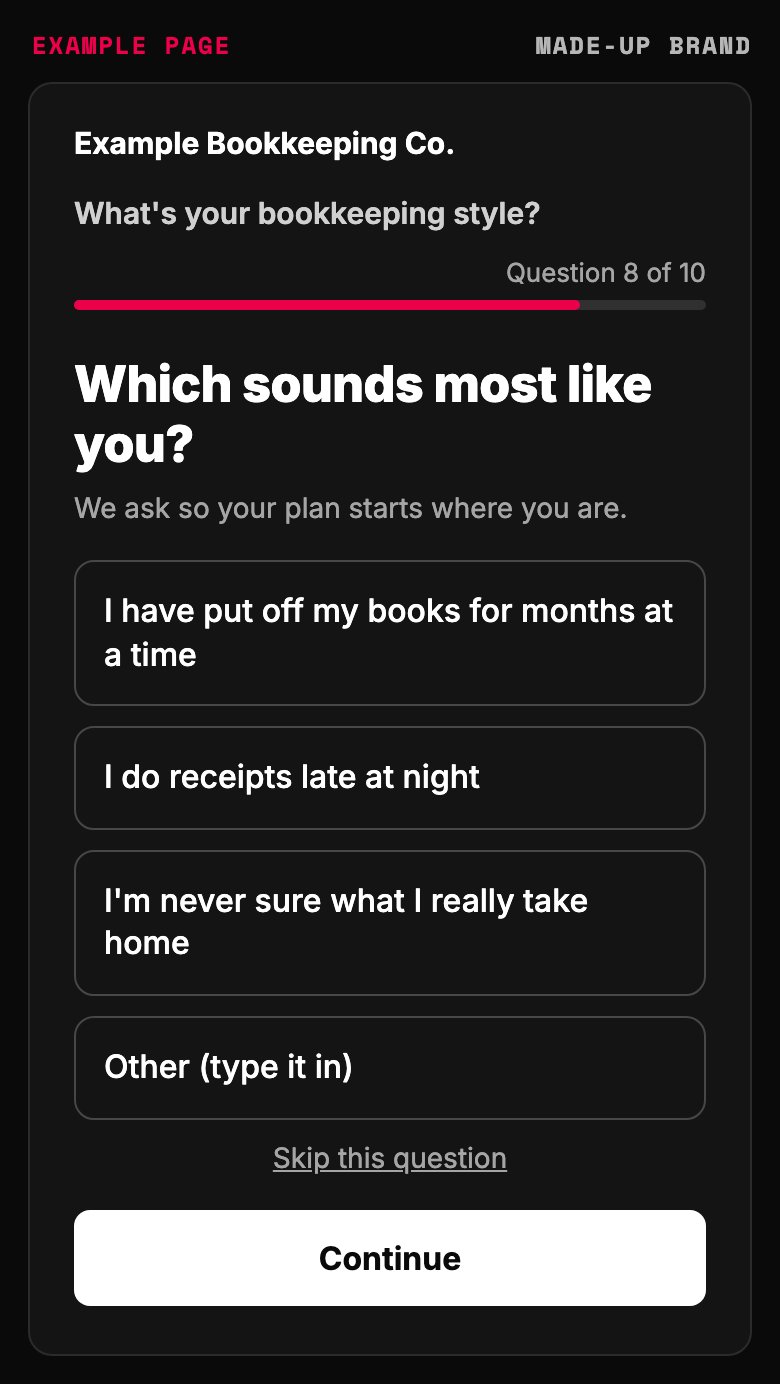
- The admission comes last, after she has invested.
- A statement she chooses. Not an accusation.
- One true reason under every question.
- Always an Other box with room to type.
- A skip button. Forced answers create pushback.
Example page built for this article with a made-up brand
Give every question a one-line reason
Every question feels like a request. A short reason under it turns the request into help.
"How long has it been this way? We ask so your plan starts where you are." It takes two seconds to read.
The UK government's design manual tells form writers to know why you are asking every question. If you cannot write the reason, cut the question.
For example, one coaching business said its call booking rate doubled or tripled after it added reason lines. That is one example, not a measured result.
Our rule: the reason must be true. A made-up reason is a small lie. Readers notice small lies.
A true reason under each question costs one line
| What was found | Who says so | How sure |
|---|---|---|
| Know why you are asking every question | GOV.UK Service Manual | Published guidance |
| Call bookings doubled or tripled after adding reason lines | One coaching business (example) | Example, not verified |
Sources: GOV.UK Service Manual, Designing good questions. Row 2: example from one business, not verified.
Open the result page with the bad news, then the fix
The result page is your sales page. If the quiz did its job, she arrives already agreeing with the problem. The page only has to show the way out.
Build it in five parts, in this order.
First, thanks and comfort. "You're not the only one who answered this way." Use it only if it is true.
Second, a label. Give her result a name she can repeat: "Your style: the Midnight Catch-Up."
Third, the bad news. Say what her last answers add up to, and what happens if nothing changes. Build it from the admission block, because that is what she remembers.
Fourth, why it keeps happening. Name the cause in one plain sentence. Here she sees why your offer works, before she sees the offer.
Fifth, the good news. Show how the problem gets fixed, then the next step: a call, a product or a free starting point.
Make the cost concrete with her own numbers. Three years of Sunday catch-ups is 156 Sundays. Say the number, and never inflate it.
One more rule: put contact details after the questions. If you ask for an email or phone first, fewer people start. The page also has to match the mood the quiz left her in, as covered in ad-to-page alignment.
Five parts, in this order: comfort, label, bad news, cause, fix
- 1. Thanks and comfort "You're not the only one who answered this way." Only if true.
- 2. A label "Your style: the Midnight Catch-Up."
- 3. The bad news What her last answers add up to, and what happens if nothing changes.
- 4. Why it keeps happening The cause, in one plain sentence.
- 5. The good news How it gets fixed, then one next step.
The Felt-Problem Quiz.
Turn her own answers into a number she can feel
Example: three answers from the bookkeeping quiz, converted with simple math
- Sundays in 3 years of weekly catch-up (3 x 52) 156
- Hours a year at 2 hours a week (2 x 52) 104
- Sundays in 10 years of the same habit (10 x 52) 520
Example. Numbers come from the taker's answers, not from outside data.
Bad news first, then the cause, then the fix and one next step
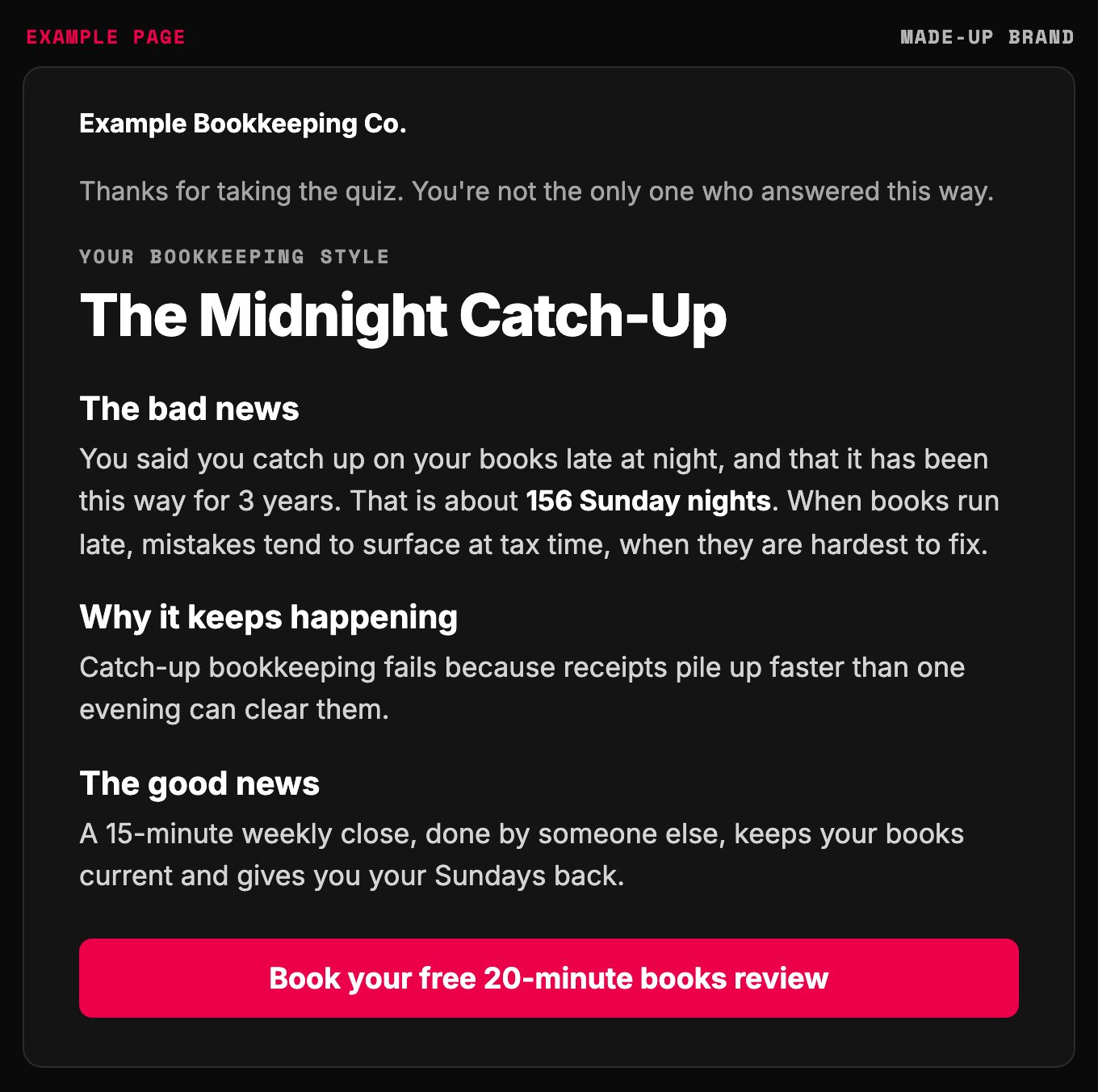
- Comfort first. Only if it is true.
- A label she can repeat.
- Her own answer turned into a number: 3 years x 52.
- The cause in one sentence, shown before the offer.
- One next step. One offer.
Example page built for this article with a made-up brand
How many questions should a quiz funnel have?
Start with 8 to 10 questions. That leaves room for all three blocks without a sudden drop from happy to heavy.
Then test length before you test anything else. Run a short, a medium and a long version. Length changes who finishes and what they spend, so let your numbers pick.
Show one question per screen. GOV.UK's design manual starts every form with one question per page. The idea is called progressive disclosure: show a little at a time, so there is less to think about.
Test length first: 5, 8 and 10 questions
| Version | Positive | Neutral | Admission | Watch |
|---|---|---|---|---|
| Short (5) | 1 | 2 | 2 | Starts and finishes |
| Medium (8) | 2 | 3 | 3 | Finishes and bookings |
| Long (10) | 2 | 4 | 4 | Bookings and sales per visitor |
Our starting split.
Qualify on the pain, not the paycheck
Income questions are the fastest way to make a quiz feel like a loan form. They also get bad answers.
People tend to report a low income higher and a high income lower, a known survey bias. So the number you collect is shaky anyway.
Ask how much the problem hurts instead.
How long has it lasted? What has she tried? What does she worry about?
A buyer who is fed up usually finds the budget. A comfortable buyer rarely does.
Our take: a buyer with a big income and no pain will usually say no. Check budget later, on the call. See how to qualify before the call.
Ask about the pain. The paycheck answer is shaky anyway
| Asks about the paycheck | Asks about the pain |
|---|---|
| "What is your yearly income?" | "How long has it been this way?" |
| Low earners round up, high earners round down. | Answers she has no reason to fake. |
| Feels like a loan form. | Feels like someone noticed. |
| Tells you who could pay. | Tells you who wants it fixed. |
Source: Wikipedia, Social-desirability bias.
Bolt the quiz onto the sales page you already have
You do not need a new funnel. Put the quiz in front of your current sales page and add the bad-news opening on top.
For example, one dating coach built a quiz in about two hours. It sat on top of an existing sales page, ran on about $10 of ads and made about $150.
This was one small test, not proof. But the build cost almost nothing.
Start with one result page for everyone. Change the label and the bad news by answer later.
A different product for every result type gets complicated fast. Keep one offer at first.
If the quiz sells a second product to people who already bought, it must not contradict the first product. For example, one weight-loss coach selling to people who had just bought a diet program changed the quiz from losing weight to keeping it off.
The quiz works on old leads too. Tag each answer in your email tool, then send follow-ups about the problem she picked.
The CAN-SPAM rules apply to every one of those emails. The sequence itself is in the lead-first email sequence, and the traffic side is in straight-to-quiz lead gen.
Small tests on existing pages, and how sure we are
| What happened | Who | How sure |
|---|---|---|
| Built in about two hours, about $10 of ads, about $150 in sales | One dating coach (example) | Example, not verified |
| Quiz switched from losing weight to keeping it off, to match the first purchase | One weight-loss coach (example) | Example, not verified |
Examples from two businesses, not verified.
One quiz can restart conversations with leads who never bought
- Quiz Send old leads to the quiz.
- Tag Each answer adds a tag in your email tool.
- Email Follow-ups speak to the problem she picked.
- Call Offer a short review call.
The Felt-Problem Quiz.
Three places a quiz stalls, and the fix for each
Lots of starts, few finishes. The quiz asks for an email first, or jumps from happy to heavy. Move the form to the end and add a neutral question.
Lots of finishes, few bookings. The result page opens with the offer. Open with the label and the bad news from her last answers instead.
Angry comments on the ad. The admission block accuses. Rewrite each line as a statement she can choose, and add Other and skip.
Fix one stall at a time. Change three things at once and you learn nothing.
Three stalls, and the fix for each
| Symptom | Cause | Fix |
|---|---|---|
| Lots of starts, few finishes | Email first, or happy to heavy too fast | Form at the end, one more neutral question |
| Lots of finishes, few bookings | Result page opens with the offer | Open with the label and the bad news |
| Angry comments on the ad | Admission block accuses | Statements she chooses, plus Other and skip |
Common quiz fixes.
Keep it true: surface a real problem, never invent one
Some people say a quiz should create the problem. We disagree.
A good quiz surfaces a problem the taker really has. A quiz that invents one is a con with a progress bar.
Our test: would an expert in this field ask a stranger these questions and stand behind the results? If not, fix the offer, not the quiz.
Watch the ad as well. Meta's personal attributes policy rejects ads that assert or imply things about the viewer, so a headline like "Are you bad with money?" can get rejected.
Health quizzes need extra care. A clinic should check its quiz against HHS guidance on tracking tools before any pixel fires on it. Every result is also an ad claim, which the FTC expects to be truthful and backed by evidence.
Henry Ford once said customers could have any color so long as it is black. Buyers now expect a choice. A quiz lets a small business speak to each buyer's problem without building a new product.
Only one corner is a quiz worth running
- Bait Answers steer her toward a problem that is not real.
- Felt-Problem Quiz She names a real problem in her own clicks.
- A con You tell her she has a problem she does not.
- A lecture True, but she feels accused and argues.
Anar's rule.
Build yours with AI this week
The prompt below builds a full quiz and result page in your preferred AI. It asks for your offer and your buyer's real problems, then drafts every question, reason line and result block.
It never invents a problem or a number. Where it needs a fact, it writes [CONFIRM].
This week: reorder your current quiz into the three blocks, and rewrite the result page to open with a label and the bad news. Then test a 5, an 8 and a 10 question version.
Want a second pair of eyes on the result page? That is part of our conversion work.
Remember the visitor who got "You are a Planner" and left? Give her the same nine questions in a better order. By the last one, she has said the problem herself, and the result page only has to agree.
Paste into your preferred AI. It asks about your offer and your buyer's real problems, then drafts the quiz, reason lines and result page.
Act as a quiz funnel writer. You build quizzes that help a buyer name a problem she really has, in her own clicks.

Ask me these one at a time, with the example. If I give you everything at once, skip the questions and start.
1. What do I sell, and what is the next step after the quiz? (Example: "Bookkeeping for small business owners. A free 20-minute review call.")
2. Who is the buyer? (Example: "Owners with 2 to 15 staff who do their own books.")
3. The 3 to 5 problems my buyers really have, in their words. (Example: "I do receipts at midnight.")
4. What they usually try first, and why it fails.
5. My current quiz or sales page, if I have one.

Then build:
1. A quiz title that promises a result she wants to know.
2. 8 to 10 questions, one per screen, in three blocks: 2 positive questions about wins or strengths; 3 to 4 neutral questions about her situation; 3 to 4 admission questions ("I have...", "I struggle with...", "No matter what I try..."), including how long it has lasted, what she has tried, and one near-future worry.
3. Under every question, a one-line true reason ("We ask so...").
4. Every admission question gets an "Other" text box and a skip button.
5. A result page: a true comfort line, a label, the bad news built from her last answers, the cause in one sentence, then the good news and the next step.
6. Where her answers allow, turn one into a plain number (years into weeks or days). Show the math.

Rules:
- Use only problems from my list. Never invent a problem, number, statistic or testimonial. If you need a fact, write [CONFIRM: what you need].
- No loaded questions, no shame words, no income questions, no fake scarcity.
- No claims about health, money results or the law that I have not confirmed.

Output:
A. The quiz, block by block, with answers and reason lines.
B. The result page.
C. Every [CONFIRM] item, numbered.
D. Three lengths to test: 5, 8 and 10 questions.
Filip Kovacevic is the founder of Anar Agency in Phoenix. He spent five years running SEO, Meta ads, email, and content for medical practices across the United States, and now does the same work for healthcare, home-service, legal, and professional-service businesses, alongside AI implementation. More from Filip →
Talk it through in 15 minutes
Bring one question from this article. We will tell you what we would do, whether or not you hire us.
Book a 15-Min Chat →