Risk Reversal Examples: What Buyers Fear Losing (Beyond the Guarantee)
Risk, to a buyer, is whatever they trade and cannot get back. Money is one loss. Time, energy, other options, identity and pride are the rest.
Risk reversal means finding each of those losses and shrinking it. Show the way back where there is one. Where there is none, show a payoff at least ten times bigger.
What is risk reversal? Shrinking what a buyer cannot undo
For example, one dog training company sold an upsell that promised a well-behaved dog. Buyers wanted that dog. Most still said no.
Who were they? Busy parents with kids, a house and a job. When exactly would they train a dog?
So the copy changed one thing. Every lesson became five minutes a day. After that, the company saw 60 to 70 percent of buyers take the upsell.
The promise stayed the same. The fear of losing their evenings went away.
Most risk reversal examples you will find online are money-back guarantees. A guarantee can give back money. It cannot give back a month, your effort or a bruised ego.
Our definition is simpler. Risk is whatever a buyer trades and cannot get back. Risk reversal means finding each of those losses and making it smaller.
The research agrees with the core idea. In studies of loss aversion, people treat a loss as about twice as big as an equal gain. Every buyer on your page is doing that math.
Same dog, same upsell; only the fear of lost time changed
| Before: sold the gain | After: shrank the loss |
|---|---|
| Promise: a well-behaved dog | Promise: a well-behaved dog |
| Training pictured as trips to the park | Training pictured as five minutes a day at home |
| Ignored the buyer's busy week | Built around the buyer's busy week |
| Share who took the upsell: not reported | Share who took the upsell: about 60 to 70 percent |
Example numbers from one business. Their claims, not our data.
Everyone still reading your page is a maybe
Think about who is on your page right now. A firm no would have left already. A firm yes would have bought.
So everyone still reading is a maybe. Belief pushes a maybe toward yes. Risk pulls it back toward no.
Most copy only adds reasons to buy. The best salespeople work the other side. They remove reasons not to buy.
Here is why that matters. Say 3 of every 100 visitors buy. Then 97 left, and you know almost nothing about why.
Shouldn't the 97 get some of your attention?
Picture yourself buying a house. Great rooms, good price, a little road noise. The agent says you will get used to it, and you walk away.
One reason not to buy beat every reason to buy. That is how a maybe turns into a no.
For more on finding those reasons, read what buyers say no to.
Everyone still on your page sits on the middle rung
- No They already left. This page will not reach them.
- Maybe Still reading. Wants it. Weighing what could go wrong and stay wrong.
- Yes They already bought.
Our ladder and wording.
Example: at 3 percent, 97 of every 100 visitors leave without buying
Out of 100 visitors at a 3 percent sale rate
- Bought 3
- Left without buying 97
Worked example: 3 percent of 100 visitors. The math is ours.
The Loss Ledger lists what a buyer puts in and may not get back, on six lines: money, time, energy, resources, identity and ego. For each line, ask whether the buyer can undo it. Where they can, say so softly all the way through, never with the word risk.
Where they cannot, show an honest payoff at least 10 times bigger, ideally 100. Shrink the line the buyer is shortest on first, and place any guarantee last, as a bonus.
The Loss Ledger: six things a buyer can lose for good
The Loss Ledger is our name for a list of everything your buyer puts in that may not come back. It has six lines. Money is only one of them.
Money. The price. A refund can return it, so it is the easiest loss to undo.
Time. Hours spent learning, setting up and waiting for a result. No refund returns a lost month.
Energy. The effort and attention it takes. Tired people do not start new projects.
Resources. Everything else that money and time could have bought. Economists call this opportunity cost: pick you, and the other thing is off the table.
Identity. Who the buyer is now. For example, one relationship coach found her clients feared a healthy relationship would feel dull, so she showed them the excitement could stay.
They got to keep who they were. She found her sales calls got easier.
Ego. What the buyer must admit by buying. A weight loss offer asks people to admit they need to lose weight, and some never will.
Now run one test on each line. Can the buyer undo it, get out of it, or get it back? Every no is a risk your copy has to answer.
Small offer? The ledger can be short.
A $27 download may only have money and ego on it. Then a clear refund and one line about the way back can be enough.
A refund gives back only one of six losses
| Line | What the buyer puts in | Can a refund return it? |
|---|---|---|
| Money | The price | Yes |
| Time | Hours learning, setting up, waiting | No |
| Energy | Effort and attention | No |
| Resources | Whatever else that money and time could buy | No |
| Identity | Who they are now | No |
| Ego | What they must admit by buying | No |
The six lines of the Loss Ledger. Table and wording are ours.
Fill in your Loss Ledger in five steps
- 1. List the steps Every action the buyer must take after paying to get the result.
- 2. Price each step What it costs on the six lines: money, time, energy, resources, identity, ego.
- 3. Ask the undo question Can they undo it, get out of it, or get it back?
- 4. Find the short line Mark the line the buyer has least of. That is the biggest risk.
- 5. Answer every no An undo line where there is a way back. A payoff of 10 to 1 or better where there is not.
Our five steps.
Which loss is biggest? The one your buyer has least of
Which line matters most? The one your buyer is shortest on. People guard what they have little of.
A buyer short on money fears the price most. They often have more time than cash. So a lower price that asks for some of their own work can sell well.
A buyer short on time fears the hours. Plenty of owners are like this. They will put money into a deal without much thought, but they guard every hour.
That is why done-for-you services cost the most. They shrink the time cost. Time-poor buyers pay well to keep their hours.
Back to the dog. Those parents could afford the upsell. They could not afford the evenings, and five minutes a day answered that.
So never assume money is the small fear. For many buyers it is the big one. Ask who you sell to first, then read our guide to cautious buyers.
Shrink the line your buyer is shortest on
| Buyer short on money | Buyer short on time |
|---|---|
| Fears the price most | Fears the hours most |
| Often has more time than cash | Often has more cash than time |
| What sells: a small price, some of their own work | What sells: done for you, short steps |
| Shrink the money line first | Shrink the time line first |
Our comparison and wording.
Can they undo it? Say so in small ways, all the way through
For every line the buyer can undo, tell them. Do it early and often, in small ways. The message is simple: this is not permanent.
Never write "no risk" or "risk-free." Mention risk at all and the buyer starts looking for it. Show the way back instead.
Learning is a common hidden cost. Anything new takes time to learn. If you can answer it honestly, do it inside a normal sentence: "You may expect weeks of setup, but each step takes about five minutes with the guide open."
Better still, let them try before they pay. A demo or a free tier has nothing to undo. They can walk in and walk out.
A small paid first step does the same job. We wrote a full guide to quick win offers.
Long contracts work the other way. Ask for 12 months up front and the buyer feels it in the gut.
Why? They cannot get out.
Month-to-month terms, a clear cancel button, data they can take with them. Each one says: you can leave.
Every undo line tells the buyer there is a way back
| Line | Example undo line (ours) |
|---|---|
| Money | Full refund within 30 days. One email, no form. |
| Time | Each step takes about five minutes. Setup fits in one evening. |
| Energy | We do the setup with you on a call. |
| Resources | Month to month. Cancel in two clicks. |
| Identity | Keep what you like about how you work now. |
| Ego | Start with one small job. Nobody else needs to know. |
Made-up examples written by us. Use only lines that are true for your offer.
Undo lines placed all the way down the page, with no 'risk-free' anywhere
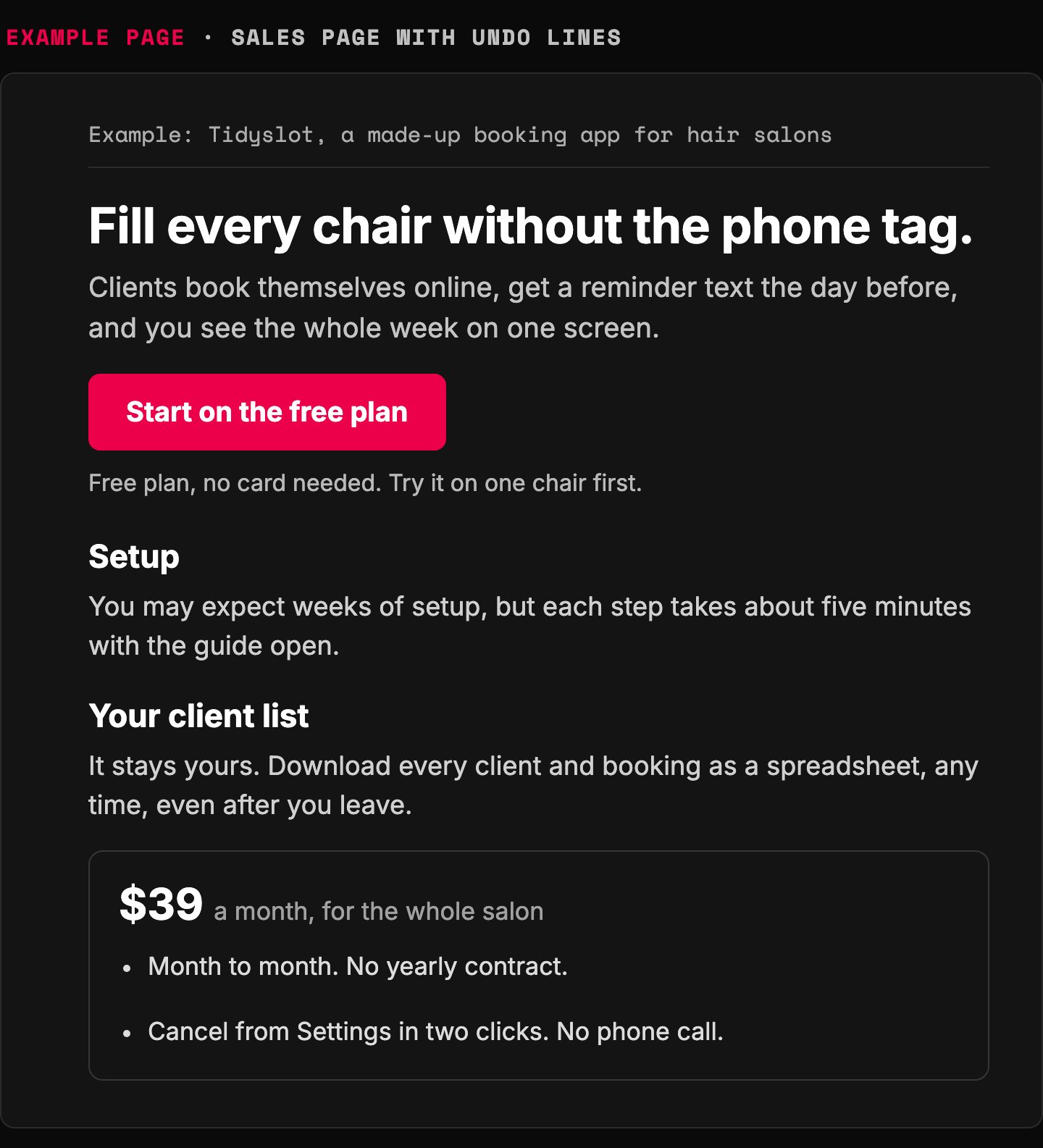
- A free plan has nothing to undo. They can walk in and walk out.
- Answers the hidden cost of learning, inside a normal sentence.
- Data they can take with them: another way back.
- Month to month, not 12 months up front. They can get out.
- A clear cancel button tells them: you can leave.
Example page built for this article with a made-up brand
Can't undo it? Show a payoff 100 times bigger
Some losses cannot be undone. Spent time is gone for good. For those, show a payoff far bigger than the cost.
The rule: the payoff should be at least 10 times the cost, and 100 times is better. At that ratio the buyer stops doing the math.
Why does anyone buy a lottery ticket? A Powerball ticket costs $2, and the jackpot odds are about 1 in 292 million. People still buy, because $2 feels tiny next to the prize.
Now picture a ticket that refunds you if you lose. The line would wrap around the store. That is the full move: a huge payoff, plus a way back.
Here is how it reads in copy. Example: three months to learn a skill you can use for the next 30 years. That is 3 months of effort for 360 months of use, a payoff of 120 to 1.
Our rule: the payoff must be true, typical and provable. Inflate it and you have a false claim, not a ratio.
Income promises are where sellers get in trouble. Read the FTC risk drivers before you write one. The safest ratios use time and years of use.
Show a payoff at least 10 times the cost; 100 times is better
- 1 to 1 The buyer weighs every dollar and every hour.
- 10 to 1 The minimum for anything they cannot undo.
- 100 to 1 The buyer stops doing the math.
Our payoff ratio rule.
People pay $2 for jackpot odds of 1 in 292 million
- Price of one Powerball play 2
- Jackpot odds (292,201,338 to 1) 1 in 292 million
Source: Wikipedia, Powerball, read 2026-10-17.
Example: 3 months in, 360 months of use out, 120 to 1
Months a buyer puts in to learn a skill, against months they can use it
- Months to learn 3
- Months of use (30 years) 360
Worked example: 30 years is 360 months. The math is ours.
Make standing still the riskier choice
Your buyer already has a plan. It is called doing nothing. Doing nothing has costs that cannot be undone either.
So show them. Compare what they lose by trying you with what they lose by waiting.
A relationship coach can say it plainly. Years in the wrong relationship do not come back. Nobody gets their thirties twice.
A famous mail-order ad made the same point. Thirty days will pass whether you act or not. Where will you be when they do?
People lean toward what they already have. Researchers call it status quo bias. A related effect, the endowment effect, makes things we own feel worth more.
Our line: only point to a cost that is true and that the buyer already feels. Inventing a danger is manufactured fear. We do not write it.
Waiting has costs too, and lost time never comes back
| Try the offer | Keep doing nothing |
|---|---|
| Money: can come back with a refund | Money: kept, for now |
| Time: a few months, with a payoff | Time: the same months, with no payoff |
| Can you undo it? Mostly | Can you undo it? Not the lost time |
Our comparison, based on the method.
Put the guarantee last in the pitch, as a bonus
So where does the money-back guarantee go? Keep it if you have one. Just stop using it as the reason to buy.
Picture a page that says yes, yes, yes, then ends on "or your money back." That line is a speed bump. It makes the buyer think about loss right before checkout.
People tend to remember the last thing they read. So the order matters: gain, then what they will not lose, then the guarantee as a small bonus.
Stacking guarantees backfires too. Each new promise names a failure the buyer had not pictured. Three guarantees read like three warnings.
How to make a guarantee scare buyers off in four easy steps:
1) Save it for the very last line.
2) Stack three more under it.
3) Write "100% risk-free" in bold.
4) Hide the conditions in gray text and hope like hell.
Whatever you promise, honor it. The FTC's guides on guarantees say a money-back promise should refund the full price when the buyer asks. Any limits must be clear enough to notice.
Put what they will not lose before the guarantee
- 1. Gain What they get, in pictures they can see.
- 2. More gain The small wins along the way.
- 3. What they will not lose The undo lines and the payoff ratio.
- 4. The guarantee Last, short, plain. A bonus, not the reason to buy.
Our order and wording.
Gain first, then what they keep, then one plain guarantee as a bonus
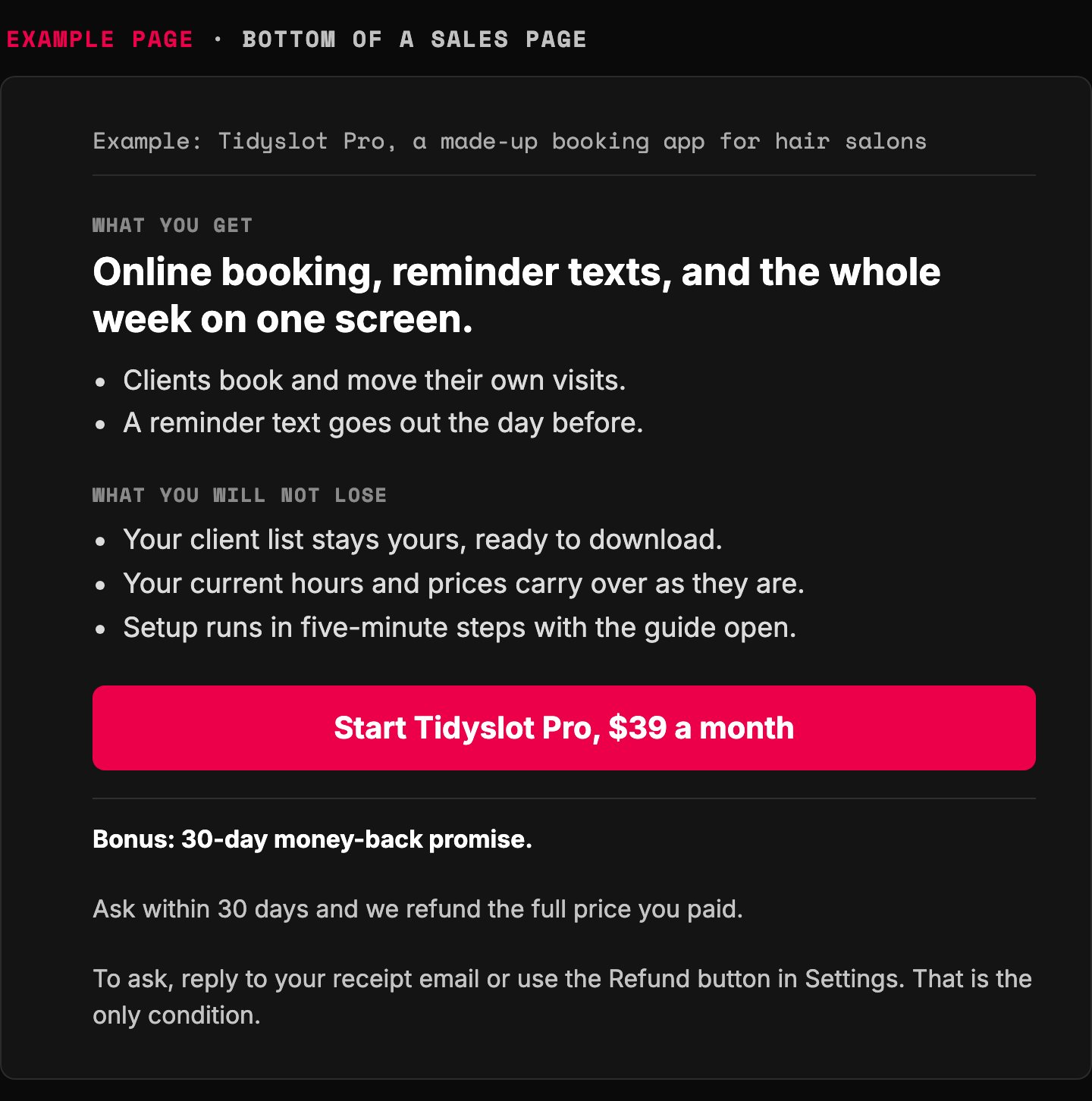
- First, the gain: what they get.
- Then what they will not lose.
- The guarantee comes last, small, as a bonus. One promise, not three.
- Honor it: the FTC guides say a money-back promise refunds the full price when the buyer asks.
- Any limit sits in plain view, clear enough to notice. No gray fine print.
Example page built for this article with a made-up brand. We planned a screenshot of the FTC guarantee rule (16 CFR 239.3), but eCFR blocks automated browsers, so this example shows the same rule applied
Does a big guarantee help? Only when nobody knows you yet
Heavy guarantees can be a warning sign. A market full of "results in 30 days or your money back" is often a market where buyers stopped getting results.
Some buyers come only for the guarantee. Call them defensive buyers: they know what they do not want, and they turn into headaches.
Does a big guarantee ever work? Yes, when nobody trusts you yet.
Take Hyundai. Its early US cars earned a poor reputation for quality. It invested in quality and added a 10-year powertrain warranty, and its reputation recovered.
Notice what came with the promise: better cars. The warranty bought time while the proof caught up.
Our decision rule: new and unknown? Use one strong, plain guarantee while you build proof.
Known, with a track record? Lead with the proof and keep the guarantee small and late.
Not sure what proof you have? Use the Proof Grid to list it.
Example guarantee claims from one business, and how sure we are
| Claim | What they saw | How sure |
|---|---|---|
| Five-minute reframe on a dog training upsell | About 60 to 70 percent of buyers took the upsell | Their claim; we have not seen the data |
| A guarantee kept quiet in one seller's template | Refund rate under 1 percent | Their rough estimate |
| Heavy guarantees draw defensive buyers | They become headaches | An opinion, not data |
Example numbers from one business. Their claims, not our data.
Unknown sellers need the guarantee; known sellers need the proof
| New and unknown | Known, with a track record |
|---|---|
| Lead with one strong, plain guarantee | Lead with results and clients |
| Use it to buy time while proof builds | Keep the guarantee small and late |
| Example: Hyundai's 10-year powertrain warranty | Example: a seller with years of public results |
Our rule. Hyundai facts from Wikipedia, Hyundai Motor America.
Where people get stuck
"My market expects a guarantee." Symptom: prospects ask for one on every call. Cause: they do not know you yet, so the guarantee stands in for proof.
Fix: show proof first and give a small result before the big sale. Then try a two-way deal. You guarantee your part of the work if they guarantee theirs.
"I wrote risk-free and nothing changed." Symptom: flat sales after a new badge. Cause: the word made buyers think about risk.
Fix: delete the word. Instead, add one line for each loss that shows the way back.
"My buyers already failed at this." Symptom: replies like "I tried this before." Cause: the copy reminds them of the failure.
Fix: show what is new and why it did not work last time. Our guide to buyers who have seen it all covers this.
Three stuck points, and the fix for each
| Stuck point | Symptom | Cause | Fix |
|---|---|---|---|
| "My market expects a guarantee" | Asked for one on every call | They do not know you yet | Proof first, a small result, a two-way deal |
| "I wrote risk-free" | Flat sales after a new badge | The word made them think of risk | Delete it; add undo lines |
| "They already failed at this" | "I tried this before" | Copy reminds them of the failure | Show what is new and why |
Our summary of the method.
Build your Loss Ledger with AI: the copy-paste prompt
Paste the prompt below into your preferred AI. It asks what you sell, who buys and what they must do after paying. Then it builds the ledger and rewrites your lines.
It never invents a number. If it needs one, it asks you. Check every line it writes against what is true for your offer.
No real proof yet? Fix that first.
Paste into your preferred AI. It asks what you sell and who buys, then builds the ledger and rewrites your lines.
Act as an offer editor. Build a Loss Ledger for my offer, then rewrite my copy so it answers each loss.

Ask me one at a time, with the example:
1. What do you sell, at what price, and how is it paid? (Example: an online course, $497 once)
2. Who buys, and what are they shortest on: money, time or energy? (Example: busy clinic owners, short on time)
3. Every step the buyer must take after paying to get the result. (Example: watch 6 lessons, set up a booking page, run it for 30 days)
4. Paste your sales page or offer text, including any guarantee.

Rules:
- Risk is whatever the buyer trades and cannot get back.
- For each step, list what it costs on six lines: money, time, energy, resources (what else that money or time could buy), identity (who they are now), ego (what they must admit by buying).
- For each cost, ask: can they undo it, get out of it, or get it back? Mark yes or no.
- Mark the line the buyer is shortest on. That is the biggest risk.
- For every yes, write one plain line that shows the way back. Never write "risk-free" or "no risk".
- For every no, write one payoff line at 10 to 1 or better. Use time and years of use, not income promises. Use only numbers I give you; if you need one, ask me.
- Write one line on what waiting costs, only if the cost is true and the buyer already feels it. Never invent a danger.
- Place the guarantee after the gain and after the undo lines, as a bonus. Keep its terms plain and complete. Flag it if there is more than one guarantee.
- Never invent results, refund rates or testimonials.

Answer in this format:
Loss Ledger: [table: step, line, cost, undo yes or no]
Biggest risk: [line, and why]
Undo lines: 1. 2. 3.
Payoff lines: 1. 2.
Cost of waiting: [one line, or "skip"]
Guarantee: [where it goes, and the rewritten wording]
Three edits to make today: 1. 2. 3.
Run it this week
1. Run the prompt for your main offer. Fill in all six lines.
2. Mark the line your buyer is shortest on. Rewrite the one sentence on your page that touches it.
3. Move your guarantee below the gain and the undo lines. Delete every "risk-free."
Remember the dog. Same promise, five minutes a day, and buyers said yes.
Want a second pair of eyes? Send us your ledger. Next, learn how to close once the risk is gone.
A refund returns the money. It never returns a lost evening.

Filip Kovacevic is the founder of Anar Agency in Phoenix. He spent five years running SEO, Meta ads, email, and content for medical practices across the United States, and now does the same work for healthcare, home-service, legal, and professional-service businesses, alongside AI implementation. More from Filip →
Talk it through in 15 minutes
Bring one question from this article. We will tell you what we would do, whether or not you hire us.
Book a 15-Min Chat →