Risk-First Buyers: How to Close Every Information Gap

A risk-first buyer weighs what could go wrong before what they could gain. To sell to them, answer every question your page leaves open: who they will work with, each step and the end, the full cost in money and effort, what they give up, what happens if life gets in the way, and who like them has done it.
Why do interested buyers leave without asking a question?
It is 11 at night. Someone has your sales page open in one tab and their bank app in the other.
They like the offer. Then a question shows up that your page never answers. Who will I actually work with?
They do not email you to ask. They close the tab and plan to come back later. Most never do.
That reader is a risk-first buyer. They ask what could go wrong before they ask what they could gain.
Which question sinks them? Often one you never thought to write down.
Here is our plain answer. Find every question your page leaves open. Answer each one in plain words, close to where people decide to buy.
We call that the Gap Close. One page, one honest read, about an hour.
Risk-first is a situation, not a type of person
A risk-first buyer is someone who weighs what could go wrong before what they could gain. The same person can be risk-first on Tuesday and carefree on Saturday.
Watch anyone shop for groceries. They toss in the cereal they always buy without a glance. Then they pick up a new brand and read the whole label.
The shopper is the same person. Only the purchase is different. A repeat buy feels safe because nothing bad happened last time.
Your offer is new to every first-time buyer. So it gets the full label check. Every time.
Three things push almost anyone into risk-first mode: other people depend on the outcome, the money is more than they can spare, or the choice is hard to undo.
Psychologists describe two ways people chase goals in regulatory focus theory. One chases gains, the other prevents losses. Our view: a big, new, hard-to-undo purchase calls up the second one.
This is our stance, and it is a deliberate one. Plenty of marketing advice sorts careful buyers by gender or age. We think that is a stereotype, and it is wrong often enough to cost you sales.
Ad platforms push back on this too. Meta's personal attributes policy bans ads that assert or imply things like a viewer's age or race.
So describe the situation instead: a new program, a big bill, or a family waiting on the result. For more on what makes people feel safe enough to act, see the Safe Place Model.

New and high-stakes purchases get the full label check
- Careful but calm Big decision, but past experience says it went fine.
- Risk-first Every gap gets noticed. Your new offer lives here.
- Autopilot Same cereal, same brand. Nobody reads the label.
- Quick look A new snack. A glance at the label, then into the cart.
Our model, built from the repeat-vs-new purchase pattern described in this article
A risk-first buyer weighs what could go wrong before what they could gain. That is a situation, not a type of person: anyone gets careful when a purchase is new, costly or hard to undo. Every unanswered question becomes a worst-case guess or a delay.
Close six gaps near the buy button: who they will deal with, every step and the end, the full cost in money and effort, what they give up and must decide, what happens if life gets in the way, and who like them has done it. Never manufacture fear to make your answer look better.
Every unanswered question becomes a guess or a delay
A gap is any question a buyer has that your page does not answer. A careful buyer does not skip a gap. They fill it.
Sometimes they fill it with the worst case. A supplement page that never says what is in it, or whether anyone has studied it, reads as unsafe.
Sometimes they fill it with a delay. Finding the answer takes effort, so they plan to come back later. That is procrastination with good manners.
Both end the same way. No sale today.
Researchers call the wider pattern ambiguity aversion: people prefer a known risk to an unknown one. Our read: a clear answer they dislike can still feel safer than no answer at all.
Here is what one missing sentence can cost. For example, one business-opportunity ad taught people to sell saunas online. Each sauna sold for $6,000 to $8,000.
The ad never said whether you had to buy the saunas first. So readers pictured a garage full of unsold saunas. Who signs up for that?
The owner added one line: you pay for each sauna only after it sells. Cost per sale dropped from about $40 to about $18, at under $200 a day in ad spend. That is the owner's reported result, not ours.
One sentence. Same ad. Less than half the cost.
This works for results too. If your page never shows the outcome, the reader pictures what could go wrong instead. Every page leaves a picture in the reader's head, so make it the good one.
A gap turns into a guess or a delay
| What the page leaves out | What a careful reader does |
|---|---|
| Whether you buy the stock first | Pictures a big upfront bill and leaves |
| What is in the supplement and whether it was studied | Assumes it is unsafe and leaves |
| When the program ends | Pictures years of effort and waits |
| Who answers questions | Pictures being alone and stalls |
Example built from the method in this article
Example: one added sentence cut cost per sale by more than half
Business-opportunity ad, before and after adding 'you pay for each sauna only after it sells'
- Before the line 40
- After the line 18
Example: the business owner's reported cost per sale, at under $200 a day in spend. Not verified by us
The Gap Close: six questions your page has to answer
The Gap Close is our method for finding and answering every question a careful buyer brings to a page. It comes down to six questions.
Who will I deal with? Real names, real roles, and a reason to trust them.
What happens, and when does it end? The steps in order, with a finish line.
What will this cost me? The money, plus the hours of effort after paying.
What do I give up, and what do I have to figure out? The trade-offs and the decisions.
What if life gets in the way? The slack, the support and the guarantee.
Has anyone like me done this? A customer who started where the reader is now.
None of these is clever. All of them are on the buyer's mind, answered or not.
Where do the answers go? Close to the buy button. An ad can leave a little mystery, but the closer someone gets to deciding, the more they need to know.
Our rule: keep each answer short, so a buyer who is ready can skip past it. Our guide to the unasked questions every landing page has to answer covers the questions that come before these.
Name the people, number the steps, and show the finish line before the price
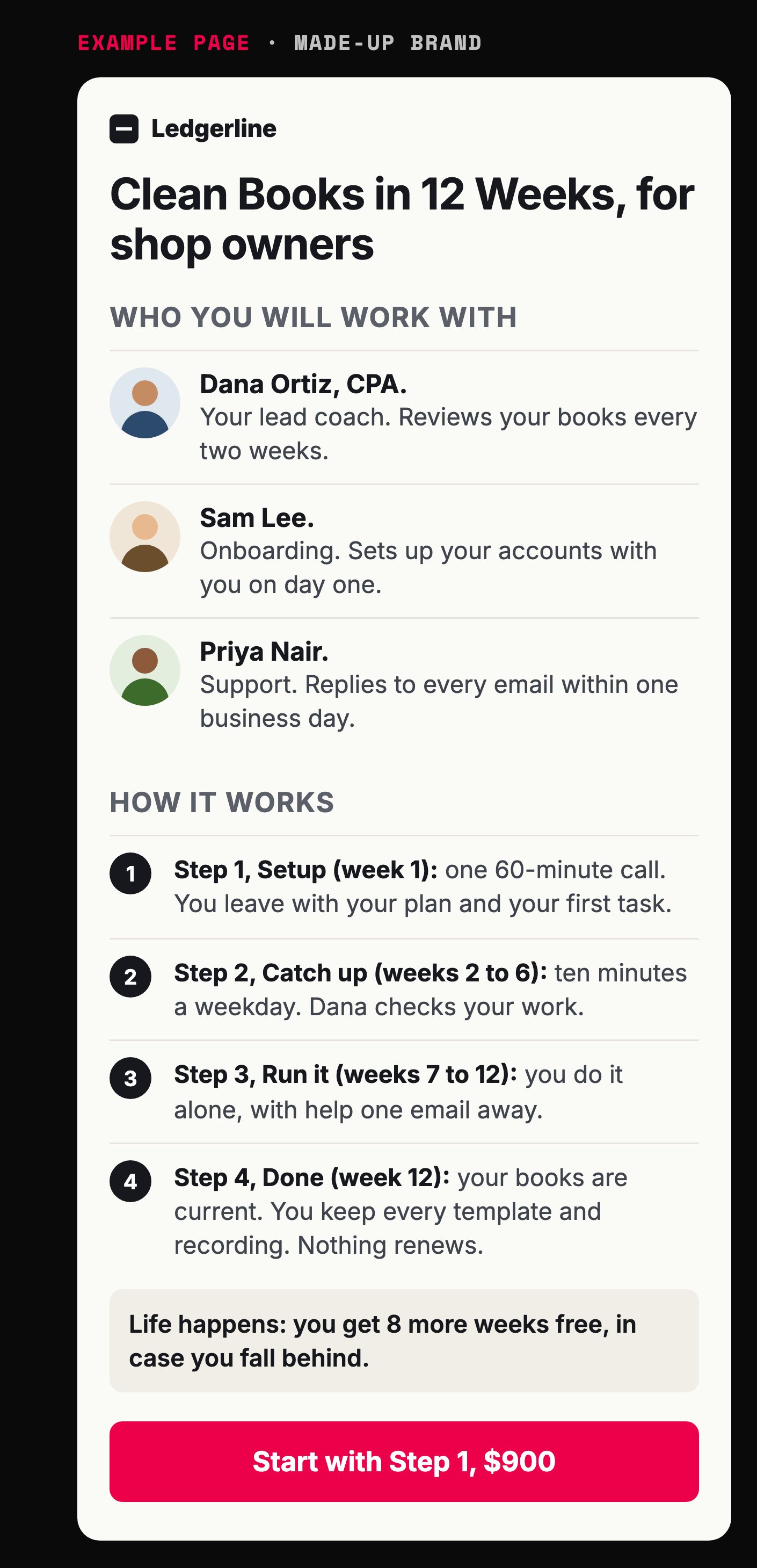
- Named people and their jobs. The buyer is never alone with one coach.
- A credential someone else checked. That outside check is what earns trust.
- The finish line, and what they keep after it.
- Slack for real life, said before they buy.
Example page built for this article with a made-up brand.
Six questions every careful buyer needs answered
- Who will I deal with? Named people, their roles, and who else vouches for them.
- What happens, and when does it end? Steps in order, a finish line, and what comes after.
- What will this cost me? The money, plus the hours of effort after paying.
- What do I give up and decide? Trade-off lines and decisions made for them.
- What if life gets in the way? Slack, recordings, extensions, support, the guarantee.
- Has anyone like me done this? A similar customer first, then their result.
The Gap Close, our method
Name the people, then show every step to the end
Start with who. A careful buyer pictures the bad version: just me and one coach on a weekly call. What if that coach is tired, busy or gone?
Answer it with a team. Name each person and their job, even a part-time assistant. Several people behind an offer work like an insurance policy.
Then show why they can be trusted. A doctor feels safe because schools, boards and reviews already checked the doctor. That outside checking is the whole point of a credential.
No credentials of your own? Borrow someone else's. Name the expert who studied your method or ingredient, and quote what they said.
See four sources of credibility for the full set.
Next, show the steps. A product is not a pile of stuff. It is a sequence of steps that gets the buyer to the result.
A pile of modules, bonuses and calls makes a careful buyer ask: what do I do first? Lay it out as Step 1, Step 2, Step 3. Give each step a name, what it does and how it helps.
Then show the end. When is the buyer done, and what happens after? A program with no finish line feels like a commitment with no exit.
For example, one business owner hired a contractor to build a sales video. The contractor only ever gave the next task, never the plan. The owner lost sleep over it and ended the deal.
A missing plan reads as winging it. Nobody hands money to someone who is winging it. Our piece on offers as expectation design shows how to set the finish line.
No license or title yet? Start on a lower rung
Each rung up is checked by more people outside your business
- Expertise What you have done, who you helped, and how you helped them.
- Credibility Who other than you says you are good: press, partners, named clients.
- Authority A title others granted and keep checking: doctor, licensed, certified.
Our summary of how outside checking builds trust
A sequence answers 'what do I do first?' A pile does not
| A pile | A sequence |
|---|---|
| 8 modules, 3 bonuses, weekly calls | Step 1: Setup. Step 2: First sale. Step 3: Repeat it. |
| Everything you get | What each step does and how it helps |
| No finish line | Done in week 12, with what you keep after |
| Buyer works out the order | The order is already decided |
Example built from the method in this article
Example: show the finish line before they buy
- Setup Week 1 One call, your plan, your first task. About two hours.
- Build Weeks 2 to 6 Ten minutes a day. One named coach checks your work.
- Run it Weeks 7 to 12 You do it alone, with help one message away.
- Done After week 12 You keep the templates and the recordings. Nothing renews.
Example built from the method in this article
Count the full cost: money, effort and what they give up
Price is only the first cost. Careful buyers also count the second one: the effort after they pay.
Buy a cheap used car, then spend every weekend fixing it. Buy a program, then spend weeks figuring it out. That double spend is what careful buyers dread.
So state the effort in minutes and days. Then cut it where you can. A 30-minute lesson can often become five minutes a day.
When someone asks how it works, they often mean something else. What do I have to give up? Answer that inside the explanation.
Write trade-off lines. For example: you keep your weekends, because each lesson takes ten minutes on a weekday. Or: you keep your current clients, because setup runs alongside your normal work.
Then make the decisions for them. Every choice you leave to the buyer is more work before they see a result, and decision fatigue wears people down.
Decide the order, the schedule and the first task. Want to offer choice? Give two or three complete plans, like a busy-week plan and a full-speed plan.
Every plan reaches the same result; only the speed changes. Our limit is three plans, because too many choices start to feel like homework.
One warning. Do not open new gaps while closing old ones. A line like 'you will also need a website' answers nothing and raises five new questions.
Money questions at the last step belong on the checkout itself. See checkout CRO for that page.
Answer the whole cost next to the price: money, minutes, trade-offs and the guarantee
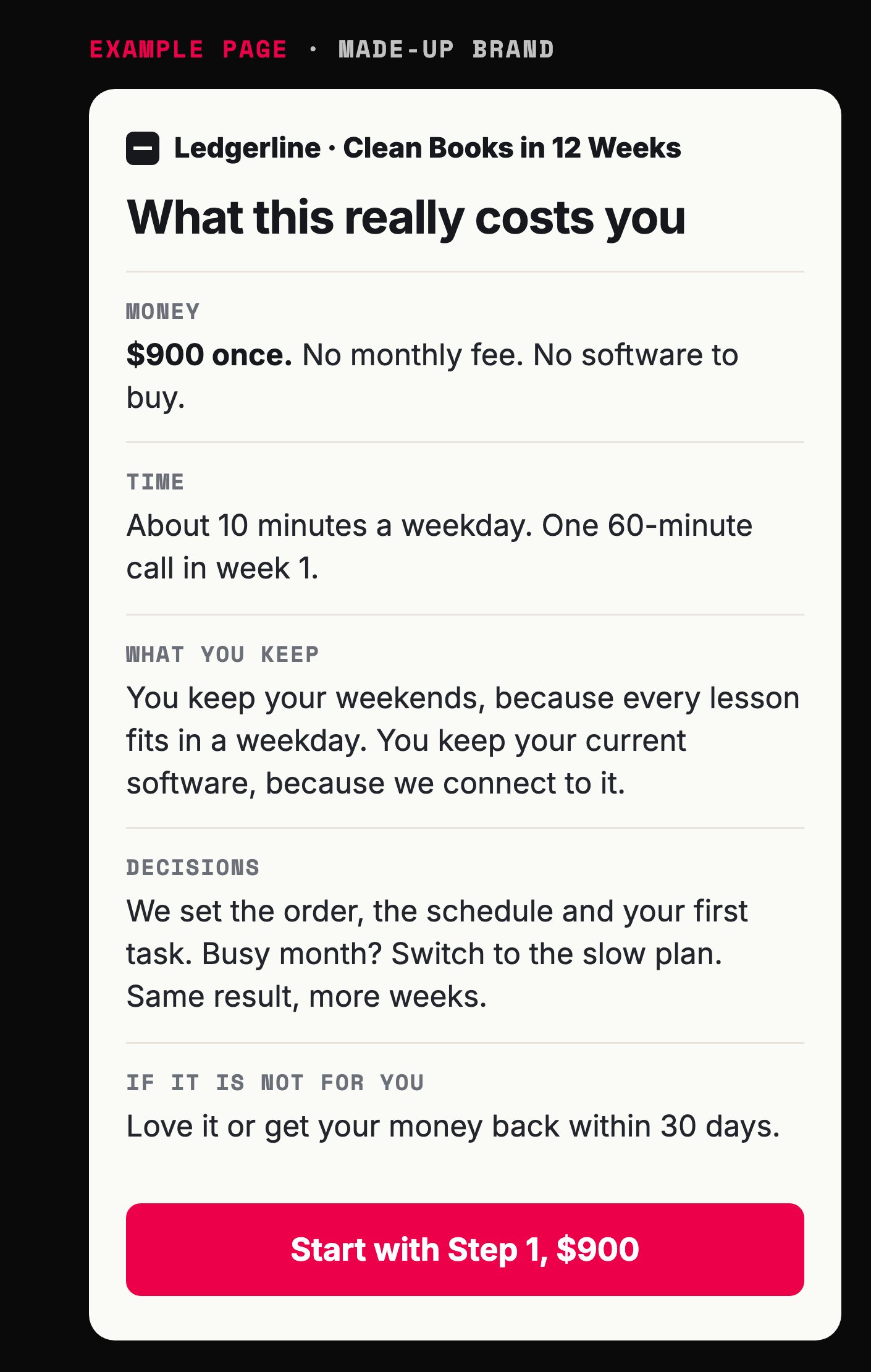
- Answers the second purchase before they picture it.
- The effort in minutes. That is the cost careful buyers fear.
- A trade-off line: you keep X, because Y.
- The guarantee worded as confidence, not as a plan for failure.
Example page built for this article with a made-up brand.
Careful buyers count the effort, not just the price
| The cost they see | The cost they fear |
|---|---|
| $900 for the course | Every evening for three months |
| A used car at a good price | Weekends spent fixing it |
| One program | Buying three more tools to make it work |
Example built from the method in this article
Write the trade-off before the buyer does
Pattern: you keep X, because Y
| What they fear giving up | Trade-off line |
|---|---|
| Weekends | You keep your weekends, because each lesson takes ten minutes on a weekday. |
| Current clients | You keep your current clients, because setup runs alongside normal work. |
| Favorite foods | You keep dessert, because the plan builds it into the week. |
| Their tools | You keep your current software, because we connect to it. |
Example built from the method in this article
Plan for real life, then show someone like them
Careful buyers know life gets in the way. Kids get sick. Work blows up.
A rigid program turns one bad week into failure.
So build slack in, and say so. For a 12-week program, add free extra weeks in case life comes up. One version: 12 weeks, plus 8 more weeks at no charge.
For example, one coaching business charged about $1,500 a month for a fixed-length program. Near the end, clients who had fallen behind went from happy to stressed and in tears. The fix was a free extension, then an offer of more paid time after it.
Soften hard rules too. Instead of 'attend 75% of calls', write this: join live when you can, every call is recorded, and you have all 12 weeks to catch up. Same rule, no threat.
Then word the guarantee as confidence, not as a plan for failure. 'Love it or get your money back' reads better than 'if it does not work, I will refund you'.
A refund gives back the money. It never gives back the time they spent. So list the support around the offer too: who answers emails, where the community lives, how fast someone replies.
Our guide to what buyers fear losing beyond the guarantee lists the other losses to cover.
Last gap: has anyone like me done this? Before you show a result, show how that customer started out like the reader. Same job, same doubts, same busy week.
Skip that and the reader thinks: nice for them, but they are not like me. When people are unsure, they copy others, which is the core of social proof. Put the money or the result last.
Use real customers, with permission. The FTC has a final rule banning fake reviews and testimonials, and a fake one wrecks the trust you just built. The proof grid shows which kinds of proof to collect.
Same rule, softer words, no threat
| Hard rule | Soft rule with room for life |
|---|---|
| Attend 75% of calls | Join live when you can. Every call is recorded, and you have all 12 weeks to catch up. |
| 12 weeks, then it ends | 12 weeks, plus 8 more weeks free in case life comes up |
| Miss a day and you fall behind | Missed a day? Pick up where you left off. |
| If it does not work, I will refund you | Love it or get your money back |
Example built from the method in this article
Show the sameness first and the result last
- Who they were Same job, same doubts, same busy week as the reader.
- What they did The steps they followed, in plain words.
- What happened The result, real and typical, shared with permission.
The Gap Close, our method
Where the Gap Close goes wrong
Watch for three mistakes. Each one has a clear sign and a clear fix.
Adding fear to create urgency. The sign: copy full of what goes wrong if they wait. The fix: remove the threat and answer the question behind it.
Scaring a careful buyer is like honking at a nervous driver. They do not speed up. They pull over.
The old trick even has a name, FUD: fear, uncertainty and doubt. Our rule is simple. We never invent doubts about a competitor, and we never manufacture fear to sell our answer.
Why does fear tempt people? Because a loss feels bigger than a gain of the same size, a pattern called loss aversion.
Using that against a careful buyer is a cheap trick. Answering their question is the honest move.
Burying the answers. The sign: every gap is answered in a wall of text nobody reads. The fix: one short answer per question, placed where that question comes up.
Opening new gaps. The sign: buyers ask more questions after the change than before it. The fix: if you mention a new step, give its time, cost and help in the same sentence.
How to lose a careful buyer in four easy steps. Step one: leave out the price and call it mystery. Step two: hide the team behind a logo.
Step three: write 'spots are filling fast' when they are not. Step four: when the buyer leaves, blame the economy.
Congratulations. You built a page for people who were going to buy anyway. Everyone else is still out there, wondering what the hell happens after they pay.
Three mistakes, three signs, three fixes
| Mistake | The sign | The fix |
|---|---|---|
| Adding fear for urgency | Copy full of what goes wrong if they wait | Remove the threat and answer the question behind it |
| Burying the answers | Every gap answered in one wall of text | One short answer per question, where it comes up |
| Opening new gaps | More questions after the change than before | Give every new step its time, cost and help |
The Gap Close, our method
Run the Gap Close on your page with AI
The prompt below runs the whole check for you. Paste it into your preferred AI, then paste your page. It reads the page as a careful first-time buyer and lists every open gap.
It never invents a fact about your business. Missing one? It asks.
This week: first, run the prompt on your main sales page. Second, write one plain answer for each gap it finds, near the buy button. Third, run it again and check that your fixes did not open new gaps.
Want a second pair of eyes? Send us the page; you are not signing up for anything.
Remember the reader at 11 at night with two tabs open? They did not need a push. They needed one answer.
Give them every answer, close to the buy button. When nothing is left to guess, there is no reason to say 'I will come back later.'
Read, list, answer, check, then do it again
- Read as a stranger A careful first-time buyer, late at night.
- List the gaps Every question the page leaves open.
- Answer near the decision One plain line per gap, close to the buy button.
- Check for new gaps Did any answer raise a fresh question?
The Gap Close, our method
Paste into your preferred AI. It asks what you sell, reads your page as a careful buyer, and returns one fix per gap.
Act as a careful first-time buyer and a plain-spoken editor. I will paste a sales page. Use only the page and my answers. Never invent a fact, number, name or testimonial; if one is missing, ask me.

Ask one at a time, with the example, and wait:
1. What I sell and the price. (Example: a 12-week bookkeeping course, $900)
2. Who buys it and what is at stake for them. (Example: shop owners whose staff depend on clean books)
3. The page text. (Paste it)

Read the page as a buyer who weighs what could go wrong before what they could gain. Check six gaps:
- Who will I deal with? Named people, their roles, and who else vouches for them.
- What happens, and when does it end? Named steps in order, a visible finish, what happens after.
- What will it cost me? Money, any cost before or after the sale, and the hours of effort.
- What do I give up, and what must I decide? Trade-offs written as 'you keep X, because Y'. Decisions made for me, or two or three complete plans.
- What if life gets in the way? Slack, recordings, extensions, the guarantee, who helps.
- Has anyone like me done this? A customer shown as similar to me before their result.

Rules:
- Quote the exact line from the page, or write MISSING.
- Write each fix as one plain sentence I could paste near the buy button. Put [FILL IN] where you need a fact from me.
- Flag any fix that raises a new question.
- No fake scarcity, no invented fear, no claims about the reader's gender, age or other personal traits, no made-up testimonials.

Output exactly:
GAP | WHAT THE PAGE SAYS | FIX (one row per gap)
NEW QUESTIONS MY FIXES COULD RAISE:
QUESTIONS FOR ME:
NEXT THREE ACTIONS:

Filip Kovacevic is the founder of Anar Agency in Phoenix. He spent five years running SEO, Meta ads, email, and content for medical practices across the United States, and now does the same work for healthcare, home-service, legal, and professional-service businesses, alongside AI implementation. More from Filip →
Talk it through in 15 minutes
Bring one question from this article. We will tell you what we would do, whether or not you hire us.
Book a 15-Min Chat →