Setting Customer Expectations: Map Every Objection to Your Offer

Setting customer expectations means deciding what your buyer predicts will happen before they pay. Every "I can't" is that prediction. Find its cause: a bad past, a missing piece, today's situation, a rule, or the ending they picture.
Answer each cause with one part of your offer. Then promise a specific result you can beat.
Setting customer expectations: every "I can't" is a forecast
From 1945 to 1954, nobody ran a mile faster than 4:01.4.
Then on May 6, 1954, Roger Bannister ran 3:59.4. Forty-six days later, John Landy ran 3:57.9.
Just over 2,000 runners have broken four minutes since then.
The runners had the same legs and the same tracks. Only what they expected had changed.
Setting customer expectations works the same way. Your buyers have their own 4:01.4. It is a limit they think they can't pass.
It sounds like "I don't have time." Or "I can't afford it." Or "I tried this before."
Each of those is a forecast. The buyer is telling you what they expect will happen if they say yes.
Your offer either changes that forecast or loses the sale. That is the whole job of an offer.
We use a one-page tool for this. The Expectation Map is a list of every "I can't" your buyer says, the cause under each one, and the part of your offer that answers it.
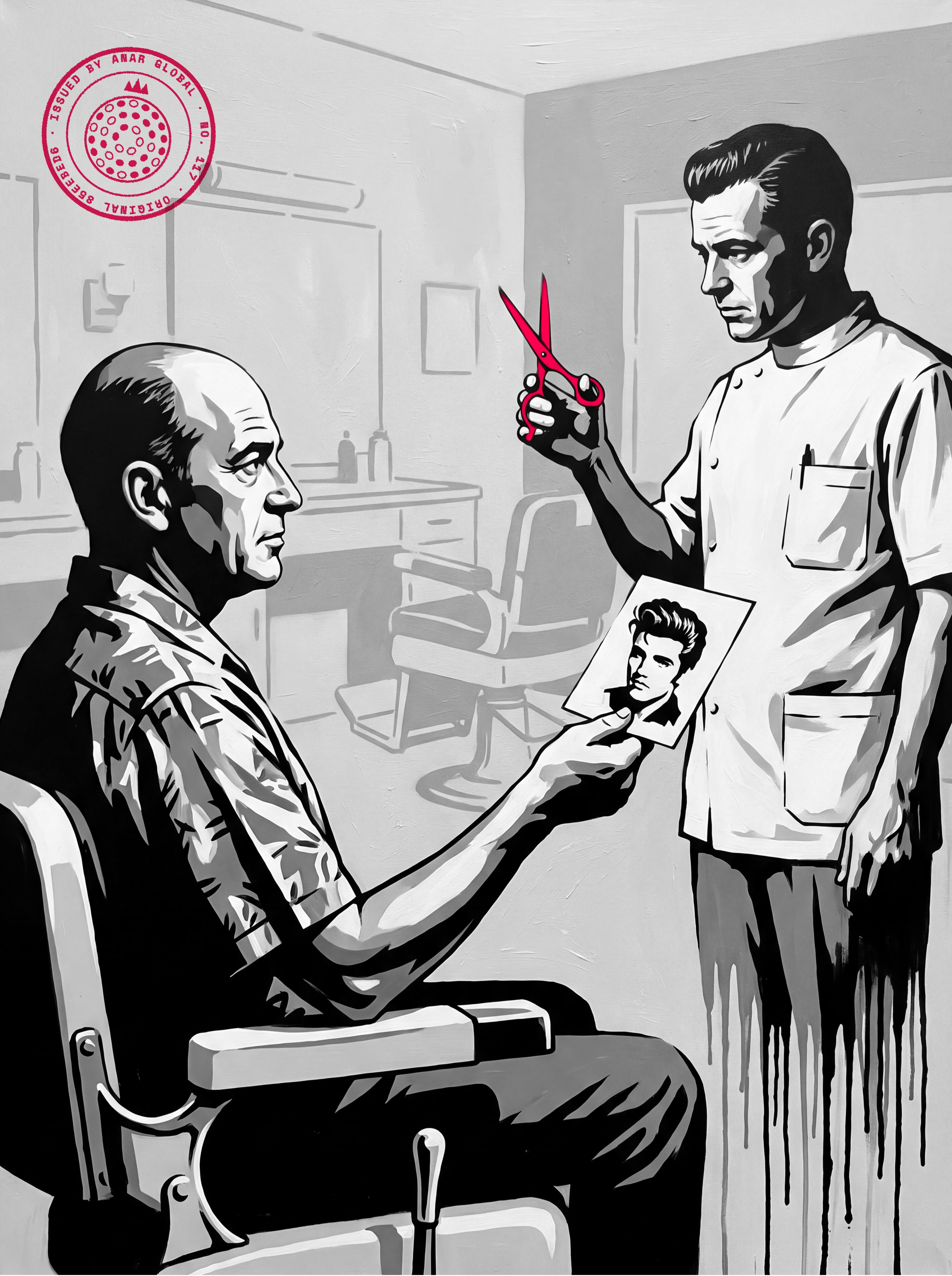
Nine years at 4:01.4, then two men under four minutes in 46 days
- 4:01.4 17 July 1945 A Swedish runner sets the mile record. It stands for nearly nine years.
- 3:59.4 6 May 1954 Roger Bannister runs the first mile under four minutes.
- 3:57.9 21 June 1954 John Landy runs faster, 46 days later.
- Just over 2,000 Since then Athletes who have broken four minutes.
Source: Wikipedia, Mile run world record progression; Wikipedia, Four-minute mile (World Athletics statistics).
Every "I can't" is a forecast about what happens after yes
| What the buyer says | What they are forecasting |
|---|---|
| "I don't have time." | This will eat my evenings and I will quit. |
| "I can't afford it." | I will pay and never earn it back. |
| "I tried this before." | It will go wrong the same way. |
| "I'm not ready yet." | I need something first, or it will fail. |
| "Now is a bad time." | What is going on today will ruin it. |
Our examples of common buyer lines.
Every "I can't" has one of five causes
A limit is what the buyer says. The cause is why they believe it. Fix the cause and the limit goes away.
If you argue with the limit, the buyer digs in. Ever told a buyer "it's not that expensive"? How did that go?
There are five causes. Buyers say them out loud, so you can learn to hear them.
The past. "It went wrong before, so it will go wrong again." A bad agency, a bad diet, a course they never finished.
A missing piece. "I need something before I can start." Money, skills, time or the right idea.
Right now. "Today's situation decides what happens next." A slow month, a truck to save for, a busy season.
A rule. "I have to do this other thing first." A big brand before coaching, or a new website before ads.
The ending. "I already know how this ends." The buyer pictures the result and acts on that picture today.
The ending is the strongest of the five. It is also the one your promise controls.
Listen to the words. "Last time" points to the past. "I need" points to a missing piece.
"With everything going on" points to right now. "First I have to" points to a rule. "It won't work for me" points to the ending.
This is a map of expectations, not of buyer types. For the beliefs that stop a buyer cold, read worthless, helpless and hopeless.
Hear the cause in the buyer's own words
| Cause | What the buyer believes | Words to listen for | Example |
|---|---|---|---|
| The past | It went wrong before, so it will again | "Last time", "I tried" | "Our last agency was a waste." |
| A missing piece | I need something before I can start | "I need", "I don't have" | "I need money to make money." |
| Right now | Today's situation decides what happens next | "With everything going on", "this month" | "I'm saving for a truck." |
| A rule | This other step must come first | "First I have to", "once I have" | "I need a new website first." |
| The ending | I already know how this ends | "It won't work for me" | "I'll pay and get nothing." |
The Expectation Map, as set out in this guide. Highlighted: the strongest cause.
The Expectation Map treats every "I can't" as a forecast with one of five causes: the past, a missing piece, right now, a rule, or the ending. Collect the buyer's exact words, tag each line with its cause, and answer the cause with one offer part: proof, a removed requirement, a pays-for-itself case, a shortcut, or a specific promise. The promise names the effort, a time range from past jobs, the full cost and who it will not work for.
Show typical results, never invent one, and deliver one thing you did not promise.
Build the Expectation Map: one offer part for each cause
An offer works by changing what the buyer expects. They pay because your page made them expect a better result than they did before.
So build the page from the forecasts. Five steps.
Step 1: collect the "I can't" lines. Pull them from sales calls, emails, refund requests and your competitors' reviews. Keep the buyer's exact words.
Step 2: tag each line with one cause. Use the listening words from the five causes. A line that fits two causes gets written twice.
Step 3: give each cause one offer part. Proof answers the past. A removed requirement answers a missing piece.
Showing how the offer pays for itself answers right now. A shortcut answers a rule. A specific promise answers the ending.
Step 4: put each answer where the doubt shows up. Proof sits next to the claim it backs. The removed requirement sits next to the price.
Step 5: read the page as the buyer. Go line by line with each "I can't" in your head. A doubt with no answer is a sale you lose without ever hearing why.
For example, picture an agency that sells patient ads to chiropractors. Its map has five rows, one per cause.
Plenty of sales pages answer two causes and skip three. A page like that wins or loses by luck.
Our six-check offer review is a second way to find the same gaps.
Five steps from a pile of objections to a page that answers them
- 1. Collect Every "I can't" from calls, emails, refunds and competitors' reviews. Exact words.
- 2. Tag One cause per line. Two causes? Write it twice.
- 3. Assign One offer part per cause: proof, removed requirement, pays-for-itself case, shortcut, promise.
- 4. Place Each answer where that doubt shows up on the page.
- 5. Read as the buyer Any doubt with no answer is a lost sale.
The Expectation Map, as set out in this guide.
Example: one agency's Expectation Map, one row per cause
For a made-up agency that sells patient ads to chiropractors
| Cause | What the chiropractor says | Offer part | Line on the page |
|---|---|---|---|
| The past | "Another agency, another pitch." | Proof | Case studies from clinics like yours, typical results labeled. |
| A missing piece | "I'd have to learn ads." | Removed requirement | "We run the ads. You answer the phone." |
| Right now | "It's my slow season." | Pays-for-itself case | How many new patients cover the fee, and what is typical. |
| A rule | "I need a better website first." | Shortcut | "We build the one page the ads need." |
| The ending | "I'll pay for three months and get nothing." | Specific promise | What you see by week 4 and week 12, and what we do if you don't. |
Example built for this guide. Made-up business.
Five causes, five answers, each where that doubt shows up
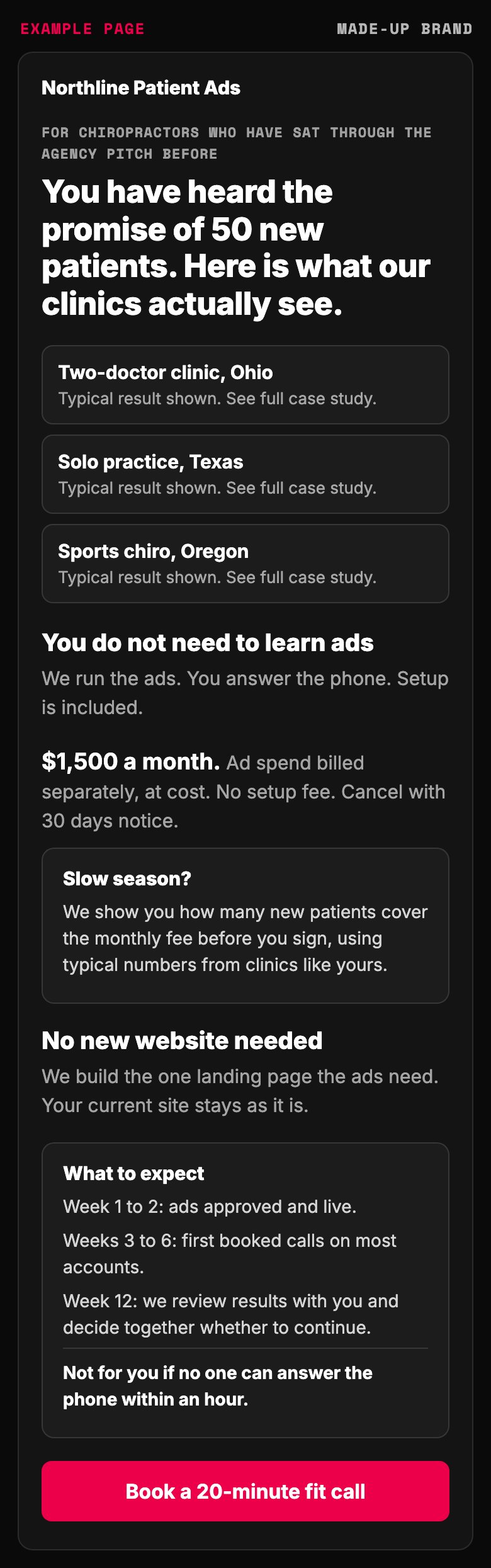
- The past: the headline names the old letdown before the buyer does.
- Proof from clinics like theirs, with typical results labeled.
- A missing piece removed: no need to learn ads.
- Right now: the slow season gets math, not a discount.
- The ending: a time range, a review date and a clear limit.
Example page built for this article with a made-up brand
Answer the past with proof that this time is different
A buyer with a bad history reads your page like a lawyer. They are looking for the clause that proves it will go wrong again.
That habit is confirmation bias: people search for facts that fit what they already believe. A bad past keeps itself alive this way.
The buyer expects a letdown, so they hold back. Holding back gets a weak result. The weak result proves them right.
How do you break the loop? Name the past before they do.
Say our chiropractor has sat through five agency pitches. Your ad says "We're not like other agencies." He has heard that line five times too.
Name the exact history instead. "You've had the call where someone promised 50 new patients and sent you price shoppers." Then show what is different, with proof from clinics like his.
On a sales call, three questions do the same job. When did it happen? What was different back then?
The third question is the big one. Why would it happen again now, with a different team and a different plan?
A bad past is a forecast built on old facts. Give them new facts.
A bad past keeps itself alive until new facts break the loop
- Forecast "This will go wrong again."
- Behavior They hold back and half-try.
- Result A weak result.
- Proof "I told you so." The forecast gets stronger.
Our model, built on confirmation bias (Wikipedia).
Naming the exact letdown beats saying you are different
| Weak answer | Strong answer |
|---|---|
| "We're not like other agencies." | "You've had the call that promised 50 patients and sent price shoppers." |
| Ignores what happened | Names what happened first |
| Best result in the headline | Typical results from clinics like his |
| Asks for trust | Shows what is different now |
Example lines written for this guide.
Remove missing pieces and rules instead of arguing with them
A missing piece sounds like a fact. "I need money to make money." "I need experience first."
Ask the obvious question. If you needed experience to get experience, how did anyone ever start?
Then let the offer remove the piece. Templates remove the need for skill. Setup included removes the need for time.
A done-for-you first step removes the need to learn the whole thing. A small paid first step can shrink the money worry too.
Rules look different but work the same way. A rule is a step the buyer believes must come first.
A coach thinks she needs a big brand before she can sell coaching. An owner thinks he needs a new website before he can run ads.
You have two answers. Show that the rule is only a habit, or hand them the shortcut that meets it.
So if you sell a ready-made shortcut to "the thing you need first," it is easy to explain. One line answers the rule and sells the product.
One exception. Rules that protect people or follow the law are real. Keep them, and say how you meet them.
Most "first I need" lines are habits the offer can remove
| What the buyer says | Real rule or habit? | What the offer does |
|---|---|---|
| "I need money to make money." | Habit | A small paid first step |
| "I need experience first." | Habit | Templates and a guided first project |
| "I need a new website before ads." | Habit | Build the one page the ads need |
| "I need a big brand before coaching." | Habit | A ready-made authority piece |
| "I need a license for this." | Real rule | Keep it. Say how you meet it. |
The Expectation Map, as set out in this guide.
What do you say when a buyer says the timing is bad?
Show how the offer helps pay for the thing they are saving for. Then prove it with typical numbers.
Bad timing is the right-now cause. The buyer believes today's situation decides tomorrow.
Say a contractor tells you, "I can't spend this month, I'm saving for a new truck." The lazy answer is a discount.
A discount says the price was the problem. It wasn't. The truck was.
The better answer connects the offer to the truck. Show how many extra jobs it takes to cover the fee, and how many your typical client gets.
Typical is the key word. The FTC says that if the results you show are not what people will generally achieve, you must clearly state what they can generally expect.
Never invent the math. If you don't have typical numbers yet, say what you know and what you don't.
A discount answers the price; the real problem was the truck
| Discount answer | Pays-for-itself answer |
|---|---|
| "Here's 20 percent off." | "Here's how many jobs cover the fee." |
| Says the price was the problem | Says the truck is the goal |
| Teaches them to wait for a deal | Shows the offer moving them toward it |
| No proof needed | Typical numbers, clearly labeled |
Example lines written for this guide.
Answer the ending with a specific promise you can beat
The ending is the story the buyer pictures before they pay. Your promise tells them that story.
If you leave it blank, they make up the story themselves. People tend to expect better outcomes than are likely, so their story gets a happy ending you never agreed to.
Why does that matter after the sale? Because people judge a purchase by what they expected from it.
Researchers call it expectation confirmation theory. Buyers measure the result against the picture they had before they paid.
For example, picture two clients who each get 12 leads in month one. One was told to expect 10. The other was told to expect 40.
Same work. Same result.
One refers a friend. The other asks for a refund.
So the promise needs four parts, and each one is specific.
Effort. Say what the buyer does each week. Effort they expect can even add value, since people paid 63 percent more for furniture they built themselves.
Time. Give a range from your past jobs, not your hopes. People are bad at guessing time on their own work.
In one study, students guessed their thesis would take 33.9 days. It took 55.5, longer than their worst-case guess.
Full cost. List everything, including setup, ad spend and renewals. A cost that shows up later is a broken promise, whatever the contract says.
Limits. Say who it will not work for. "This won't work if you can't answer the phone within an hour."
Then deliver one thing you never promised. When the result beats the promise, your happy client helps sell the next one.
Example: the same 12 leads, one happy client and one refund
Leads delivered minus leads promised, for two clients who each got 12 leads in month one
- Told to expect 10 2
- Told to expect 40 -28
Worked example: 12 minus each promise. Made-up clients; the math is ours.
Students took longer than even their worst-case guess
Days to finish a senior thesis, average of 37 students
- Best-case guess 27.4
- Usual guess 33.9
- Worst-case guess 48.6
- Actual time 55.5
Source: 1994 study summarized in Wikipedia, Planning fallacy.
A promise you can beat names four things
- Effort What the buyer does each week.
- Time A range from your past jobs, not your hopes.
- Full cost Setup, ad spend, renewals. All of it.
- Limits Who it will not work for.
The Expectation Map, as set out in this guide.
Where an Expectation Map goes wrong, and how to fix it
Most failures come from three habits. Before we fix them, here is the wrong way, as a joke.
How to set the wrong expectations in four easy steps:
1. Promise your best result ever. Call it typical.
2. Write "results vary" and let the buyer fill in the rest.
3. Answer "I can't afford it" with a discount.
4. Mention the renewal in month two. Act surprised when they're mad as hell.
Stuck point one: you answered the objection and they still stalled. You argued with the limit. Tag the cause and answer that instead.
Stuck point two: refunds from clients who got decent results. The promise was vague or too big. Rewrite it with the four parts and your typical numbers.
"Results vary" is not a promise. It is a shrug that only sounds like legal language. The FTC says adding "Individual results may vary" does not stop buyers from reading a result as typical.
Time frames and results are claims, and claims must be truthful and backed up. Read the claims and refund rules that get sellers in trouble.
Stuck point three: your own forecast is writing the offer. Sellers have expectations too. A seller who expects to fail softens the headline, drops the guarantee and prices low.
Then the forecast comes true. That is a self-fulfilling prophecy.
The fix starts with one question. Would you do the same quality of work at $100? At $10,000?
If the answer is yes both times, the price is not what makes your work good. That means a low price comes from fear, not from the quality of your work.
So raise prices on new clients only. Charge the next new client 25 percent more than today, and the one after 50 percent more.
Current clients keep their price until they leave. Set the number itself with how to price from your buyer's income.
Three stuck points, and the fix for each
| Symptom | Cause | Fix |
|---|---|---|
| You answered the objection; they still stalled | You argued with the limit, not its cause | Tag the cause and answer that |
| Refunds from clients with decent results | The promise was vague or too big | Four-part promise, typical numbers |
| The offer feels weak and you can't say why | Your own forecast of failure | The price question, then raise prices on new clients |
The Expectation Map, as set out in this guide.
Example: raise the price on new clients only
A $2,000 a month service; current clients stay at $2,000
- Current clients 2000
- Next new client (+25%) 2500
- The one after (+50%) 3000
Worked example: $2,000 times 1.25 and 1.5. Made-up price; the math is ours.
Same price. Only one card tells the buyer what will happen
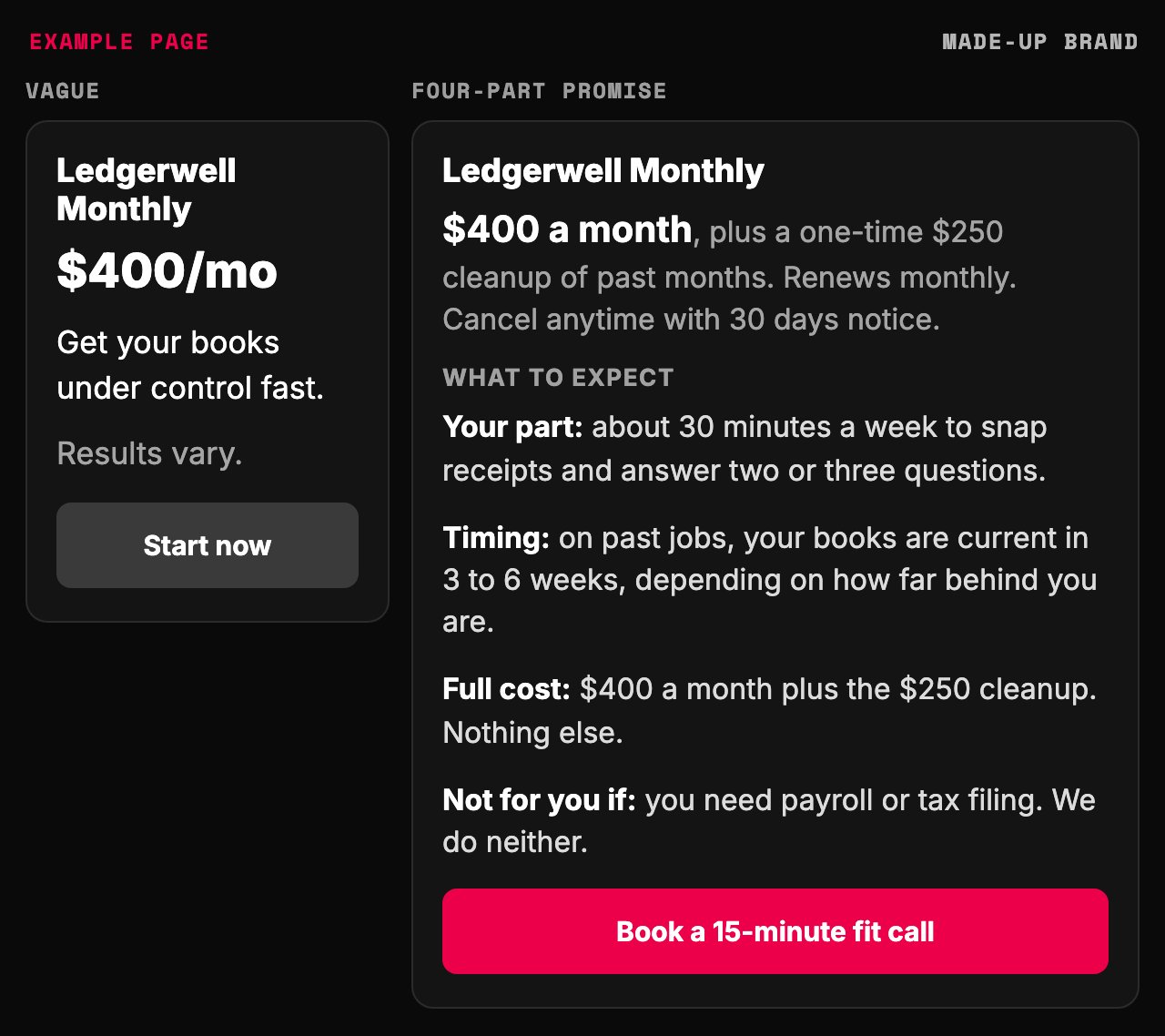
- This sets no expectation. The buyer fills the gap with hope.
- Effort: what the buyer does each week.
- Time: a range taken from past jobs, not a hopeful date.
- Full cost: every charge, including the one-time cleanup and the renewal.
- Limits: who it will not work for, said up front.
Example page built for this article with a made-up brand
Build your Expectation Map with AI: the copy-paste prompt
Paste the prompt below into your preferred AI. It asks for your offer, your buyers' real objections and your proof, one at a time.
Then it tags each objection with a cause, picks an offer part and writes the line for your page. It never invents a result.
It also lists every gap where you need proof you don't have yet. That list is your to-do list.
Want a second pair of eyes? Send us your map.
Paste into your preferred AI. It asks about your offer, your buyers' objections and your proof, then maps each one to a cause and an answer.
Act as an offer strategist. Build an Expectation Map for one offer.

Ask me one at a time, with the example:
1. What do you sell, to whom, and at what price? (Example: patient ads for chiropractors, $1,500 a month)
2. Paste every "I can't", objection or reason for stalling you hear, in the buyer's own words. (Example: "I tried an agency before and it was a waste.")
3. What proof do you have? Real results only, and say which ones are typical. (Example: four client case studies, typical result stated in each)
4. For the promise: what does the buyer do each week, how long did the first result take on your past jobs, what is the full cost including renewals, and who does it not work for?

Rules:
- Tag each line with one cause. Past: it went wrong before. Missing piece: I need something first. Right now: today's situation blocks it. Rule: a step that must come first. Ending: I already know how this ends. A line that fits two causes is listed twice.
- Answer the cause, never the limit itself.
- Past: proof from buyers like them, typical results labeled. Name the old letdown, then show what is different.
- Missing piece: remove the requirement (templates, setup included, a done-for-you first step).
- Right now: show how the offer helps pay for what they are saving for, using only my numbers. Never answer with a discount alone.
- Rule: show it is only a habit, or offer the shortcut. Never tell anyone to skip a legal or safety rule.
- Ending: a promise with four parts: effort, a time range from my past jobs, full cost, and who it is not for.
- Never invent a result, number or testimonial. If I did not give it, ask me, or write [NEEDS PROOF].
- "Results vary" is never the promise. No fake deadlines or countdowns.

Show your reasoning, then answer:
Map: buyer line | cause | offer part | the line for my page | where it goes on the page
Promise: four sentences (effort, time range, full cost, limits)
One thing to deliver that I do not promise
Gaps: every line with no answer yet
Next three actions: 1. 2. 3.
What to do this week
Monday: pull 20 "I can't" lines from your calls, emails and refund requests.
Midweek: run the prompt. Fix the row with no answer first.
Friday: rewrite your promise with effort, a time range, full cost and limits. Put it next to the price.
Next, check what buyers fear losing beyond the guarantee in risk reversal examples, and how to handle objections in your copy.
Bannister did not get new legs. He got a new forecast, and so did 2,000 runners after him. Your offer is where your buyer gets a new forecast.

Filip Kovacevic is the founder of Anar Agency in Phoenix. He spent five years running SEO, Meta ads, email, and content for medical practices across the United States, and now does the same work for healthcare, home-service, legal, and professional-service businesses, alongside AI implementation. More from Filip →
Talk it through in 15 minutes
Bring one question from this article. We will tell you what we would do, whether or not you hire us.
Book a 15-Min Chat →