Quick Win Offers: Replace the Free Audit With a Paid First Step

A Quick Win replaces the free audit with a fifteen-minute call that ends in one working fix the owner can use within a day. That result earns the next step: a paid plan with a fixed price. Then comes 90 days of paid work, then ongoing work.
Busy owners say yes because they see a result before they risk money.
The free audit alternative busy owners say yes to
An agency spends six hours on a free audit. Thirty slides, red arrows, a score out of 100. The owner never opens the file.
Why would they? A stranger asked for an hour, the logins, and another hour to hear what is wrong with their business.
The good owners have sat through that a dozen times. They know the audit is a sales document. So they stopped saying yes.
In Demand-Side Sales 101, Bob Moesta interviews a founder who fired his bank. If a slide deck is ready before anyone asks about his business, he gets up and leaves.
The free audit has the same flaw. The pitch arrives before the questions do.
The free audit alternative we use is the Quick Win. Fifteen minutes, one working fix, then a paid plan with a fixed price.
Our take: most free audits are not generous. They are a pitch dressed up as a report.
An audit leaves a document; a Quick Win leaves something that works
| Free audit | Quick Win |
|---|---|
| Asks for an hour, then another hour | Asks for fifteen minutes |
| Needs logins before trust exists | Works with what they show you on the call |
| Ends with a list of problems | Ends with one fix in place by tomorrow |
| Next step: a proposal | Next step: a paid roadmap with a fixed price |
| Built per prospect, six hours each | Built once per trade |
Our comparison. The Quick Win as set out in this guide.
What is a quick win offer? One working fix in fifteen minutes
A quick win offer is a short first call that ends with one fix the prospect can use within a day. Not a list of findings. One fix.
The Quick Win is our name for the whole ladder that starts with that call. It flips the usual order of selling.
The usual order: prove you are smart, ask for money, then deliver. Our order: deliver something small, ask for money, then deliver something bigger.
What counts as one fix? A text that goes out when a call is missed. A note to customers who have not been back in a year.
Or a booking page with the broken step removed. Small, real, and working by tomorrow.
Why does the order matter? Psychologists call it the foot-in-the-door effect. A person who says yes to something small is more likely to say yes to something bigger later.
Donald Miller frames it as dating in Building a StoryBrand. A low-risk first step is asking for a date. A contract is a marriage proposal.
Most agencies propose on the first call. Then they wonder why nobody calls back.

Deliver a small result before you ask for any money
| The usual order | The Quick Win order |
|---|---|
| 1. Prove you are smart | 1. Deliver one small result |
| 2. Ask for money | 2. Ask for money for the plan |
| 3. Deliver a result | 3. Deliver the bigger result |
Our method.
Letting people get value first lifted results in two published cases
| The case | What changed | What happened | How sure |
|---|---|---|---|
| Hello Bar, a website message tool | Users built their first message before signing up | Activation rose 52.11 percent | Reported in Hacking Growth (Ellis and Brown) |
| StoryBrand, a marketing workshop company | Gave away a free PDF with a workshop ad at the back | Revenue doubled in twelve months with no ad spend | The author's own report in Building a StoryBrand |
Sources: Hacking Growth; Building a StoryBrand. Their numbers, not ours, and not verified by us.
After a Quick Win, the owner holds a working fix and one honest line about the next job
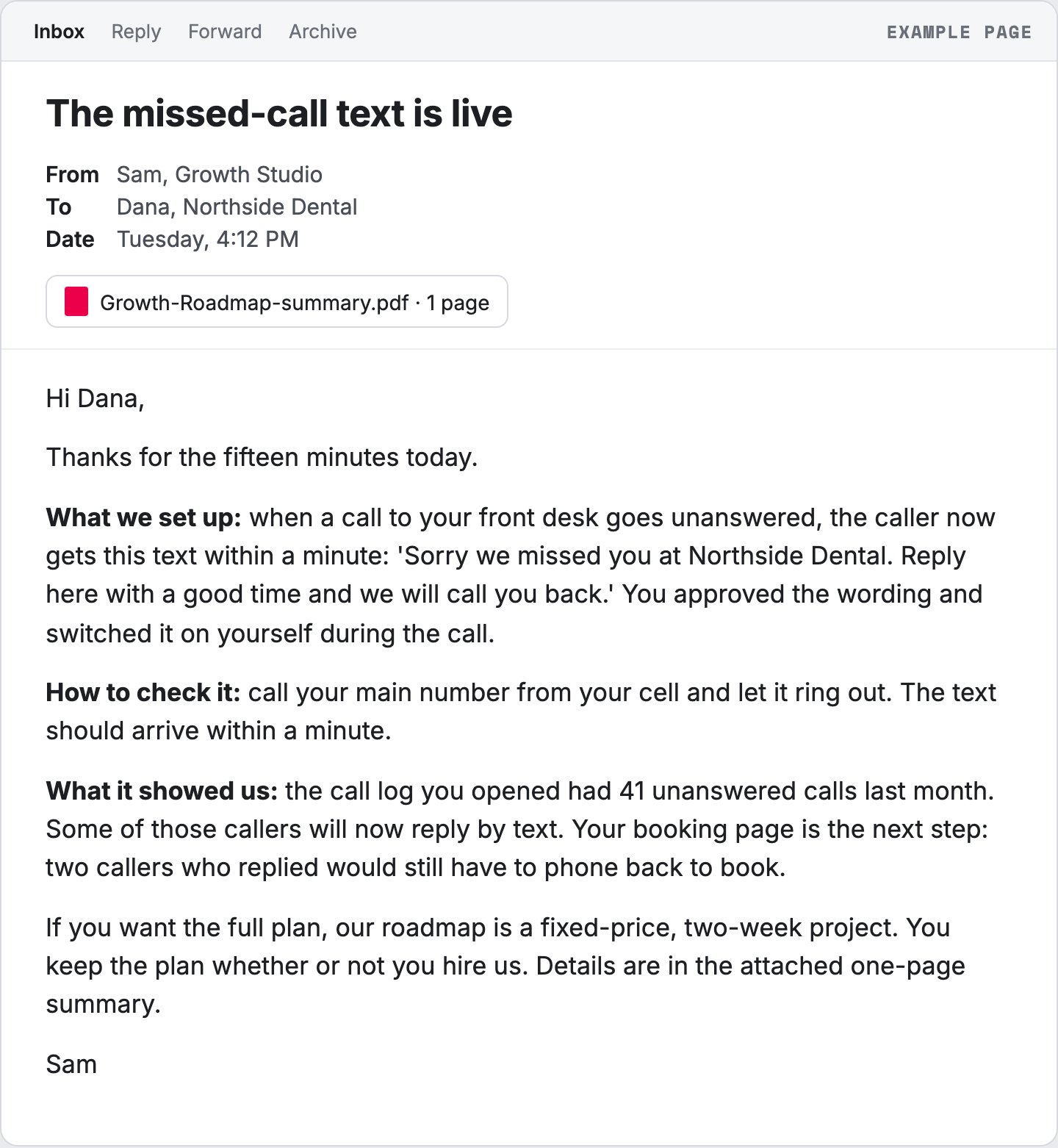
- The subject names a result, not a meeting.
- The owner said yes and pressed the button. Nothing was sent from their account without it.
- The owner can test the fix in one minute.
- The bigger job shows up without a pitch.
- The roadmap is a product they keep, not a proposal.
Example page built for this article with a made-up brand. Structure follows the Quick Win steps and seven tests in the article. All names and the 41 are invented for the example.
The Quick Win is a four-rung ladder that replaces the free audit: a 15-minute call that ends in one fix usable within a day; a fixed-price roadmap that sells the planning; a 90-day sprint paid up front; then ongoing work. A real Quick Win passes seven tests: a result, usable within a day, low risk, built once per trade, built on an asset the prospect already owns, framed as money to collect, and one fix rather than the whole plan. Check opt-out and consent rules before touching a customer list, and fee-sharing rules before proposing a share of results.
Why a small first step works: it lowers the risk of saying yes
A small first step works because it lowers the risk of saying yes. The price is often not the problem. The fear is.
In Competing Against Luck, Clayton Christensen and his co-authors describe four forces in every switch. Two push a buyer toward the new thing: the pain of the problem and the pull of a better answer.
Two hold them back: the habit of how things work now, and worry about the new choice. The push and pull have to beat both brakes together.
How strong are the brakes? People feel a loss about twice as much as an equal gain. A bad hire costs an owner money and pride.
The book has a clean example. Health clubs learned that annual contracts scared many people away from joining at all.
Our reading: an agency retainer is that annual gym contract. A free audit does not fix it. It adds an hour of homework and a lecture.
A Quick Win goes after the fear directly. The owner sees a result before they risk a dollar.
So what is left to be afraid of? Not much.
A first step has to beat habit and worry, not just look good
- Worry about the new What if this agency is like the last one?
- Pull of the new A fix that works by tomorrow.
- Habit of the present We have always handled leads this way.
- Push of the problem Calls go unanswered and money walks away.
Four forces from Competing Against Luck (Christensen, Hall, Dillon, Duncan). The agency examples are ours.
A loss weighs about twice as much as an equal gain
Relative weight people give to losing versus gaining the same amount (gain = 1)
- Gaining an amount 1
- Losing the same amount 2
Kahneman and Tversky, as cited in Competing Against Luck. Rounded to the book's 'twice as powerful'.
The four rungs of the Quick Win ladder
The Quick Win ladder has four rungs. Each one is earned by the one below it. Nobody is asked to trust a stranger with a year.
Rung 1: the Quick Win. Fifteen minutes and one fix they can use within a day. Free, or a small fee.
Rung 2: the paid roadmap. A fixed-scope, fixed-price diagnosis and plan. It is the thinking most agencies give away in the first unpaid month.
Rung 3: the 90-day sprint. The work the roadmap calls for, paid before it starts. A fixed price on rung two makes paying up front feel normal on rung three.
Rung 4: ongoing work. A retainer, or a share of results where the client's field allows it.
The roadmap is the rung that changes the money. In business terms it is a proof of concept: a small paid project that shows whether the big one is worth doing. Both sides find out cheaply.
Price the roadmap like real work. A price that looks too low tells the buyer the work is weak.
The Lean Analytics authors tell the story of ClearFit, a hiring software company. At $99 a month, small business buyers doubted it.
At $350 per job, sales tripled and revenue grew tenfold. Higher price. Less doubt.
ClearFit also switched to a per-job price, which buyers already understood. Both changes made the offer easy to judge. Our full method for setting the number is in how to price from your buyer's income.
Each rung is earned by the one below it
- 1. The Quick Win 15 minutes, one fix usable within a day. Free or a small fee.
- 2. The paid roadmap Fixed scope, fixed price. The planning agencies usually give away.
- 3. The 90-day sprint The roadmap's work, paid before it starts.
- 4. Ongoing work A retainer, or a share of results where the field allows it.
The Quick Win, as set out in this guide.
The owner risks a little more only after seeing a little more
| Rung | What they pay | What they get | What it proves |
|---|---|---|---|
| 1. Quick Win | Nothing or a small fee | One working fix | You can deliver |
| 2. Roadmap | A fixed price | A plan they keep | You understand their business |
| 3. Sprint | 90 days, paid up front | The plan, built | The plan pays |
| 4. Ongoing | Monthly | Growth and upkeep | It keeps paying |
Our method.
The paid roadmap is sold as a product with a fixed scope, a date and a file the owner keeps
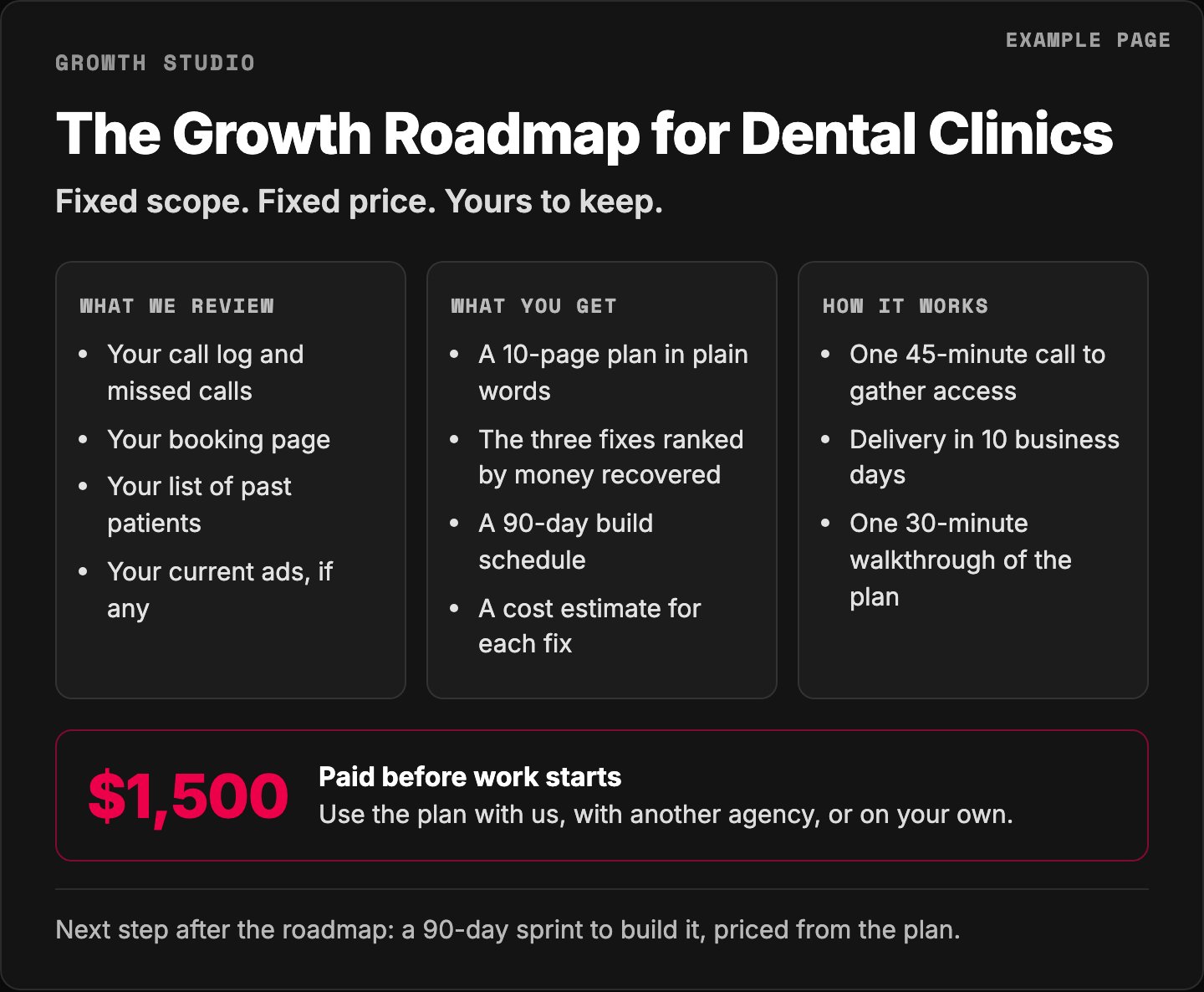
- The scope and price are set before the call, not after it.
- A finished file, not a promise of a proposal.
- A date makes it a product.
- The owner can take it elsewhere. That honesty is the point.
- Rung three is named, but not sold here.
Example page built for this article with a made-up brand. Rung two as defined in the article. The price and timings are invented for the example, not a recommended price.
How to pick the fix: seven tests
A real Quick Win passes seven tests. Fail one and you have a discovery call with a nicer name.
The first three are about speed. It is a result instead of a talk, it works within a day, and little can go wrong.
The next two are about cost. You build it once per trade, not once per prospect. And it runs on something the prospect already owns.
The last two are about honesty. Frame it as money they can collect, not a list of mistakes. Give one fix fully, never the whole plan.
The best Quick Wins recover money from something sitting idle. Old customer lists, missed calls, bookings started and never finished.
That money is real. Harvard Business Review research sent a test lead to 2,241 US companies. Only 37 percent answered within an hour, and 23 percent never answered at all.
So ask an owner how many calls went unanswered last month. If they cannot say, you found your fix. Our playbook for that one is speed to lead.
Why does building once matter? Fifteen minutes is only possible when the fix is ready before the call. Custom work is lovely, and it takes all afternoon.
Fail any one test and it is a discovery call with a nicer name
| Test | What passing looks like |
|---|---|
| A result, not a talk | They leave with something working |
| Usable within a day | Live by tomorrow |
| Low risk | Little can break if it goes wrong |
| Built once per trade | Ready before the call, reused for every prospect |
| Uses what they own | An idle list, missed calls, unfinished bookings |
| Framed as money to collect | Revenue they earned and have not collected |
| One fix, not the whole plan | The bigger job shows itself without a pitch |
Our method.
Almost a quarter of companies never answered a new lead at all
How fast 2,241 US companies answered a test lead sent through their website
- Within an hour 37
- 1 to 24 hours 16
- More than 24 hours 24
- Never answered 23
Source: Harvard Business Review, The Short Life of Online Sales Leads (2011).
Should the first step be free or paid?
Rung one can be free or carry a small fee. Rung two is always paid, at a fixed price. That is our rule.
A small fee filters. The merely curious drop out. Serious buyers step forward.
Mike Michalowicz describes the effect in Clockwork. His firm began asking applicants for a small deposit, and serious prospects paid and jumped the queue. The tire-kickers never paid.
So which one, free or paid? Charge on rung one when your calendar fills with people who never buy. Keep it free when you need more conversations.
Either way, never cut the roadmap price to win the deal. A cheap roadmap tells the owner it is a cheap plan. Hold the price.
Before you charge for rung three, check that the sprint pays for itself. The math is in offer economics before launch.
Charge on rung one when you need fewer, better calls
| Rung one is | Use it when | What it filters |
|---|---|---|
| Free | You need more conversations | Nothing; you filter on the call |
| A small fee | Your calendar fills with people who never buy | The merely curious |
| A deposit against the roadmap | Demand is steady and you want serious buyers first | Anyone not ready to buy the plan |
Our decision rule. Rung two is always paid at a fixed price.
Removing fear sold more, even when the price went up
| The case | What changed | What happened | How sure |
|---|---|---|---|
| ClearFit, hiring software | From $99 a month to $350 per job | Sales tripled; revenue grew tenfold | Company account in Lean Analytics |
| A homebuilder selling condos to downsizers | Raised prices, added movers and storage | Sales rose 22 percent | Author account in Demand-Side Sales 101 |
| Profit First Professionals | Asked applicants for a small deposit | Serious buyers moved ahead; tire-kickers dropped out | Author's own firm, in Clockwork; no numbers given |
Sources: Lean Analytics; Demand-Side Sales 101; Clockwork. Their results, not ours, and not verified by us.
Where Quick Wins go wrong, and the fix for each
Most Quick Wins fail in one of three ways. Each has a clear sign and a clear fix.
The fix takes an afternoon. Calls run long because the fix is built per prospect. Build one version per trade before you book a single call.
The owner says thanks and vanishes. The fix solved everything, so nothing bigger showed. Pick a fix that makes the next problem visible, like recovered calls that now need a booking page.
Nobody buys the roadmap. It sounded like a proposal with a price on it. Sell it as a product with a fixed scope, a date and a finished file they keep.
How to waste a busy owner's first fifteen minutes in four easy steps:
1. Ask for their logins before you say hello.
2. Share your screen and open a 30-slide audit.
3. List every mistake they ever made. Call it value.
4. Close with a twelve-month retainer, follow up four times, and wonder why the hell they went quiet.
That is not a first step. It is an ambush with a calendar invite.
Three ways a Quick Win fails, and the fix for each
| Sign | Cause | Fix |
|---|---|---|
| Calls run past an hour | The fix is built per prospect | Build one version per trade before booking calls |
| The owner says thanks and vanishes | The fix solved everything; nothing bigger showed | Pick a fix that reveals the next problem |
| Nobody buys the roadmap | It reads like a proposal with a price | Sell it as a product: fixed scope, a date, a file they keep |
Our method.
Check the rules before you touch a list or share fees
Two rules can turn a good Quick Win into a legal problem. Check both before you copy this.
First, customer lists. If the fix emails past customers, the FTC's CAN-SPAM guide sets the rules on honest headers, a real address and a working opt-out.
Text messages carry stricter consent rules. Get the owner's legal answer on consent before any text goes out.
Second, results shares. Some professions limit fee splitting with outsiders, and law is the clearest case. Use a flat fee there.
And never send anything from their accounts without a clear yes. You are a guest on the first call. Act like one.
Two rules to check before the first Quick Win goes out
| If the fix | The rule | What to do |
|---|---|---|
| Emails past customers | CAN-SPAM: honest headers, a real address, a working opt-out | Use the owner's own list, with an opt-out in every email |
| Texts past customers | Stricter consent rules for texts | Get the owner's legal answer on consent first |
| Ends in a share of results | Some professions limit fee splitting; law is the clearest | Use a flat fee in those fields |
Sources: FTC CAN-SPAM compliance guide; Telephone Consumer Protection Act; fee-splitting rules. Not legal advice.
Build your Quick Win with AI: the copy-paste prompt
Paste the prompt below into your preferred AI. It asks about your trade and your service, then designs the Quick Win and the paid roadmap.
It never invents numbers. If it needs one, it asks you or marks it as a guess to check.
It also runs the seven tests and the rules check. You get a plan you can use, not a pep talk.
Want a second pair of eyes on the result? Send it to us.
Paste into your preferred AI. It asks four questions, then gives you the fix, the seven-test check, the roadmap and the rules to check.
Act as an offer designer for a service business. Build one Quick Win offer and the paid roadmap that follows it.

Ask me one question at a time, with the example:
1. What do you sell, and to which trade? (Example: ads and follow-up for dental clinics)
2. What does a typical owner in that trade own but not use? (Example: a list of patients not seen in 18 months)
3. What does your full service cost, and what does your first month of work include? (Example: $3,000 a month; review, plan, setup)
4. Do your clients work in a regulated field? (Example: law, health care, finance)

Rules:
- The Quick Win is one fix the owner can use within a day, delivered in a 15-minute call. Never a list of findings.
- It passes seven tests: a result, not a talk; usable within a day; low risk; built once per trade; uses an asset they already own; framed as money to collect, not mistakes; one fix, never the whole plan.
- It makes the next, bigger problem visible without a pitch.
- Rung two is a paid roadmap: fixed scope, fixed price, a finished file the client keeps even if they hire someone else. Price it like real work, never as a discount.
- Rung three is a 90-day sprint paid up front. Rung four is ongoing work.
- Messages to a customer list need a working opt-out. Texts have stricter consent rules. Never send from their accounts without a clear yes.
- In regulated fields, flag any share of results and suggest a flat fee.
- Never invent a number. Ask me, or mark it as a guess to check.
- No fake deadlines, no pressure lines.

Output:
Quick Win: [the fix, the asset it uses, a 15-minute call plan in 5 steps]
Seven tests: [pass or fail each, with a reason]
Bigger problem it reveals: [one line]
Roadmap: [scope, deliverables, price, delivery date]
Sprint and ongoing: [one line each]
Rules to check: [list]
Next three actions: 1. 2. 3.
Run it this week
1. Pick one trade you serve. Run the prompt for it.
2. Build the fix once and time a dry run. Cut anything past fifteen minutes.
3. Offer it to five owners in that trade instead of an audit. Count how many ask about the roadmap.
Still want an audit somewhere in your funnel? Keep it short and specific, like the audit lead magnet. And plan what you send between rungs with lead-first nurture.
Remember the founder who walks out when the deck is ready? Show up with a fix instead. Now he has a reason to stay.
An audit describes your work. A Quick Win lets them hold it.
One trade, one fix, five owners
- Pick one trade Day 1 Run the prompt for it.
- Build the fix once Day 2 Time a dry run. Cut anything past fifteen minutes.
- Offer it to five owners Days 3 to 5 Instead of an audit. Count who asks about the roadmap.
Our method.

Filip Kovacevic is the founder of Anar Agency in Phoenix. He spent five years running SEO, Meta ads, email, and content for medical practices across the United States, and now does the same work for healthcare, home-service, legal, and professional-service businesses, alongside AI implementation. More from Filip →
Talk it through in 15 minutes
Bring one question from this article. We will tell you what we would do, whether or not you hire us.
Book a 15-Min Chat →