How to Create an Offer: Start With Principles, Not Products
To create an offer, start with what must be true for your customer to get the result. Those are your principles. Stack them into a point of view.
Then build the process, the product and the message, and only then decide where to promote it. Offers built from the ad down need a new hook every month.
How to create an offer: start with what must be true
Picture a team three months into research. They have read every review and every rival's sales page. They still have no hook.
Here is what nobody on that team wants to hear. If you need three months to find a hook, the problem is the product, not the hook.
This guide shows how to create an offer from the bottom up. You start with what must be true for the customer to get the result. The ad comes last.
First, a plain definition. An offer is a way to get someone a result in exchange for something they give you, usually money and sometimes attention.
Marketers call the result side of that trade the value proposition. Our view: you cannot write it well until you know why the result happens.
Most offers get built upside down. Someone sees a format selling for a rival, writes the ad, then decides what goes inside.
So the ad does all the work. It wears out. You write another one.
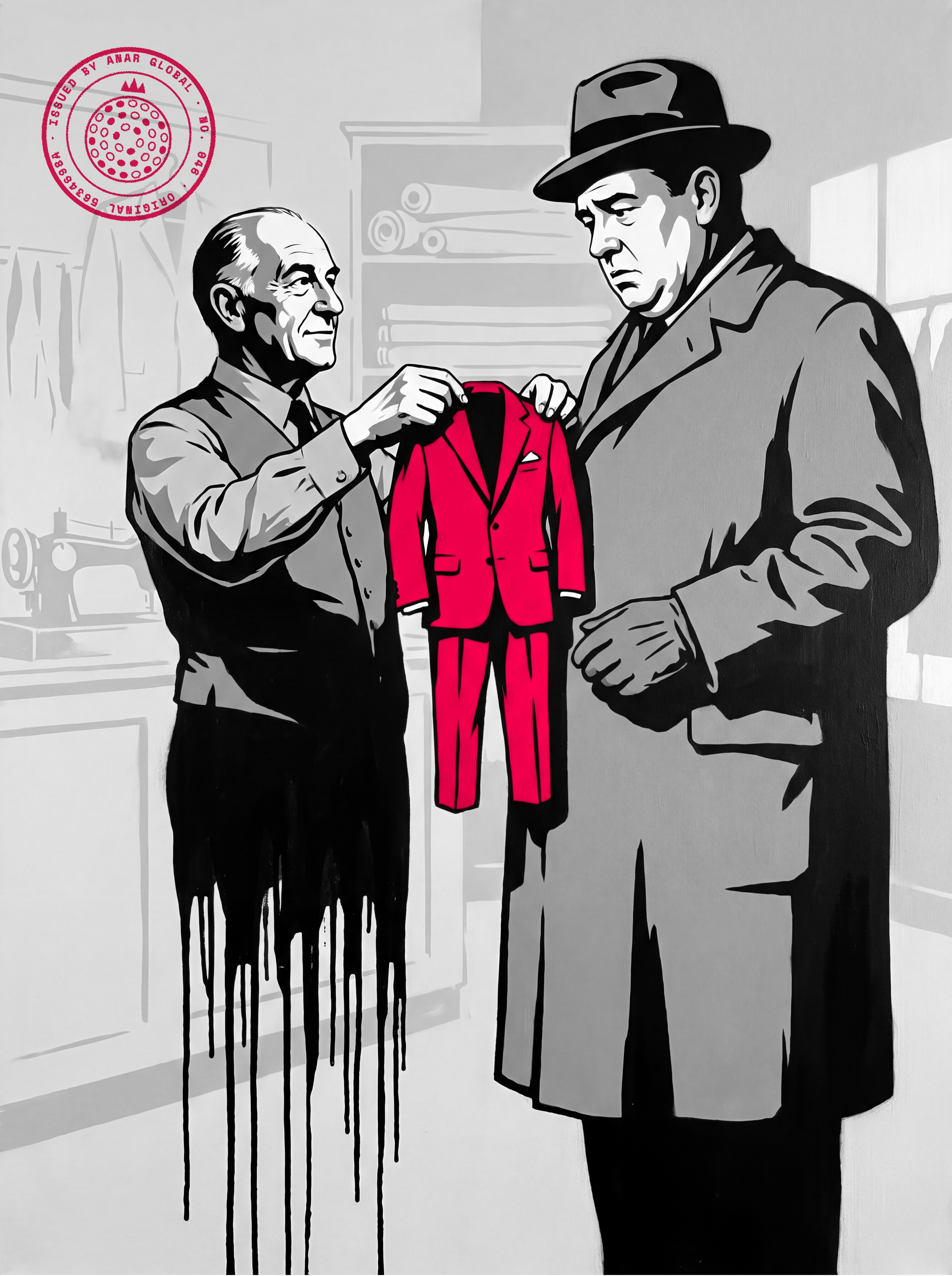
Built from the ad down, the ad does all the work
| From the ad down | From the principles up |
|---|---|
| Starts with a format that sells for someone else | Starts with what must be true for the buyer's result |
| Writes the ad first | Writes the ad last |
| Hunts for a hook for months | The hook comes from the point of view |
| Needs a new angle when sales drop | The message stays true, so it keeps working |
Our comparison, using the Principle Ladder as set out in this guide.
Build the offer in six rungs, from the bottom up
The Principle Ladder is a six-rung order for building an offer. Each rung is built from the one below it.
1. Principles: what must be true for the customer to get the result.
2. Point of view: what your principles add up to when you stack them. It is your way of seeing the problem.
3. Process: the steps, in order, that follow from that point of view.
4. Product: the process, packaged. It says what is included, how long it takes and what it costs.
5. Message: what you say about the product. It is easy to write, because it describes something real.
6. Distribution: where the message goes, like ads, posts and email. Marketing is just this top rung.
Before rung one, answer one question. Who is the buyer, and what result do they want? No buyer means no principles, because there is no result to work back from.
Pick that buyer with care. What they earn limits what you can earn from them, so check it with our guide to pricing from your buyer's income.
What about the things that matter to you? Write them down too. Just know the market does not care about them, so they can never replace a principle.
Six rungs, built from the bottom; marketing is only the top one
- 1. Principles What must be true for the customer to get the result.
- 2. Point of view What the principles add up to.
- 3. Process The steps that follow, in order.
- 4. Product The process, packaged and priced.
- 5. Message A plain description of the product.
- 6. Distribution Where the message goes: ads, posts, email.
The Principle Ladder. Step zero, before rung one: pick the buyer and the result they want.
The Principle Ladder is a six-rung order for building an offer, from the bottom up: principles (what must be true for the customer to get the result, whoever does the work), point of view (what the principles add up to), process, product, message and distribution. Pick the buyer first, keep 3 to 10 principles, dig until each would hold for a stranger, and test the point of view by arguing the opposite.
What is a principle? A fact the result depends on
A principle is something that must be true for the customer to get the result, no matter who does the work. It is not a personal taste or a tactic.
Think about building a car. It must have wheels. It must have an engine.
In most places the law also says it needs an exhaust system. Those are principles. The paint color is a choice.
A car with no wheels is a sculpture.
Philosophers call the deepest kind a first principle: a basic truth you cannot get from any other truth. You build everything else on top of it.
The hard part is digging deep enough. Most people stop one layer too soon.
For example, picture someone who sells buyer psychology to online stores. Their first try: "Conversion rates affect how a store performs." True, and useless.
Go one layer down: "People react to certain triggers in the same ways." Now there is something to build on.
Here is our test. Would it still hold if a stranger did the work? If yes, it is a principle, and if it only holds for you, it is a preference.
A principle holds no matter who does the work
| The statement | What it is | Why |
|---|---|---|
| A car needs wheels | Principle | True for any builder |
| Red cars look better | Preference | Depends on taste |
| Conversion rates affect store sales | Too shallow | True, but nothing to build on |
| People react to certain triggers in the same ways | Principle | The layer the result depends on |
| Run a seven-day challenge | Tactic | Belongs on the process rung |
Examples from this guide. The car and store examples are worked examples, not data.
A first principle is a truth you cannot get from another truth
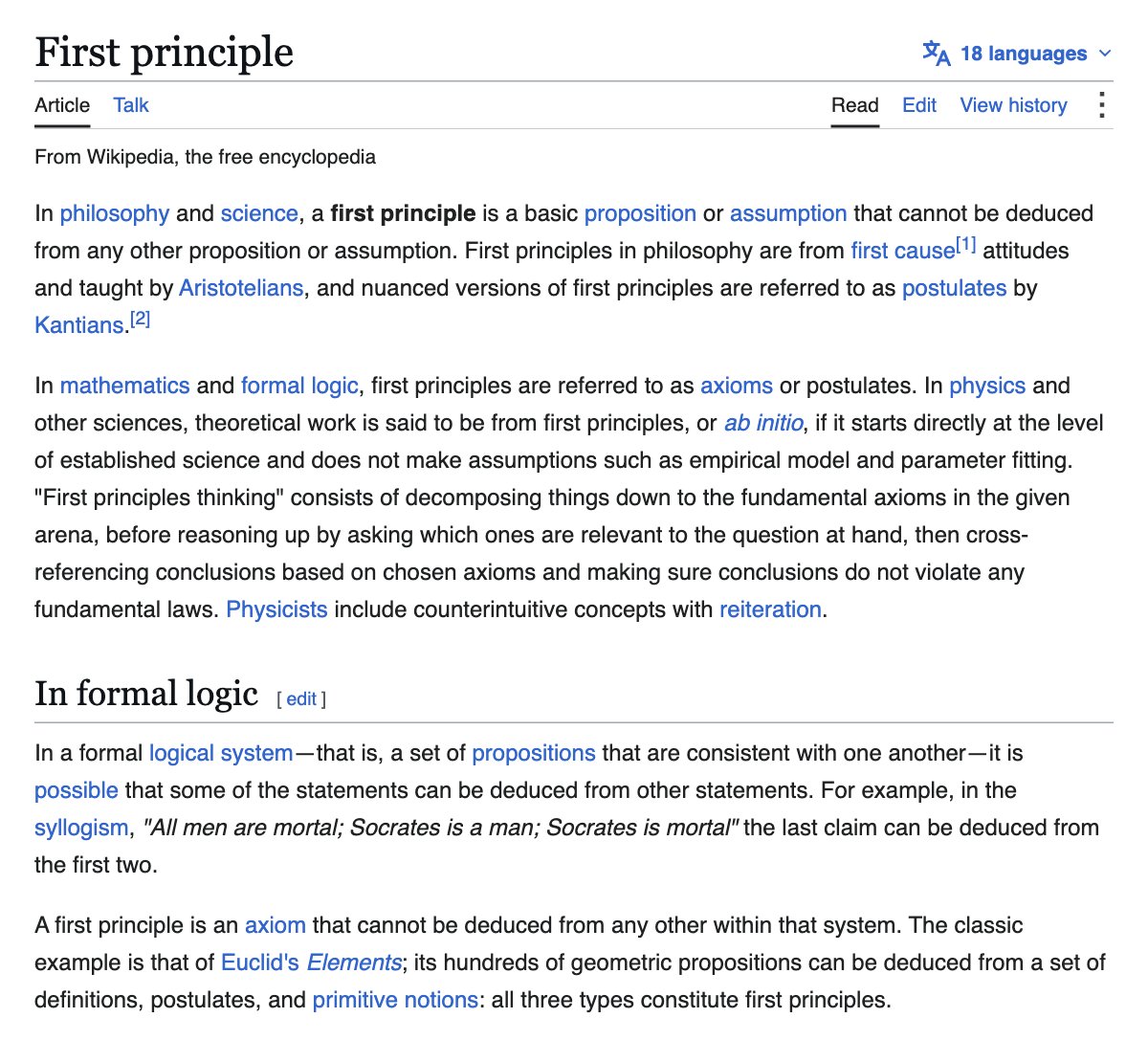
- Rung one of the Principle Ladder uses this idea for offers.
- This is what a principle is: a truth you cannot get from another truth.
- Break the result into parts until each part is simply true. Then build back up.
- Hundreds of results from a few starting truths. That is how the ladder works.
Screenshot of Wikipedia, First principle, taken 2026-10-17. All pinned phrases are the page's own wording.
How do you find your principles? Ask what must be true, then ask why
Start with the result your buyer wants. Then ask what must be true for them to get it. Write down every answer.
Next, ask why each answer is true, and go one layer down. Engineers call this habit the five whys. Stop when the answer would hold for anyone.
Most offers land on three to ten principles. Fewer than three is a slogan. More than ten is a manual.
Stuck? Ask which deals you loved or hated, and why. Ask what your best results all had in common.
Then ask what it costs people not to know this. And why does the result matter to them at all?
Keep pushing on that last one. Most results end in a feeling, like relief, pride or peace of mind. The jobs to be done idea makes the same point: people buy progress in their life, not features.
Do it with two other people for fifteen minutes. They will catch the tactics you are calling principles.
Five questions get you from goals to principles
- 1. What result? Name the result your buyer wants, in their words.
- 2. What must be true? List every condition the result depends on.
- 3. Why? Ask why each one is true. Go down a layer until it holds for anyone.
- 4. What did the best results share? Look at the deals you loved and hated, and why.
- 5. Why does it matter to them? Push to the feeling at the end: relief, pride, peace of mind.
The Principle Ladder, rung one. Keep 3 to 10 principles.
Stack your principles until the point of view is obvious
Put your principles side by side. If they are true and deep, a point of view shows up on its own. You do not have to invent one.
For example, take a course that teaches people to write novels. Its first principle: finishing a book is a numbers game.
Five pages each morning before work is 1,825 pages a year. At 300 pages a book, that is about six books a year.
Its second principle: readers remember two or three great scenes long after the rest fades. So the scenes come first.
Stack the two and the point of view is plain. Books get finished with small daily pages, built around a few great scenes. The process and the product follow from that.
See how this changes things for the buyer. A whole book feels scary. Five pages before breakfast does not.
That is the payoff. A good point of view makes the result feel possible, and that feeling sells better than hype.
Example: five pages a day adds up to about six books a year
- Pages written each morning 5
- Pages in a year (5 x 365) 1825
- Books a year, at 300 pages each 6
Worked example: 5 x 365 = 1,825; 1,825 / 300 = about 6. The math is ours.
Example: a novel-writing course built from two principles
| Rung | The novel-writing course |
|---|---|
| Principles | Finishing a book is a numbers game. Readers remember two or three great scenes. |
| Point of view | Books get finished with small daily pages, built around a few great scenes. |
| Process | Plan the big scenes first. Then write five pages every morning. |
| Product | A course built around the scene plan and the daily page habit. |
| Message | Write five pages a day. That pace adds up to about six books a year. |
| Distribution | Wherever new writers already spend time. |
Worked example to show the method. Not a real company's results.
Every line on the page comes from one rung of the ladder
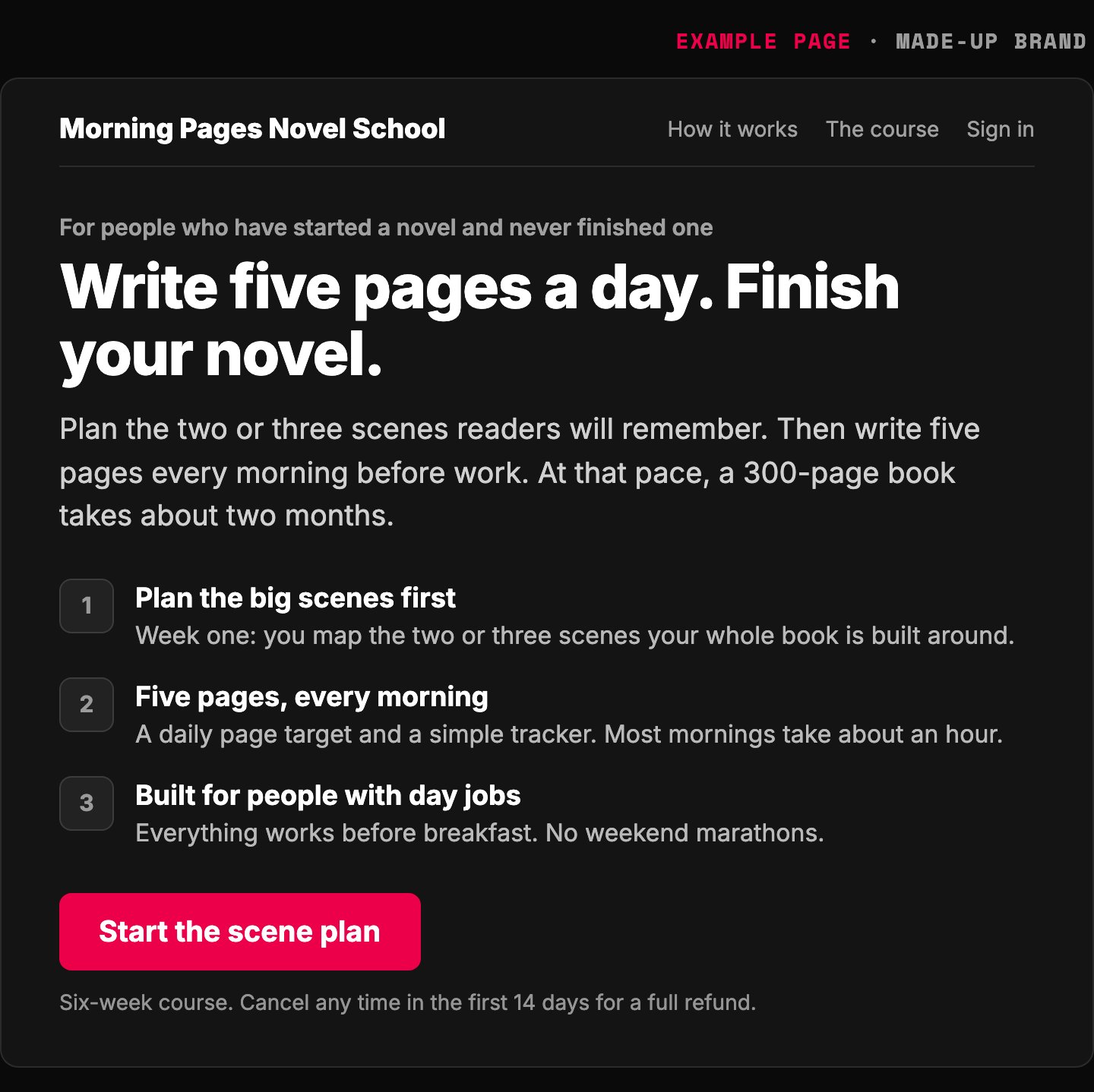
- Message rung: the point of view, said in one plain sentence.
- Simple math from a principle: 5 pages a day x 60 days = 300 pages.
- Principle two turned into process step one.
- Principle one, finishing is a numbers game, turned into a habit.
- The product rung: what is included, how long, and the terms, stated plainly.
Example page built for this article with a made-up brand
Test your point of view: can you defend it against anyone?
A real point of view survives an argument with anyone. That is the test, and it takes ten minutes.
Write the opposite of your point of view. Then argue for it as hard as you can. Debaters call this steelmanning: making the other side's case as strong as you can.
Did the other side win? Then you have an opinion, not a point of view. Go back down to your principles and dig.
What makes a point of view hold up? Math, and other people. You can show the numbers, and it works when someone else does the work.
Ad copy, the words that sell, is an argument in writing. A true point of view wins it without tricks.
Here is an example of a line that wins the argument: "Your service is great. But can you take a month off? If not, you own a job, not a business."
That line works because the buyer can check it against their own life. No tricks needed.
If the opposite argument wins, you have an opinion
| Question | Pass | Fail |
|---|---|---|
| Argue the opposite as hard as you can. Who wins? | Your point of view | The other side |
| Can you show it with numbers? | Yes, simple math | Only a feeling |
| Does it work when someone else does the work? | Yes | Only when you do it |
| Can the buyer check it against their own life? | Yes | Only if they trust you |
Our test for the point of view rung of the Principle Ladder.
An opinion needs you; a point of view holds without you
| An opinion | A point of view |
|---|---|
| True because you say so | True because the math shows it |
| Loses to a good counter-argument | Survives the strongest counter-argument |
| Copy needs tricks to sell it | Copy just explains it |
Our comparison.
Your marketing wins the first sale. Your product wins the rest
An ad can win the first sale. Only the product wins the second, the third and the fifth.
That matters, because a business grows through repeat buyers. Marketers track it as customer retention and customer lifetime value.
Offers built from the ad down chase the first sale only. Buyers do not come back. So the business must convince strangers from zero, every month, forever.
For example, one agency sent in lots of buyers through affiliates, partners paid for each sale. The marketing was strong. The buyers did not stay, and its recurring revenue fell hard.
Old-school direct mail put a wall between seller and buyer. The seller threw a sales letter over it, and the buyer threw cash back. Nobody on either side ever met.
How to build an offer that needs a new hook every month, in four easy steps:
1. Copy a format that is selling for someone else.
2. Write the ad before you know what is inside.
3. Spend three months hunting for a hook.
4. When sales drop, blame the hook and start again.
That is not an offer. It is a treadmill with a checkout page. Watch your churn rate, the share of buyers who leave, and you will see it.
Marketing wins one sale; the product keeps the loop turning
- Ad wins the first sale The message brings in a new buyer.
- Product gets the result The principles do their job.
- Buyer buys again No new ad needed.
- Buyer tells a friend A new buyer arrives without an ad.
Our model of first and repeat sales.
What changes when the principles are written down
Written principles make the message easier to write, and they keep working longer. Here are two examples from other businesses.
For example, one couples-coaching company had copy that felt pushy, even to its owner. He spent about two months writing down what he believed about relationships.
His point of view: love is trust and safety, and couples slowly trade desire for safety. Couples who last keep desire alive. So the whole business became about bringing desire back.
After that, the copy turned into plain conversation. Hiring got easier too, because new people could see the point of the work.
Its next sales video was written in about 20 minutes. It converted at 3.2 percent, for a $250 a month program.
Another example: one low-price offer ran for two to three years without a single split test, where you compare two versions. The only change was a new price of $27.
We have not seen either set of numbers. Treat them as examples, not proof.
Why would that work? The owner believed in the offer. When you know why the product works, the copy sounds sure of itself, and buyers feel that.
Tactics wear out as markets change. A point of view lasts longer, because it never depended on one tactic.
Example: once the point of view was written down, the copy came fast
| The case | What changed | What happened | How sure |
|---|---|---|---|
| A couples-coaching company | About two months writing down its point of view | Next sales video written in about 20 minutes; 3.2% conversion on a $250 a month program | Example; we have not seen the data |
| A low-price front offer | Built from its principles, then left alone | Ran two to three years with no split tests; only the price changed, to $27 | Example; not verified |
| An agency selling through affiliates | Strong marketing, weak reason to stay | Buyers did not stay; recurring revenue fell | Example; no numbers given |
Example numbers from other businesses. Not our results, and not verified by us.
Where people get stuck building an offer
Four stuck points show up again and again. Each one has a symptom, a cause and a fix.
Your principles read like business goals, such as "raise conversions" or "get more leads." Those are business numbers, and they sit one layer too high. Ask why until the answer would hold for anyone.
Your list is all about you. "I want freedom" is a value you hold, not a fact the result depends on. Keep it, but keep it off the ladder.
People praise the offer but do not buy. Praise is free. Buyers show love with a credit card, not a compliment, so count sales and show more proof of what it does.
You cannot find principles at all. Usually that means you have not picked a buyer yet. Pick one buyer and one result, then start again.
Want a second check on the finished offer? Run it through the patterns behind offers that sell.
Four stuck points, and the fix for each
| Symptom | Cause | Fix |
|---|---|---|
| Principles read like goals: "raise conversions" | One layer too high | Ask why until it holds for anyone |
| The list is all about you | Personal values, not facts the result needs | Keep them, but off the ladder |
| People praise it but do not buy | Praise is free | Count sales; show more proof |
| No principles come at all | No buyer picked yet | Pick one buyer and one result first |
Our stuck-point list for the Principle Ladder.
Build your Principle Ladder with AI: the copy-paste prompt
Paste the prompt below into your preferred AI. It asks who you sell to and what result they want. Then it sorts your ideas into principles, preferences and tactics.
It stacks your principles into a point of view and argues the other side. Then it drafts the process, product, message and distribution, in that order.
It never invents results or numbers. If a claim in your message needs proof, it asks you for it.
Paste into your preferred AI. It asks who you sell to and what they want, then builds the ladder rung by rung.
Act as an offer strategist. Help me build one offer with the Principle Ladder, from the bottom rung up.

Ask me one question at a time, with the example:
1. Who is the buyer? (Example: adults who want to finish a novel)
2. What result do they want? (Example: a finished book)
3. What do you sell now, if anything? (Example: a writing course)
4. What do you think must be true for that result? List it all. (Example: a book is a numbers game)

Rules:
- A principle must be true for the result no matter who does the work. Not a taste, not a tactic, not a business metric.
- For each item I give, ask "why?" until it would hold for a stranger. Mark each one: principle, preference, tactic or too shallow.
- Keep 3 to 10 principles.
- Stack them into a point of view in one sentence.
- Test it: argue the opposite as hard as you can. If the opposite wins, tell me which principle is weak and what to dig into.
- Then write the process (steps in order), the product (what is included, how long), the message (one plain sentence) and distribution (where my buyers already spend time).
- Never invent results, numbers, testimonials or deadlines. Any number in the message must come from my own data or from simple math on numbers I gave you. Say which.
- If I have no buyer yet, stop and help me pick one first. Ask what they earn, because that limits what I can charge.

Show your reasoning, then answer in this format:
Buyer and result:
Principles (3 to 10), each marked:
Point of view:
Defend-it test: the opposite argument, and who wins:
Process:
Product:
Message:
Distribution:
Next three actions: 1. 2. 3.
Run it this week, then build the rest
1. Run the prompt for your main offer. Keep only what survives the why test.
2. Argue the opposite of your point of view with a friend. Fix any principle that loses.
3. Rewrite your main headline from the point of view. Then describe the result, not the deliverables.
Before you pay for ads, check the numbers on the offer. Then plan why buyers stay past month two, and find how you stand apart from what rivals sell.
Remember the team three months into research? They did not need a better hook. They needed a product worth talking about, the kind that spreads by word of mouth.
Need a small first offer to start with? See quick win offers.
Ads wear out. Principles do not.
Three short sittings take you from principles to a new headline
- Run the prompt Day 1 Answer its four questions. Keep what survives the why test.
- Argue the opposite Day 3 With a friend. Fix any principle that loses.
- Rewrite the headline Day 5 Say the point of view in one plain sentence.
Our suggested order.

Filip Kovacevic is the founder of Anar Agency in Phoenix. He spent five years running SEO, Meta ads, email, and content for medical practices across the United States, and now does the same work for healthcare, home-service, legal, and professional-service businesses, alongside AI implementation. More from Filip →
Talk it through in 15 minutes
Bring one question from this article. We will tell you what we would do, whether or not you hire us.
Book a 15-Min Chat →