Point of View Marketing: How to Change What Your Buyer Believes

Point of view marketing changes how a buyer reads the facts instead of fighting their belief. Buyers filter messages three ways. They ignore what seems useless, bend what they see to fit the past, and turn a few cases into a rule.
Reverse it: break the rule with a real exception, show the whole picture, then add what they missed.
What is point of view marketing?
You start shopping for a red car. By Friday, the whole city is full of red cars.
They were always there. Your brain just stopped ignoring them. Psychologists call it the frequency illusion.
Your buyers do the same thing to your page. Most of what you wrote never reaches them.
Point of view marketing is changing how a buyer reads the facts, instead of arguing with what they already believe. It works in ads, on pages, in emails and on sales calls.
Here is the short version. Every buyer runs three filters before anything feels true: delete, distort and generalize.
We run them backwards. Break their rule, show the whole picture, then put back what they missed. Arguing with the belief comes last, and usually it is not needed.
Every message passes three filters before it feels true
- 1. Delete The brain throws out what seems useless right now. Threats always get through.
- 2. Distort What it does see gets bent to fit one past experience.
- 3. Generalize A few cases become a rule with all, never or must in it.
- Feels true The search stops. Anything that disagrees bounces off.
Method: the Three-Filter Read
Three filters decide what your buyer believes
Every buyer filters your message three ways before it becomes a belief. Each filter does a different job.
Delete means the brain throws out whatever is not useful right now. Threats always get through. Everything else can get thrown out.
How far does deleting go? In one famous study, about half the people counting basketball passes missed a person in a gorilla suit. The gorilla was in plain view.
Distort means the brain bends what it did see to fit what it expects. One bad experience becomes a lens, like a magnifying glass, for every case that looks like it. People distort to stay safe or to look good.
Generalize means the brain turns a few cases into a rule, so it never has to think about them again. Logicians call the mistake faulty generalization. Listen for words like "all", "never" and "must".
What survives the three filters feels true. Then they stop looking, and people favor whatever agrees with them, a habit called confirmation bias.
Markets filter too. People repeat each other's stories, so a whole niche can share one rule. That shared rule is the wall your ad hits.
Deleting is not rare: about half missed a gorilla in plain view
- of viewers counting basketball passes did not notice a person in a gorilla suit About half
Wikipedia, Inattentional blindness (the 1999 Simons and Chabris study)
You can hear each filter in what buyers say
| Filter | What it sounds like | What it hides |
|---|---|---|
| Delete | "I didn't know you did that." | A fact that was on your page all along |
| Distort | "I tried that once. Total mess." | Everything outside that one bad time |
| Generalize | "They're all the same." | Every case that breaks the rule |
Example lines written for this article
Before a message feels true, every buyer runs three filters: delete what seems useless, distort what they see to fit past experience, and generalize a few cases into a rule. The Three-Filter Read names all three for your market, then reverses them in order. First, break the market's rule with one real exception.
Second, remove the lens: zoom out from the bad experience the rule grew from and blame the setup, never the buyer. Third, put back the facts they missed, the old way as a loss and your way as a gain. Answer every question you ask in the next line.
Every exception and fact must be real and provable.
Why arguing with a belief gets you nods and no sales
Arguing with a belief gets agreement without action. The buyer nods, says "good point", and does nothing.
Why? A belief sits on top of a stack: what they see, then what they think, then what they believe, then what they know.
Most marketing fights at the belief level. As long as the way they see it stays the same, the belief grows back. Researchers have a name for beliefs that outlive the evidence: belief perseverance.
Pull hard on a belief and it holds on harder. Psychologists call that push-back reactance.
So we loosen beliefs. We never yank them.
How to make a market dig in, in four easy steps. Step one: tell them they are wrong. Step two: call their old choice dumb.
Step three: pile on more proof. Step four: ask why they still have not bought.
You won the argument. They kept their money.
The fix starts with what they see. Change what they see, and the belief has nothing left to stand on. Our guide to agreeing on the cause first works on the same layer.

Most marketing argues with the belief; change starts with what they see
- See How they read the facts. Change this and the rest moves.
- Think Their opinion about what the facts mean.
- Believe Where most ads argue, and get nods with no sale.
- Know Feels like fact. Almost impossible to argue with.
Method: the Three-Filter Read
Pulling on a belief makes it hold harder
| Arguing with the belief | Changing what they see |
|---|---|
| You are wrong about agencies | Here is one case that breaks the rule |
| More proof, louder | One missed fact, shown calmly |
| The buyer defends their past choice | The buyer blames the old setup, not themselves |
| Agreement, no action | A new view, then a decision |
Method: the Three-Filter Read
Run the filters backwards: rule first, missed facts last
Reverse the filters in the opposite order they run. The brain deletes, then distorts, then generalizes. So we break the rule first, remove the lens second, and put back the missing facts last.
Why that order? Show a missing fact while the rule still stands and the two collide. The buyer feels the clash and throws out the fact.
The forward order can work too. It is just easier for the buyer to notice what you are doing.
Of the three steps, putting back what they missed is the strongest. It changes the other two at the same time.
It lands best once the rule has a crack in it. Crack the rule first, then fill in the facts.
The Three-Filter Read is our name for this: name the rule, the lens and the missed facts, then reverse them in that order. If the rule is a whole story your market tells itself, start with arguing against the story your market believes.
Reverse the filters: rule first, missed facts last
- 1. Break the rule One real exception to what the market agrees is true.
- 2. Remove the lens Zoom out from the bad experience the rule grew from.
- 3. Put back what they missed The strongest step, once the rule has a crack.
- 4. Check On a call: how do you see it now? On a page: do they keep reading?
Method: the Three-Filter Read
Step 1: Break the market's rule with one real exception
To break a rule, find one real exception to it. A rule that says "all" cannot survive a single counterexample. One true exception plants doubt.
First, name the rule. What does your whole market agree is true? Write it in one line with "all", "never", "only" or "must" in it.
Careful here. "Life is hard" is not a rule. It is a situation.
A rule explains why things are the way they are. If you cannot name your market's rule, you do not know your market yet.
Then ask yourself one question. What is the exception to this rule?
For example, picture a doctor who teaches parents to handle minor illness at home. The market's rule: a sick child goes to the doctor. If many doctors really do this with their own kids, the headline writes itself: "Why do so many doctors care for their own kids at home?"
Some readers will answer, "Because they are doctors." Good. The next line is ready: they know a few things you do not, and this page shows you what they are.
The template: why do experts do for themselves the thing you were told not to do? Fill it only with something you can prove.
Another rule, from email marketing: bigger incentives, like discounts, bring more buyers. True, they bring buyers. But what kind?
Often the kind who only buy on a deal. Now the rule has a crack, and you did not have to call anyone wrong.
Each market rule has an exception you can turn into a headline
| Market rule | The exception question | Example headline |
|---|---|---|
| A sick child goes to the doctor | Who skips that step for their own kids? | Why do so many doctors care for their own kids at home? |
| Bigger incentives bring more buyers | What kind of buyers do they bring? | More discounts, more buyers. Which buyers? |
| Good parents go with their gut | Then why do so many buy parenting books? | If instinct were enough, why the bookshelf? |
Examples of the method; use a headline only if the exception is true for your market
Your market's rule is already written down, in its own words
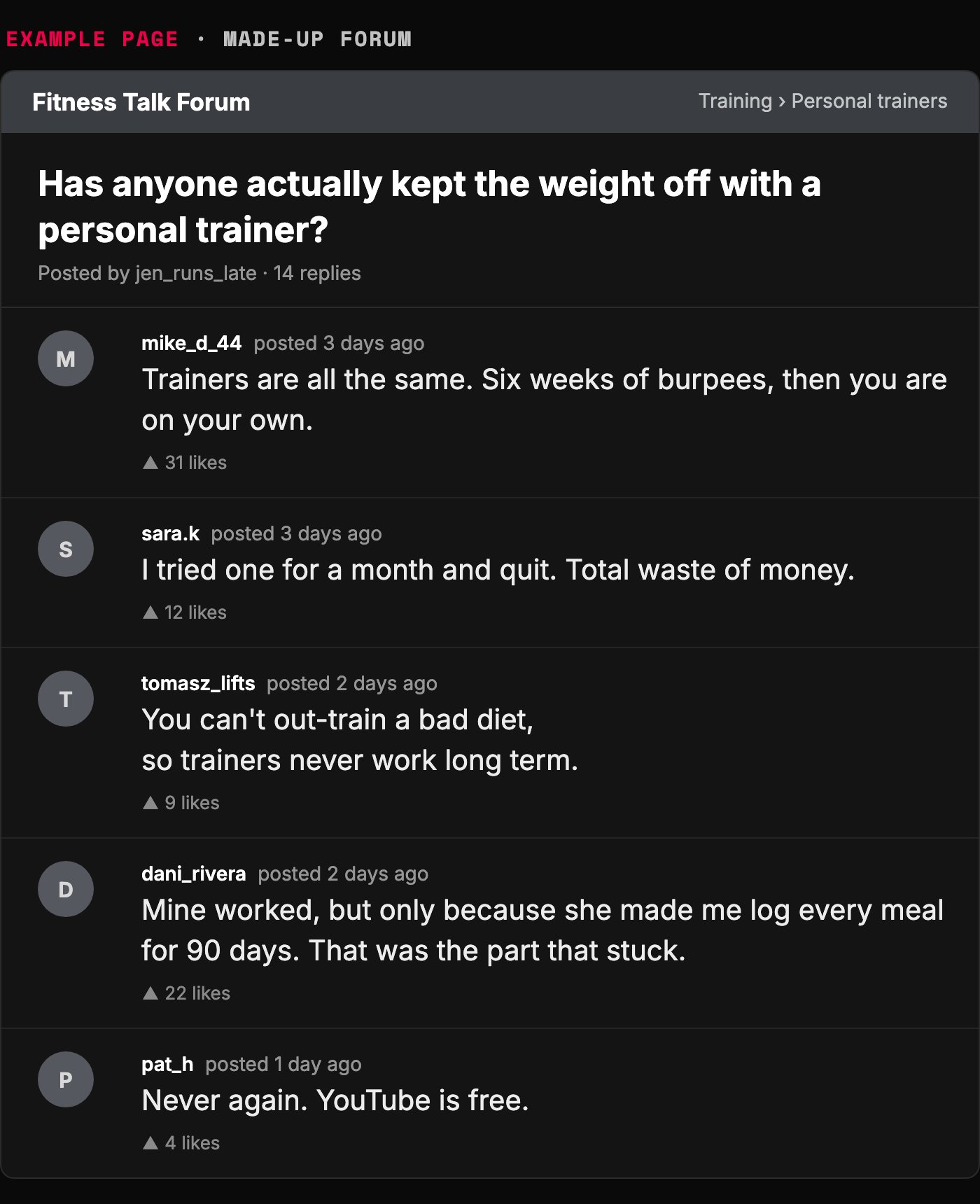
- The market's rule, in their words. The word all gives it away.
- The lens: one bad month behind the rule. Zoom out from this.
- Another rule. Never is the second giveaway.
- The exception. A real one like this becomes your headline.
Example page built for this article with a made-up brand. No real forum, person or brand.
Step 2: Remove the lens so they see the whole picture
Distortion works like a magnifying glass. It zooms in on one bad moment until it fills the whole view. To fix it, zoom back out.
Here is how a lens turns into a rule. "I tried webinars and they did not work" is a distortion. Say it a few more times and it becomes "webinars do not work."
Zooming out means showing what sat outside the lens. How long did they test, and what did they change?
Then show who tried the same thing and got a different result.
A plain way to write it: most people struggle when they are new, and you did too. So how do you explain the business down the street that books new clients every week this way? The only answer is that it knows something you have not seen yet.
One warning. People distort to feel safe or to protect their status. Blame the setup, never the person.
Nobody buys from someone who just called them a fool. Words that insult the buyer spread through the whole offer, as our piece on what not to say in copy shows.
A distortion is one bad moment, magnified until it fills the view
| Through the lens | Zoomed out |
|---|---|
| I tried webinars and they did not work | How long did you test, and what did you change? |
| Webinars do not work | Who ran the same play and got a different result? |
| I am bad at this | The setup failed. The person did not. |
Method: the Three-Filter Read
Step 3: Put back what they missed, as gain or loss
The strongest step is putting back what the buyer deleted. Bring the missed facts into view and they have to weigh them.
Plain lines do this: have you thought about this, look at this, here is something else.
The brain does not sort facts into good and bad. It sorts them into gain and loss. Losses usually weigh more, which researchers call loss aversion.
So show the old way's facts as a loss first. Then show yours as a gain. Get a "no" on the old way, and the "yes" on yours comes easier.
Take a home-cleaning service. Against the old way: doing it yourself costs your whole Saturday, every week. For the new way: we hand you back your Saturdays.
Before you write a word of the case for your offer, draft the case against it. If you can beat the best argument against you, the rest is easy. The habit has a name: steelmanning.
Every missed fact you bring back must be true. Our rule: if you could not prove it, do not use it.
Example: show the old way as a loss first, then yours as a gain
| Against the old way (loss) | For the new way (gain) |
|---|---|
| Cleaning it yourself costs your whole Saturday | We hand you back your Saturdays |
| Every week, forever | One booking, then it just happens |
| You still do the bathroom last, tired | You walk into a clean house |
Example lines for a made-up home-cleaning service
Should you ask the question or answer it yourself?
In copy, answer it yourself, right away. When a page asks a question, the reader's mind starts answering. Leave a gap and it often answers "no."
So ask, then answer in the next line. How do you explain it? Only one way: they know something you do not.
The question opens the door. Your answer walks through it. For the full method, see our guide to assumptive questions.
On a sales call, questions work differently. Give the reason before you ask: "I am just curious why you chose that." A question with no reason makes people wonder about your motive, and they get defensive.
After you show a new way to see it on a call, check it. Ask: "How do you see it now?" If they say they see it differently, the shift worked.
On a page, the check is quieter. If people keep reading without stopping, the point landed. Where they drop off is where they said no.
Ask the question, then answer it before they can say no
- 1. Agree with their experience Most people struggle when they are new, and you did too.
- 2. Show the exception A real case that breaks the rule they built from it.
- 3. Ask So how do you explain that?
- 4. Answer in the next line Only one way: they know something you have not seen yet.
- 5. Point ahead This page shows you what it is.
Method: the Three-Filter Read
Exception first, its answer next, then the missed facts as loss and gain
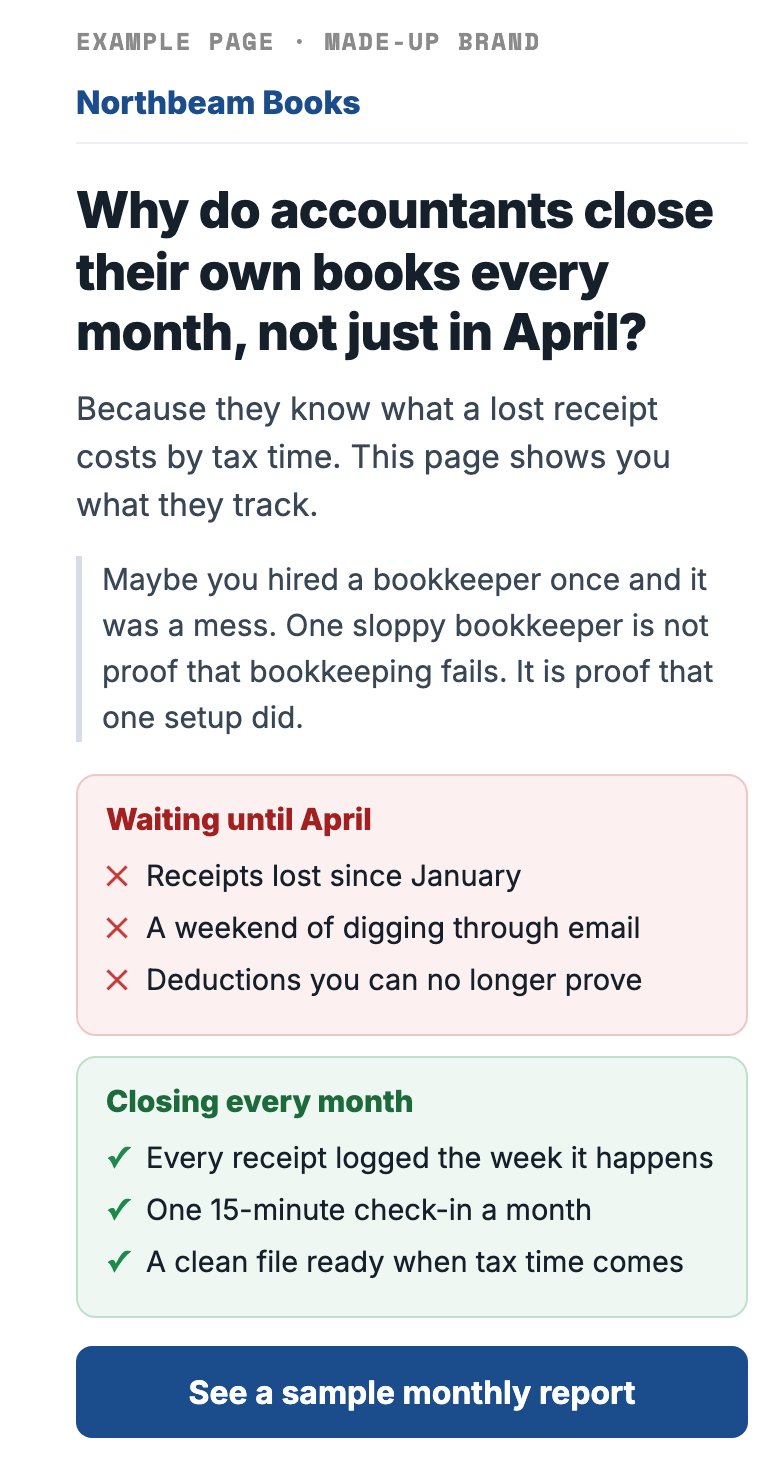
- Step 1: the exception. It cracks the rule 'I only need a bookkeeper at tax time.'
- The question gets its answer in the very next line. No gap for a no.
- Step 2: zoom out from one bad experience. Blame the setup, never the reader.
- Step 3: the facts they missed, shown as a loss first.
- Then the same facts as a gain.
Example page built for this article with a made-up brand.
Where people get stuck
Most stuck points come from doing the right step in the wrong place. Here are the four we see most.
Readers leave at your best fact. The cause: the rule was still standing, so the fact clashed with it. The fix: crack the rule with an exception first, then bring the fact.
Buyers agree and still do not buy. The cause: you argued with the belief, not with how they see the problem. The fix: re-explain why they have the problem.
Your rule sounds like a mood. "Times are tough" is a situation, not a rule. The fix: ask what your buyers think causes it, and write that down.
Comments turn angry. The cause: you hit a belief tied to safety, family or faith head-on. The fix: start inside their view and widen it.
Our guide to the three beliefs that stop a buyer covers the softer ones.
Most stuck points are the right step in the wrong place
| What you see | Why | Fix |
|---|---|---|
| Readers bounce at your best fact | The rule was still standing | Crack the rule first, then bring the fact |
| Buyers agree and still do not buy | You argued with the belief | Re-explain why they have the problem |
| Your rule sounds like a mood | It is a situation, not a rule | Ask what they think causes it |
| Comments turn angry | You hit a safety, family or faith belief head-on | Start inside their view and widen it |
Method: the Three-Filter Read
Is changing someone's point of view manipulation?
It can be. The same steps that fix a wrong belief can plant one. A hammer does not care what it builds.
Here is our line, and it is ours. Every exception is real, and every missed fact is true and checkable.
We never invent a customer who beat the odds.
Go easy on beliefs tied to health, safety, money to live on, family or faith. Breaking those head-on makes people defensive. Meet them inside their view, then widen it.
The law sets the floor: ads must be truthful and not misleading. A reframe can mislead even when each sentence is true. Our guide to FTC risk drivers covers where claims go wrong.
It also works in reverse. When a competitor reframes your market, find the exception to their exception. The exception that goes deeper wins.
For decades, researchers have studied how the same facts, framed a new way, change choices. They call it the framing effect. Use it to show people what is there, never what is not.
The method is only as honest as the facts you feed it
- Never A made-up customer who beat the odds, told to help. Still a lie.
- Our lane Real exceptions and missed facts, so the buyer sees the whole picture.
- Never Invented proof plus pressure. This is where fines live.
- Careful True facts, framed to leave a false impression. Fails the law's test.
Our rule, plus the FTC standard that ads be truthful and not misleading
Run the Three-Filter Read with AI
The prompt below runs the whole method on your market. Paste it into your preferred AI and answer five questions. It returns your market's rule, an exception headline, a lens line, the missed facts and one opening paragraph.
It will not invent an exception. If it needs one, it asks you for a real one.
This week: first, write your market's rule in one line. Second, find one real exception and turn it into a headline. Third, test the new opening against your old one, one change at a time, as in one-variable ad testing.
Want a second pair of eyes on your rule? Send it to us; you are not signing up for anything.
Remember the red cars. Nobody painted the city red. Someone just told your brain where to look, and what we notice follows what we care about.
You do not need louder ads. You need buyers looking in the right place.
Paste into your preferred AI. It asks five questions, then gives you your market's rule, an exception headline, a lens line, the missed facts and an opening paragraph.
Act as a careful direct-response copywriter. Help me change how my buyers see my offer with the Three-Filter Read. Use only my answers and the rules below. Never invent a fact, a customer, a result or a number. If you need one, ask me for a real one.

Ask one at a time, with the example, and wait:
1. What I sell, and to whom. (Example: monthly bookkeeping for small contractors)
2. What my buyers believe about it, in their own words. Paste reviews, comments or call notes if I have them. (Example: 'I only need a bookkeeper at tax time.')
3. One real exception to that belief that I can prove. (Example: the accountants we work with close their own books every month)
4. The facts my buyers usually miss, and how I can prove each one. (Example: lost receipts cost them at tax time; our receipt log shows it)
5. Where this will run. (Example: landing page headline and first paragraph)

Rules:
- Write the market's rule in one line with 'all', 'never', 'only' or 'must' in it. If answer 2 is a situation ('times are tough'), not a rule, tell me and ask again.
- Order: break the rule first, then remove the lens, then add the missed facts. Never lead with the facts.
- Break the rule with my real exception only. Write it as a question headline, then answer it in the very next line. Never leave a question open.
- Lens line: name the one bad experience the belief grew from, then show what sat outside it. Blame the setup, never the buyer.
- Missed facts: show the old way as a loss first, then my way as a gain.
- If the belief touches health, safety, money to live on, family or faith, do not attack it. Start inside it and widen it.
- No fake scarcity, no invented customers, no income claims.

Show your reasoning in three lines, then use exactly this format:
MARKET RULE:
EXCEPTION HEADLINE:
NEXT LINE (THE ANSWER):
LENS LINE:
MISSED FACTS (LOSS, THEN GAIN):
FULL OPENING PARAGRAPH:
CALL CHECK: one question to ask on a sales call to see if their view changed.
NEXT THREE ACTIONS:
Filip Kovacevic is the founder of Anar Agency in Phoenix. He spent five years running SEO, Meta ads, email, and content for medical practices across the United States, and now does the same work for healthcare, home-service, legal, and professional-service businesses, alongside AI implementation. More from Filip →
Talk it through in 15 minutes
Bring one question from this article. We will tell you what we would do, whether or not you hire us.
Book a 15-Min Chat →