A Persuasion Framework for Copy: Start With the Cause
A good persuasion framework starts with the cause, not the pitch. Before you say why your offer is better, say what changed. Name the outcome your reader wants, why the usual way no longer gets it, and what caused that.
Once the reader agrees with the cause, your offer is the next logical step.
A persuasion framework that starts before the pitch
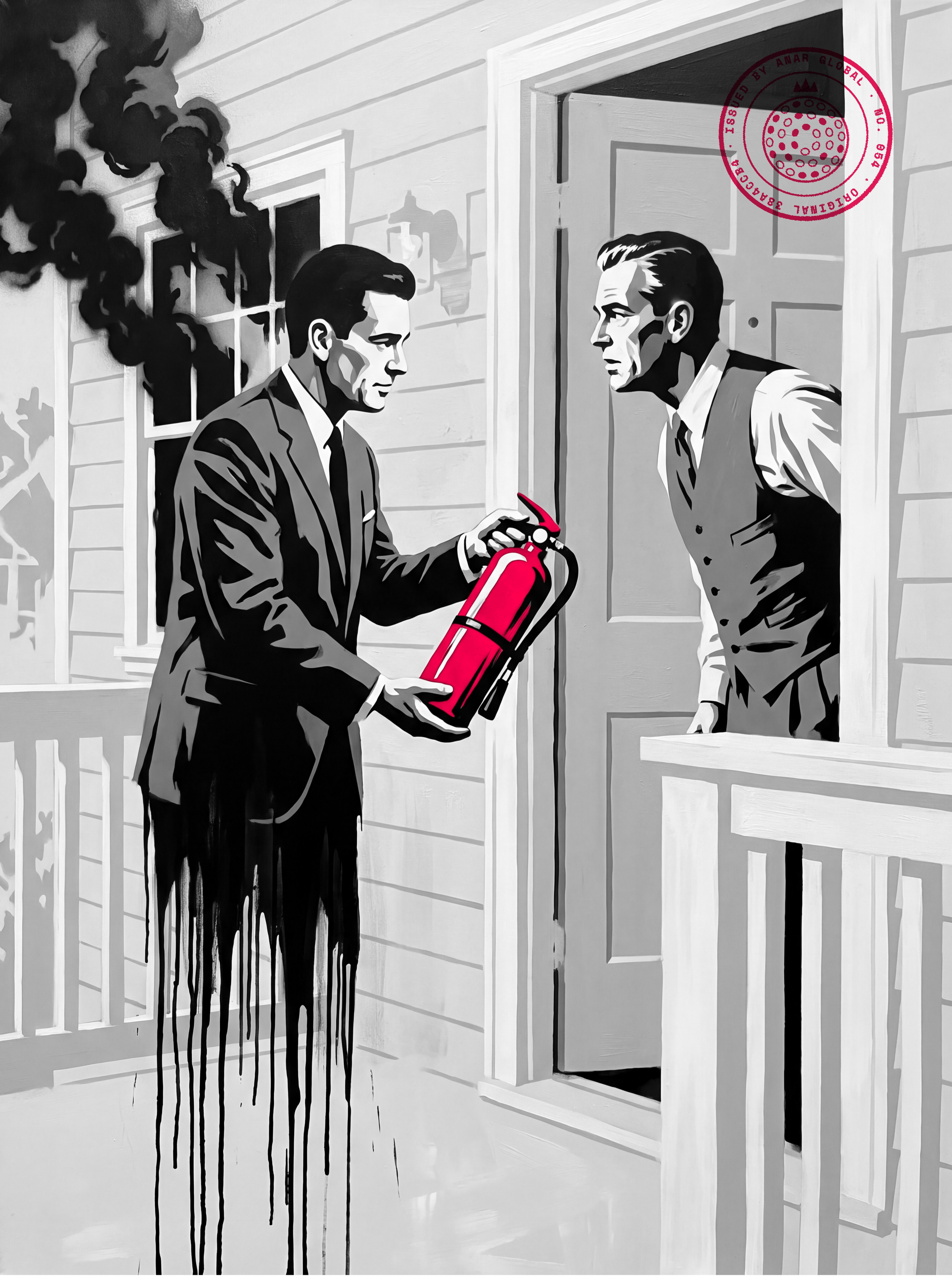
Picture a stranger at a party. He walks up and says, "You should switch banks."
No hello. No reason. You argue, or you walk away.
Now picture a different first line: "The bank on Main Street is closing next month."
Now you are listening. Same stranger. Same pitch.
The second version gave the conversation a reason to exist. Good persuasion starts right there.
Most persuasion frameworks start at the pitch: our product, our features, our proof. This one starts one step earlier.
Every ad, sales page and sales video asks someone to change something. Change needs an argument. And an argument needs a cause, the reason the conversation is happening at all.
Skip the cause and you jump into a talk the reader never agreed to have. They are not ready for it. So they push back, or they scroll.
Pitch first, and you start a fight.
Pitch first starts a fight; cause first starts a conversation
| Pitch first | Cause first |
|---|---|
| "You should switch banks." | "The bank on Main Street is closing next month." |
| Opens with what you want | Opens with what changed for them |
| The reader brings their own counter-argument | The reader agrees before you ask for anything |
| You argue on their ground | They think about your topic |
Our comparison, using the party example in this guide.
What is a cause in copywriting? The reason the argument exists
A cause is the reason your argument exists. It answers one question: what happened that we are talking about this at all?
Most copy runs in this order: offer, then argument. The cause never shows up. We write it the other way round: cause first, then the argument, then the offer.
Why does the order matter so much? Because whoever names the cause decides what the talk is about.
Let the reader pick the topic, and you argue on their ground. You face their reasons, their examples and their doubts. You rarely win there.
So pull them onto your ground instead. Once they accept your cause, the rest of the talk stays on your topic.
Researchers saw a version of this in the 1968 US election. In Chapel Hill, North Carolina, the issues voters ranked highest closely matched the issues local news covered most. That study started agenda-setting theory.
The news did not tell people what to think. It chose what they thought about. That is the job of a cause.
Courts work the same way. The opening statement is often the first time the jury hears from a lawyer, and it tells them what the case is about before any evidence.
Your Cause Line is that opening statement. The close is the verdict, and it should land right back on the cause.
Every offer stands on a cause; most copy skips it and starts at the top
- 1. The cause What happened that we are talking about this at all?
- 2. The argument Why the usual way fails and the new way wins.
- 3. The change you ask for What the reader should do differently.
- 4. The offer Your product, as the next logical step.
The Cause Line method, bottom rung first.
Your Cause Line is the opening statement; your close is the verdict
| In a courtroom | In your copy | Its job |
|---|---|---|
| Opening statement | The Cause Line | Says what this is about and why we are here |
| The case | The argument | Shows why the usual way fails and the new way wins |
| The verdict | The close | Lands right back on the cause |
Our model. Courtroom terms as described in Wikipedia, Opening statement.
The Cause Line is the short paragraph that comes before your pitch. It names the outcome the reader wants, why the usual way no longer gets it, and the change that caused that, with a source. Build it in four steps: decide what you argue against, list the limits, name the change, then show why the new way wins.
A good cause is about today, happens to the reader, has a source, and is true. Put it in the ad, then go one level deeper on the page.
How to write a Cause Line in four steps
The Cause Line is the short paragraph above your opening. It says what the reader wants, why the usual way stopped getting it, and what changed. Here is how we build one.
Step 1: decide what you argue against. Has your buyer seen offers like yours? Then argue against the way they use now, and only then for yours.
New to the idea? Then argue against where they are now: the outcome they want and do not have.
Step 2: list the limits. Assume they want the outcome. Then show, with evidence, why the usual way no longer gets it.
Step 3: name the change. Finish this sentence: the old way stopped working because ___ changed. That change is where the cause comes from.
Step 4: show why the new way wins. Give the logic and the feeling. One without the other is half an argument.
Here is a worked example. Say you sell a course on starting an online store.
Against: stores that buy and hold stock. Limit: you order it, store it and ship it, and by then tastes have moved. Change: print on demand makes each item only after someone orders it.
New way: a store that makes to order can follow a trend the week it starts. By now the reader has agreed three times, and you have not mentioned a course.
Cause first. Course second.
Four steps from what changed to why your way wins
- 1. Pick what you argue against Seen offers like yours? Argue against their current way. New to it? Argue against where they are now.
- 2. List the limits Assume they want the outcome. Show, with evidence, why the usual way no longer gets it.
- 3. Name the change The old way stopped working because ___ changed. That is the source.
- 4. Show why the new way wins Logic and feeling, both. Then, and only then, the offer.
The Cause Line method, in four steps.
Example: a course on starting an online store, built step by step
| Step | The question | Example line |
|---|---|---|
| 1. Against | What way do they use now? | Stores that buy and hold stock |
| 2. Limits | Why does it no longer get the outcome? | Order it, store it, ship it, and tastes have moved |
| 3. Change | What changed, and where can they check it? | Print on demand makes each item after it is ordered |
| 4. New way | Why does the new way win? | A store that makes to order can follow a trend the week it starts |
Example built with the method. Print on demand as defined in Wikipedia, Print on demand.
Give the cause a source, or it sounds made up
A cause needs a source: where the problem came from. Without one, the reader assumes you made it up.
This is where a cause differs from framing. Framing picks the issue to focus on. A cause also says how the issue got here.
The linguist George Lakoff made framing famous in politics. Framing tells people where to look. A cause also tells them how the problem got there.
So is the word "because" enough? A 1978 study at a copy machine tested exactly that.
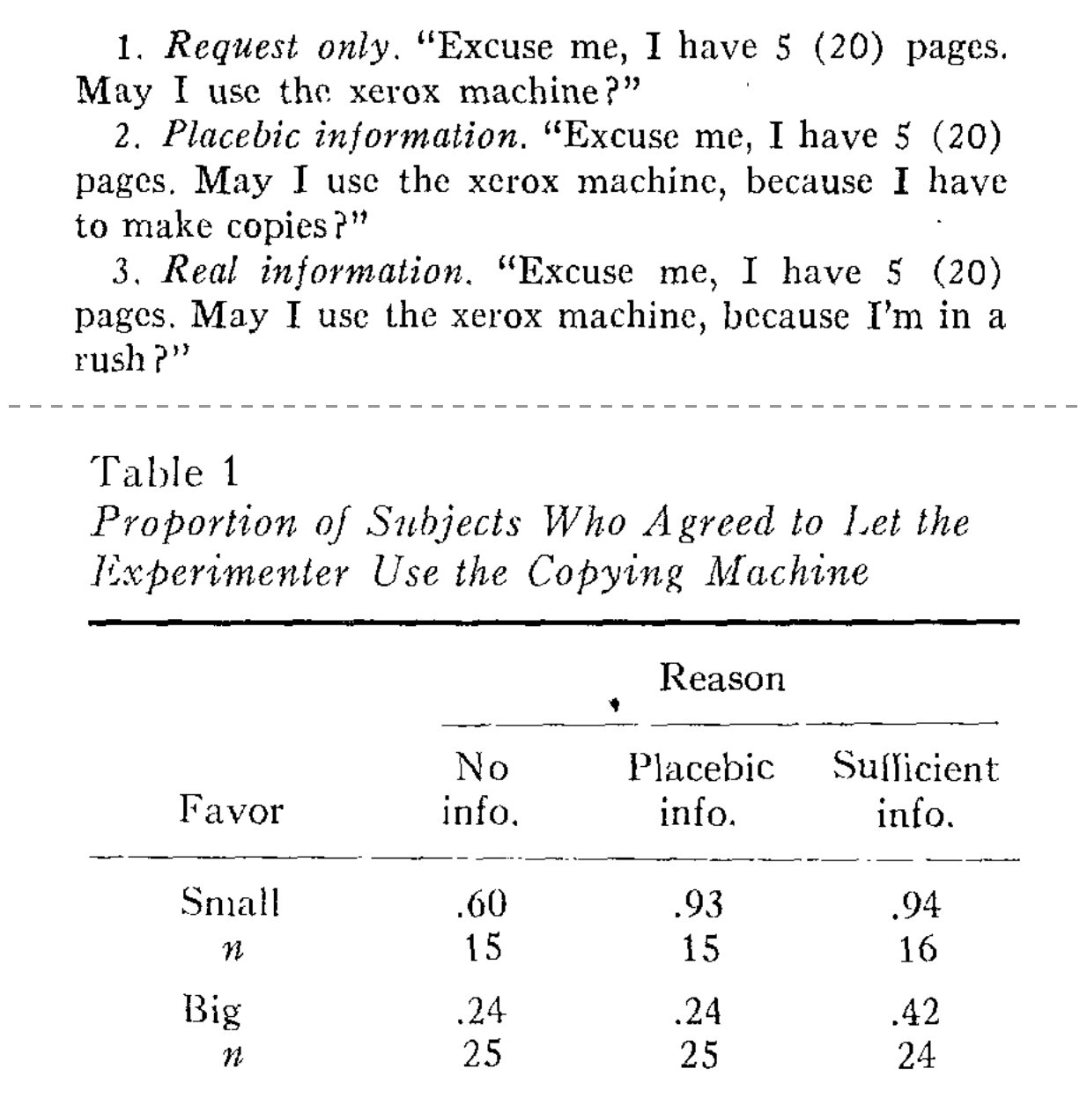
A stranger asked people to let them cut in line to copy 5 pages. With no reason, 60 percent said yes. With an empty reason that says nothing new, "because I have to make copies", 93 percent said yes.
A real reason, "because I'm in a rush", got 94 percent. So for a small favor, any reason worked.
Then the stranger asked to copy 20 pages. The empty reason did nothing: 24 percent, same as no reason. Only the real reason lifted it, to 42 percent.
Buying is a big favor. An empty cause will not carry a sale.
That is why our rule is simple: the cause must be true, and you must be able to show it. The FTC says ads must be truthful and claims need evidence behind them.
No source? No sale.
For a big favor, only a real reason raised the yes rate
Share of people who let a stranger cut in line at a copy machine, by request and by reason given
- 5 pages, no reason 60
- 5 pages, empty reason 93
- 5 pages, real reason 94
- 20 pages, no reason 24
- 20 pages, empty reason 24
- 20 pages, real reason 42
Source: Langer, Blank and Chanowitz (1978), Journal of Personality and Social Psychology, Table 1.
An empty reason works for a small favor and fails for a big one
- The empty reason. It gives no new information.
- The real reason.
- Small favor: any reason worked. 60, 93 and 94 percent said yes.
- Big favor: the empty reason did nothing. Only the real reason helped.
- A peer-reviewed study, 1978.
Screenshot of Langer, Blank and Chanowitz (1978), The Mindlessness of Ostensibly Thoughtful Action, Journal of Personality and Social Psychology 36(6), page 637, Table 1, taken 2026-10-17. Two parts of the page, joined at the dashed line
Four tests every cause should pass
Run every cause through four tests before it goes live. If it fails one, fix it first.
It is about today. Problems in the future do not feel like problems. If a limit is coming, show what it costs the reader now.
It happens to them. The best cause is not a choice the reader made. It happened to them, and it changes what they gain or lose.
It has a source. Say where it came from: a change in the market, a new rule, a rising cost, a new tool.
It is true. This one is our rule. If a reader checks, it holds.
One more habit: open by agreeing. Disagree with someone often enough and they start to dislike you. Psychologists call that pushback reactance.
So aim the cause at the situation or at bad advice, never at the reader. For example: "Everyone says quit your job to start a business. Great, if you like not knowing how the bills get paid."
On Meta, this is also an ad rule. Its personal attributes policy bans ad text that states or implies things about the viewer, like "Are you bankrupt?" Speak to the situation instead.
How to start an argument nobody asked for, in four easy steps:
1. Open with "We are the best in the business."
2. Tell the reader they are doing it wrong.
3. Tell them again, louder.
4. Test forty headlines and wonder why the hell none of them hook.
That is not a sales page. That is heckling.
The strongest cause is about today and happens to the reader
- Today, but their choice Reads as blame. The reader gets defensive.
- Today, and it happened to them The strongest cause. Use this box.
- Someday, and their choice Easy to ignore. Rewrite it.
- Someday, and it will happen to them Show what it costs them now.
The four tests in this guide, as a grid.
Fail one test and the cause will not hold
| Test | Fails | Passes |
|---|---|---|
| About today | "Prices may rise someday." | "This price rise hits your next order." |
| Happens to them | "You picked the wrong supplier." | "Suppliers changed their terms." |
| Has a source | "Everything is harder now." | "The rule changed, and here is the notice." |
| True (our rule) | A number you cannot show | A fact a reader can check in a minute |
Our examples, written for this guide. The fourth test is our rule.
One product can carry two causes. Use the true one.
The same product can carry two opposite causes, and both can be strong. You choose which one to tell.
Example: a hair care brand with no famous faces. Cause A: famous brands can skimp on ingredients because fans buy anyway. A brand nobody knows has to make a product good enough to sell itself.
So the brand pays no celebrities and asks you to try it. Its weak spot just became its reason to buy.
Cause B fits a brand that does pay big names. Great ingredients cost money, and a great product nobody hears about dies. So the brand pays famous people to spread the word, and the sales fund better ingredients.
Both work. Only one is true for you. Use that one.
Notice what both causes did. They turned the weak spot into part of the argument. That is how a small brand answers "I have never heard of you."
When your cause needs proof, use the kinds in the Proof Grid.
Example: one hair care brand, two opposite causes, both strong
| Cause A: no famous faces | Cause B: famous partners |
|---|---|
| Famous brands can skimp because fans buy anyway | Great ingredients cost money |
| A brand nobody knows must sell on quality | A great product nobody hears about dies |
| So no celebrities: try it and judge | So famous people spread the word |
| Use it if you pay no big names | Use it if you do |
Example of the method. Use only the cause that is true for your brand.
Put the cause in the ad, then go deeper on the page
The cause belongs wherever the reader first meets you. Usually, that is the ad.
The ad sets the cause in one line. For example: "Why coaches are dropping webinars, and what they run instead."
The page then picks up where the ad left off. First, admit the click, which means you name the ad they came from: "You came from our ad about webinars. Here is what it had no room to say."
Then go one level deeper than the ad did. Most pages act as if the visitor found them by chance. The visitor knows they clicked an ad, so say it.
For example, one finance company tested many sales videos against a page written like a news story, called an advertorial. The article page kept winning. The format was not the reason.
The article page carried the cause. The videos never did. The fix is to open the video with the article's cause, then let the video make the argument.
This also explains why warm audiences, people who already know you, buy more. They already share your cause. A good Cause Line does the same work for strangers.
One rule of ours here: if your page looks like an article, label it as an ad. The FTC treats an ad format as deceptive when it misleads people about who is behind it.
More on matching the page to the ad in ad-to-page alignment.
The ad sets the cause; each screen after it goes one level deeper
- Set the cause The ad One line about what changed.
- Admit the click First screen Name the ad they came from, then go deeper.
- Make the argument Middle Limits, the change and its source, why the new way wins.
- Land on the cause The close The offer as the answer to the cause you opened with.
The Cause Line method across one ad and one page.
The ad sets the cause, and the page picks it up before any offer
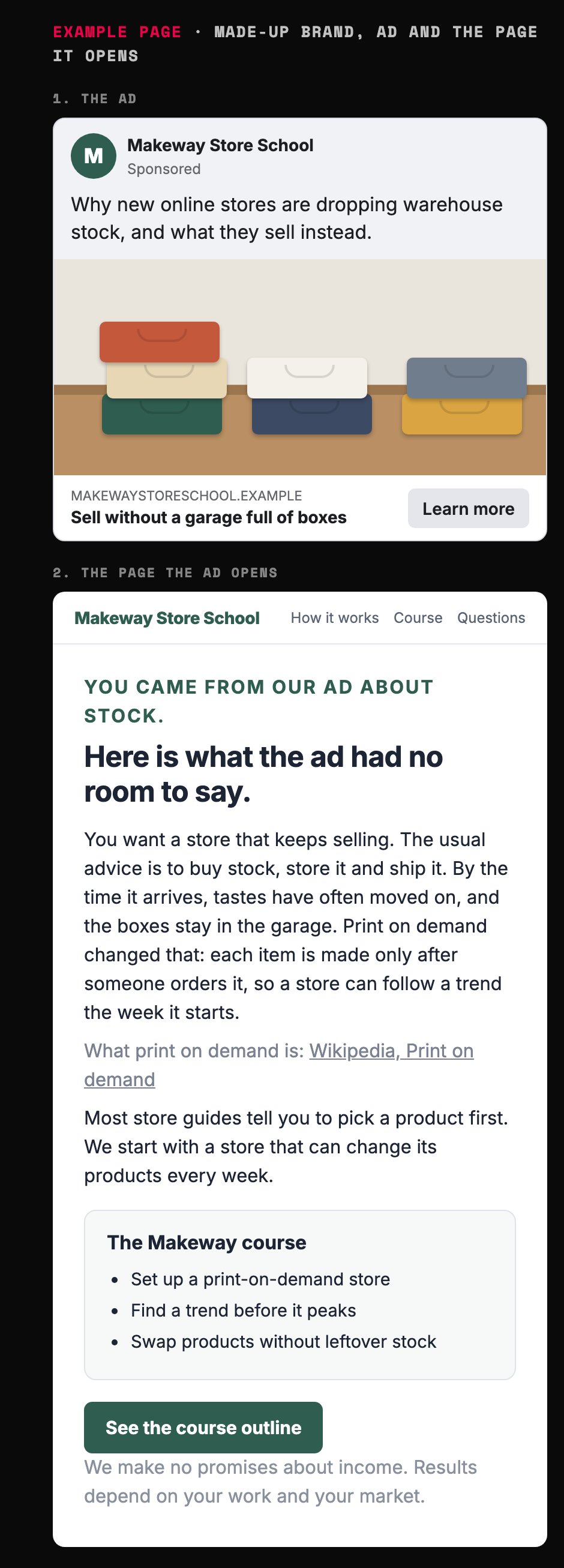
- The ad sets the cause in one line.
- The page admits the click instead of pretending it was found by chance.
- The limit of the usual way, with no blame on the reader.
- The change has a source the reader can check.
- The offer appears only after the cause.
Example page built for this article with a made-up brand. The print on demand definition is from Wikipedia, Print on demand
Where do people get stuck with the cause?
Three stuck points show up again and again. Each one has a clear sign.
Viewers leave in the first minute. The cause is missing, so nobody expects to gain anything by staying. People only stay to get something.
The fix: put the Cause Line in the first 30 seconds. A usability study found users often leave a web page within 10 to 20 seconds. More in the first 90 seconds of a sales video and what retention does to your cost.
Endless headline tests. You test 30 headlines and nothing moves. You are hoping a test will find a cause you never wrote.
The ad, the article page, the headline and the opening are where the cause lives. That is why tests there move numbers. Write the Cause Line first, then A/B test two versions of it, one change at a time.
Readers argue back. Comments like "every company says that" mean you opened with your position. Open with the change instead, and let them agree first.
A missing cause is the cheapest fix in marketing. It costs one paragraph.
Three signs your copy has no cause, and the fix for each
| Sign | Cause | Fix |
|---|---|---|
| Viewers leave in the first minute | Nobody expects to gain anything by staying | Put the Cause Line in the first 30 seconds |
| Headline tests never move | You are testing toward a cause you never wrote | Write the Cause Line, then test two versions of it |
| Readers argue back | You opened with your position | Open with the change and let them agree first |
The Cause Line method.
Many visitors decide to stay or leave within seconds
- Seconds before many users leave a web page 10 to 20
- Seconds that matter most for staying or leaving First 10
Source: Nielsen Norman Group, How Long Do Users Stay on Web Pages? (2011).
Write your Cause Line with AI
Paste the prompt below into your preferred AI. It asks about your offer and your buyer, one question at a time.
Then it builds the four lines and runs the four tests. It never invents evidence. When a fact is missing, it asks you or flags it.
Check every source before you publish. A cause is only as strong as its proof.
Need a hook to go with it? Read how to write a hook from change plus hope.
Paste into your preferred AI. It asks about your offer and your buyer, then writes a Cause Line, an ad line and a first page line, and tests the cause.
Act as a direct-response copy editor. Help me write a Cause Line: the short paragraph that comes before my pitch and says why this conversation exists.

Ask me one question at a time, with the example:
1. What do you sell, and to whom? (Example: a course on starting an online store, for people with a day job)
2. What outcome does the buyer want? (Example: a store with steady sales)
3. What do they use or try now to get it? (Example: a store that buys and holds stock)
4. Have they seen offers like mine before? (Example: yes, many)
5. What changed that makes the usual way work worse now, and where can a buyer check it? (Example: print on demand makes each item after it sells; a public page that explains it)

Rules:
- Never invent a fact, number, study or quote. If I cannot name a source for the change, say the Cause Line is not ready and ask what I can prove.
- Buyers who have seen offers like mine: argue against the way they use now, then for mine. Buyers new to the idea: argue against where they are now.
- Build four lines: what I argue against; the limits of the usual way; the change and its source; why the new way wins, in logic and in feeling.
- Test the cause: about today, not someday; happens to the buyer, not chosen by them; has a source; true and checkable. Mark each one pass or fail.
- Agree with the buyer first. Aim at the situation or at bad advice, never at the buyer.
- In ad text, never state or imply the viewer's personal traits (no "Are you in debt?").
- No fake urgency and no invented fear.

Output:
Cause Line (2 to 4 sentences):
Ad line (under 15 words):
First line of the page, admitting the click:
Tests: today / happens to them / source / true
What I must prove before publishing:
Next three actions: 1. 2. 3.
Your Cause Line this week: three steps
1. Run the prompt for your best-selling offer.
2. Put the Cause Line at the top of your main ad and the first screen of its page.
3. Read it to one customer. If they nod, keep it; if they argue, fix the source.
Remember the stranger at the party? He never changed his pitch. He changed his first line.
Next problem: your market already believes a story about how to get the outcome. Here is how to argue against the story your market believes.
Pitch first, and you start a fight. Cause first, and you start a conversation.

Filip Kovacevic is the founder of Anar Agency in Phoenix. He spent five years running SEO, Meta ads, email, and content for medical practices across the United States, and now does the same work for healthcare, home-service, legal, and professional-service businesses, alongside AI implementation. More from Filip →
Talk it through in 15 minutes
Bring one question from this article. We will tell you what we would do, whether or not you hire us.
Book a 15-Min Chat →