Sale vs Close: The Promise and the Justification
The five sales process steps are awareness, attention, education, the sale and the close. The sale and the close are two different jobs. The sale is the buyer accepting your promise.
The close is the buyer justifying the price by doing the math on what else that money could buy. Buying needs both.
Sales process steps: the yes at the end is two jobs
The call went great. They nodded. They said it sounds amazing.
Then you said the price. They said, "Let me think about it." Then you heard nothing for three weeks.
Sound familiar? They wanted it. They just could not justify it.
Most lists of sales process steps end with one word: action. The classic AIDA model runs awareness, interest, desire and action, and marketers have used it for more than a century.
We split that last step in two. The sale is the buyer accepting your promise. The close is the buyer justifying the price.
Two jobs. Treat them as one, and the buyer stalls right before saying yes.
The classic model ends in one step; we split it into two jobs
| AIDA | Five sales process steps |
|---|---|
| Awareness | Awareness: they notice you are different |
| Interest | Attention: a question they cannot answer yet |
| Desire | Education: reasons to believe it works |
| Action | The sale: they accept your promise |
| (no step) | The close: they justify the price |
AIDA as described in Wikipedia, AIDA (marketing). Five steps: our method.
The five sales process steps, in plain words
A sales process is the path a buyer walks from never hearing of you to paying you. Ours has five steps, in this order.
Awareness. They notice you because you look or act different from everyone else. Once the whole market copies your look, it stops being different.
Attention. You raise a question their brain cannot answer yet, so they keep looking for the answer. A yes-or-no question gets answered too fast, and they stop looking.
Education. They learn what this is and why it works, and it feels like learning. It is really motivation: they want reasons to believe it is okay to buy.
The sale. They accept your promise. No money moves yet.
The close. They justify the price. Then they pay.
Skip a step and the next one gets weaker. Education only works as well as the attention you earned before it.
These steps are not only for one call. They can run across your ads, emails and a community, reaching thousands of people at once.
One warning: these steps are a process, not an outline for a sales letter. For the teaching step done well, see educational copy that motivates.
Five steps, in order; each one feeds the next
- 1. Awareness They notice you are different from the rest of the market.
- 2. Attention A question opens that they cannot answer yet.
- 3. Education They get reasons to believe. It feels like learning; it works as motivation.
- 4. The sale They accept a promise you can keep. No money yet.
- 5. The close They justify the price with their own math. Then they pay.
Our five-step sales process.
Each missing step shows up in its own way
| Step | It needs | What you see when it is missing |
|---|---|---|
| Awareness | Something different from the rest of the market | They scroll past |
| Attention | A question they cannot answer yet | They glance, then leave |
| Education | Reasons to believe, and proof they can see | Polite interest, no movement |
| The sale | A promise you can keep | "Sounds great" with no next step |
| The close | The math of trade-offs, done by them | "Let me think about it" |
Our five-step sales process.
Promise-Then-Justify splits the end of every sale into two jobs. First the sale: the buyer accepts a promise you can keep. Then the close: the buyer justifies the price by doing the math on trade-offs, consequences and who else lives with the decision.
Desire plus justification equals action. Teach before the call so they have energy left to decide, answer "how much?" straight, and let them make the decision.
Desire plus justification equals action
Desire plus justification equals action. A buyer needs both at the same time, or nothing happens.
Think of something you wanted to buy last month and did not. A gaming chair, a car, a piece of land.
You wanted it. You could not justify it.
That is the whole game. Most offers pump up desire and forget the reasons. Some pile up reasons for something nobody wants.
Both end the same way. No sale.
So build both together. Every time you raise the want, add one more reason it makes sense.
In crowded markets, the best reason is often an honest one about why past attempts failed: "It was not your fault; the method was wrong." We only use that line when it is true.
More on this balance in why action is desire minus objections.
Desire without reasons stalls; so do reasons without desire
- Wants it, cannot defend it "Sounds amazing." Then silence.
- Action They want it and can explain why. They buy.
- Nothing No want, no reasons. Probably the wrong buyer.
- A sensible shrug Plenty of reasons, no pull. They agree and do nothing.
Our method: desire plus justification equals action.
The sale is the promise, not the payment
Most people think the sale is asking for money. It is not. The sale is the promise.
A promise is what you commit to deliver so the buyer gets the outcome. For example: "I will teach you everything I know about marketing." One sentence, one outcome.
The promise tests your integrity. Make one you cannot keep and you lose the buyer's trust. Lose their trust and you lose them.
Trust is the currency. The brands that last kept one promise for decades: Toyota sold reliable cars, Mercedes sold luxury.
Promises also carry legal weight. The FTC's advertising guide for small business says ad claims must be truthful and backed by evidence.
Our test for a promise: one sentence, one outcome, something you can keep, and something the buyer could repeat to a friend.
How do you know the sale is made? The buyer tells you. They name the problem out loud before any money moves, or they start asking you to sell to them.
That is your green light. To get there without pushing, read how to let the prospect land on the claim. Every sale also spends trust, as trust cycles explains.
A pitch asks for money; a promise commits to an outcome
| A pitch | A promise |
|---|---|
| Asks for money | Commits to what you will deliver |
| Lists features | Names one outcome |
| Says what sounds good | Says only what you can keep |
| Ends when they pay | Gets tested after they pay |
Our five-step sales process.
The sale is one promise you can keep, with its limits and its price
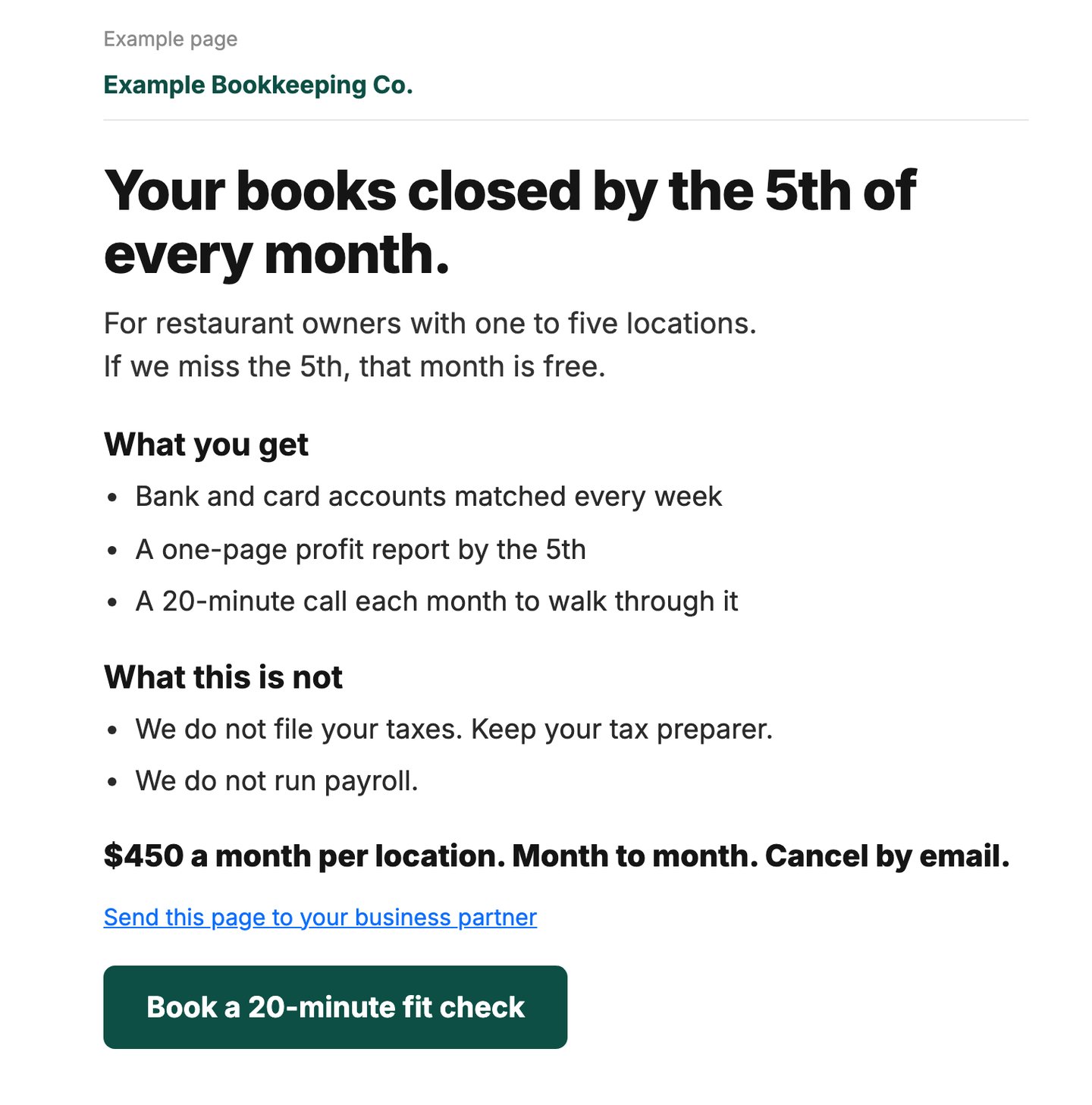
- The sale: one promise, one outcome, something the firm can keep.
- The promise is specific enough to be tested.
- Saying what you will not do keeps the promise honest. It also lets them add you instead of replacing someone.
- The price is stated straight. No one has to ask twice.
- Help for the other person who lives with the decision.
Example page built for this article with a made-up brand. The firm, promise and price are illustrative, not a real business or result.
The close is the math of trade-offs
The close is where the buyer justifies the price. They do math, and not only money math.
Education handed them the reasons. The close is where they put those reasons together and check the total.
They ask what else this money could buy. Economists call that opportunity cost: the value of the next best option you give up.
For example, picture a man weighing a $2,000-a-month car lease. A typical seller talks about gas savings. He does not care about gas.
A good seller asks what he does for fun. His answer is travel. Now the seller knows the real competition: a second place abroad for the same $2,000 a month.
The close works on that trade-off. It is not a louder promise. It shows why this choice beats the other one.
Money is not the only cost. The bigger the price, the bigger the consequences, and the more people have to live with them.
A partner at home is part of most big decisions. If your buyer is married, you are selling to two people, even when only one is on the call.
Buyers also try to hand you the decision. "What would you do?" Choose for them, and you own the blame if it goes wrong.
Our line: we make suggestions, you make decisions. It keeps the choice, and the ownership, with them.
Once buyers justify a choice themselves, it tends to stick. Psychologists call this choice-supportive bias: people rate their own picks higher after they make them.
The close is the buyer doing math, so help with every line
| What they weigh | The question in their head | What you do |
|---|---|---|
| Money | "What else could this buy?" | Ask what they would give up, and talk about that |
| Consequences | "What if this goes wrong?" | Be plain about what you promise and what you do not |
| People at home | "What will my partner say?" | Give them something clear to share |
| Blame | "Will it be my fault?" | Suggest, then let them decide |
Our method. Opportunity cost as defined in Wikipedia, Opportunity cost.
Deciding for the buyer makes you own the blame
| You decide for them | We make suggestions, you make decisions |
|---|---|
| They feel relief now | They feel ownership now |
| You own the outcome | They own the outcome |
| If it goes wrong, you are the reason | If it goes wrong, they still own the next step |
Our five-step sales process.
Why do buyers stall at the end of a sales call?
Buyers stall at the end because they ran out of energy to decide. Learning how something works uses up the same energy they need to weigh trade-offs.
For example, one seller noticed that buyers who arrived already knowing how it worked went straight to the close. Buyers who did not needed 30 to 40 minutes of explaining. By the end, they were too tired to think about trade-offs.
Researchers call the general pattern decision fatigue: choices get worse after a long stretch of choosing.
The fix is simple. Teach before the call, with a short page, a video or an email. Then the call is for the promise and the math.
Teaching on the call feels thorough. It uses up the energy they need to say yes.
Two other stuck points show up all the time. Selling too early: you pitch and they go cold, because they never asked to buy. Wait for the question.
Skipping the front steps: they listen politely and nothing sticks, because nothing grabbed them first. Earn attention, then teach.
Getting people to show up ready is its own skill. See pre-call sequences that get people to attend.
Example: when the call does the teaching, the close gets only the energy that is left
- Hello Minutes 0 to 5 Small talk and the reason for the call.
- "How does this work?" Minutes 5 to 40 The buyer learns the basics on the call. This uses up most of their energy.
- The price Minutes 40 to 45 Now they must weigh trade-offs, with little energy left to do it.
- "Let me think about it" The next day No decision.
Example call built from the method. The 30 to 40 minutes of explaining is one seller's example, not our data.
Three places buyers stall, and the fix for each
| Stuck point | What you see | Why | Fix |
|---|---|---|---|
| Teaching on the call | A long call, then a tired "let me think about it" | Learning used up their energy to decide | Teach before the call |
| Selling too early | You pitch and they go cold | They never asked | Build interest; wait for the question |
| Skipping the front steps | Polite listening, nothing sticks | Nothing grabbed them first | Earn attention, then teach |
Our method. Decision fatigue as described in Wikipedia, Decision fatigue.
Teach before the call, so the call is about the promise and the math
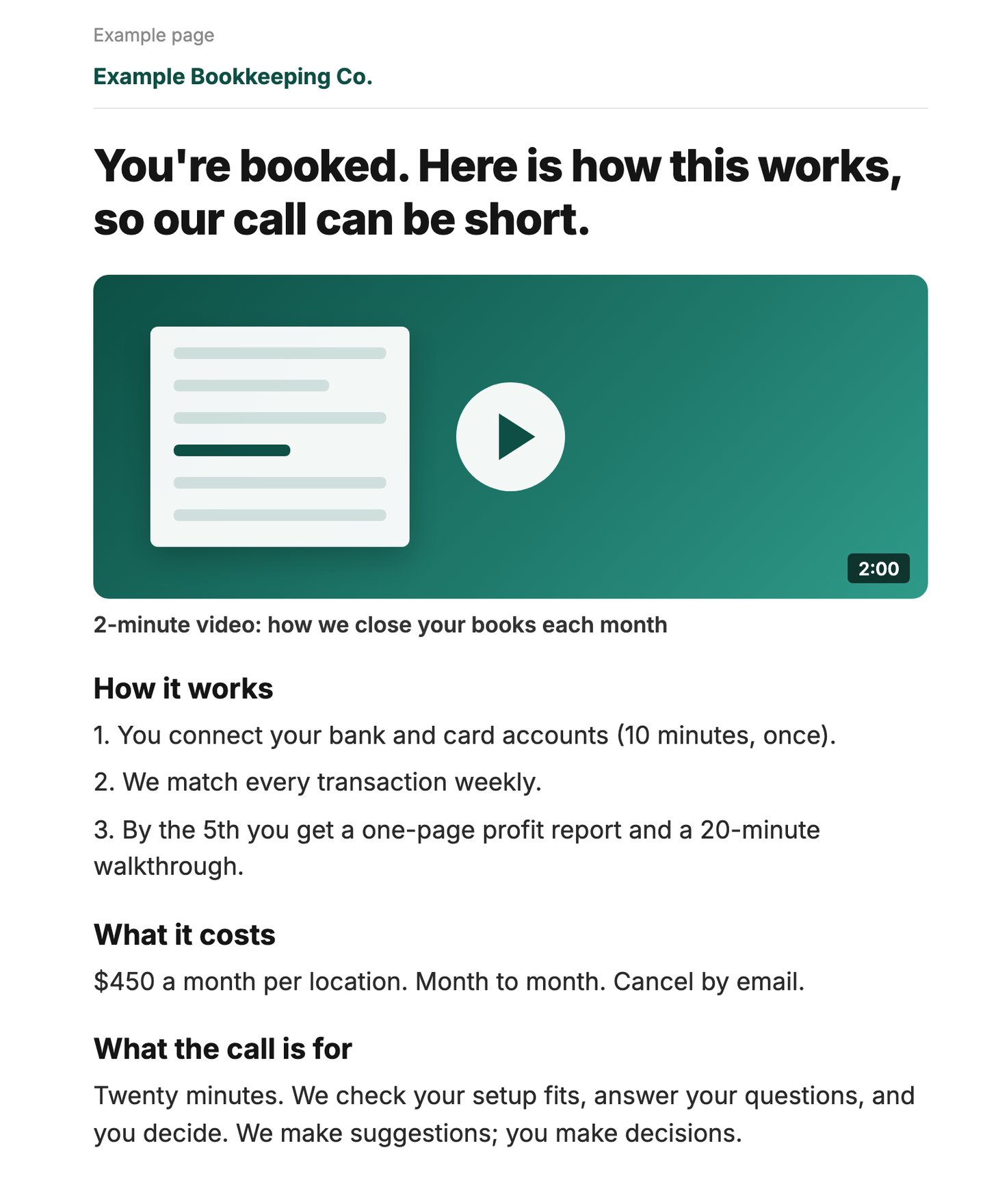
- A short video does the teaching before the call.
- How it works is learned here, not in minute 30 of the call.
- The price comes before the call. No surprise at the end.
- The call is for the promise and the math, and the buyer decides.
Example page built for this article with a made-up brand. The firm, steps and price are illustrative, not a real business or result.
Is "how much?" a buying signal?
Yes. A buyer who asks how much is usually ready to decide, not hunting for the cheapest deal.
Nobody asks the price of something they have no interest in. The question means they built their own reasons and want to check the math.
So answer it. Say the number straight. Then tell them what it is and what it does, without pushing.
Aim for value so clear that the buyer hears the price and thinks, "oh, that's it." Help them picture owning it. People value what they own more than what they might buy, a pattern called the endowment effect.
People feel a loss more than a gain of the same size, a pattern called loss aversion. So the price has to look small next to what they get, not just fair.
Watch how you price, too. If buyers must quit what they already pay for to join you, they face three hard things at once: leave, lose what they paid, and start over.
Collaborative pricing removes that. Price so they can keep what they have and add yours. Adding is easy to say yes to.
How to lose a ready buyer in four easy steps:
1. Hear "how much?" and decide they are cheap.
2. Dodge the number for twenty minutes.
3. Repeat the promise, louder.
4. Make them quit their current program to join yours. Call it commitment.
That is not selling. That is a hostage situation with a calendar link.
For objections that come after the price, see the take-away close.

Answer the price first, then explain what it is
| Dodge it | Answer it |
|---|---|
| "We'll get to that later" | Say the number in one sentence |
| Treats them as a bargain hunter | Treats them as ready to decide |
| Repeats the promise | Explains what it is and what it does |
| The buyer feels handled | The buyer feels respected |
Our five-step sales process.
Collaborative pricing turns a hard swap into an easy add
| Competitive pricing | Collaborative pricing |
|---|---|
| "Join us instead of what you have" | "Keep what you have and add us" |
| They must quit, lose what they paid, and start over | They add one thing |
| A replace decision | An add decision |
Our five-step sales process.
Everything you buy runs the same five steps
Everything you have ever bought went through these five steps. A car makes it easy to see.
You see an ad, and something in it is different. A question opens in your head. You go learn, and part of learning is the test drive.
Then comes the promise, the brand's one-line claim about what the car is. Then the deal, where the math starts: does it fit the budget?
Now run your own offer through the same five rows. Which step is weak?
If the weak step is the close, read the stacked close. If it is the wrong buyer, start with qualifying before the call.
A car purchase runs all five steps
| Step | When you buy a car |
|---|---|
| Awareness | An ad that looks different from the others |
| Attention | A question opens that you want answered |
| Education | You read up, then take a test drive |
| The sale | The brand's one-line promise about the car |
| The close | The math: does it fit the budget? |
Our walk-through of the five steps.
Grade your next sales call with AI
Paste the prompt below into your preferred AI, with notes from one recent call. It sorts what happened into the five steps. Then it tells you which job was missing: the sale or the close.
It never invents numbers or quotes. It works only from your notes, and it says when the notes are too thin to judge.
Want a second opinion on what it finds? Send it to us.
Paste into your preferred AI with notes from one call. It scores the five steps, then tells you whether the sale or the close was missing.
Act as a sales coach. Grade one sales conversation with the five-step sales process, and find which job was missing at the end: the sale or the close.

Ask me one at a time, with the example:
1. What do you sell, and at what price? (Example: monthly bookkeeping, $450 a month)
2. Who was the buyer? (Example: owner of two restaurants)
3. Paste notes or a transcript from the conversation. (Example: my notes from a 40-minute call)
4. How did it end? (Example: "let me think about it")

Use only what is in my notes. Never invent quotes, numbers or outcomes. If the notes are too thin to judge a step, say so.

The five steps:
- Awareness: did they notice something different about us?
- Attention: did a question open that they wanted answered?
- Education: did they learn what it is and why it works? Did that happen before the call or on it? Teaching on the call drains the energy they need to decide.
- The sale: did they accept a promise we can keep? Signs: they named the problem out loud, or asked us to sell to them.
- The close: did they justify the price? Look for the trade-off math: what else the money could buy, what happens if it fails, who else lives with the decision, who gets blamed.

Rules:
- Desire plus justification equals action. Say which one was low.
- "How much?" is a buying signal. Check that I answered it straight, then explained what it is.
- Pricing that makes them replace something is harder to say yes to than pricing that lets them add.
- Never suggest pressure, fake deadlines or fake scarcity. Suggest; let the buyer decide.

Show your reasoning, then answer:
Step scores (strong / thin / missing): Awareness, Attention, Education, Sale, Close
The missing job: sale or close, with the evidence from my notes
My promise in one sentence, rewritten so I can keep it
The trade-off the buyer was weighing
Next three actions: 1. 2. 3.
What to do this week
1. Write your promise in one sentence. Cut anything you cannot keep.
2. Move the how-it-works part out of the call. Put it in a page or email they see first.
3. On your next call, answer "how much?" in one breath. Then ask what they would give up to buy it.
Remember the buyer who said it sounds amazing, then went quiet? They bought the promise. Nobody helped them with the math.
The promise makes them want it. The math lets them buy it.

Filip Kovacevic is the founder of Anar Agency in Phoenix. He spent five years running SEO, Meta ads, email, and content for medical practices across the United States, and now does the same work for healthcare, home-service, legal, and professional-service businesses, alongside AI implementation. More from Filip →
Talk it through in 15 minutes
Bring one question from this article. We will tell you what we would do, whether or not you hire us.
Book a 15-Min Chat →