Customer Trust Cycles: Why Every Sale Spends Trust
A customer trust cycle means building trust before you ask for money, then rebuilding it after. Every ask spends trust. So does a sale, because a new buyer does not know yet if it will work.
Alternate help weeks with sales weeks timed to payday, and rebuild after every sale.
Why your email list stopped buying
Picture a list that gets an offer every single day. Week one, the money is great. Week three, nobody buys anything.
It was the same list with the same offers. It had simply stopped buying.
For example, one dating-advice business mailed its list a new partner offer every day. It made good money, then the list stopped buying within about three weeks.
What happened? The list ran out of trust. Every offer took a little, and nothing put any back.
This guide fixes that with a customer trust cycle. You put trust in with help. You take it out with an ask.
Then you put it back before you ask again. That is the whole loop.
We call the balance the Trust Budget. The Trust Budget is how much trust your audience has left before your next ask.
The same dating business later ran its list this way. The dead list started buying again.
Constant asking burns a list; trust cycles keep it buying
| An offer every day | The Trust Budget |
|---|---|
| Every email asks for money | Help weeks with no ask, then a sales week |
| Sends whenever there is something to sell | Sales week lands on payday |
| Email tries to sell the whole product | Email sells one idea; the page sells the product |
| Next offer goes out right after a sale | New buyers get help before any new offer |
| New leads hide the decline | Old subscribers keep buying |
Our comparison of the two approaches.
Every sale spends trust, even the ones that work
A sale spends trust too. This is the part most people miss.
The buyer paid. But they do not know yet if it will work for them. Until it does, they carry a doubt.
That doubt is common enough to have a name: buyer's remorse, the regret that can follow a purchase.
So right after a sale, trust is at its lowest. That is exactly when most businesses send the next offer.
Our verdict: that is not follow-up. It is asking again when the trust is already used up.
Think of trust as a bank account. Help is a deposit. Every ask is a withdrawal, whether the reader says yes or no.
The product refills the account. If it works, trust comes back, and the next ask has something to spend.
Big brands spend less trust per sale. The buyer of a famous watch gets the status the day they buy it. They do not wait to see if it works.
Proof from other buyers does the same job. When many people already use a thing, buyers trust it sooner, a pattern called social proof.
Most small businesses have neither. Their buyer has to wait for the result. So they must rebuild trust on purpose.
Every ask is a withdrawal, including the sale itself
| What you send | Deposit or withdrawal | Why |
|---|---|---|
| A useful tip with no ask | Deposit | They got something and gave nothing |
| A small test that works | Deposit | They checked you, and you were right |
| An offer they ignore | Withdrawal | It still cost attention and belief |
| An offer they buy | Withdrawal | They do not know yet if it will work |
| Help to use what they bought | Deposit | The product starts proving itself |
The Trust Budget, as set out in this guide.
Give, test, ask on payday, rebuild, then repeat
- Remove distrust Say what is free and when the offer comes
- Give and test Help weeks, each with a small test they can pass
- Ask on payday One sales week that sells an idea
- Rebuild Help every new buyer use what they bought
The Trust Budget treats an audience's trust like a bank account. Help with no ask is a deposit; every ask is a withdrawal, and so is every sale, because a new buyer does not know yet if it will work. Remove distrust first, make each message a small test the reader can pass, put sales weeks on payday and help weeks between them, sell the idea in the email and let the page sell the product, and rebuild with every new buyer before the next offer.
Then repeat.
Why do email lists stop responding? New leads hide the drop
Email list fatigue means your list is tired of your offers. It rarely shows up on a chart, because new leads hide it.
Every week, fresh names replace the people who quietly gave up. Revenue looks flat. With healthy trust, it would be climbing.
Stop adding leads for a month and the truth shows up. The old list barely buys.
For example, one business that bought leads by the million found each lead earned money for about 45 days. After that, people got tired of being asked.
Here is why that matters. As a rough rule, only about 1 in 10 people on a list will ever buy.
On a list of 100,000, that is about 10,000 buyers. The other 90,000 are where growth comes from.
Every customer you have was once in that 90 percent. The help weeks exist to turn more of them into buyers. Constant asks only squeeze the 10 percent.
Keeping buyers coming back is called customer retention. New leads cover for bad retention, right up until you stop buying them.
How to kill a list in three weeks, in four easy steps:
1. Mail an offer every day. Call it staying top of mind.
2. Treat opens as proof that people still care.
3. When sales drop, split test three more subject lines.
4. Buy more leads so the revenue chart stays flat. Then call flat a win.
That is not list management. It is a countdown to a dead list.
Example: on a list of 100,000, about 90,000 have not bought yet
About 1 in 10 people on a list ever buy. The rest are where growth comes from.
- People on the list 100000
- About 1 in 10 who buy 10000
- The ones help weeks work on 90000
Worked example of the 1-in-10 rule of thumb. The math is ours.
Example: a list mailed daily offers went quiet in about three weeks
- Daily partner offers Week 1 Good money from the first mailings
- Sales stop Weeks 2 to 3 The list stops buying almost entirely
- Help weeks added After Help and tests first, then sales weeks; the list buys again
Example from another business. Not our results, and not verified by us. No figures were shared for the revival.
Remove distrust before you try to build trust
Your reader has been sold to before. Probably this week.
Free training? They wonder where the pitch is.
A free call? Same question.
People can guess what you want from them better than you think. Others used the same webinars, videos and booking pages, and many used them badly.
So the first job is to remove distrust. Say what is free, what is paid, and when the offer comes. Here is where to put the offer and how to label it.
Then check six kinds of trust. A buyer needs all six before they pay.
They trust that you are the real deal. They trust the product works. They trust they will get the outcome.
They trust it is not a scam. They trust other people use it. And they trust themselves to use it.
That last one is the highest form of trust. It is also the one most offers ignore.
Plenty of buyers have paid for three courses and finished none. They did not stop trusting the sellers. They stopped trusting themselves.
Psychologists call this self-efficacy: a person's belief that they can do what it takes to reach a goal.
So a good help email does not only prove you. It proves to the reader that they can do it. More on the four sources of credibility.
A buyer needs six kinds of trust, and trust in themselves sits at the top
- You are the real deal You do what you say you do
- The product works It does what it claims
- They will get the outcome It works for people like them
- It is not a scam No trick waiting after the sale
- Others use it Real people already get results
- They trust themselves They believe they will actually use it
The six kinds of trust in the Trust Budget, bottom to top.
Make every email a test the reader can pass
The fastest way to earn trust is to invite a test, then pass it.
Give the reader one small thing to try today. If it works, they trusted you a little, and you were right.
For example, one dating-advice business gave readers exact text messages to send. Readers sent them and got replies. Test passed.
Small and fast beats big and impressive. A test that takes a weekend will not get done.
Everything you send is a test. The free content is a test. The email is a test.
The product is the biggest test of all. That is why the rebuild after a sale matters so much.
This is giving before you get. People tend to return a favor, a pattern called reciprocity.
Most direct marketing runs it backwards. Ask first, give later. Then marketers wonder why so few people buy.
Need a starting point? Our examples for five kinds of business are in the table below. Use them as a pattern, not a script.
For a full help-first sequence, see eight nurture emails, written out. For new leads, read follow-up that gives before it asks.
A good test is small, fast and easy to check
| Business | Test to send in a help week | How they know it worked |
|---|---|---|
| Guitar lessons | A 5-minute warm-up for one hard chord change | The change is smoother tonight |
| Bookkeeping service | A three-line check for duplicate bills | They find or rule out one in ten minutes |
| Dog trainer | One cue to stop pulling on the leash | The next walk is calmer |
| Local roofer | What to photograph after a storm | They have the photos a claim asks for |
| Online store | A sizing check with a tape measure | They order the right size the first time |
Our examples, written for illustration. Not results.
A help email gives one small test, shows how to check it, and asks for nothing
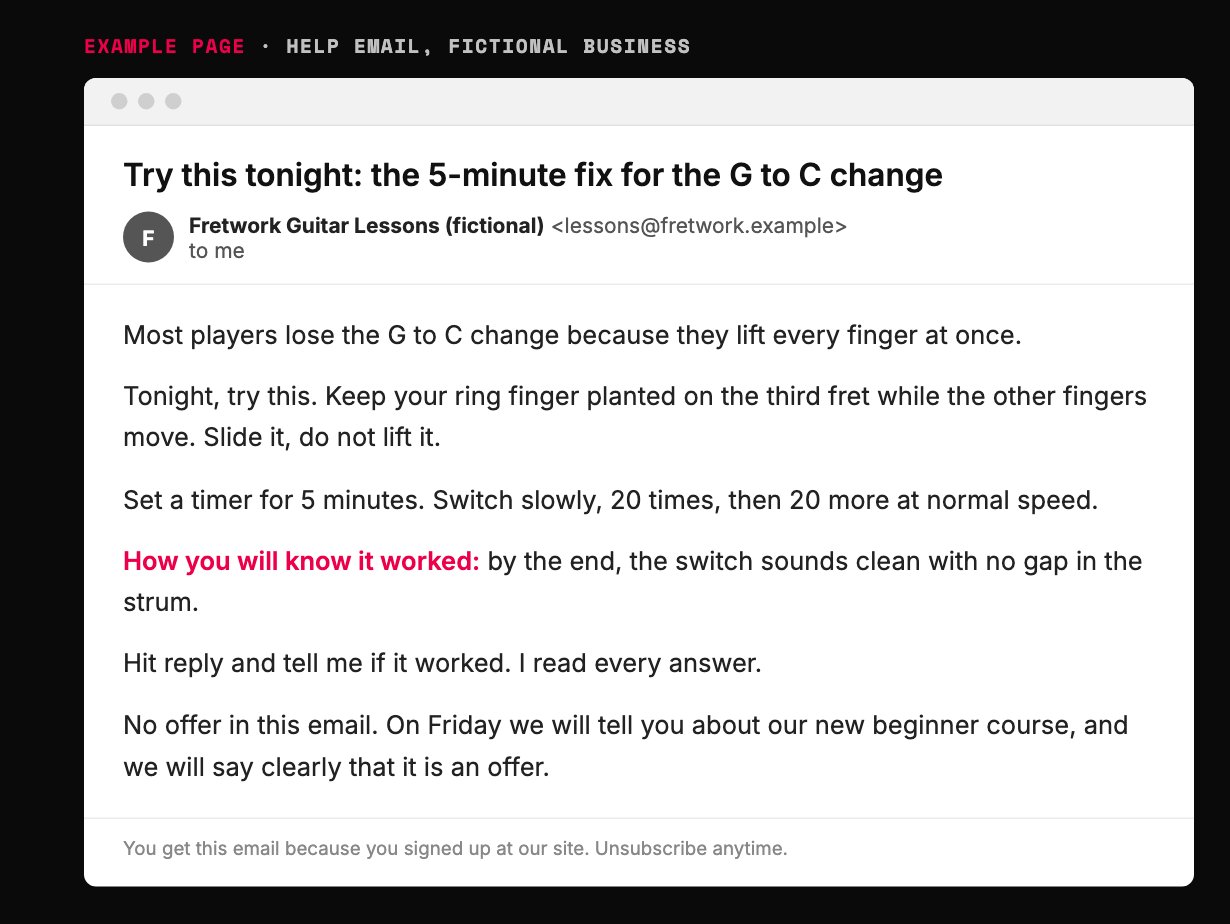
- One small thing the reader can try today.
- Short. A test that takes a weekend never gets done.
- The reader can check the result on their own. That is the test.
- Invites a reply, not a purchase.
- Names the next offer and when it comes, so there is nothing to suspect.
Example page built for this article with a made-up brand. No results are claimed
When should you send the sales email? On payday
Put the sales week where the money is. People buy when the paycheck lands, not the week before.
So map when your buyers get paid. It depends on who they are and how they work.
In a federal survey of US employers summarized on the Payroll page, every two weeks was the most common pay schedule, at 45.7 percent. Weekly came next, at 31.8 percent.
Then build the month around it. Help week, payday sales week, help week, and repeat.
Most buyers paid every two weeks? Then it is one help week and one sales week, in turns.
Not sure when they get paid? Ask a few customers. It is a fair question.
In the sales week, sell the idea, not the product. The email's job is to make the idea wanted and earn the click.
The page does the selling. An email has no room for the full case, the price, the details and the proof.
For example, one business could not make a single sale from email. It switched to selling one idea per email and letting the page close, and daily sales followed.
How many asks a month is too many? See how often to sell to your audience without wearing it out.
Every two weeks is the most common US pay schedule
Share by pay frequency in a federal survey of US employers
- Every two weeks 45.7
- Weekly 31.8
- Twice a month 18.0
- Monthly 4.4
Source: BLS Current Employment Statistics survey, February 2022, as summarized in Wikipedia, Payroll.
Example: buyers paid every other Friday get help weeks between paydays
| Week | Type | What goes out |
|---|---|---|
| Week 1 | Help | Three useful emails, each with one small test |
| Week 2 (payday Friday) | Sales | One idea per email; the page sells the product |
| Week 3 | Help | Results from readers, one new test, no ask |
| Week 4 (payday Friday) | Sales | A new idea, the same offer page |
Example calendar built from the method. Send counts are an example, not a rule.
The email sells the idea; the page sells the product
| The email | The page |
|---|---|
| Makes one idea wanted | Shows the full product |
| Earns the click | Earns the sale |
| No price, no full case | Price, details and proof |
| Short enough to read in a minute | Long enough to answer every question |
The Trust Budget, sales week rules.
After the sale, rebuild before you ask again
A new buyer is the most fragile person on your list. They paid, and the doubt is fresh.
So a sale starts a help cycle, not another sales cycle. Our rule: no new offer to a buyer until they have used what they bought.
First, confirm what happens next. What they get, when, and who to contact.
Second, help them use it. One small step they can finish fast. That is the product passing its first test.
Third, show the result. Their own, or a real one from someone like them.
Fourth, ask how it went. Fix what is not working. Then they rejoin the normal cycle.
Subscriptions work the same way, with one twist. Billing is automatic, so the whole membership is one long help cycle. Your job is to keep delivering.
Some products need the buyer to act, like a course or coaching. That is active. You must stay active too.
Others just run in the background, like software someone pays for and rarely opens. That is passive. More on why members stay or cancel.
Each rebuild also raises what a buyer is worth over time, their customer lifetime value. A buyer who trusts you buys again.
Rebuild trust with every new buyer before the next offer
- 1. Confirm what happens next What they get, when, and who to contact.
- 2. Help them use it One small step they can finish fast.
- 3. Show the result Their own, or a real one from someone like them.
- 4. Ask how it went Fix what is not working, then rejoin the normal cycle.
Our rebuild steps for new buyers.
Active products need active help; passive ones need steady delivery
| Active | Passive |
|---|---|
| The buyer must do work to get value | Value arrives with little effort |
| Courses, coaching, programs | Software or services that run in the background |
| You stay in touch often | You keep delivering and stay out of the way |
| Trust drops when they stall | Trust drops when the service slips |
The Trust Budget, applied to subscriptions.
How to revive a dead email list
A dead list is usually a tired list. It can come back.
Step one: stop all offers. No soft pitches either.
Step two: run a help cycle. Useful emails, each with one small test the reader can pass.
Step three: wait for payday. Then run one sales week that sells the idea and lets the page close.
Step four: go back to help. Then repeat, and track sales for each sales week.
The same cycle works on every channel: email, podcasts, video, social posts and groups. Plot your help and sales on each one. Look for the rhythm where people keep buying.
Most list advice tunes one email at a time. That never asks whether the list has any trust left to spend.
While you rebuild, watch your spam complaints, because they show trust running out. Gmail and Yahoo both publish a spam complaint limit. The Gmail sender guidelines and Yahoo sender best practices are in the box below.
A complaint is trust going below zero. That reader is not saying no. They are saying stop.
Stop the asks, rebuild, then sell on payday
- 1. Stop all offers No soft pitches either.
- 2. Run a help cycle Useful emails, each with a small test.
- 3. Sell on payday One sales week that sells the idea.
- 4. Back to help Repeat, and track sales per sales week.
The Trust Budget, applied to a tired list.
Keep spam reports under 0.10 percent and never reach 0.30 percent
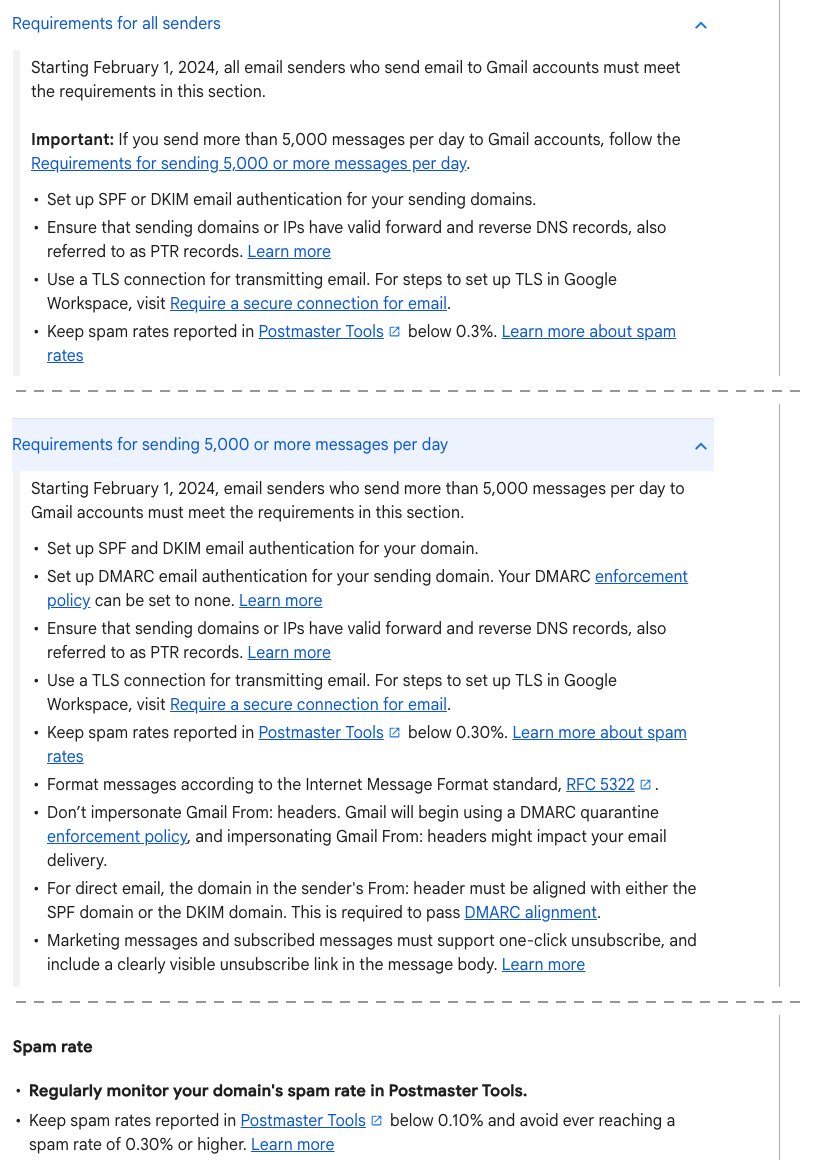
- The hard line for every sender: under 0.3 percent spam reports.
- The target is lower: under 0.10 percent.
- Free Google tool where you read your own spam rate.
- Big senders must let readers leave in one click.
- A visible way out costs less trust than a spam report.
Screenshot of Google's Email sender guidelines help page, taken 2026-10-17
Plan your next month with AI: the copy-paste prompt
Paste the prompt below into your preferred AI. It asks five questions, sorts your last emails into help and asks, and builds a month of sends around payday.
It never invents a number. If it needs a figure you did not give, it asks.
Read the calendar before you use it. You know your buyers. It does not.
Want more from the list itself? Read email as the profit center of a service business.
Paste into your preferred AI. It asks five questions, sorts your last emails into help and asks, and builds a calendar around payday.
Act as an email planner. Build a one-month Trust Budget calendar for my list.

Ask me one at a time, with the example:
1. What do you sell, and to whom? (Example: online guitar lessons, $39 a month, adults learning at home)
2. How big is your list, and how often do you send now? (Example: 8,000 people, 5 emails a week)
3. When do most of your buyers get paid? If I do not know, help me guess from who they are, and mark it as a guess. (Example: most are paid every other Friday)
4. Paste or describe your last 10 emails. (Example: subject line plus one line on each)
5. What small thing could a reader try today and see work? (Example: a 5-minute warm-up that fixes one chord change)

Rules:
- Label each past email Help (no ask) or Ask (any offer, even a soft one). Tell me my ratio.
- Every ask spends trust, and so does every sale, because a new buyer does not know yet if it will work.
- Help weeks: useful emails with no ask. Each one carries one small test the reader can try and see work.
- Sales weeks: start on payday. Each email sells one idea and earns the click. The page sells the product.
- After every sales week, go back to a help week.
- Recent buyers get no new offer until they have used what they bought.
- Say plainly what is free and when an offer is coming. No fake deadlines, no fake scarcity.
- Never invent a number. If you need a figure I did not give, ask me.
- If you can browse, check Gmail's and Yahoo's current sender guidelines and tell me their spam complaint limits.

Show your reasoning, then answer:
My ratio: Help / Ask
Payday: [date pattern, and whether it is a guess]
Calendar: week by week, each email with a subject idea, its type (Help or Ask), and the test or idea it carries
What to watch: spam complaints, unsubscribes, replies, sales per sales week
Next three actions: 1. 2. 3.
Run it this week
1. Run the prompt. Sort your last month of emails into help and asks.
2. Find your buyers' payday. Move your next offer to that week.
3. Before then, send one help email with a test the reader can pass.
Remember the list that died in three weeks? It came back the same way. Help first, then one clear ask on payday.
Give first, and you earn the right to ask again.

Filip Kovacevic is the founder of Anar Agency in Phoenix. He spent five years running SEO, Meta ads, email, and content for medical practices across the United States, and now does the same work for healthcare, home-service, legal, and professional-service businesses, alongside AI implementation. More from Filip →
Talk it through in 15 minutes
Bring one question from this article. We will tell you what we would do, whether or not you hire us.
Book a 15-Min Chat →