Why Your Ads Aren't Converting: The Conversion-First Audit
Ads usually fail to convert because the system behind the click has a gap, not because the traffic is wrong. Anyone with a credit card can buy clicks. Before you buy more, check five things in order: your offers, their order, your pages, your follow-up and your tracking.
Fix the first gap you find.
Why are my ads not converting? Usually it is not the traffic
An owner tells us leads are slow. So they want more traffic. A bigger budget, a new channel, a wider audience.
Here is the catch. Traffic is the one thing anyone can buy, any afternoon, with a credit card.
So why are your ads not converting? Something after the click is broken. More traffic finds the break faster, at a higher price.
For example, one health-education brand grew from about $12 million a year to $32 million, then $54 million. It bought less paid traffic while it grew. It made very few changes to its website.
What changed was what it sold, and in what order. Less traffic. Better system.
A conversion system is everything that turns a click into a customer: offers, pages, follow-up and tracking. This guide is the audit we run before we touch an ad budget.
Five checks, in order. Traffic comes sixth.
Slow leads look like a traffic problem. They are usually a conversion problem
| What owners ask for | What usually needs fixing |
|---|---|
| More budget | An offer that is missing or out of order |
| A new channel | A page that talks about the product, not the problem |
| A wider audience | Follow-up that starts tomorrow instead of now |
| Cheaper clicks | Tracking that counts leads instead of sales |
Our audit order. Traffic is the only input on the left that anyone can buy on demand.
Example: one brand grew more than fourfold while buying less paid traffic
Yearly revenue in millions of dollars, by its own account
- Before 12
- First year 32
- Second year 54
Example numbers from another business. Not our results, and not verified by us.
Name all four offers before you buy another click
Every funnel that works sells in steps. We name four of them.
The lead magnet is the free first value. It solves one problem the buyer already knows they have, and makes them feel smart. It can be the ad itself, a short video or a checklist.
The entry offer is a small first yes: a low-price tool, a paid diagnostic, a short call with a clear agenda. Its job is to turn a reader into a buyer. It is not there to make you rich.
The core offer is the service you actually sell. The high-value offer is what your best customers buy next: the retainer, the bigger scope, the yearly plan.
Open a blank page. Write each one in a single sentence.
Can you fill all four lines? If not, stop buying traffic.
Clicks you buy while a line is still blank are not marketing. They are gambling with a nicer dashboard.
The Four-Piece Gate is that one page. It names every offer you sell, in order, or says why you skip one. You fill it in before you spend on ads.
Why does a blank line hurt so much? Because the sales that come later pay for the ads that bring people in. For example, picture a lead that costs $30 and a first sale worth $22.
You lose $8 on every lead. Now add a $3,000 core offer that 3 of every 100 leads buy. That is $9,000 per 100 leads, or $90 per lead.
Same ads. Different business. What a buyer is worth over time is called customer lifetime value, and it decides how much you can spend to win a customer.
Four offers, each one earning the right to the next
- Lead magnet Free first value. Solves one known problem and makes the buyer feel smart.
- Entry offer A small first yes. Turns a reader into a buyer.
- Core offer The service you actually sell.
- High-value offer What your best customers buy next.
Our method. Name each one in a sentence, or skip one on purpose and write down why.
Example: the same $30 lead loses $8 or earns $90, depending on what you sell next
| What you sell | Earned per lead | Cost per lead | Result per lead |
|---|---|---|---|
| Only the $22 first sale | $22 | $30 | Lose $8 |
| Plus a $3,000 core offer, 3 buyers per 100 leads | $90 more | $30 | Earn $82 after the $8 loss |
Worked example with made-up round numbers: $3,000 x 3 / 100 = $90 per lead. The math is ours.
Before you buy traffic, write your lead magnet, entry offer, core offer and high-value offer in one sentence each. A blank line means stop and fill it, unless your market skips the middle offer on purpose (executives, high earners, big life decisions) and you write down why. Then audit in order: the order of the offers, the pages, the follow-up and the measurement.
Traffic comes last, small, one change at a time.
Some markets should skip the middle offer
Four pieces is the default, not a law. Some buyers will never buy a small first offer. Selling one to them draws the wrong crowd.
Executives are the clearest case. A company leader will pay $5,000 or $10,000 for an audit and not think twice. The same person will not buy a $27 guide.
Why not? They do not fix problems themselves. They hire the best person to fix them.
For example, one consultant sells growth audits from about $2,500. Between his book and that audit, he sells nothing at all.
Owners whose businesses bring in $20,000 a month or more often act the same way. Teach them, show a video that builds belief, then book a call. A cheap course would only attract fans who never pay.
People facing big life decisions skip it too. A retiree moving $750,000 of savings is not buying a $7 offer first. Their path is a free guide, a contact form and a call with a real person.
So here is our rule: the bigger the decision, the longer the path. A $5 product goes straight to checkout. A $500 offer gets a short page that builds the case first.
Skipping the middle on purpose is fine. Skipping it by accident is not. Write the reason on the gate page, next to the empty line.
Is your entry offer a paid diagnostic? Read how to turn an audit into a lead magnet before you price it.
The bigger the decision, the longer the path
| The decision | Example | The path |
|---|---|---|
| Small | A $5 tool | Ad, then straight to checkout |
| Considered | A $500 offer | Ad, a short page that builds the case, then checkout |
| Big | Moving $750,000 of retirement savings | Ad, free guide, contact form, a call with a person |
Our rule. Prices are examples.
Some buyers will never buy a small first offer
| Buyer | Will buy | Will not buy | Path instead |
|---|---|---|---|
| Company executives | A $5,000 to $10,000 audit | A $27 guide | Diagnostic or consultation |
| Owners earning $20,000 a month or more | A call about their business | A cheap course | Teach, video, book a call |
| Retirees with large savings | A guide and a conversation | A $7 offer | Guide, form, a person |
| Most buyers paying their own money | A small first offer | A big first ask from a stranger | All four pieces |
Our rule. Example price points.
Put the offers in order, and cut steps that only cost money
The right offers in the wrong order still fail. Each step should create the need for the next one.
The free value should point at the method the entry offer sells. The entry offer should reveal the bigger problem the core offer solves.
For example, one seller could move $7 products all day. His upsells converted at 5 percent, then 3 percent. He blamed the traffic.
The real cause? He filled the upsell slots with whatever other products he had. None of them followed from the first purchase.
Our take: an upsell should be the next step, not the rest of the warehouse. More on offering the next problem's fix.
Order also tells you about trust. A buyer who makes about three small purchases in 30 days tends to buy what comes next. A buyer who takes the $7 offer and never the $200 one has a trust problem, not a price problem.
Now cut the steps that only cost money. Say a click costs $2 and half the visitors fill in your opt-in form. Each person who reaches your offer now costs $4.
If the ad already gives away the useful idea, skip the form. Send the click straight to the entry offer. A form with nothing new behind it is a toll booth on an empty road.
More on building that small first step in quick-win offers.
Example: an opt-in form doubles what it costs to show your offer
- Cost per click 2
- Visitors who fill in the form 50
- Cost per person who sees the offer 4
Worked example: $2 / 0.50 = $4. The math is ours.
An upsell should be the next step, not the rest of the warehouse
| Random upsells | Next-step upsells |
|---|---|
| Every other product you own | The one thing the first purchase makes them need |
| The buyer has to guess why | The reason is obvious from what they just bought |
| Example: 5 percent, then 3 percent take rates | Each yes makes the next one easier |
| Owner blames the traffic | Owner fixes the order |
Our comparison. Take rates are one seller's example, not verified by us.
Does your page talk about the problem or the product?
Pages that sell talk about the problem the visitor feels. Pages that fail talk about the product.
Most pages lead with features because features are easy to write. Easy is a bad reason to write anything.
Check every page and ad for six faults.
Features first: it lists what the product is. Explaining too early: it explains how it works before the visitor cares.
A buy button above the headline: nobody buys before they know what it is. A generic headline: any competitor could use it word for word.
An early ask: it asks for the sale before the visitor feels understood. Product testimonials: reviews praise the product, not the change in the buyer's life.
For example, one company runs small karaoke nights hosted by real Broadway performers. Describe it as an hour on the subway to sing with strangers for $1,000, and it sounds like a punishment. Describe it as a night singing with the stars of the shows you love, and it sounds like a dream.
Same night. Same price.
One pitch sells a chore. The other sells a story the buyer will tell for years.
The ask must fit the offer, too. An ad that says $1 a month and then asks you to book a demo call feels wrong. Nobody books a meeting about a dollar.
Give each page one ask. Too many options make people put off the choice. We go deeper in problem pages and ad-to-page alignment.
Then check the form. Baymard's cart abandonment research finds that about 70 percent of online shoppers leave a cart without paying, averaged across 50 studies. Watch engagement rate to see which pages lose people early.
Six faults that make a page talk about the product instead of the problem
| Fault | How to spot it | The fix |
|---|---|---|
| Features first | The first screen lists what it is | Open with the problem the visitor feels |
| Explaining too early | How it works comes before why it matters | Show the cost of the problem first |
| Buy button above the headline | An ask before any reason | Move the button below the case |
| Generic headline | A competitor could sign it | Write a line only you can say, to one person |
| Early ask | The sale comes before understanding | Ask once they feel understood |
| Product testimonials | Reviews praise the packaging | Use reviews about the buyer's change |
Our page checklist. Applies to ads, landing pages and thank-you pages.
One pitch sells a chore. The other sells a night they will talk about for years
| Product-first | Problem-first |
|---|---|
| An hour on the subway | Sing with the stars of the shows you love |
| Sing with strangers | A small room where everyone gets a verse |
| $1,000 and a day off work | A night you will tell people about |
| Bring a friend for safety | Bring a friend to share it |
Example: a small-group karaoke night with Broadway performers, pitched two ways.
Five page faults in one scroll, and every one talks about the product
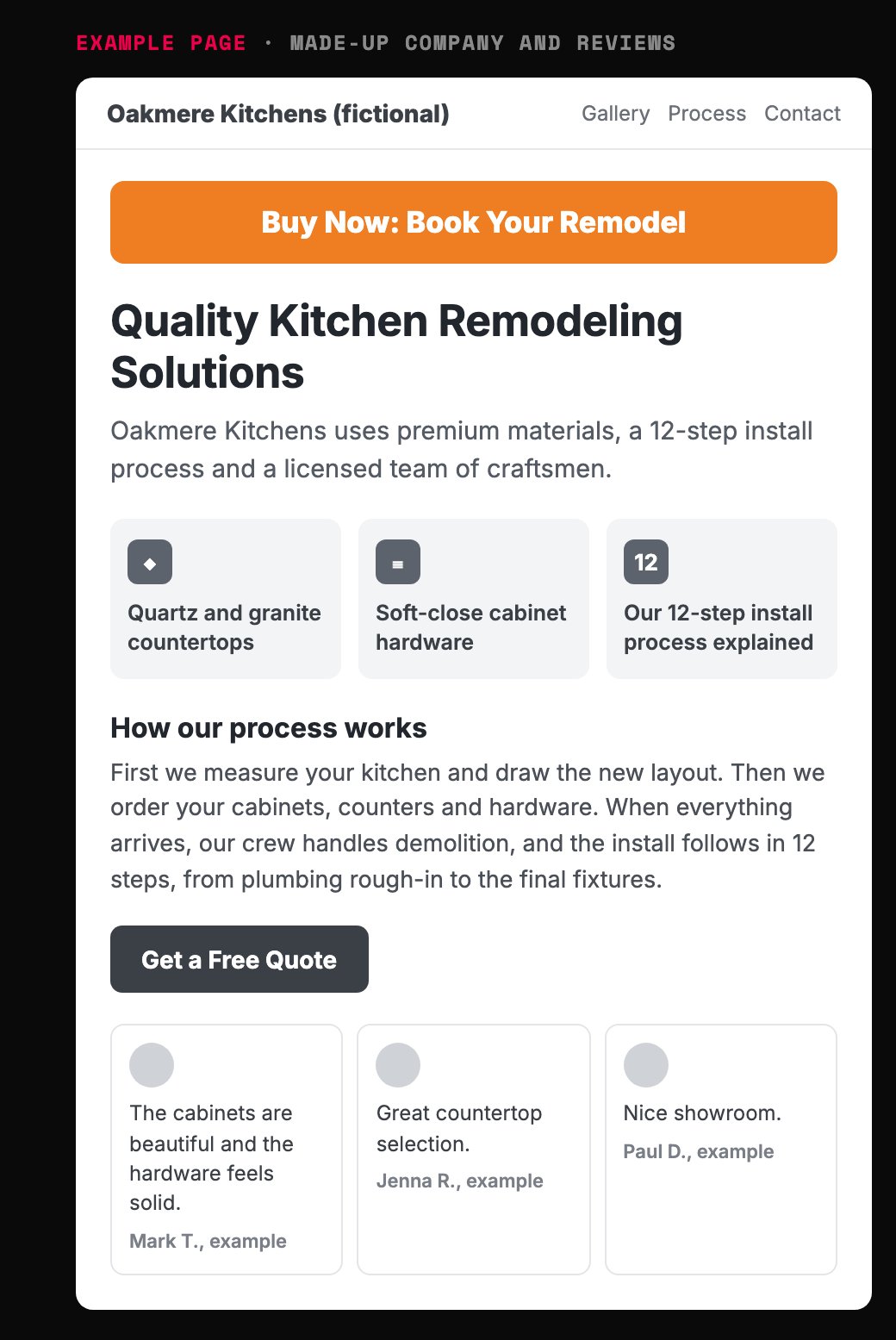
- An ask before any reason. Nobody buys before they know what this is.
- Any competitor could sign this headline.
- Features first. It lists what the product is, not the problem the visitor feels.
- Explaining too early. How it works, before the visitor cares why it matters.
- These reviews praise the cabinets. None says what changed for the buyer.
Example page built for this article with a made-up company. The reviews and names are fictional and labeled as examples
Answer every lead fast, then answer every objection
Speed comes first. A Harvard Business Review study of online leads found that firms that tried to reach a lead within an hour were nearly seven times as likely to have a real conversation as firms that waited longer. Of 2,241 companies tested, 23 percent never replied at all.
Meta's own advice on responding to leads also puts speed first. Our guide to speed to lead covers the setup.
Next, the people who did not buy. Do not show them the same ad again. If it did not convince them once, five more views will not either.
List the top reasons people say no: price, trust, timing, fit. Make one ad for each reason. Show them in order, only to visitors who did not buy.
Ads shown to people who already visited are called retargeting. This way, the retargeting has a plan. Random follow-up gets random results.
Then email the list you already have. These people know you, and reaching them costs almost nothing.
For example, one large online store showed a month of about $1.8 million in sales on about $1 million of ad spend. It said email was what kept that month from losing money. That is one store's account, and a store is not a service business, so we would not treat it as a benchmark.
The idea still holds for most businesses. When paid ads only break even, email to people who already know you is the cheapest place to find profit. Here is how to turn your list into a profit center.
Nearly a quarter of companies never answered a web lead at all
How fast 2,241 US companies responded to a test lead from their website
- Within an hour 37
- 1 to 24 hours 16
- More than 24 hours 24
- Never 23
Source: Harvard Business Review, The Short Life of Online Sales Leads (2011).
Follow up in minutes, then with one ad per objection
- 1. Reply in minutes Leads reached within an hour were nearly seven times as likely to talk.
- 2. List the reasons people say no Price, trust, timing, fit.
- 3. One ad per reason Each ad answers one objection. Never the same ad again.
- 4. Show them in order Only to visitors who did not buy.
- 5. Email your list On a schedule. The cheapest sale you have.
Our follow-up order. Speed figure: Harvard Business Review (2011).
Retarget with one ad per objection, in order, never the ad that already failed
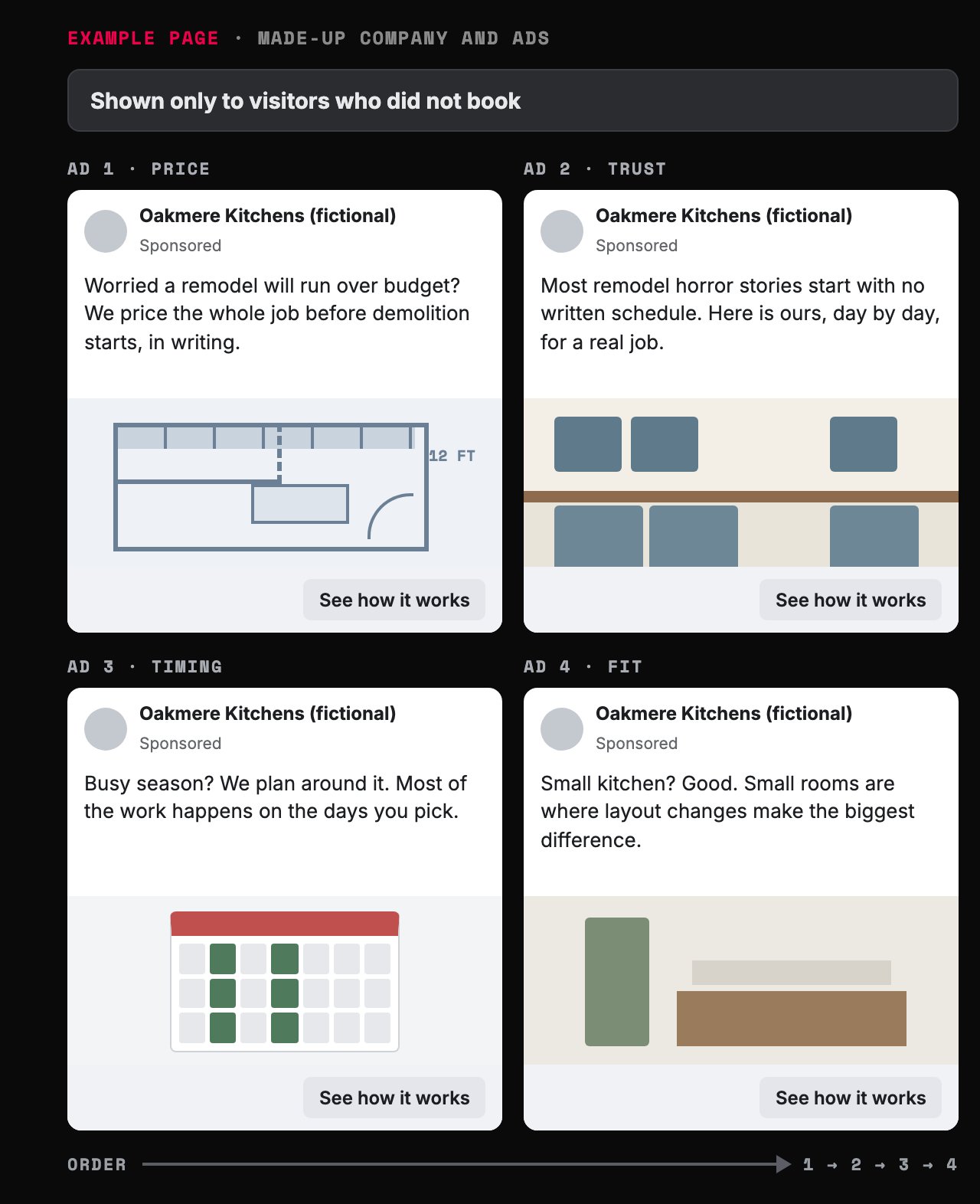
- Only people who visited and did not buy see these.
- One ad, one objection. This one answers price.
- Answers trust with something the buyer can check.
- Shown in order, not at random.
- None of these is the ad they already ignored.
Example page built for this article with a made-up company and made-up ad copy. No numbers shown
Count the sale, not the lead
Measurement is the check that quietly breaks the other four. Pick one action that counts as a conversion: a form, a booked call or a sale.
Set it up as a key event in your analytics and as the same conversion in your ad platform. If the two tools count different things, you are steering with two maps.
Then send the sale back to the ad platform. A lead who buys two weeks later is invisible to the ad platform unless you tell it. Google lets you import offline conversions, and Meta lets you connect a CRM.
Expect a lag. Many buyers see an ad and buy 14 to 30 days later, sometimes months later. Judge a campaign on last week's leads and you judge it too early.
Tools that track each buyer from first ad to purchase start to pay for themselves at about $1,000 a day in spend. Below that, a clean CRM and honest weekly counts do the job.
Google's funnel exploration report shows each step and how many people drop off. That report is the scoreboard for this audit.
Why does this matter so much? Until you send sales back, the platform only knows who filled in a form. So it finds more people who fill in forms, not more people who buy.
More on that in why Meta results are not leads and server-side conversion tracking.
The platform learns from sales only when you send them back
- Ad Someone clicks.
- Lead They fill in a form or book a call.
- CRM You record what happens next.
- Sale Often 14 to 30 days later.
- Send it back Offline import or a CRM connection tells the platform which leads paid.
Our measurement order.
Then buy traffic: small, and one change at a time
Now traffic makes sense. Start small.
A test does not need $20,000. At $50 a day you can learn two things: do people opt in, and do they buy the entry offer?
Write every result as a lesson. "We spent $5,000, made $25,000, and here is what we learned" is a test. "We spent $5,000" is a receipt.
Then change one thing at a time. For example, one event business sold a $497 ticket and made about 3.6 times its ad spend back.
It then raised the price to $997 and doubled the daily budget, from about $1,000 to about $2,000. Both changes went live together. Sales got worse, and nobody could say which change did it.
The fix was to go back to $497, let it settle, then raise the budget alone. Our one-variable testing guide and Google Ads budget guide cover the rest.
How to burn an ad budget in four easy steps. Step one: decide your problem is traffic. Step two: double the price and the budget in the same week.
Step three: send every click to an opt-in form with nothing new behind it. Step four: show the people who said no the same ad five more times.
Congratulations. You paid a hell of a lot to learn what one blank page would have told you for free.
Example: two changes in one week, and nobody could tell which one broke the funnel
| Stage | Price | Daily ad spend | What happened | How sure |
|---|---|---|---|---|
| Steady | $497 | About $1,000 | About 3.6 times ad spend back | Example; not verified by us |
| Two changes at once | $997 | About $2,000 | Sales got worse | Example; not verified by us |
| The fix | Back to $497 | Hold, then raise alone | Planned: settle first, then one change | Advice, not a result |
Example numbers from another business. Not our results, and not verified by us.
A test ends in a lesson. A receipt ends in a number
| A receipt | A test |
|---|---|
| We spent $5,000 | We spent $5,000, made $25,000, and here is what we learned |
| $20,000 to find out | $50 a day to find out |
| Price and budget changed together | One change at a time |
| Bought before the audit | Bought after the five checks pass |
Our testing rules.
Run the conversion-first audit with AI this week
The prompt below runs the whole audit. Paste it into your preferred AI and answer its questions about your offers, pages, follow-up and tracking.
It does not guess. It stops at the first check that fails and tells you what to fix before you spend more.
This week: first, write your four offers on one page, or the reason you skip one. Second, run the prompt on your main funnel. Third, fix the first failed check before you raise any budget.
Want a second pair of eyes? Send us the result. You are not signing up for anything.
Back to the owner who asked for more traffic. The traffic was never missing. What was missing was a step after the click.
Clicks are for sale. Customers are built.
Paste into your preferred AI. It asks about your offers, pages, follow-up and tracking, then names the first gap and the fix.
Act as a conversion auditor. Audit my funnel in a fixed order and stop at the first check that fails. Use only my answers. Never invent a number, a result or a benchmark; if you need one, ask me.

Ask one at a time, with the example, and wait:
1. My free first value (lead magnet). (Example: a checklist of costly kitchen remodel mistakes)
2. My entry offer, or "none" and why. (Example: none, my buyers are executives who hire experts)
3. My core offer and its price. (Example: kitchen remodel, from $40,000)
4. My high-value next offer. (Example: a yearly home care plan)
5. The first screen of my ad and my landing page, pasted in.
6. What happens after a lead arrives: my first reply time, what non-buyers see next, how often I email my list.
7. What counts as a conversion in my analytics and in my ad platform, and whether closed sales get sent back.
8. My daily ad spend and the last change I made to the funnel.

Checks, in order:
1. Gate: all four offers named in one sentence each. A missing entry offer passes only if my buyer is an executive, a high earner or facing a big life decision, and I gave the reason.
2. Order: each offer creates the need for the next. Flag unrelated upsells. Flag an opt-in form in front of a low-price offer when the ad already gives the useful idea.
3. Page: problem before product, one call to action, no buy button above the headline, a headline only I could write, testimonials about the buyer's change, an ask that fits the price.
4. Follow-up: first reply within minutes, one ad per objection for non-buyers instead of the same ad again, regular email to my list.
5. Measurement: one conversion definition in both tools, sales sent back to the ad platform, a 14 to 30 day buying lag allowed for.
6. Traffic: only if checks 1 to 5 pass. Start small. Change one thing at a time.

Never suggest fake scarcity, fake reviews or hidden prices.

Answer in this format:
FIRST FAILED CHECK:
WHY IT FAILS:
THE FIX:
OTHER GAPS (in order):
TRAFFIC: buy more now, or wait, and why
NEXT THREE ACTIONS: 1. 2. 3.

Filip Kovacevic is the founder of Anar Agency in Phoenix. He spent five years running SEO, Meta ads, email, and content for medical practices across the United States, and now does the same work for healthcare, home-service, legal, and professional-service businesses, alongside AI implementation. More from Filip →
Talk it through in 15 minutes
Bring one question from this article. We will tell you what we would do, whether or not you hire us.
Book a 15-Min Chat →