Server-Side Conversion Tracking: Fix the Count, Then Teach the Platform

Server-side conversion tracking means your own server, not the visitor's browser, tells the ad platform when a conversion happens. It recovers events browsers lose to blockers, cookie limits and closed pages. It also sends what browsers never see, like a lead your sales team marked qualified, so the platform learns what a good lead is.
What is server-side conversion tracking?
Monday morning. The ad platform says you got 41 leads last week. The CRM says 52.
Sales says nine were real. Three numbers. None of them agree.
The ad platform spends your budget on the worst of the three. It learns from what it can see. It saw the least.
Server-side conversion tracking means your own system, not the visitor's browser, tells the ad platform what happened. It sends the events the browser lost. It also sends the ones a browser never sees, like a lead your sales team marked qualified.
Search the term and you mostly get server-side tagging, a tag manager that runs on your server. That is one way to build it. The idea is bigger.
A server-side event is a record your system sends straight to the ad platform. It says what happened, when, to whom, and carries one shared ID so it gets counted once.
This is the plumbing under the signal layer of the marketing engineer's map.
Glamorous? No. It touches money on day one.
Each tool counts something different, and only one count is the truth about leads
| Count | Who reports it | What it really measures |
|---|---|---|
| Platform leads | The ad platform | Leads it could see and link to an ad |
| CRM leads | Your own system | Every lead that really arrived |
| Real leads | Your sales team | Leads worth a call back |
Anar's Match Check
Why do browser conversion counts drift?
Browser counts drift because the browser is a lossy reporter, and it loses events unevenly.
The tracking tag is a small script in your visitor's browser. It reports only if the page loads, the script runs and the person allows it. The message must also leave before they do.
That is four chances to lose a lead. Ad blockers stop the script. Privacy rules in some browsers wipe its cookies within days.
Ron Kohavi, Diane Tang and Ya Xu cover this in Trustworthy Online Controlled Experiments. A browser signal gets cancelled if the next page loads first.
The loss rate differs by browser. Ad clicks touch payments, so the authors send them the slower way, through a server.
Their Bing story is the warning. Mobile ad click rates looked wildly different by phone system. The first instinct was to invent stories about the users.
The real cause was the counting. One system sent clicks through a server.
One used a lossy browser signal. One had a bug that logged swipes as clicks.
So a drifting count is not just smaller. It is biased.
The platform learns most from browsers that report cleanly. Everyone else gets guessed.
Even the click is not safe. In Lean Analytics, Alistair Croll and Benjamin Yoskovitz give the number. Expect 4 to 6 percent of clicks from search engines or ads never to reach your site.
Your dashboard is not lying. It is watching the game from behind a pillar.

Some ad clicks never reach the page at all
- of clicks from search engines or ads that never show up on the site 4 to 6
- out of every 100 search clicks that roughly land 95
- more visitors one shopping site recovered by making its pages fast and reliable, before it slowed again 3 to 4
Lean Analytics, Alistair Croll and Benjamin Yoskovitz
Click rates differed by phone because the counting differed, not the people
| How the click was counted | How it works | What it cost | What the report showed |
|---|---|---|---|
| Server redirect | The click goes to a server, gets logged, then moves on | A slower page | A reliable count |
| Browser signal | The page sends a signal and leaves | Some signals lost | A lower click rate |
| Redirect with a bug | Swipes were logged as clicks | Bad data | A click rate that looked too good |
Trustworthy Online Controlled Experiments, Kohavi, Tang and Xu, chapter 3 (Bing mobile ads)
Rung 1 is the event the browser sees, a form fill or a purchase, sent from both the browser and your server with one shared ID so it counts once. Rung 2 is the first quality stage your CRM records, such as a booked estimate, an attended consult or a meeting held, staged within 48 hours and sent back before the platform's age limit with hashed contact details and the saved click IDs. Rung 3 is the sale, with its value.
Optimize each campaign on the deepest rung that still meets the platform's learning minimum, report on every rung, and climb when volume allows. Nothing is sent without consent on record, and nothing sensitive is sent at all.
What a server-side event carries
A server-side event carries five things: what happened, when, where, who, and one shared ID.
What happened is the event name, like Lead or QualifiedLead. When is the moment it really happened, not the moment you sent it. Where is the source: your website, a phone call, a chat, a store.
Who is the contact detail you already hold, scrambled before it leaves. Hashing turns an email into a fixed code. The platform can match that code to its own users without ever reading the address.
The shared ID matters most. The browser and your server both report the lead. Both copies carry one ID, so it counts once.
The experiment book calls this a join key. It is one ID in every log, so two views of one event match. Skip it and every lead counts twice.
So which one do you keep, browser or server? Both. The browser sees what the person does on the page.
Your server sees what the business knows: the form that truly arrived, the stage sales set, the sale. It sees less of the visit and more of the truth.
One warning before you build. A server event is still personal data, so consent rules travel with it.
Five fields, and the shared ID is the one people forget
| Field | Plain meaning | What breaks without it |
|---|---|---|
| Event name | What happened: Lead, QualifiedLead, Purchase | The platform cannot tell a form from a sale |
| Event time | When it really happened | Late events get refused |
| Source | Website, phone call, chat or store | The platform guesses where it came from |
| Hashed contact | Email or phone, scrambled before it leaves | No match to a real person |
| Shared ID | One ID on the browser copy and the server copy | Every lead counts twice |
Anar's summary; join keys from Trustworthy Online Controlled Experiments, Kohavi, Tang and Xu, chapter 13
The browser sees the visit. Your server sees the business
| Browser tag | Server event |
|---|---|
| Sees clicks, scrolls and page views | Sees the form that truly arrived |
| Blocked, wiped or cancelled before it sends | Not affected by blockers or closed pages |
| Knows nothing after the visit | Knows the stage sales set and the sale |
| Fast to set up | Needs a CRM field and a little building |
Anar's reading of client-side vs server-side instrumentation in Trustworthy Online Controlled Experiments, Kohavi, Tang and Xu
Check the match before you trust any number
Before anyone reads a conversion report, compare four counts for one week. We call this the Match Check.
Count one: new leads in your CRM, the record of who really arrived. Count two: lead events your server sent. Count three: events each platform says it received from your server.
Count four: events each platform received from the browser. Four counts, one week. What should agree?
CRM leads and server events sent should match exactly. A gap over 2 percent means your own pipe is broken, so fix it first.
Sent minus received is the number of rejected events. Read every rejection. The error usually names the missing field or the late timestamp.
Browser events divided by CRM leads is the browser ratio. It will sit below 1.
Write it down as your baseline. A move over 10 percent in a week gets investigated.
Last, check contact coverage: the share of server events that carry an email or phone. If your form requires one, coverage should be at 100 percent.
These bands are ours, and the idea behind them comes from A/B testing. The experiment book's sample ratio check covers a test split 50/50.
If the real split lands outside 0.99 to 1.01 on large numbers, there is almost surely a bug. About 6 percent of Microsoft's experiments failed that check.
Our version: decide the expected ratio before you look. Out of band means nobody reads the cost per lead until it is fixed. No match, no report.
Why four counts and not one? The Accelerate team warns that every measure is a proxy. A single measure can go bad without a sound.
Their IBM story makes it concrete. Every log said a storage box was fast.
Customers kept saying it was slow. The logs measured the box, not the way customers used it.
Your tracking tag is the box. Your sales team is the customer report. Once a month, ask sales how many leads were real and compare it to rung 2 below.
Then make the check run itself. In High Output Management, Andy Grove puts a thermometer in the egg boiler.
He wires it to a bell, so nobody waits for a ruined batch. A daily Match Check with an alert is that thermometer.
Four counts for one week tell you if your tracking is honest
- CRM leads Every new lead in your own system. This is the record of who arrived.
- Server events sent Your own log of what you sent each platform. Should equal CRM leads.
- Server events received What each platform says it got. The gap is rejected events.
- Browser events received Divide by CRM leads for the browser ratio. Track the change, not the level.
Match Check, Anar
Decide what counts as a pass before you look at the numbers
| Check | Pass | Fail means |
|---|---|---|
| CRM leads vs server events sent | Gap of 2% or less | Your own pipeline drops leads. Fix it first |
| Server events sent vs received | Zero rejected | Read the error: usually a late or missing field |
| Browser ratio, week over week | Moves less than 10% | A tag, a form or a consent banner changed |
| Contact coverage on lead events | 100% when the form requires it | A field mapping bug |
| Sales' real leads vs rung 2 | Close, checked monthly | The quality stage means something else to sales |
Anar's working bands, adapted from the sample ratio check in Trustworthy Online Controlled Experiments, Kohavi, Tang and Xu
One filled-in week: four checks pass, and the one that fails gets read first
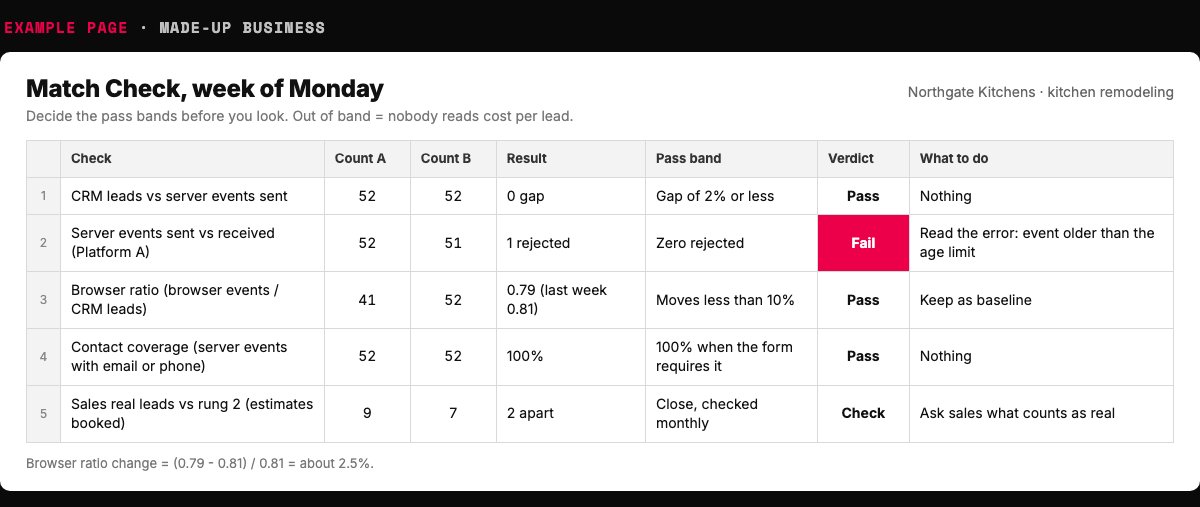
- Your own pipeline. CRM and server must match before anything else counts.
- One rejected event. Read the error first; here the stage arrived too late.
- The browser always misses some. Watch the change, not the level.
- Every lead form asks for an email, so every server event should carry one.
- The human count. Sales is the check the tracking tag cannot run on itself.
Example page built for this article with a made-up business
Send back the stages your CRM knows
The Send-Back Ladder is our rule for what to send. Start with the form. Climb to the first quality stage, and stop where the platform can still learn.
In Principles of Marketing Engineering and Analytics, Gary Lilien's team defines a conversion as any action the marketer decided it wants. Notice who decides. You do.
Most accounts let the default decide. The default is a form fill. So the platform gets great at finding people who fill in forms.
Rung 1 is the form or purchase, sent from browser and server with one shared ID. Rung 2 is the first quality stage your CRM records: booked, attended, accepted. Rung 3 is the sale, with its value.
Optimize on the deepest rung that still happens often enough for the platform to learn. Each platform publishes its own weekly minimum, listed in the dated box below. Report every rung, even the ones too rare to optimize on yet.
Feedback also expires. Donella Meadows lists how feedback fails in Thinking in Systems. Late information is near the top.
Ad platforms enforce it for you. Send a quality stage after the platform's age limit, and it is refused.
So the CRM rule needs a deadline. Every lead gets a stage within 48 hours, in one field, with one owner. Speed to lead covers the human side, and book-a-call math shows which stage between lead and sale is weakest.
A ladder with an empty rung is just a tracking tag with extra steps.
Climb from the form to the sale, and optimize on the deepest rung with enough volume
- Rung 1: the form or purchase Sent from the browser and your server, with one shared ID.
- Rung 2: the first quality stage Booked, attended or accepted. Staged within 48 hours, sent before the age limit.
- Rung 3: the sale Sent with its value. Report on it even when it is too rare to optimize on.
Send-Back Ladder, Anar
Rung 2 is usually the first target: deep enough to mean quality, common enough to learn from
| Business type | Rung 1 | Rung 2 | Rung 3 |
|---|---|---|---|
| Home services | Form or call | Estimate booked | Job sold, with ticket value |
| Clinic or med spa | Consult request | Consult attended (neutral name) | Treatment plan accepted, value only |
| Law firm | Intake form | Case reviewed and accepted | Retainer signed |
| B2B services or software | Demo request | Meeting held with a fit company | Deal won, first-year value |
| Online store | Purchase | Purchase with real margin | Second order |
Illustrative template, Anar. Write who sets each stage and how fast
Consent decides what you may send, not where you send it from
Moving tracking to your server does not change what a person agreed to. It gives you one place to enforce it.
The UK regulator's guidance on cookies and similar technologies is plain. Tell people what you set and why, and get consent that is actively and clearly given.
Our rule: consent is a field on the record, not a banner on the page. Capture it when the person chooses.
Store it with the lead. The server checks it before any event goes out.
The experiment book treats opt-ins and opt-outs as their own log stream that must join to everything else. We treat consent the same way.
Then write an allow list: the exact fields that may leave your server. Everything not on the list gets dropped. A block list fails the day someone adds a new form field.
Never send health conditions, treatments or money trouble. If a person would not tell it to a stranger, it stays on your server. Use neutral event names like "consult attended".
For clinics, the US health regulator's guidance on online tracking is strict. A tracking vendor that gets protected health information for a provider needs a signed business associate agreement. A cookie banner is not a valid authorization.
Our own rule for clinics goes further: neutral events only, and no tracking on booking or patient pages until counsel signs off. That is not legal advice. Our healthcare and med spa work starts with that review.
And never use your server to sneak past a browser's privacy rules. Some browsers already cut short the cookies that disguised setups try to plant.
A server is a checkpoint. It is not a disguise.
Consent decides if an event may leave. Sensitivity decides what it may say
- Send nothing No consent and sensitive data. Drop it at the server.
- Still send nothing Consent never covers health, money or other sensitive details.
- No personal data Follow each platform's no-consent rules, with no contact details.
- Send it Hashed contact details, neutral event name, fields on the allow list only.
Anar's working rule. Not legal advice
Consent has to be told, chosen and recorded, and tags count as much as cookies
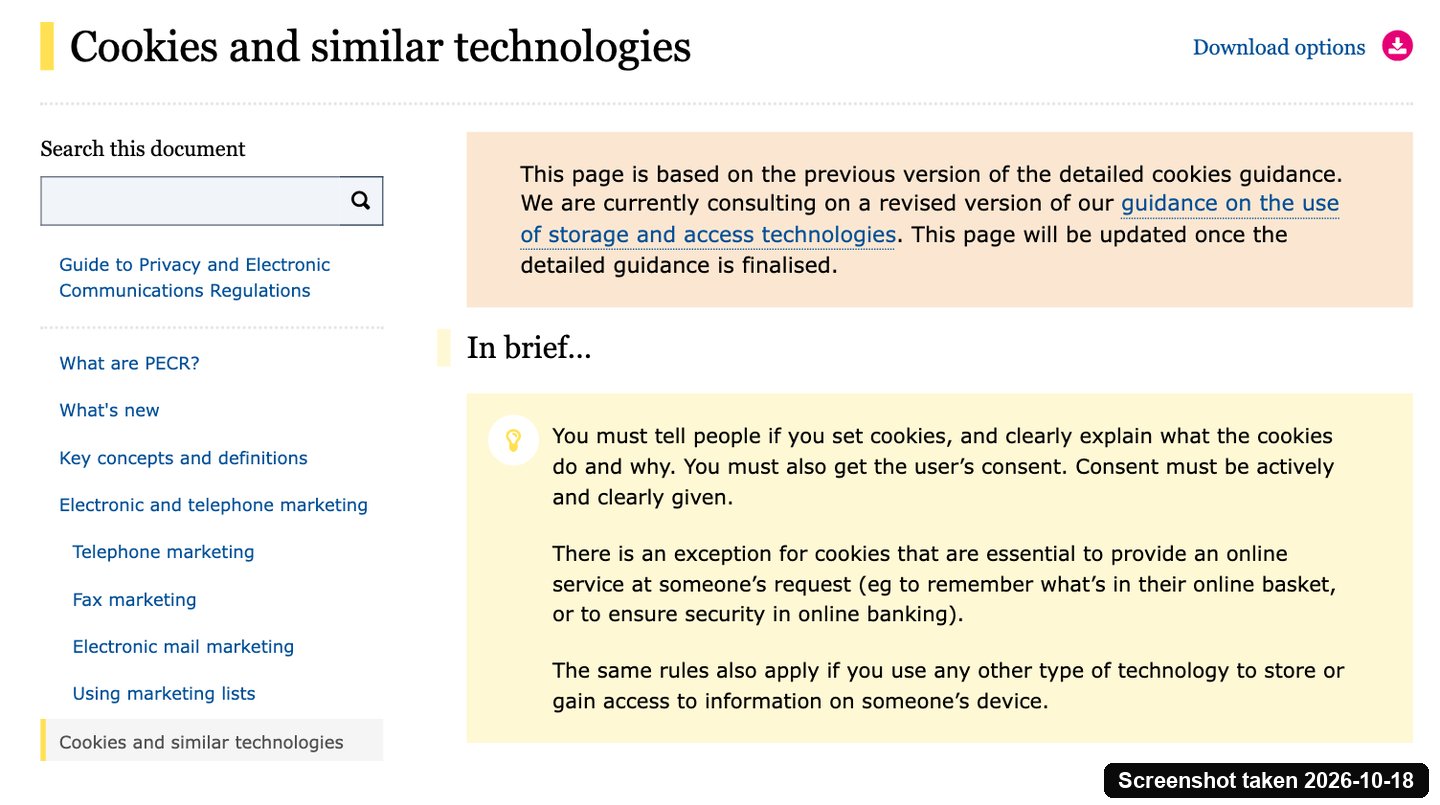
- Similar technologies count too. Tracking tags and pixels are not a loophole.
- Tell them what and why, in plain words.
- A choice the person makes, not a default. Store that choice with the lead.
- Ad tracking is not essential to the service. It needs consent.
Screenshot of the ICO's Cookies and similar technologies page, taken 2026-10-18. Pin 4 is our reading, not the ICO's words
When server-side tracking is not worth building yet
A dozen leads a month? Park this build. No ad platform can learn much from that.
Here is the test we use. Build it when leads arrive every week and sales will stage them within two days. If you have neither, fix the settings that quietly change your campaigns first.
Ad platforms publish big average gains for their own server tools. Those are the seller's numbers about the seller's product. Test the effect in your own account instead.
How to make an ad account confidently wrong, in four easy steps. Step one: switch on server events next to the browser tag, and skip the shared ID.
Step two: celebrate, because the cost per lead just halved. Every lead now counts twice.
Step three: send every form fill as a qualified lead, since nobody has time to stage them. Step four: scale the budget on the new numbers.
The platform then finds you twice as many people who never answer the phone. A cost per lead that halves overnight is a counting bug, not a damn miracle.
Build it when leads arrive weekly and sales will stage them fast
| Your situation | What to do |
|---|---|
| A dozen leads a month | Wait. Fix offer and campaign settings first |
| Leads every week, no staging habit | Set the 48-hour staging rule first, then build |
| Leads every week, sales stages within two days | Build all three rungs |
| Health or finance business | Legal review of every field before any build |
Anar's decision rule
Build it in one week
A working team can build this in five days. Nothing changes what a campaign optimizes for until Friday's test passes.
Monday is the audit. List every event, its source and its duplicates, and run last week's Match Check.
Tuesday is capture. Save the ad click IDs in hidden form fields, and store each consent choice with the lead.
Wednesday you define rung 2, name its owner, and count last month's rung-2 leads per week. Thursday you wire it. Rung 1 goes out with the shared ID, then rung 2 with hashed contact details, through the allow list.
Friday is proof. Send one test lead end to end. Find it once in each platform, then run the Match Check again.
Where this data lives and which tools move it is the job of the marketing engineering stack. The settings below change often. The method above does not.
Nothing changes what a campaign optimizes for until Friday's test passes
- Audit Monday List every event, its source and duplicates. Run last week's Match Check.
- Capture Tuesday Save ad click IDs in hidden form fields. Store each consent choice with the lead.
- Define Wednesday Pick rung 2, name one owner, count last month's rung-2 leads per week.
- Wire Thursday Server sends rung 1 with the shared ID, then rung 2, through the allow list.
- Prove Friday One test lead end to end, found once per platform. Match Check again.
Anar's build order
Run the Match Check with AI
The prompt below runs the Match Check and picks your rung. Paste it into your preferred AI and answer seven questions with last week's numbers.
This week: run it once, fix whatever fails first, and choose your rung 2. Next week, run it again and put the ratios on the Monday growth cockpit memo, next to spend.
Once rung 2 is flowing, learn to read results, not leads, before anyone judges the new campaign. Then point a creative testing engine at qualified leads instead of clicks.
Would you rather have it built and tested for you? It is a common first project in our marketing engineering work, next to the paid media it feeds.
Remember Monday's three numbers? After the build, the platform sees all 52 leads and hears which nine were real.
Stop asking the platform for better leads. Start telling it what a better lead is.
Paste into your preferred AI. It asks seven questions about last week's counts, checks each ratio, flags consent gaps, and names the rung to optimize on.
Act as a careful tracking auditor. Use only my numbers and the rules below. Never invent a count; if one is missing, ask me for it.

Ask one at a time, show the example, and wait:
1. What do you sell, and what counts as a good lead? (Example: kitchen remodels; a booked in-home estimate)
2. Last full week, how many new leads did your CRM record? (Example: 52)
3. How many lead events did your server send to each ad platform? (Example: none, we only have the browser tag)
4. How many lead events did each platform say it received from the browser, and from the server? (Example: browser 41, server 0)
5. How many server lead events carried an email or a phone number? (Example: 0)
6. How many leads did sales call real, and how many reached your first quality stage? (Example: 9 real, 7 booked)
7. Do you store each person's consent choice with the lead? (Example: no)

Rules:
- CRM leads and server events sent should match. A gap over 2 percent means our own pipeline is broken. Fix it before anyone reads a report.
- Events sent minus events received = rejected events. Any rejection: read the error first.
- Browser ratio = browser events / CRM leads. Under 1 is normal. Record it as the baseline. A move of more than 10 percent from one week to the next means investigate.
- Contact coverage should be near 100 percent when the form requires an email or phone.
- Send-Back Ladder: rung 1 the form, rung 2 the first quality stage, rung 3 the sale with its value. Optimize on the deepest rung that meets the platform's current learning minimum. Ask me for that minimum, or look it up if you can browse, and say which you used.
- No consent on record means no personal data goes to any ad platform. Never send health, money or other sensitive details. Use neutral event names.
If you can browse, first check each ad platform's current help pages for event age limits and duplicate rules, and tell me if anything changed.

Show your math, then use exactly this format:
MATCH CHECK: (each ratio, pass or fail)
WHAT IS BROKEN:
RUNG TO OPTIMIZE ON NOW:
CONSENT GAPS:
NEXT THREE ACTIONS:

Filip Kovacevic is the founder of Anar Agency in Phoenix. He spent five years running SEO, Meta ads, email, and content for medical practices across the United States, and now does the same work for healthcare, home-service, legal, and professional-service businesses, alongside AI implementation. More from Filip →
Want the loop built and tested?
Bring one ad account and your CRM. In 15 minutes we will run the Match Check with you and tell you which rung you can optimize on today.
See how we build them →Want to do this work yourself? See how we train marketing engineers.