Speed to Lead: Answer Every New Lead in Five Minutes

Speed to lead is the time from a new enquiry to your first real reply. In one study, firms that tried to reach leads within an hour were nearly seven times as likely to talk with a decision maker as those an hour slower. Aim for an instant reply, a human call within five minutes, and an alert at fifteen.
Speed to lead: the first reply usually wins the deal
It is eleven at night. A parent sits at a laptop after the kids are in bed. She asks a college about a degree for working adults.
The college sends a form email the next day. The packet comes a week later. By then she has moved on.
That gap has a name: speed to lead.
The college was Southern New Hampshire University, in a story told in Competing Against Luck, Clayton Christensen's book on why people buy. It swapped the email for a phone call inside ten minutes. By 2016 its revenue had grown about 34 percent a year for six years.
Speed to lead is the time from a new enquiry to your first real reply. Our target is five minutes in working hours.
Fast firms do not try harder. They build it so nobody has to remember. Speed is a setup, not a mood.
The callback was one of dozens of changes at that school. So we do not credit it with the growth. But it is the change any business can copy by Friday.
Nearly one in four companies never answered a web lead at all
- US companies sent a test web enquiry 2241
- never replied 23
- average reply, among firms that answered within 30 days 42
Source: Oldroyd, McElheran and Elkington, Harvard Business Review (2011).
How fast should you respond to a lead?
Respond within five minutes in working hours, and never later than an hour. Two studies stand behind those numbers. Both deserve a closer look.
For a 2011 Harvard Business Review article, researchers sent test enquiries to 2,241 US companies and timed the replies. Only 37 percent answered within an hour. Twenty-three percent never answered at all.
Among firms that replied within a month, the average wait was 42 hours. Forty-two hours. These firms built the form, then ignored it.
A second data set in the same article covered 1.25 million leads at 42 companies. Firms that tried to reach a lead within an hour were nearly seven times as likely to talk with a decision maker as firms that waited one hour more. Against firms that waited a day, the gap was over 60 times.
Where does five minutes come from? From an earlier lead response study by InsideSales.com and MIT researcher James Oldroyd. It covered three years of data from six companies: over 15,000 leads and 100,000 call attempts.
Calling within five minutes instead of thirty made reaching the lead about 100 times more likely. It made qualifying them about 21 times more likely. Qualifying meant the lead agreed to a next sales step.
How sure is that? Less sure than the headlines say. InsideSales.com sold calling software, its chief executive co-wrote the HBR piece, and six companies is a small sample.
So we treat five minutes as a strong target, not a law of nature. We have seen no study where waiting helped.
Only 37 percent of companies answered a web lead within an hour
Share of 2,241 US companies, by time to first response to a test web lead
- Within an hour 37
- 1 to 24 hours 16
- More than 24 hours 24
- Never 23
Source: Oldroyd, McElheran and Elkington, The Short Life of Online Sales Leads, Harvard Business Review (2011).
The odds of reaching a lead fell fastest in the first ten minutes
Contact index by minutes from form to first call, as charted in the study (higher is better)
- Contact index: 5 min 9300, 10 min 1600, 15 min 550, 20 min 300, 25 min 150, 30 min 100, 35 min 50, 40 min 50
Source: InsideSales.com/MIT Lead Response Management Study (2007): six companies, 15,000+ leads, 100,000+ calls. Vendor data.
The one-hour rule is well measured; the five-minute rule rests on one vendor study
| Finding | Data behind it | How sure |
|---|---|---|
| 37% answered within an hour; 23% never | 2,241 US firms tested (HBR, 2011) | Measured audit |
| Within an hour: about 7x as likely to qualify as one hour later | 1.25 million leads, 42 firms (HBR, 2011) | Measured; one author ran a sales software firm |
| 5 minutes vs 30: about 100x the contact odds, 21x the qualify odds | 6 firms, 15,000+ leads (2007) | Vendor data, small sample |
| A callback in under ten minutes | One university, told in a book | Case story |
Sources: Harvard Business Review (2011); InsideSales.com/MIT study (2007); Competing Against Luck (2016).
Three layers that answer every lead. Instant: an automatic text and email the second a form arrives, naming who will call and when. Human: a named person calls within five minutes in working hours, or at the promised time out of hours.
Backstop: an alert to the owner when fifteen working minutes pass with no human contact. Grade each lead from its form answers (A and B get the five-minute call, C the same day, F a helpful reply), make the first call about removing a worry, text right after a missed call, and track the median, the 90th percentile and the count over fifteen minutes every week. Get consent before any automated text.
Why fast wins: people ask at the moment they decide
A lead is hottest the second they press send. The problem is in front of them. So is your name.
The school's leaders saw that an adult who finally asks about a degree has often thought about it for a long time. The question sits right beside the decision. A generic reply a day later was, in the book's words, "tantamount to not responding at all."
Andy Grove, who ran Intel, made the same point about managers in High Output Management. The same work pays off far more when it is done early than when it is done late. His sharpest case is a valued employee who says he is quitting: deal with it that minute, or the chance is gone.
Leads follow the same rule, and this part is our reading, not his. A reply in minutes reaches a person still holding the problem. A reply tomorrow reaches someone who has moved on, or already called someone else.
Speed is also an early number. It moves days before revenue does. So you can fix it before the month is lost.
Southern New Hampshire University swapped a mailed packet for a phone call
| Before | After |
|---|---|
| A form email within 24 hours | A phone call within ten minutes |
| The same mailed packet for everyone | A trained counselor with the answers at hand |
| Success counted in packages mailed | Success counted in minutes |
| The student chases old transcripts | The school asks permission and pays the $10 fee |
| Aid and credit answers in weeks | Aid and credit answers in days |
Source: Christensen, Hall, Dillon and Duncan, Competing Against Luck (2016).
The 5-Minute Window: three layers that answer every lead
The 5-Minute Window is our three-layer setup that answers every lead fast, with nobody watching an inbox. Each layer covers the gap the last one leaves.
Layer 1, instant. The second the form is sent, an automatic text and email go out. They confirm you got it, name who will call, and say when.
This layer works at two in the morning and on Sundays. It is what the lead sees while your team is still finding the phone.
Layer 2, human. A named person calls within five minutes in working hours. Out of hours, they call at the time the instant message promised, usually first thing next morning.
Layer 3, backstop. If fifteen working minutes pass with no human contact, an alert goes to the owner or manager. Without it, the whole setup runs on memory.
Big companies write targets like these into a service-level agreement, a stated response time that gets measured. A small firm can write one on a single line. Every lead, a human, five minutes.
Will the instant text feel robotic? Not if it is short, signed and specific.
"Got it. Sam will call you between 4 and 5 today" is a reply, not a robot.
Three layers, so no lead depends on someone remembering
- Instant Automatic text and email the second the form arrives. Who will call, and when.
- Human A named person calls within five minutes in working hours, or at the promised time.
- Backstop Fifteen working minutes with no human contact sends an alert to the owner.
Anar's working targets.
Inside fifteen minutes, every lead has a reply and a person on it
- Form sent 0 min Instant text and email: received, who calls, when.
- Human call Under 5 min Name, what they asked about, one question.
- Text at once Missed call Who called, why, and the next try.
- Backstop alert 15 min No human contact yet? The owner is pinged.
- Promised time Out of hours The call lands when the instant message said.
Anar's working targets.
The instant text names who calls and when; the missed-call text names the next try
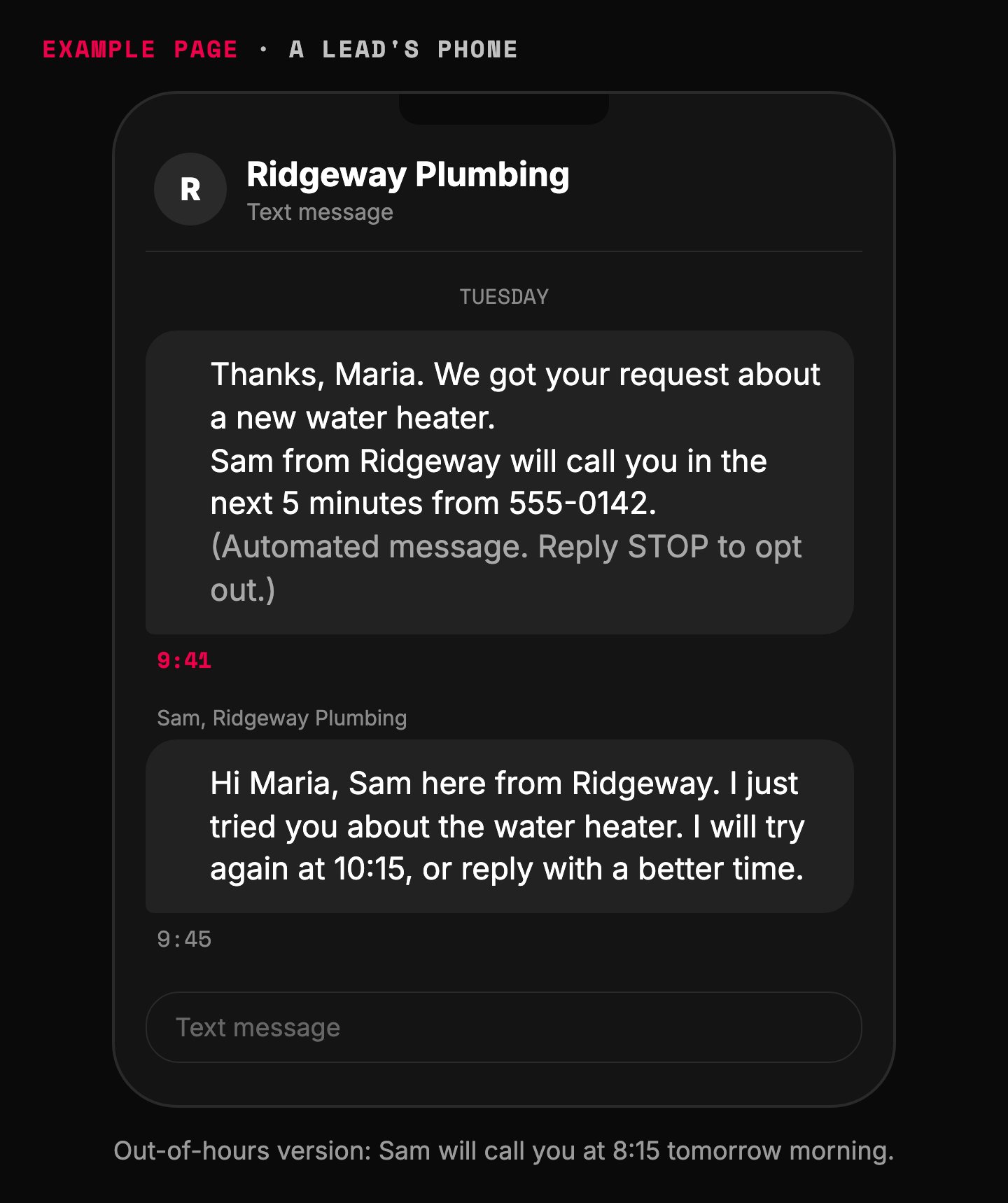
- Sent the second the form arrived.
- Names the person who will call, and when.
- Says it is automated, and goes only to people who ticked the box.
- Missed call? A text right away: who, why, next try.
- After hours, promise a time, then keep it.
Example page built for this article with a made-up brand, taken 2026-10-18. Business, names and the 555 number are made up.
Grade the lead first, then set its clock
Grade every lead from its form answers, and let the grade set how fast a human calls. Every lead still gets the instant reply.
The sample sales process in SYSTEMology, David Jenyns's book on writing down how a business runs, works this way. Each lead gets a letter grade. The grade decides how to contact them, how fast, and what to offer.
Our version grades from the form, so grading never adds delay. A and B leads get the five-minute call. C leads get a call the same working day.
F leads are the ones you cannot help. They still get a useful reply and a free resource. Never silence.
The same process has one rule we copy. Log every contact, then set the next follow-up at once, until the lead is won or lost.
A lead with no next step is a lead you have quietly given up on.
Every lead gets the instant reply; the grade sets the human clock
| Grade | Who it is | Human clock | First contact |
|---|---|---|---|
| A | Fits, has budget, wants it now | 5 minutes | Call, then text |
| B | Fits, has budget, not urgent | 5 minutes | Call, then text |
| C | Fits, budget or timing unclear | Same working day | Call or email |
| F | Not a fit | No call | Helpful reply and a free resource |
Anar's rule, adapted from the sample sales process in SYSTEMology (2020).
What should the first call do? Remove the worry
The first call should remove the lead's biggest worry, not pitch them. Speed gets you on the phone. The call decides if they stay.
The school did not use its fast callback to sell. Trained counselors with every answer at hand took calls that could run an hour or more. They drew out each worry about money and old credits.
It even paid the ten-dollar fee to fetch old transcripts. Credit and aid answers came in days, not weeks.
Our script for the first thirty seconds is simple. Your name, the thing they asked about, one question about their situation. Nobody has to think about how to open.
No answer? Text at once. Say who called, why, and when you will try again.
Plenty of people screen unknown numbers. The text tells them the missed call was you.
At night, an automated assistant can answer, ask the first questions and book a time. It must say it is automated, and hand over to a person the moment the lead asks. Costs and limits are in our AI receptionist guide.
What you send after the call matters too. That is the job of the first email and the eight-email sequence.
A fast call wins only when it removes a worry
| Pitch call | Worry-removal call |
|---|---|
| Opens with what you sell | Opens with what they asked about |
| Talks about features | Asks what is stopping them |
| Ends with a price | Ends with the next step booked |
| The lead feels sold to | The lead feels helped |
Anar's rule, after the university case in Competing Against Luck (2016).
A missed call is followed by a text within a minute
- Call Within five minutes in working hours.
- Text Straight after a missed call: who rang, why, and the next try.
- Email The same day, with the answer to their question.
- Next step Log the contact and set the next follow-up before you hang up.
Anar's working order.
Track the median and the slow leads, not the average
Record the minutes from form to first human contact for every lead. Then read the middle value and the misses. The average hides the leads you lost.
Chip Huyen makes this point about software in AI Engineering. Response time is a spread, so an average misleads. In her example, one slow request out of ten pushed the average to almost four times the typical time.
Leads work the same way, and this transfer is ours. Picture ten leads. Nine got a call in two to five minutes, and one waited ten hours, until the next morning.
The average says 63 minutes. The median, the middle value, says 3. Neither tells you about the lead who waited all night.
So we track three numbers each week.
The median. The 90th percentile, the time by which nine in ten leads got a human. And the count of leads that waited over fifteen minutes.
In the example, the 90th percentile is 5 minutes. Only the miss count shows the ten-hour wait.
One lead. Ten hours. The average hides it.
Then sort each miss by where the minutes went. A lead that was slow to reach a person needs a routing fix. A lead that waited after a person had it needs a staffing fix.
Put the weekly median beside the four rates in book-a-call math. Speed moves first, so it warns you early.
Example: one slow lead turns a 3-minute team into a 63-minute average
| Measure | Ten example leads |
|---|---|
| Minutes to first human contact | 3, 4, 3, 3, 2, 4, 5, 2, 3, 600 |
| Average | About 63 minutes |
| Median (the middle value) | 3 minutes |
| 90th percentile (nine in ten answered by) | 5 minutes |
| Leads over 15 minutes | 1, the ten-hour wait |
Example. Ten made-up leads; our arithmetic.
Where the minutes went decides the fix
| Slow to reach a person | Slow once a person had it |
|---|---|
| Form goes to a shared inbox | Owner is on a job or a call |
| Leads pulled once a day | No script, so the call waits |
| Fix: route to a phone and add the alert | Fix: a named owner per block, plus a backup |
Anar's rule.
The average says an hour; the miss count finds the lead who waited all night
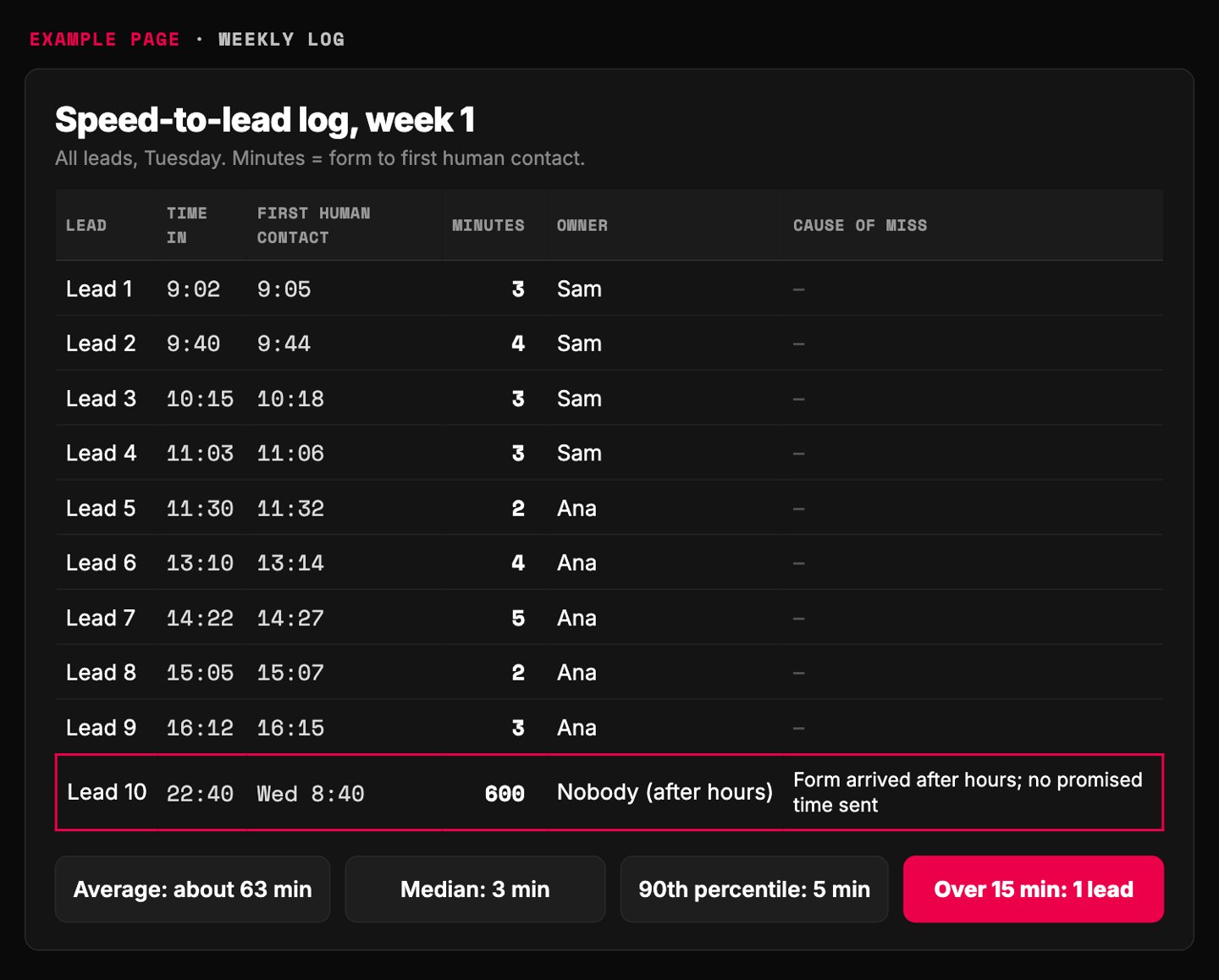
- Minutes from form to first human contact, every lead.
- One slow lead drags the average to an hour.
- The middle value: the team is fast.
- Only this number shows the ten-hour wait.
- Sort every miss by cause, then fix one.
Example page built for this article with a made-up brand, taken 2026-10-18. Ten made-up leads; our arithmetic.
Where speed to lead breaks, and how to fix it
Most slow replies are not lazy people. They are bad plumbing.
The HBR researchers blamed three habits. Firms pulled leads from their database once a day. Sales reps chased their own prospects first, and rules handed out leads by territory and fairness.
How to lose a lead you already paid for, in four easy steps:
1) Send the form to a shared inbox someone checks after lunch.
2) Pull new leads into the sales system once a day.
3) Hand them out by territory, so fair beats fast.
4) Call once, leave a voicemail, and wait.
That is not a sales process. That is a damn expensive way to buy a list.
Fast on Monday, slow by Thursday. The cause is a setup that runs on effort. The fix is the backstop alert, plus one named owner for each block of the day.
"Whoever sees it" means nobody.
Fast replies, but nobody books. The cause is a first call that pitches. Use the worry-removal opener, then put a booking link in the follow-up text.
More in how to qualify a lead before the call.
"We are a small shop. We cannot answer in five minutes." You may be on a roof or with a patient.
That is what the instant layer is for.
A text that names a time has answered the lead. Then keep the promise. A time kept beats a fast reply followed by silence.
Three ways speed to lead breaks, and the fix for each
| Symptom | Cause | Fix |
|---|---|---|
| Fast on Monday, slow by Thursday | The setup runs on effort | Backstop alert and a named owner per block |
| Fast replies, but nobody books | The first call pitches | Worry-removal opener and a booking link in the text |
| "We cannot answer in five minutes" | No instant layer | An automatic text that names a time, then keep it |
Anar's working fixes.
Can you text leads automatically?
Automatic texts are allowed in most places once the person has agreed to them. Get that permission on the form, in plain words, before the first text goes out.
In the United States, the Telephone Consumer Protection Act treats a text as a call. Automated marketing calls and texts to a mobile need prior express written consent under the federal rules.
The FCC also ruled that AI-generated voices count as artificial voices. So an AI calling assistant needs the same consent.
Our rule is stricter than the law. Every form gets an unticked checkbox for texts, even for plain replies.
Rules change and differ by country. The dated box below holds the details, so check them where you operate, or ask a lawyer.
Build your 5-Minute Window with AI this week
The prompt below builds the whole setup in your preferred AI. It asks about your form, your hours and your team. Then it writes the instant messages, the grades, the alert and a weekly log.
It never invents a number. Where it needs one of yours, it asks.
This week, do three things. Tonight, fill in your own form from a private email address and time the reply. Tomorrow, switch on the instant text and the fifteen-minute alert.
Next week, log minutes to first human contact for every lead. Read the median on Friday. Then move on to getting booked calls to show up.
Remember the parent at the laptop at eleven at night? She was ready to say yes. Answer her before she closes the laptop.
Paste into your preferred AI. It asks five questions, then writes your instant messages, lead grades, call opener, alert rule and weekly log.
Act as a sales operations planner. Build my 5-Minute Window: a setup that answers every new lead fast.

Ask me these one at a time, with the example shown. If I answer everything at once, skip ahead.
1. Where do my leads come from? (Example: "website form and lead ads")
2. What does my form ask? (Paste the fields.)
3. My working hours, and who can take calls in each block. (Example: "Mon to Fri 8 to 5. Sam mornings, Ana afternoons.")
4. How I grade leads today, if at all.
5. How fast I reply now. If I do not know, tell me to fill in my own form tonight and time the reply.

Then build:
1. Instant layer: one text and one email sent the second a form arrives. Under 40 words each. Confirm receipt, name who will call, give a time. Add an out-of-hours version that promises a specific time next morning.
2. Grades A, B, C and F, using only my form answers. A and B: a human call within 5 minutes in working hours. C: the same working day. F: a helpful reply and a free resource, no call.
3. Human layer: a 30-second call opener (my name, what they asked about, one question about their situation) and the text to send right after a missed call.
4. Backstop: who gets an alert when 15 working minutes pass with no human contact.
5. Weekly log: lead, time in, first human contact, minutes, owner, cause of any miss. Report the median, the 90th percentile and the count over 15 minutes.

Rules:
- Never invent a number or a fact about my business. Ask me, or write [CONFIRM: what you need].
- Every automated text or voice says it is automated, and goes only to people who ticked an unticked consent box. Tell me to check the texting rules where I operate.
- No fake urgency or scarcity in any message.

Output: the messages, the grading table, the call opener, the alert rule, the log columns, and my next three actions.
Time every lead, read the misses, fix one cause, repeat
- Time Minutes from form to first human contact, every lead.
- Read Median, 90th percentile and misses over fifteen minutes, each Friday.
- Sort Each miss: slow to reach a person, or slow once they had it.
- Fix Change one cause, then time the next week.
Anar's weekly review.

Filip Kovacevic is the founder of Anar Agency in Phoenix. He spent five years running SEO, Meta ads, email, and content for medical practices across the United States, and now does the same work for healthcare, home-service, legal, and professional-service businesses, alongside AI implementation. More from Filip →
Talk it through in 15 minutes
Bring one question from this article. We will tell you what we would do, whether or not you hire us.
Book a 15-Min Chat →