How to Improve Show Rate: The Pre-Call Messages That Get People to Show Up
Show rate is the share of booked calls where the person actually shows up. To improve it, send four messages between booking and the call, and make each one give something. Say what they will get, share a client story, say what you prepared, and text an hour before.
Then follow up every no-show and fix your messages.
How to improve show rate: give people a reason to come
It is 2:00 on a Tuesday. You open the call link and wait.
Now it is 2:04. Then 2:09. Nobody comes.
They booked it themselves four days ago. They picked the time. Now the slot is empty and your afternoon has a hole in it.
This guide shows how to improve show rate, the share of booked calls where the person turns up. It is for anyone who sells through a booked call. Coaches, consultants, agencies, any service with a sales call.
Here is the short answer. People skip a call when the reason they booked has faded. The messages between booking and call keep that reason alive.
Most reminder emails do the opposite. They ask for something instead.
"Just a reminder about your call. Please let us know if you cannot make it."
That reads like a parking ticket, not an invitation.
We write every pre-call message as a gift instead. Each one says, "Here is what I am bringing you. All you have to do is show up."
A reminder that gives beats a reminder that asks
| Reminder that asks | Reminder that gives |
|---|---|
| "Just a reminder about your call." | "Here are the three things I am bringing you." |
| "Let us know if you cannot make it." | "Pick a new time here if today got busy." |
| Calendar entry: "Call" | Calendar entry: "Your lead-cost review, 30 minutes" |
| Feels like a bill | Feels like an invitation |
Our comparison. Example wording.
Why do people book a call and then not show up?
A no-show feels rude. Usually the reason is more boring than that.
The person booked when the problem felt urgent. Four days later the pressure has eased. The calendar entry just says "Call," so the dentist and the school pickup win.
Memory fades fast without a nudge. Psychologists call the pattern the forgetting curve.
So what brings the reason back? A health-centre study in England tested three free changes against missed appointments.
First, receptionists asked patients to repeat the date and time back on the phone. The next month, missed appointments fell 3.5 percent.
Second, nurses had patients write the next appointment on the card themselves. Missed appointments fell 18 percent against the six months before.
Third, a wall sign that counted missed appointments was swapped for one that counted the people who came. With all three running, misses were 31.7 percent below the average of the past 12 months.
Then the team paused the changes for one month. Misses went back up. They turned the changes on again, and misses fell 29.6 percent.
Three lessons carry straight over to a sales call. First, the person commits out loud.
Second, showing up feels normal. Third, there is something worth coming for.
People who say when and where they will act are more likely to follow through. Researchers call that an implementation intention. The new wall sign used social proof: we copy what most people around us do.

Three free changes cut missed appointments by almost a third
Drop in missed appointments after each change, in percent
- Patients repeat the time back 3.5
- Patients write the card themselves 18
- All three changes together 31.7
- All three, switched back on after a pause 29.6
Source: Martin, Bassi and Dunbar-Rees, Journal of the Royal Society of Medicine (2012). Each change compared with the study's own earlier period.
The same three moves work on a sales call
| What the clinic did | Why it worked | Your version |
|---|---|---|
| Patient says the time back | They commit out loud | Ask for a reply "yes" to the confirmation |
| Patient writes the card | It is now their plan, not yours | Ask them to add the call to their own calendar |
| Sign counts people who came | Showing up feels normal | "Nearly everyone who books makes it", only if true |
Study changes from Martin, Bassi and Dunbar-Rees (2012). Sales-call versions are ours.
The Show-Rate Stack is four pre-call messages that each give something: a confirmation that says what the person gets and asks for a reply, a real client story that answers a common doubt, a morning-of note about what you prepared, and a text and email one hour before. Match the count to the wait, put a reschedule link in every message, follow up each no-show with concern, and fix the weakest message every month.
The Show-Rate Stack: four messages that each give something
The Show-Rate Stack is four messages between booking and call, and each one gives the person something. Here it is for a call booked three to five days out.
1. The confirmation, right away: say what they will get, how long it takes and what to bring. Ask them to reply "yes" or add it to their own calendar.
That reply works like the patient writing on the card in the study. People like to stay consistent with what they have said.
2. A client story, one or two days before: one real client who had the same doubt, and what happened. The next section shows how to write it.
3. The prep note, the morning of: "I looked at your site and I have three things to show you." Only send it if you did the work.
Why does that note work? People like to return effort that someone made for them. That is reciprocity.
4. The last reminder, one hour before: a short text and an email, both with the link. At 1:59 they are hunting for the link, not rereading your email.
Put a reschedule link in every message. Someone who moves a call is still a lead. Someone who skips it in silence is usually gone.
Name the calendar entry properly too. "Your lead-cost review with Dana, 30 minutes" beats "Call."
How to empty your calendar in four easy steps:
1. Send one email that says "Reminder" and nothing else.
2. Ask them to confirm they still want your time.
3. Leave out the call link. They can search for it.
4. Book them two weeks out and hope like hell.
A reminder that asks for something feels like a bill. Nobody rushes to pay a bill.
Four messages, and every one gives the person something
- 1. Confirmation Right away. What they get, how long, what to bring. Ask for a reply "yes".
- 2. Client story One to two days before. A real client with the same doubt.
- 3. Prep note The morning of. What you looked at for them. Only if you did it.
- 4. Last reminder One hour before. A short text and an email, with the link.
The Show-Rate Stack, for a call booked three to five days out.
The stack spreads across the wait, and ends one hour before
- Confirmation At booking Reply "yes", add to calendar, reschedule link.
- Client story 1 to 2 days before First name in the subject. The doubt, what they did, what happened.
- Prep note Morning of "I have three things to show you."
- Text and email 1 hour before Time, link, one line on what they get.
The Show-Rate Stack.
Message 1 gives first, asks for one reply, and makes moving the call easy
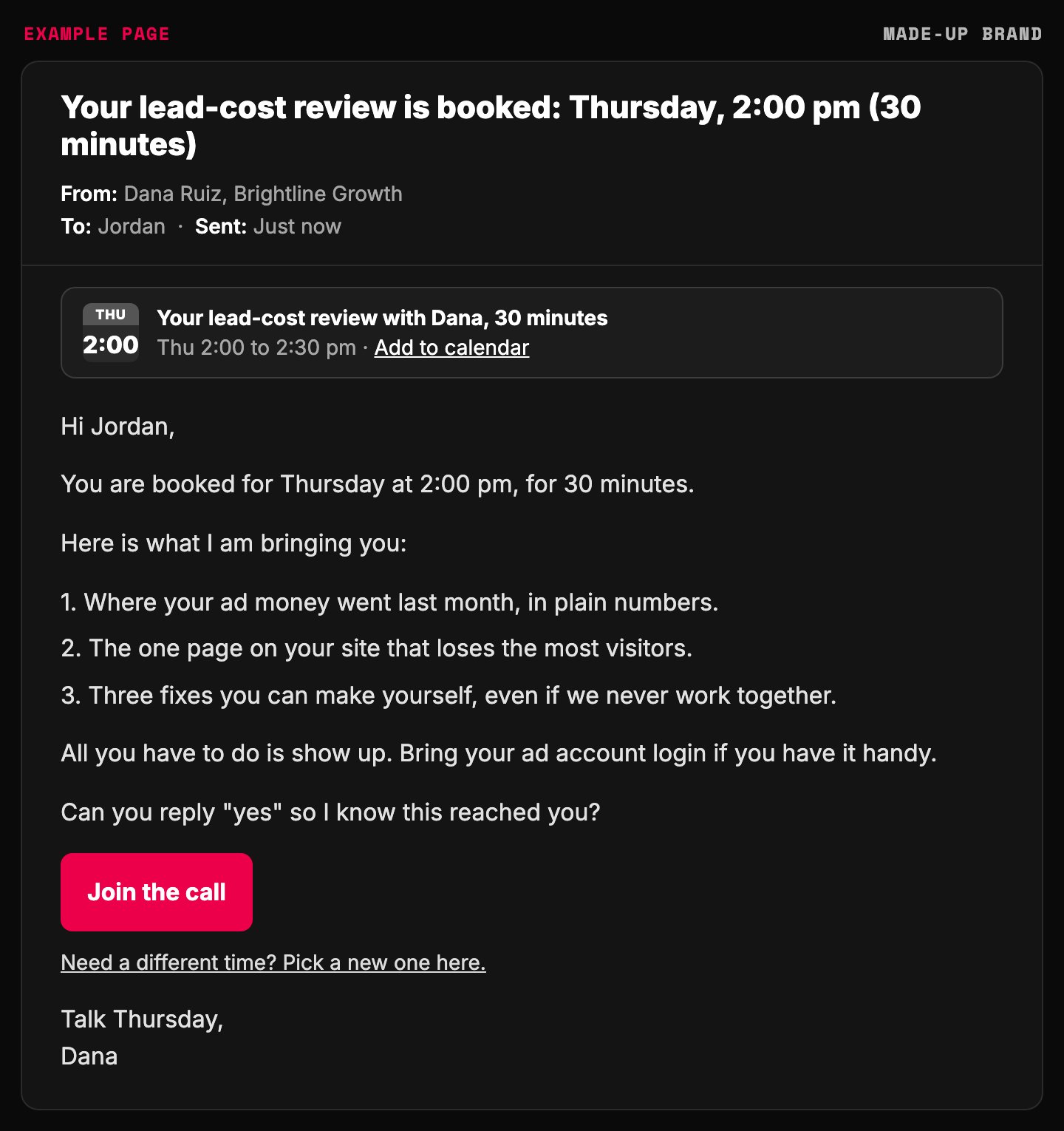
- Say what the call is and how long it takes.
- Lead with what they get, even if they never buy.
- One small ask: a reply. That is their commitment out loud.
- A reschedule link in every message. A moved call is still a lead.
- Name the calendar entry. Never just "Call".
Example page built for this article with a made-up brand
Answer the unspoken doubt with a real client's story
Almost every person who books has a doubt they never say out loud. Will this work for someone like me? Is this just a pitch?
The second message answers that doubt with one real client. Put the client's first name in the subject line.
For example: "Meet Dana. She was sure this call was a sales pitch."
Then write three short parts: what she worried about, what she did, and what happened next, in her words.
Where do the doubts come from? Your own sales calls. Write down the three or four worries you hear most, and match one client story to each.
Use real clients, with their permission. The FTC's endorsement guidance says an endorsement must reflect the person's honest opinion. If a result is better than usual, say what people usually get.
Short of stories? Ask your happiest clients for one paragraph each. More on finding the fear behind a doubt in handling objections in copy.
A story about a client beats any promise about the call. It is proof, not a pitch.
Match one real client story to each doubt you hear on calls
| Doubt you hear | Story email subject | What the story shows |
|---|---|---|
| "Is this just a pitch?" | Meet Dana. She was sure this call was a sales pitch. | What she got on the call before any offer |
| "Will this work for a business my size?" | Meet Sam. He runs a two-person shop. | What changed for a business like theirs |
| "I have tried this before." | Meet Priya. She had been burned twice. | What was different this time |
Example: names and subject lines are made up to show the format. Use real clients, with permission.
Do text reminders reduce no-shows? Yes, so ask to text
Yes. A review of randomized trials on appointment reminders found clear gains from a simple text.
With no reminder, people attended 67.8 percent of appointments. With a text reminder, 78.6 percent. With a phone call, 80.3 percent.
So a text did almost as much as a call. In two of the studies, a text cost 55 and 65 percent less per attended appointment than a call.
For a small team, the choice is easy. Text the one-hour reminder. Save phone call reminders for your biggest calls booked far out.
Ask permission first. Put a checkbox on your booking form that says you will text about this call, and leave it unticked.
Keep each text short. The time, the link, and one line about what they get. Rules on texting live in the Telephone Consumer Protection Act in the US, and the current details sit in the box below.
A text reminder did almost as much as a phone call
Share of appointments attended, by type of reminder
- No reminder 67.8
- Text reminder 78.6
- Phone call reminder 80.3
Source: Gurol-Urganci and others, Cochrane review (2013), randomized trials of appointment reminders.
Texts cost far less per attended appointment than calls
- Lower cost per attendance than a call, in one study 55
- Lower cost per attendance than a call, in another 65
- People in the trials comparing a text with no reminder 5841
Source: Gurol-Urganci and others, Cochrane review (2013).
Match the number of messages to the wait
The longer the wait, the more the reason fades. So match the messages to the gap, and shorten the gap when you can.
Same-day call? Send the confirmation and the one-hour text. One to two days out, add the prep note.
Three to five days out, send the full stack. More than five days, add one useful message at the midpoint, like a short video that answers a common question.
Better still, offer slots in the next two days. Fewer days means less time for their interest to cool.
The same idea drives speed to lead: interest is highest right after someone asks for help.
The longer the wait, the more messages it needs
| Wait before the call | What to send | Messages |
|---|---|---|
| Same day | Confirmation and the one-hour text | 2 |
| 1 to 2 days | Confirmation, prep note, one-hour text | 3 |
| 3 to 5 days | The full stack | 4 |
| More than 5 days | The full stack plus one useful message at the midpoint | 5 |
Our rule for the Show-Rate Stack.
The review behind the text-reminder numbers is free to read
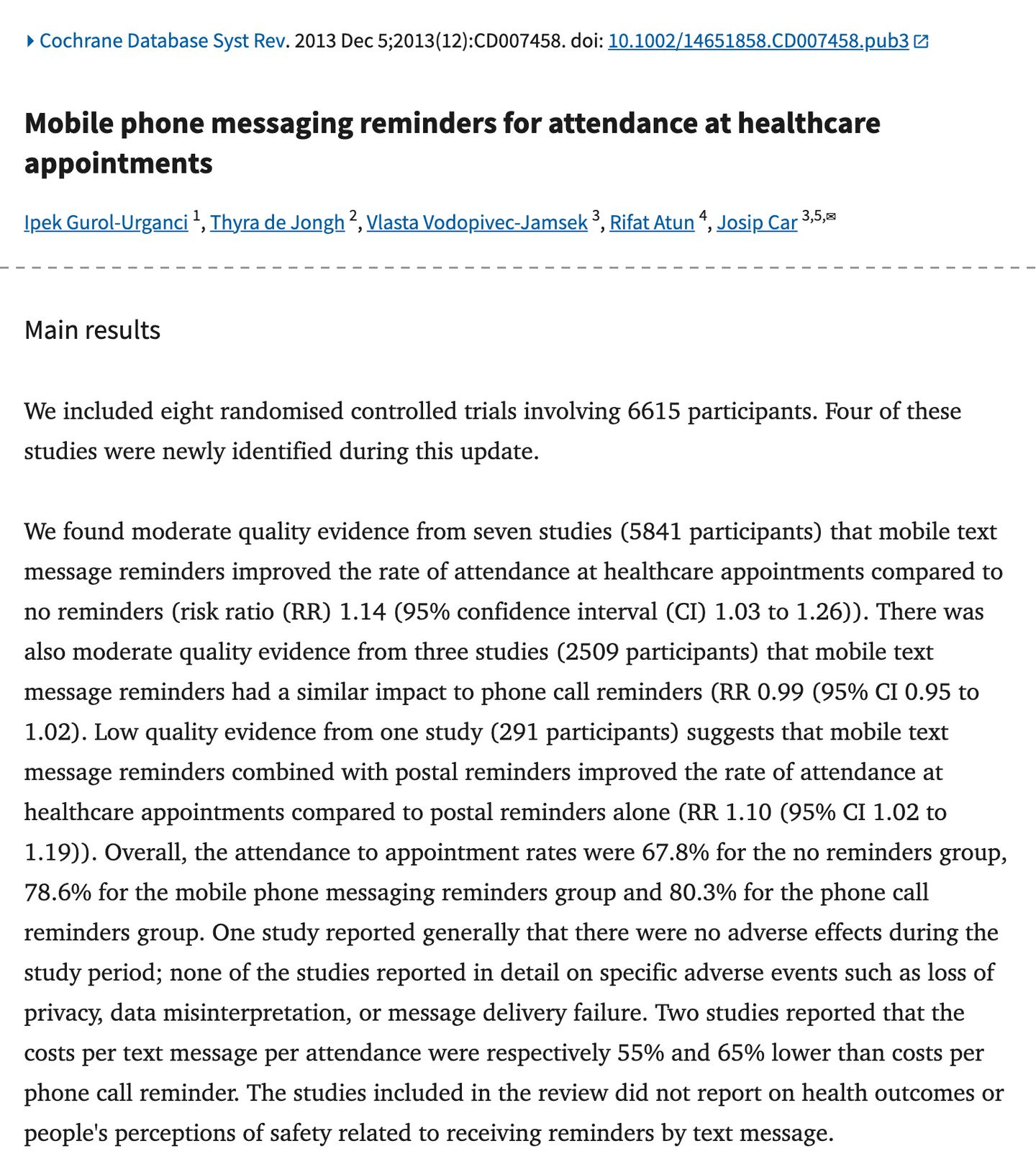
- A review of randomized trials on appointment reminders.
- Seven trials, 5,841 people: texts raised attendance compared with no reminder.
- 67.8% with no reminder, 78.6% with a text, 80.3% with a call.
- Per attended appointment, texts cost 55 and 65 percent less than calls in two studies.
Screenshot of the Cochrane review Mobile phone messaging reminders for attendance at healthcare appointments on PubMed Central, taken 2026-10-17
What to say to someone who missed the call
Some people will still miss. Follow up within the hour, and lead with concern, not blame.
Try this: "I had us down for 2:00. Did something come up? Or was there something I could have done better before the call?"
Then give the reason you are asking. "I want to help the next person even better, and your answer helps me do that."
People answer that. It is a request for help, not a guilt trip. And a person who feels heard often rebooks.
Add a link to pick a new time. Write once more the next day with something useful, and once a week later with a new angle.
After three messages, stop. Move them to your regular emails, like the ones in this eight-email nurture sequence.
Some people will never take a one-on-one call. For example, one course business sends every buyer who never books into a free weekly webinar. They go through the course together, answer questions, and offer the call at the end.
One more rule. "I only have one slot left" must be true. The FTC's advertising guide is clear that claims must be truthful, and a fake "almost full" line is a false claim.
Concern gets a reply; blame gets silence
| Blame | Concern |
|---|---|
| "You missed our call." | "I had us down for 2:00. Did something come up?" |
| "Please respect our time." | "Was there something I could have done better?" |
| No reason given for asking | "Your answer helps me help the next person." |
| No way back | A link to pick a new time |
Our comparison. Example wording.
Three messages, then stop
- Concern and a question Within the hour Did something come up? Could I have done better? Rebook link.
- Something useful Next day A short tip or answer tied to why they booked.
- A new angle A week later A client story or a different reason to talk.
- Stop After that Move them to your regular emails.
Our no-show rule.
Turn every no-show answer into a better reminder
Every no-show reply is free research.
"I forgot." "I was not sure what the call was for." "I thought it was a pitch."
Each answer points at one message. "I forgot" means the one-hour text is missing or late. "Not sure what it was for" means the confirmation is vague.
"I thought it was a pitch" means you need a client story for that exact doubt.
So once a month, look at your messages one by one. Find the weakest one and fix only that one. If you book a lot of calls, do it every week or two.
Track four counts every week: booked, showed, rescheduled and missed. Show rate is showed divided by booked.
It is one of the rates in book-a-call math, and usually the one you can move fastest.
We call this the Repeat step: send, track, ask, fix one message, then send again. Small fixes add up.
Every no-show answer fixes one message
- Send The four messages.
- Track Booked, showed, rescheduled, missed.
- Ask Every no-show: what happened?
- Fix one The weakest message, once a month.
The Show-Rate Stack, Repeat step.
Each no-show reason points at one message to fix
| What they say | Which message failed | The fix |
|---|---|---|
| "I forgot." | Last reminder | Text one hour before, with the link |
| "I was not sure what it was for." | Confirmation | Say what they get and how long it takes |
| "I thought it was a pitch." | Client story | A story for that exact doubt |
| "Something came up." | Every message | A reschedule link they can find in one tap |
Our diagnosis table. Example replies.
Build your pre-call sequence with AI
Paste the prompt below into your preferred AI. It asks about your offer, your call and the doubts you hear. Then it writes all four messages and your no-show follow-up.
It never invents a client story. It asks you for a real one, or leaves a marked gap for you to fill.
Check every line before you send it. You know your clients. The AI does not.
Want a second pair of eyes on the result? Send it to us.
Paste into your preferred AI. It asks five questions, then writes the Show-Rate Stack and the no-show messages for your offer.
Act as a sales-call coordinator. Write my pre-call messages with the Show-Rate Stack, then my no-show follow-up.

Ask me one at a time, with the example:
1. What do you sell, and what happens on the call? (Example: a 30-minute lead-cost review for med spa owners)
2. What will the person get on the call, even if they never buy? (Example: three fixes for their ads)
3. How many days usually pass between booking and the call? (Example: 4)
4. What doubts do you hear most on calls? (Example: "Is this a pitch?", "Will this work for a small clinic?")
5. One real client per doubt, with permission: name, the doubt, what they did, what happened. (If I have none, leave [REAL CLIENT STORY NEEDED]. Never invent one.)

Rules:
- Every message gives something. None asks for anything except a reply "yes".
- Confirmation at booking: what they get, how long, what to bring, ask for a reply "yes".
- Client story 1 to 2 days before: first name in the subject, the doubt, what they did, what happened.
- Prep note the morning of: only what I really prepared. Ask me what that is.
- Last reminder 1 hour before: short text and email, time and link.
- Same-day call: confirmation and 1-hour text only. 1 to 2 days: add the prep note. 3 to 5 days: all four. Over 5 days: all four plus one useful message at the midpoint.
- Reschedule link in every message.
- Texts only with written permission from a checkbox at booking. If you can browse, check the current FCC rules on texting consent and tell me if anything changed.
- No fake scarcity, no guilt, no claims I cannot prove. Results that are not typical need the usual result next to them.
- No-show: within the hour, concern not blame, ask if I could have done something better, say the answer helps me help the next person, give a rebook link. Then once the next day with something useful, once a week later. Then stop.

Output:
Messages: each with send time, channel, subject, body under 90 words
No-show follow-up: three messages
Tracking: booked, showed, rescheduled, missed; show rate = showed / booked
Next three actions: 1. 2. 3.
What to do this week
1. Rewrite your confirmation so it says what they get. Add the reschedule link.
2. Add a text one hour before each call, for people who said yes to texts.
3. Message every no-show from last month. Ask what happened, and write down the answers.
People show up but don't buy? That is a different problem. Start with how to qualify leads before the call.
Next Tuesday at 2:00, the link opens and someone is there. They came because you gave them a reason.
A reminder asks them to come. A reason makes them want to.

Filip Kovacevic is the founder of Anar Agency in Phoenix. He spent five years running SEO, Meta ads, email, and content for medical practices across the United States, and now does the same work for healthcare, home-service, legal, and professional-service businesses, alongside AI implementation. More from Filip →
Talk it through in 15 minutes
Bring one question from this article. We will tell you what we would do, whether or not you hire us.
Book a 15-Min Chat →