How to Qualify Leads Before a Call: Offer an Evaluation

To qualify leads before a call, offer an evaluation instead of a strategy call: one honest answer about the buyer's own business, like what it is worth or what it costs them. Promise a concrete result in your ad, not a giant dream. On the call, give the answer first.
Then let the buyer ask how you help.
How to qualify leads before a call: sell an answer, not a pitch
A man carries a dusty painting into a pawn shop on a TV show. He waits his turn. The expert squints, names a number, and the man almost falls over.
Nobody dragged him there. He came for one answer about something he owns.
Now look at your own booking page. "Book a free strategy call." Nobody waits in line for that.
This guide is about how to qualify leads before a call. Most advice starts with a long form. We start earlier, with the offer and the words in your ad.
Here is the short version. Offer an evaluation: one honest answer about the buyer's own thing. Then run the call in four steps and let the buyer ask how you can help.
Do that and the right people book. The wrong people skip it on their own. No twenty-field form needed.
Buyers dodge a strategy call; they line up for an answer about themselves
| Book a free strategy call | Find out what your ads cost per client |
|---|---|
| The seller wants it more than the buyer | The buyer wants the answer |
| Everyone knows it is a pitch | The pitch only comes if they ask |
| Books anyone with a free hour | Books people who care about the number |
| The buyer guards their wallet | The buyer leans in to hear the verdict |
Our method, as set out in this guide.
People dodge sales calls because they know it is a pitch
Say the word call and most buyers tense up. They picture forty minutes of a stranger wanting their money. They would rather watch Netflix.
That fear has a reason. A one-to-one call holds the buyer's whole attention, so it can sell bigger tickets than a page or a webinar.
For example, a common pattern: a webinar sells offers of $1,000 to $3,000, and a phone call sells $5,000 to $10,000. Those are example ranges, not measured data.
So the format that earns the most is also the one buyers avoid the most. Is that bad luck? No, both facts have one cause: the call takes their full attention.
The usual fix is a new name: strategy call, breakthrough call, discovery call, clarity call.
Buyers see through every one of them. A new name on a pitch is still a pitch, and now it looks like you tried to hide it.
Pushing harder makes it worse. Psychologists call the urge to fight back against pressure reactance.
Our take: hiding the pitch is the problem, not the name. We cover the honest way to place an offer in why hidden pitches backfire.
Example: a one-to-one call can sell a ticket about three times bigger than a webinar
Top of the example price range each format can sell
- Webinar 3000
- Phone call 10000
Example ranges ($1,000 to $3,000 and $5,000 to $10,000), not measured data and not our results.
Renaming the call fools nobody
| What the page says | What the buyer hears |
|---|---|
| Free strategy call | A sales call |
| Breakthrough call | A sales call with hype |
| Discovery call | They discover my budget |
| Clarity call | A sales call, but vague |
| Find out what your ads cost per client | An answer about my business |
Our method, as set out in this guide.
The Evaluation Call qualifies buyers before they book by replacing the strategy call with an honest evaluation of something the buyer owns, such as what it is worth or what it costs them. The ad promises a concrete result, not a giant dream, and offers no gift for booking. The question assumes only what is true for every buyer you would take.
On the call: give the evaluation, ask how they feel, tell a true and typical story, and wait for the buyer to ask how you help before you explain the offer. Committees get a one-page PDF with pros and cons; existing buyers get an orientation that invites them to ask.
Offer an evaluation of something the buyer owns
An evaluation is a short, honest verdict on something that belongs to the buyer: their art, their business idea, their ad account.
People love to find out about themselves. That is why the pawn shop has a line and your calendar does not.
The question you answer for them is your offer.
How much is your art worth? How much is your business idea worth? How much could you earn as an affiliate?
For example, two online offers built on those last two questions brought in about $1 million between them. That is the owner's figure. We have not seen the data.
Doctors already work this way. Nobody calls a checkup a pitch. The exam comes first, and the treatment plan answers what the exam found.
That is consultative selling, which means selling by advising first. The checkup just moves to the front, and the buyer books for the checkup.
To build yours, fill three blanks: a measuring word (worth, costing, missing, ranking), the buyer's thing, and a number or verdict they cannot get alone.
One test before you publish it. Can you really give that answer on the call? If not, change the question.
Want the evaluation to work as a lead magnet too? Read how to build audits as lead magnets.
An evaluation question names the buyer's own thing and a number
| Who sells | Evaluation question | What the buyer gets |
|---|---|---|
| Art coach | How much is your art worth? | A price range for their work |
| Business coach | How much is your business idea worth? | A verdict on the idea |
| Affiliate program | How much could you earn as an affiliate? | A realistic monthly range |
| Agency for local services | What does each booked job cost you in ads? | One cost-per-job number |
| Dental marketing | Where does your office rank for 'dentist near me'? | Their place on the map |
The first three questions are from the example offers in this guide; the last two are ours, for illustration.
Four checks turn a vague call into an evaluation
- 1. Pick their thing Something the buyer owns: art, an idea, an ad account, a website.
- 2. Pick a measuring word Worth, costing, missing or ranking.
- 3. Check you can answer it A real number or verdict, on the call.
- 4. Use it as the headline The question replaces the words strategy call.
Our method, as set out in this guide.
Name the call after the answer the buyer gets, and hold the offer until they ask
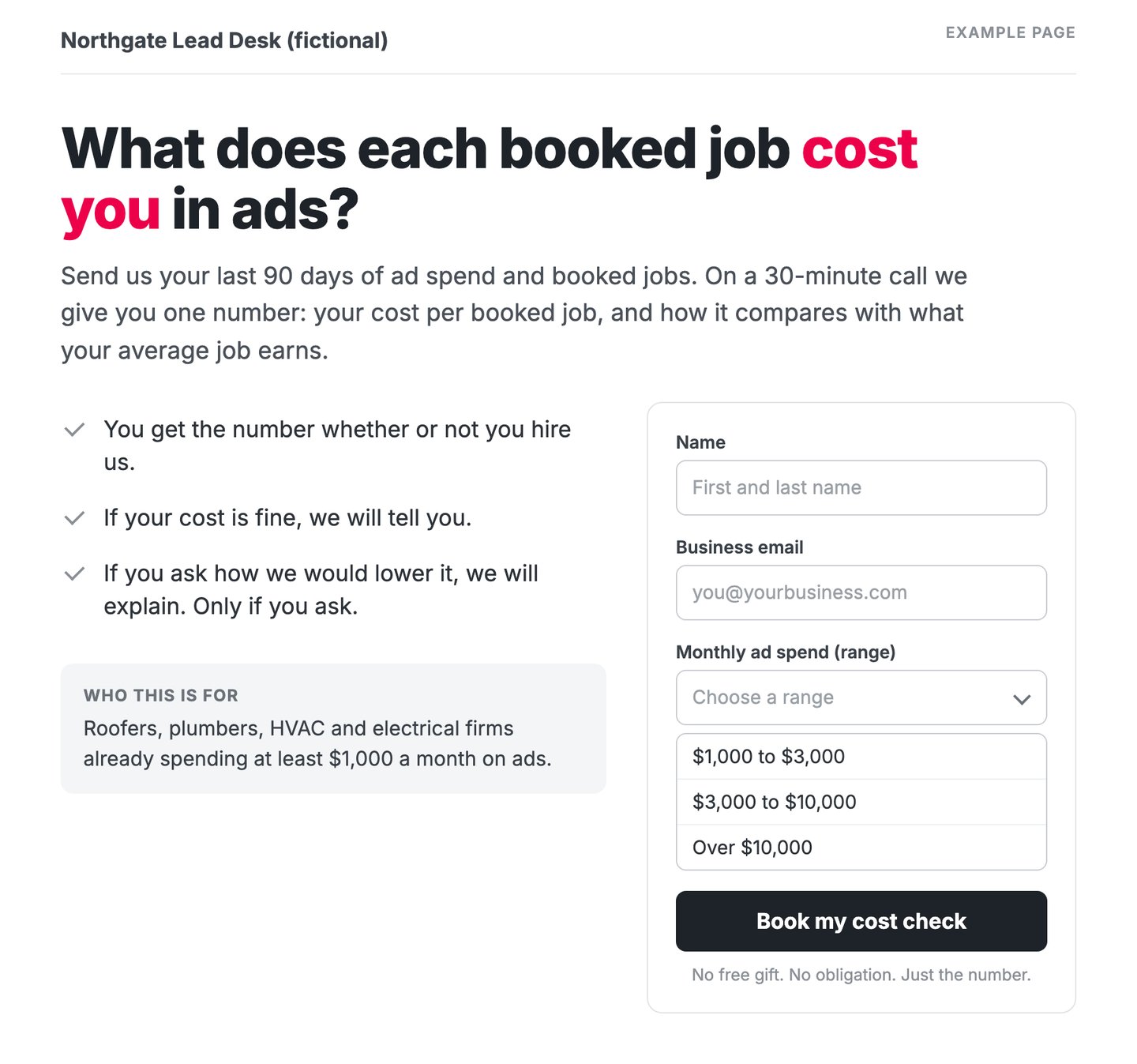
- The call is named after the answer the buyer gets, not 'strategy call'.
- The evaluation is real and complete on its own.
- An honest verdict, even when the news is small.
- The offer comes only after the buyer asks.
- No bribe for booking, so the calendar fills with people who want the answer.
Example page built for this article with a made-up brand. No results are claimed.
Build one true assumption into the question
A good evaluation question takes something for granted. "How much is your art worth?" assumes the art is worth something. If you want the answer, you already agree the art has value.
Linguists call this a presupposition: a belief a sentence quietly assumes. Used badly, it turns into a loaded question, the trap kind lawyers love.
That assumption makes the buyer curious. They want to know the number.
There are two kinds. A fault assumption: "What are you doing wrong that makes clients leave?" A gift assumption: "What is already good about your work that buyers cannot see yet?"
Both can fill a calendar. Which one should you use?
Our rule: assume only what is true for every person you would take on. If you cannot say that out loud, rewrite the question.
Our take: the gift kind works better.
Tell a buyer they are broken, and they book to get fixed. Tell them they have something good, and they book to grow it. That is the client you want.
Fault questions also tempt you to find a fault on every call. That is how an evaluation turns into an ambush.
Assume what is good, and only what is true for every buyer
| Fault assumption | Gift assumption |
|---|---|
| "What are you doing wrong that makes clients leave?" | "What is already good about your work that buyers cannot see?" |
| Assumes the buyer is broken | Assumes the buyer has something worth growing |
| Tempts you to find a fault on every call | Lets the verdict be honest either way |
| Books people who want rescue | Books people who want to grow |
Our rule and our take. Both kinds can fill a calendar.
The words in your ad decide who books the call
The promise in your ad works like a filter. The people who want that promise are the people who book.
For example, one coach selling to other coaches first promised a seven-figure business. His calls were easy to fill and hard to close.
He changed the promise to eight to twelve new clients. Calls got harder to fill and much easier to close. His result, not ours.
Why? A giant dream pulls people who want the outcome and want to skip the work. A concrete number pulls people already doing the work.
Bribes do the same damage. Offer a free gift for booking and you fill the calendar with people who wanted the gift.
Is it the offer or the audience? Often it is a good offer in front of the wrong people. The fix is usually a few words in the ad, not a new funnel.
More on that in matching the ad to the page.
How to fill your calendar with people who will never buy, in four easy steps:
1. Promise a seven-figure year to anyone with a pulse.
2. Rename the pitch a breakthrough call. Nobody will notice.
3. Throw in a free gift for booking.
4. Report booked calls as the win. Ignore the bank account.
That is not lead generation. That is a crowded waiting room.
Buyers who have seen every trick read your ad differently. See how to sell to buyers who have heard it all.

The ad's promise decides whether calls are easy to fill or easy to close
- The goal: an evaluation An answer they want, about their own thing.
- Concrete promise "Eight to twelve new clients." Fewer calls, better ones.
- Giant dream or a gift "Seven figures." A full calendar of tire kickers.
- Vague strategy call Hard to fill and hard to close.
Our grid. The seven-figure and eight-to-twelve examples are one coach's experience, not our results.
A concrete promise books people already doing the work
| Books the wrong people | Books buyers |
|---|---|
| Build a seven-figure business | Get eight to twelve new clients |
| Free gift for every booking | A real answer about your business |
| Change your life | Cut what each new client costs you |
| Book your breakthrough call | Find out what your idea is worth |
The first row is from one coach's example; the rest are ours, for illustration.
Run the call in four steps, and let the buyer ask
Run the call in this order. Skip a step and the call turns into the pitch they feared.
Step 1: give the evaluation. The number, the verdict and the reason. Give it early, before any talk about your offer.
Step 2: ask how they feel about it. Then stop talking. Let them think out loud.
Step 3: tell one or two true stories. Someone like them, what they did, what happened. Social proof works because people copy people like them.
Stories must be real and typical. The FTC's endorsement guidance says that if a result you share is not typical, you must clearly say what results people generally get. Our guide to the four sources of credibility covers which stories to use.
Step 4: wait for their question. It can come in a few ways.
How do I do that? Can you help? How much?
Then answer it: "Good question, here is how we do it." Now you explain your service because they asked.
Skip step 4 and it sounds like this: "Your painting is worth a lot, so want to buy my course?" It feels pushy because it is.
When the buyer asks, they lead the call. That is the point. This is pull, not push: they come to buy, you never chase.
Our rule: give the honest verdict, even when the news is small. Some sellers tell every caller their thing is worth a fortune. That is flattery, not an evaluation, and buyers find out.
Price is not the only "how much" in their head.
How long will this take? Do I have the skills? Do I need more experience first?
Answer those in the ad and on the call, before they have to ask. Each one you leave open is a reason to say no later.
Give the answer first, and explain the offer only after they ask
- 1. Give the evaluation The number, the verdict, the reason. Honest, even when the news is small.
- 2. Ask how they feel Then stop talking and listen.
- 3. Tell a true story Someone like them, a typical result.
- 4. Wait for their question How do I do that? How much? Then answer it.
Our method, as set out in this guide.
The pitch lands only when the buyer asks for it
| Pushy | Patient |
|---|---|
| Gives the verdict, then pitches in the same breath | Gives the verdict, then asks how they feel |
| Seller decides when to sell | Buyer asks how it works |
| Buyer defends their wallet | Buyer asks the price |
| Feels like an ambush | Feels like help they asked for |
Our method, as set out in this guide.
Price is one of four 'how much' questions in the buyer's head
| The question | Answer it here |
|---|---|
| How much does it cost? | Only after they ask, on the call |
| How much time will it take? | In the ad and in step 3's story |
| How much skill do I need? | On the booking page |
| How much experience do I need? | In the evaluation itself |
Our method, as set out in this guide.
How do you qualify a lead when a committee decides?
When a group decides, the person on the call is not the buyer. They are the messenger.
Sales teams call that group the buying center: everyone who weighs in on one purchase. Your evaluation has to survive a meeting you are not in.
So do the work for them. Put every pro and every con in one short PDF they can pass around. Say it plainly: we did the research so you do not have to.
Listing the cons sounds risky. It is the opposite. It shows you are fair, and it answers objections before that meeting starts.
Keep it to one page. What it is, what it costs, what could go wrong, how long it takes, and what happens next.
Can a messenger carry your pitch for you? No. Can they carry a page? Yes.
One page with the cons on it travels further than any pitch
| Section | What it says |
|---|---|
| What it is | One sentence, no jargon |
| Pros | What changes for them, in their numbers |
| Cons | What could go wrong, and what it costs to stop |
| Cost and timeline | Total price and how long it takes |
| Next step | One action and who takes it |
Our method, as set out in this guide.
A one-page brief with the cons as plain as the pros reaches the meeting you will not attend
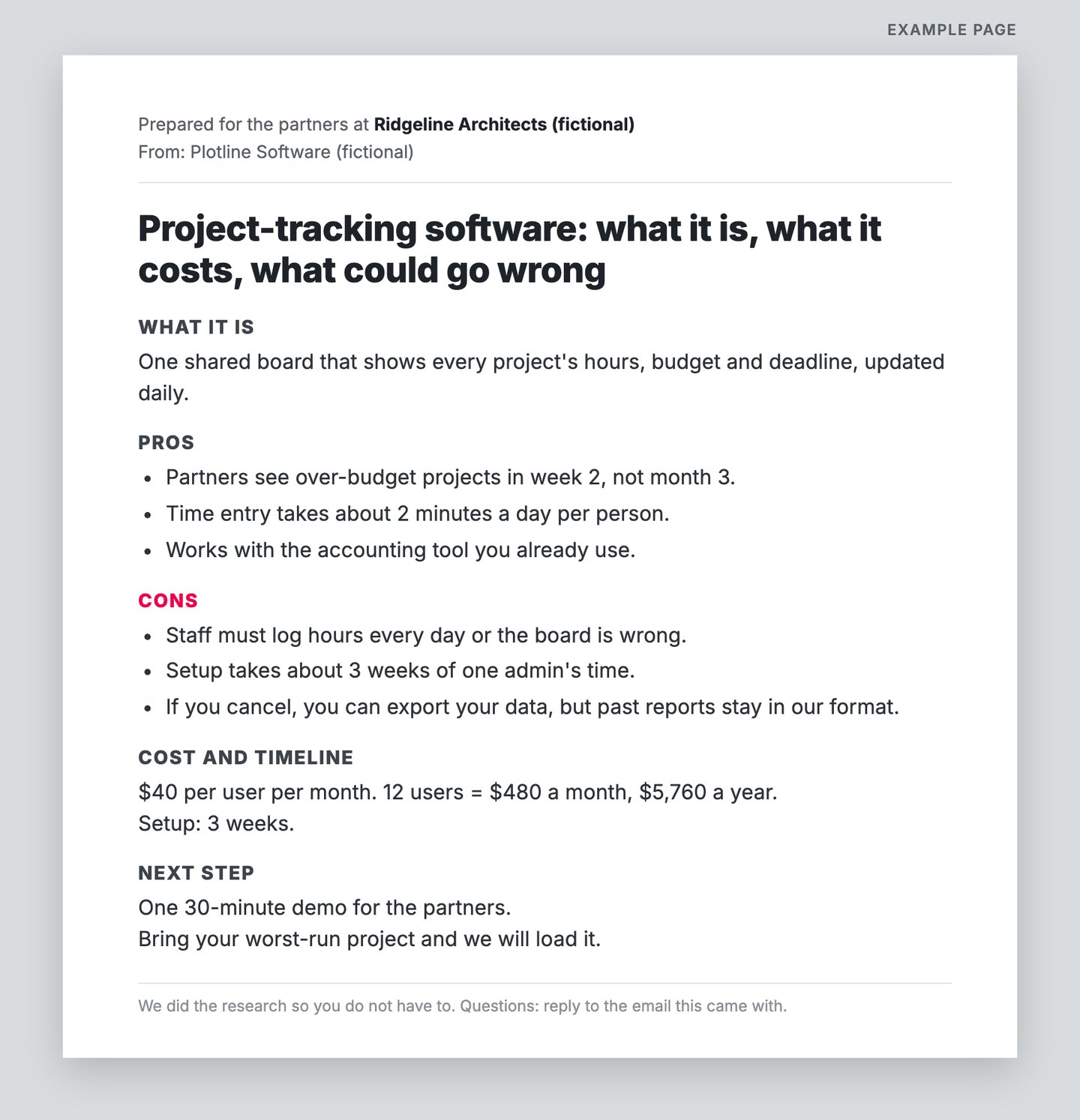
- Written for the people in the meeting you will not attend.
- The cons get their own section, as plain as the pros.
- Name the real objection before the committee does.
- Total cost in their numbers, no math left for them to do.
- One next step, and who takes it.
Example page built for this article with a made-up brand; the firms, product and prices are invented.
Your easiest calls come from people who already bought
The best-qualified lead already paid you once. So book calls from your buyers, not just from ads.
Call it an orientation, not onboarding. Welcome them and show how the product works. Then mention one other thing you do, say it is not for everyone, and ask who wants to hear how it works.
Hands go up. Those people book.
For example, one software company used a welcome like this to mention a $600,000 result from a second offer. So many buyers asked that the phone team could not keep up. That is their figure, not ours.
Two rules from us. The result you mention must be real and typical, the same test as any advertising claim. And the product they bought must work fine without the call.
Want the full logic of selling the next step? Read how to upsell the next problem.
A welcome that ends with a raised hand books the warmest calls
- Welcome Day 1 Thank them and show how the product works.
- Mention one other thing Same welcome A real, typical result from another offer.
- Say who it is for Same welcome It is not for everyone. Say so.
- Ask for hands End Who wants to hear how it works? Those people book.
Our version of the orientation. The $600,000 example in the text is another business's figure, not verified by us.
Write your evaluation offer with AI
Paste the prompt below into your preferred AI. It asks about your buyer and your service, one question at a time.
It writes three evaluation questions, a booking headline and the four-step call order. It flags any assumption that is not true for everyone you would take.
It never invents results. No real story yet? It leaves the story slot empty and tells you so.
Paste into your preferred AI. It asks five questions, then writes your evaluation questions, headline and call order.
Act as a sales offer editor. Turn my free call into an evaluation people want to book, and give me the call order.

Ask me one at a time, with the example:
1. What do you sell, and for how much? (Example: marketing for dental offices, $3,000 a month)
2. Who is your best client, in one line? (Example: a dentist with 2 to 4 chairs who already runs some ads)
3. What can you check or measure for them on a call? (Example: what each new patient costs in ads)
4. What real result has a typical client had? Say "none" if you have none. (Example: none yet)
5. Does one person decide, or a group? (Example: the dentist and an office manager)

Then write:
- Three evaluation questions. Shape: a measuring word (worth, costing, missing, ranking) plus something the buyer owns. I must be able to answer each on the call with a number or a clear verdict.
- Under each question, the assumption it makes. Flag any assumption that is not true for every client I would take, and rewrite it. Prefer assumptions about something good the buyer already has.
- One booking headline that promises a concrete result, not a giant dream. No free gift for booking.
- The call order: 1. give the evaluation 2. ask how they feel about it, then listen 3. one true, typical story, only from my answer to question 4 (if "none", write "add a real story when you have one") 4. wait until they ask how, or how much, then explain the offer.
- Short answers to the hidden how-much questions: how much time, skill and experience the buyer needs.
- If a group decides: an outline for a one-page PDF with what it is, pros, cons, cost, timeline and next step.

Rules: never invent results, numbers or testimonials. No fake deadlines or fake scarcity. Give an honest verdict even when the news is small.

Output, in this order: questions with assumptions, headline, call script, how-much answers, PDF outline if needed, next three actions.
What to do this week
1. Rename your call after the answer the buyer gets from it.
2. Rewrite your ad promise as a concrete result your typical client gets.
3. On your next three calls, run the four steps. Do not explain your offer until they ask.
Then check whether more calls turn into clients. The book-a-call math shows what to measure, and the show-rate guide covers getting booked people to turn up.
The man with the painting never asked for a pitch. He asked what it was worth, then asked what to do next.
Offer a pitch and buyers run. Offer to price their painting and they wait in line.

Filip Kovacevic is the founder of Anar Agency in Phoenix. He spent five years running SEO, Meta ads, email, and content for medical practices across the United States, and now does the same work for healthcare, home-service, legal, and professional-service businesses, alongside AI implementation. More from Filip →
Talk it through in 15 minutes
Bring one question from this article. We will tell you what we would do, whether or not you hire us.
Book a 15-Min Chat →