Content That Sells: Where to Put the Offer and How to Label It

Content that sells gives the full answer first and makes one offer later. Label the offer the moment it starts, in plain words like "This part is an ad for our service." Never dress an ad up as a news story, a review or a neutral show.
Delay the offer to earn trust. Never disguise it.
Content that sells gives the answer first and labels the offer
Picture two web pages about sore knees.
The first one looks like a news story. Halfway down, the reporter starts selling a knee cream. Nothing on the page says it is an ad.
The second one is a real guide. At the end, a box says, "Our offer: we sell a knee cream. Here is the price."
Both pages want the sale. Only one of them lies to get it.
Content that sells works the second way. You give people the whole answer first. Then you make one offer, later, and you call it an offer the moment it starts.
We call this Pitch Placement. It is a plan for where your offer goes in a podcast, a video, an article, an email or a group.
Why bother, if the first page sells too? Because tricks wear out. Buyers remember who fooled them, and the law is clear.
A disguise hides the ad; a delay just puts it later
| Disguise | Delay (Pitch Placement) |
|---|---|
| Looks like a news story, a review or a neutral show | Is a real lesson that stands on its own |
| The offer is never called an offer | The offer is labeled the moment it starts |
| Buyers feel fooled when they spot it | There is nothing to spot |
| Deceptive under FTC guidance | Fits FTC guidance on clear labels |
Our comparison, using the FTC's Native Advertising guide.
Every big sales format started as something people wanted
Why is it called a soap opera? Soap makers sponsored the first radio dramas, and the name stuck.
Procter and Gamble went on to sponsor and produce about twenty soap operas for TV. One of them, Guiding Light, ran from 1937 to 2009, first on radio and then on TV.
Nobody tuned in for the soap. They tuned in for the story. The soap came along.
The pattern repeats. A sales letter once looked like a newspaper article. Today that is called an advertorial.
An infomercial looks like a TV show. A magalog looks like a magazine. Webinars were free trainings, Facebook groups were communities, and sales calls were free consultations.
Each one worked while it felt new. Then everyone copied it. Buyers learned to spot it, and their guard went up.
Once buyers know a format, better copy barely helps. A new ad cannot fix a format buyers already see through.
Buyers who have never seen your kind of offer are different. They still read long pages. Here is how to move a market that is not aware yet.
Each big sales format began by looking like something else
| Format | What it looked like at first | What buyers learned |
|---|---|---|
| Soap opera | A radio drama | Soap makers paid for the story |
| Advertorial | A newspaper article | The article was selling |
| Infomercial | A TV show | The show was one long ad |
| Magalog | A magazine | The magazine was a catalog |
| Webinar | A free training | The pitch comes at the end |
| Facebook group | A community | The call invite comes fast |
| Sales call | A free consultation | The price comes on the call |
Soap opera, advertorial, infomercial and magalog: Wikipedia entries cited below. Webinars, groups and calls: our summary of common practice.
A sales format wears out in five steps
- New shape Buyers have nothing to compare it to.
- Copies Other sellers copy what works.
- Recognition Buyers learn the shape.
- Guard up They skim, skip and leave at the offer.
- Escalation Sellers chase bigger claims or a new shape.
Our model of how sales formats wear out.
Pitch Placement puts one clearly labeled offer inside useful content, after the full lesson. Run the cut test: if the piece still helps with the offer removed, it is content, and the offer gets a plain label where it starts. If not, it is an ad and says so at the top.
Make the offer later than the other sellers your buyer has learned to ignore, use a format your buyer trusts, and never disguise an ad as news, a review or a neutral show.
Delay the offer, never disguise it
There are two ways to stop an offer from feeling pushy. One is fair. One is a lie.
Disguise means the ad pretends to be something else: a news story, an independent review, a neutral guest. The FTC says it is deceptive to mislead people about whether content is an ad.
Delay means the content is real and complete. The offer comes after it, with a label. Nothing is hidden.
People get help before anyone asks them to buy. That is a fair trade, not a trick.
Here is our test. Cut the offer out of the piece. Is it still worth someone's time?
If yes, it is content. Label the offer where it starts.
If no, the whole piece is an ad. So say that at the top, in the first few seconds.
Some sellers go further. They film a sales video to look like one episode of a long-running show that does not exist. That is a disguise, and we do not use it.
Aim for full help first and a label people can see
- Plain ad Honest but early. Warm buyers may listen. Cold buyers skip.
- Pitch Placement Real help, then a labeled offer. Our target.
- Pushy and hidden No help and no label. The worst corner.
- Disguise Real-looking help with a hidden ad. Deceptive.
Our model.
How long should you wait before you make the offer?
Long enough to give the full answer. Not so long that people leave first.
Inside one piece, the offer goes after the main lesson. In a long sales video, it often comes 30 to 50 minutes in. In a 10-minute video, it is the last minute.
Across many pieces, the same rule holds. Who do you trust more? The stranger who asks for money on day one, or the person who helped you for a month first?
Easy answer. Psychologists call the pull to return a favor reciprocity. Every sale also spends some of that trust, as we cover in how every sale spends trust.
Most groups get this wrong. A new member joins, and the first message says, "Want to hop on a call?"
Wait a few weeks. Help first.
Timing also depends on your rivals. If a rival asks after three weeks, and you ask after a year of real help, your offer arrives with far more trust.
Waiting costs something too. Every extra week, some people drift away and never hear the offer.
Our decision rule: make your offer later than the other sellers your buyer has learned to ignore. If most people leave before the offer arrives, ask sooner. If people leave the second it starts, ask later and help more first.
The lesson runs first, and the offer gets its own chapter labeled Ad
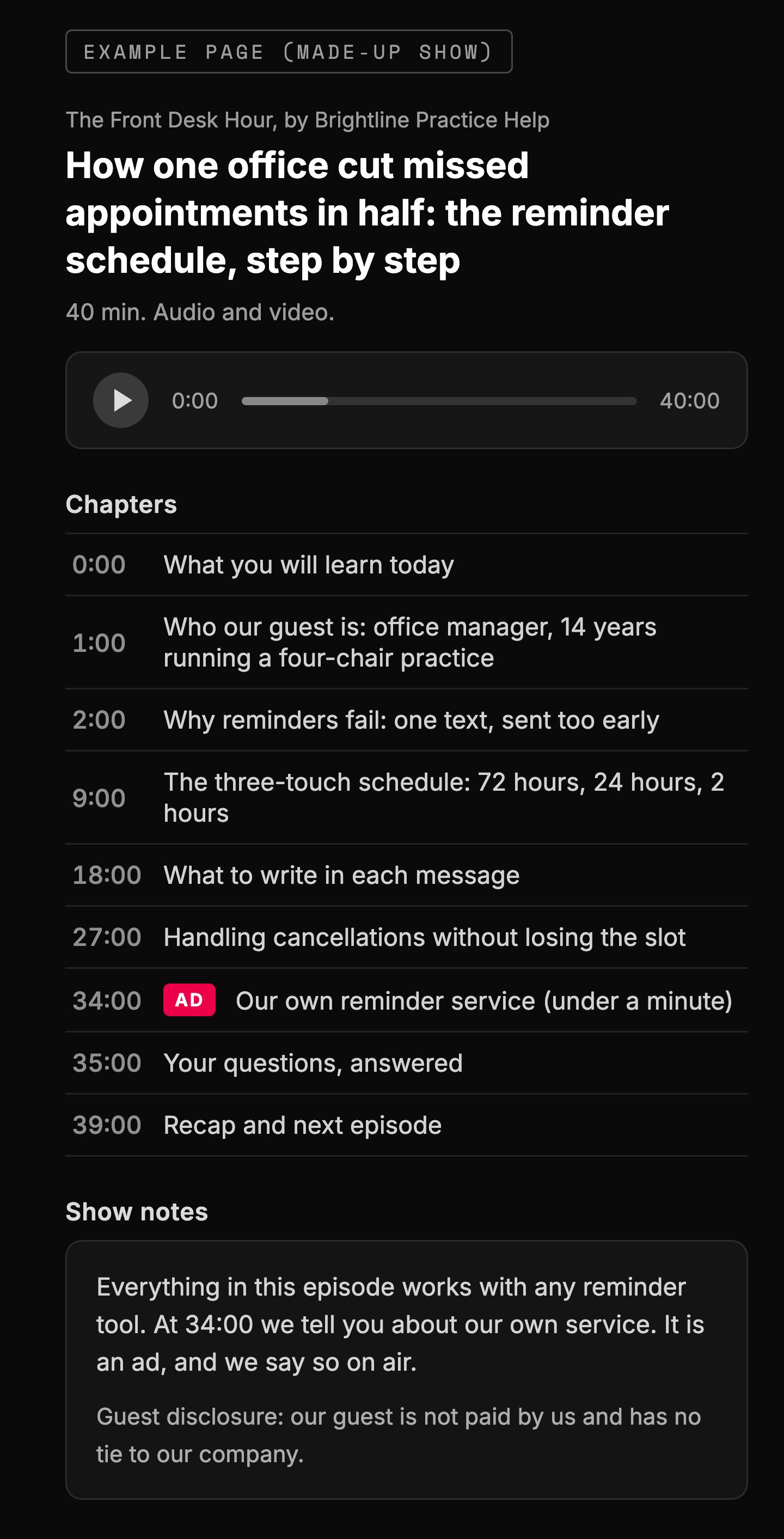
- The full lesson comes first. Nothing held back for the offer.
- The offer gets its own chapter, labeled Ad, in plain words.
- Short. Label, who it is for, next step, then back to the show.
- The episode keeps going after the offer.
- Any paid tie is stated. No tie? Say that too.
Example page built for this article with a made-up brand
Example: in a 40-minute episode, the offer comes after the lesson
- Hook and who it is for 0:00 Say what the listener will learn.
- Credibility 1:00 True facts about the speaker.
- The full lesson 2:00 to 34:00 Every step. Nothing held back for the offer.
- Offer break, labeled 34:00 "This part is an ad for our own service." Under a minute.
- Back to content 35:00 to 40:00 Questions, recap and the next episode.
Example plan, ours.
Example: in a group or newsletter, help for a few weeks before the first direct offer
- Day 1 Welcome and one useful thing. No ask.
- Week 1 Answer questions. Share a free guide or tool.
- Weeks 2 and 3 Teach one lesson in depth. Mention your service once, labeled.
- Week 3 or later First direct offer, labeled, with the price or next step.
Example plan, ours.
Label the offer the moment it starts
A label only works if people see it. For paid endorsements inside a long video, the FTC says the best spot is right before or at the start of the endorsement.
A note in the video description is not enough on its own. Many people never read the description.
Words matter too. The FTC lists plain terms such as "Ad" and "Paid Advertisement" as easy to understand. It calls "Promoted" ambiguous at best.
What if the product is plainly yours? The law asks for less in that case. We label it anyway, because a label costs five seconds and a fooled buyer costs the whole relationship.
Our offer break has four parts. Say it is an offer, and say who it is for.
Give the price or the next step. Then go back to the content, or stop.
Here is one we would use, as an example: "Quick break, this part is an ad for our own service. If you manage a dental office and patients keep missing appointments, we run the reminders for a flat monthly fee. The link is below, and now, back to step three."
Guests count too. Anyone you pay, or who works with you, says so on air before they recommend anything.
Calls get the same honesty. If you will make an offer on the call, the booking page says so. Our guide to qualifying before the call covers what to ask first.
Claims inside the offer follow the usual rules. See the FTC risk drivers in marketing claims.
A useful email first, then one boxed offer with the Ad label on it
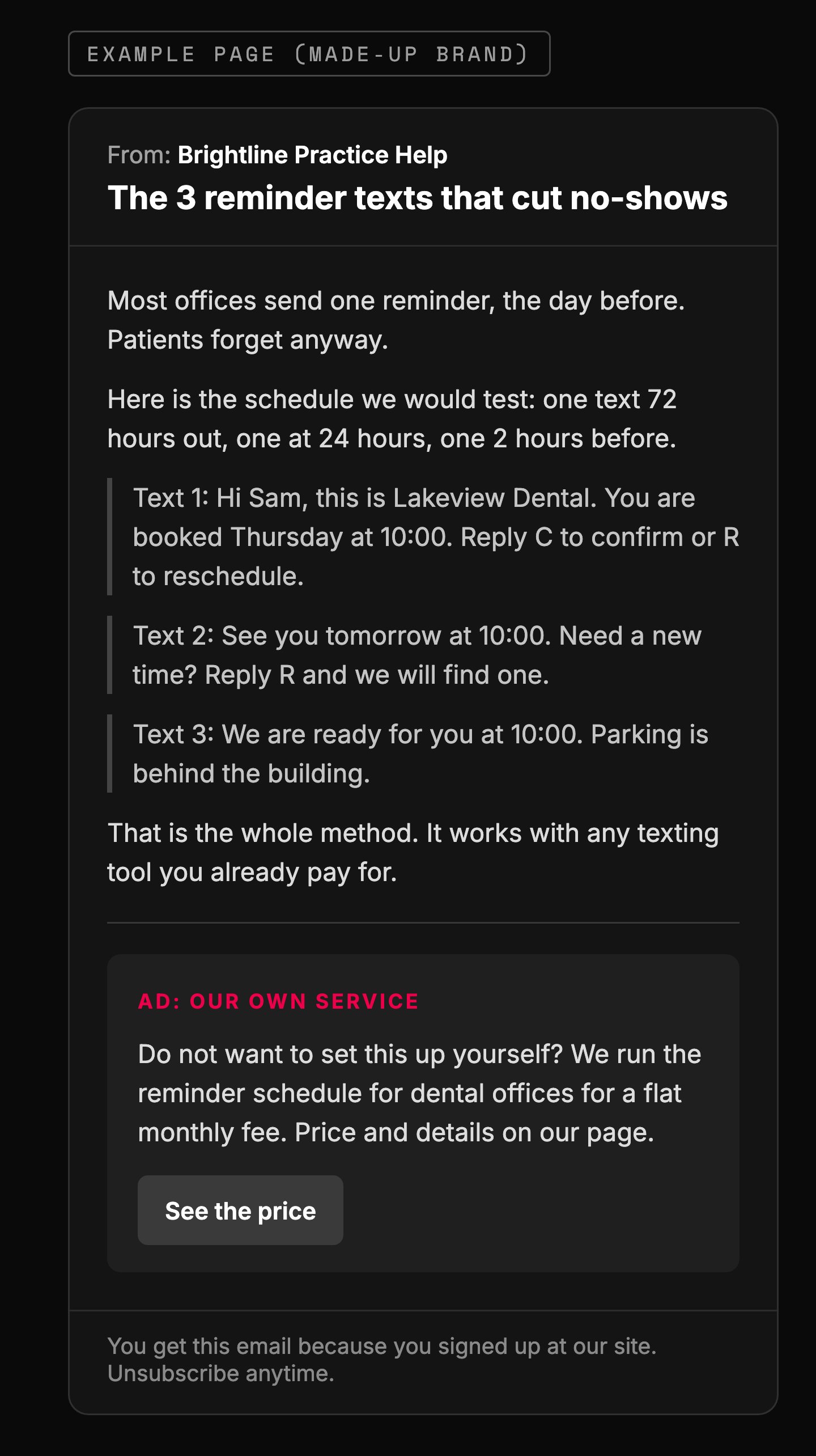
- The full method, free. A reader can use it without buying anything.
- Says plainly that the lesson is finished.
- The label sits on the offer itself, in plain words.
- Who it is for and what it does, in two sentences.
- One next step. The price is not hidden behind a call.
Example page built for this article with a made-up brand
Plain labels work: "Ad" beats "Promoted"
| Label | Clear? | Why |
|---|---|---|
| "This part is an ad for our own service." | Clear | Plain words, said where the offer starts |
| "Ad" or "Paid Advertisement" | Clear | On the FTC's list of terms people understand |
| "Promoted" | Unclear | The FTC calls it ambiguous at best |
| A note in the video description only | Not enough alone | Many viewers never see the description |
| "Thanks to our friends at..." | Unclear | A thank-you does not say money changed hands |
Sources: FTC, Native Advertising: A Guide for Businesses; FTC, Endorsement Guides: What People Are Asking.
The offer break: four parts, under a minute
- 1. Label it "This part is an ad for our own service."
- 2. Say who it is for One kind of buyer, one problem.
- 3. Price or next step One link, one action.
- 4. Go back or stop Return to the lesson, or end the piece.
Our template.
Put the offer in a format your buyer already trusts
People believe information more when it arrives in a form they already trust.
A common pattern: many buyers over 50 trust articles and journals. Podcast fans trust long conversations. Many 18 to 22 year olds trust short video.
So look at what your buyer's platform keeps showing them. Which format repeats?
How long are the pieces that do well? What does the room behind the speaker look like?
Match that format, and make it real. A real episode with a real lesson. Not a sales video in a podcast costume.
Set up the speaker in the first minute, with true facts. What have they done, and for whom?
Scripts trip people up. Have the speaker read the script aloud. Every word they stumble on gets rewritten in their own words.
If an older format still works for your buyer, leave it alone. New is not a strategy. For writing the lesson itself, see educational copy that motivates.
Put the offer where your buyer already looks for real information
| Buyer | Format many of them trust | Where the offer goes |
|---|---|---|
| Many buyers over 50 | Articles and journals | A labeled box after the full article |
| Podcast listeners | Long conversations | A labeled break after the main lesson |
| Many 18 to 22 year olds | Short video | A labeled last line and a link marked as an ad |
A common pattern. Check your own buyer's habits before you plan.
Match the format first, then make it real
- 1. Find the platform Where does your buyer spend time?
- 2. Note what repeats Which format keeps showing up?
- 3. Note the length How long are the pieces that do well?
- 4. Copy the look, not a lie Same set and length. A real lesson inside.
- 5. Read the script aloud Rewrite every word the speaker trips on.
Our method.
How do you know your audience has its guard up?
They tell you. Not in words. In what they do.
Watch a few recorded visits with a free tool like Microsoft Clarity. Remember that most people scan anyway. In one well-known study, 79 percent of test users always scanned a new page.
So scanning alone means little. Scrolling past the whole lesson straight to the price means a lot.
On calls, the first question is "How much?" Buyers ask about payment plans before you mention any. That usually means they have sat through many sales calls already.
Sales come in spikes instead of a steady line. View rates and sign-up rates slide month after month.
People even learn to stop seeing anything shaped like an ad. Designers call it banner blindness.
The loudest sign is people leaving the second the offer starts. For example, one webinar seller watched people leave at the pitch. Around 2014 it was a slow trickle, and by 2018 about half the room left.
For example, another webinar business saw its cost per lead rise from between $120 and $200 to between $300 and $500. New ads and new angles did not fix it.
So what is the fix? Not a better disguise. More real help before the ask, and a format your buyer has not seen a thousand times.
Five signs your audience has its guard up
| Sign | What it means | What to do |
|---|---|---|
| They scroll past the lesson straight to the price | They have seen this shape before | Give more real help before the price |
| They ask about payment plans before you mention any | They have sat through many sales calls | Change the format, not just the script |
| Sales come in spikes, not a steady line | They buy on their schedule, not yours | Publish on a steady rhythm before you ask |
| View and sign-up rates slide month after month | The format is wearing out | Test a format your buyer trusts more |
| Many people leave when the offer starts | The ask came too soon | Move the offer later, label it, keep it short |
Our checklist.
Example: cost per lead more than doubled while the ads kept changing
Cost per lead for one webinar business, low and high end, before and after its format wore out
- Before, low end 120
- Before, high end 200
- After, low end 300
- After, high end 500
Example from another business. Not our result, and not verified by us.
Where people get stuck with offers in content
How to make your audience hate your offer in four easy steps:
1. Pitch strangers in the first minute, before you have helped anyone.
2. Call the sales call a "free strategy chat" and spring the price at the end.
3. Put "sponsored" in small grey type in the description, where nobody looks.
4. When sales drop, build a sneakier costume instead of a better show.
Each one works for a while. Then it stops working, and buyers remember the bullshit.
Stuck point one: people love the content and never buy. The offer is vague, or missing. Fix it with one clear offer: who it is for, what it does, the price and one next step.
Stuck point two: people leave the moment the offer starts. The ask came before the help, or the format is worn out. Move the offer later and keep it under a minute.
Stuck point three: a guest pushes their own product. Fine, if they say so. Ask every guest to state any paid tie on air, before they recommend anything.

Three stuck points and the fix for each
| Symptom | Cause | Fix |
|---|---|---|
| People love the content and never buy | The offer is vague or missing | One clear offer: who, what, price, next step |
| People leave the moment the offer starts | The ask came before the help, or the format is worn out | Move the offer later; keep it under a minute |
| A guest pushes their own product | A paid tie nobody mentioned | The guest states the tie on air first |
Our checklist.
Plan your offer placement with AI
Paste the prompt below into your preferred AI. It asks about your content, your buyer and your offer, one question at a time.
Then it tells you where the offer goes, what the label says and what to measure. It also writes the offer break in plain words.
It will not write a disguise. If you ask it to hide that something is an ad, it says no and gives you the honest version.
Want a second set of eyes on the plan? Send it to us.
Paste into your preferred AI. It asks about your content, your buyer and your offer, then gives you the offer spot, the label line and the offer break.
Act as a content strategist. Help me place one honest, clearly labeled offer inside one piece of content, using Pitch Placement.

Ask me one question at a time, with the example:
1. What is the piece, its format and length? (Example: a 40-minute podcast episode)
2. What does it teach, in one sentence? (Example: how a dental office cuts no-shows)
3. Who is it for? (Example: dental office managers)
4. What is the offer, its price and the one next step? (Example: a reminder service, $400 a month, book a 20-minute fit call)
5. Is anyone in it paid by me or tied to me? (Example: no)
6. Where do people stop watching or reading now? (Example: I don't know)

Rules:
- Cut test: if the piece is not worth the time with the offer removed, tell me it is an ad and must say so at the top.
- The full lesson comes before the offer. Never hold back part of the answer to force a sale.
- Label the offer the moment it starts, in plain words, such as "This part is an ad for our own service." Never "Promoted", never a description note alone.
- Offer break under one minute: label, who it is for, price or next step, then back to the content or stop.
- A paid or connected guest states the tie before recommending anything.
- If it leads to a call, the booking page says an offer may be made on the call.
- Never write a disguise: no fake news stories, fake reviews, fake episode numbers, fake scarcity. If I ask, refuse and give the honest version.
- Never invent results, numbers or testimonials. Use only what I give you.
- Timing: if people leave before the offer, move it earlier. If they leave the moment it starts, move it later and help more first.

Output:
Cut test: content or ad, and why
Offer spot: [time or place]
Label line: [exact words]
Offer break: [under 60 words]
Guest line: [words, or none needed]
What to measure: [where people leave, before and after the offer]
Next three actions: 1. 2. 3.
Place one honest offer this week
1. Pick your next piece of content. Run the cut test on it.
2. Run the prompt. Write the offer break and the label line.
3. Publish it. Then check where people leave, and move the offer one step if you need to.
Turning one long piece into many short ones? Read one article, twenty pieces. Clips that carry an offer need the same label, so see the AI podcast clip pipeline.
Back to those two knee pages. One sold a cream by pretending. The other helped first and said so.
Guess which one people come back to. Help first, sell second, and never sell in a mask.

Filip Kovacevic is the founder of Anar Agency in Phoenix. He spent five years running SEO, Meta ads, email, and content for medical practices across the United States, and now does the same work for healthcare, home-service, legal, and professional-service businesses, alongside AI implementation. More from Filip →
Talk it through in 15 minutes
Bring one question from this article. We will tell you what we would do, whether or not you hire us.
Book a 15-Min Chat →