Educational Marketing Copy: Why Explaining It Well Does Not Sell
Educational marketing copy explains what a product is. It feels helpful, but it makes readers store facts and compare you with rivals. Copy that sells says what the product will do for the buyer, in their future.
Keep the explaining short and high-level. Turn feature lines into 'it will' lines, and keep every line true.
Educational marketing copy explains the product and loses the sale
Picture a man buying a camera so he looks better on video calls. The product page lists the sensor, the lenses and the frame rates. Every line is true.
So what does he do next? He opens three tabs and compares cameras. A friend names a better one, and this camera never gets sold.
The page taught him well. Then he used the lesson to shop somewhere else.
That is educational marketing copy: copy that explains what a product is. It feels helpful to write. It sends readers off to compare.
Now picture the same page with one line changed. "Once it is set up, it will light your face like a studio, and every call will look planned."
Same camera. Same facts. Now the camera is doing something for him.
The spec page teaches the camera; the it-will page sells what it does
| What it is | What it will do |
|---|---|
| 4K sensor, three lenses, 60 frames a second | Once it is set up, it will make every call look planned |
| Reader asks: what do other cameras have? | Reader asks: how much is it? |
| The buyer does the work of imagining | The product does the work |
| Builds a comparison | Builds a picture |
Example lines, written by us.
Run the walk-away test: do readers know it, or feel it?
The walk-away test is one question you ask after reading your own page. Do you walk away knowing about the product, or feeling something about it?
Know a lot and feel nothing? The page is educational. That is a damn good manual with a Buy button stapled on.
Read the page once, start to finish, as the buyer. Then check three signals.
Rereads. If you had to read a line two or three times, so will your buyer. On a live page, a heat map shows where readers stall and scroll back.
The price question. Did the page make you ask what it costs before you saw a button? If not, it informed you and stopped.
Memory or want. Count the facts you remember. Then ask yourself if you want it.
Readers do not study pages anyway. In one study of how people read online, 79 percent of test users scanned new pages, and only 16 percent read word by word.
A page that only works when studied works for one reader in six.
Five minutes tells you if your page teaches or sells
- 1. Read it once Start to finish, as the buyer, without stopping to edit.
- 2. Know or feel? Lots of facts and no feeling means the page is educational.
- 3. Mark the rereads Any line you read twice will lose a buyer. Heat maps show them on live pages.
- 4. The price question Did you want to know the price before you saw a button?
- 5. Memory or want Count the facts you remember, then ask what you want.
The walk-away test, as set out in this guide.
Only 16 percent of test users read a web page word by word
- Test users who scanned any new page 79
- Test users who read word by word 16
Source: Nielsen Norman Group, How Users Read on the Web.
Five places a reader walks away from an educational page
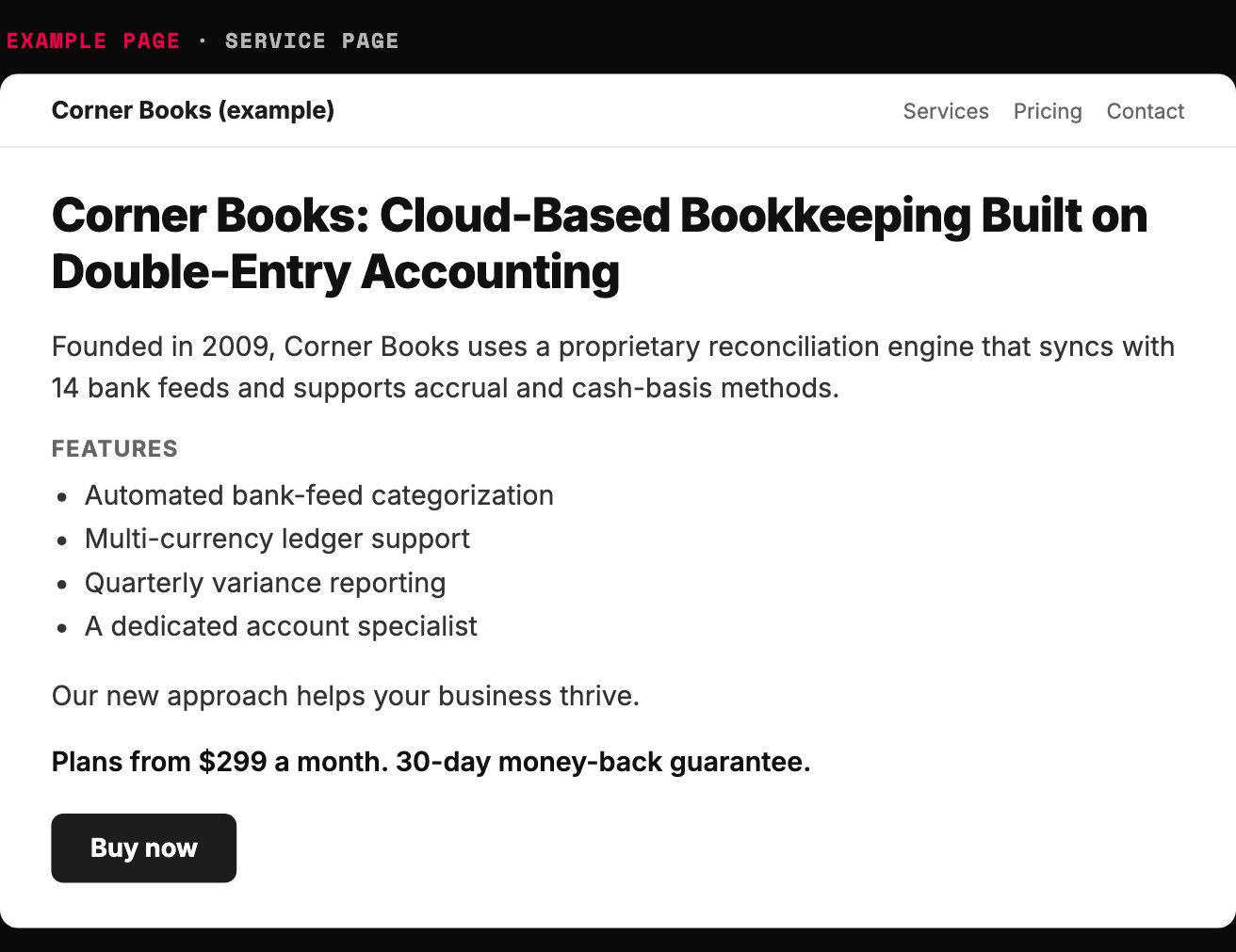
- Says what it is. Nothing here happens to the buyer.
- A line most readers read twice. This is where they stall.
- Every bullet is a spec a rival can beat. This sends the reader to compare.
- Abstract words. Nobody could photograph thriving.
- The price arrives before the reader wants anything.
Example page built for this article with a made-up brand
The It-Will Rule writes every benefit as something the product will do for the buyer, in their future. Teach in broad strokes, keep mechanisms at helicopter height, turn abstract words into pictures, and pick the verb that answers what holds the buyer back. Every it-will line must be true, and every fact the buyer needs stays on the page, below the future.
Why does explaining it well still lose the sale?
Learning costs the reader energy, and wanting needs that same energy. Spend it on a lesson, and the lesson is all they take home.
New facts have to be stored. Psychologists call the effort of holding them cognitive load. Storing is heavy work, which is why a dull class feels three hours long.
Familiar things only have to be recalled. A word calls up a picture the reader already owns. That is light work, like watching a good movie.
The chain runs one way. Words call up pictures. Pictures call up feelings.
Tell a barista you write high-ticket sales copy and you get a blank stare. Ask if they have seen Mad Men, the show about 1960s ad writers, and they picture it at once.
Sales calls work the same way. For example, a 55-minute call that teaches for 45 minutes leaves 10 minutes to decide, and the buyer arrives at the decision already tired.

Educational copy makes readers store; motivational copy lets them recall
| Educational copy: storing | Motivational copy: recalling |
|---|---|
| Builds new memories from scratch | Calls up pictures the reader already owns |
| Heavy, like a dull class | Light, like a good movie |
| Energy goes to thinking | Energy goes to feeling |
| Ends with: I know a lot about it | Ends with: I want it |
Our summary. Background: Wikipedia, Cognitive load; Wikipedia, Recall (memory).
Example: a call that teaches for 45 minutes leaves 10 to decide
Minutes in a 55-minute sales call, by what the time is spent on
- Teaching the product 45
- Deciding to buy 10
Example call shape to show the method. Not a measured result.
An educated buyer is a comparing buyer
Copy that explains features turns the sale into a comparison. In a comparison, the buyer holds the power, not you.
Every spec is a question the buyer can take to a rival. Your three lenses meet their four lenses. Now you are one row in a table.
Who can afford spec-sheet copy? Businesses that get paid whichever item wins. Comparison shopping sites mostly do not sell the products they list; they earn a cut through affiliate deals.
Big marketplaces, search engines and streaming libraries are in that same position. You probably are not.
Too many options also make choosing harder, which researchers call choice overload. A spec page sends the reader to every rival at once.
A single seller has to compete on the experience. That means the future the buyer gets, told in pictures.
Spec-first copy only pays if you win every comparison
- Where you win One seller, future-first copy. The buyer pictures life with it.
- Optional Marketplaces can sell the future too. They do not need to.
- Where sales stall One seller, spec-first copy. The buyer compares you with everyone.
- Where specs work Comparison sites and marketplaces earn whichever item wins.
Our model. Comparison sites: Wikipedia, Comparison shopping website.
The It-Will Rule: let the product do the work
The It-Will Rule writes every benefit as something the product will do for the buyer, in their future. "It will" puts the effort on the product, not on them.
Copy comes in three kinds. Educational copy says what it is. Motivational copy says what it will do for you, and inspirational copy says who you will become.
Good pages use all three, in different amounts. A little "it is," a lot of "it will" and some "you will."
Why does the word "it" matter so much? Because the buyer already tried to fix this alone. "It will" moves part of the effort onto something outside them.
Psychologists call the sense of who controls an outcome locus of control. Our read: a tired buyer is glad to hand part of the job to something else.
The future part matters too. People are always guessing how they will feel later, a habit called affective forecasting. An it-will line fills in that guess for them.
Then match the verb to what holds the buyer back. A buyer who feels worthless hears "it will get you paid."
A buyer who feels hopeless hears "it will free your evenings." A buyer who feels helpless hears "it will show you each step." More on what holds buyers back in the three beliefs that stop a buyer.
Words like once, when and then carry the reader into that future. We cover them in sequence words.
Write mostly in the middle row: the product acts, the buyer gains
| Kind | What it says | Who acts | Sounds like |
|---|---|---|---|
| Educational | What it is | Nobody | "It has a 4K sensor." |
| Motivational | What it will do for you | The product | "It will make every call look planned." |
| Inspirational | Who you will become | The buyer | "You will be the one who always looks ready." |
The It-Will Rule. Example lines written by us.
Pick the it-will verb that answers what holds the buyer back
| What holds the buyer back | Verbs that fit | Example line |
|---|---|---|
| Feels worthless | it will get you, you'll be able to | "Once it is live, it will get you paid on time." |
| Feels hopeless | it will free you, it will allow you | "It will free your evenings." |
| Feels helpless | it will show you, it will guide you | "It will show you each step." |
The It-Will Rule. Example lines written by us.
The same facts, with the product doing the work in the buyer's future
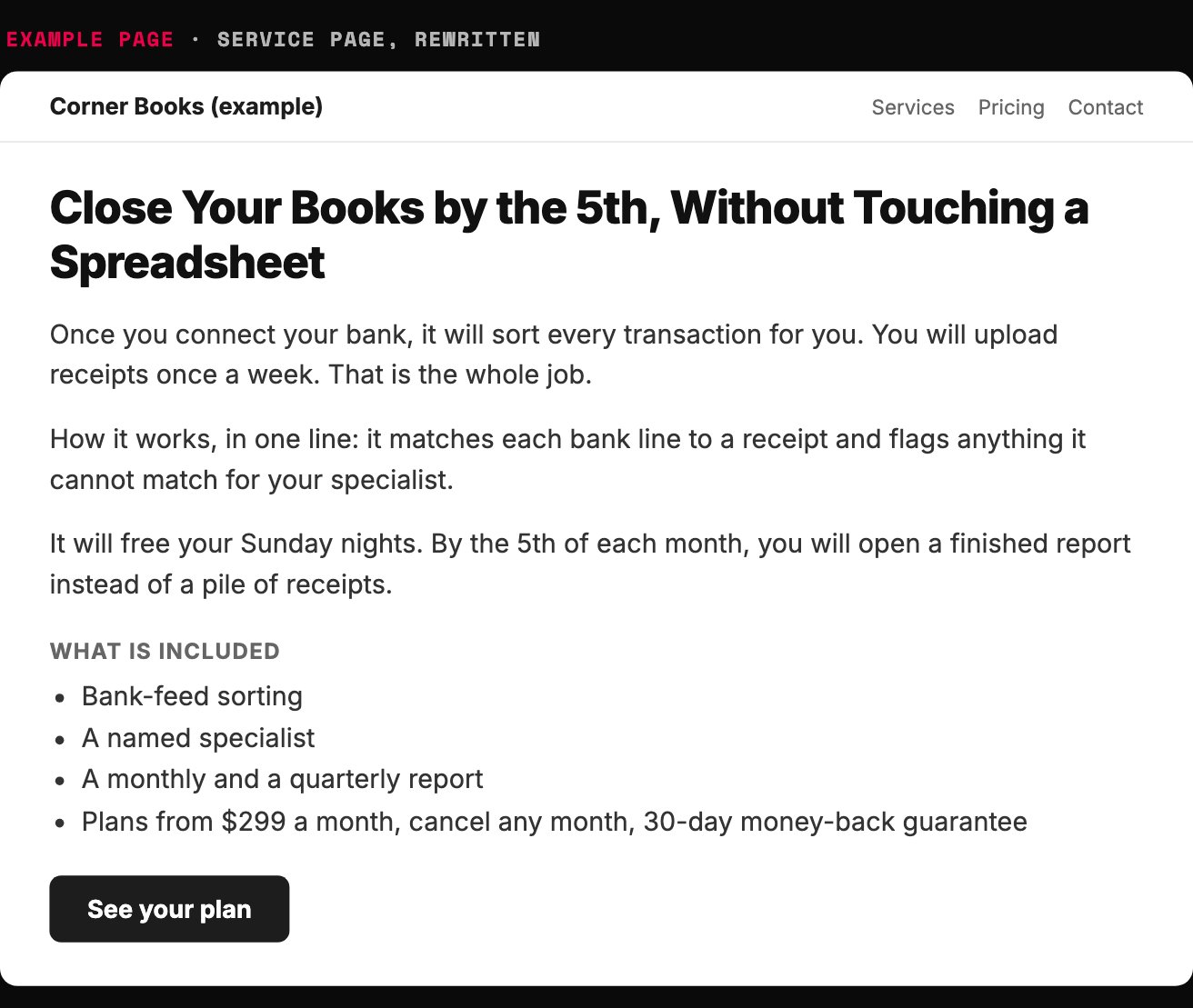
- Leads with what it will do, in the buyer's future.
- It will: the product carries the work.
- The buyer's real share of the work, said plainly.
- The mechanism at helicopter height: one line.
- Every fact is still here, below the future.
Example page built for this article with a made-up brand
Keep every it-will line true
An it-will line is a promise. Only write the ones your product keeps.
"Once you take this pill, it melts the fat for you" is a perfect it-will line. It is also a false one. The FTC's advertising guide for small businesses says ad claims must be truthful and backed by evidence before they run.
If the buyer has to do work, say so. Then let the product carry its real share. "It will show you each step, and you will do them in 20 minutes a day."
Our rule on facts: they stay on the page. They just stop being the pitch.
Put what is included, the price and the terms below the future, in plain words. The reader should finish able to explain the product in broad strokes, enough to defend the purchase to a spouse.
They should feel they understand it, and be moved to act. Hiding what is in the box is not persuasion.
It just leads to a refund later. More in the claims and refund rules that get sellers in trouble.
An it-will line is a promise; only write the ones the product keeps
| Overclaim | True it-will line |
|---|---|
| "It melts the fat for you." | "It will plan every meal, so you never guess." |
| "You will never work again." | "It will handle the invoices. You check them once a week." |
| Hides what is included | Lists what is included, below the future |
| No proof behind the claim | Every claim backed before the page goes live |
Example lines, written by us. Rule: FTC, Advertising FAQs: A Guide for Small Business.
Swap every abstract word for something the reader can picture
If the reader cannot picture it, they cannot feel it. Abstract words are the most common teaching habit after feature lists.
Think of words like "thriving," "a new approach" and "unforgettable vacations." What does any of that look like?
A buyer asks the follow-up in their head. What kind of vacation? Who pays for it?
A mental image is an experience that feels like seeing something that is not there. Concrete words build one. Abstract words skip it.
So run the underline pass. Print the page and underline every word nobody could photograph. Rewrite each one as a scene.
Experts do this the most, because they forget what it was like to be a beginner. That trap is called the curse of knowledge.
For the paragraph that explains how it works, fill in this pattern. "The real problem isn't [what they blame]. The real problem is [the actual cause]."
"That's why [your fix]. Now you can see how [it works, in one line]. When you start [first step], it will [first result]."
Plain words help everywhere. The federal plain language guidelines ask writers for common words and short sentences. Your buyer deserves the same.
If nobody could photograph it, rewrite it
| Abstract words | What the buyer wonders | Picture version |
|---|---|---|
| Thriving business | Thriving how? | Booked three weeks out, and you turned two jobs down |
| A new approach | New compared to what? | You stop chasing leads on Friday night |
| Unforgettable vacation | Where? Who pays? | A week at the lake, paid for, phone off |
| Stress-free | Free of which stress? | Monday morning, and nothing in the inbox is on fire |
Example rewrites, written by us.
When should copy teach? When the lesson is new and kept high-level
Teach when the lesson is something the buyer could not learn anywhere else. Keep it high-level.
A lesson nobody else knows makes the reader feel let in on something. A lesson everyone knows just costs them energy.
Think in three heights. From a plane, you see the whole map. From a helicopter, you see the landmarks, and in traffic you read street signs.
Mechanisms belong at helicopter height. The reader thinks "okay, that makes sense" and keeps moving toward the result.
Drop to street level and they start checking your work. That is when the comparison tabs open.
Can you show it instead? A short demo or a picture teaches faster than any paragraph.
Blog posts and tutorials can teach in full. Open with what the reader will be able to do, teach the how in broad strokes, and close with what happens next. That is the shape of content that gets read.
Explain the mechanism from helicopter height, never from traffic
- In traffic Street signs and every screw of the mechanism. The reader starts checking and comparing.
- Helicopter The landmarks: how it works in one or two lines. Mechanisms belong here.
- Airplane The whole map: the result, and who it is for.
Our model of how deep to explain.
Fewer specifics, more future: one upsell example
For example, one membership business sold a trial right after the first purchase. A 10-minute video walked through the newsletter, the group and the calls. About 10 percent of buyers took it.
They swapped it for a checkbox at checkout with three sentences of outcome copy: help at every step, the result at last, and a community behind them. About 25 percent took it.
Two things changed at once, the format and the words. So treat it as an idea to test, not proof. Our rule still holds: the checkbox says what is included.
An upsell asks a buyer to add more. It sells best when it names the next problem the first purchase creates.
How to write a page people study and never buy from, in four easy steps:
1. Open with the history of your company. Start at the founding.
2. List every feature in the order the engineers built them.
3. Explain the mechanism down to the last screw.
4. End on the price and a copy-pasted guarantee. Call it transparency.
Example: three outcome sentences were taken 2.5 times as often as a feature video
Share of buyers who took a membership trial after the first purchase. The format and the copy changed together.
- 10-minute feature video 10
- 3-sentence outcome checkbox 25
Example numbers from another business. Not our results, and not verified by us.
Rewrite your page with AI: the copy-paste prompt
Paste the prompt below into your preferred AI. It asks for your page, your buyer and what the product truly does. Then it runs the walk-away test and rewrites the lines.
It never invents a result. It flags every claim that needs proof you did not give it.
Read every rewritten line out loud before you use it. If your product cannot keep the promise, cut the line.
Want a second read on the result? Send it to us, or see how to describe the result instead of the deliverables.
Paste into your preferred AI. It asks for your page, your buyer and what the product truly does, then finds the educational lines and rewrites them.
Act as a sales page editor. Rewrite my page with the It-Will Rule.

Ask me one at a time, with the example:
1. Paste the page or section. (Example: my bookkeeping service page)
2. Who buys, and what are they stuck on? (Example: shop owners doing their books at midnight)
3. What does the product really do for them, and what proof do I have? (Example: books closed by the 5th of each month; 40 client reviews)
4. What work must the buyer still do? (Example: upload receipts once a week)

Rules:
- Walk-away test first: list every line that teaches what the product is (features, history, mechanism, jargon). Mark any line a reader would need to read twice.
- Rewrite each benefit as what the product will do for the buyer, in their future: "Once you..., it will..., you'll be able to..."
- The product is the actor. Use "it will" for work the product does and "you will" for who the buyer becomes.
- Pick the verb for what holds the buyer back: feels worthless, "it will get you"; feels hopeless, "it will free you"; feels helpless, "it will show you".
- Turn every abstract word into something a person could photograph.
- Keep the mechanism to one or two sentences the buyer could repeat to a friend.
- Keep every fact the buyer needs (what is included, price, terms, cancelling) on the page, below the future. Never hide it.
- Only promise what my answers support. Never invent a result, number or testimonial. Flag any claim that needs proof I did not give.
- If the buyer must do work, say so plainly.

Output:
Educational lines found: [list]
Rewritten lines: [old -> new]
Claims that need proof: [list]
Walk-away test after the rewrite: know it or feel it, and why
Next three actions: 1. 2. 3.
Run the walk-away test this week
1. Read your main page once as the buyer. Write down: know it or feel it?
2. Run the prompt. Rewrite your five biggest feature lines as it-will lines that are true.
3. Underline every abstract word and turn each one into a scene. Then read the page again.
Remember the camera that never got sold? Its page told him what it was. Your page can tell the buyer what it will do.
Facts tell buyers what a thing is. "It will" tells them why they want it.

Filip Kovacevic is the founder of Anar Agency in Phoenix. He spent five years running SEO, Meta ads, email, and content for medical practices across the United States, and now does the same work for healthcare, home-service, legal, and professional-service businesses, alongside AI implementation. More from Filip →
Talk it through in 15 minutes
Bring one question from this article. We will tell you what we would do, whether or not you hire us.
Book a 15-Min Chat →