Timeline Words: Persuasive Transition Words That Move a Reader
Persuasive transition words, which we call timeline words, put events in order: once, when, then, after, by the time. They walk a reader from the problem to the result one step at a time. To outline any page, write the outcome, list three to five points, and join each point with a timeline word.
Use them only for true steps.
Persuasive transition words turn a list into a path
Picture two sales pages for the same online piano course.
The first one lists eight benefits in a row. Learn faster. Play real songs.
Practice anywhere. Fun for adults. By benefit five, your eyes slide off the page.
The second page tells it in order. "Tonight, you learn one song with your right hand. By Friday, you add your left."
"Once both hands work together, you pick the next song yourself."
Same course. Same price. Only the second page uses persuasive transition words, and only the second one shows the reader a path.
Those small words are what we call timeline words. Tonight, by Friday, once. They put events in order, so the reader moves from where they are to where they want to be.
Copy without them reads like a TV with every channel on at once. Copy with them reads like a road.
Why does order matter so much? Because every offer sells a change. And every change has a before and an after.
A list asks the reader to connect the dots; a timeline connects them
| A list of benefits | A timeline |
|---|---|
| Learn faster | Tonight, you learn one song with your right hand |
| Play real songs | By Friday, you add your left hand |
| Practice anywhere | Once both hands work, you pick the next song |
| The reader sorts it out | The reader just follows |
Example: a made-up piano course. Our wording.
What are timeline words?
Timeline words are small words that say when something happens. Once, when, then, after, before, until, no longer.
Grammar books file most of them under conjunctions and discourse markers. They are the glue between ideas.
Linguists say words like these give a text cohesion. Each sentence hooks onto the one before it.
In copy they do a bigger job. They set the order of events. And order is how a reader works out what causes what.
Without order, the reader cannot see the change. Without the change, there is no sale.
They fall into three groups, plus one special kind. Past words look back.
Present words hold the reader in today. Future words point at the result.
Turn words mark the moment things changed. "It wasn't until." "The difference was when."
Keep the table below open while you write. You will use most of it in one page.
Four kinds of timeline words, and the job each one does
| Points to | Timeline words | What it does in copy |
|---|---|---|
| The past | before, I used to, remember, since, back then | Shows where the problem started |
| The present | now, right now, while, not yet, no longer | Holds the reader in today |
| The future | once, when, then, after, soon, by the time, you'll be able to | Walks the reader to the result |
| The turn | suddenly, until, it wasn't until, as soon as, the difference was when | Marks the moment things changed |
Our grouping of common timeline words.
Timeline Words are small words such as once, when, then, after and by the time that put events in order, so a reader moves from the problem to the result one step at a time. Outline any page as the outcome, three to five points, and a timeline word joining each point. Open with a failure timeline for buyers who already tried, and a forward timeline for those who never did.
Start in the past, present or future depending on where the pain lives. Aim fix and change at things, never at the reader. Use timeline words only for steps you control, and honest conditions for results you cannot promise.
Outline any page in five minutes: outcome, points, joins
This is the outline we use for any ad, email or sales page. It takes five minutes and one sheet of paper.
Step 1: write the outcome at the top. One line. What the buyer has at the end.
Step 2: list three to five points in order. Facts, arguments or steps. One line each.
Step 3: join each point to the next with a timeline word. Then, once, when, after or by the time.
Step 4: put your product in the future. The change happens later. Your product is how the reader gets there.
Step 5: end where the next step is buying. The reader has followed every link. The last link needs your product to happen.
Why does this work? The reader never has to figure out what comes next. The words carry them.
A list asks the reader to connect the dots. A timeline connects them for you.
The same outline holds up in long Facebook ads. Long copy with no order still fails. Copy in a clear order works at any length.
Five steps from a blank page to an outline
- 1. Outcome One line at the top: what the buyer has at the end.
- 2. Points Three to five facts, arguments or steps, in order.
- 3. Joins One timeline word between each point and the next.
- 4. Product in the future The change happens later. The product gets them there.
- 5. End on buying The last link needs your product to happen.
The Timeline Words outline, as set out in this guide.
Example: one outline for a bookkeeping service, joined by time
- Know your profit every Friday Outcome Without opening a spreadsheet.
- Receipts pile up in the truck Right now Nobody sorts them.
- Tax time turns into a guess Then You find out what you made months late.
- Once you snap each receipt, we sort it that day Once The step we control.
- By Friday, one page shows your profit By the time The last link needs the service.
Example: a made-up bookkeeping service for contractors. Our wording.
Has your buyer tried before? Then start with the failure
Before you write the first line, answer one question. Has your buyer already tried to solve this?
If they tried and failed, write a failure timeline. Walk through what they did and what happened each time. Then show what has to be different.
If they never tried, write a forward timeline. They have no failure to remember. So show what happens first, then next, once they start.
Mix these up and the page breaks. A forward timeline sounds naive to someone who failed five times.
They have heard "just do this" before, so they hit the back button.
Repeated failure changes people. The extreme version is called learned helplessness: after setbacks they could not control, people stop trying, even when a way out exists.
So the failure timeline goes first for them. It says, in effect, "you were not the problem."
Then it names the real cause and the new order of steps. Our rule: the good news must be a real difference, not a louder promise.
Naming that cause is its own skill. See start with the cause, and for buyers who have seen every pitch, selling to buyers who have seen it all.
Buyers who failed need the failure told first; new buyers need the next step
| Tried and failed | Never tried |
|---|---|
| Start in the past: what they tried | Start in the present: where they are |
| Show why each try failed | Show what happens first |
| Name what is different now | Then show what happens next |
| End on the new order of steps | End on the result, step by step |
| Key words: you tried, each time, no longer | Key words: once, when, then, by the time |
The Timeline Words method, as set out in this guide.
Five beats that tell a burned buyer it was not their fault
- 1. The bad news What they tried, in order. Each try, and what happened.
- 2. The cause Why every try failed. One real cause, not their effort.
- 3. The good news What is different now. A real difference, not a louder promise.
- 4. The new order When you change this one thing, then this happens, then that.
- 5. The far side What life looks like after. Honest about what is typical.
The Timeline Words method, as set out in this guide.
Feelings live in time, so pick where your copy starts
Every feeling points to a time: the past, the present or the future.
Worry and hope point forward. Anxiety is defined as the expectation of a future threat.
Regret points back. It is wishing you had chosen differently in the past.
So where you start your copy sets the feeling the reader brings to it. Start in the wrong place and the feeling never shows up.
There are three stuck beliefs, and each one has its own starting point.
A buyer who feels not good enough starts in the past. Show where that belief began. It did not start with them.
A buyer who feels stuck starts in the present, with a little past. What they are doing now, and what they tried that did not stick.
A buyer who sees no good future starts in the future. Then go back to the day the hope was lost.
Past, present or future? Ask where the pain lives, and start there.
More on these three beliefs in the three beliefs that stop a buyer.
Regret looks back; worry and hope look ahead
- Regret Past Wishing a choice had gone differently. Use it to show where the problem began.
- The stuck point Now What is not working today. Keep it short and concrete.
- Worry and hope Future Both look ahead. Worry at a threat, hope at the result.
Regret and anxiety as defined in Wikipedia's Regret and Anxiety entries. The copy use is ours.
The buyer's stuck belief tells you where on the clock to begin
| The buyer feels | Start the copy in | Example opening line |
|---|---|---|
| Not good enough | The past | "Remember the first time someone told you [X]? That is where this started." |
| Stuck right now | The present, plus a little past | "Right now you do [X] every week. You already tried [Y]. It did not stick." |
| No good future | The future, then back | "Five years from now, nothing has changed. Here is the day it stopped feeling possible." |
The Timeline Words method. Example lines are ours.
Watch the timeline words that tell readers they failed
Some timeline words carry a hidden message. "When you try" is the big one.
Read it slowly. "When you try to run ads" assumes it did not work.
People who succeed do not say they tried. They say they did it.
Linguists call a hidden assumption like this a presupposition. The sentence takes something for granted without saying it.
"Fix" and "change" work the same way. "We will fix your marketing" says it is broken.
"Once you change your mindset" says something is wrong with the reader. They feel it, even if they cannot name it.
Use these words on purpose or not at all. Aim them at a thing, never at the person.
"Once we rebuild the follow-up emails" points at emails. Nobody gets defensive about emails.
Our take: half the copy that feels pushy is not pushy at all. It is quietly calling the reader a failure.
Bad words spread through a page fast. Here is how one wrong word infects an offer.
Three common phrases quietly tell the reader they failed
| You write | The reader hears | Write instead |
|---|---|---|
| "When you try to run ads..." | You failed at ads | "Ads stop working when [the real cause]..." |
| "We'll fix your marketing" | Your work is broken | "We'll rebuild the follow-up emails" |
| "Once you change your mindset" | Something is wrong with you | "Once the page loads in two seconds" |
Our examples.
Timeline words make claims sound like facts, so keep every link true
Here is what most copy guides skip. A claim told in order sounds like a fact.
To argue with a timeline, a reader has to hold the whole chain in mind and find the weak link. That takes energy, and most readers will not spend it.
Research on stories points the same way. People absorbed in a story argue back less.
That power can also mislead. Something that happens after a step was not always caused by it.
The old name for that mistake is post hoc ergo propter hoc: after this, therefore because of this.
The law looks at these chains too. The FTC checks implied claims as well as express ones.
Its own example: "kills the germs that cause colds" implies the product prevents colds. The ad never says it, but the order of the words does.
Our rule: use when for steps you control. Use if for results you cannot promise.
"Once you book, we call you within one business day" is fine, if you do. "Once you join, you lose 30 pounds" is a promise you cannot keep.
A timeline with one false link is not copy. It is a trap with good grammar.
More on where implied promises get sellers in trouble: the FTC risk drivers in marketing claims, and why outcomes still need honest wording.
Use when for steps you control, and if for results you cannot promise
| Steps you control | Results you cannot promise |
|---|---|
| Use once, when and then | Use if, can, and most buyers who |
| "Once you book, we call within one business day" | "Clients who finish can expect..." only with proof of what is typical |
| Proof: your own process | Proof: data on typical results |
| Risk: none, if you deliver | Risk: an implied promise the FTC can check |
Our rule, using the FTC's Advertising FAQs and Endorsement Guides FAQ.
A fill-in opening built from timeline words
Here is an opening template packed with timeline words. Fill the brackets with true facts only.
Look at the order. It opens with the result and a time frame. That is the future.
Then it admits the work. That is the present. Then it tells the story from the past up to now.
Our favorite line in it is "Full disclosure: this takes work." It is honest. It also lets the wrong buyer leave early.
For example, one opening built this way, posted as a comment in a business group, drew 50 to 100 likes. A small test, but a real one.
Careful with the first line. The FTC says a result in a testimonial reads as what others can expect. A line like "results not typical" does not change that.
So the result in your opening must be typical, or the copy must say what is typical. Your best month is not a template. It is the exception.
A six-line opening that moves from the future to the past and back
- Future: the result "Here's how I got [true, typical result] in [time frame]."
- Future: the payoff "By the time you finish this, you will be able to [skill]."
- Present: the honest gate "Full disclosure: this takes work. If that is fine with you, read on."
- Past: the old way "My name is [name]. I used to [old way]."
- Turn: the change "It wasn't until [moment] that things moved. The difference was when I started [new step]."
- Present: the choice "Most people have to [hard way]. What if you skipped that and [new way] instead? That is what I did."
Our template. Fill every bracket with true facts only.
Where people get stuck with timeline words
How to write copy nobody can follow, in four easy steps:
1. List every benefit at once. Call it value.
2. Jump from last year to next month to today in one paragraph.
3. Tell the reader "when you try" five times. Wonder why they feel bad.
4. End the story before the product shows up. Hope like hell they scroll.
Stuck point one: the copy reads like a list. Every paragraph could go in any order. The cause is missing joins.
The fix is a brick pass. Read the draft aloud, mark every jump between points, and lay one timeline word in each gap.
Stuck point two: the reader asks "wait, when?" The timeline jumps around. Pick one start point from the belief map, then move forward only.
Stuck point three: the story ends and nothing needs buying. The last step happens without you. Move the product into that last step, so the change needs it.
Editing someone else's copy? Same pass. Missing joins are the most common fix we make.
Five moves that turn a list of points into one path
- Read it aloud Hear where the story stops making sense.
- Mark every jump Any spot where one point just ends and the next begins.
- Lay one brick Put one timeline word in each gap.
- Check the order Each step must happen before the next one.
- Check the links Coming after is not proof of cause. Prove each one.
The Timeline Words method, as set out in this guide.
Five timeline words turn six loose facts into one path
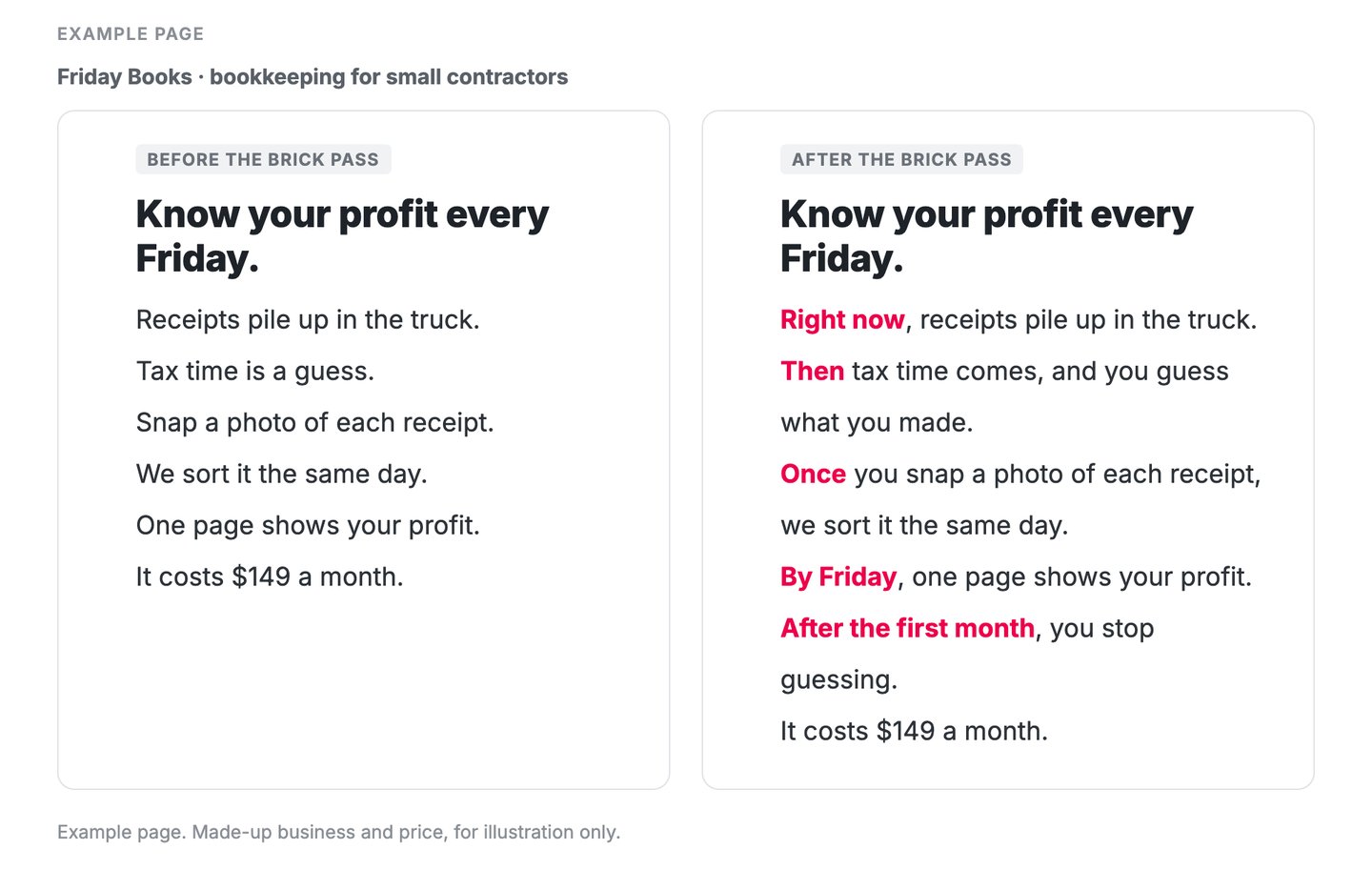
- Six facts, no order. The reader has to sort them.
- Starts where the buyer is today.
- A step the business controls, so "once" is honest.
- The result, placed in the future.
- The far side. A feeling, not a number we cannot promise.
Example page built for this article with a made-up brand; business, copy and price are invented.
Outline your page with AI
Paste the prompt below into your preferred AI. It asks about your offer, your buyer and what they tried, one question at a time.
Then it picks a failure or forward timeline and a start point. It writes the outline and a short draft with the timeline words in bold.
It will not invent results. It also flags any link where one thing only comes after another but is sold as the cause.
Want a second pair of eyes on the draft? Send it to us.
Paste into your preferred AI. It asks about your offer, your buyer and what they tried, then writes the outline and a short draft.
Act as a copy editor. Outline one piece of copy with Timeline Words: small words like once, when, then, after and by the time that put events in order.

Ask me one question at a time, with the example:
1. What are you selling, and what does the buyer have at the end? (Example: bookkeeping for contractors; they know their profit every Friday)
2. Who is the buyer? (Example: owners of small roofing companies)
3. Have they tried to solve this before? What did they try? (Example: yes, a spreadsheet and a cheap app)
4. Which is closest to how they feel: not good enough, stuck right now, or no good future? (Example: stuck right now)
5. What are your 3 to 5 points, in order? (Example: receipts pile up; taxes become a guess; we sort receipts daily; one page every Friday)
6. Which steps do you control, and which results can you not promise? (Example: we control the daily sorting; we cannot promise lower taxes)

Rules:
- Outline = the outcome at the top, then the points in order, with one timeline word joining each point to the next.
- Tried and failed: write a failure timeline. Walk through what they tried, why each try failed, and what is different now.
- Never tried: write a forward timeline. Show what happens first, then next, step by step.
- Start point: not good enough = start in the past. Stuck right now = start in the present, with a little past. No good future = start in the future, then go back to where hope was lost.
- The product sits in the future. The last step of the timeline needs the product to happen.
- Never write "when you try" unless I ask. Aim "fix" and "change" at a thing, never at the reader.
- Use once, when and then only for steps I control. Results I cannot promise get honest conditions ("can", "most buyers who").
- Flag any link where one thing only comes after another but is presented as the cause.
- Never invent results, numbers, testimonials or time frames. Use only what I give you. If a fact is missing, ask.

Output:
Timeline type: failure or forward, and why
Start point: past, present or future, and why
Outline: outcome, then each point with its joining word
Draft: under 200 words, timeline words in bold
Links to check: any claim I must prove before I publish
Next three actions: 1. 2. 3.Add the bricks this week
1. Pick one page that sells. Run the brick pass on it.
2. Run the prompt for the same offer. Compare its outline with your page.
3. Cut every "when you try" and every promise you cannot keep.
Next, choose how the page starts. See whether your ad should start with why or how.
Back to those two piano pages. One handed the reader a pile of facts. The other handed them a path.
Facts are bricks. Timeline words are the cement that holds them together. Without it, you just own a pile.

Filip Kovacevic is the founder of Anar Agency in Phoenix. He spent five years running SEO, Meta ads, email, and content for medical practices across the United States, and now does the same work for healthcare, home-service, legal, and professional-service businesses, alongside AI implementation. More from Filip →
Talk it through in 15 minutes
Bring one question from this article. We will tell you what we would do, whether or not you hire us.
Book a 15-Min Chat →