How to Sell to Sophisticated Buyers Without Pushing Them Away
A sophisticated buyer checks your offer against rules they already hold: what they know, how they like to buy, and what someone they trust told them. To sell to them, cut the pressure. Remove stacked upsells and decide-now deadlines.
Give specific information, matched proof and room to think. Then invite them to a call.
Sophisticated buyers bring their own rules to the sale
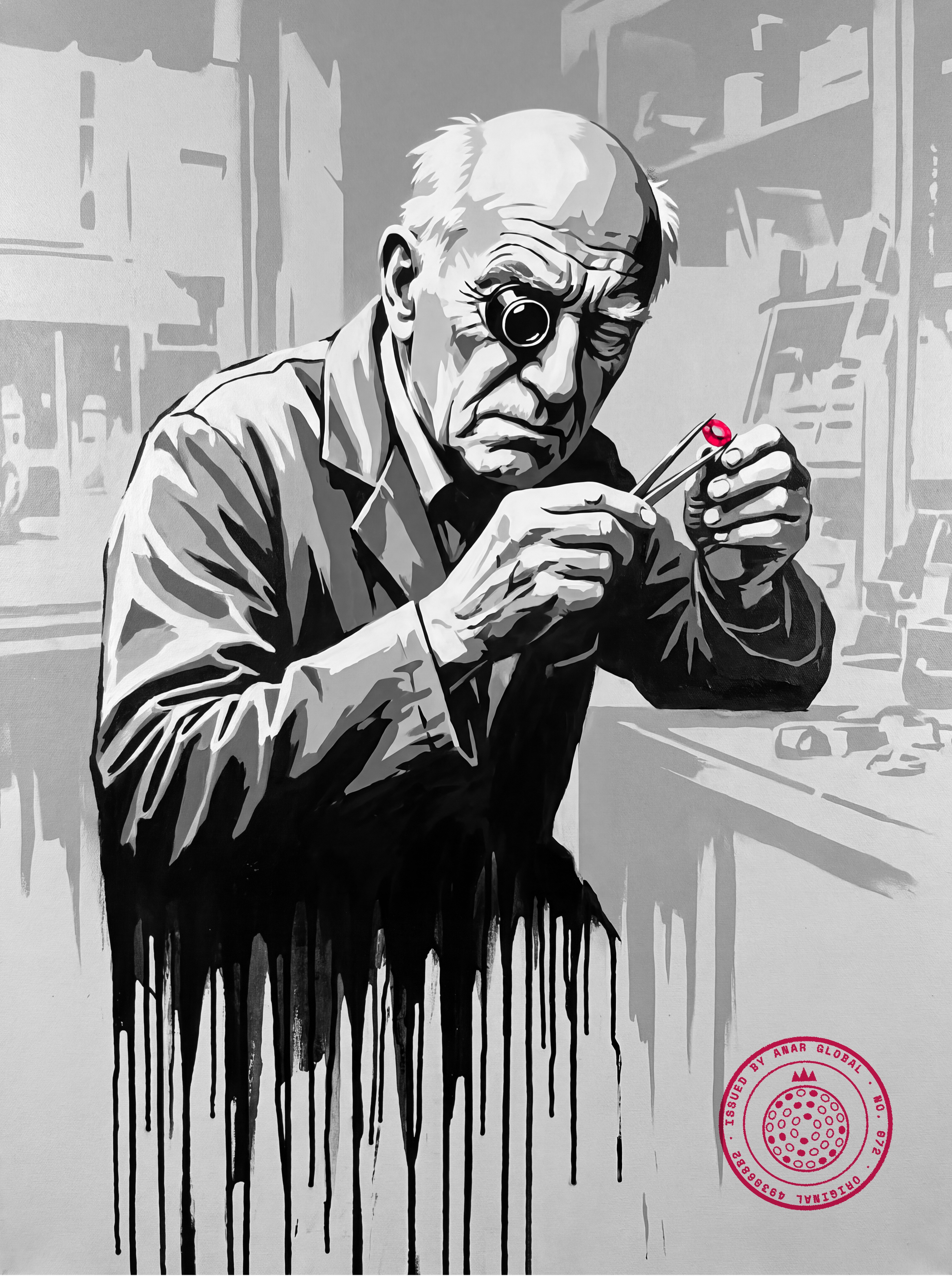
Three men walk into a suit shop. Each needs a suit for a wedding.
The first has never been to one. He says, "Just dress me." He buys whatever the clerk calls perfect.
The second knows what he wants and already owns the shoes. A clerk follows him around anyway. He walks out to the shop next door.
The third is the groom, and he holds a list. "You look great in red," says the clerk. "My wife said purple," says the groom.
Same shop, same suits. Only the first man wanted to be sold. The other two were sophisticated buyers.
A sophisticated buyer checks your offer against rules they already hold. The rules come from what they know, how they like to buy, or someone they trust.
Most funnels are built for the first man. This guide is for the other two. We call the method the Permission Path: give information, give room to think, then invite once.
Only one of the three buyers wanted to be sold
| The buyer | Where his rules come from | What he needs from the shop |
|---|---|---|
| First-time guest | Nowhere yet | An expert to choose for him |
| Experienced guest | His own experience | Space, and help when he asks |
| The groom | His wife's list | Help carrying out someone else's choice |
Illustration used in this guide.
What is a sophisticated buyer? Ask three questions
A sophisticated buyer is someone who tests your claims against what they already know. To see how much they know, ask three questions.
How many times has the market heard this promise? The copywriter Eugene Schwartz showed how markets wear out.
The first seller makes a plain promise. Later sellers make bigger promises, then explain new reasons why, then sell an identity.
Example: low-carb diets. First came "lose 30 pounds in 30 days." Then 40 pounds, then 47.
Then came new diets with new reasons. In the end, people stopped dieting and started calling themselves keto.
How much marketing has this person seen? Every ad they read, yours and your rivals', teaches them the sales script. They can guess your next line before they read it.
What do they know from real life? Picture two people who both weigh 250 pounds.
One is a former athlete who studied nutrition. The other has never dieted and feels stuck for good.
They weigh the same and see the same ad. But they read it in two completely different ways.
The three answers do not always match. A law firm owner is an expert in law and a beginner in marketing. One person can be both at once.
So score all three before you write a word. A high score on any one of them means you are selling to a skeptic.
Markets move from plain promises to bigger ones, new reasons and identity
- 1. A plain promise "Lose 30 pounds in 30 days." Nobody has heard it before.
- 2. Bigger promises 40 pounds. Then 47.
- 3. New reasons why New diets, each with its own explanation.
- 4. An identity People stop dieting and start calling themselves keto.
Stages after the copywriter Eugene Schwartz. Diet example used in this guide.
Score all three, because one person can be high on one and low on another
| Question | What it measures | Example |
|---|---|---|
| How often has the market heard this promise? | How worn out the category is | Diet ads after decades of claims |
| How much marketing has this person seen? | How well they know the script | A buyer who reads every ad in the niche |
| What do they know from real life? | Skills and training of their own | A former athlete who studied nutrition |
Method as taught in this guide.
The Permission Path is a sales process for sophisticated buyers. Score the buyer on three questions: how often the market has heard the promise, how much marketing they have seen, and what they know from doing the work. Find who shaped their rules.
Remove forced steps such as stacked upsells, unskippable videos and decide-now deadlines. Lead with something they can study, give specific information and matched proof, then make one optional invitation to a call or a done-with-you offer.
Experts test both halves of your reason why
Experts test two things: why you say the problem happens, and why you say your fix works. Together, those two answers are your reason why, also called your mechanism.
A beginner hears the reason and nods. An expert holds each half up against what they know.
Take buttered coffee, sold as a diet drink. The problem story blames insulin for stored fat. The fix is butter in your morning coffee.
An expert knows facts about insulin that the story leaves out. They poke a hole in the problem half. Then they poke one in the fix.
Both halves fail. So does the sale.
Experts also run the math. A pound of fat is commonly counted as 3,500 calories. So 30 pounds in 30 days needs a deficit of 3,500 calories every day.
Say the buyer burns about 2,500 calories a day. To hit the claim, they would eat nothing and still burn 1,000 more through exercise, every single day.
So the claim feels wrong to them. They can check it in a minute with a free government weight planner.
So never invent a magic mechanism to sound new. Experts call bullshit on it fast. A real big idea comes from something that really changed, like a new tool, a new rule or a new cost.
Titles get the same test. "I am a nutritionist" impresses a beginner. An expert asks where you trained.
Example: "30 pounds in 30 days" needs a 3,500-calorie deficit every day
- Calories in 30 pounds, at the common 3,500 per pound 105000
- Daily deficit needed over 30 days 3500
- What this example buyer burns in a day 2500
Worked example: 30 x 3,500 = 105,000; 105,000 / 30 = 3,500. The 2,500 figure is an example, not a measurement.
An expert tests the problem half and the fix half separately
| Half of your reason why | The buttered-coffee version | What the expert asks |
|---|---|---|
| Why the problem happens | Insulin makes you store fat | Is that the whole story about insulin? |
| Why the fix works | Butter in your coffee | Where does that fat go? |
| The promise | Fast weight loss | Does the math add up? |
Example used in this guide.
Find out who wrote the buyer's rules
Every buyer's rules come from one of three places. Find which one before you sell.
Nowhere yet. The first man in the suit shop had no rules. He wanted an expert to decide for him.
Their own experience. The second man had his own rules. Push him and he leaves.
Someone else. The groom's rules came from his wife. She is not in the shop, but she decides.
Sociologists call the people we judge ourselves by a reference group. For your buyer, it might be a spouse, a doctor or a business partner.
Health offers hit this all the time. A buyer whose doctor said to cut butter will fear a high-fat diet. Your page has to answer the doctor too.
So ask who shaped the buyer's rules. Then answer that person's questions on the page.
Then there is the buyer who only feels expert. They have watched enough videos to sound like a pro.
Psychologists link this to the Dunning-Kruger effect: people with low skill in an area often overrate their skill. These buyers raise expert objections and leave like experts.
They are also loyal to the brands and creators who taught them. Tell them their favorite brand is wrong, and you lose them.
When someone else wrote the rules, answer that person too
| Source of the rules | Suit shop | Health offer | What to do |
|---|---|---|---|
| Nowhere yet | "Just dress me" | No idea what to eat | Be the expert they hand it to |
| Their own experience | Shoes already at home | Has dieted well before | Give space; answer when asked |
| Someone else | The wife's list | The doctor said cut butter | Answer that person's questions on the page |
Method as taught in this guide.
Buyers who only feel expert react like experts, so treat them the same
| Feels expert | Is expert |
|---|---|
| Learned from videos and posts | Learned from doing the work |
| Loyal to the creators who taught them | Loyal to what has worked for them |
| Leaves if you knock their favorite brand | Leaves if your facts are wrong |
| Needs trust before they stay | Needs trust before they stay |
Method as taught in this guide.
Forced selling drives away the buyers worth keeping
A forced sales process pushes the buyer at every step. Click, buy, watch this upgrade, decide now.
It works on beginners. They want someone to tell them when to buy.
For example, one software company sold well from a simple showcase page. Then buyers hit an upsell with a video they could not skip. Complaints poured in from one group, who hated that step.
Their logic was simple. "I would not sell this way, so I will not buy this way."
Why are experts so harsh? They think in yes or no. A sales video can be great for its first 30 percent, then one wrong line ends it.
Beginners think in shades of grey. You can lose them for a minute and win them back.
Some pressure tricks have a name: dark patterns, such as fake urgency and fees hidden until checkout. The FTC has a whole report on them.
Pressure makes buyers trust you less. Experts will not put up with it.
How to lose an expert buyer in four easy steps:
1. Invent a magic mechanism. Make it sound scientific.
2. Give yourself a title nobody can check.
3. Stack three upsells right after checkout.
4. Add a countdown timer and a video they cannot skip. Then pray like hell.
Forced selling pushes at every step; permissive selling gives room
| Forced | Permissive |
|---|---|
| Click, buy, decide now | Read, understand, decide later |
| Stacked upsells right after checkout | One optional next step |
| Videos they cannot skip | Information they can study |
| Countdown timers | Room to think |
| Works on beginners | Works on experts |
Method as taught in this guide.
Beginners forgive a wrong line; experts leave at the first one
| Beginner buyer | Sophisticated buyer | |
|---|---|---|
| How they think | Shades of grey, close enough | Yes or no |
| After a wrong line | You can win them back | Usually gone |
| Proof they need | Any happy customer | A case that matches their situation |
| How they want to learn | An overview that inspires | The steps, in order |
| Pushy selling | Goes along with it | Walks out |
Method as taught in this guide.
The Permission Path: information, space, then one invitation
The Permission Path is a sales process that lets sophisticated buyers decide at their own pace. It has five steps.
Step 1: Spot the buyer. Score the three questions above. High scores mean you take the slower road.
Step 2: Remove the force. Cut stacked upsells right after purchase. Cut videos they cannot skip and deadlines that say decide now.
Step 3: Lead with something they can study. Use a lead form and a specific guide or white paper. Name their exact problems, in their words.
Example: for heavy AI users, the guide names usage limits that hit too soon, code that comes back wrong and databases that break on launch. It does not promise that AI makes you rich.
Step 4: Give information and room. Show the steps, not an overview. Show proof that matches their trade, size and problem, as in our proof stack.
Step 5: Invite once. Offer a call or a done-with-you option for people who want help. Make it easy to say no.
At every step, the buyer silently asks four questions. Do you understand my problem? Do you respect my intelligence?
Will the pressure grow once I am in? Will my data be sold?
Persuasion research points the same way. Motivated, able readers judge the argument itself, and the opinions they form that way tend to last longer.
Read more about follow-up that gives first in lead-first nurture, and about closing without pressure in the take-away close.
Five steps from first ad to an invitation they can turn down
- 1. Spot the buyer Score the three questions. High scores mean the slower road.
- 2. Remove the force No stacked upsells, no videos they cannot skip, no decide-now deadlines.
- 3. Lead with something to study A lead form and a guide that names their exact problems.
- 4. Give information and room Steps, not an overview. Proof that matches their situation.
- 5. Invite once A call or a done-with-you option. Easy to say no.
The Permission Path, as set out in this guide.
Every step has to answer what the buyer will not say out loud
| The buyer wonders | What answers it |
|---|---|
| Do you understand my problem? | A guide that names their exact problems |
| Do you respect my intelligence? | Steps and details, not hype |
| Will the pressure grow once I am in? | No stacked upsells, one optional invitation |
| Will my data be sold? | Say plainly what you do with their details |
Method as taught in this guide.
After the opt-in, give the guide and one optional invitation
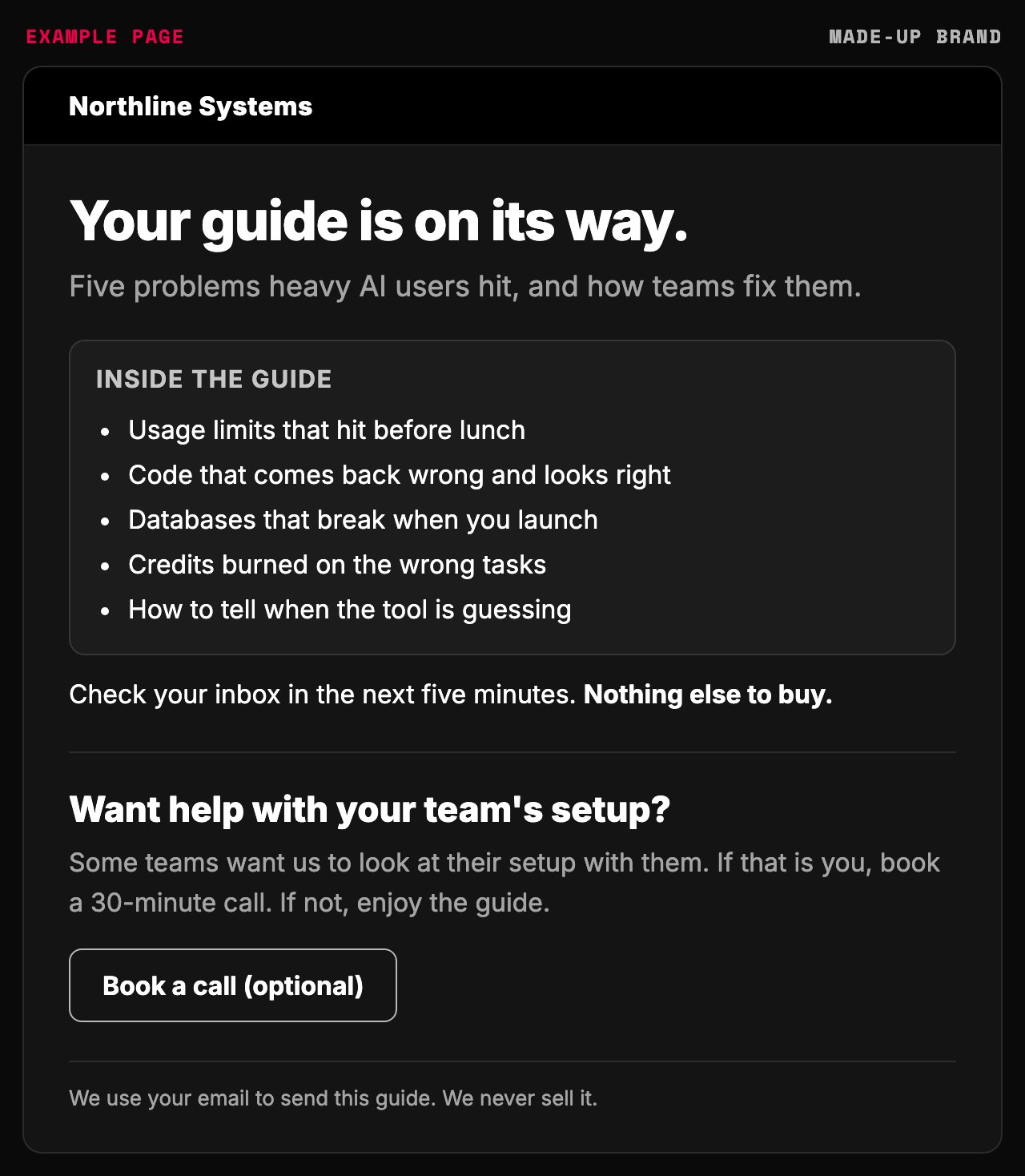
- Names their exact problems, not a promise to get rich.
- No stacked upsell after the opt-in.
- One invitation, and it says it is optional.
- Answers the quiet question: will my data be sold?
Example page built for this article with a made-up brand
Sophisticated buyers are slower to win and slower to leave
Sophisticated buyers take longer to win. They also spend more and stay longer.
Trust is the reason. They keep paying while trust holds, and it can hold for years when their need keeps coming back. Keeping those buyers is called customer retention.
Beginners buy the new idea. When a newer idea shows up, they leave.
Agencies see this as three kinds of client. Dreamers know what they want but not what makes it work. Realists have done the work and hit one wall.
Pragmatists built it themselves. Now they want someone to keep it running.
Example: a realist had ads working at about $60 per sale, then watched them die. A pragmatist spends $2,000 a day and needs someone to maintain it. A dreamer with no fast win often leaves by the next payment.
Posts built for likes and comments pull dreamers. Pragmatists rarely comment. They watch quietly and judge whether you can do the job.
No case studies for pragmatists yet? Win realists first. Their results become the credibility that pulls in pragmatists.
Pragmatists are the hardest to attract and the most likely to stay
- Dreamers Know what they want, not what makes it work. Leave fast without an early win.
- Realists Did the work and hit one wall. Example: ads at about $60 per sale that died.
- Pragmatists Built it themselves and want it kept running. Example: $2,000 a day in ad spend.
Examples from other businesses. Not our results, and not verified by us.
Can a cheap front-end offer sell to expert buyers?
Yes, if the cheap offer does not contradict what your best buyers believe. A broad front end pulls every level of buyer, and that is fine.
A front end that insults your top buyers is not fine. Picture a sound offer rebranded as a blueprint to manifest clients by magic.
Dreamers pour in. Pragmatists leave.
Scale that, and you can win 50 customers a day you hate serving. You pay for ads, and the ads bring you buyers who complain.
That is not growth. It is a treadmill you paid for.
Want only top-level buyers? Skip the cheap step. Use a book-a-call page with qualifying questions and copy that tells the wrong buyer this is not for them.
Then run the call math to see how many calls you need.
A cheap offer can pull every level, as long as it does not insult the top one
- Book-a-call with filters Only top buyers. Fewer of them.
- Best case Pulls every level and keeps the top level.
- Worst case Small and wrong.
- The treadmill Lots of buyers you hate serving.
Method as taught in this guide.
Example: an agency audit for law firm owners
Here is the Permission Path on one hard buyer. A law firm owner pays an agency every month and cannot tell if it works.
Picture a lawyer who now consults on marketing. Her buyers are experts in law and beginners in ads. She is both, so she can say, "I am one of you, and I also run ads."
Her hook names the worry: "Is your agency doing the bare minimum while you foot the bill?" It does not promise more leads.
Then she puts the price next to what they already spend. Example: $5,000 a month in agency fees plus ad spend is about $10,000 a month going out. A $1,500 audit to check it is small next to that.
The problem is narrow, so the offer almost builds itself. One kind of buyer, one problem, one fix.
No case studies yet? Do the first audit free. Or show example scenarios, clearly labeled as examples.
One example firm has a strong agency but needs four screening questions on its lead form. Another pays for ads while the agency takes credit for leads that came from the firm's good name.
Never pass an example off as a client. The FTC's endorsement guidance expects reviews to come from real customers, and its advertising guide expects proof behind every claim.
For this buyer, the first step is a diagnosis. For the heavy AI user, it was a guide.
The first step changes from buyer to buyer. The rule stays: let them study before you ask.
More in the audit lead magnet.
Example: a $1,500 audit against about $10,000 a month going out
- Agency fee per month 5000
- Fee plus ad spend, about, per month 10000
- One audit, one time 1500
Example from another business. Not our result, and not verified by us.
Example: the audit is sold with one invitation and one follow-up, no pressure
- 1. Video ad Names the worry: is the agency doing the bare minimum?
- 2. Lead form Short. The buyer raises a hand.
- 3. Audit page Lawyer plus marketer, price next to their spend, labeled example findings.
- 4. One follow-up If they go quiet: still frustrated with your agency? The audit is here when you want it.
Example funnel used in this guide.
An expert buyer trusts a named worry, a real skill and labeled examples
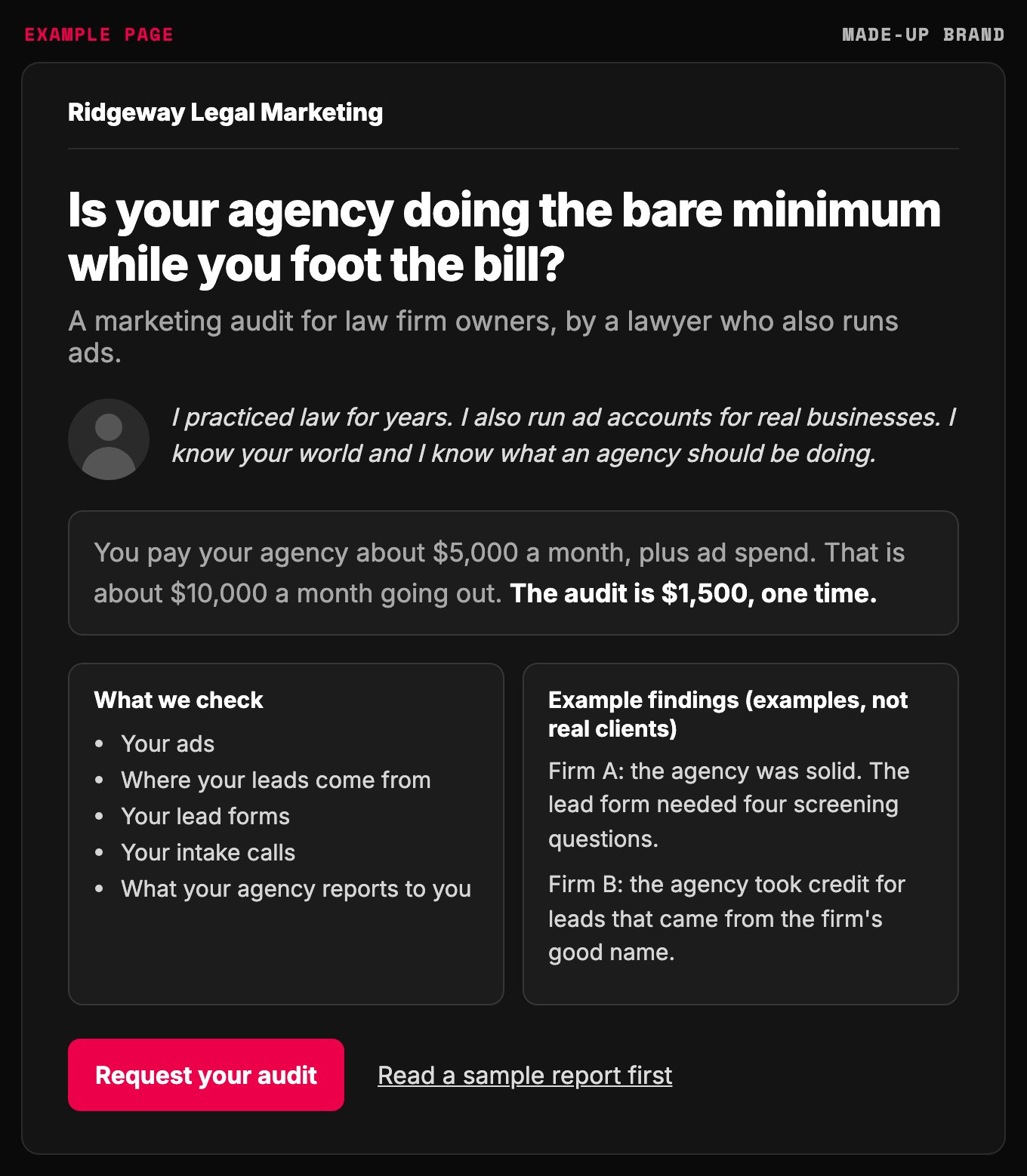
- Names the owner's worry. No promise of more leads.
- She is a lawyer too, and she has the ad skills they lack.
- The price sits next to what they already spend each month.
- Scenarios are labeled as examples, never passed off as clients.
- A way to study before buying. No pressure.
Example page built for this article with a made-up brand
Audit your sales path with AI: the copy-paste prompt
Paste the prompt below into your preferred AI. It asks five questions about your offer and your sales steps.
Then it scores your buyer, flags every forced step and tests your reason why like an expert would. It ends with a new path and three actions.
It never invents facts about your market. If it is unsure, it asks.
Paste into your preferred AI. It asks five questions, then scores your buyer, flags forced steps and rewrites your path.
Act as a sales-process reviewer. Check whether my sales path fits sophisticated buyers, using the Permission Path.

Ask me one at a time, with the example:
1. What do you sell, and at what price? (Example: a $1,500 marketing audit for law firms)
2. Who buys it? (Example: law firm owners who already pay an agency)
3. Every step from first ad to final sale, in order. (Example: video ad, lead form, sales page, checkout, upsell video)
4. Your main claim, and your reason why it works. (Example: "Know in one week if your agency is worth it")
5. The proof you show. (Example: two reviews from dentists)

Then do this, and show your reasoning:
A. Score the buyer 1 to 5 on three lenses: how many times the market has heard this promise, how much marketing this buyer has seen, and what they know from doing the work. One line per score. If you are unsure, ask me. Never invent facts about my market.
B. Name anyone else who shapes the decision (spouse, doctor, partner) and what that person will ask.
C. Flag every forced step: stacked upsells right after purchase, videos they cannot skip, decide-now deadlines, countdown timers.
D. Test my reason why like an expert would. Check the problem half, the fix half and any math. List each hole.
E. Check my proof: does it match the buyer's trade, size and problem?
F. Rewrite the path: something to study first, then information and room to decide, then one optional invitation to a call or a done-with-you offer.

Rules: no fake scarcity, no invented results, no made-up reviews. Any example scenario must be labeled as an example.

Answer in this format:
Lens scores: market / exposure / knowledge
Outside voice and their question:
Forced steps to cut:
Holes in my reason why:
Proof gaps:
New path: step 1 > step 2 > step 3
Next three actions: 1. 2. 3.
Run it this week
1. Run the prompt on your main offer. Write down your three scores.
2. Cut one forced step this week. Start with the upsell right after checkout.
3. Write one guide that names your buyer's exact problems, and end it with one optional invitation.
Next problem: what to offer once they say yes. Read how to sell the next problem.
Remember the groom? He bought a purple suit from the clerk who listened.
Push the expert out the door, and they find the shop next door. Give them room, and they walk to your counter.

Filip Kovacevic is the founder of Anar Agency in Phoenix. He spent five years running SEO, Meta ads, email, and content for medical practices across the United States, and now does the same work for healthcare, home-service, legal, and professional-service businesses, alongside AI implementation. More from Filip →
Talk it through in 15 minutes
Bring one question from this article. We will tell you what we would do, whether or not you hire us.
Book a 15-Min Chat →