Credibility Marketing: The Four Sources of Trust

Credibility comes from four sources: results that customers report, trust borrowed from people your market already believes, a record of your past work, and your own true story. Find your weakest source and fix it first. Every testimonial must name a real, typical result, and every endorser's tie to you gets disclosed.
Credibility marketing: why should a stranger believe you?
A buyer watches your best video testimonial. A client says you doubled her bookings in a month.
The buyer does not think, "This seller is good." The buyer thinks, "Is she even real?"
That is a fair question. AI can now make a video of a person saying things they never said. So a testimonial that used to settle a buyer's doubts now raises new ones.
Credibility marketing is how you get a stranger to believe you before they buy. This is about trust in you, not in your offer.
We sort that belief into four sources: results, borrowed trust, record and story. Most sellers lean on one and ignore three. That is why their proof feels thin.
The short answer: find the weakest of your four, fix that one first, and keep every piece true and easy to check.
Belief comes from who speaks and what they speak about
- Record Your past work: a few short facts and one full case.
- Results Customers say what changed, with a number.
- Story Your true account of how you got here.
- Borrowed trust Someone your market believes vouches for you.
The Four Sources, our framework.
The Four Sources: results, borrowed trust, record and story
The Four Sources is our map of where a buyer's belief in a seller comes from. Every proof you have fits one of the four. Each one answers a different doubt.
Results. Customers say what changed after working with you. It answers one doubt: did this work for someone like me?
Borrowed trust. Someone the market already believes vouches for you. It answers: who else thinks you are good?
Record. Your past work, as a few short facts and one case told in full. It answers: have you done this before?
Story. Your own true account of how you got here. It answers: why should I listen to you?
Researchers started studying this seriously during World War II, under the name source credibility. People judge the speaker before they judge the message.
That is not fair, but it is normal.
This guide is about the seller. Proof for the offer itself is a separate job, covered in the Proof Stack.
Each source answers a different doubt in the buyer's head
| Source | The buyer's doubt | Fastest way to get it |
|---|---|---|
| Results | Did this work for someone like me? | Ask a customer for the four points |
| Borrowed trust | Who else thinks you are good? | Ask a respected peer for a one-minute video |
| Record | Have you done this before? | Write five short facts and one full case |
| Story | Why should I listen to you? | Write the true version in three lines |
The Four Sources, our framework.
The Four Sources is a map of where a buyer's belief in a seller comes from: results customers report, trust borrowed from people the market already believes, a record of past work, and the seller's own true story. Fix the weakest source first. Testimonials name a specific, typical result.
Endorsers' ties are disclosed, including early access. The record is a few repeated facts plus one full case. The story is shaped, never invented.
Results: ask for the change and the number, not the compliment
A results testimonial names what the customer used, where they used it, and what moved. Everything else is a compliment.
Most testimonials read like a thank-you card: "great guy, really enjoyed it." That is nice, but it is useless.
The buyer is not deciding whether you are pleasant. They are deciding whether it will work for them. So the testimonial has to show it working.
Do not leave customers to guess what to say. Ask for one or two minutes of video, and give them four points to cover.
The four points: which part they used, where they used it, the number that changed, and what happened next. Most people are glad to help. They just do not know what useful sounds like.
For example: "I used the follow-up script on my own leads. Booked calls went from 9 to 14 a week. I hired help the next month."
One legal rule applies here. The FTC treats a customer's result as what buyers can generally expect. If that result is not typical, the ad must say what the typical result is.
A small "results not typical" line does not fix it. The FTC's endorsement guide wants the typical result stated plainly.
Our rule is simpler: feature only results you could show a skeptic. More on the claims that get sellers in trouble with the FTC.
A compliment says you are nice; a result says it works
| Compliment | Result |
|---|---|
| "Great guy, really enjoyed it." | "I used the follow-up script on my own leads." |
| No part of the work named | Names the part they used |
| No number | "Booked calls went from 9 to 14 a week." |
| Ends at the feeling | "I hired help the next month." |
Illustrative wording, not a real testimonial.
Give customers four points and they give you a usable testimonial
- 1. The part Which part of the work did you use?
- 2. The place Where did you use it?
- 3. The number What number changed, from what to what?
- 4. What next What happened after that?
Our testimonial ask. One or two minutes of video.
A testimonial ask that gets a result, not a compliment
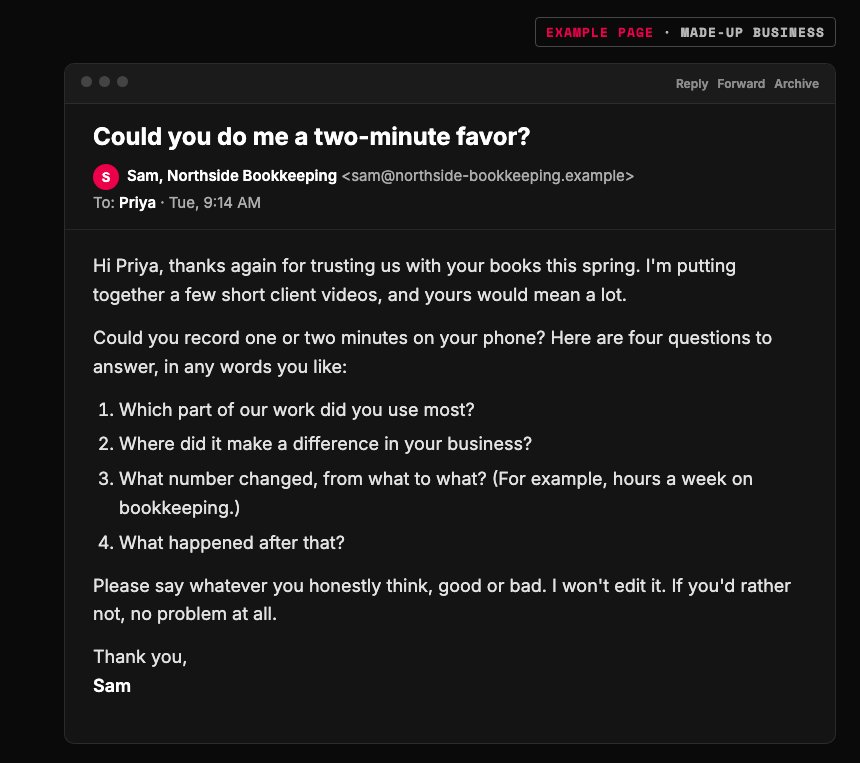
- Name the length. Short asks get a yes.
- Point 1: the part they used.
- Point 3: the number. This is what makes it proof.
- Never ask for a positive review. Ask for an honest one.
Example page built for this article with a made-up brand. All names are made up.
How do you get testimonials before anyone has bought?
Let a small group buy early, at full price, in exchange for an honest public review. Give no discount, and no script for what they must say.
Here is how we run it. Invite your warmest followers to get in a week before everyone else. Cap it at about 10 to 12 people.
Ask for three things in return: a short video review from their own account, permission to share it, and answers when a prospect messages them.
That last one matters most. A prospect can talk to a real buyer with you out of the room. That is hard to fake.
For example, one $6,000 course had no testimonials at launch, because it was still being recorded. Its seller let 12 people buy early for a video review. Buyers later said those videos, and messaging the 12 directly, pushed them to buy.
Two rules keep this clean. Early access is a perk, and the FTC lists early access as a connection you must disclose. So each early buyer says they got in early in exchange for a review.
Second, the perk never depends on a good review. The FTC's rule on buying reviews bans incentives tied to a positive or negative review. Tell them to say whatever they want, and do not ask to see it first.
Scared of what they might say? Then the product is not ready. Fix that before you launch.
Ten to twelve early buyers can supply your first proof
- 1. Invite Your warmest followers, a week before everyone else.
- 2. Full price No discount. Cap it at about 10 to 12 people.
- 3. Ask for three things A video review, permission to share, answers to prospects.
- 4. Disclose Each one says they got early access for a review.
- 5. Publish as posted Do not preview, edit or pick only the good ones.
Our early-buyer method.
Ask for an honest review; never pay for a positive one
| Fine | Not fine |
|---|---|
| Early access in exchange for an honest review | Early access only if the review is positive |
| "Say whatever you want" | A script that tells them what to feel |
| Early access disclosed next to the review | Early access kept quiet |
| Posting every review you got | Writing a review for a buyer |
Sources: 16 CFR 255.5 and 16 CFR 465.4 (eCFR).
Early access is a connection you disclose
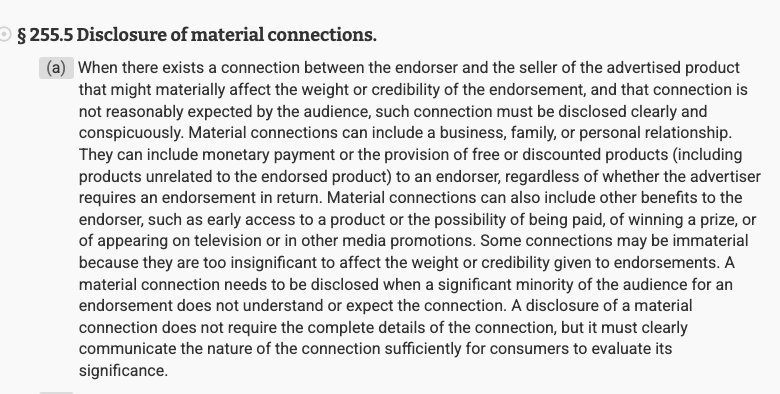
- If buyers would not guess the tie, you must say it.
- Friends, family and business partners count.
- A free or cheaper product counts, even if no review is required.
- Early access counts too. Early buyers say they got in early.
Screenshot of eCFR, 16 CFR 255.5 Disclosure of material connections, taken 2026-10-17
Borrowed trust: write the endorsement for the endorser
An endorsement is trust lent by someone your market already believes. A testimonial says it worked. An endorsement says you are worth hearing.
Borrowed trust works even when the lender is not an expert. That is the halo effect: a good impression in one area spills into another.
Former senator Bob Dole became a paid spokesman for Viagra. He was famous and trusted, not a doctor, and that was enough.
You do not need a senator. A name your niche respects is enough.
Before you ask anyone, ask a few people one question: "What would you say about me?" Listen for the answer that repeats. It tells you what to sell.
For example, one copywriter collected 60 to 70 short endorsement videos for a launch. Nearly all said the same thing: he was the best storyteller they knew. So he built the program around storytelling.
Then write the ask so it takes them five minutes. Give the length, one or two minutes. Give three bullet points and a rough script they can change.
Follow up. Silence usually means they are busy, not that they said no.
If the endorser has a tie buyers would not expect, say so. Payment, free product, family, a business link: the FTC's endorsement guides count all of them. Put the disclosure next to the endorsement.
Make the endorsement a five-minute job and more people say yes
- 1. Ask what they would say Listen for the answer that repeats.
- 2. Short personal message Friendly, humble, never entitled.
- 3. Length and points One or two minutes, three bullet points.
- 4. A rough script Theirs to change. It saves them the thinking.
- 5. Follow up Silence usually means they are busy, not saying no.
Our endorsement ask.
A name your niche respects is enough
| Endorser | What they lend | Disclose? |
|---|---|---|
| A peer your buyers follow | Trust from people like them | Only if there is a tie |
| A past client's boss | A bigger name on a real result | If they got anything from you |
| A partner or past employer | Proof you did the work | Yes, the business tie |
| A paid spokesperson | Fame (the halo effect) | Yes, always |
Disclosure rule: 16 CFR 255.5 (eCFR). Endorser list is ours.
Record: a short list you repeat, and one case you tell in full
Your record is your past work, in two forms: a few short facts you repeat everywhere, and one case study you tell start to finish.
The short facts are your credibility builders. They can be years in the field, a number you moved, a type of client, an award, a press mention. You do not need many.
Our rule: five at most. Put the same ones on your site, proposals, ads and calls, until a buyer could repeat them back to you.
Why repeat? When a small audience sees you again and again, you start to look famous to them. For example, one seller grew a launch group to about 3,000 people, and people in his market told him they saw him everywhere.
A case study does the other job. It goes deep on one piece of work. Our template has three parts: the situation, what you changed, and what happened, with numbers you can show.
Our take: one deep case does more than ten shallow ones. The short facts get attention. The case earns belief.
New, with no record yet? Document your first job like it is your only one, with the client's permission to share the result. Then read how to position yourself when you are new.
Short facts get attention; one full case earns belief
| Credibility builders | Case study |
|---|---|
| Five short facts at most | One piece of work, told in full |
| Repeated on every page and call | Told once, where a buyer is deciding |
| Years, numbers, client types, awards | The situation, what changed, what happened |
| Read in seconds | Read when they are serious |
Our rule for the record.
Most sellers already have more record than they use
| Kind of fact | What it looks like | Check before you use it |
|---|---|---|
| Years | "Twelve years doing this one thing" | True to the year |
| A number you moved | "Cut no-shows from 30 to 12 percent" | You can show the data |
| Client type | "Built for 40 dental offices" | Count them |
| Outside mention | An award, a talk, a press piece | Link to it |
| An unusual win | A result nobody expects from you | Client permission |
Illustrative examples. Every fact you use must be true and checkable.
Story: shape the true version, never invent one
Your story is the one source nobody else can supply. People trust people who seem like them, a pattern researchers call homophily.
That is why so many seller stories start low. The seller was fired, broke, hurt or stuck. The buyer sees their own situation, then sees a way out.
The message is simple: I was where you are, and I found the way through.
Some marketers will tell you to make a story up, or to blend three people's stories into one. We do not. Neither should you.
Our rule: shape the story, never invent it. You can pick where it starts, cut the boring years and tell it with feeling. Every fact still has to be true.
Why so strict? A buyer who catches one made-up detail stops believing the true ones too. And the FTC already bans testimonials that misrepresent the person or what they went through.
You choose how to tell your story, not what happened
| Shaping (fine) | Inventing (never) |
|---|---|
| Start at the low point | Make up a low point |
| Cut the boring years | Borrow someone else's hardship |
| Tell it with feeling | Blend three people into one |
| Round a number down | Inflate a number |
Our rule. The FTC bans testimonials that misrepresent the person or their experience (16 CFR 465.2).
Where credibility breaks, and how to fix it
Sellers get stuck in three places. Each one has a clear sign.
Stuck 1: buyers say your proof looks fake. AI made every testimonial suspect, so yours gets doubted too.
The fix is to say it out loud: "You have no reason to believe a stranger online, so here is how to check me." Then offer real checks: a live call, a client they can message, a record they can look up. This is how you close the gaps a careful buyer sees.
Stuck 2: you cannot name clients. Contracts or industry rules block it. Describe the kind of client and the real result, and say names were left out on purpose.
Never swap in a made-up client to fill the gap. A real result with no name still counts.
Stuck 3: you broke a number. You said 50 spots and sold 51, or the deadline moved. Every broken promise spends trust you had saved up.
For example, one launch announced a cap of 200 and sold about 100. The seller later said the cap was his biggest mistake, because it was too ambitious. Pick a number you can hit, then keep it.
How to wreck your credibility in four easy steps:
1. Post "great guy, highly recommend" and call it proof.
2. Give a discount for five-star reviews only.
3. Borrow a sadder backstory from someone else.
4. Announce 20 spots, sell 40, and hope nobody counts.
Buyers smell that bullshit from the first line. Then they leave.
Three stuck points, each with a sign and a fix
| Stuck point | The sign | The fix |
|---|---|---|
| Proof looks fake | Buyers ask if your clients are real | Say it out loud, then offer a live call or a client to message |
| You cannot name clients | Contracts or rules forbid it | Kind of client, real result, names left out on purpose |
| You broke a number | Spots or deadlines moved | Pick a number you can hit, then keep it |
Our fixes.
Example: a cap set too high left half the spots unsold
- Spots announced 200
- Spots sold, about 100
Example from another business. Not our result, and not verified by us.
Audit your Four Sources with AI
Paste the prompt below into your preferred AI. It asks what you have under each source, scores all four, and names the weakest.
Then it writes your testimonial ask and your endorsement ask. It never writes a testimonial for you. The customer does that.
Want a second pair of eyes on the result? Send it to us.
Paste into your preferred AI. It asks what you have under each source, scores them, and writes your testimonial and endorsement asks.
Act as a credibility auditor. Audit how believable I am as a seller, using the Four Sources: results, borrowed trust, record and story.

Ask me one at a time, with the example:
1. What do you sell, and to whom? (Example: bookkeeping for small dental offices)
2. Results: paste your two best testimonials. (Example: "Great to work with.")
3. Borrowed trust: who has vouched for you, and what is their tie to you? (Example: a past employer, unpaid)
4. Record: list past wins with numbers you can show. (Example: 40 clients over 6 years)
5. Story: in three lines, how did you come to do this work?

Rules:
- A results testimonial names what the customer used, where they used it, the number that changed, and what happened next. Anything else is a compliment.
- If a result is not typical, the ad must state the typical result. A "results not typical" line alone is not enough.
- Any tie a buyer would not expect (payment, free or discounted product, early access, family, business) is disclosed next to the endorsement.
- Never make a perk depend on a positive review. Never write, invent or merge testimonials or stories. Shaping a true story is fine. Inventing facts is not.
- Record: five short facts at most, repeated everywhere, plus one case told in full: the situation, what changed, the result with numbers.
- No testimonials yet? Plan 10 to 12 early buyers at full price, honest video reviews, early access disclosed.
- Never invent a number or a quote. If I did not give it, ask me.

Score each source 0 to 3 and say why. Then answer:
Weakest source: [name, score, why]
Fix this week: [one action]
Testimonial ask: [a message I can send, with the four points as questions]
Endorsement ask: [a message with the length, three bullet points and a rough script]
My credibility builders: [five at most, from my answers only]
Disclosures I owe: [list]
Next three actions: 1. 2. 3.
Fix your weakest source this week
1. Run the prompt and find your weakest source.
2. Send one testimonial ask with the four points, and one endorsement ask with three bullets.
3. Write your five credibility builders and put them on your homepage.
Remember the buyer who asked whether your client is real? Give them her result, her permission and a way to reach her.
Claims ask for trust. Proof pays for it.
Fix the weakest source first, then build up
- Run the audit Score all four sources.
- Send two asks One testimonial ask, one endorsement ask.
- Write five facts Put them on your homepage.
- Tell one full case The situation, what changed, what happened.
Our order of work.

Filip Kovacevic is the founder of Anar Agency in Phoenix. He spent five years running SEO, Meta ads, email, and content for medical practices across the United States, and now does the same work for healthcare, home-service, legal, and professional-service businesses, alongside AI implementation. More from Filip →
Talk it through in 15 minutes
Bring one question from this article. We will tell you what we would do, whether or not you hire us.
Book a 15-Min Chat →