FTC Compliance for Marketing Claims Starts With Your Refunds
FTC trouble for small sellers often starts after the sale, not in the ad. A refund gets refused. The buyer disputes the card charge.
Too many disputes can cost you the account that lets you take cards, and angry buyers file complaints. Pay refunds fast, keep disputes low, and prove every earnings claim.
FTC compliance for marketing claims starts with refunds
A buyer pays nearly $30,000 for real estate coaching. It does not work, so they ask for the money back. The seller says the refund window was three days, and it closed.
That is from a real FTC case. It ended with the owners banned from coaching and a judgment of about $29 million.
Most FTC compliance advice for marketing claims starts with the ad. We start one step later. What happens after the buyer pays?
Our answer: a refused refund becomes a card dispute. Too many disputes put your card payments at risk. Then buyers complain, and complaints are one way the FTC hears about ads.
So the ad copy matters. But in the cases we have read, the refund is where the trouble starts.
This is a general guide, not legal advice. For your own offer, ask a lawyer who knows advertising law.
A three-day refund window ended in a ban and a $29 million judgment
The Ganadores real estate coaching case, as reported by Inman
- Charged per student for workshops and mentoring 28000
- The refund window buyers were told had passed 3
- Monetary judgment, mostly suspended because the owners could not pay 29.175
Source: Inman, Real estate coaches who preyed on Spanish speakers banned by FTC, January 2024, reporting the FTC's case.
The Refund Chain has five links, and each costs more than the last
The Refund Chain is the order in which FTC trouble usually builds. It has five links, and each one feeds the next.
Link one, refunds: A buyer asks for the money back. You say yes or no.
Link two, chargebacks: A buyer who hears no calls the card company. A chargeback is the card company taking the payment back out of your account.
Link three, the merchant account: That is the account that lets you take cards. Card networks watch how many of your payments get disputed, and too many disputes can bring fines or a shutdown.
Link four, complaints: Buyers who cannot get their money back complain to the Better Business Bureau, to state offices and to the FTC.
Link five, the regulator: Many complaints that tell the same story start to look like a pattern. Regulators act on patterns.
Each link costs more to fix than the one before. A refund costs you one sale. A court order can mean refunds to every buyer.
The Refund Chain Check is our one-hour review of all five links, using your own records. Find the first weak link. Fix that one first.
Five links turn one refused refund into an FTC case
- 1. Refunds A buyer asks for the money back. You say yes or no.
- 2. Chargebacks A refused buyer asks the card company to take the payment back.
- 3. Merchant account Too many disputes bring fines, held funds or a shutdown.
- 4. Complaints Buyers write to the BBB, state offices and the FTC.
- 5. The regulator Many complaints with the same story look like a pattern.
The Refund Chain, as set out in this guide.
Each link costs more to fix than the one below it
- Refund You return one sale.
- Chargeback You lose the sale and pay a dispute fee.
- Merchant account Fines, held money, or no card payments at all.
- Complaints Strangers read about you before they buy.
- Regulator Lawyers, a court order, and possibly refunds to every buyer.
Our model. Refunds to all buyers as a remedy: FTC, Advertising FAQs: A Guide for Small Business.
The Refund Chain Check is a one-hour review of the five links that turn one refused refund into an FTC case: refunds, chargebacks, the merchant account, complaints and the regulator. Pull your refund and chargeback rates, run your sales on one merchant account, let buyers complain where you can see it, and back every earnings claim with written proof of typical results. Fix the first weak link first.
How does the FTC find out about a business? Often from complaints
The FTC learns about deceptive ads from many places. Its guide for small businesses lists complaints from consumers and from competitors.
The same guide says the FTC looks for a pattern of deception, not one dispute between a buyer and a seller.
One angry buyer is a dispute. Fifty with the same story is a pattern.
Buyers also have a legal right to dispute some card charges. The Fair Credit Billing Act covers charges for things not delivered as agreed, and the CFPB tells buyers to call the card company right away.
So do earnings claims matter less? No. Here is our read of the public cases, and it is only ours.
Refused refunds and piles of complaints bring a seller to the regulator's attention. Then the seller has to defend the claims in the ads.
The law on claims is short. Under the FTC Act, unfair or deceptive practices are illegal. The FTC's guide adds that ads must be truthful and backed by evidence before they run.
So our rule has two halves. Fix the refund chain first, because it sets off the alarm. Fix every claim too, because the law asks for proof either way.
Owners watch the ad; the FTC hears from buyers
| What owners watch | What reaches the regulator |
|---|---|
| The ad copy | Complaints from buyers and competitors |
| Cost per sale | How many buyers tell the same story |
| One unhappy buyer | A pattern of unhappy buyers |
| The refund policy as written | Whether refunds were actually paid |
Our comparison, based on FTC, Advertising FAQs: A Guide for Small Business.
Refunds set off the alarm; claims still need proof
| Who | What they say | What to do |
|---|---|---|
| Our read of public cases | Refused refunds and piles of complaints bring a seller to the regulator. | Fix the refund chain first. |
| The FTC Act | Unfair or deceptive practices are illegal. Ads must be truthful and backed by evidence before they run. | Prove every claim, refunds or not. |
| Business Opportunity Rule | Earnings claims need a reasonable basis and written proof when made. | Make no number you cannot document. |
Sources: 15 U.S.C. 45; FTC Advertising FAQs; 16 CFR Part 437. The first row is our opinion.
Link one: honor the refund you promised, and pay it fast
A guarantee is a promise the buyer will test. Federal guarantee guides say to use words like "money back guarantee" only if you refund the full price when the buyer asks.
Any conditions have to be stated clearly. A three-day window the buyer never noticed is not clear.
A guarantee also does not replace proof. The FTC's advertising guide says a money-back guarantee is no substitute for evidence behind your claims.
Why do sellers refuse refunds at all? Usually the money is already gone.
The closer, the salesperson who made the sale, took a commission. The ad platform got paid. So did the agency.
When the buyer asks for the money back, nothing is left to give.
Our rule: hold back part of every sale for refunds, sized to your real refund rate. Pay commissions only after the refund window closes.
Then track one number every week: refunds divided by sales. If it rises two weeks in a row, stop raising ad spend and find out why.
A refund you pay costs you once. A refund you refuse comes back bigger. More on what buyers fear losing in our guide to risk reversal.

A guarantee holds when the full refund is easy to get
| A guarantee that holds | A guarantee that breaks |
|---|---|
| Full price back when the buyer asks | A partial refund after a fight |
| Conditions printed next to the promise | Conditions buried in a contract |
| Paid within days | Paid in months, or never |
| Money held back for refunds | Money already paid out to sales and ads |
16 CFR Part 239, Guides for the Advertising of Warranties and Guarantees (full refund, clear conditions); the rest are our rules.
Links two and three: keep chargebacks low, on one merchant account
Your chargeback rate is disputes divided by card payments. Card networks check it every month.
Example: 30 disputes on 2,000 payments is 1.5 percent. On 1,000 payments, the same 30 disputes is 3 percent.
It is the same number of unhappy buyers, at twice the rate.
If you go over a network's limit, the fines start. If you stay over it, you can lose the account. The current limits are in the box below, and they change.
Here is the test we trust most. Can your business run on one merchant account?
Some sellers spread sales across many accounts so each one looks clean. That is called load balancing, and law enforcement treats it as a red flag.
It may not even work. Stripe's help pages say Mastercard flags accounts one at a time, so a single bad account can still get caught.
Need a second account to hide your dispute rate? Then the rate is the problem. Fix the cause, not the math.
The cheapest chargeback is the one a fast refund prevents. If you bill every month, make the renewal date and the cancel button easy to find, as in how to keep members paying past month two.
Example: the same 30 disputes is 3 percent on 1,000 payments
Chargeback rate for 30 disputes, by number of card payments in the month
- 1,000 payments 3
- 2,000 payments 1.5
- 4,000 payments 0.75
Worked example: 30 divided by each payment count. The math is ours.
One merchant account shows the real problem; many accounts hide it
| One merchant account | Load balancing |
|---|---|
| Your real dispute rate, in one place | The rate split up so each account looks clean |
| The card network sees the problem early | The problem hides until it is bigger |
| Fixing the product fixes the number | Fixing the number leaves the product broken |
| Normal for a healthy business | A red flag for law enforcement |
Venable LLP on load balancing; Stripe Support, Monitoring program FAQ; our comparison.
Link four: let buyers complain where you can see it
Complaints go somewhere. The only question is whether you see them first.
Buyers can complain to the Better Business Bureau, to their state consumer protection office and to the FTC at ReportFraud.ftc.gov. None of those land in your inbox.
So give buyers one place to complain where you can see it. Put every customer in one shared group. A seller who keeps buyers apart is hiding the problem from themselves too.
In your group, fifty people with the same problem is something you can fix this week. In a regulator's files, it is a pattern.
Next, never leave a new buyer alone. Someone outside sales should welcome them by name within a day.
Why not the closer? A buyer who just paid hears every call from sales as another pitch.
Then count success stories, not only sales. Cost per sale tells you the ads work. Success stories tell you the product works, as in every sale spends trust.
How to get a letter from the FTC in four easy steps:
1. Promise a number you cannot prove.
2. Sell it to people who cannot afford to lose the money.
3. Hide the refund rules in the contract, then say no.
4. Keep every buyer in a separate inbox, so nobody compares notes.
That is not a business plan. It is a countdown to that letter.
Complaints in the open turn into fixes, then proof
- Complaint A buyer says what went wrong, where you can see it.
- Fix You fix it while it is one post, not fifty.
- Result The buyer gets what they paid for.
- Story A real success story you can show.
- Better buyers Real proof draws buyers who fit and complain less.
Our model.
A new buyer should never be left alone
- Day 1: a real welcome Someone outside sales, by name.
- Day 1: the refund steps In the welcome email, in plain words.
- Day 2: a first win One small task they can finish in under an hour.
- Day 7: a check-in Ask what is not working. Fix it or refund it.
Our onboarding rule.
What can you say about earnings? Say how, not how much
Earnings claims carry the strictest rules in this area. Say what the buyer will learn and do, not what they will make.
The FTC has sent a formal notice to more than 1,100 sellers of money-making offers. It warned that deceptive earnings claims can bring a civil penalty for each violation.
Some offers count as a business opportunity, for example when you promise to supply the buyer's customers or accounts. Then the Business Opportunity Rule applies.
Under that rule, an earnings claim needs a reasonable basis and written proof at the moment you make it. The buyer must also get a written earnings claim statement.
That statement shows how many buyers, and what share of all buyers, earned at least that much. Could you fill it in for your biggest claim?
The rule counts spoken claims too. A closer who asks "How much do you want to make?" and then maps out $50,000 a year can be making an earnings claim.
Testimonials follow the same idea. The FTC's endorsement guidance says a specific result is read as what others can expect. "Results not typical" does not change that.
So show what buyers generally get, or show the method. "Become a land investor" promises a skill you can teach. "Buy land and get rich" promises money you cannot prove.
Honest numbers also sell better to wary buyers. See four sources of credibility and the Proof Stack.
Say how buyers do the work, not how much they will make
| Promises how much | Shows how |
|---|---|
| "Make $10,000 a month" | "Here is what a land investor does each week" |
| Picks a goal number on the sales call | Walks through the job, the costs and the hours |
| One best result in big type | Typical results, next to the method |
| "Results not typical" in small print | No small print needed |
Our comparison. Typical results rule: FTC, Endorsement Guides: What People Are Asking.
An earnings claim statement must show how many buyers hit the number
| The statement must include | What it means for you |
|---|---|
| The title in bold capitals | "EARNINGS CLAIM STATEMENT REQUIRED BY LAW" |
| Who made the claim, and when | A name and a date |
| The claim and the dates it covers | When those earnings happened |
| Number and share of all buyers who reached it | Out of everyone who bought, not just winners |
| How those buyers differ from new ones | For example, where they live |
| Proof available on request | Written proof in your files |
Source: 16 CFR 437.4(a)(4), Business Opportunity Rule.
Before you claim a number, the rule asks for this
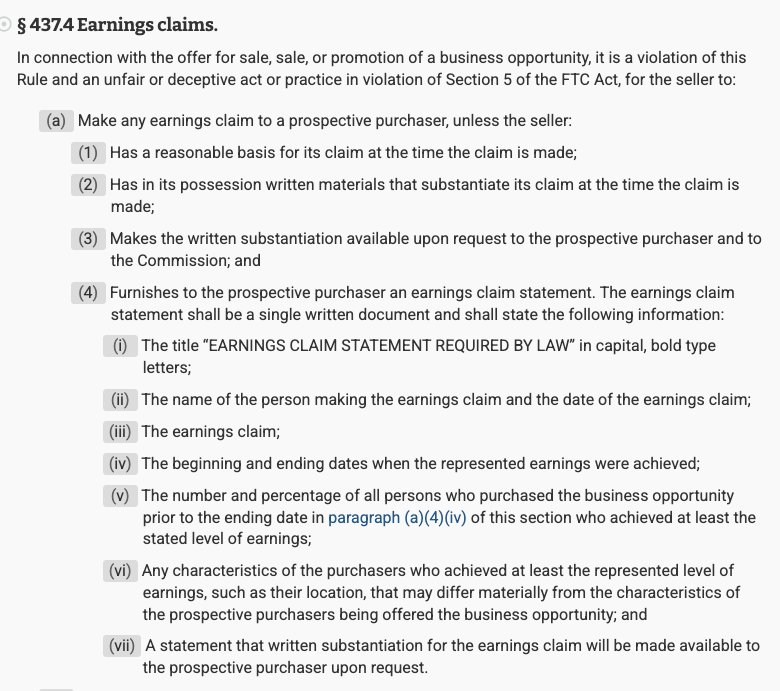
- Proof first, claim second.
- The proof must be in writing, in your files.
- A separate written statement, with this exact title.
- How many buyers, out of all of them, hit the number.
- Buyers can ask to see your proof.
Screenshot of eCFR, 16 CFR 437.4 Earnings claims (Business Opportunity Rule), taken 2026-10-17
Who you sell to raises or lowers the stakes
The same claim is riskier with some buyers. Be most careful with people who are new, in debt and looking for a way out.
They have no skills yet and no way to judge the promise. So they buy the dream. When the dream has not shown up in three weeks, they ask for their money.
That is how a seller drifts into trouble. First you sell to people already doing the work. Then you run out of them.
So you sell to everyone, with bigger promises. The refunds pile up.
Our rule: no big-ticket programs for people living on a fixed income, such as retirees on Social Security. Our 10 percent pricing ceiling exists for the same reason.
The FTC's advice to buyers warns that a cheap starter offer can grow into tens of thousands of dollars of coaching. It tells buyers to expect the upsell.
Run ads for someone else? The FTC's guide says ad agencies must check the proof behind a client's claims themselves. They cannot just take the client's word.
Money promises to new, indebted buyers carry the most risk
- Careful An honest skill promise. Watch refunds closely.
- Danger Big money promises to people who cannot lose the money.
- Safest Skilled buyers learning a skill.
- Risky Money promises still need written proof.
Our model.
The FTC put more than 1,100 sellers of money-making offers on notice
- Businesses sent the notice 1100
- Civil penalty per violation at the time 43792
Source: FTC press release, October 2021. Penalty amounts are adjusted for inflation each year (16 CFR 1.98).
Where the Refund Chain Check goes wrong, and the fix
Four mistakes are easy to make. Each one looks fine from the inside.
Low refunds, high chargebacks. Buyers could not find the refund steps, so they went to the bank. Put the steps in the welcome email.
A second processor "for backup." If its real job is to spread out disputes, it is load balancing with a nicer name. Fix the dispute rate first.
A disclaimer instead of proof. Small print under a big number does not change what the big number says. Show typical results, or show the method.
Refunds approved, then paid months later. A slow yes feels like a no to the buyer. Pay within days, and say so in the guarantee.
Four mistakes that look fine from the inside
| What you see | Why it happens | The fix |
|---|---|---|
| Low refunds, high chargebacks | Buyers could not find the refund steps | Put the steps in the welcome email |
| A second processor "for backup" | It spreads out disputes | Fix the dispute rate first |
| A disclaimer under a big number | Small print does not change the claim | Show typical results or the method |
| Refunds approved, paid months later | A slow yes feels like a no | Pay within days, and say so |
Our checklist.
Run the Refund Chain Check with AI
Paste the prompt below into your preferred AI. It asks for your numbers one at a time. Then it scores each link and names the first one to fix.
It never invents a card network limit. It asks for your processor's current numbers, or looks them up if it can search the web.
1. Pull last month's sales, refunds and chargebacks from your processor.
2. Run the prompt, then fix the first weak link it names.
3. Send every new buyer a welcome from a real person outside sales.
Want a second pair of eyes on your offer? Send us the result.
Remember the three-day refund window from the start? Saying yes to that one buyer would have cost one sale. A fast refund is the cheapest legal protection you will ever buy.
Paste into your preferred AI. It asks for last month's numbers and your claims, then scores each link and names the first one to fix.
Act as a refund and chargeback risk reviewer for a small online business. Run the Refund Chain Check on my offer.

Ask me one question at a time, with the example:
1. What do you sell, at what price, and how do buyers pay? (Example: a $2,000 coaching program, paid by card)
2. Last full month: how many sales, refunds and chargebacks? (Example: 120 sales, 9 refunds, 3 chargebacks)
3. How many merchant accounts or payment processors take your sales, and why? (Example: one account)
4. Your refund promise, word for word, and how many days refunds take to pay. (Example: "Full refund within 14 days", paid in 3 days)
5. Every earnings or results claim in your ads, pages, emails and sales calls. (Example: "Clients add $5,000 a month")
6. Who buys: new to this, or already doing the work? Any buyers on a fixed income? (Example: mostly beginners)
7. Complaints in the last 90 days, and where they were made. (Example: 2 emails, 1 Better Business Bureau)

Rules:
- Never invent a card network limit. Ask me for my processor's current dispute limits, or look them up on the processor's or card network's public pages if you can browse. Say which you used and the date.
- Refund rate = refunds / sales. Chargeback rate = chargebacks / card payments. Show the math.
- Score each link Low, Medium or High: refunds, chargebacks, merchant accounts, complaints, claims, buyers.
- More than one merchant account used to spread out disputes is High.
- An earnings claim without written proof of what typical buyers earn is High. "Results not typical" does not fix it.
- A refund promise with hidden conditions, or refunds paid slowly, is High.
- Big-ticket programs sold to people on a fixed income are High.
- This is a risk check. For anything High, tell me to have an advertising lawyer review it.

Answer in this format:
Rates: refund % / chargeback %
Link scores: [each link, Low/Medium/High, one reason]
First weak link: [the earliest link scored High or Medium]
Claims to rewrite: [each claim, plus a version that says how, not how much]
Next three actions: 1. 2. 3.

Filip Kovacevic is the founder of Anar Agency in Phoenix. He spent five years running SEO, Meta ads, email, and content for medical practices across the United States, and now does the same work for healthcare, home-service, legal, and professional-service businesses, alongside AI implementation. More from Filip →
Talk it through in 15 minutes
Bring one question from this article. We will tell you what we would do, whether or not you hire us.
Book a 15-Min Chat →