How to Price Your Product From Your Buyer's Income
To price your product, start from your buyer's income. Not your costs. Set a monthly price near 1 percent of what your buyer earns in a month.
Keep any one-time price at or under 10 percent of what they earn in a year. Then check that your costs fit under that price.
How to price your product: start from what the buyer earns
Picture someone asking whether $600 a month is a lot to charge. There is no answer. Expensive compared to what?
To a freelancer bringing in $6,000 a month, it is a tenth of everything. They think about it for a week. Then they probably say no.
To a firm bringing in $80,000 a month, it is under 1 percent. The owner approves it between two emails.
Same service. Same price. Two completely different decisions.
This is how to price your product from the buyer's side. The price stayed the same. What changed is how big a slice of their income it takes.
Cost-plus pricing: add up your costs, add a markup, glance at competitors. It tells you your floor, and nothing else.
Our take: cost-plus is popular because it is easy, not because it works. It only needs your own numbers. It never asks what the buyer earns.
A price that ignores the buyer's income is a guess with a decimal point.
Pricing guides list three C's: cost, competitors and customers. Cost sets your floor. Competitors show what buyers are used to paying.
The customer's income sets the top. Most guides skip it.
Pricing from the buyer's side is called value-based pricing. Our version is the One-and-Ten Rule. We checked every public number in it, and we label other businesses' results as examples.
Costs give you the floor; the buyer's income gives you the top
| Cost-plus pricing | One-and-Ten Rule |
|---|---|
| Starts from what the product costs you | Starts from what your buyer earns |
| Tells you the least you can charge | Tells you the most the buyer can say yes to |
| Same price for every buyer | A price for each kind of buyer |
| Checks competitors after | Checks your costs fit under it |
Our comparison. Cost-plus as commonly taught; One-and-Ten Rule as set out in this guide.
Set two lines: 1 percent a month, 10 percent a year
The One-and-Ten Rule is a pricing check with two lines. Both come from your buyer's income.
The one line is the target for low-price monthly plans sold to many people. Price near 1 percent of the buyer's average monthly income. At that size the charge is smaller than their other bills, so more buyers can say yes.
That is the line for subscription pricing. Easy yes.
The ten line is for one-time prices and big programs. Any one-time price, or six months of a pricier monthly plan, stays at or under 10 percent of the buyer's yearly income.
Where did the rule start? With the average Social Security benefit. Example: $1,542.22 a month gives a one line of $15.42 and a ten line of about $1,850.
Why a share and not a dollar figure? Because that is how people judge a price. A dollar figure with no income behind it is just a number.
In a well-known study, most people would drive 20 minutes to save $5 on a $15 calculator. On a $125 jacket? No. Same five dollars.
One government number gave both lines in 2022
Average monthly Social Security benefit, all beneficiaries, June 2022, and the two lines it produces
- Average monthly benefit, June 2022 1542.22
- The one line: 1 percent a month 15.42
- The ten line: 10 percent of a year 1850.66
Source: Social Security Administration, Monthly Statistical Snapshot, June 2022. Lines computed from it.
Same five dollars, different share, different answer
| The item | The saving | Share of the price | Drive 20 minutes? |
|---|---|---|---|
| $15 calculator | $5 | 33% | Most said yes |
| $125 jacket | $5 | 4% | Most said no |
Tversky and Kahneman (1981), as summarized in Wikipedia, Mental accounting.
The One-and-Ten Rule prices from the buyer's income, read from a dated public source: about 1 percent of monthly income for a monthly plan, and at or under 10 percent of yearly income for any one-time price or six months of a pricier plan. Anchor on the person who pays, check your costs fit under the price, state every total, and test one step up before one step down.
What if your costs are higher than the 1 percent line?
Costs above the one line? Common. Do not ignore the line, and do not sell below cost.
Coaches hit this first. About $19 a month will not pay for anyone's time.
You have three moves. Judge the price by the ten line instead. Change the buyer, or change the first step.
For coaching and anything high-touch, the ten line is the real limit. A monthly price far above the one line is fine if six months of it stays under the buyer's ten line. Here the one line barely matters.
Example: a $297 plan for six months is $1,782. So the buyer must earn at least $17,820 a year.
Change the buyer. Divide your price by 0.10 to get the yearly income a buyer needs. A $6,500 program needs buyers earning about $65,000 a year or more.
So sell it to them. Not to everyone. Your costs are your problem, not the buyer's.
Change the first step. Sell something smaller first, under the line for the buyer you have. Then offer the big program to people who got results.
A small paid first offer is one way to build that step.
Example: a $6,500 program needs buyers earning $65,000 a year
Yearly income a buyer needs for each price to sit at their ten line (price divided by 0.10)
- $1,000 program 10000
- $2,500 program 25000
- $6,500 program 65000
- $10,000 program 100000
Worked example: each price divided by 0.10. The math is ours.
Which income should you use? The income of the person who pays
Use the income of the person who pays. We call that number the anchor. Pick a different one and the monthly price moves more than four times over.
Our decision rule: retirees and monthly plans sold to many people get the Social Security average. Working-age buyers get per-person income. Household income only counts when the whole household decides and pays together.
Why anchor so low? It is on purpose. Many buyers, retirees and young people on part-time pay, live on about $1,500 to $1,600 a month.
At 1 percent of that, almost everyone can say yes.
Household income runs much higher. It counts every earner in a home, not the person holding the card. Price from it and you price for earners who are not paying.
Example: a Census median household income of $83,730 gives a one line of about $70. Different anchor. Different price.
The average moves every month. So look up the latest figure on the SSA snapshot each time you price.
Example: an average of $1,943.15 gives a one line of $19.43. That sits close to what a top streaming plan charges.
The income you anchor on moves the monthly price 4.5 times
The one line (1 percent of monthly income) under four public income figures
- SSA average benefit, June 2022 15.42
- SSA average benefit, Sept 2026 19.43
- US per capita income, 2020 to 2024 37.23
- US median household, 2024 69.78
Source: SSA Monthly Statistical Snapshots (June 2022, September 2026); Census QuickFacts; Census P60-286. Highlighted: the rule's original anchor.
The 1 percent line and a top streaming plan still sit side by side
- Average monthly Social Security benefit, Sept 2026 1943.15
- 1 percent of it 19.43
- Netflix Standard plan, Oct 2026 19.99
Source: SSA Monthly Statistical Snapshot, September 2026; Netflix Plans and Pricing page, read 2026-10-16.
The anchor is one cell on a free government page
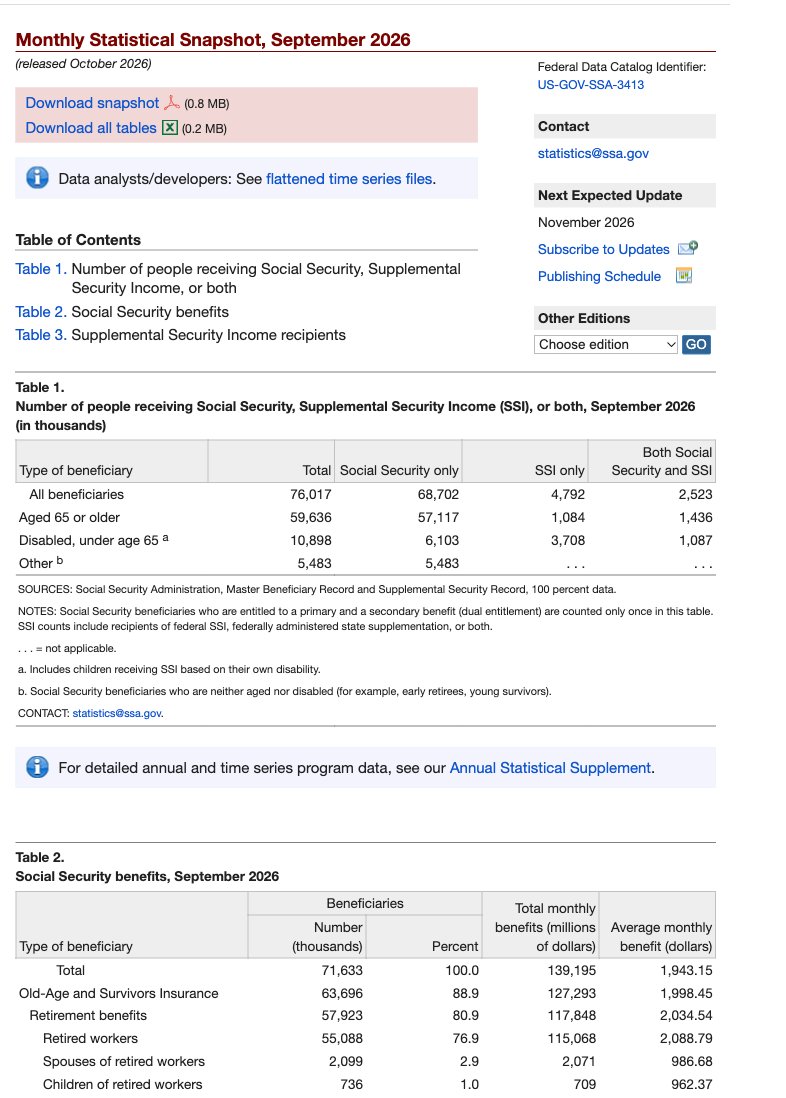
- Use the newest month. The page updates monthly.
- Past months are in this Other Editions list, back to the June 2022 figure the rule began with.
- This is the column the rule reads.
- All beneficiaries: $1,943.15. One percent is $19.43 a month.
- Retired workers alone: $2,088.79. Use this if your buyer is a retiree.
Screenshot of the SSA Monthly Statistical Snapshot, September 2026, taken 2026-10-16
How do I calculate the selling price of a product? Six steps
Take 1 percent of the buyer's monthly income for a monthly price. Take 10 percent of their yearly income for the most any one-time price should be. The examples follow a working-age US buyer.
Step 1: name one buyer. One kind of person, paying with their own money. Retired homeowners, freelance designers, new parents.
Step 2: find their income on a public page. Retirees or a mass-market plan? Use the SSA snapshot.
Working-age buyers? Census QuickFacts lists income per person for any town, county or the whole US. Example: $44,673 a year, or $3,722.75 a month.
Step 3: take 1 percent for the monthly price. Example: $37.23 a month. Now compare it with what your buyer already pays for something similar.
Far above it? Then your page must explain the difference in plain words. Or the buyer explains it to themselves, with the back button.
Step 4: take 10 percent of the year for the ceiling. Monthly income times 12, times 0.10. Example: $4,467.30, the most any one-time price should be for this buyer.
Step 5: if your monthly price sits above the one line, check six months of it. Six months must stay under the ten line. Example: a $297 coaching plan is $1,782, under $4,467.
Then check your costs. Serving one buyer for six months must cost you less than that total. If not, change the buyer or the offer.
Step 6: make your current price the middle of a ladder. The low offer is one step down. The high is one step up or a premium tier.
Each rung gets its own cost check. All of them stay under the ten line.
Example, around a $297 plan: about $210 low, about $415 high. Six months of the high is $2,490, under $4,467. More on offering the next step up.
Six steps from a public number to a price you can defend
- 1. Name one buyer One kind of person who pays with their own money.
- 2. Find their income SSA snapshot or Census QuickFacts. Write down the date. Divide by 12.
- 3. Take 1 percent That is the monthly price. Compare it with what they already pay.
- 4. Take 10 percent of the year That is the ceiling for any one-time price.
- 5. Check six months If the monthly price is above the one line, six months must stay under the ceiling, and cover your costs.
- 6. Build a ladder Low, middle and high offers, all under the ceiling.
The One-and-Ten Rule, in six steps.
One free page gives you per-person and household income for any place
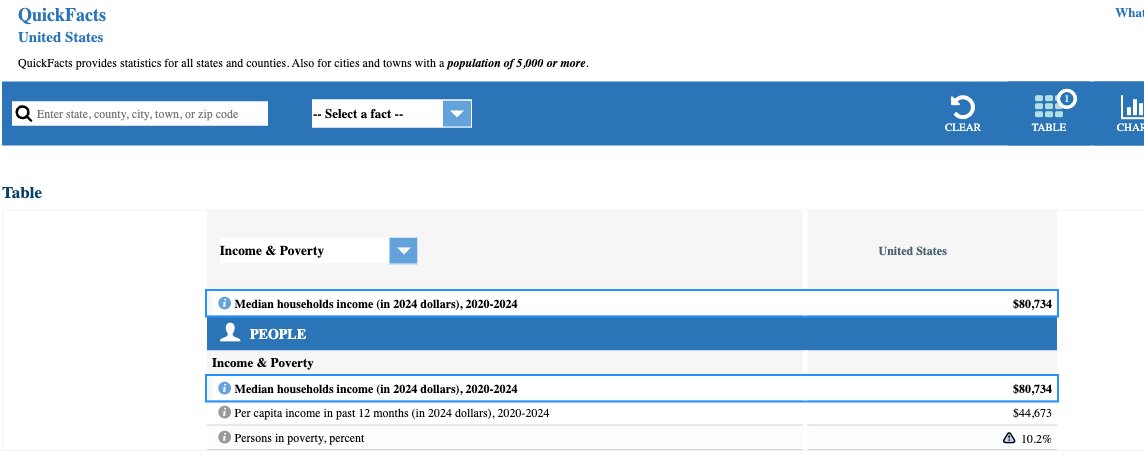
- Type a state, county or city here to swap in your buyer's area.
- Add up to six places side by side to compare buyers.
- Click the info icon for the definition and the survey behind the number.
- Household income: $80,734. Use it only when the whole household decides.
- Per person: $44,673. Divide by 12 for the monthly figure: $3,723.
Screenshot of Census QuickFacts, United States, Income & Poverty topic, taken 2026-10-16
Test one step up before one step down
Start high, and test one step up before one step down. Lowering a price later is easy. Raising it later is hard.
What is a step? The next rung on your ladder. In the $47 to $67 to $97 example in the table below, each step is about 40 to 45 percent.
Use steps about that size on your own ladder. There is no set test length. So show each price to a similar number of buyers from the same traffic, and compare sales per visitor.
The table holds examples from other businesses, not our data. We do not know what those members earned. So treat the membership case as a reason to test a higher price, not a reason to ignore the one line.
The basketball case shows the math of cutting. At $10 instead of $27, a member must stay about 2.7 times as long to bring in the same money. Cutting price to fix slow sales is not a strategy; it is a markdown.
How to price yourself out of business in four easy steps:
1. Copy a competitor's price. Theirs was a guess too.
2. Add a markup to your costs and pray like hell.
3. Cut the price the first slow month.
4. Sell a program your buyer cannot afford. Call it premium.
Economists call this price elasticity: how much your sales move when the price moves. You only learn yours by testing.

Example: two price raises kept buyers buying; a planned cut was advised against
| The case | What changed | What happened | How sure |
|---|---|---|---|
| A membership with about 5,000 paying members, around 2008 | Price raised from $47 to $67 to $97 | The share of visitors who bought did not drop | Example; we have not seen the data |
| A low-price first book | Priced at $3, near what buyers pay for apps | 20 to 30 percent more revenue than the other prices tested | Example; not verified |
| Online basketball training for teens, $27 a month, about 70 members | Owner wanted to drop to $9.99 | Advice: keep $27, consider $47, add a team plan near $100 a month | Advice, not a result |
Example numbers from other businesses. Not our results, and not verified by us.
Example: at $10 a month, a member must stay 2.7 times as long
Months needed to collect $81 from one member, by monthly price
- $27 a month 3
- $10 a month 8.1
Worked example: $81 divided by each price. Prices from the basketball case; the math is ours.
Treat 10 percent as a ceiling, not a target
Ten percent of a buyer's yearly income is the most a price should take. Past it, a price crowds out housing, school and health care.
The ten line comes from a pattern in FTC coaching cases. Outside salespeople paid per sale, no refunds, and prices of $20,000 to $50,000.
The regulator draws no percent line. The FTC's consumer guidance on coaching programs warns that a cheap starter system can grow into tens of thousands of dollars of coaching. It tells buyers to expect the upsell.
Our take: sellers who blow far past the ten line usually know exactly who they are selling to. That is not premium pricing. It is a bet that the buyer will not do the math.
So the ten line protects the buyer. It does not make a price legal.
False income claims break the law at any price. So does a refund you never honor. Read the claims and refund rules that get sellers in trouble with the FTC.
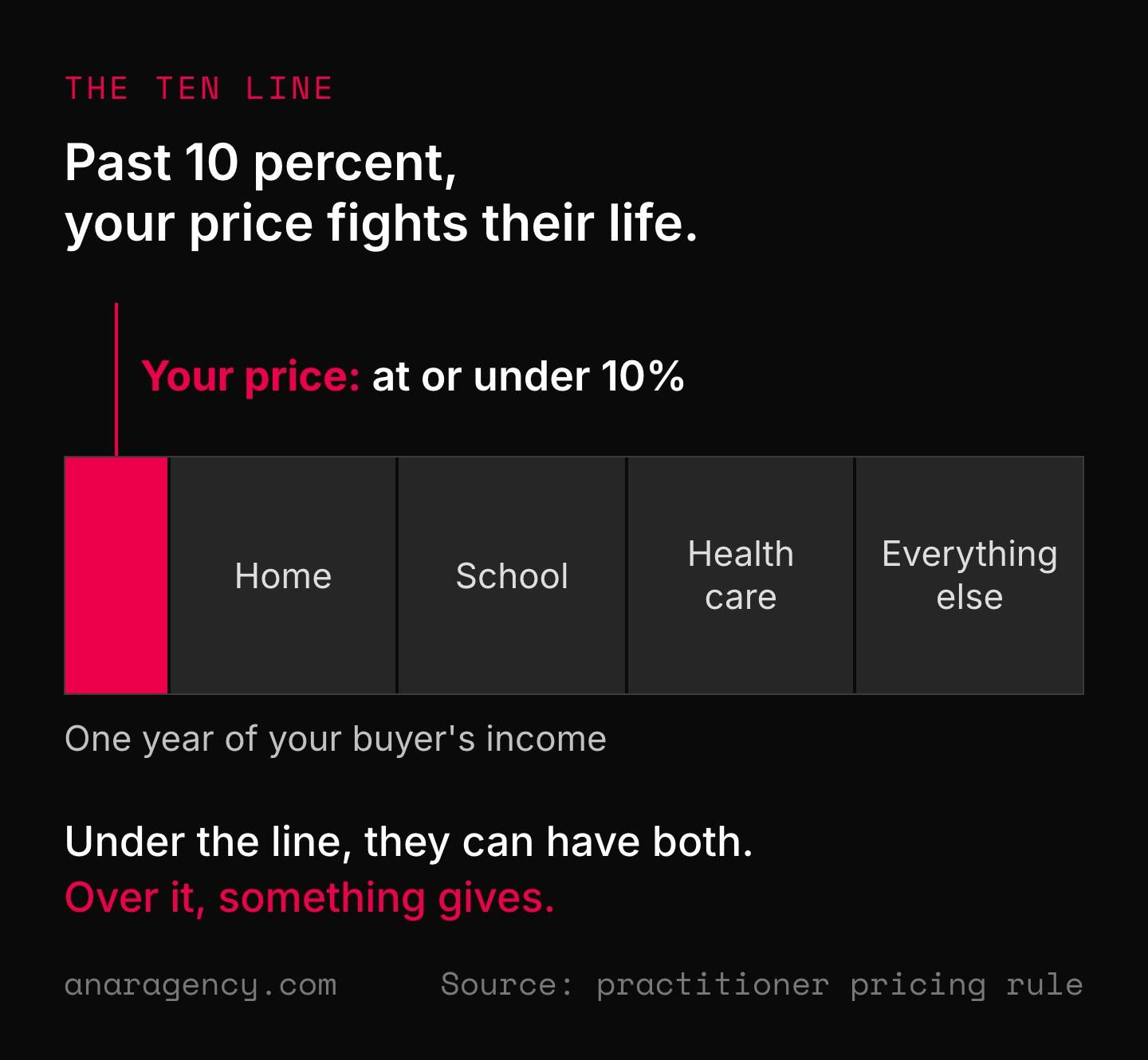
The rule draws a line at 10 percent; the FTC draws none
| Who | What they say | What to do with it |
|---|---|---|
| The rule | 10 percent of yearly income is the most to take. Built on a pattern in FTC cases: outside salespeople paid per sale, no refunds, $20,000 to $50,000 prices. | Use 10 percent as your ceiling. |
| FTC consumer guidance | No percent. A cheap starter system can grow into tens of thousands for coaching. Expect the upsell. Talk to someone you trust. | Under the line does not make a price legal. |
| Our rule | The ceiling protects the buyer. The law asks for honest claims, real refunds and easy cancelling. | Price under the line and follow the law. |
Sources: the One-and-Ten Rule; FTC, When a Business Offer or Coaching Program Is a Scam.
The FTC names no percent. It names the upsell, the pressure and the testimonials

- A cheap starter system that grows into tens of thousands of dollars is the FTC's first warning.
- Buyers are told to slow down and talk to someone they trust before a big purchase.
- Testimonials get checked. Use only real, typical ones.
- The FTC tells buyers to stop when asked for more money.
Screenshot of FTC consumer advice, When a Business Offer or Coaching Program Is a Scam, taken 2026-10-16. Two sections of the page, joined at the dashed line
Payment plans shrink the first step, not the price
A payment plan makes the first step smaller. Not the price. So the ten line applies to the total.
Splitting a price does not shrink it. It hides it. Our take: a plan whose total is hard to find was built that way on purpose, and that is bullshit.
For example, one webinar's $1,000 program converted 0.3 percent of viewers with the whole price due today. Offered as $100 today and four payments of $200, a $900 total, it converted about 3 percent. The lower total played a part too.
For example, picture $1,000 up front and $500 a month, sold to freelancers who make $4,000 a month. Their ten line is $4,800.
Ninety days costs $2,500. That is under the line. The eighth monthly payment crosses the line.
State the total. The FTC's policy statement on recurring charges says sellers must clearly disclose the total cost and how to cancel. Cancelling should be as easy as signing up.
More on why members stay or cancel.
A smaller first payment, and a $100 lower total, lifted buying from 0.3 to 3 percent
Share of webinar viewers who bought, by payment option, in one business's example
- $1,000 today 0.3
- $100 today + 4 x $200 3
Example numbers from other businesses. Not our results, and not verified by us. Total of the split: $900.
Example: the same plan crosses the 10 percent line at the eighth payment
$1,000 up front plus $500 a month, for a buyer making $4,000 a month
- 90 days (3 payments) 2500
- 6 monthly payments 4000
- Ten line for this buyer 4800
- 8 monthly payments 5000
Worked example: $4,000 x 12 x 10 percent = $4,800. Example plan; the math is ours.
Price your offer with AI: the copy-paste prompt
Paste the prompt below into your preferred AI. It asks who buys and what it costs you to deliver. Then it runs both lines and the cost check, and shows its math.
It never guesses an income figure. It looks up the latest one from the SSA snapshot or Census QuickFacts if it can browse, or asks you. Check the number and date it reports before you use the price.
It does not guess, and neither should you.
Want a second pair of eyes? You can send us the result, or check the numbers on the whole offer before launch.
Paste into your preferred AI. It asks who buys and what it costs you to deliver, then gives you a monthly price, a one-time ceiling and a ladder.
Act as a pricing analyst. Price one offer from my buyer's income with the One-and-Ten Rule.

Ask me one at a time, with the example:
1. What do you sell, and how is it paid? (Example: coaching, $297 a month)
2. Who pays with their own money? (Example: freelance designers)
3. Your cost to deliver to one buyer for six months? (Example: $600)
4. What do they already pay for something similar? (Example: $49 a month)

Income: never invent a figure. Retirees and mass-market plans: SSA Monthly Statistical Snapshot, average monthly benefit. Working-age buyers: Census QuickFacts per capita income for their area. Household income only if the whole household pays. Look up the latest figure if you can browse; if not, ask me. Report the number, source, data year and lookup date.

Rules:
- One line: monthly price near 1% of monthly income. The target only for low-price monthly plans sold to many people.
- Ten line: any one-time price or payment plan total at or under 10% of yearly income. A ceiling for the buyer's protection, never a target.
- Coaching, programs, anything high-touch: the ten line is the real limit. A monthly price passes if 6 months of it stays under the ten line.
- Cost check: 6-month delivery cost below 6 months of the price.
- Above the lines? Never price below cost. Change the buyer (price / 0.10 = yearly income needed) or offer a smaller first step.
- Far above what they already pay? Tell me how my page should explain the difference in plain words.
- Ladder: my price is the middle; low is one step down, high is one step up or a premium tier. Each gets a cost check, all under the ten line. A step is the next rung, about 40 to 45 percent in the example.
- Test one step up before any step down.
- Payment plans: state the full total and how to cancel.

Show your math, then answer:
Income used: [number, source, data year, lookup date]
One line: $ / Ten line: $
My price: passes or fails, and why
Cost check: passes or fails
Ladder: low $ / middle $ / high $, with cost checks
Price to test next: $
Next three actions: 1. 2. 3.
Run it with AI this week
1. Run the prompt for your main buyer. Answer its four questions.
2. Run it again for every price you charge now. List any that cross a line.
3. Pick one price to test one step up. Set the date you will read the result.
Price set? The next question is how much you can spend on ads to win each buyer.
Costs set the floor. Your buyer sets the ceiling.

Filip Kovacevic is the founder of Anar Agency in Phoenix. He spent five years running SEO, Meta ads, email, and content for medical practices across the United States, and now does the same work for healthcare, home-service, legal, and professional-service businesses, alongside AI implementation. More from Filip →
Talk it through in 15 minutes
Bring one question from this article. We will tell you what we would do, whether or not you hire us.
Book a 15-Min Chat →