Free Virtual Events That Pay for Themselves
A virtual event funnel that pays for itself has four parts. A free event, never a paid ticket. One paid upgrade: a VIP seat on the live call where your question gets answered.
Three to four hours or more of real teaching. One offer at the end. Then judge it on two numbers: cost per sign-up and revenue per attendee.
How a virtual event funnel pays for its own ads
For example, take March 2020. One company had already spent about $4 million on ads for in-person seminars. Then lockdowns hit, one country at a time.
So it emailed the same people the same offer, now as an online event. The host ran it from a kitchen counter. Pots and pans in the shot.
Then it ran that same event every week for eight weeks. About $500,000 in ads turned into about $5 million collected. Its claim, not our data.
Nobody cared about the kitchen. They paid for what they learned that day.
That is a virtual event funnel: a free online event that ends with an offer. Built right, it pays for its own ads.
Your Zoom plan sets how many VIP seats you can sell
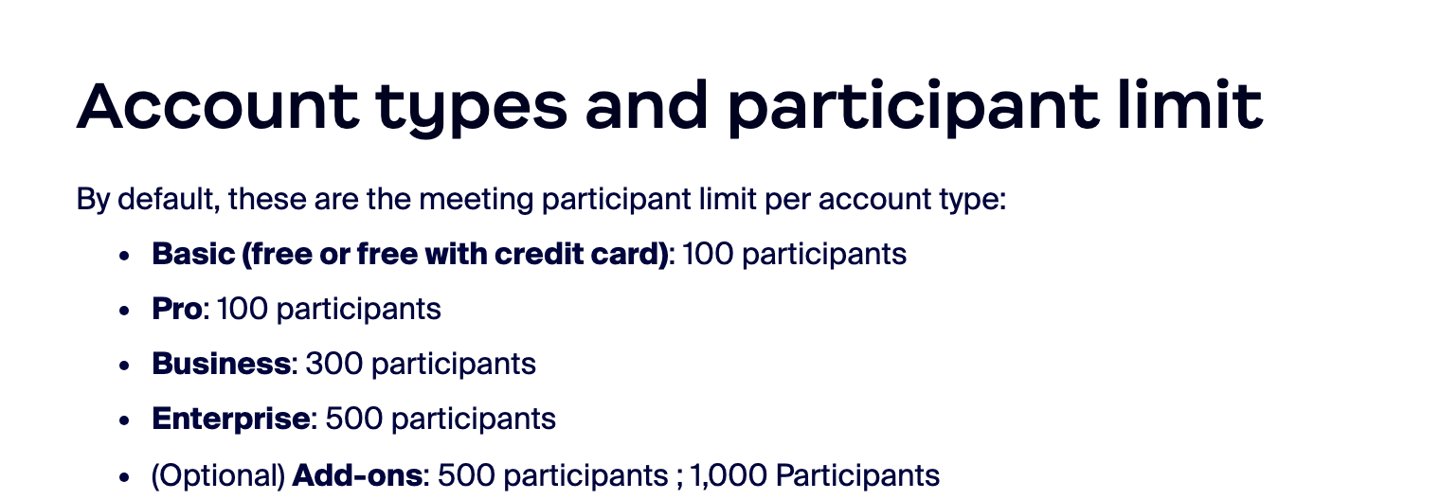
- Your plan's number is your VIP seat count. Never sell more VIP seats than the call holds. Free guests watch the stream.
- 100 seats on the call on Basic and Pro.
- 300 on Business, 500 on Enterprise.
- A large meeting add-on raises it to up to 1,000.
Screenshot of Zoom Support, Understanding meeting participant limits, taken 2026-10-17.
Build it in four pieces: free seat, VIP seat, long day, one offer
The whole funnel has four pieces. You can build it with one landing page and a Zoom account.
1. A free seat: free means free. Not $1, not $7.
Even a one-dollar ticket wrecks the numbers. Any price, even a tiny one, scares off a big part of the crowd.
The free seat is a loss leader. It costs you money so the rest of the day can earn it back.
2. One paid upgrade, the VIP seat: right after sign-up, offer a seat on the live Zoom call. The promise: your question gets answered.
Free guests watch a live stream on YouTube or Facebook instead. Zoom can send the call to both.
Why does that sell? People show up with questions. A guaranteed answer is worth real money to them.
Keep the price low. The exact price does not much matter. Its job is to pay back part of the ad bill.
3. A long live day: real teaching, face to camera, for three to four hours or more. Slides only where they help.
4. One offer at the end: one clear offer, then questions until the last one gets an answer. That is where the profit is.
Our rule: the VIP seat must be worth its price on its own. Say plainly what is free and what is paid, because ad claims must be truthful. Gut the free day to push upgrades and you have a bait and switch, not a funnel.
Four pieces, one landing page, one Zoom account
- 1. Free seat Free to register. Never a paid ticket, not even $1.
- 2. VIP seat A small paid seat on the live Zoom call, with a guaranteed answer to your question.
- 3. Long live day Three to four hours or more of real teaching, face to camera.
- 4. One offer One clear offer at the end, then questions until every one is answered.
Our method.
The free day stays complete; the VIP seat adds access
| Free seat | VIP seat |
|---|---|
| Watches and comments on the YouTube or Facebook stream | Sits on the live Zoom call |
| Gets the full teaching | Gets the full teaching, plus the seat and any bonuses |
| May get a question answered | Gets a question answered, guaranteed |
| Pays nothing | Pays a small price that covers part of the ads |
Our summary. Streaming: Zoom Support.
A Self-Paying Event is a free online event with one paid upgrade: a VIP seat on the live call with a guaranteed answer to your question. It runs three to four hours or more, with gifts for showing up, real teaching, one offer at the end and questions until every one is answered. Promote it for ten days, judge it on cost per sign-up and revenue per attendee, send offers above $2,500 to a call, and run it four times before changing anything.
Example results run from a $12,000 test to a $1.27 million launch
Big numbers first, with a warning. These are one agency's numbers from its own clients. We have not seen the accounts.
A $12,000 test returned $38,000 with under a week of ads. A $61,000 campaign brought in $1,061,000.
A four-hour summit spent $900,000 and brought in about $2.3 million. One client sold a $21,000 offer and turned $70,000 in ads into $1.7 million.
On one book launch, VIP seats and preorders covered about 40 percent of $1.27 million in ads.
Notice what is missing. No costs, no refunds, no profit.
Revenue is not money in the bank.
Most of these events sold business programs. Income promises are regulated, and the FTC's notice on money-making claims applies at any size. We teach the structure, never the income claims.
Why not a five-day challenge instead? A challenge is really a four- or five-hour event cut into daily pieces. One agency saw about 30 percent of the crowd drop on day two.
For example, one business ran a challenge, then an event a year later on about the same budget. The event made about 3.5 times the front-end revenue, and the show rate doubled.
Our take: a one-day event asks people to show up once. A five-day challenge asks five times.
Example results ran from a $12,000 test to a $1.27 million launch
| The event | Ad spend | Result | How sure |
|---|---|---|---|
| Seminars moved online after in-person events closed | About $500,000 over 8 weekly runs | About $5 million collected | Their claim |
| Coaching and information business | $61,000 | $1,061,000 collected; $25 per attendee | Their claim |
| Business coaching, switched from a challenge | $12,000, under a week of ads | $38,000 | Their claim |
| Branding coach, four-hour summit | $900,000 | About $2.3 million | Their claim |
| A $21,000 offer | $70,000 | $1.7 million collected | Their claim |
| Book launch, 13 hours, many speakers | $1.27 million | About 40% of ads covered by VIP seats and preorders | Their claim |
Example numbers from one agency's clients. Their claims, not our data. Revenue, not profit.
Example: a 30 percent drop on day two leaves 700 of every 1,000
People left in a multi-day challenge, if 1,000 attend day one
- Day one 1000
- Day two 700
Worked example from a day-two loss of about 30 percent. The math is ours.
Why call it an event and not a webinar?
Because buyers have heard "free webinar" before. They expect slides and a long pitch. So call it a "free virtual event" or a "free summit."
Name the result, not the feeling. "A transformation" is not a result.
What will they have when the day ends? Put that in the title.
Tie it to a date people already think about. Before the holidays, the new year, the busy season.
Use one host. People come for one person and that person's story. Add guest speakers only if their names fill a room on their own.
Skip the studio. Set your light with the window blinds. A pricey studio helps your ads, and that is about it.
Set your quality bar at seven out of ten. If a page or ad looks good enough, run it.
Nobody ever bought a program because the backdrop was nice.
An event promises a result; a webinar promises slides
| Pitched as a webinar | Pitched as an event |
|---|---|
| "Free webinar" | "Free virtual event" or "free summit" |
| Slides most of the time | Face to camera most of the time |
| About an hour | Three to four hours or more |
| A vague transformation | A concrete result tied to a date |
| Several guest speakers | One host, unless the guests are famous |
Our summary.
Example: name what they will have when the day ends
| Vague | Concrete result and a date |
|---|---|
| Transform your business | Fill next month's calendar before the holidays |
| Master social media | Plan 30 days of posts in one Saturday |
| Grow your salon | Book every chair for December, starting this weekend |
Examples written by us to show the rule.
How long should a virtual event be? Three to four hours, at least
Longer than you think. Plan on three to four hours at minimum, because longer days sell better. For example, one solo host holds a Zoom crowd for six to eight hours.
Ninety minutes is only the first teaching block. Here is the run of show, in order.
Start: welcome people and give a free gift right away, just for showing up. Then teach, with no warm-up chatter.
First block: teach for about 90 minutes.
Break: play testimonials and case studies while people grab a coffee. Give a second gift to everyone who comes back.
Use real stories only. If a guest or partner is paid, say so.
More teaching: keep going until the day reaches at least three to four hours.
Recap, then the offer: sum up the day, then make the offer in your own words. Pitch for about an hour, with no script.
Questions: promise the call stays open until every question gets an answer. Then keep the promise.
Why the gifts? Small yeses make bigger ones easier, which psychologists call the foot-in-the-door effect. A gift also invites reciprocity.
Give away real teaching. For example, put the first three modules of your paid course into the free day. People who get a result come back for the rest.
A three-to-four-hour day, with two gifts and one offer
- Welcome and a gift Start A free gift for everyone who showed up. Then straight into teaching.
- First teaching block About 90 min The core lesson, face to camera.
- Testimonials play Break Real case studies while people take a break.
- Second gift Return A bonus for everyone who comes back.
- More teaching Hours 2 to 3+ Keep going until the day reaches three to four hours.
- Recap, offer, questions End About an hour of offer, then questions until the last one is answered.
Our run of show.
Ninety minutes is the first block, not the whole event
Hours, low end of each range
- First teaching block 1.5
- Suggested minimum event 3
- One solo host's events 6
- Multi-speaker book launch 13
Our minimum is 3 to 4 hours. Examples: one solo host runs 6 to 8; one book launch ran 13.
Judge it on two numbers: cost per sign-up and revenue per attendee
Events throw off a pile of numbers. Ignore most of them.
Cost per sign-up: ad spend divided by registrations. This is your ad number.
Revenue per attendee: every dollar the event brings in, divided by the people who showed up. Count VIP seats, offer sales and later sales from its follow-up.
Show rate, the share of sign-ups who actually show up, links the two. Divide cost per sign-up by show rate and you get cost per attendee.
For example, picture $8 per sign-up and a 25 percent show rate. Each attendee costs $32. If revenue per attendee beats $32, the event pays for itself.
What counts as good? A 12 to 15 percent show rate is decent, and 25 to 30 is the target. Aim for $7 to $8 per sign-up, and $12 to $15 during a big launch.
Those are 2022 targets. Use them as a first guess. Then replace them with your own.
Conversion rate? It matters less than you think. Ten percent of 10,000 attendees beats ten percent of 1,000, as long as each attendee pays back more than they cost.
Some advertisers accept a loss for 90 days because later sales pay it back. Try that only if you know your most you can pay for a buyer.
Show rate is the cheapest number to move. Start with the show-rate sequence.
Example: show rate decides what each attendee costs
Cost per attendee at $7.66 per sign-up (cost per sign-up divided by show rate)
- 12% show rate 63.83
- 15% show rate 51.07
- 25% show rate 30.64
- 30% show rate 25.53
Worked example: $7.66 is one business's cost per lead; show rates are the benchmarks below. The math is ours.
Grade your event against these, then against your own runs
| Number | Figure | How sure |
|---|---|---|
| Show rate, decent | 12 to 15 percent | 2022 benchmark |
| Show rate, target | 25 to 30 percent | 2022 benchmark |
| Cost per sign-up, normal | $7 to $8 | 2022 target; varies by market |
| Cost per sign-up, big launch | $12 to $15 | 2022 target |
| Show rates shown on screen | 22, 30 and 35 percent | Example from one business; we have not seen the accounts |
2022 benchmarks. Last row: example numbers from one business, not our data.
Promote it for ten days: three days of teaching, then seven days of sign-ups
A first event needs about ten days of ads. That is ten days in total, and the seven days of sign-up ads are part of it.
Days 1 to 3: useful posts and short videos on the event's topic. No link, no sign-up, no mention of the event.
Days 4 to 10: registration ads. Then the event. For buyers with day jobs, Saturday works best.
The next day: the encore. About 60 minutes, a 15-minute recap, then questions with the offer still open.
Email everyone who registered, including people who left halfway. People who were on the fence often buy here.
Once the event repeats, ads run Monday to Friday for each Saturday event.
Why the days with no link first? People warm to a face they have seen before. That is the mere-exposure effect.
The sign-up page works like any other: a headline, a date, a form. For the ads themselves, see how many ads to run.
Ten days of ads, then the event, then the encore
- Teach, no link Days 1 to 3 Useful posts and videos on the event's topic. No sign-up, no mention of the event.
- Sign-up ads Days 4 to 10 Ads ask people to register for the free event.
- The event Saturday Three to four hours or more, live.
- The encore Sunday 60 minutes: a 15-minute recap, then questions. Email every registrant, including those who left early.
- Weekly rhythm Once it repeats Ads Monday to Friday for each Saturday event.
Our method.
A sign-up page that names the result, the date and the price: free
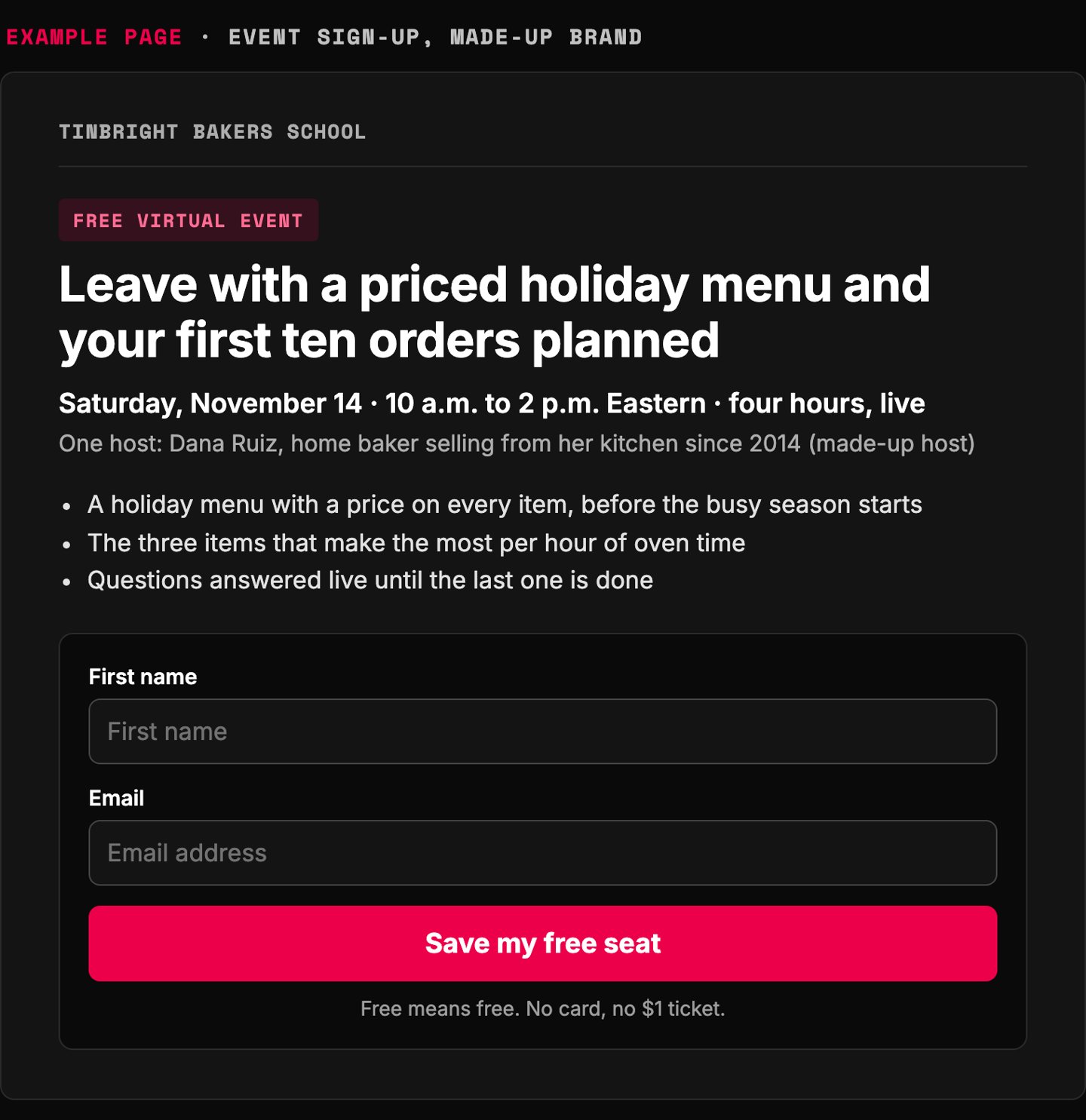
- Called a free virtual event, not a webinar.
- The title names what they will have when the day ends.
- A Saturday before the busy season, and a long live day: four hours.
- A headline, a date, a form. That is the whole page.
- Free means free. Not $1, not $7.
Example page built for this article with a made-up brand. The school, host and date are made up.
Run the same event four times before you change it
First runs are practice. The host is finding the rhythm. The list is still small.
Commit to running the same event four times in a row. You want clean data before any change.
Every run grows the list. Every week you invite that list again. Revenue per attendee tends to climb toward the end of a run.
The crowd gets tired after about six weeks of back-to-back runs. So run six weeks on, two weeks off.
About once a quarter, change the hook, the angle the ads lead with. The event itself stays the same.
A recorded, always-on version comes later. Wait for four to six live runs, then use the recording with the best pitch.
How to kill a working event in four easy steps:
1. Charge $1 for the ticket. It is only a dollar.
2. Book three guest speakers nobody has heard of.
3. Cut it to 45 minutes, because attention spans.
4. Change the title, the price and the pitch after one weak run. Then call the model broken.
One weak run is not data. It is a rehearsal.
Change one thing at a time when you do change. Here is how to test one variable.
Four identical runs before one change
- Run the same event
- Write down the two numbers
- Invite the growing list again
- Repeat until run four
Our method.
Six weeks on, two weeks off, a new hook each quarter
| Rule | Number | Why |
|---|---|---|
| Identical runs before any change | 4 | First runs are practice |
| Weeks of back-to-back runs before fatigue | About 6 | The same crowd tires |
| Rest after a streak | 2 weeks off | Then six more weeks on |
| Hook change | About once a quarter | New angle, same event |
| Live runs before a recorded version | 4 to 6 | Keep the recording with the best pitch |
Our method.
Checkout or a call? Draw the line at $2,500
Let the price decide where buyers go. The rule: $2,500 or less goes to a checkout page during the event. Above it goes to a phone call.
Nobody types a card number for a $21,000 offer in a chat box. They want a human first.
After three hours together, those calls get easy. Sales closers turn into order takers. For example, one offer closed 40 to 50 percent of calls.
Put one person on the chat. When someone asks how to buy, answer them privately with the link.
Big crowd, high price? Line up enough closers before the day, not after.
Make the checkout page short. See checkout fixes, and for calls, the math of booked calls.
The price decides where the buyer goes
| $2,500 or less | Above $2,500 |
|---|---|
| Checkout page, during the event | A booked phone call |
| Link sent privately in chat when someone asks | Closers lined up before the day |
| The buyer decides alone | The buyer wants a human first |
Our method.
Plan your event with AI: the copy-paste prompt
Paste the prompt below into your preferred AI. It asks about your offer, your buyer, your list and your budget. Then it builds the title, the VIP seat, the run of show and the ten-day calendar.
It never invents a cost or a show rate. With no numbers yet, it uses the targets in this guide and labels them as guesses.
It does not guess. Neither should you.
Paste into your preferred AI. It asks five questions, then gives you titles, a VIP seat, a run of show, a ten-day calendar and your break-even number.
Act as an event planner. Plan a free online event that has to pay for its own ads, using the rules below.

Ask me one at a time, with the example:
1. What do you sell after the event, and at what price? (Example: a $2,000 group program)
2. Who is the buyer? (Example: salon owners who want more bookings)
3. What will they have, or be able to do, when the event ends? (Example: next month's bookings planned)
4. Do you have an email list or audience? How big? (Example: 3,000 emails)
5. Your ad budget for the first event, and your cost per sign-up and show rate if you know them. (Example: $3,000; unknown)

Rules:
- The event is free. Never a paid ticket, not even $1.
- One paid upgrade only: a VIP seat on the live Zoom call, with a promise that the buyer's question gets answered. Small price. It must be worth the price on its own. Free guests watch a live stream.
- Length: at least 3 to 4 hours live. A gift at the start for people who show up, about 90 minutes of teaching, a break with real testimonials, a second gift for those who come back, more teaching, a recap, the offer, then questions until every one is answered.
- One host, face to camera. Call it a free virtual event, never a webinar.
- Promotion: 10 days in total. Days 1 to 3: useful posts on the topic with no link. Days 4 to 10: sign-up ads. Next day: a 60-minute encore with a 15-minute recap, then questions.
- Offers of $2,500 or less go to a checkout page. Offers above $2,500 go to a booked call.
- Run the same event four times before changing anything.
- Never invent numbers. If I do not know my cost per sign-up or show rate, use $7 to $8 per sign-up and a 12 to 15 percent show rate, and label both as guesses.
- No income promises, no fake scarcity, no made-up testimonials.

Show your math, then give me:
Event title: 3 options, each naming a concrete result and a date people already think about
VIP seat: what it includes and a price to test
Run of show: start and end time for each block
10-day promotion calendar
My two numbers: cost per attendee (cost per sign-up divided by show rate) and the revenue per attendee I must beat
Where buyers go: checkout or call, and why
Runs 1 to 4: what stays fixed, and what I write down after each run
What to do this week
1. Write one title that names a concrete result and a date.
2. Email your current list about a free event before you buy a single ad. That is how the first online test began.
3. Book a Saturday, block four hours, and write down the two numbers you need to beat.
Then fix the next problem: getting people who registered to show up. For the offer at the end, read teaching before the pitch.
Free seats fill the room. VIP seats pay for it.

Filip Kovacevic is the founder of Anar Agency in Phoenix. He spent five years running SEO, Meta ads, email, and content for medical practices across the United States, and now does the same work for healthcare, home-service, legal, and professional-service businesses, alongside AI implementation. More from Filip →
Talk it through in 15 minutes
Bring one question from this article. We will tell you what we would do, whether or not you hire us.
Book a 15-Min Chat →