How to Write a Facebook Ad: Why, What, Then How
To write a Facebook ad for people who were not looking for you, use three parts in order. Spend about 60 percent of the words on why their problem happens. Spend 30 percent on what changes for them.
Use the last 10 percent to hint at how. Your landing page explains the rest.
How to write a Facebook ad for people who were not looking
A homeowner is scrolling Facebook at nine at night. Your ad says "Water heater installs from $899." She keeps scrolling.
So is she the wrong buyer? No. Her shower went cold this morning, and your ad talked about a price before it talked about her morning.
That is the usual way to write a Facebook ad. Lead with the offer. It works on the few people already shopping and misses everyone else.
So here is how to write a Facebook ad for a cold audience, meaning people who never heard of you. Open with why the problem happens. Then say what changes, then hint at how.
We call it the Why-What-How Ad. It is a cousin of the old AIDA model (attention, interest, desire, action), with one difference. It tells you how many words each part gets.
An offer-first ad talks to the shoppers; a why-first ad talks to everyone else
| Offer-first ad | Why-What-How Ad |
|---|---|
| Opens with the price or the offer | Opens with a problem the reader has lived |
| Speaks to the few already shopping | Speaks to the many who have not named the problem |
| Explains the method in the ad | Hints at the method; the page explains it |
| Judged on click rate | Judged on cost per lead |
Our comparison.
Spend 60 percent on why, 30 on what and 10 on how
The Why-What-How Ad is a three-part ad for cold traffic. About 60 percent of the words explain why the problem happens. About 30 percent show what the reader gets, and about 10 percent hint at how.
Why, about 60 percent. Start with the word why plus something the reader has lived. "Why do water heaters quit on the coldest morning of the year?"
That question assumes the problem is real. Language experts call that a presupposition. The reader does not argue with it; they remember it.
What, about 30 percent. Next comes the result they want. For example, hot water tonight, a fair price and the old tank hauled away.
How, about 10 percent. One line says a method exists, like "Here is how we swap it in one visit." The landing page carries the rest.
Why that order? People do not buy while they are stuck in a problem. They buy once they can see the way out.
So the ad walks them across: problem, then result, then a hint of the method. The percentages are a guide. The order is the rule.
The why also wins the first glance. Most people scan a screen instead of reading it, and their eyes favor the first words of the first lines. Spend those words on the why.

Example: in a 150-word ad, 90 words go to the why
Words per layer in a 150-word cold ad, split 60/30/10
- Why 90
- What 45
- How 15
Worked example: 150 words split 60, 30 and 10 percent. The math is ours.
Each layer has one job
| Layer | Share | Its job | Example line (plumbing) |
|---|---|---|---|
| Why | About 60% | Name a problem the reader has lived | Why do water heaters quit on the coldest morning of the year? |
| What | About 30% | Show the result they want | Hot water tonight, old tank hauled away |
| How | About 10% | Say a method exists, in one line | Here is how we swap it in one visit |
The Why-What-How Ad. Example lines are ours, for illustration.
One cold ad, three layers: most of the words go to the why
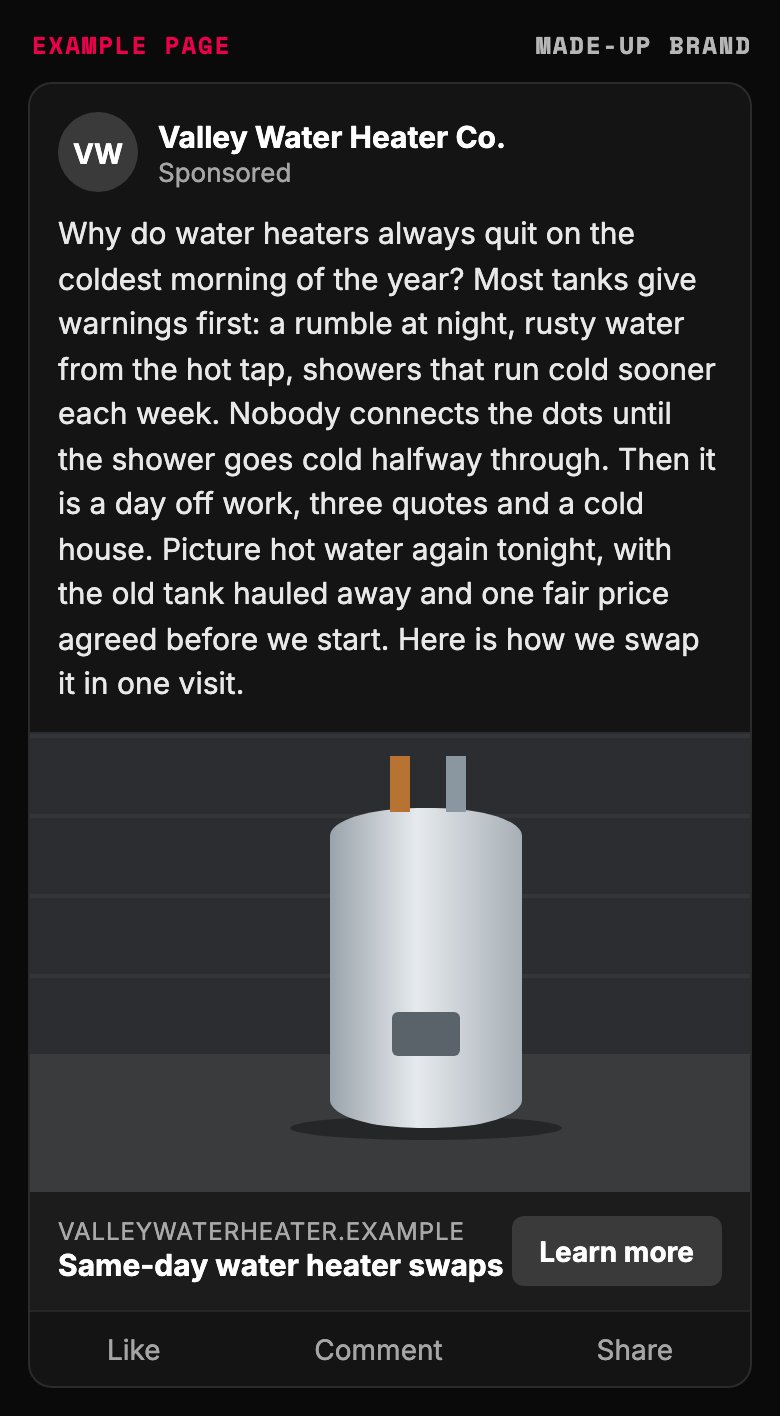
- The why line: the word why plus a moment the reader has lived.
- Still the why layer, about 60 percent of the words. It describes the situation, never the person.
- The what layer, about 30 percent: a result, not a lesson.
- The how layer, one line. The landing page explains the rest.
- No price in the opening. The page handles price after the reader wants the result.
Example page built for this article with a made-up brand
The Why-What-How Ad is a cold-traffic ad in three parts. About 60 percent of the words explain why the problem happens, in the buyer's own complaint words. About 30 percent show what result they get, sold as a result and not a lesson, and about 10 percent hint at how in one line, with the landing page carrying the rest.
Describe the situation, never the person. Flip the order for search. In retargeting, open with the problem again and sort visitors by how far they read.
Find your why line in five minutes
The why line has to be something your buyer actually lived. Lines written at a desk sound like "Tired of plumbing issues?" Nobody describes their own morning that way.
Here is the five-minute method. Search "biggest complaints about [your product]" and "biggest downside to [your product]". Read the answers word for word.
Then read the forums where buyers vent, like Reddit threads about your product. Then ask your preferred AI what people struggle with most about the problem you fix.
Copy their exact words. Each separate complaint is a separate ad. A water heater buyer has at least four: cold showers, rusty water, a noisy tank, the surprise bill.
One rule before you write. Describe the situation, never the person.
Meta does not allow ads that assert or imply personal attributes, such as age, health or money trouble. "Struggling with debt?" points at the reader. "Why budgets are so hard to keep" points at the situation.
Keep the why honest too. The FTC expects proof for any claim a reasonable reader takes from an ad. A why line that describes a real moment has very little to prove.
Details still matter. The more exact the situation, the more the right people respond.
Our own lead ads point the same way. Ads aimed at one named niche cost us about $19 to $62 per lead, against $181 for a broad "business owner" audience. Those ads used niche audiences as well as niche words, so treat this as a hint, not proof.
Five searches give you a list of real why lines
- 1. Search the complaints "Biggest complaints about [your product]"
- 2. Search the downside "Biggest downside to [your product]"
- 3. Read where buyers vent Forums and Reddit threads about your product
- 4. Ask your preferred AI What do people struggle with most about this problem?
- 5. Copy their exact words One complaint per ad. Never polish their words into yours.
The Why-What-How Ad, research step.
Describe the situation, never the person
| Points at the person | Describes the situation |
|---|---|
| Struggling with debt? | Why budgets are so hard to keep |
| Still single at 50? | Why dating apps feel like a second job |
| Is your house a mess? | Why clutter comes back after every big clean |
Rule: Meta Advertising Standards, Privacy Violations and Personal Attributes, read 2026-10-17. Example lines are ours.
In our own lead ads, a named niche cost far less per lead than a broad audience
Cost per lead, Anar's own Meta lead ads, by audience
- Med spa owners 19
- Contractors 61
- Broad "business owner" 181
Anar's own Meta lead ads, May to November 2025, about $9,190 across 16 campaigns. Contractors ran $60 to $62; shown at $61. Niche audiences, not only niche copy.
Write the what as a result, not a lesson
The what layer sells the result. It does not teach. Teaching belongs on the page, after the click.
Here is the test. "Module one shows you how to set up an ad account" is a lesson. "You run your first ad the same afternoon" is a result.
Which one do you want? The second. The first sounds like homework.
Two small words help in crowded markets: without and even if. "Hot water tonight, without a weekend of quotes." "A website that brings in calls, even if you hate writing."
Each one knocks out a fix the reader already tried or dreads. You stand apart without naming a competitor.
Keep one want per ad. A homeowner wants hot water, then no surprise bills, then a house that just works.
Each of those wants is its own ad. If you cram all three into one ad, none of them lands.
The what layer sells the result, not the lesson
| Lesson (teaches) | Result (sells) |
|---|---|
| Module one shows you how to set up an ad account | You run your first ad the same afternoon |
| We explain the five types of water heaters | Hot water tonight, and no second visit |
| Our consult covers your treatment options | See the likely result on screen before you book anything |
Example lines are ours, for illustration.
Example: each want a homeowner has becomes its own ad
- Hot water tonight Ad one: the cold shower.
- No surprise bills Ad two: the quote that doubled.
- A house that just works Ad three: the weekend lost to repairs.
- Peace of mind Ad four: guests arriving on a cold morning.
Example ladder, ours. Ask "why do they want that?" to climb one level.
Keep the how to one line and let the page finish it
The how is a teaser, one or two lines at most. "Here is a new way to do it." "Here is how we do it in one visit."
Why so short? If you give away the method, the reader has no reason to click. You also turn a feed post into a manual.
The page picks up where the ad stopped. Its headline continues the same thought: "How to go from cold showers to hot water by tonight." Then the page delivers the other 90 percent of the how.
The ad and the page are one conversation. If the page starts a new topic, it loses the reader the ad just won. Our guide to matching the page to the visitor's state covers that handoff.
The other common mistake is stopping at the why. Plenty of ads, like the evening news, show the problem and never the way out.
The reader feels worse and does nothing. That is not persuasion. It is a bad mood you paid for.
The page picks up the sentence the ad started
- Ad: why Names the cold-shower morning.
- Ad: what Hot water tonight.
- Ad: how One line: here is how we swap it in one visit.
- Page headline How to go from cold showers to hot water by tonight.
- Page body The other 90 percent of the how: steps, proof, price.
The Why-What-How Ad. Example lines are ours.
The page finishes the sentence the ad started
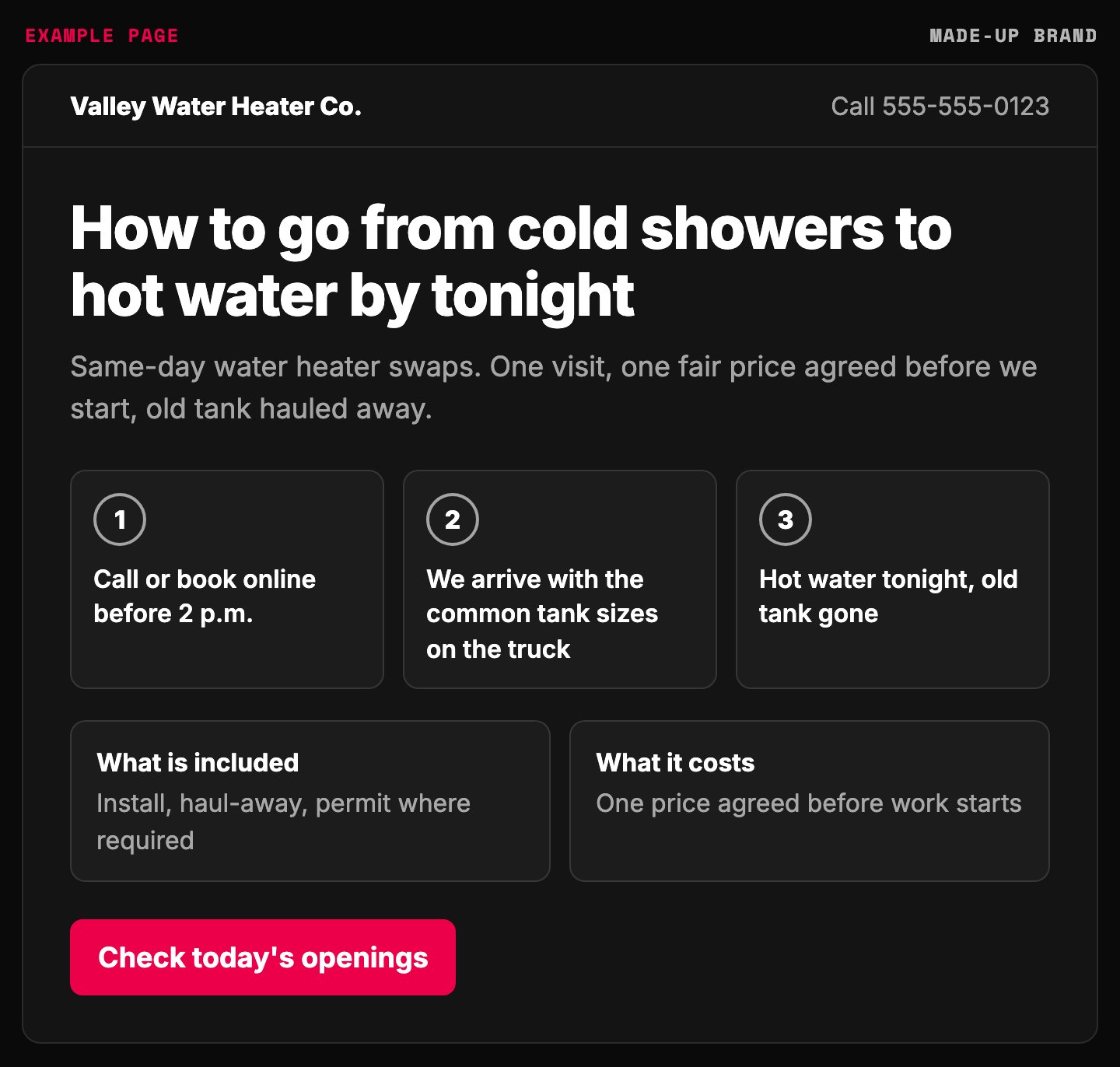
- The headline picks up the ad's sentence: from the problem to the result.
- The what again, in the same words the ad used.
- Here the page delivers the how the ad only hinted at.
- Price appears after the reader wants the result, not in the ad's first line.
Example page built for this article with a made-up brand
What if your buyers have heard every promise?
Some buyers have tried everything. Four agencies, three plumbers, a shelf of courses. A fresh why still works on them if it aims at the last thing they tried that failed.
Ask why this time would be different. "Why would a fifth agency fix what four could not?"
Or ask the question their own history already answers. "If one more tutorial were the answer, would you still be watching them?"
These lines do one job. They pull a buyer who got burned before back into the problem, so your result sounds new again.
Buyers who doubt they can do it at all need a different kind of line. Our guide to the three beliefs that stop a buyer covers those.
Four openers for buyers who have heard it all
| Opener | Shape | Example |
|---|---|---|
| Re-entry why | Why would this time be different? | Why would a fifth agency fix what four could not? |
| History question | If X worked, why are you still doing Y? | If one more tutorial were the answer, would you still be watching them? |
| Without | The result, minus the thing they dread | Hot water tonight, without a weekend of quotes |
| Even if | The result, even if the obstacle stays | A website that brings in calls, even if you hate writing |
Example lines are ours, for illustration.
Should a search ad start with why? Usually not
A search ad is the exception. The reader typed the problem into Google, so they already did the why part themselves.
Flip the order. Lead with what and how. Put one short why line at the end, as the reason your way works.
The format pushes you there anyway. Google lets you enter up to 15 headlines and 4 descriptions for one responsive search ad and mixes them. That is room for results and proof, not a story.
Never mix both orders in one ad. A why-first ad and a what-first ad are written for two different readers. Write one of each.
Selling to buyers who already know the problem but not its cause? That is a third ad, built in our guide to problem-aware ads.
Flip the order when the reader typed the problem
| Cold feed ad | Search ad |
|---|---|
| The reader was not looking | The reader typed the problem |
| Why first, about 60 percent | What and how first |
| How is one line | Why is one line, at the end |
| Job: make the problem felt | Job: show the fix matches the search |
The Why-What-How Ad, flipped for search.
Retargeting ads: put them back in the problem first
Someone clicked, read and left. Do they still have the problem? Of course.
Most retargeting forgets that. It repeats the offer, as if the visitor already wants it. Our rule: open with the problem again, then walk them back to the result.
Better still, sort visitors by how far they read. Someone who left on the first screen needs the whole ad again. Someone who reached the story goes back to the story, and someone who reached checkout needs a small next step.
Lumping all three into one "visitors" audience serves none of them. It is the same mistake as running one ad for everyone.
Meta's own example of retargeting with website custom audiences uses visitors from the last 30 days who have not converted yet. The exact settings change, so they sit in the dated box below.
Retarget by how far they read, not one bucket of visitors
| How far they got | What they know | What to show them |
|---|---|---|
| Left on the first screen | Almost nothing | The full why-first ad again |
| Reached the story | The problem and your product | The story again, then the result |
| Reached checkout | Nearly everything | The problem in one line, then a small next step |
Our retargeting rule. Every segment opens with the problem again.
Where people get stuck with why-first ads
Stuck point one: a good click rate and expensive leads. Usually the ad is a pitch. The few shoppers click, and everyone else scrolls past.
Click rate is clicks divided by the times the ad was shown. It counts clicks, not buyers. Judge the ad on cost per lead and lead quality instead.
Stuck point two: people react but nobody clicks. The ad stops at the why. Add the what by the second paragraph, even if it is one line.
Stuck point three: nobody reacts at all. The why line came from your desk, not from your buyers. Go back to the complaint searches and use their words.
For example, one dating coach rebuilt his ads in this order. He reported that his cost per sale fell by half and his conversion rate doubled. We have not seen his data.
How to burn a cold-traffic budget in four easy steps:
1. Open with your price. Strangers love a number with no reason attached.
2. Explain your whole method in the ad. Now nobody needs to click.
3. Run the same ad in the feed, on search and in retargeting. Three readers, one script.
4. Judge it on click rate and celebrate the clicks. Ignore the leads that never showed up, and call the whole damn thing brand awareness.
Four stuck points and the fix for each
| Symptom | Likely cause | Fix |
|---|---|---|
| Good click rate, expensive leads | The ad is a pitch, so only shoppers click | Rebuild it why-first; judge on cost per lead |
| People react, nobody clicks | The ad stops at the why | Add the what by the second paragraph |
| Nobody reacts at all | The why line came from your desk | Use your buyers' own complaint words |
| Ad rejected | A line points at the reader's traits | Describe the situation instead |
Our diagnosis table.
Example: one coach's reported result after switching to this order
| Business | What changed | What he reported | How sure |
|---|---|---|---|
| A dating coach | Rebuilt his ads in why, what, how order | Cost per sale cut in half; conversion rate doubled | Reported; we have not seen the data |
Example from another business. Not our result, and not verified by us.
Write your Why-What-How Ad with AI
Paste the prompt below into your preferred AI. It asks about your buyer and your offer, one question at a time. Then it writes a cold ad, a search ad and three retargeting openers.
It never makes up a complaint. It asks you for real ones, or searches for them if it can, and shows you where each line came from.
Read every line out loud before it runs. If you would not say it to a customer's face, cut it.
Need more room for the story? See how to write a long Facebook ad.
Paste into your preferred AI. It asks five questions, then writes every piece and shows which buyer complaint each one used.
Act as a direct-response copywriter. Write my ads with the Why-What-How method.

Ask me one question at a time, with the example:
1. What do you sell, and to whom? (Example: same-day water heater swaps for homeowners)
2. Where will the ad run: cold social feed, search, or retargeting? (Example: cold Facebook feed)
3. Paste 3 to 10 real complaints from your buyers, in their words. (Example: "the shower went cold halfway through")
4. What result do they want most? (Example: hot water tonight)
5. What makes your method different, in one line? (Example: we carry the common sizes on the truck)

Complaints: never invent one. If I have none and you can browse, search "biggest complaints about [product]", "biggest downside to [product]" and buyer forums, then list what you found with links. If you cannot browse, ask me.

Rules:
- Cold feed: about 60% why, 30% what, 10% how. Open with "Why" plus a complaint from my list.
- The what is a result, not a lesson. Use "without" or "even if" when the market is crowded.
- The how is one line. The landing page explains the rest.
- One want per ad.
- Describe the situation, never the person. No line may state or hint at the reader's age, health, money trouble or other personal traits. If you can browse, check Meta's current rule on personal attributes first.
- Search: lead with what and how; one short why line at the end. If you can browse, check Google's current character limits.
- Retargeting: open with the problem again in one line. Write three versions: left early, reached the story, reached checkout.
- No made-up numbers, results, deadlines or testimonials.

Output:
1. Cold feed ad, with the why, what and how parts labeled
2. Two more why lines, each from a different complaint
3. Search ad: 5 short headlines, 2 descriptions
4. Three retargeting openers
5. A landing page headline: "How to go from [problem] to [result]"
6. Which complaint each piece used
Run it this week
1. Run the complaint searches for your main offer. Save ten real phrases.
2. Run the prompt and launch one why-first ad next to your current ad. Change only that, as in our one-variable testing guide.
3. Compare cost per lead, not click rate. Then read whether your ad should start with why or how to sharpen the next draft.
The homeowner with the cold shower is still scrolling. This time your ad starts with her morning.
Meet her at the cold shower, not at the price tag.

Filip Kovacevic is the founder of Anar Agency in Phoenix. He spent five years running SEO, Meta ads, email, and content for medical practices across the United States, and now does the same work for healthcare, home-service, legal, and professional-service businesses, alongside AI implementation. More from Filip →
Talk it through in 15 minutes
Bring one question from this article. We will tell you what we would do, whether or not you hire us.
Book a 15-Min Chat →