CMO vs CRO: Use the Zigzag Test to Pick the Right Job

A CMO, or chief marketing officer, runs the big picture: the market, the offer, and how ads, marketing and sales work together. CRO, short for conversion rate optimization, is detail work that makes one funnel earn more per visitor. To pick, look at the sales chart.
A zigzag needs CMO work first. A steady line is ready for CRO.
CMO vs CRO: one runs the system, one tunes the funnel
For example, one influencer with 15 million followers asked for help growing his sales. Then he opened his sales chart. Up, down, up, down.
Fifteen million fans, and no control over his sales.
That chart settles the CMO vs CRO question faster than any job post. A CMO, or chief marketing officer, owns the big picture, called macro work: the market, the offer, and how the teams work together. CRO here means conversion rate optimization, the detail work, called micro work, that makes one funnel earn more per visitor.
One note on the name. In some job titles CRO means chief revenue officer. That is a different job, and this guide is not about it.
Our take: most marketers pitch the wrong job. They sell page tweaks to a business that runs on luck. Or they sell big strategy to a business that only needs a better upsell.
A zigzag runs on luck; a steady line runs on control
| Zigzag sales | Steady sales |
|---|---|
| Big swings up and down | Small moves around a level |
| The business is not in control of its sales process | The business is in control |
| Customers decide when they buy | The business decides when people buy |
| Our rule: CMO work first | Our rule: CRO work first |
The Zigzag Test as set out in this guide. The order of work is our rule.
What is the difference between a CMO and a CRO?
A CMO works on the whole business. A CRO works inside one funnel.
Macro work picks the market, the offer and the channel. It decides who does what and how each person gets paid. Micro work fixes the ad, the page, the order form, the upsell and the booking step.
The big picture controls the small one. Think of a city. It follows state law, and the state follows federal law, but a city can still push the state to change.
A business works the same way. A sharp funnel can show the CMO where the market is moving. So CRO is part of the CMO job, not a rival to it.
A CMO who cannot read a funnel is guessing. A CRO who ignores the market is polishing a car with no engine.
A CMO owns the whole system; a CRO owns one funnel
| CMO (chief marketing officer) | CRO (conversion rate optimization) |
|---|---|
| Macro: market, offer, channel | Micro: ad, page, order form, upsell |
| Connects ads, marketing and sales | Works mostly inside marketing |
| Manages people and pay | Manages the funnel |
| Many meetings | Few meetings |
| Answers for the whole business | Answers for one funnel's earnings per click |
Our comparison. Definitions: Wikipedia, Chief marketing officer; Conversion rate optimization.
Each level sets the limits for the one below it
- Page and upsell Headlines, choices, order form. CRO work.
- The funnel Front end, upsells, booking step. CRO work.
- Teams and pay Ads, marketing, sales, and how each is paid. CMO work.
- Market and offer Who you sell to and what you sell. CMO work.
Our model of macro and micro work.
The Zigzag Test asks one question before any pitch: are your sales a zigzag or steady? A zigzag means the business is not in control of its sales process, so CMO work comes first: one message from ad to sales call, pay that rewards sales, every lead called, team cost near 10 percent of revenue. A steady line means it is in control, so CRO work comes first: score every funnel item per 100 visitors and keep earnings per click above cost per click.
Agree on pay before the line turns steady.
Run the Zigzag Test: ask one question, read one chart
The Zigzag Test is one question you ask before you pitch anything. Are your sales a zigzag, or are they steady?
Ask to see monthly sales as a line. Do not trust the owner's description. Look.
A zigzag means the business is not in control of its sales process. It runs on luck, and customers decide when they buy.
A steady line means the business is in control. It decides when people buy.
Our rule: a zigzag gets CMO work first. A steady line gets CRO work first.
Why that order? A better page on a business that runs on luck just makes the lucky months bigger. The bad months stay bad.
What about follower counts, list size and last spring's big launch? Ignore them. The line does not care.
The CMO's job is done when the zigzag turns into a steady line. Already steady? Start with a conversion-first audit.
Four steps from one question to the right first job
- 1. Ask the question Are your sales a zigzag, or are they steady?
- 2. See the line Monthly sales as a chart. Not the owner's description.
- 3. Name the shape Big swings up and down, or a steady level.
- 4. Pick the first job Zigzag: CMO work. Steady: CRO work.
The Zigzag Test as set out in this guide.
What each answer tells you to do next
| They say | What it means | Your first move |
|---|---|---|
| Zigzag | Not in control of the sales process | Map the three teams and how each is paid |
| Steady | In control of the sales process | Score every funnel item per 100 visitors |
| Big numbers, no chart | They do not know yet | Ask for monthly sales before you pitch |
Our decision rule.
CMO work: get ads, marketing and sales pulling the same way
Every business that sells has three teams, even when one person plays all three. Advertising buys attention. Marketing turns that attention into buyers with copy, pages and emails.
Sales gets more money from each buyer, on the phone or at checkout. Most zigzags start where these three stop talking.
You have heard this before. Sales says the leads are junk. Marketing says the ads are weak, and the ad team says the copy does not convert.
So the CMO meets each team every week. One message runs all the way down. If the ad promises to help you lose 20 pounds, the page says it and the sales call says it too.
Then map how each team gets paid. That is where the fights come from. Each team chases its own incentive, not your sales.
An agency paid 7 to 15 percent of ad spend earns more when you spend more. A writer paid on opt-ins will write curiosity headlines. A rep who picks which leads to call will skip anyone who looks broke.
For example, one company doing about $100 million a year hired a marketer who pushed opt-ins to 70 percent. Sales did not follow. The headline drew clicks from the wrong people.
The fix for picky reps is short: cut the form to name, phone and one question, their biggest problem. Then everyone gets a call. More on that in qualifying before the call.
How to keep a zigzag forever in four easy steps:
1. Pay the agency a share of spend. Ask it to spend less.
2. Pay the page writer on opt-ins.
3. Let sales choose which leads deserve a call.
4. Hire a fancier copywriter and hope like hell.
In the weekly meeting, ask only how and what. Write the target number on a note stuck to your screen. Questions that start with why invite stories, and stories do not pay.
Last, check the team cost. Our rule of thumb: about 10 percent of revenue. A bloated team leaves no fuel for growth.
To turn the target into a daily plan, use book-a-call math. A team paid on the wrong number will hit the wrong number.

The CMO keeps one message moving through three teams
- Advertising Numbers and stats. What do we need to hit the target?
- Marketing The message. Does the page say what the ad promised?
- Sales Every lead called. Does the call say it too?
- Pay review Is each team paid on sales, not spend, opt-ins or leads?
The weekly CMO meeting as set out in this guide.
Each team chases the number it is paid on
| Who | Paid on | What goes wrong | Fix |
|---|---|---|---|
| Ad agency | 7 to 15% of ad spend | More spend, not more sales | Judge it on sales per dollar |
| Page writer | Opt-in rate | Curiosity clicks from the wrong people | Judge it on sales |
| Lead builder | Leads delivered | Cheap leads nobody buys from | Judge it on sales |
| Sales reps | Closed deals | Skip leads that look broke | Short form, call everyone |
Common pay setups and our fixes.
Example: a $400,000 team eats 40 percent of a $1 million month
Monthly team cost on $1 million of monthly revenue
- Rule of thumb (10%) 100000
- Bloated team (40%) 400000
Worked example: 10 percent and 40 percent of $1,000,000. The math is ours.
CRO work: judge each step by dollars per visitor, not conversion rate
CRO work comes down to one test: earnings per click must beat cost per click. Above it, you make money and can scale. Below it, every click loses money.
Conversion rate alone lies. Anyone can raise it by cutting the price.
So score every item in the funnel by what it adds per 100 visitors. We call that its contribution: the price times the share of people who take it.
For example, a $47 front end (the first thing people buy) that 1.8 percent of visitors buy adds $84.60 per 100 visitors. Drop the price to $3, and say 15 percent of visitors buy. That adds only $45.
Looks worse, right? Now add a $200 upsell that 17 percent of buyers take.
With the $47 front end, the upsell adds $61.20. With the $3 front end, it adds $510, because far more people reach it.
Total: $145.80 against $555 per 100 visitors. That is about $1.46 against $5.55 per visitor.
The catch: this assumes cheaper buyers take the upsell at the same 17 percent. They may not. So it is a test to run, not a promise.
Selling physical goods? Subtract the cost of each item from its contribution first.
Then fix pages by taking things out. Assume the page could sell to every visitor, and ask what stops them. Extra choices are the usual answer.
Psychologists call it Hick's law: more choices mean a slower decision. Pile on decisions and you get decision fatigue, where each choice gets worse than the last.
Usability experts say the same about screens: cut what is irrelevant or rarely needed. Start with earnings per visit over conversion rate, then fix the checkout.
Build a funnel like a sculpture: by cutting away, not by adding stickers.
Example: the $3 front end loses $39.60 up front and gains $448.80 on the upsell
| Item | $47 front end | $3 front end |
|---|---|---|
| Front-end buyers per 100 visitors | 1.8 | 15 |
| Front-end contribution | $84.60 | $45.00 |
| Upsell buyers ($200, 17% take) | 0.306 | 2.55 |
| Upsell contribution | $61.20 | $510.00 |
| Total per 100 visitors | $145.80 | $555.00 |
Worked example: price x share who take it. Assumes the 17 percent upsell rate holds for both; test it.
Example: 15 buyers per 100 visitors put 2.55 people into a $200 upsell
- Visitors 100
- Buy the $3 front end 15
- Take the $200 upsell 2.55
Worked example: 15 percent, then 17 percent of buyers. The math is ours.
Example: the cheaper front end earns $5.55 a visitor against $1.46
Front end plus one upsell, per visitor. This must beat what each click costs.
- $47 front end 1.46
- $3 front end 5.55
Worked example: totals per 100 visitors divided by 100. The math is ours.
CMO or CRO: which job fits you?
Pick by what you enjoy, not by title. Do you like meetings, notes and telling people what to do? Do you want to answer for the whole business?
Then you want CMO work.
Would you rather sit alone and tweak a funnel until it pays more? Then you want CRO work. You can do both, and many people do.
Most people start narrow, as a copywriter or an ad buyer. Then they offer one thing beyond the job they were hired for.
With an ad client, try this: 'Your ads would do better if I could shape the offer too. Mind if I adjust a few things?'
Each yes earns the next ask: emails, then the offer, then upsells and the back end. One day you are running the big picture.
Part-time CMO work is common. The general term is a fractional executive: senior work done part-time or on contract.
One warning. If the client's team cannot get work done, your results suffer and the client will not keep you long. So bring one or two junior writers you trust, and sell both the advice and the work itself.
Meetings and people point to CMO; quiet funnel work points to CRO
| CMO work fits you if | CRO work fits you if |
|---|---|
| You like meetings and notes | You would rather work alone |
| You are fine telling people what to do | You like tweaking until the numbers move |
| You want to answer for the whole business | You want to answer for one funnel |
| You can push back on an agency | You can find what stops a buyer |
Our fit test.
Each yes earns the next ask, until you run the big picture
- Copywriter or ad buyer The narrow job you were hired for.
- The page and the emails Offer one thing beyond the job.
- The offer Ask to shape what the ads sell.
- Upsells and back end Raise what each buyer is worth.
- CMO You own the teams and the pay.
Our model of moving from a narrow role into CMO work.
Audit an upsell by taking things out: five extra choices before the yes
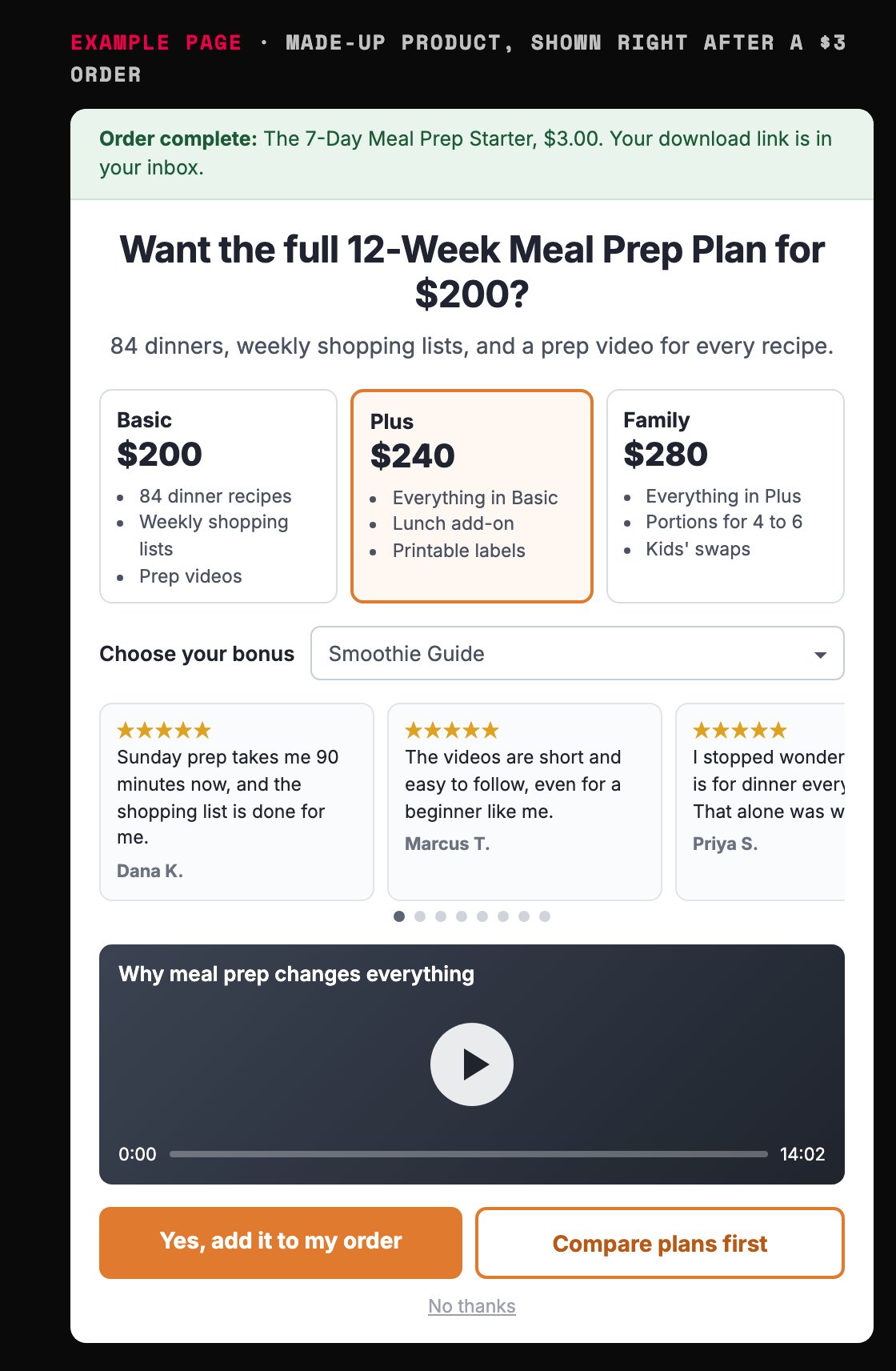
- Three prices means three decisions. Offer one.
- A fourth decision before the yes. Cut it.
- Eight testimonials. Keep the two strongest.
- A 14-minute video. Most buyers will not watch it on an upsell. Cut it or shorten it.
- A second path away from yes. Remove it.
Example page built for this article with a made-up product. Not a real product or a real result.
Agree on pay before the sales line turns steady
Here is the trap. You turn a zigzag into a steady line, the pain stops, and the client asks why they still need you.
So set the deal at the start. Ask for profit share, revenue share, equity, or a cut if the business sells.
Watch for one common offer. The client already does $200,000 a month, their base, so they offer to pay you only on growth above it.
Sounds fair? It is not. Once you run the role, you answer for that $200,000 too.
So ask for 2 to 3 percent of the base and 5 to 10 percent above it. Say it plainly: I am responsible for keeping the base, so I am paid for it.
Example: in a $250,000 month, 5 percent above base pays $2,500. Add 2 percent of the base and it pays $6,500.
Then put four things in writing. Define profit. Get read-only access to the payment account and the books, such as a view-only role in your payment processor.
Add a clause that they cannot rewrite your work to dodge your share, and a fee if they remove you. To size what each buyer is worth before you sign, see offer economics before launch.
Example: being paid on the base turns $2,500 into $6,500
Your pay in a $250,000 month when the client's base is $200,000
- 5% above base only 2500
- 2% of base + 5% above 6500
Worked example: 5% of $50,000; plus 2% of $200,000. The math is ours.
Four contract lines that protect a profit or revenue share
| Line | Why it matters |
|---|---|
| Profit defined in writing | Otherwise any expense can shrink your share |
| Read-only access to payments and books | You can check the number you are paid on |
| No rewriting your work to dodge the share | A small edit should not end your pay |
| A fee if they remove you | Your work keeps paying them after you leave |
Our contract checklist.
Ask for a role that can see payments and reports but cannot change anything
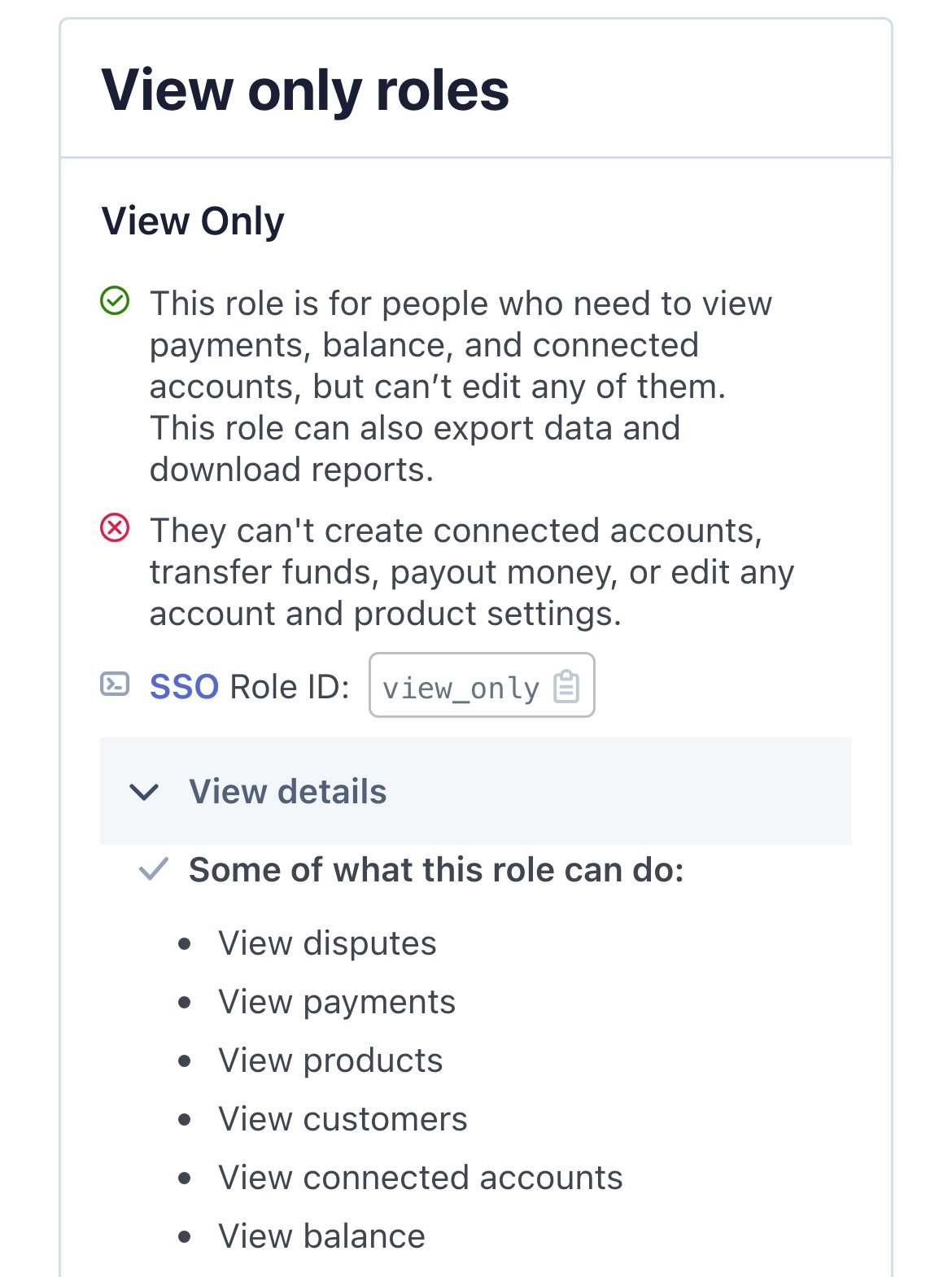
- Ask the client for a role like this one.
- You can see the money. You cannot touch it.
- Pull the numbers your share is paid on yourself.
- View payments: one of the two lines to check each month.
- View balance: the other line to check each month.
Screenshot of Stripe Docs, User roles page, View Only role, taken 2026-10-17. One example of a read-only role in a payment processor; other processors have similar roles
Run the Zigzag Test with AI: the copy-paste prompt
Paste the prompt below into your preferred AI. It asks for the sales line, the three teams, the funnel prices and the pay terms. Then it names the first job and shows its math.
It never guesses a number. If you skip one, it asks again.
Want a second set of eyes on the answer? Send it to us.
Paste into your preferred AI. It asks for the sales line, the teams, the funnel and the pay, then names the first job and shows its math.
Act as a marketing lead. Run the Zigzag Test on one business and tell me whether it needs CMO work or CRO work first.

Ask me one at a time, with the example:
1. Monthly sales for as many months as you have. (Example: 40k, 95k, 30k, 110k, 45k)
2. The three teams: who runs ads, who writes pages and emails, who sells. How is each one paid? (Example: agency on 10% of spend, freelancer per page, two reps on commission)
3. Monthly revenue and monthly team cost. (Example: $100,000 revenue, $35,000 team)
4. Every item in the funnel with its price and the share of buyers who take it. (Example: $27 book at 3% of visitors, $97 upsell at 20% of buyers)
5. Cost per click or per visitor, and cost to deliver each item if physical.

Never invent a number. If I skip one, ask again or mark it unknown.

Rules:
- Big swings up and down = zigzag: the business is not in control of its sales process. CMO work first.
- Steady line = in control. CRO work first.
- CMO check: one message from ad to page to sales call; each team's pay rewards sales, not spend, opt-ins or lead counts; sales calls every lead; team cost near 10% of revenue.
- CRO check: contribution per 100 visitors = price x share who take it, for every item. Subtract delivery cost for physical goods. Earnings per visitor must beat cost per visitor.
- Fix pages by removing choices and steps before adding anything.
- Pay: if offered pay only above the current base, suggest 2 to 3% of the base plus 5 to 10% above it. Profit defined in writing, read-only access to payments and books, a no-change clause, an exit fee.

Show your math, then answer:
Line: zigzag or steady, and why
First job: CMO or CRO
Top three problems, with the number behind each
Earnings per visitor vs cost per visitor
Pay terms to propose
Next three actions: 1. 2. 3.
What to do this week
1. Ask three clients or prospects the zigzag question. Get the line, not the story.
2. If it zigzags, map the three teams and their pay. If it is steady, score every funnel item per 100 visitors.
3. Before any new deal, write the pay terms and the four contract lines.
That influencer did not need more followers. He needed control.
Copy fixes the page. Control fixes the line.

Filip Kovacevic is the founder of Anar Agency in Phoenix. He spent five years running SEO, Meta ads, email, and content for medical practices across the United States, and now does the same work for healthcare, home-service, legal, and professional-service businesses, alongside AI implementation. More from Filip →
Talk it through in 15 minutes
Bring one question from this article. We will tell you what we would do, whether or not you hire us.
Book a 15-Min Chat →