Funnel Architecture: Build Your Sales Funnel as a Decision Timeline

Funnel architecture is the order of offers in your funnel. Plan it as a timeline of your buyer's problems. Your first offer fixes today's problem.
The next one fixes the problem that fix creates in the next 30 to 90 days. The last one keeps the result going. Keep decisions few, and judge each step by money per buyer.
Funnel architecture: plan the order of decisions, not the pages
You copy a funnel that made someone else a fortune.
Same pages. Same upsells. Same order.
You launch it. It flops.
So you rewrite the copy. Still nothing. The copy was never the problem.
Funnel architecture usually means the pages and how they link. We mean something underneath: the order of decisions your buyer makes, and when each one shows up in their life.
Here is the short version. Your first offer fixes today's problem. Each next offer fixes the problem the last one created.
Get that order right for your market, and the pages get easy to write.

Pages are the layout; the timeline decides what goes on them
| Planning by pages | Planning by Decision Timeline |
|---|---|
| Starts from a funnel someone else built | Starts from your buyer's problems, in order |
| Asks: video or text? Two upsells or three? | Asks: what problem does this buyer have next? |
| Blames the copy when it flops | Checks the order of offers first |
| Judges each page by its yes rate | Judges the whole path by money per buyer |
Our comparison, from the method in this guide.
Why a copied sales funnel fails in a new market
A sales funnel is a series of decisions.
Buy this. Add that. Take the next step.
The pages only carry those decisions. The classic funnel picture shows a wide top narrowing to a sale. It says nothing about what to offer next.
Every market meets its problems in its own order. When you copy a funnel, that order is what you really copy.
Take a funnel that sells people a way to start a business. First learn the method. Then buy templates to save work, then buy help to go faster.
That fits someone building a business. Now drop it into dating.
Nobody who is dating wants templates. Someone who just met a partner wants to keep them. Later, they want a commitment.
Same three steps. Wrong three problems. No copy rewrite fixes that.
A business funnel's three steps solve the wrong problems in dating
| Step | Business opportunity | Dating |
|---|---|---|
| First offer | Learn the method | Meet someone |
| Second offer | Templates that cut the work | Keep the relationship going |
| Third offer | Help to move faster | Get a commitment |
Example market timelines, summarized by us.
The Decision Timeline is a funnel plan built from your own market, never copied from another. Today: one offer for the problem the buyer arrives with, which works on its own. The next 30 to 90 days: an offer for the problem that fix creates.
The long run: an offer for keeping or growing the result. Find each step by asking what is better than the last result. Keep decisions few: one bump, up to three upsells, no downsells by default.
Judge every step by price times take rate across the whole path, and keep every add-on unticked with a one-click no.
Map three points: today, the next 90 days, the long run
The Decision Timeline is a funnel plan with three points, set by when your buyer meets each problem. You can sketch one in ten minutes.
Today. The problem they arrived with. Your first offer fixes that, and only that.
The next 30 to 90 days. The problem your fix creates.
That problem is not real yet at checkout, but it will be soon. That is your second offer.
The long run. A year out, or five.
Keeping the result, or growing it. That is your third offer.
Why does this work? Because every fix makes a new problem.
Lose weight, and the next problem is keeping it off. Learn to trade, and the next problem is time. Watching the market eats your day.
Whole industries run on this. In the razor-and-blades model, the razor handle fixes today's problem. The blades fix the problem that comes back every few weeks.
Nothing in it is a trick. The second problem is real, and the first purchase created it.
A Decision Timeline: one buyer, three problems, three offers
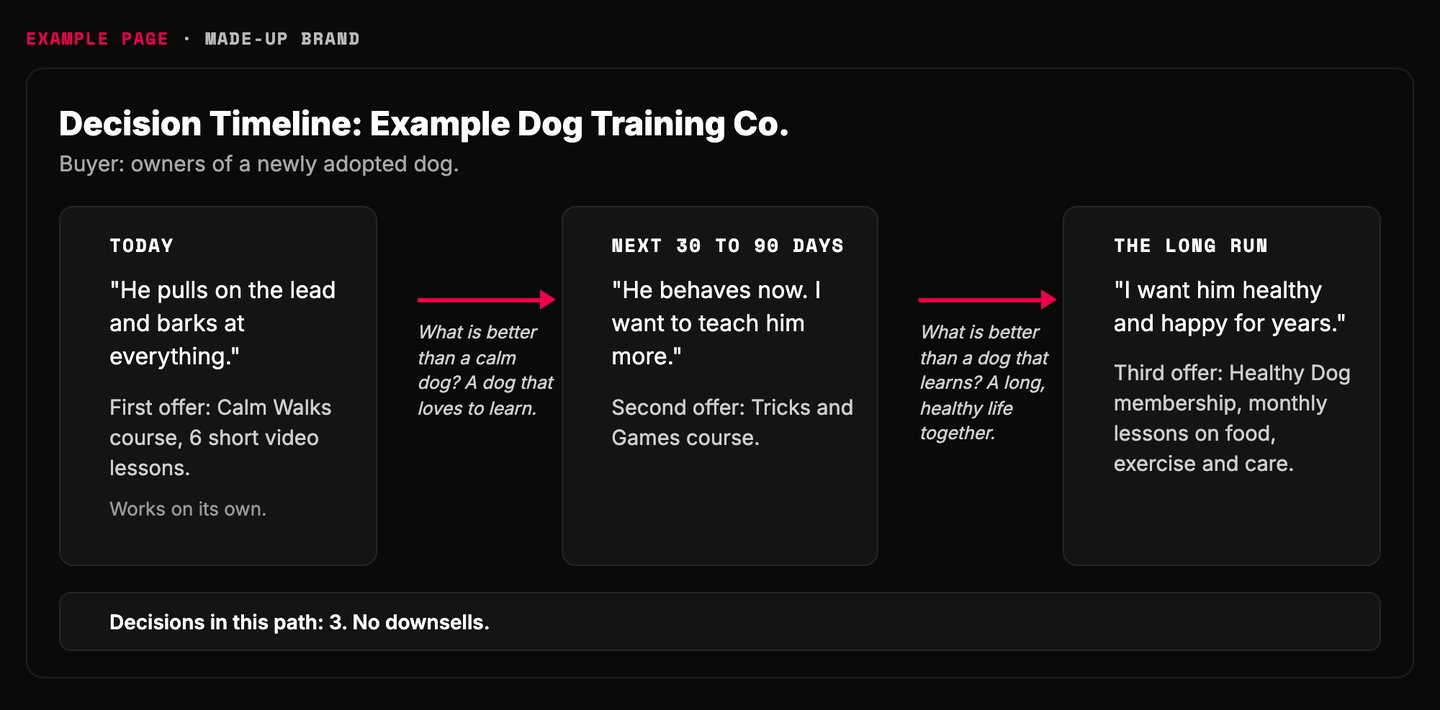
- Start with the buyer's own words for today's problem.
- The first offer must deliver without the later ones.
- Find each next offer by asking what is better than the last result.
- The last offer keeps the result going.
- Fewer decisions, more money per buyer.
Example page built for this article with a made-up brand
Three points, set by when the buyer meets each problem
- First offer Today Fixes the problem they arrived with. Works on its own.
- Second offer Next 30 to 90 days Fixes the problem the first fix creates.
- Third offer The long run Keeps the result going, or grows it.
The Decision Timeline, as set out in this guide.
Map your timeline in five steps
- 1. Name one buyer One kind of person in one market.
- 2. Write today's problem In the buyer's own words.
- 3. Ask what the fix creates What will they run into next?
- 4. Place it in time Next 30 to 90 days, or the long run.
- 5. Name each offer Ask: what is better than the last result?
The Decision Timeline, in five steps.
How do you find the next offer? Ask what is better than the last result
To find each next offer, take the result of the last step and ask: what is better than that? The answer is your next offer. Often it is the headline too.
Example: learning to trade is good. What is better?
Getting the research done for you, so you skip the hours of study. Better still? Keeping more of what you make.
Notice the pattern. Each step cuts the buyer's work or time. People are impatient, and a good upsell sells them the shortcut.
Having it done for you beats getting help. Getting help beats doing it yourself. Most markets climb in that order.
The table below shows real market timelines. Use them as ideas to start from, not as copies. Your market's order may differ.
So check yours against your customers. In a Harvard Business Review case, a builder's condos for people moving to a smaller home were not selling. Sales rose once it helped buyers with the move itself, not just the building.
Nine markets meet their problems in nine different orders
| Market | Today | Next 30 to 90 days | The long run |
|---|---|---|---|
| Weight loss | Lose the weight | Keep it off | Fix what the weight loss left behind |
| Pain relief | Stop the pain | Repair the damage | Keep it from coming back |
| Trading | Learn a system | Get the research done for you | Keep more of what you make |
| Software | Monthly plan | Yearly or lifetime upgrade | Ready-made campaigns loaded in |
| Dog training | Fix the problem behavior | Teach tricks | A long, healthy life |
| Consulting | Get clients | Get recurring deals | Land bigger clients |
| Game design course | Build games for fun | Get hired | Ship your own game |
| Parenting | Today's behavior | The next stage | Who they become as adults |
| Care planning for aging parents | Qualify for care help | Get more out of retirement | Manage the parent's money |
Example timelines, summarized by us. Check your own market's order with your customers.
Each rung answers: what is better than the last result?
- Learn to trade The first offer. Learning takes hours. What is better?
- Research done for you Skip the study. What is better still?
- Keep more of what you make The long run: protect the result.
Example: a trading education funnel, summarized by us.
Fewer decisions make more money
Every page in a funnel asks for a decision. Each decision is a chance to say no and leave.
So count them. Three upsells are three decisions. Add a downsell (a cheaper offer shown after a no) after each one, and you have six.
For example, one private-client offer ran three upsells and no downsells. Its take rates held at about 15, 14 and 13 percent. A take rate is the share of buyers who say yes.
Compare a common pattern with downsells: 15 percent, then 8, 8, 4, 3 and 1. More steps. Smaller yeses.
Why do the yes rates sink? The answer is anchoring.
Tell a prospect a project costs $5,000 to $10,000. You hear $10,000. They hear $5,000.
The anchoring effect means the first number sticks. A downsell puts a lower number in the buyer's head. Every offer after it gets judged against that lower number.
Research on choice overload points the same way. Too many options can stall a decision, though not in every case.
Our default: no downsells. Add one only if the whole path earns more.
Without downsells, yes rates held; with them, each step trailed lower
Share of buyers who said yes at each decision after the first purchase, two example paths
- Three upsells, no downsells: 1 15, 2 14, 3 13
- Upsells plus downsells: 1 15, 2 8, 3 8, 4 4, 5 3, 6 1
Example numbers from other businesses' offers. Not our results, and not verified by us. The downsell pattern is an illustrative common case.
Judge each step by money per buyer, not by yes rate
A step's value is its price times its take rate. We call that its contribution per buyer.
Example: a $197 upsell taken by 15 percent adds $29.55 per buyer. A $97 downsell taken by 8 percent adds $7.76.
The downsell looks like free money. It is not, if it drags down the next upsell.
So do the math on the whole path. Picture a $297 second upsell. Without the downsell it holds at 14 percent and adds $41.58 per buyer.
With the downsell in front of it, it falls to 8 percent and adds $23.76. The path with no downsell earns $71.13 per buyer. The path with it earns $61.07.
The extra offer cost you $10.06 a buyer. That is not a bonus step. It is a tax.
An order bump is a small add-on the buyer can tick on the order form. A good bump does not ask for a new decision. It makes the first one bigger.
For example, one book funnel sold a $27 ebook. Adding the audiobook turned it into a $36 order, and the next add-on made it $66. That seller reports that a bigger first yes lifts the take rate on later upsells.
Use one bump, never a stack of them. And if an upsell flops, check the step in front of it before you touch the offer.
Two prices on one upsell page can help too. Some buyers always pick the cheapest option, and a few always pick the most expensive. Economists call charging different buyers different prices price discrimination.
For example, one seller reports 20 to 30 percent more per order from two tiers on one upsell page, with the copy unchanged. Keep the two prices far apart. Two options, not three.
To judge the full path, track how much each visit earns. More money per buyer also raises what you can pay for each customer.
One unticked bump makes the first yes bigger instead of adding a new decision
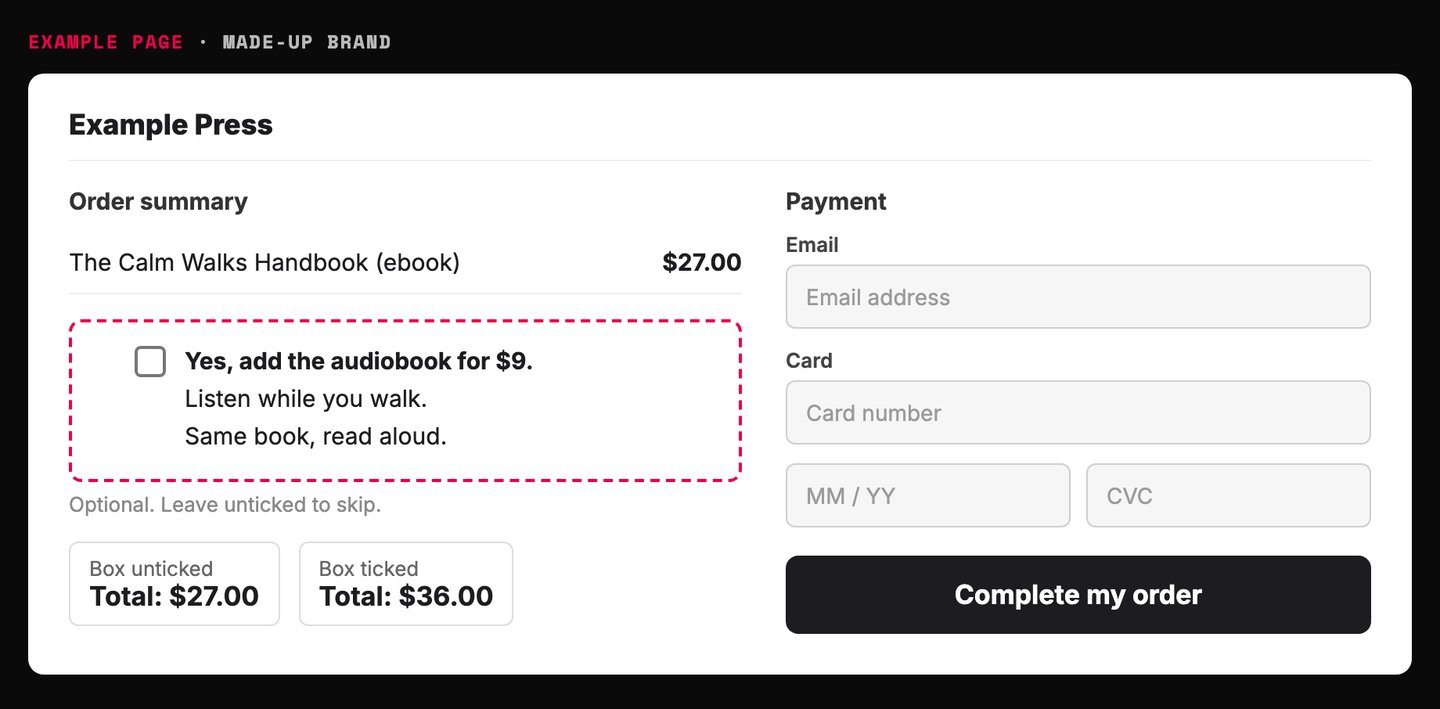
- Starts unticked. The buyer chooses it.
- The price sits in plain view.
- It adds to the decision they already made. It is not a new one.
- The total updates the moment they tick it. No surprise costs.
- One bump. Never a stack.
Example page built for this article with a made-up brand
Example: the $7.76 downsell cost the path $10.06 per buyer
Money per buyer from two upsells, with and without a downsell between them
- No downsell 71.13
- With downsell 61.07
Worked example: $197 x 15% + $297 x 14% = $71.13; $197 x 15% + $97 x 8% + $297 x 8% = $61.07. Take rates from the example paths; the $297 price and the math are ours.
Example: one order form turned a $27 buyer into a $66 buyer
Order size by what the buyer added on the order form, in one book funnel
- Ebook only 27
- Plus the audiobook 36
- Plus the next add-on 66
Example numbers from other businesses' offers. Not our results, and not verified by us.
The front end picks the customer you get
Your first offer decides who walks in. Your later offers decide whether they stay happy.
The lazy funnel sells more of the same.
Buy one bottle. Now buy six. Now twelve.
For example, one large supplement seller ran that model. Plenty of its customers ended up with pantries full of unopened bottles. That is not a loyal customer.
A timeline funnel sells the next problem instead. Weight loss leads to keeping it off, then to fixing what the loss left behind, like skin care. Each step opens a new product, not a bigger box of the old one.
Our take: more-of-the-same upsells are popular because they need no thinking. The buyer pays for that laziness first. Then you do.
Done right, customer lifetime value (what one customer spends with you over time) adds up from each problem you help fix. Map them as a customer journey, in the order your buyer lives them.
More of the same fills pantries; the next problem builds customers
| More of the same | The next problem |
|---|---|
| Buy one bottle, then six, then twelve | Lose the weight, keep it off, fix what it left behind |
| Every upsell is the same product | Every upsell is a new product |
| Buyers stockpile, then stop | Buyers come back when the next problem shows up |
| Easy to plan | Takes ten minutes of thinking about the buyer |
Our comparison. The pantry case is another business's example.
Where funnel maps go wrong, and how to fix them
How to build a funnel that fights itself in four easy steps:
1. Copy a funnel from a market you have never sold to.
2. Put a downsell after every no. Then wonder why the yeses keep shrinking.
3. Stack five bumps on the order form and call it optimization.
4. Make every upsell a bigger box of the same thing, and hope to hell nobody counts the bottles.
The fixes are in the table below. The most common one is the first row: the upsell is fine, and the step before it is broken.
Fit matters as much as order.
For example, one pocket Bible funnel sold well up front. Its sellers did not share their buyers' faith, and they filled the upsells with items from one church tradition. They later called it a mistake.
The cross-sell has to match who the buyer is, not just what they bought. Ask buyers what came next, and use their words.
Our rules for every step: bumps start unticked, every price sits in plain view, and saying no takes one click. The FTC's policy on recurring charges says a pre-checked box does not count as consent.
Surprise costs drive buyers away, too. Baymard Institute research finds extra costs are the most-cited reason shoppers abandon a checkout. For the order form itself, see checkout fixes that lift sales.
Most broken upsells are fixed one step earlier
| Symptom | Likely cause | Fix |
|---|---|---|
| An upsell almost nobody takes | The step before it: a weak bump, or a downsell setting a low anchor | Fix the step in front of it, then retest the offer |
| Yes rates fall off past step two | Too many decisions | Cut downsells and extra bumps; keep three upsells at most |
| Refunds and angry emails after an upsell | The offer clashes with who the buyer is | Ask buyers what came next and match their words |
| Buyers buy once and disappear | More-of-the-same upsells | Offer the next problem on the timeline instead |
Our summary of the method in this guide.
Map your funnel with AI: the copy-paste prompt
Paste the prompt below into your preferred AI. It asks about your market and your offers. Then it maps all three points and runs the path math.
It never invents a take rate. If you have no numbers yet, it marks those steps as tests to run.
Feed it your customers' words, not your guesses. A few real answers beat a pile of assumptions.
Paste into your preferred AI. It asks about your market and offers, then maps three points and scores the path per buyer.
Act as a funnel planner. Map my funnel as a Decision Timeline: the order of problems my buyer meets, and one offer for each.

Ask me one at a time, with the example:
1. What is your first offer and its price? (Example: dog training course, $47)
2. Who buys it? (Example: owners of a newly adopted dog)
3. What problem does it fix today, in the buyer's words? (Example: "He pulls on the lead and barks at everything")
4. What did buyers run into after it worked? Use reviews, emails or calls. (Example: "Now I want to teach him tricks")
5. Your current funnel steps, prices and take rates, if you have them. (Example: bump $9, upsell $97, take rates unknown)

Rules:
- Three points. Today: the problem they came with. The first offer fixes only that, and must work on its own. Next 30 to 90 days: the problem that fix creates. The long run: keeping or growing the result.
- Find each next offer by asking "What is better than [the last result]?" Prefer offers that cut the buyer's work or time.
- Never copy another market's funnel. If my steps look like a template from a different market, say so.
- Flag any upsell that is just more of the same product.
- Default path: one order bump, up to three upsells, no downsells. Add a downsell only if the whole path earns more per buyer.
- Score each step as price x take rate, then the whole path per buyer. Never invent a take rate. If I have none, mark it "test" and tell me what to measure.
- Ethics: bumps start unticked, every price is on the page, and saying no takes one click.

Show your math, then answer:
Today: problem / offer / price
Next 30 to 90 days: problem / offer / price / bridge line
Long run: problem / offer / price / bridge line
Decisions in the path: number
Money per buyer: $ (or "test")
Cut or test first:
Next three actions: 1. 2. 3.
What to do this week
1. Write the three points for your main offer. Use the prompt, or a pen.
2. Ask five recent buyers what problem showed up after they bought. Check their answers against your second point.
3. Count the decisions in your funnel. Cut one downsell or one extra bump, then compare money per buyer.
Remember the copied funnel from the top? Its pages were fine. Its timeline belonged to someone else's market.
Once the order is set, write each page with what an upsell page should say. Then price each step with how to price your product, and check the totals with offer economics before launch.
Every fix makes a new problem. Be standing there with the next fix.

Filip Kovacevic is the founder of Anar Agency in Phoenix. He spent five years running SEO, Meta ads, email, and content for medical practices across the United States, and now does the same work for healthcare, home-service, legal, and professional-service businesses, alongside AI implementation. More from Filip →
Talk it through in 15 minutes
Bring one question from this article. We will tell you what we would do, whether or not you hire us.
Book a 15-Min Chat →