Write the Landing Page Before the Ad
Write the landing page first, then cut your ads out of it. Write the full page body, pull the headline from it, then lift each ad from a line on the page, usually the opening. The click then lands on the same words the ad used.
Ads written apart win clicks the page cannot keep.
Write the landing page for your ads first, then cut the ads out of it
Picture two people working on one campaign. They have never met.
One writes the landing page on Monday. A freelancer writes the ads on Thursday, and gets judged on clicks.
The ads win. Click rates climb. Sales sit still, and everyone blames the page.
The page was fine. The ads were fine. They just did not match, because the two writers never talked.
A landing page for ads is the page someone sees right after they click an ad. Most teams write that page and the ads as two separate jobs. That is the mistake.
Here is the fix. Write the whole page first, then cut your ads out of it.
Each ad becomes a real piece of the page. The visitor clicks on a piece and lands on the rest of it.
Written apart, the ad and page argue; page first, they agree
| Ads written apart | Page-First Rule |
|---|---|
| Ad written to win clicks | Ad cut from a line on the page |
| Page written as a separate job | Page written first, headline last |
| Click lands on new words | Click lands on the same words |
| Judged on click rate | Judged with its page, on sales |
Our comparison. The Page-First Rule as set out in this guide.
Why do my ads get clicks but no sales?
Usually because the ad and the page were written apart. The ad made a promise. The first screen of the page talked about something else.
A person clicks to get something. They land somewhere that feels unrelated, and they feel cut off. So they hit back.
Researchers saw this pattern early. In the early 1990s, Peter Pirolli and Stuart Card at Xerox PARC noticed that people hunt for information the way animals hunt for food. They follow a scent.
Every link gives off a scent. A strong one keeps people moving. A weak one sends them somewhere else.
Usability research shows what happens on arrival. When the first screen gives too little sign that people are on the right track, they decide the page is not worth exploring and simply leave.
Search ads pay for a mismatch twice. Google's Quality Score grades three things, and one is how relevant and useful your landing page is to people who click. A weak match costs you in ad price and in sales.
So read two numbers together. A high click rate with low sales is a sure sign the ad and the page were written apart.
High clicks with low sales point at an ad and page written apart
- Weak ad, good page Lift a new ad from the page's opening.
- The pair works Keep it, and raise spend slowly.
- Offer or audience Start again with the page body.
- Written apart The ad promises what the page does not deliver.
Our rule of thumb for reading click rate and sales side by side.
The Page-First Rule is an order of work for paid traffic: write the landing page body first with no headline, pull the headline out of the body, lift every ad from a line on the page (starting with the opening), and write ad headlines last in the page's words. Fit the page format to the traffic source: scannable blocks for feed clicks, one video for video clicks, the searcher's words for search clicks. Judge each ad and its page as one pair, on sales per visitor.
Curiosity buys a click, not a buyer
A curious click is not an interested click. That difference decides whether the page can sell.
Think of a buyer in three steps. First they care about the result you sell. Then they plan to get it, and last they buy.
Intent is a plan to get something out of the click. You cannot raise it on its own. You raise interest in the outcome, and intent follows.
A curiosity ad skips that step. The person clicks to find out what the ad is about. They have no plan to get anything.
So the page meets a tourist. Tourists look around. Then they leave.
Writers call this trick the curiosity gap: enough to make you wonder, not enough to know. It is built for news headlines, not for a page that has to sell.
So is curiosity always wrong? No. An ad can raise a question, if the first screen answers that same question.
The mistake is raising one question and then answering a different one. That sends the visitor the wrong way.
Intent grows out of interest in the outcome; a curious click has neither
- Interest They care about the outcome you sell.
- Intent They click with a plan to get that outcome.
- Outcome They buy and get it.
Our model of a buying click.
Example: the lifted ad says what the page says; the curious ad says nothing
| Curiosity ad | Ad lifted from the page |
|---|---|
| "You won't believe what fixed my dog's walks" | "Your dog is not stubborn. Your leash is teaching him to pull." |
| Clicks to find out what it is | Clicks to fix the pulling |
| Page has to explain itself from zero | Page opens on the same two lines |
| Judged on click rate | Judged on sales per visitor |
Example ads for a made-up dog trainer. Our comparison.
The Page-First Rule: write the page, then the headline, then the ads
The Page-First Rule is a four-step order of work: page body, page headline, ads, ad headlines. Every ad comes out of the page. None is written apart from it.
Step 1: Write the page body with no headline. The whole argument: the problem, its cause, your answer, the proof, the offer. Leave the headline blank on purpose.
Why leave it blank? A headline written first boxes the copy in. Every paragraph bends to fit a promise you made before you knew what you had.
Step 2: Pull the headline out of the body. Read what you wrote. The best line is usually already in there, and the page already backs it up.
Step 3: Lift the ads from the page. Each ad is a sentence, a scene or a claim taken from the page. Start with the opening.
Step 4: Write the ad headline last. Use the page's promise in the page's words. Nothing the page cannot prove.
Most teams write the ad, then go looking for a page. We write the page, then pull the ads out of it.
Four steps, in this order, and the ad comes third
- 1. Page body Problem, cause, answer, proof, offer. No headline yet.
- 2. Page headline Pulled from the body, so the page already backs it up.
- 3. The ads Lines, scenes and claims lifted from the page. The opening first.
- 4. Ad headlines The page's promise, in the page's words.
The Page-First Rule, in four steps.
Lift your first ad from the page's opening
Your first ad should be your page's opening. Then the click lands on the same sentence the ad started.
The opening is the part of the page written for a cold stranger. It already has to stop someone and make them want more. That is an ad's job too.
For example, picture a made-up dog trainer who fixes leash pulling. The page opens with two lines: "Your dog is not stubborn. Your leash is teaching him to pull."
Those two lines become ad one. The visitor clicks and sees the same words at the top of the page.
They do not have to guess, and they do not get lost.
Then work down the rest of the page. The how-it-works part becomes a demo ad. The customer story becomes a story ad, and the answer to the biggest doubt becomes a third.
Does every ad need its own page? Not quite. Every distinct promise needs its own first screen, but ads that make the same promise can share one.
The first line still has to stop the scroll, which is the job of the first three seconds. To find which lifted ad wins, change one thing at a time.
Every part of the page can become an ad, and each needs its own match on arrival
| Part of the page | The ad it becomes | What the first screen must show |
|---|---|---|
| The opening | Ad one: the opening lines, word for word | Those same lines |
| How it works | A demo clip of the product working | The same clip, or a still from it |
| A customer story | The story, told short | A first screen that opens with that story |
| The answer to the biggest doubt | An ad that names the doubt | The same doubt, answered at once |
The Page-First Rule, step 3. Our table.
The ad is the page's first two lines, so the click lands where it started
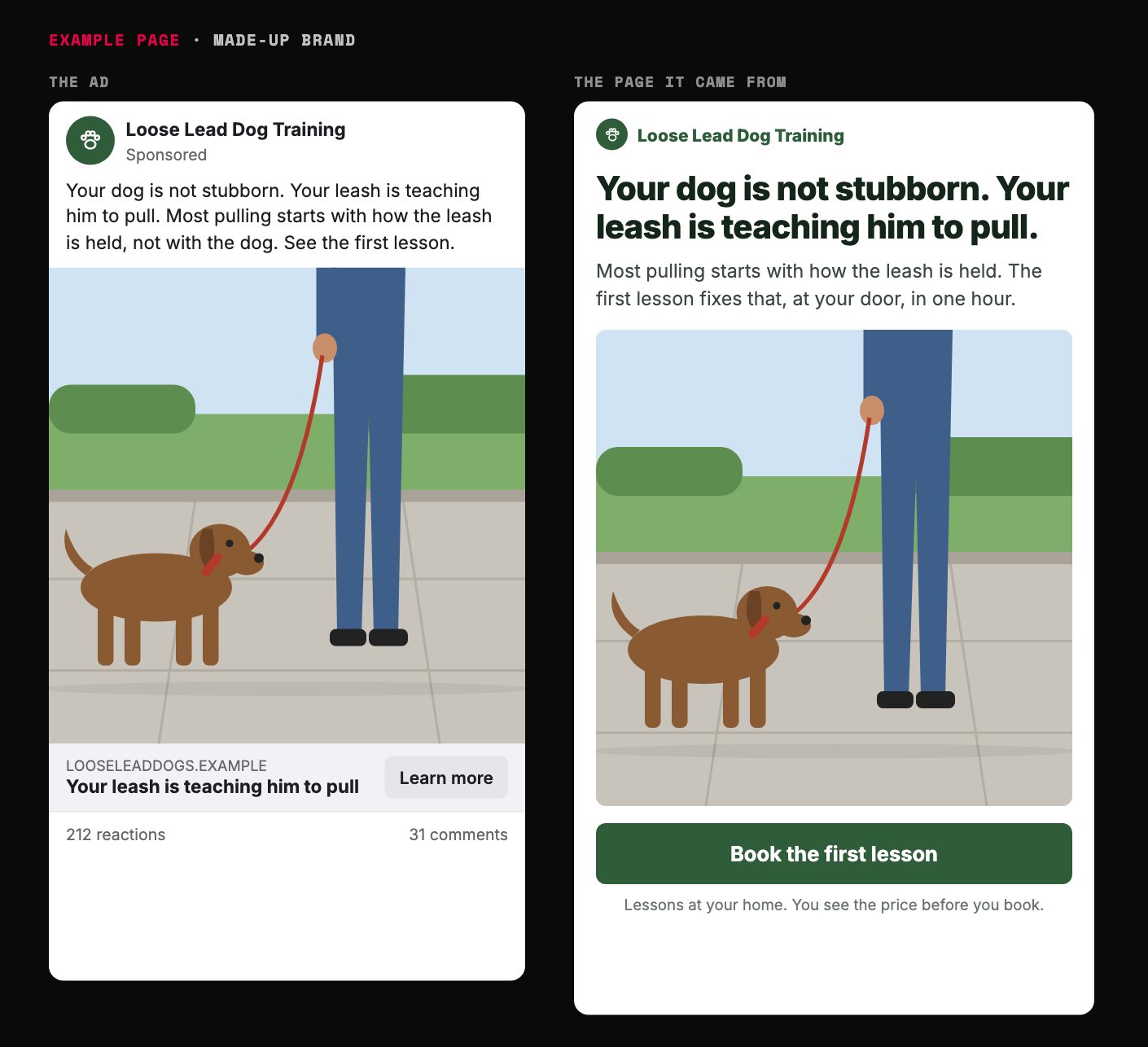
- Ad one is the page's opening, lifted word for word.
- The click lands on the same two lines. No guessing.
- Same picture. A new image would feel like a new place.
- The ad promised the first lesson. The page offers exactly that.
Example page built for this article with a made-up brand
Match the page to where the click came from
The page format should fit how people use the place they just left. Each platform trains a different habit.
Feed users scroll from top to bottom. On Facebook or Instagram, people scan, skip and stop when something grabs them. They control the pace.
So give feed traffic a page they can scan. Use short blocks, clear labels and a layout that feels like the feed they just left.
Why does a familiar layout matter? Think of your first day in a new city.
You feel worn out, but not from the flight. You are tired from finding your way around.
A page that looks nothing like the place the visitor came from makes them do that work again. Many will not bother.
Scanning is normal. In one classic study, 79 percent of test users scanned any new page, and only 16 percent read word by word.
The top of the page gets most of the looking. In a later eyetracking study, people spent about 57 percent of their viewing time above the fold. The fold is the bottom edge of the first screen.
Video viewers watch from start to finish, along a timeline. Send YouTube clicks to one video and nothing else. The ad that sends them is covered in how to write a YouTube ad.
On most sales videos, viewers cannot skip ahead. Their only way out is to leave. So the start carries the weight, which is why the first 90 seconds of a sales video matter so much.
Search clicks come from people who typed a question. Put their words in your headline.
Feed clicks get blocks to scan; video clicks get one video
| Where the click came from | What they were doing | Send them to |
|---|---|---|
| A feed (Facebook, Instagram) | Scanning top to bottom, in control of the pace | A page of short blocks that feels like the feed |
| Video (YouTube) | Watching along a timeline | One video and nothing else |
| Search (Google) | Looking for an answer to words they typed | A headline that repeats their words |
Our rule for matching page format to traffic source.
Most visitors scan, and most of the looking happens on the first screen
- of test users scanned any new page (1997) 79
- of viewing time spent above the fold (2018) 57
- of viewing time in the first two screens (2018) 74
Source: Nielsen Norman Group, How Users Read on the Web (1997) and Scrolling and Attention (2018).
Build the feed page in blocks, and keep the demo
For feed traffic, build the page as a stack of blocks. Each block answers one thing a scanner wants to know.
The top: one short promise and one action, like a simple sign-up page. Someone ready now can act now.
What it is: the product, its benefits and its main features, laid out like a store page.
The demo: show the thing working. Most copycat pages skip it, which is a mistake. A demo proves how the product works without the visitor doing anything.
The proof: real reviews from real customers. Then the long copy, for readers who want every detail.
The close: the offer laid out like a product listing. What they get, the price and the button.
For example, one online business built its page in this order for feed traffic. It reports 300 to 500 sales a day when ad tracking worked best, and about 100 a day later.
The blocks are still the page body from step one, in scan order. The ads still come out of it.
Six blocks in scan order, with the demo most pages skip
- 1. The top One short promise and one action.
- 2. What it is Product, benefits and main features, like a store page.
- 3. The demo The product working, with no effort from the visitor.
- 4. The proof Real reviews from real customers.
- 5. Long copy Every detail, for the readers who want it.
- 6. The close What they get, the price and the button.
Our page stack for feed traffic.
Example: simple one-action pages and a block-built page, in other businesses' numbers
| The case | What happened | How sure |
|---|---|---|
| An online business with a feed page built in this block order | 300 to 500 sales a day when ad tracking worked best; about 100 a day later | Example; we have not seen the data |
| Simple one-action offer pages (one form, one button) | 10 to 20 percent of visitors took the action | Example claim; not verified |
Example numbers from other businesses. Not our results, and not verified by us.
Six blocks in scan order, and the demo is the one most pages leave out
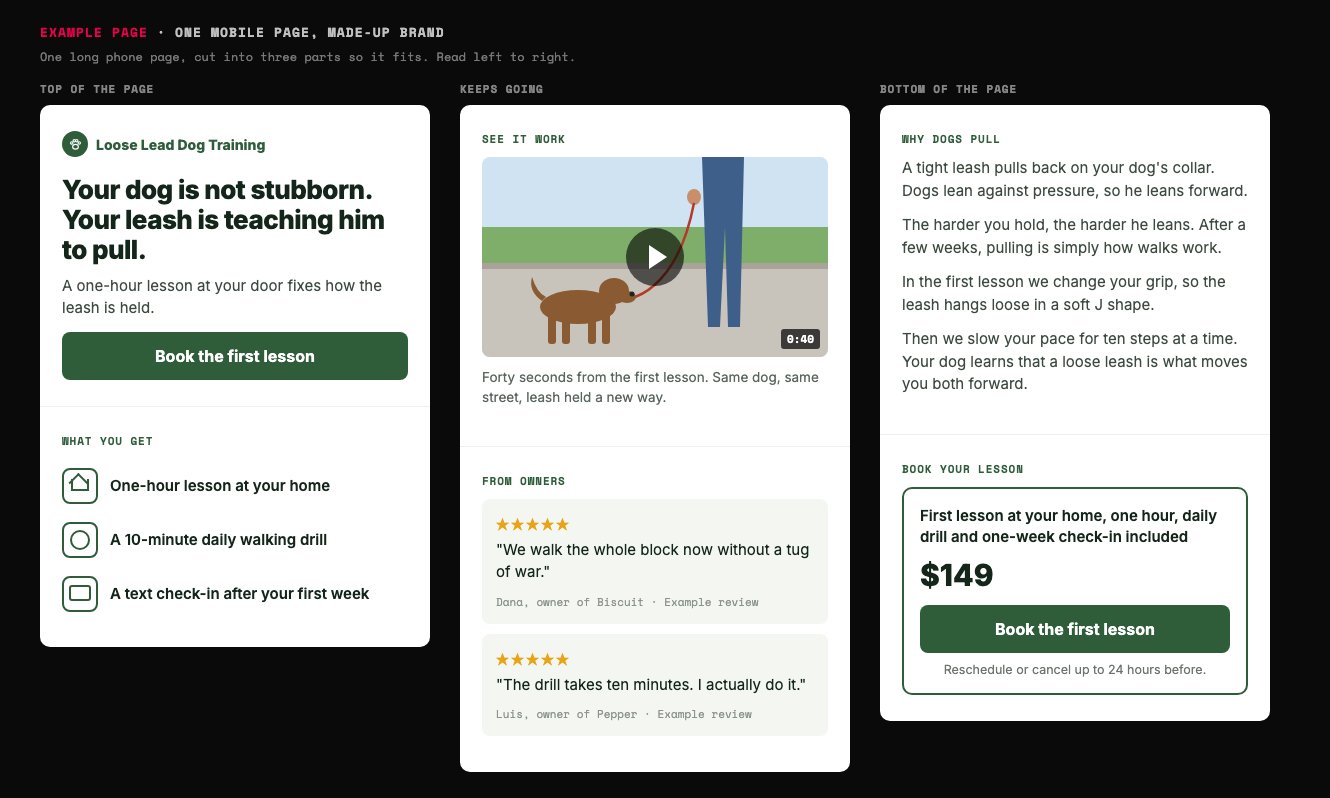
- One promise, one action. Someone ready now can book now.
- What it is, laid out like a store page.
- The demo. It shows the result without the visitor doing anything.
- Proof from customers. Real reviews only on a live page.
- The close reads like a product listing: what, price, button.
Example page built for this article with a made-up brand. Reviews are marked as examples
Judge the ad and its page as one pair
How to buy a thousand clicks that go nowhere, in four easy steps:
1) Write the ads first. Make them as curious as possible.
2) Pay the ad writer on click rate. Never mention sales.
3) Send every ad to the homepage.
4) Blame the page. Pay someone to redesign the damn thing.
That is not a campaign. It is a costly way to learn nothing.
An ad is never a winner alone. It wins with its page, and we judge the pair on sales per visitor. Our way to score it is earnings per visit.
Our take: click-rate reports are popular because clicks are easy to count. Sales are harder to count, and they pay the bills.
Already have ads and a page written apart? Run the check in reverse. Open each ad, then its page, and read only the first screen.
Look for four things: the same promise, the same words, the same picture, and a format that fits the source. If one is missing, fix the page top or lift a new ad from the page.
What else that first screen must answer is in the questions visitors ask in silence.
We never cross one line. Advertising one thing and pushing another on purpose is bait-and-switch. The FTC's advertising guide for small businesses says ads must be truthful and not misleading.
Score the ad alone and the curious ad wins; score the pair and the sale wins
| Scoring the ad alone | Scoring the ad and page together |
|---|---|
| Click rate | Sales per visitor |
| Cost per click | Cost per sale |
| Winner: the most curious ad | Winner: the ad whose page sells |
| Fix: write a cleverer ad | Fix: lift a new ad from the page |
Our comparison.
Write the page, lift the ads, judge the pair, then back to the page
- Write The page body, no headline
- Pull The headline from the body
- Lift Ads from page lines, opening first
- Fit The format to the traffic source
- Judge Ad and page together, on sales
The Page-First Rule as a repeating loop.
Run the Page-First Rule with AI
Paste the prompt below into your preferred AI, along with your finished page copy. It pulls a headline from the page, lifts ads from it, and checks each ad's first screen.
It will not write ads from nothing. If you have no page body, it helps you write the body first.
It also refuses any claim the page cannot prove. You should refuse them too.
Want a second pair of eyes on the result? Send it to us.
Paste into your preferred AI with your page copy. It pulls a headline, lifts three to five ads and checks each first screen.
Act as a direct-response editor. Use the Page-First Rule to turn my landing page into ads that match it.

Ask me one at a time, with the example:
1. Paste the full page copy. (Example: the whole page, top to bottom)
2. Where will the clicks come from? (Example: Facebook feed, YouTube, Google search)
3. What does the buyer get, and what does it cost? (Example: a 4-week leash training course, $149)

Rules:
- No page body, no ads. If I have only notes, help me write the body first: problem, cause, answer, proof, offer. No headline yet.
- Pull the page headline from the body. Use a line or claim the page already backs up.
- Lift 3 to 5 ads from the page. Ad one uses the opening lines, word for word or close to it. The others come from the demo, a customer story, and the answer to the biggest doubt.
- For each ad, quote the page line it came from.
- Each distinct promise needs its own first screen. If an ad's promise is not on the first screen, tell me to add it there or build a separate first screen.
- Fit the format to the source. Feed: a scannable page in short blocks. Video: one video and nothing else. Search: the searcher's words in the headline.
- No curiosity-only ads. No claim the page cannot prove. No fake urgency, no invented numbers or reviews.
- If you can browse, check the platform's current ad specs before giving lengths.

Show your reasoning, then answer:
Page headline: [line] (pulled from: [page line])
Ads: 1. 2. 3. (each with its source line)
First-screen check: promise / words / picture / format, pass or fix
Page format for this source: [one line]
Score the pair on: sales per visitor
Next three actions: 1. 2. 3.
What to do this week
1. Pick your best-clicking ad. Open its page and read only the first screen.
2. Paste the page into the prompt. Get three ads lifted from it, starting with the opening.
3. Run the lifted ads against your current one. Judge them on sales per visitor, not clicks.
Ads and page now match, but sales are still slow? The next problem is the visitor's state of mind. Read how to match the page to the feeling the ad creates.
Remember the two writers who never met? Get them working from the same page.
Your ad should be the first line of your page, not a stranger's promise.

Filip Kovacevic is the founder of Anar Agency in Phoenix. He spent five years running SEO, Meta ads, email, and content for medical practices across the United States, and now does the same work for healthcare, home-service, legal, and professional-service businesses, alongside AI implementation. More from Filip →
Talk it through in 15 minutes
Bring one question from this article. We will tell you what we would do, whether or not you hire us.
Book a 15-Min Chat →