How to Write a VSL Opening That Keeps People Watching
To write a VSL opening, tell the viewer their own story before you say anything about yourself. Use four lines: when the problem started, where they are now, what they keep trying, and why it is not working. Stay on the problem until they feel heard.
Then turn to a true promise and introduce yourself.
How to write a VSL: the opening decides who reaches the offer
A sales video starts. A man in a nice office smiles at the camera. "Hi, I'm Dave, and I've run this company for 20 years."
Your thumb is already moving. Nobody gives a damn about Dave yet. He has not said one thing about you.
This guide shows you how to write a VSL opening that starts with the viewer instead. It uses four lines, in order, then a turn toward the fix. You can draft yours this week.
A VSL, or video sales letter, is a sales video that walks a viewer from a problem to an offer. Think of a sales letter read out loud over pictures. It has three parts: the opening, the body and the close.
They do not matter equally. The close can only sell to people who are still watching. The opening decides how many of them are left.
So the opening gets most of your writing time. A hooked viewer will sit through an ordinary middle. A bored viewer leaves before it starts.
The close follows a pattern you can reuse, covered in the stacked close. This guide is about the first minutes only.

A seller-first opening gives the viewer a reason to leave
| Seller first | Viewer first |
|---|---|
| "Hi, I'm Dave, 20 years in business." | "It started the spring the phone went quiet." |
| About the seller | About the person watching |
| The viewer waits for a reason to care | The viewer sees their own week |
| Name in the first seconds | Name after the four lines |
Our comparison. Example lines are ours.
Open with a story, not a claim or a question
A script can do three things in its first line. It can make a claim, ask a question or tell a story. Each one does something different to the person watching.
A claim gets checked. "This is the fastest way to fill your schedule." The viewer starts looking for reasons you are wrong.
People tend to look for evidence that fits what they already believe. A viewer of a sales video already believes you are selling. If you push harder, you get pushback, not agreement.
A question gets answered. "Are you tired of chasing leads?" The viewer answers it in their head, often with "not really."
A story gets followed. "It started the spring the phone went quiet." There is nothing to argue with and nothing to answer.
People who are absorbed in a story judge it less harshly. Researchers call that state narrative transportation. So open with a scene, and save your claims for later.
Does that mean you can never ask a question? No. A rhetorical question with a known answer works: "How long can you keep doing this?" They answer "not much longer," and that answer helps you.
A question they cannot answer yet also works. They wait for you to answer it. Skip any question that sends their mind somewhere else.
A claim gets checked, a question gets answered, a story gets followed
| The move | Example first line | What the viewer does |
|---|---|---|
| Claim | "This is the fastest way to fill your schedule." | Looks for reasons you are wrong |
| Question | "Are you tired of chasing leads?" | Answers it, often with "not really" |
| Story | "It started the spring the phone went quiet." | Pictures it and keeps watching |
| Question with a known answer | "How long can you keep doing this?" | Answers "not much longer", which helps you |
Our summary. Example lines are ours. Background: Wikipedia, Transportation theory (psychology).
The Opening Four is a VSL opening that tells the viewer their own story before the seller appears. Line one: where it started, the day the problem began. Line two: where they are now.
Line three: what they keep trying. Line four: why it is not working. Use "you", soften backstory with "maybe", stack five true details.
Stay on the problem at least 90 seconds for struggling viewers, then turn with "what" and "how" into a true promise. Your name comes last.
The Opening Four: where it started, where they are, what they try, why it fails
The Opening Four is a four-line VSL opening that tells the viewer their own story before you mention yourself. Each line answers one question about them. Here are the four, with an example for roofing company owners.
1. Where it started: the day the problem began, which is the day they noticed it. "It started the spring the phone went quiet."
2. Where they are now: their life today, in details they can picture. "Now it is Tuesday morning, you are in the truck, and next week has two jobs on it."
3. What they keep trying: the fixes they already use. "You boosted a post, bought a lead list and tried the agency a friend swore by."
4. Why it is not working: those fixes have not brought the result. "And your crew still stands around half the week."
Why does line four matter so much? If their fixes worked, they would not be watching your video. Saying it out loud shows you know where they really are.
Line one has a trap. Many writers open on a happy past: "A few years ago, the referrals just came." Skip it, because people count a problem from the day they noticed it.
So start the story on that day. The viewer is inside it from the first sentence.
Know the buyer's age before you write. Age decides when their story starts and which words sound normal. Then write the lines the way you would say them, and read them out loud.
Four lines tell the viewer their own story before you appear
- 1. Where it started The day the problem began. "It started the spring the phone went quiet."
- 2. Where they are now Today, in details they can picture. "Tuesday, in the truck, two jobs next week."
- 3. What they keep trying Their current fixes. "A boosted post, a lead list, an agency."
- 4. Why it is not working The result has not come. "Your crew still stands around half the week."
The Opening Four. Example lines for roofing company owners are ours.
Start on the day the problem began, not on the good old days
| Happy past | The day it started |
|---|---|
| "A few years ago, the referrals just came." | "It started the spring the phone went quiet." |
| Describes a time with nothing to fix | Describes the day they noticed the problem |
| The viewer remembers it as fine | The viewer remembers it as the start |
| Feels like a speech | Feels like their story |
Our comparison. Example lines are ours.
A full Opening Four fits on one page, and the name comes last
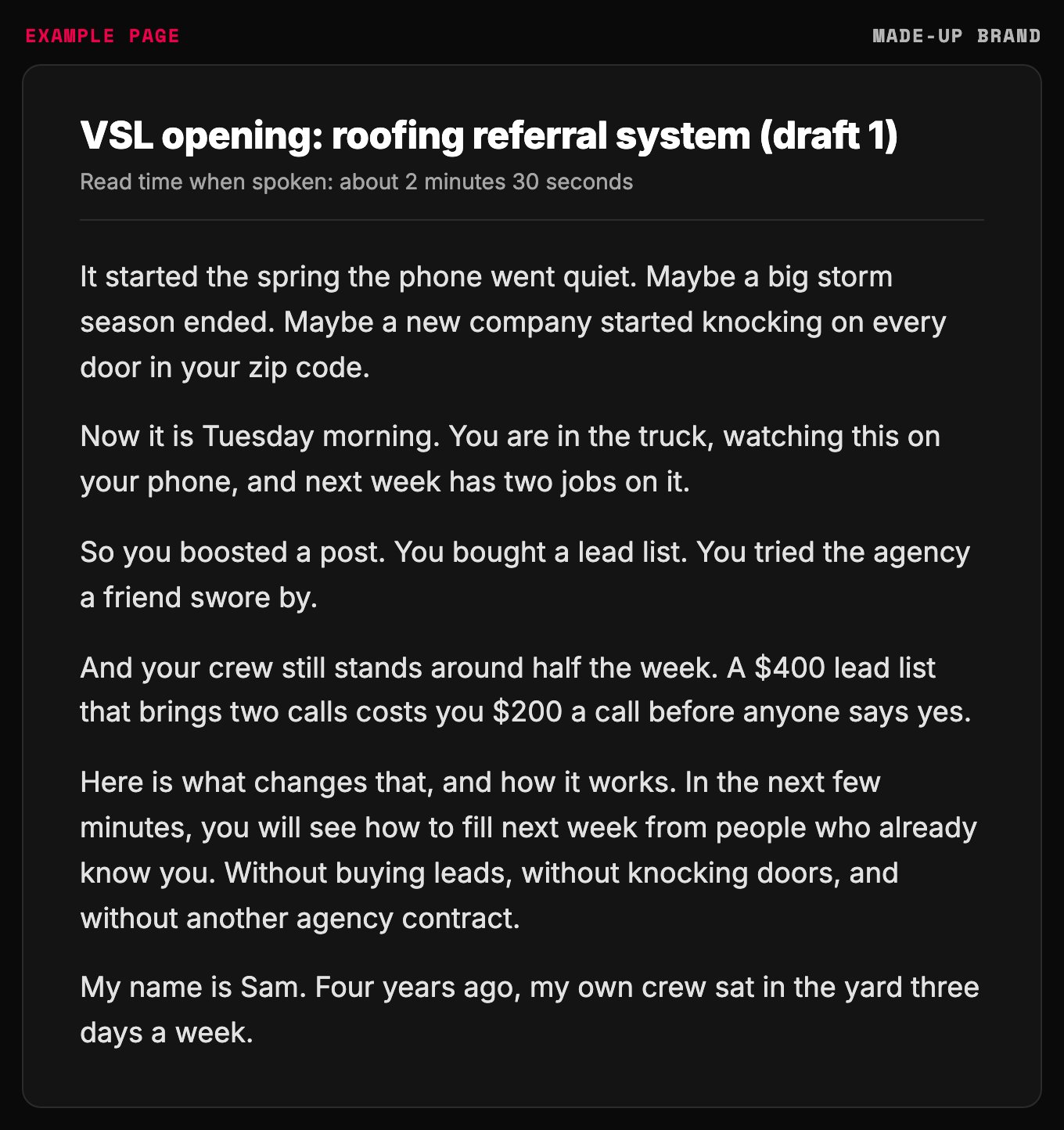
- Line one: the day the problem started, not the good old days.
- The word maybe keeps a detail from feeling wrong to the viewer.
- Something true right now, so they agree.
- Line three: the fixes they already tried.
- Your name comes only after the four lines.
Example page built for this article with a made-up brand
Make every line feel true: say you, add maybe, stack five details
The Opening Four only works while the viewer keeps nodding. If one detail is false, they stop agreeing. Then they start doubting everything after it.
Say "you." It is the most useful word in the script. Write the whole opening in the second person.
Name something true right now. "You are watching this on your phone." It is true for almost everyone, so they agree without thinking.
Add "maybe" to the backstory. "Maybe it was a slow winter, or maybe a new company started knocking on every door in your zip code." If a detail does not fit them, it sounds like one option, not a mistake.
Stack five details. List five common situations or causes. Each viewer finds about three that fit and lets the rest pass.
Why does that work? People rate a broad description as personal when part of it fits them. Psychologists call it the Barnum effect.
Our rule: use it to be accurate, never to trick people into thinking you know them. Every detail in your stack must be true for a real share of your buyers.
Then do the math for them. For example: "A $400 lead list that brings two calls costs you $200 a call before anyone says yes." If you skip the math, they do it themselves, and their numbers may not help you.
Five small moves keep every line true for the viewer
| The move | Example line | Why it works |
|---|---|---|
| Say "you" | "You are in the truck again." | The viewer is the subject of every line |
| Name something true now | "You are watching this on your phone." | True for almost everyone, so they agree |
| Add "maybe" | "Maybe it was a slow winter." | A detail that does not fit sounds like one option |
| Stack five details | Five common causes in one line | Each viewer finds about three that fit |
| Do the math | "$400 for two calls is $200 a call." | Their own math may not help you |
Our summary. Example lines and numbers are ours.
How long should a VSL opening be? Long enough for the viewer to feel heard
A VSL opening runs as long as the four lines need. The real question is how long to stay on the problem. That depends on the viewer's mood.
Struggling viewers want to be heard first. Someone who feels stuck is watching for comfort. If you rush to the good news, you skip the part where they feel understood.
For them, our rule is at least 90 seconds on the problem. We plan two to three minutes, as a buffer. Then turn toward the way out, and do not go back.
Viewers who are doing well need a short dip. Start on the goal, touch the problem, then go back to the goal. They want the how, not the sympathy.
How do you turn? Change the question word. "Why" keeps a person inside the problem, while "what" and "how" point them at a way out.
So the turn sounds like this: "Here is what changes that, and how it works." It is the same viewer, now facing a new direction.
Long openings are normal. For example, one debt-relief VSL ran about 13 minutes before the speaker said his name. That business reported 17 to 20 percent of viewers reaching the buy button, against 3 to 5 percent it called typical.
We have not seen that data. Treat it as a reason to test a longer opening, not a promise. Track how many viewers reach your offer, as shown in VSL retention.
One limit. Describe only problems your real buyers have, at the size they would recognize. Making the pain sound worse than it is does not make good copy, and the FTC expects ad claims to be truthful.
Struggling viewers need time on the problem; ambitious viewers need a short dip
| Struggling viewer | Doing well, wants more |
|---|---|
| Starts low, on the problem | Starts high, on the goal |
| At least 90 seconds on the problem | A short touch of the problem |
| Wants to feel heard | Wants the how |
| Turn with "what" and "how", then stay on the way out | Go back to the goal fast and stay there |
Our rules for VSL openings.
Example: a struggling viewer's opening stays on the problem before it turns
- Where it started First lines The day the problem began, as a scene.
- Where they are, what they try Next Today's details and the fixes that failed.
- Still on the problem 90 seconds or more We plan two to three minutes as a buffer.
- What and how The turn A true promise and a reason to keep watching.
- Your name Then Only facts that tie you to their problem.
Our rule: at least 90 seconds on the problem for struggling viewers, two to three minutes planned.
Example: one long opening reported far more viewers reaching the offer
| What was reported | The number | How sure |
|---|---|---|
| Opening length before the speaker's name | About 13 minutes | Example; not verified |
| Viewers reaching the buy button | 17 to 20 percent | Example; we have not seen the data |
| What that business called typical | 3 to 5 percent | Example; not verified |
Example from another business. Not our result, and not verified by us. One debt-relief VSL.
Turn the opening with a true promise and a reason to stay
After the four lines and the turn, the opening ends with a promise. Some writers say an opening should promise nothing. We disagree: with no promise, the viewer has no reason to sit through the body.
Promise only what the product really does. "In the next few minutes, you will see how to fill next week from people who already know you." A small, true promise beats a big one they doubt.
Add a "without" list. Name the chores and beliefs that held them back. "Without buying leads, without knocking doors, and without another agency contract."
Give them a reason to watch to the end. Tell them what the last part of the video gives them. A small payoff carries people through the slow middle.
Then stop. No countdown clocks, and no claim that the video comes down tonight. Fake urgency buys a few seconds and costs your trust for good.
What fears stop a buyer later in the video? See what the buyer is afraid to lose.
The opening ends with a true promise and a reason to stay
- Change the question Move from "why" to "what" and "how".
- Promise what is real Only what the product really does.
- Add a "without" list Name the chores and beliefs that held them back.
- Give a payoff Tell them what the end of the video gives them.
Our rules. No fake urgency, no invented results.
Say your name only after the viewer sees themselves
Your name comes after the opening, not before it. By then the viewer trusts that the video is about them. Now it matters who you are.
The best openings barely mention the seller. They sketch a situation, and the viewer steps into it. Give enough detail for them to recognize it, but not so much that it stops fitting them.
Then comes the intro. Say your name, then only the facts that tie you to their problem: "I was where you are." Your hobbies, your dog and your 20 years can wait.
Lead with yourself, and the viewer thinks: this is about him, not me. Lead with them, and by the time you say your name, they want to know it.
After the intro, the body follows the shape of the hero's journey: what happened to you, what you found and how it works. The full order is in the twelve-beat VSL skeleton.
Only facts that tie you to their problem belong in the intro
| Seller-first intro | Viewer-first intro |
|---|---|
| Comes in the first seconds | Comes after the four lines |
| Years in business, awards, hobbies | "I was where you are" |
| The viewer thinks: this is about him | The viewer thinks: he gets it |
| Your name means nothing yet | Your name now matters to them |
Our comparison.
Where VSL openings go wrong, and how to fix them
Most broken openings fail in one of four places. Each one has a symptom you can see, a cause and a fix.
Viewers leave in the first seconds. Cause: the video opens on the seller. Fix: move your name and story after the Opening Four.
Viewers say "that's not me." Cause: one detail, stated as fact, that is false for many of them. Fix: soften the backstory with "maybe" and stack five details.
The opening feels flat. Cause: it starts on a happy past or on a fact. Fix: start on the day the problem began, as a scene.
Viewers leave right after the problem. Cause: it was too short to feel heard, or the pain was bigger than real life. Fix: keep it true, and give struggling viewers their 90 seconds before you turn.
How to lose a viewer in the first minute in four easy steps:
1. Say your name, your title and your years in business.
2. Ask a question they can answer with "nope."
3. Open on how great things used to be.
4. Jump to the good news before anyone feels heard. Then wonder where everyone went.
A list of credentials is not a hook. It is a reason to scroll.
Four common breaks, each with a symptom you can see
| Symptom | Cause | Fix |
|---|---|---|
| Viewers leave in the first seconds | Opens on the seller | Name and story after the Opening Four |
| "That's not me" | One detail stated as fact, false for many | Add "maybe" and stack five details |
| The opening feels flat | Starts on a happy past or a fact | Start on the day the problem began |
| Viewers leave right after the problem | Too short, or bigger than real life | Keep it true, give it 90 seconds |
Our diagnosis table.
Four breaks in one opening, each fixed by the Opening Four
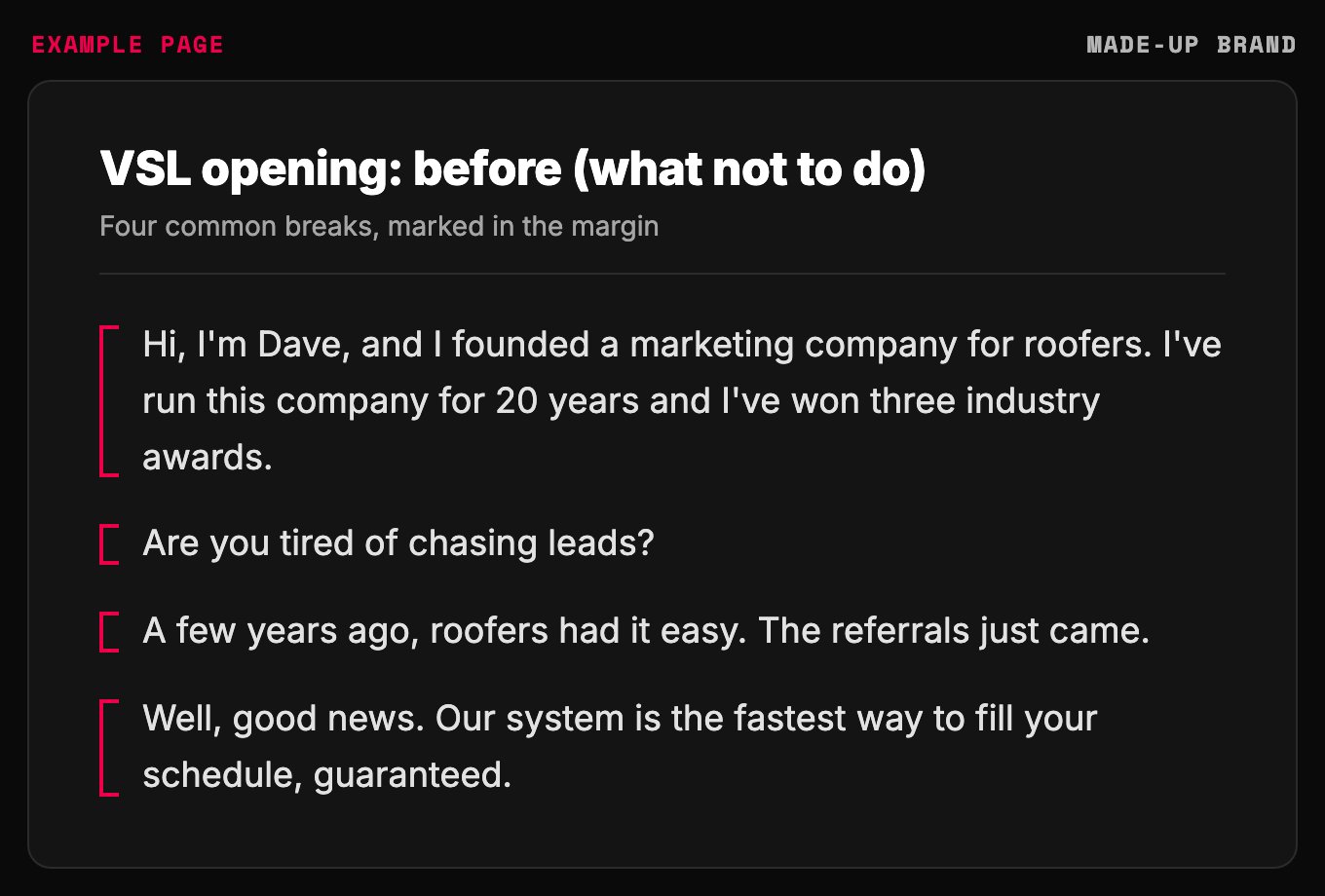
- Opens on the seller. Move the name after the four lines.
- A question they can answer with no.
- A happy past. Start on the day the problem began.
- A claim, and the good news comes before anyone feels heard.
Example page built for this article with a made-up brand
Use the same four lines in your video ads
A video ad is a VSL opening with a button at the end. The same four lines work. Often the best ad is cut straight from the opening.
On YouTube, viewers can skip in-stream ads, so the first lines carry all the weight. The beats for that are in the YouTube ad script.
Take the ad's words from the VSL itself. Then the person who clicks hears the story they clicked on. A mismatch gets clicks and no sales, as ad-to-page alignment shows.
One rule for ads. Describe the situation, not the person. "Next week has two jobs on it" is a scene, while "your business is failing" is an insult.
Need a sharper first line? Try change plus hope. This is classic direct response work: one story, one action, and a result you can count.
Write the opening once, then cut the ad from it
- Write The four lines and the turn
- Read aloud Fix every line you trip on
- Cut the ad 30 seconds from the same lines
- Check Where viewers stop watching
- Rewrite The weakest line first
Our working loop.
Write your VSL opening with AI: the copy-paste prompt
Paste the prompt below into your preferred AI. It asks about your buyer one question at a time. Then it writes the Opening Four, the turn, the promise and a short ad.
It never invents numbers, results or deadlines. If it needs a fact, it asks you. Read its draft out loud before you use a word of it.
Writers have known for a long time that a narrative hook, a gripping first line, keeps people reading. The prompt just keeps you honest about whose story it is.
Paste into your preferred AI. It asks about your buyer one question at a time, then writes the opening, the turn, the promise and a 30-second ad.
Act as a VSL scriptwriter. Write the opening of my video sales letter with the Opening Four.

Ask me one question at a time, with the example:
1. What do you sell, and what does it really do? (Example: a referral system for roofing companies)
2. Who buys it, and about how old are they? (Example: roofing company owners, 40 to 60)
3. When did their problem start, the day they noticed it? (Example: the spring the phone went quiet)
4. What does a normal day look like for them now? (Example: in the truck on a Tuesday, two jobs booked next week)
5. What do they already try? (Example: boosted posts, lead lists, agencies)
6. Why are those not working? (Example: leads are shared with three other roofers)
7. Is the buyer struggling, or doing well and wanting more?

Rules:
- No name, company or credentials before the four lines are done.
- The four lines, in order: where it started, where they are now, what they keep trying, why it is not working.
- Open with a scene, never a claim. No question they can answer with no.
- Say "you". Name one thing true right now (watching on a phone). Soften backstory with "maybe". List five situations so each viewer finds three.
- Do the math for them with my numbers only.
- Struggling buyer: stay on the problem at least 90 seconds, plan two to three minutes. Doing well: a short dip, then the goal.
- Turn with "what" and "how", not "why".
- Then a promise of only what the product really does, a "without" list, and what they get by watching to the end.
- Then the intro: my name and only facts that tie me to their problem.
- Never invent numbers, results, testimonials or deadlines. No fake urgency. Describe the situation, never insult the person. If you need a fact, ask me.

Output:
Opening script, with each part labeled
Questions I still need to answer
A 30-second ad cut from the same lines
Read-aloud check: ask me to read it out loud, time it and mark every line I trip on.
Write your opening this week
1. Run the prompt for your main buyer. Pick their mood first: struggling, or doing well and wanting more.
2. Read the draft out loud with a timer running. Fix every line you trip on.
3. Cut a 30-second ad from the same four lines. Keep your name out of it until the end.
Remember Dave? He can keep his 20 years. He just has to earn the right to mention them.
Tell them their story first. Then they will listen to yours.
Filip Kovacevic is the founder of Anar Agency in Phoenix. He spent five years running SEO, Meta ads, email, and content for medical practices across the United States, and now does the same work for healthcare, home-service, legal, and professional-service businesses, alongside AI implementation. More from Filip →
Talk it through in 15 minutes
Bring one question from this article. We will tell you what we would do, whether or not you hire us.
Book a 15-Min Chat →