YouTube Ad Script: Five Beats and the Ten-to-One Ratio
Write a YouTube ad script in five beats. A hook in the first five seconds that goes against what viewers believe. Then expand it to 30 seconds, show proof, make the ask, and ask again near two minutes.
Test five hooks first. Then check that view rate is about ten times click-through rate.
How do you write a YouTube ad script people do not skip?
Five seconds. That is all a skippable YouTube ad is sure to get.
Then a Skip button shows up in the corner.
Most people write a YouTube ad script like a TV spot. A logo, a warm hello, a slow build. The viewer is gone before the good part arrives.
We write it as a race against that button. Every second has one job. The jobs come in a fixed order.
This method is for offers that have to sell on day one. A great ad with basic targeting beats a weak ad with perfect targeting.
So fix the script before you touch the settings.
Three moments decide a skippable YouTube ad
- Viewers can skip after this (Google) 5
- A cost-per-view charge starts here (Google) 30
- Where this method places the close 1:30 to 2:00
Google Ads Help, Skippable in-stream ads and CPV bidding; close timing from our method
Five seconds, then the Skip button
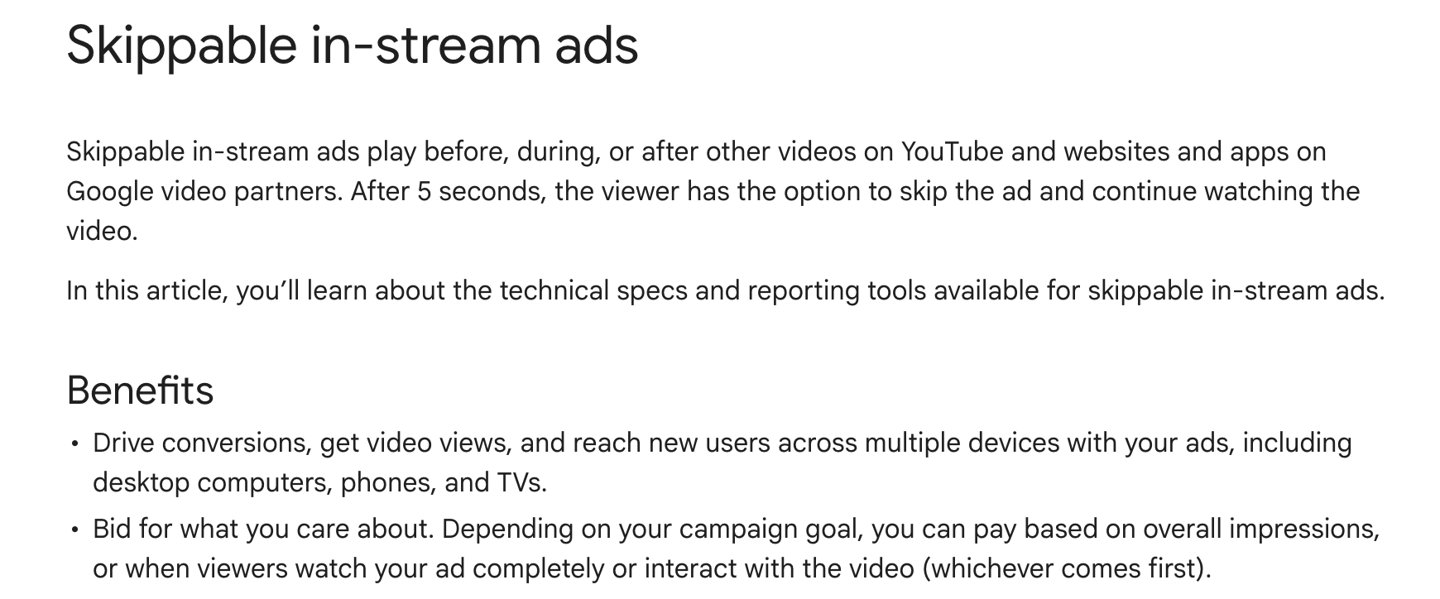
- Five seconds. That is all a skippable ad is sure to get.
- On some bid types you pay every time the ad is shown.
- On cost-per-view you pay when they watch 30 seconds, or a shorter ad to the end, or interact. A skip at second four costs nothing.
Screenshot of Google Ads Help, Skippable in-stream ads, taken 2026-10-17. The 30-second rule is from Google's cost-per-view bidding page.
Build the ad as a timeline, not a smooth story
Most people want a YouTube ad to flow from start to finish.
Nice music. One clean story. One ask at the end.
That is the wrong goal. Think of a plain car with a rocket bolted on. Ugly, but it gets there fast.
Why ugly? Because the crowd changes while the ad plays.
At ten seconds, almost everyone is still there. By forty, the eager ones have clicked and the bored ones have skipped. At ninety, you are talking to a smaller, warmer group.
So each part of the script talks to whoever is still watching. That is why the ask comes more than once.
The clock has three phases. The first five seconds are awareness: viewers cannot leave yet, so they just see what this is.
Six to thirty seconds is attention. The job is to keep them watching long enough to want the click.
After thirty seconds comes focus. This is where clicks are won or lost.
The crowd changes as the ad plays, so each phase has a different job
- Awareness 0 to 5 sec They cannot skip yet. They see what the ad is about.
- Attention 6 to 30 sec Keep them watching long enough to want the click.
- Focus 30 sec to 1:30+ Clicks are won here. Ask more than once.
Our method
Write the YouTube ad as a timeline in five beats: a hook in the first five seconds that goes against what the viewer believes, an expansion to 30 seconds, proof from 30 to 60 seconds with customers who each answer a different doubt, the ask plus the answer, and a close near two minutes that asks again for a true reason. Test five hooks on one body, then five middles (10 to 30 seconds) on the winner. Then check the ratio: view rate should be about ten times click-through rate.
A low view rate means fix the hook. A good view rate with a weak click rate means fix the middle. Repeat every week.
The five beats of a YouTube ad script, second by second
Here is the full shape. Five beats, one job each, for one person talking to the camera.
Beat one, the hook, 0 to 5 seconds. A strong statement or a question. It usually says the opposite of what the viewer thinks.
Beat two, the expansion, 5 to 30 seconds. Make the hook real in a few sentences: a benefit, a picture, or a use case. Once viewers start thinking, they stop reaching for the button.
Beat three, proof, about 30 to 60 seconds. One line on who you are. Then two or three customers.
Beat four, the ask plus the answer. Say what they get when they click, and why it fixes the problem from the hook. This is your call to action.
Beat five, the close, about 1:30 to past 2:00. Ask again, with a reason to act now.
Two minutes sounds long. It is not long for the people who chose to stay.
Two limits on this shape. It is built for a person on camera, so image and voiceover ads need a different plan. And it is built for offers that must pay back fast, not software that earns its money over years.
Treat it as a map, not a law. The order matters most. The exact seconds can move.
Five beats, one job each, in a fixed order
| Beat | When | Job |
|---|---|---|
| 1. Hook | 0 to 5 sec | Say the opposite of what they believe |
| 2. Expansion | 5 to 30 sec | Make it real: a benefit, a picture, a use case |
| 3. Proof | about 30 to 60 sec | Who you are, then 2 or 3 customers |
| 4. Ask plus answer | before 1:30 | What they get on the click, and why |
| 5. Close | 1:30 to 2:00+ | Ask again, with a true reason |
Our method
What should the first five seconds of a YouTube ad say?
Say the opposite of what your viewer believes. That style of hook usually works best.
For example: "Want to lose weight fast? Keto is not the answer."
The viewer thought keto was the answer. Now they are not sure.
That doubt is a small crack. The next 25 seconds widen it.
Four hook types to rotate: a bold statement, a question, a worry that never leaves their head, or a belief they gave up on that can actually change.
Where do you find those beliefs? Your support inbox. The same wrong idea shows up in emails every week, and it belongs at the front of your ad.
Here is how you pay, under Google's rules. On cost-per-view bidding, you pay when someone watches 30 seconds, or a shorter ad to the end, or interacts with it.
So a viewer who skips at second four costs you nothing. So does one who leaves at second 29.
That makes the first 30 seconds a free filter. People who were never going to buy can leave before the meter starts. You pay for the ones who stay.
The hook still has one job: keep the right person. A clear hook keeps them and lets the rest go, for free.
One catch. That rule only holds on cost-per-view bidding; on other bid types you can pay every time the ad is shown. The settings box near the end has the details.
More on why openings work at all: the first three seconds and hooks built on change plus hope.
Four hooks to rotate in your first batch
| Hook type | Example |
|---|---|
| A bold statement | Example: "Your dog is not stubborn. Your leash is." |
| A question | Example: "Want to lose weight fast? Keto is not the answer." |
| A worry on their mind | Example: "Still checking your credit score every morning?" |
| A belief they gave up on | Example: "You were told your old dog cannot learn. That is wrong." |
Our hook types and example lines
A weak opening spends five seconds on you. A strong one spends them on the viewer
| Weak opening | Strong opening |
|---|---|
| Logo and music | One line that goes against their belief |
| "Hi, I'm the founder of..." | A question they have asked themselves |
| Talks about the company | Talks about the viewer's problem |
| Nobody knows who it is for | The right viewer knows in one line |
Example built for this article
Use three customers to answer three different doubts
Proof comes at about the 30-second mark. They stayed. Now you have to earn their belief.
Start with one authority line: who you are and how many people you have helped. Use your real number.
Then two or three customers. The rule that matters: each testimonial answers a different doubt.
Take a credit repair ad. One customer had an old collection mark that had sat there for years. Another had a score under 650 and thought it could not move in two months.
A third finally bought a car. Three customers, three doubts, three answers.
Three people saying "it worked" is one testimonial read three times. Three people knocking down three doubts is a real argument.
Our rule on top: real customers, their real words, and results they actually got. The FTC bans fake reviews and testimonials, and a made-up customer is not a shortcut. It is a legal risk.
Need more kinds of evidence than customer stories? See the proof grid.
Each customer story should answer a different doubt
| Doubt in the viewer's head | The customer who answers it |
|---|---|
| "My old collection mark is stuck forever" | Customer 1: had one sitting for years, got it fixed |
| "My score is too low to move fast" | Customer 2: under 650, changed in two months |
| "Will this ever change my life?" | Customer 3: finally bought a car |
Example from one credit repair business
Ask more than once, because the crowd keeps changing
Beat four joins the ask to the answer. Tell them what they will see after the click, and why it solves the problem from the hook.
Be literal. "Click below to watch the free training on the three steps" beats "learn more" every time.
Then ask again in the close. And again. Each ask gets its own reason, because each ask is for a different slice of the crowd.
Pushy? Not to the person who tuned in at minute one. For them, it is the first ask.
Plenty of sample closes lean on "last and final chance" urgency. We do not write that unless it is true.
Our close uses a true reason. A real deadline, a real price change, or the plain cost of waiting another month.
Fake urgency gets the click. Then it loses the buyer at the next page.
Use a true reason to act now, never a fake one
| Fake urgency | True reason |
|---|---|
| "Last and final chance" with no end date | "The free training comes down Friday" |
| A countdown that resets | A real price change, with the date |
| Fear of missing out | The plain cost of waiting another month |
Our rule; the fake-urgency line is a common sample close
Test the hook first: five ads, one body
Shoot one body and five openings. That is your first batch.
Only the first 5 to 10 seconds change. Everything after stays the same. So any difference in results comes from the hook.
Why start there? One hook can make or break the whole ad. It is also the cheapest part to reshoot.
Pick the top one or two winners. Then shoot a second batch of five that changes only the 10 to 30 second section.
That middle section is where click rate moves. That second batch is where the best ads tend to show up.
This is plain A/B testing: change one part, keep the rest still. We use the same logic in one-variable ad testing.
How to waste a shoot day in four easy steps. Step one: write five completely different ads. Step two: launch all five at once.
Step three: crown a winner after one day. Step four: have no idea why it won. Congratulations, you bought a damn expensive coin toss with a camera crew.
Want a steady stream of tests after this? Our creative testing engine shows how to keep it going.
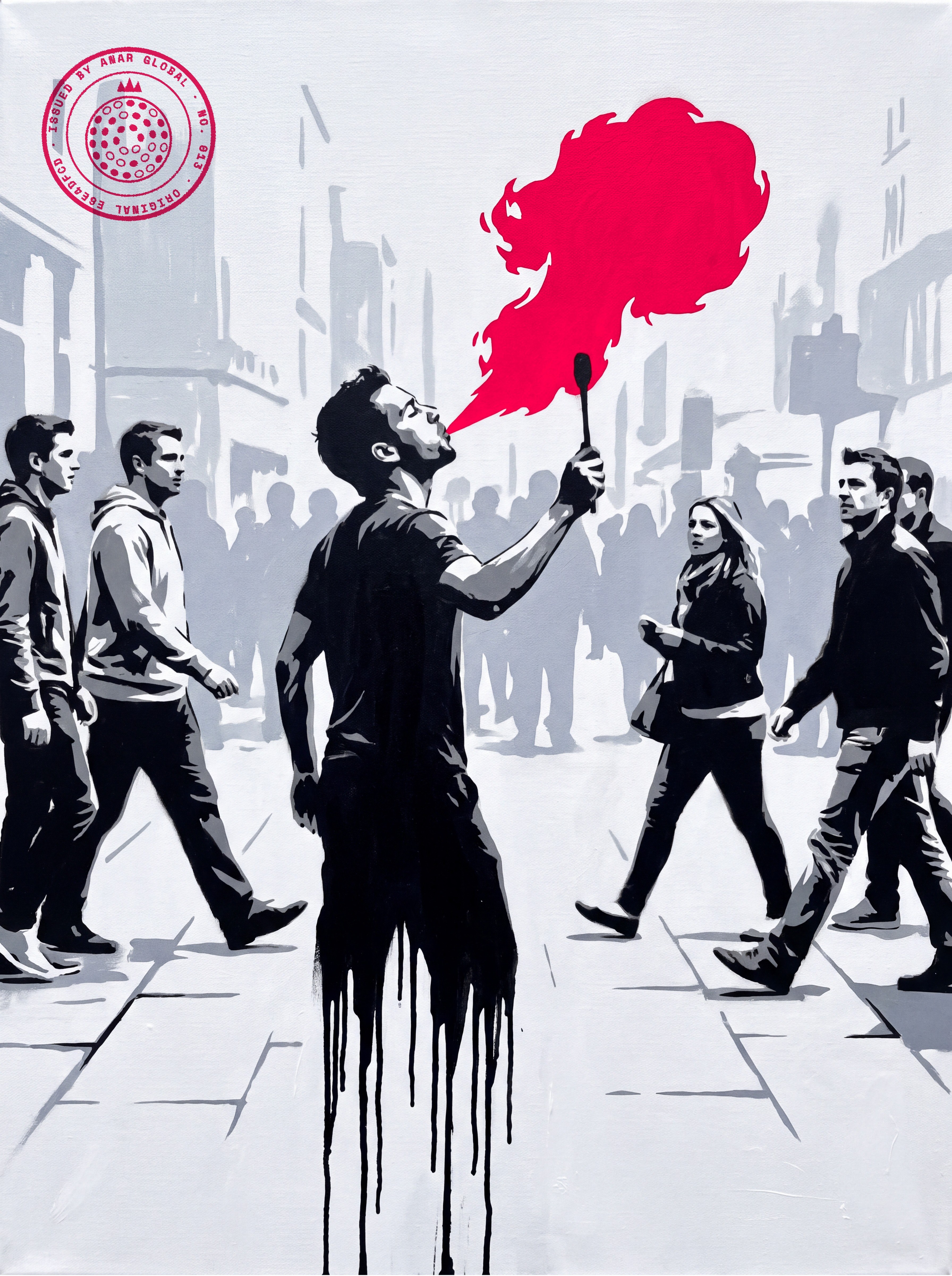
Test the hook first, then the middle
- Batch 1: five hooks Five ads. Only the first 5 to 10 seconds change.
- Pick one or two winners Keep the hooks that hold the most viewers.
- Batch 2: five middles Five new ads. Only the 10 to 30 second section changes.
- Keep the best The second batch is where the best ads tend to show up.
Our method
Batch 1 is one body with five different openings
| Ad | 0 to 10 sec | 10 sec to end |
|---|---|---|
| Ad 1 | Hook A | Same body |
| Ad 2 | Hook B | Same body |
| Ad 3 | Hook C | Same body |
| Ad 4 | Hook D | Same body |
| Ad 5 | Hook E | Same body |
Method example
What is a good view rate to CTR ratio? About ten to one
View rate should be about ten times your click-through rate. Ten to one is the golden ratio.
Two definitions first. View rate is views divided by impressions, in Google's own definitions. Click-through rate is clicks divided by impressions.
So divide your view rate by ten. That is the lowest click-through rate you want.
Here is an approximate example from one advertiser's account. Treat these numbers as rough, not a measured result.
View rate was roughly 21.4 percent and click-through rate roughly 1.88 percent. A tenth of 21.4 is about 2.1. So that ad was a little short.
Higher is better. Ads that hold this ratio tend to keep working. It is a rule of thumb, not a Google benchmark.
What does Google say? That low clicks are normal in video campaigns. Clicks are not usually the main goal.
That is fair for brand ads. For an ad that has to sell today, there is no sale without the click.
So read the two numbers together. Google says a low view rate can mean the start of your ad was weak, so fix the hook. A good view rate with a weak click rate points at the middle, which is the job of your second batch.
When the cost per sale runs too high, read your numbers top down. Think of a grade point average. You cannot raise it directly; you raise it one class at a time.
Cost per sale is the average. Click rate and view rate are the classes. Cost per click, cost per view and cost per thousand impressions are the tests inside each class.
Most of the time, the problem lives one level down. For the full tree from feed to sale, see reading ad data.
Approximate example: a view rate near 21.4% needs about a 2.1% click-through rate
Ten-to-one rule: target click-through rate = view rate / 10
- View rate 21.4
- Target click rate (view rate / 10) 2.14
- Example click rate (approximate) 1.88
Approximate example figures from one advertiser's account. Rough numbers, not a measured result
Cost per sale is the grade average. Find the class that dragged it down
- The tests Cost per click, cost per view, cost per thousand impressions.
- The classes Clicks, click-through rate and view rate. Most problems live here.
- The grade average Cost per sale, the number you control on the platform.
- The report card Return on ad spend: sales value divided by ad cost.
Our method
View rate is views divided by impressions, and a low one points at the start
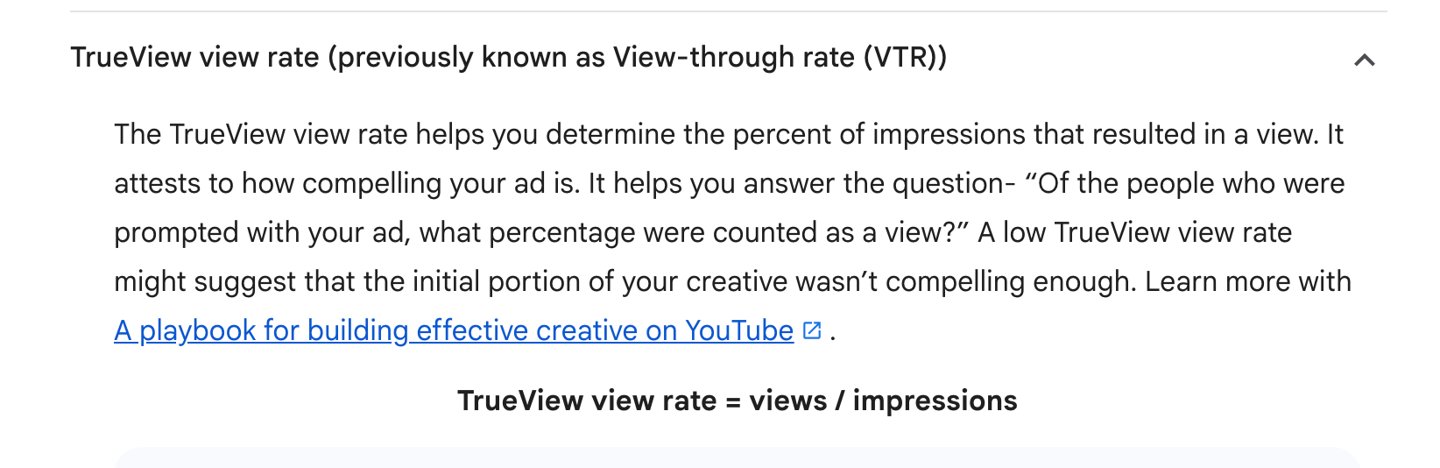
- Our rule: divide this number by ten. That is the lowest click rate you want.
- Google says a low view rate can mean the start was weak. Fix the hook.
- View rate is views divided by impressions.
Screenshot of Google Ads Help, About YouTube ads and view metrics, taken 2026-10-17. The ten-to-one rule is ours.
Fix a dying YouTube ad by changing one word
Good ads stop working over time. When one does, do not start over. Look for the one word that is out of date.
For example, one finance ad was doing great, then it faded. Near the start, the person on camera pointed at a date when something big would happen.
That date had passed. So the advertiser found the next date that mattered just as much.
They swapped that one word and ran the same ad again. It took off again.
Every market has an anchor like that. It is the thing on everyone's mind.
In finance it is a date. In credit or dog training, it might be a news story or a change in the law.
Put your market's anchor in the hook. Then move their attention from that event to your offer. We cover this in the news hook.
Check every week. Compare this week to last week in your ad account, column by column.
Spending a lot? Check every three days too.
For example, one account showed click rate up 50 percent and cost per click down 20 percent. Good news. Now ask why: a new audience, or a better ad?
The settings this method touches are below, in one place.
A dying ad came back when one stale date was swapped
- The ad fades Step 1 A finance ad that was doing great starts to die.
- Find the stale word Step 2 Near the start, it named a date that had passed.
- Swap one word Step 3 The next date that mattered as much. Same ad otherwise.
- It runs again Step 4 It took off again.
Example from one advertiser; we have not seen the account
Run it with AI
The prompt below runs this whole method. Paste it into your preferred AI and answer eight questions.
It writes five hooks, one body and a plan for your second batch. Give it your view rate and click rate, and it checks the ratio too.
It never invents a customer, a result or a number. Missing one? It asks.
This week: first, read ten support emails and write down the wrong belief that repeats. Second, run the prompt and shoot one body with five hooks. Third, after a week, divide your view rate by ten and hold it up against your click rate.
Want a second pair of eyes on the script? Send it to us; you are not signing up for anything.
The skip button is not your enemy. It is a stopwatch that shows you where the script broke.
Five seconds to earn the stay. A ten-to-one ratio to know it worked.
Paste into your preferred AI. It asks about your buyer, offer and customers, then writes five hooks, one body and a second batch.
Act as a careful direct-response scriptwriter for skippable YouTube ads. Use only these rules and my answers. Never invent a customer, a result, a statistic or a deadline. If something is missing, ask me.

Ask one at a time, with the example, and wait:
1. Who the ad is for. (Example: dog owners whose dog pulls on the leash)
2. The wrong belief they hold about the problem. Check your support inbox. (Example: 'He will grow out of it')
3. What they get when they click, in plain words. (Example: a free 20-minute training)
4. Who I am and how many people I have helped, real number only. (Example: trainer, 1,200 dogs)
5. Two or three real customers: the doubt each one had, and what actually happened. (Example: 'too old to learn', now walks loose)
6. A true reason to act now, or 'none'. (Example: the training comes down Friday)
7. The anchor in my market: a date, a news story or a rule change people talk about, or 'none'.
8. Optional: my ad's view rate and click-through rate. (Example: 21.4% and 1.88%)

Rules:
- Script for one person talking to the camera, in five beats.
- Beat 1, 0 to 5 seconds: the hook. A strong statement or a question that goes against the belief in answer 2. Use the anchor from answer 7 if there is one.
- Beat 2, 5 to 30 seconds: expand the hook in a few sentences with a benefit, a picture or a use case.
- Beat 3, about 30 to 60 seconds: one authority line from answer 4, then each customer from answer 5, each answering a different doubt. Use only what I gave you.
- Beat 4: the ask plus the solution. Say exactly what they see after the click and why it helps.
- Beat 5, about 1:30 to 2:00: ask again, with the reason from answer 6. If answer 6 is 'none', use the plain cost of waiting. No fake urgency, no income claims.
- Repeat the ask at least twice after beat 3, with a different reason each time.
- Batch 1: write 5 different hooks for the same body. Batch 2: write 5 versions of the 10 to 30 second section for the winning hook.
- If I gave answer 8: target click-through rate = view rate / 10. Say if my ad is above or below it. Below means rewrite the 10 to 30 second section first. A low view rate means rewrite the hook first.

Use exactly this format:
FIVE HOOKS:
BODY (beats 2 to 5, with timings):
BATCH 2 MIDDLES:
RATIO CHECK:
WHAT TO SHOOT FIRST:

Filip Kovacevic is the founder of Anar Agency in Phoenix. He spent five years running SEO, Meta ads, email, and content for medical practices across the United States, and now does the same work for healthcare, home-service, legal, and professional-service businesses, alongside AI implementation. More from Filip →
Talk it through in 15 minutes
Bring one question from this article. We will tell you what we would do, whether or not you hire us.
Book a 15-Min Chat →