Brand Symbolism: Label, Logo, Mantra, Symbol
Brand symbolism is how a mark comes to mean more than its words. Every business carries four marks. A label is the negative name others stick on you.
A logo says who you are. A mantra is a short phrase that puts a picture in the buyer's head. A symbol carries the whole idea without explanation.
Brand symbolism: the marks that explain you before you speak
Picture two ads for the same home cleaning service. One shows a logo and the line "Quality cleaning solutions." The other says "Come home to a quiet Sunday."
You can see the second one. You forget the first one before you finish scrolling.
That difference is brand symbolism. A few words, or one small mark, can do the work of a whole sales page.
This guide gives you a way to sort every mark your business carries, and to fix the weak ones this week.
Why bother? Because a symbol is the cheapest explainer you will ever own. Nobody needs a video to know what a famous swoosh means.
Here is the short version. Labels push buyers away, and the market usually hands them to you. Logos say who you are.
Mantras and symbols pull buyers in. You write the mantra. A mark becomes a symbol once buyers tie your whole idea to it.
One line describes a service; the other paints a picture
| "Quality cleaning solutions" | "Come home to a quiet Sunday" |
|---|---|
| Names a category | Shows a moment |
| Fits any cleaner in town | Fits one feeling |
| Gone in a second | Still there after the scroll |
| Needs more copy to work | Works with no more words |
Made-up example to show the method.
Every business carries four marks: label, logo, mantra, symbol
Think of the four marks as a ladder. Each one carries more meaning than the one below it. We call this the Four Marks.
The label is the name other people stick on you, like "overpriced," "scammy" or "just another agency."
It is a negative mark. Its job is to stop the buyer from thinking about you at all.
The logo stands for one specific business. On day one it means almost nothing. It is a name tag.
The mantra is a symbol made of words. Nike has its swoosh, and it has "Just Do It". Every strong symbol comes with a mantra.
The symbol stands for the idea itself. Show it, and people fill in the rest.
You need no video and no pitch.
So what is the difference between a label and an identity? They work the same way but point in opposite directions. A label tells people what to avoid, and an identity tells them who they get to become.
Symbols give energy. They pull people toward you. Labels drain energy and push people away.
Our rule: you own two of these marks outright, the logo and the mantra. You have to win the other two.
Each mark carries more meaning than the one below it
- Label The negative name others stick on you. Pushes buyers away.
- Logo Says which business you are. Means little on day one.
- Mantra A symbol made of words. Calls up a picture.
- Symbol Carries the whole idea. No explanation needed.
The Four Marks, as set out in this guide.
Symbols pull buyers in; labels push them away
| Symbol | Label |
|---|---|
| Gives energy | Drains energy |
| Pulls people toward the thing | Pushes people away from it |
| Becomes an identity buyers want | Stops buyers from thinking about you |
| You can build it | The market usually hands it to you |
The Four Marks, as set out in this guide.
The Four Marks sorts every brand into four levels. The label is the negative name the market sticks on you; use the labels your market already knows on bad practices, and hand back any label put on you instead of arguing inside it. The logo says who you are.
The mantra is a short, true phrase that calls up a picture with no extra words. The symbol carries the whole idea once buyers attach it to your mark. Make the change real with one ritual: separate, change, rank, welcome, then a ceremony.
Why a symbol works: buyers take the shortcut without noticing
Why does a symbol work so well? Because it is a guess built on top of another guess.
Take a German car. The badge means quality.
Why? Because it is made in Germany.
Why does that matter? Because Germans have a reputation for good engineering.
Each step is a rough guess, and the buyer never checks it. Researchers call this the country-of-origin effect. Where a product comes from changes how good people think it is.
That is where its power comes from. Buyers cannot argue with a shortcut they never noticed taking. The symbol skips the debate.
A photo explains a lot. A video explains more. A symbol holds the whole story at a glance, and it lasts longer than any decade's slang.
Big brands know this, so they sell a feeling on top of the product. Gucci sells luxury, not clothes. Mercedes sells status, not cars.
So ask the one question that matters. What feeling do you sell on top of your product?
For example, a home cleaner might sell a quiet Sunday. A tax firm might sell a calm April. If you are not sure, start with what business you are really in.
One car badge rides on a chain of guesses nobody checks
- The badge The buyer sees the logo.
- Quality The badge means a good car.
- Made in Germany Quality, because of where it is built.
- Good engineers Germany, because of a reputation for engineering.
Example of the country-of-origin effect (Wikipedia, Country-of-origin effect).
Big brands sell a feeling on top of the product
| Brand | The product | What they sell on top |
|---|---|---|
| Gucci | Clothes | Luxury |
| Mercedes | Cars | Status |
| Apple | Computers | Exclusivity |
| Example: a home cleaner | Cleaning | A quiet Sunday |
Brand examples as commonly described, not brand statements. The home cleaner is our made-up example.
What is a brand mantra? A short line that puts a picture in the buyer's head
A brand mantra is a short phrase that calls up a picture with no extra words. Say it, and the buyer sees the product, the people and the feeling.
That is the whole test. Read your line out loud and wait. Does a picture show up, or just a category?
"Quality solutions for your business" calls up nothing. "Just Do It" calls up a runner on a cold street before sunrise.
A few famous ones: Apple's "Think different", used from 1997 to 2002. Avis's "We try harder". Burger King's "Have it your way."
The best ones carry a promise. Patek Philippe's 1996 campaign told buyers they never really own its watch. They only take care of it until their children inherit it.
That line turns a watch into an heirloom. The price stops feeling like a cost and starts feeling like a gift.
Our rule on top of the picture test: the line must be true. A mantra that promises calm from a chaotic business becomes a joke your customers tell for you.
Write yours in four moves. Name the feeling you sell. Write ten lines of five words or fewer that show it.
Read each one to someone outside your business, ask what they see, and keep the one that matches.
Notice that every line above describes the result, not the work. More on that in selling outcomes instead of deliverables.
A strong mantra calls up a picture with no extra words
| Mantra | Brand | The picture it calls up |
|---|---|---|
| Just Do It | Nike | A runner on a cold street before sunrise |
| Think different | Apple | The misfit who changes things |
| You never really own it; you look after it for the next generation | Patek Philippe (paraphrase) | A father handing a watch to his son |
| Quality solutions for your business | Anyone | Nothing |
Slogans: Wikipedia entries for Just Do It, Think different and Patek Philippe. Pictures described are our reading.
Write a mantra in four moves
- 1. Name the feeling What feeling do you sell on top of your product?
- 2. Write ten lines Five words or fewer. Each one shows the feeling.
- 3. Read them out loud To someone outside your business. Ask what they see.
- 4. Keep the match The line where their picture matches your feeling, and it is true.
The Four Marks method.
Labels: use the ones your market already knows
You cannot stop a market from labeling. Buyers do it to save time. What you can do is use labels on purpose.
Every market has labels everyone already understands. Use one, and you skip the explaining.
Roofing has "storm chasers": crews that roll into town after hail, sell fast and vanish.
A local roofer can say, "Storm chasers leave after the hail. We live here." That one line does the job.
That is the second use of a label. Name what you want buyers to avoid. A label shrinks interest in whatever it touches.
Our line on this: label a practice, never a named person or rival, and only when it is true. A false label can get you sued. Watch the words that hurt you too, in what not to say in copy.
Labels can also flip. In 1887 Britain passed a law that made foreign goods show where they were made. Copies with fake British marks had flooded in, and many came from Germany.
The "Made in Germany" tag was meant as a warning. Germany turned it into a mark of quality.
That is a label becoming a symbol. It took proof, not argument.
You choose two marks; the market hands you the other two
- Logo and mantra Yours to write. Make the mantra paint a picture.
- Symbol Won when buyers attach the whole idea to your mark.
- A label you aim at a practice Name what buyers should avoid. True, never a named rival.
- A label stuck on you Do not argue inside it. Hand it back.
The Four Marks, as set out in this guide.
When a label sticks to you, hand it back
Sooner or later someone labels you. "You're just another agency." "You're the expensive one."
Most owners defend. "No, we're different." That is arguing inside the label, and each denial repeats it louder.
The better move is to take the label off and put it back where it belongs.
In a public debate, that means turning it back on the person who threw it. With a customer, we never do that. We hand it to the practice that earned it.
For example, a prospect says, "Agencies just burn your money." Do not argue.
Say, "Some do. They lock you in for a year and report clicks instead of sales. Here is how we report."
Now the label sits on the bad practice. You stand next to it, not inside it. The same move works on the bigger story a market believes, in arguing against the market's story.
How to make your brand mean nothing in four easy steps:
1. Pick a tagline that lists your services. Nobody sees a picture, but hey, it is accurate.
2. When someone calls you overpriced, write a long post about why you are not. Use the word overpriced six times.
3. Put another company's award in the middle of your homepage. Free ads for them.
4. Call your onboarding a ritual. Make it one welcome email and a PDF nobody opens.
Arguing inside a label makes it louder; handing it back moves it onto the bad practice
| Defend inside it | Hand it back |
|---|---|
| "No, we're not like other agencies." | "Some agencies do burn money. Here is how we report." |
| Repeats the label | Puts it on the practice that earned it |
| Puts you on trial | Puts the bad practice on trial |
| You argue | You show proof |
Made-up example to show the method.
Awards and badges: the giver ranks above every winner
Awards are symbols too. Watch who hands them out.
When a software company gives awards to its top users, every winner who posts a photo with it advertises that company. The giver sits on top. Every winner stands one step below.
So think twice before you build your brand around another company's badge. It says you were judged by them.
Should you never show a badge? No, show it as proof, in the proof part of the page, not as your identity. Our proof grid shows where each kind of evidence goes.
The bigger move is to give one yourself. Name a milestone your customers reach, mark it in public, and let them post it.
Copying a rival's award rarely works. Buyers can tell. A copy feels cheap.
Every winner who posts an award advertises the giver
- Give the award A company names a milestone.
- Winner posts it A photo with the plaque.
- Audience sees the giver The giver's name rides along.
- More chase it The giver's status climbs.
The Four Marks, as set out in this guide.
Build a ritual: one passage that changes who your customer is
A ritual is not a routine. A routine repeats every week. A ritual is a passage people go through once, and they come out as someone new.
A ceremony is different again. The ritual changes the person on the inside. The ceremony celebrates that change on the outside: the photo on stage, the certificate, the handshake on draft day.
Our four steps: separate the person from where they were, put them through a change, give them a rank, then welcome them into the group. Then mark it with a ceremony.
Anthropologists describe the same shape. The classic rite of passage has three phases: separation, a threshold stage in between, and joining the new group.
Which model should you use? Plan the timeline with the three phases. Design what happens inside with our four steps, because rank and welcome are the parts customers talk about.
Before you build one, answer four questions. What are we changing? Who does this person become?
Where do they go next? What will they hold or show that proves it?
For example, a bookkeeping firm could run a 30-day "clean books" passage. Day one, the client hands over the box of receipts. Day 30, they get a one-page report and a "Books Closed" certificate for the wall.
That client is no longer behind on their books. Now they are an owner who knows their numbers. That new identity is what they bought.
If your product changes nothing about who the buyer is, you are selling something anyone could sell. Passages like this also explain why members stay.
A ritual changes who the customer is, then a ceremony shows it
- 1. Separate Mark the break from where they were.
- 2. Change Put them through the work that changes them.
- 3. Rank Give them a new level or title.
- 4. Welcome Bring them into the group at that level.
- Ceremony Mark it in public: a certificate, a photo, a post.
The Four Marks, as set out in this guide.
Plan the timeline with three phases; design the inside with four steps
| Rite of passage phase | What happens | Our step | Example: bookkeeping firm |
|---|---|---|---|
| Separation | Leave the old status | Separate | Client hands over the box of receipts |
| Threshold | Between old and new | Change | 30 days of catch-up work together |
| Joining | Enter the new group | Rank and welcome | "Books Closed" level, invited to the owners' group |
| (Outside marker) | Celebrate it | Ceremony | One-page report and certificate for the wall |
Phases: Wikipedia, Rite of passage (van Gennep). Steps: The Four Marks. Bookkeeping firm is a made-up example.
A rite of passage is one move from one group to another, in three phases
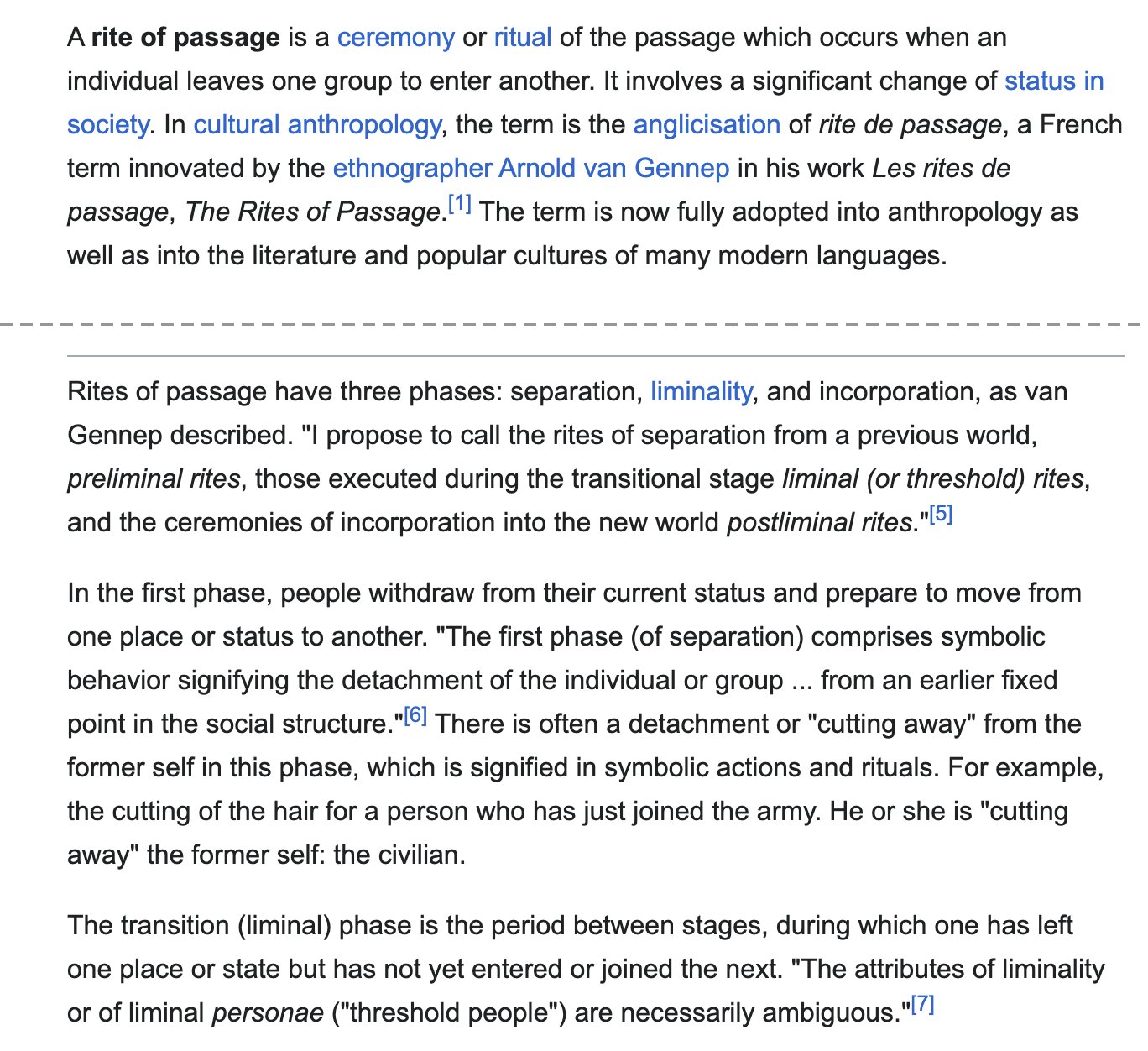
- One passage, one move from one group to the next. Not a weekly routine.
- The point is a new status. That is what your customer buys.
- Three phases. Use them to plan the timeline.
- Separation needs a visible act. Yours can be handing over the old mess.
- The middle is the work. They have left the old status but not joined the new one yet.
Screenshot of Wikipedia, Rite of passage, taken 2026-10-17. Two parts of the page joined at the dashed line.
Run your Four Marks with AI: the copy-paste prompt
Paste the prompt below into your preferred AI. It asks six questions about your business. Then it sorts your marks, writes ten mantra drafts and sketches one ritual.
It will not invent proof, awards or customer quotes. You bring those.
Read the drafts out loud. Most will be flat. One or two will paint a picture.
Paste into your preferred AI. It asks six questions, then hands back your label, ten mantra drafts and a ritual sketch.
Act as a brand strategist. Sort my business into the Four Marks (label, logo, mantra, symbol) and write me a mantra that paints a picture.

Ask me one at a time, with the example:
1. What do you sell, and to whom? (Example: home cleaning for busy parents)
2. What feeling do buyers get on top of the product? (Example: a quiet Sunday)
3. What negative label do buyers use for businesses like mine? (Example: "rotating strangers")
4. Which bad practice earned that label? (Example: a different crew every visit)
5. What is your current tagline, if any?
6. What change does a customer go through with you, from first day to "done"? (Example: messy house to a home they never think about)

Rules:
- Label: the negative name the market sticks on a business. Never invent one; use mine. Put it on the practice that earned it, never on a named person or competitor, and only if it is true.
- Logo: say only whether my tagline and logo describe a category or call up a picture.
- Mantra: write 10 lines of 5 words or fewer. Each must call up a picture with no extra words, and each must be true for my business. No claims about results, speed or price that I did not give you.
- Symbol: say which of my marks could carry the whole idea one day, and what I would have to prove for that to happen.
- Ritual: design one passage in four steps (separate, change, rank, welcome) plus one ceremony that marks the end in public. Use only what I told you I deliver.
- Never invent proof, awards, reviews or customer quotes.

Answer in this format:
Label buyers use: [label] / Practice that earned it: [practice]
One line that hands the label back: [line]
Current tagline: picture or category, and why
10 mantra drafts, best first
Top 3 to test on someone outside my business
Ritual: Separate / Change / Rank / Welcome / Ceremony
Next three actions: 1. 2. 3.
What to do this week
1. Write down the label buyers use for businesses like yours. Then write the practice that earned it.
2. Run the prompt. Test your three best mantras on someone outside your business, and keep the one that paints the right picture.
3. Sketch one passage your customer goes through, and the ceremony that marks the end.
Remember the two cleaning ads? One described a service. The other gave the buyer a picture to keep.
Once the mantra is set, back it up. Start with the four sources of credibility.
A logo says your name. A symbol says the rest.
Label, logo, mantra and a ritual can all sit on one first screen
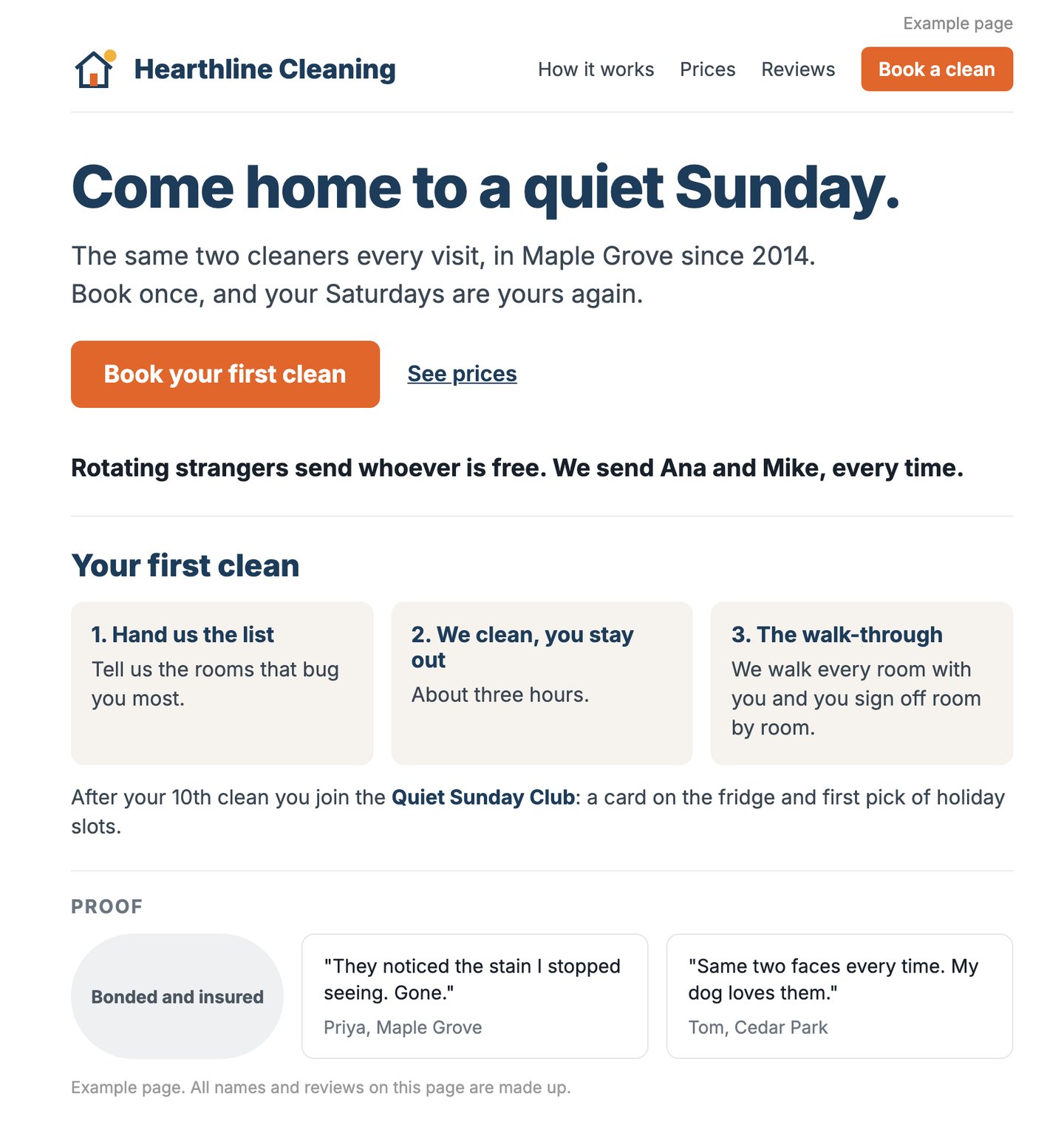
- The logo: it only says who we are.
- The mantra: five words, one picture.
- The label goes on the practice, never on a named rival.
- The ritual: the client signs off and becomes a regular.
- The ceremony: a public marker of the new status.
Example page built for this article with a made-up brand. All names and reviews are made up.

Filip Kovacevic is the founder of Anar Agency in Phoenix. He spent five years running SEO, Meta ads, email, and content for medical practices across the United States, and now does the same work for healthcare, home-service, legal, and professional-service businesses, alongside AI implementation. More from Filip →
Talk it through in 15 minutes
Bring one question from this article. We will tell you what we would do, whether or not you hire us.
Book a 15-Min Chat →