Copywriting Mistakes: What Not to Say in Your Sales Copy

The worst copywriting mistakes are lines that fight your own offer. A bad word aimed at something close to you lands on you. Two lines that cannot both be true create doubt.
Find every one. Then answer it with something true the reader can check, or delete it. There is no third option.
Copywriting mistakes you cannot see by proofreading
A buyer reads your founder story. It says your team quit high-ticket sales because it felt sleazy.
Ten minutes later, he books a call. The call is for your high-ticket program.
Your sales rep is great. Kind, honest, home by six.
Doesn't matter. The buyer is already guarded, and he cannot say why.
The rep did nothing wrong. The page did.
Most lists of copywriting mistakes cover typos, weak headlines and long sentences. Those matter. But the costly ones are lines that fight your own offer.
Here is the whole answer up front. Every line that works against you gets one of two fixes. You answer it, or you delete it.
What the page says is not what the buyer brings to the call
| What the page says | What the buyer feels on the call |
|---|---|
| "High-ticket sales felt sleazy to us." | This call is high ticket. Is this rep sleazy? |
| "We spent $4,000 of savings on a pricey course." | This is going to be expensive. |
| "We worked 12 to 15 hours a day." | Is the person on the phone burned out? |
| "Book your strategy call now." | Something feels off. I cannot say what. |
Example lines from one sales video for a store-building service. The right column is our reading of what each line plants.
Buyers say no for two reasons: objections and conflict
A buyer says no for two reasons. Objections and conflict.
An objection is a reason to resist, like price or time. Conflict is something on your page that works against the rest of your page.
Objections get all the attention. We cover them in handling objections in copy. Conflict gets almost none.
Conflict comes in two shapes. A bad word that lands on you. Or two lines that cannot both be true.
Why does a clash hurt? Holding two ideas that fight each other is uncomfortable. Psychologists call it cognitive dissonance, and people act to make it stop.
On a sales page, the easiest way to make it stop is the back button.
Now take away the objections and the conflict. The buyer has nothing left to say no to.
That is when you hear "sounds too good to be true." Our take: if every claim on the page is true, that is a compliment. It means the buyer looked for a problem and found none.
Only a page with no objections and no conflict leaves nothing to say no to
- Objections only The buyer has a reason. Answer it on the page.
- Worst case A reason to resist, plus a doubt they cannot name.
- Too good to be true Nothing left to say no to. A compliment, if every claim is true.
- Feels off Every question answered, and the buyer still goes to read reviews.
Our model of the two reasons a buyer says no.
The Answer-or-Delete Rule fixes conflict in sales copy: any bad word aimed at something close to you, and any two lines that cannot both be true. Every conflict gets one of two fixes. Answer it, only with something true, short and checkable, voiced as the reader's own doubt right after the line.
Or delete it. There is no third option. Start with the next-step check: every line that mentions the step you ask for at the end.
A bad word aimed at anything close to you lands on you
Picture your copy as a room. You and the reader sit inside it.
Every idea you mention walks in and stays for the rest of the talk. Mention sleazy salespeople, and they sit down next to your rep.
There is research behind this. Psychologists call it priming: one thing you see shapes how you react to the next, without you noticing.
So here is the first rule. Any bad word you aim at something close to you also lands on you.
Close means anything the reader links to you. Your industry, your price level, your kind of product.
And the step you ask them to take at the end.
One bad trait can color how people judge a whole person. That bias has a name, the horn effect.
Your rep picks up that bad trait from the page. Now the buyer doubts the rep, not just the offer.
For example, one sales video for a store-building service told a founder story with three bad lines. High-ticket sales felt sleazy. The founders spent $4,000 of savings on a pricey course and worked 12 to 15 hours a day.
Each line sounds honest. Each one walked into the room.
The offer was high ticket and ended in a sales call. So the reader carried "sleazy," "expensive" and "burned out" straight onto the phone.
The fix is the next-step check. Find the last thing you ask the reader to do. Then read every earlier line that mentions it, or anything like it.
Book a call? Check every line about calls, sales and salespeople.
Asking for a payment? Check every line about price and money.
People do not want expensive things. They want valuable things. Write the word you want them to feel.
Check every line about the step you ask for at the end
- 1. Find the last step Book a call, pay, sign up, start a trial.
- 2. List what is close to it A call: sales, salespeople, phones. A payment: price, cost, money.
- 3. Mark every mention Search the whole page, including the founder story.
- 4. Read each one as the buyer Does it make the last step feel better or worse?
- 5. Answer or delete Worse means it gets a true answer or it goes.
The Answer-or-Delete Rule, step one.
Same founder story, minus the words that follow the buyer onto the call
| Before | After |
|---|---|
| High-ticket sales felt sleazy, so we got out. | We tried a lot of models. Most needed us on the phone all day. |
| We spent $4,000 on an expensive course. | We bought what we could find. None of it was complete. |
| We worked 12 to 15 hours a day and burned out. | We wanted a model that ran in under three hours a day. |
| So we built a system to sell to you. | So we built the one model that passed every test. |
Example rewrite of one founder story. Our wording.
Nine kinds of conflict hide in most sales pages
Conflict takes more forms than most writers expect. These are the nine we look for, with the fix for each in the table below.
Two lines that cannot both be true. "We never share our formula," then "we build stores for other people." Or "I am not in it for the money," right above a $600 price.
Swearing off what you sell. "I swore I would never run paid traffic again," on a page that only exists because of paid traffic.
Sweeping words. "Everyone sells cheap digital files now." Everyone includes you.
Loaded words. Words with a strong feeling attached, called loaded language. "Rich" makes the reader picture sports cars, and your page shows a laptop.
Proof you never show. "I work with the biggest accounts." The reader asks, which ones?
If you cannot name them, say why, and say why that is good for them.
A gap the reader fills. If you never say why you teach this instead of just doing it, the reader makes up a reason. It is never a kind one.
Credit given away. "I bought one course and it changed everything." Now that course is the hero, not you.
A guarantee that promises more pain. "Not happy? Get six more months free."
The buyer hears six more months of the thing that did not work.
A real money-back promise is simpler. Under the FTC's guides on guarantees, "money back" should mean a full refund on request.
An opening that puts the reader down. "You wish you could sing, but your voice is not good enough." A page that pushes the reader down and never lifts them back up makes them feel bad whether they buy or not.
Why are bad lines so strong? People give bad news more weight than good news, which researchers call negativity bias.
One sour line can outweigh three sweet ones.
Each kind of conflict plants a different doubt, and each has a fix
| The conflict | Example line | What the buyer hears | The fix |
|---|---|---|---|
| Two lines that clash | "We never share it" ... "we teach it" | Which one is the lie? | Answer the clash, or cut one line |
| Swearing off what you sell | "Never running ads again" on an ad | You do the thing you hate | Delete the vow |
| Sweeping words | "Everyone sells cheap files" | Including you | Shrink the group |
| Loaded words | "Expensive", "rich" | Costly, or a promise you do not show | Use the word you mean |
| Proof you never show | "The biggest accounts" | Which ones? | Name them, or say why not |
| A gap the reader fills | No reason you teach it | Nobody would share a winner | Say why, with proof |
| Credit given away | "One course changed everything" | Buy the course, not you | Keep the credit with you |
| Guarantee with more pain | "Six more months free" | Twice the work | Offer real money back, or say nothing |
| Put-down opening | "Your voice is not good enough" | I feel bad either way | Lift them back up fast |
Our list. Example lines adapted from real sales pages and videos.
Five honest-sounding lines that each work against the sale
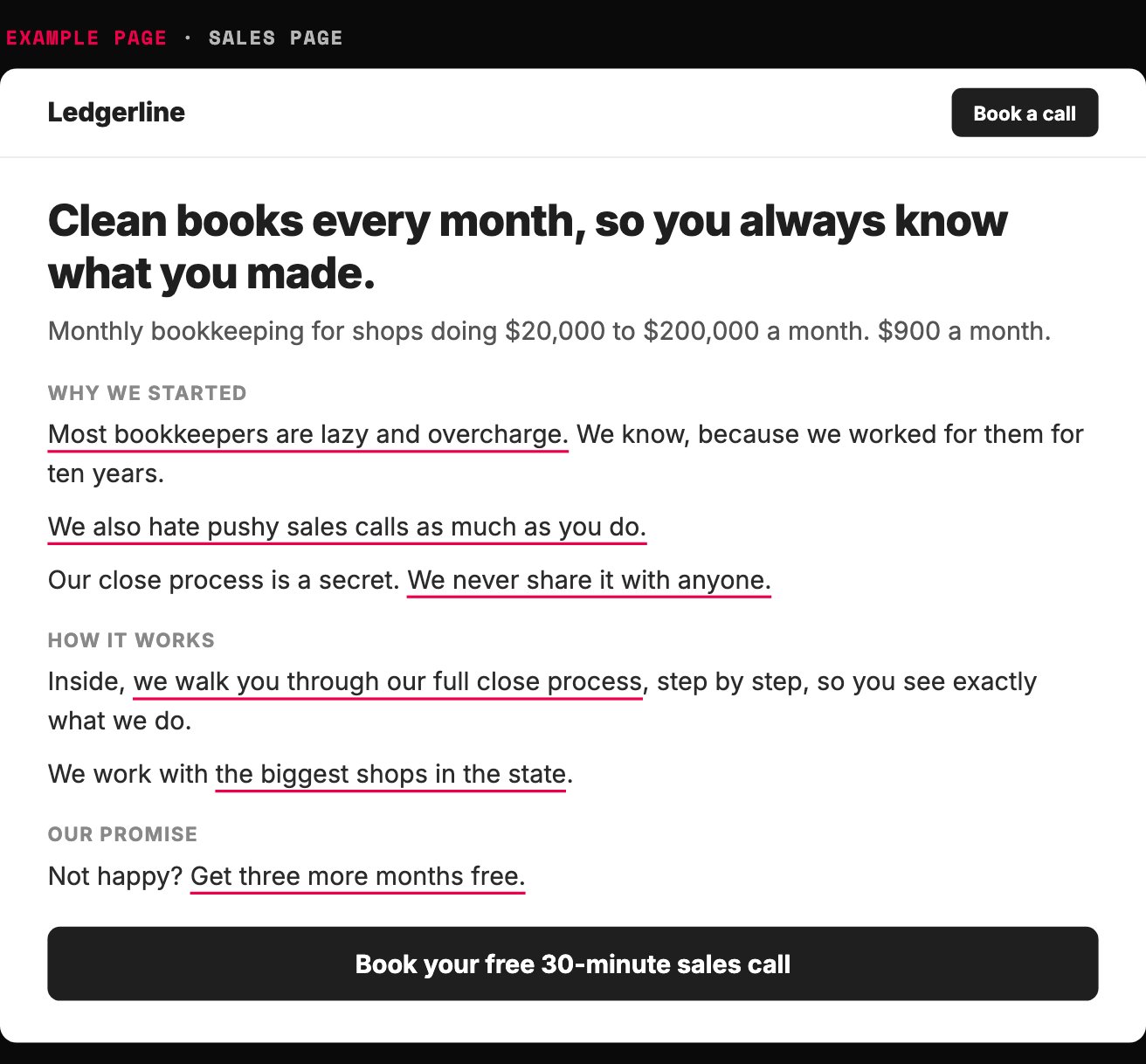
- You are a bookkeeper. The insult lands on you.
- The page hates sales calls, then asks for one.
- Two lines that cannot both be true.
- The buyer asks: which ones?
- The buyer hears three more months of the problem.
Example page built for this article with a made-up brand
The Answer-or-Delete Rule: fix every conflict one of two ways
The Answer-or-Delete Rule is our one-line edit for conflict. Every conflict on the page gets answered or deleted. There is no third option.
Leaving it in and hoping is not an option. Softening the word is not an option either.
When do you answer? Only when you have a really good answer.
A good answer is true, short, and something the reader can check. It makes sense on its own. A weak answer asks the reader to trust you.
"Trust me" is not an answer. It is a second objection.
It is also what the law asks for. The FTC says ad claims must be truthful and backed by evidence.
Not sure your answer is good? Then it is not. Delete the line.
How do you answer inside the copy? Ask the question for the reader. Write their doubt in their own words, right after the line that causes it.
For example: "Wait, you just said you never share the formula. Now you build stores for other people. How is that different?"
Then give the real difference in plain words. Asking the question out loud shows the reader you saw it too.
It works like answering the question your reader never asks. You get there first.
Every conflict gets one of two fixes, and there is no third
- 1. Name the conflict Quote the line. Say what the buyer hears.
- 2. Write your best answer One or two plain sentences.
- 3. Test it Is it true? Short? Can the buyer check it?
- 4. Passes? Answer it Voice the doubt in the buyer's words, then answer.
- 5. Fails? Delete it Cut the line that caused the conflict.
The Answer-or-Delete Rule.
A good answer points to the truth; a weak one asks for trust
| Weak answer: delete instead | Good answer: keep it |
|---|---|
| "Trust us, we are different." | "Here is the page we built last month. Click it." |
| "We have our reasons for sharing it." | "We share the result. You never have to learn the method." |
| "Our clients love us." | "Here are three clients, by name, with their own words." |
| Needs a paragraph to explain | Fits in two sentences |
Our examples. A good answer must be true for your business, or it gets deleted.
Every conflict answered in the buyer's words, or cut
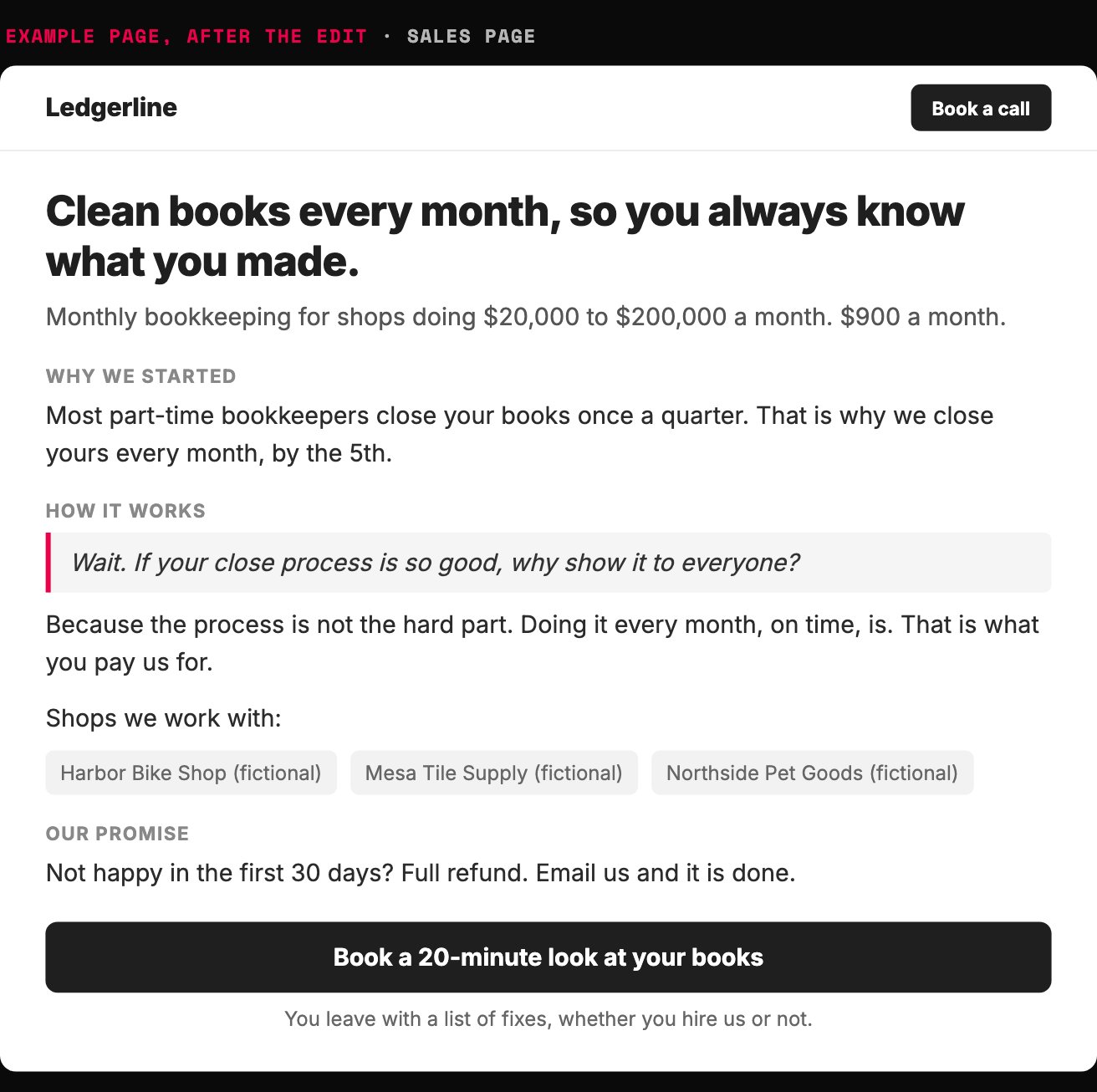
- Smaller group, and the difference comes right after.
- The buyer's doubt, asked for them, in their words.
- A short answer the buyer can check.
- The claim now has names on it.
- Real money back. No extra months of the problem.
Example page built for this article with a made-up brand
How do you criticize competitors without hurting yourself?
Criticize the old way, then show how you are different right away. Do it before the bad feeling can settle on you.
Naming an enemy is fine. Comparing yourself with the other options, called comparative advertising, is normal.
The danger is waiting too long to show the difference. Wait too long, and the reader lumps you in with the thing you just attacked.
Shrink the group. Not "most photographers fail in year one," but "most traditional photographers fail in year one." The word traditional keeps you out of it.
Bridge with "that's why." Hit the old way, then say "that's why we stopped doing it." Show what you do instead.
Challenge the timeline. Buyers who have seen every pitch will defend the method they use. So do not call it wrong.
Say what that method did well back then, and what changed since.
Time is hard to argue with. More on selling to buyers who have seen every pitch.
Show, then tell. Pick an example the reader has already seen with their own eyes. A difference they can see beats a difference you claim.
Four ways to hit the old way without hitting yourself
| Move | Instead of | Write |
|---|---|---|
| Shrink the group | Most photographers fail in year one | Most traditional photographers fail in year one |
| Bridge with "that's why" | Agencies waste your budget | Spray-and-pray ads waste budget. That's why we stopped running them. |
| Challenge the timeline | Cold calling does not work | Cold calling worked when people answered unknown numbers |
| Show, then tell | We are different | A side-by-side the reader can check |
Our examples of each move.
How to tell your backstory without dragging in your past
Say a hard part of your past only if it helps the sale. Otherwise skip it, or move through it fast.
Fast means a montage, like in a movie.
"We tried everything. Some of it worked. Most of it did not."
Then name the tests you started using. For example: under three hours of work a day, it has to grow, and no phones.
Show each old model failing one test, without insulting it. High-ticket sales was fine, except it meant living on the phone.
Your current model is the only one that passes every test. That is a story, not a confession.
One more rule. Never hand the credit for your results to someone else's product.
Not "one course changed everything." Try this instead:
"I bought a stack of courses. Each had a piece. None had the whole thing, so I built my own model."
The second version keeps the credit with you. And you are the one the reader can hire.
Move through the past fast, then land on the one model that passes every test
- We tried everything Then Some of it worked. Most of it did not. One sentence, no dwelling.
- We set tests The turn Under three hours a day. It has to grow. No phones.
- Fails one test Each old model Fine, except it meant living on the phone. No insults.
- One model passes all of them Now That model is what you are buying.
Our structure for a founder story. Example tests.
When buyers google your reviews, look for conflict first
When buyers stop to google you and read reviews, something on the page planted a doubt they cannot name.
They are hunting for it. If it is not on the page, they look everywhere else.
Can a split test fix that? Rarely. An A/B test compares two versions of one part of a page, and conflict often sits in a part you are not testing.
Ten new headlines will not fix a bad line in paragraph nine. Clean the page first. Then test.
And most readers skim. In Nielsen Norman Group's research, 79 percent of test users always scanned a new page instead of reading it.
A skimmer may catch the bad word and miss your answer. So if a skimmer could catch the bad word and miss the answer, delete the line.
Stuck point one: "but it is true." True is not enough. A true line about something close to you can still land on you, so keep it only if it helps the sale.
Stuck point two: cutting all the edge. Some writers delete every enemy and end up bland. Keep the enemy and separate from it fast.
Stuck point three: blaming the rep. Low show or close rates? Read the page before you retrain the team.
More on what the page sells and what the call closes.
How to send a buyer straight to your bad reviews in four easy steps:
1. Call your own industry a bunch of crooks.
2. Say you hate sales calls. Then ask for one.
3. Promise it is easy, one paragraph after the part where you did all the hard work.
4. Offer six more months of the same as your guarantee, and pray like hell.
Three stuck points, and the fix for each
| Symptom | Cause | Fix |
|---|---|---|
| Buyers google your reviews before they buy | A doubt on the page they cannot name | Run the audit before any new test |
| Copy turns bland after the edit | Every enemy deleted | Keep the enemy, separate from it fast |
| Low show or close rates on calls | The page put a bad word on the call | Fix the page before the rep |
Our diagnosis table.
Run a conflict audit with AI: the copy-paste prompt
Paste the prompt below into your preferred AI. It asks four questions, reads your copy as your buyer, and lists every conflict with a fix.
It never invents proof. If an answer needs proof you have not given it, it asks you.
Read its list yourself. You know which answers are true. It does not.
Want a second pair of eyes on the result? Send it to us.
Paste into your preferred AI. It asks four questions, reads your copy as your buyer, and gives you every conflict with an answer or a cut.
Act as a copy editor. Audit one piece of my sales copy with the Answer-or-Delete Rule.

Ask me one at a time, with the example:
1. Paste the copy. (Example: my whole sales page, top to bottom)
2. What do you sell, and what does it cost? (Example: monthly bookkeeping, $900 a month)
3. What is the last step you ask the reader to take? (Example: book a 20-minute call)
4. Who is the reader, and what have they tried before? (Example: shop owners who tried two cheap bookkeepers)

Read the copy as that reader, line by line. Flag every conflict:
- A bad word aimed at anything close to me: my industry, my price level, my kind of product, or the last step.
- Two lines that cannot both be true.
- Swearing off something my offer depends on.
- Sweeping words that include me ("everyone", "most [my category]").
- Loaded words that paint the wrong picture ("expensive" where I mean "valuable").
- A claim I never prove, which makes the reader ask "which ones?"
- A gap the reader will fill with suspicion (why I sell this instead of only doing it; how long it took me).
- Credit for my results given to someone else's product.
- A guarantee that promises more of the work instead of money back.
- An opening that puts the reader down and never lifts them back up.

For each conflict, apply the rule: answer it or delete it. No third option.
- Answer only if the answer is true, short and something the reader can check. Write it as the reader's doubt in their own words, right after the line, then the answer.
- If the best answer asks the reader to trust me, delete the line.
- If a skimmer could see the bad word and miss the answer, delete it.
- Never invent proof, numbers, testimonials or scarcity. If an answer needs proof I have not given you, ask me for it.

Output:
Conflicts found: [number]
Table: line quoted / type / what the reader hears / answer or delete / new line
Next-step check: every line that mentions the last step, and whether it helps or hurts
Three fixes to make first: 1. 2. 3.What to do this week
1. Run the next-step check on your main page. Mark every line about the step you ask for.
2. Run the prompt. Answer or delete every conflict it finds.
3. Ship the clean version before you test a single new headline.
Back to the rep with the guarded buyer. Clean the page, and his next buyer shows up with no doubt to undo.
Once the page is clean, the next job is moving the reader forward. Start with timeline words that pull a reader to the next step, then getting booked buyers to show up.
Every line on the page argues for you or against you. Delete the ones arguing against you.
Read, mark, fix, then read again for the last step
- Read as the buyer Line by line, at the buyer's speed.
- Mark every conflict Bad words close to you, and lines that clash.
- Answer or delete True and checkable stays. The rest goes.
- Next-step check Read every line about the last step again.
The Answer-or-Delete Rule as a loop.

Filip Kovacevic is the founder of Anar Agency in Phoenix. He spent five years running SEO, Meta ads, email, and content for medical practices across the United States, and now does the same work for healthcare, home-service, legal, and professional-service businesses, alongside AI implementation. More from Filip →
Talk it through in 15 minutes
Bring one question from this article. We will tell you what we would do, whether or not you hire us.
Book a 15-Min Chat →