Limiting Beliefs in Marketing: Worthless, Helpless, Hopeless

Three limiting beliefs stop a buyer who wants your result. Worthless: "that is not for people like me." Helpless: "I don't know how."
Hopeless: "nothing works for me." Each needs a different answer: respect, a smaller first step, or a way out shown by someone in the same spot. Find the one your buyer holds and write to it.
Limiting beliefs in marketing: why a buyer who wants it still says no
She read the whole page. She asked two good questions. She said it sounded great.
Then nothing. No call, no sale, no reply to the follow-up.
So you send more reasons. Another case study, a bigger discount, a longer feature list. It rarely works.
She was not short of reasons. One belief was in the way. This is what limiting beliefs in marketing look like from the seller's chair.
A limiting belief is something a buyer believes about themselves or their world that stops them from acting. A buyer can want the result and still hold the belief.
There are three: worthless, helpless and hopeless. Each one needs a different answer. Most copy answers the wrong one, with more proof.
Why is doing nothing so easy? Because it feels safe. Researchers call it status quo bias, and a stop-belief makes it stronger.
Our rule is short. Name the belief and answer that one.
Never make it worse.
More reasons rarely move a buyer; the right answer does
| The usual fix | The Stop-Belief Check |
|---|---|
| Send another case study | Ask which of three beliefs is in the way |
| Offer a bigger discount | Find the cause under that belief |
| Add more features to the page | Answer that one belief first |
| Same message for every buyer | One belief per ad, all three on the page |
Our comparison. The Stop-Belief Check as set out in this guide.
What are the three stop-beliefs? Worthless, helpless and hopeless
The three stop-beliefs are worthless, helpless and hopeless. Each one shows up as a feeling first.
Worthless feels like being judged. The buyer compares themselves to someone else and comes up short. "That is for people like them, not me."
This belief is about the buyer's sense of their own worth. It is not a doubt about whether your offer is worth the price. Mix those up and you answer the wrong question.
We judge ourselves by looking sideways at other people. Leon Festinger named this social comparison theory in 1954. Low self-esteem makes every comparison hurt more.
Helpless feels like doubt. The buyer lacks the knowledge, skill or experience to get the result. "I would not know where to start."
The opposite has a name. Self-efficacy is the belief that you can do what it takes, a term Albert Bandura proposed in 1977.
Hopeless feels like fear. The world seems unsafe and the problem seems bigger than the buyer. "Nothing works for people in my spot."
It often starts with an event. A lost job, a divorce, a health scare, a bankruptcy. People who fail again and again can stop trying even after things change, a pattern called learned helplessness.
The short version? Worthless needs respect.
Helpless needs a smaller step. Hopeless needs a way out.
Three beliefs, three feelings, three different answers
| Belief | It feels like | The buyer says | They lack | Answer with |
|---|---|---|---|---|
| Worthless | Being judged | "That is for people like them, not me." | A sense they measure up | Respect and a new comparison |
| Helpless | Doubt | "I would not know where to start." | Know-how, skill, experience | Depth, then a smaller first step |
| Hopeless | Fear | "Nothing works for people in my spot." | Safety and a way out | Someone similar who got out |
The Stop-Belief Check. Example buyer lines are written for this guide.
Worthless looks at other people, helpless at skill, hopeless at the world
- Worthless Me compared to others. Answer: respect and people like them.
- Hopeless The world is unsafe. Answer: a way out and a safe first step.
- Helpless I lack the know-how. Answer: depth and a smaller step.
- Not a stop-belief Doubt about the offer, not the buyer. Answer: say plainly who it is for and who it is not.
Our map of the three stop-beliefs.
The Stop-Belief Check finds the one belief stopping a buyer who wants the result. Sort real buyer words into worthless (feels judged), helpless (lacks the know-how) or hopeless (feels out of options). Find the cause: historical, constraining, current, formal or final.
Answer with respect, a smaller first step, or a way out shown by someone similar. One belief per ad, all three on the page, and never make a belief worse to sell.
How do you tell which belief your buyer holds? Listen to their words
You find the belief in what buyers say and what they react to. Not in what you guess at your desk.
Step one: collect their words. Sales call notes, support emails, comments on your ads, reviews of your competitors. Real lines beat smart guesses.
Step two: ask three questions. What does this buyer want above everything else?
What do they lack that stops them? Is that lack about worth, skill or safety?
Step three: watch what lights them up. Any reaction points to a need. Status and lifestyle talk pulls in the worthless buyer.
How-to content and books pull in the helpless one. Fear and bad news pull in the hopeless one.
Then sort the lines. "Everyone else seems to get this" is worthless.
"I'm not technical" is helpless. "I've tried everything" is hopeless.
Most markets lean one way. One belief shows up far more often than the other two. That one leads.
Need a steady supply of buyer words? We cover it in how to build a customer truth system.
Ordinary review lines already tell you which belief is in the way
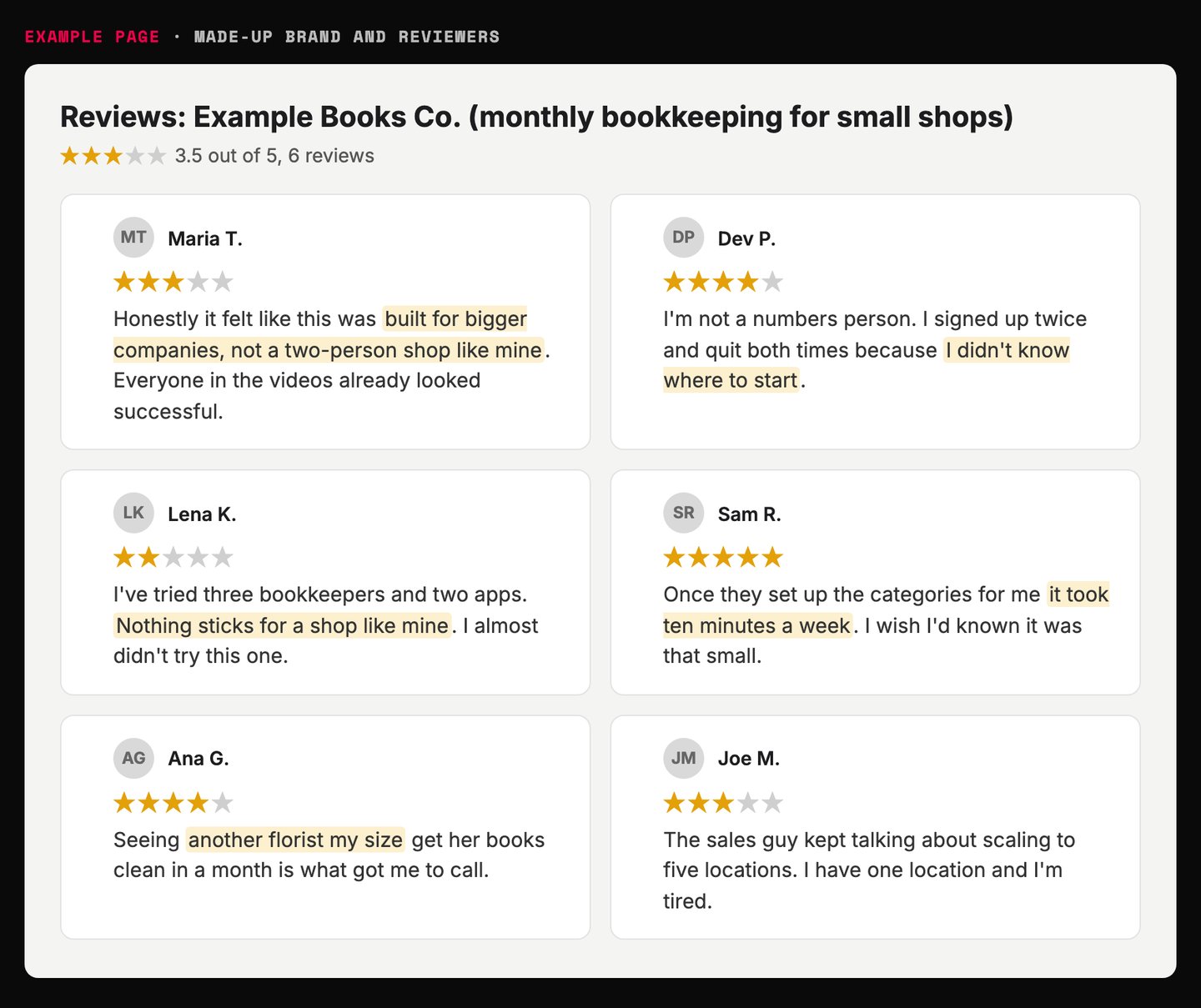
- Worthless: she compares herself to the people in the videos and comes up short.
- Helpless: he lacks the know-how, not the desire.
- Hopeless: past tries taught her to expect failure.
- The helpless answer that worked: a small first step done for him.
- The hopeless answer that worked: someone in the same spot who got out.
Example page built for this article with a made-up brand
Three steps to find the belief from your buyers' own words
- 1. Collect their words Call notes, emails, ad comments, competitor reviews. At least 20 real lines.
- 2. Ask three questions What do they want most? What do they lack? Is the lack worth, skill or safety?
- 3. Watch what lights them up Status talk, how-to talk or fear talk. Any reaction points to a need.
The Stop-Belief Check, step by step.
The buyer's own words tell you which belief leads
| What the buyer says | Belief | What to answer |
|---|---|---|
| "Everyone else seems to get this." | Worthless | People like them who did |
| "I'm not technical." | Helpless | The first step, made small |
| "I've tried everything." | Hopeless | Why this time is different |
| "I don't have time to learn it." | Helpless | We set it up for you |
| "Nothing works in this market." | Hopeless | Someone in their market who got out |
Example lines written for this guide. Sort your own the same way.
Answer each belief with a different job
Each belief needs its own answer. Send the right one and the buyer relaxes. Send the wrong one and they nod and leave.
For helpless: show depth, then shrink the task. Describe their problem before they do. Explain why the usual fix fails.
Then make the first step small: a template, or a setup you do for them. Ten minutes, not ten weeks.
Helpless buyers are our favorite. They want to grow. They test what you tell them, and when it works, they trust you.
For hopeless: show a way out. Show someone in the same spot who got out.
Make the first step safe. Give them a group, so they are not alone.
Proof from someone similar changes what people expect. Before May 6, 1954, nobody had run a mile in under four minutes. Roger Bannister did it that day, and John Landy did it 46 days later.
That is social proof at work. The buyer thinks: if they could, maybe I can. Safety is a big part of that, so take the risk off the buyer too.
For worthless: respect them and change the comparison. Show people like them, not people above them. Redefine what success looks like, so they already measure up.
This is the belief we lead with least. Buyers who buy only to feel better often do not stay. They wanted a feeling, not a change.
One offer, three ads, each answering one stop-belief
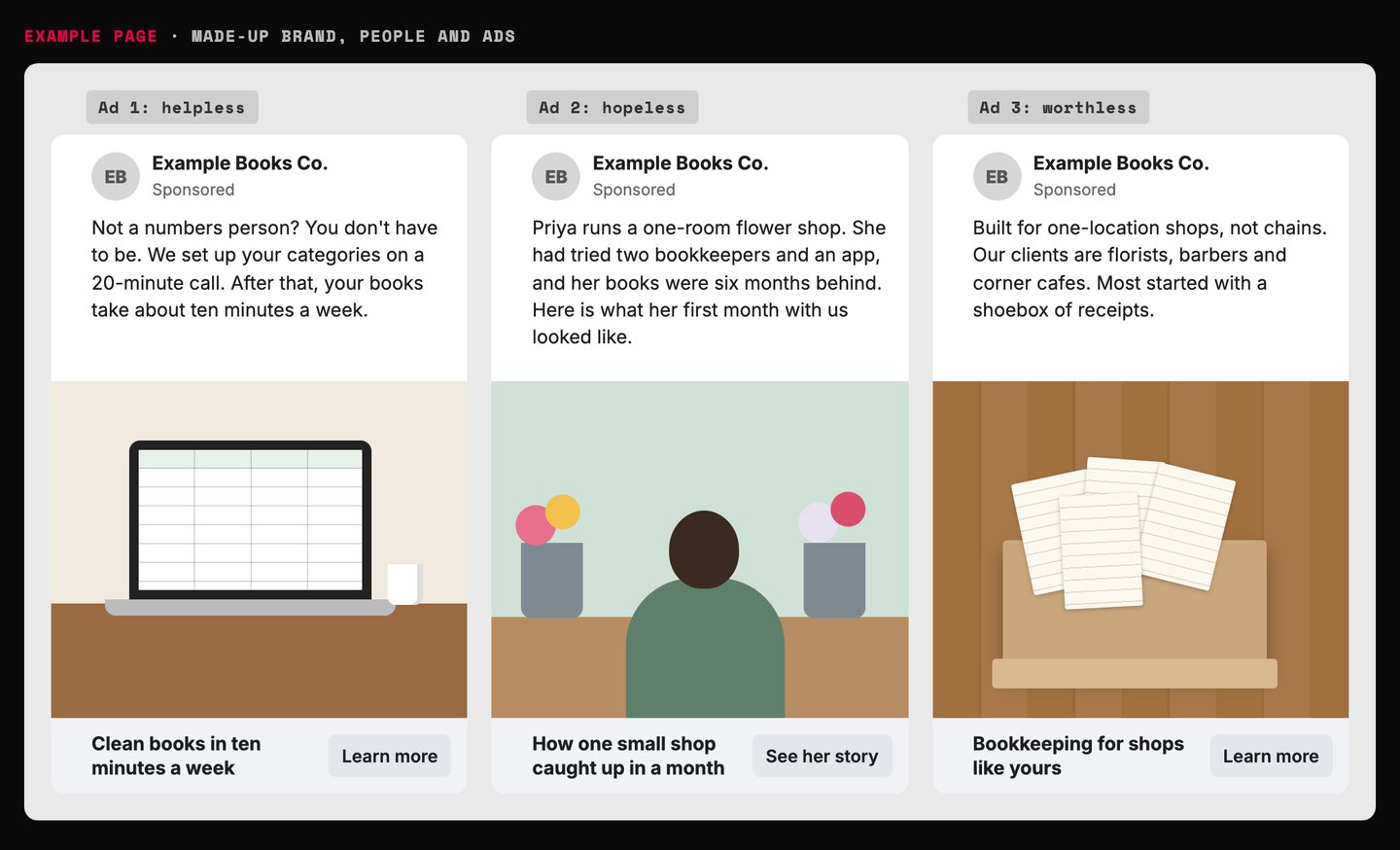
- Helpless: shrink the task until it looks easy.
- Hopeless: name the past failure first.
- Then show someone in the same spot who got out.
- Worthless: people like them, not people above them.
- Same offer, same audience, same page. Keep the ad that brings buyers.
Example page built for this article with a made-up brand
Each belief gets its own proof and its own first step
| Belief | Show them | Proof that works | First step to offer |
|---|---|---|---|
| Helpless | Their problem, described before they say it | How it works, in plain steps | A template or a setup done for them |
| Hopeless | Someone in the same spot who got out | A story from a buyer like them | A small, safe, reversible step |
| Worthless | People like them, not above them | Ordinary buyers, real results | An easy start with no status test |
The Stop-Belief Check. Our restatement of how to answer each belief.
Once one runner broke four minutes, the next did it 46 days later
- No sub-four-minute mile Before May 1954 Nobody had run a mile in under four minutes.
- Roger Bannister, 3:59.4 May 6, 1954 The first sub-four-minute mile, at Oxford.
- John Landy, 3:57.9 June 21, 1954 The second, 46 days later, in Finland.
Source: Wikipedia, Four-minute mile.
Find the cause under the belief: five reasons buyers expect to fail
Every stop-belief sits on an expectation: if I try this, here is what will happen. Every expectation has a cause.
Find the cause and you know what to put on the page. There are five.
Historical: "It happened before." Answer with proof that this time is different.
Constraining: "I need X first." Money, skill, an idea. Remove the X with a template, a setup or a smaller first step.
Current: "Right now I can't." Show how the purchase helps the goal they are saving for, then prove it.
Formal: "You have to have X before you can do Y." Sell the shortcut that meets the rule, or show the rule is optional.
Final: "It is going to fail." The whole offer is your answer. A clear first week, a fair guarantee, a picture of what happens next.
For example, picture an ad to chiropractors. They expect another agency and another sales pitch, because it happened before (a historical cause). So the ad names that history, shows what is different, then removes the "I would have to learn ads" constraint.
Why does the cause matter so much? Because beliefs feed themselves. The buyer expects to fail, acts like it, fails, and says "I told you so."
Researchers call that a self-fulfilling prophecy. Then confirmation bias makes the buyer read your page looking for the catch.
We go deeper on all five causes in how to design an offer around expectations.
Five causes, and the piece of your offer that answers each
| Cause | Sounds like | Answer on the page |
|---|---|---|
| Historical | "It happened before." | Proof that this time is different |
| Constraining | "I need X first." | A template, a setup or a smaller step |
| Current | "Right now I can't." | How it helps the goal they are saving for |
| Formal | "You have to have X before Y." | The shortcut that meets the rule |
| Final | "It is going to fail." | A clear first week and a fair guarantee |
The five causes of a limiting expectation, restated in our words.
A stop-belief feeds itself until something breaks the loop
- Cause Something happened before.
- Expectation If I try, it will fail.
- Behavior They try halfway, or not at all.
- Outcome It does not work.
- Proof The belief now looks true.
Our diagram. See also Wikipedia, Self-fulfilling prophecy.
Which limiting belief should your ad lead with? One per ad
Lead each ad with one belief: the one most of your buyers hold. The page behind the ad covers the other two.
Why only one? An ad that answers all three reads like a list. Nobody feels seen by a list.
Not sure which one leads? Write three ads for the same offer, one belief each. Show them to the same audience and keep the one that brings buyers, not just clicks.
The page is where the other two get their turn. That is one reason long ads and long pages work for bigger purchases.
The ad itself still needs a shape. We use the three-layer ad: why, what, then how.
A mismatch costs more than one weak ad. For example, one large company selling a business opportunity to buyers over 40 found most of them were hopeless.
Its after-sale emails and coaching calls were written for the other two beliefs. Everything felt like pushing a car uphill.
More tests. Same friction.
So match the belief at every step. The ad, the page, the emails and the calls all answer the same belief first.
The ad leads with one belief; the page answers all three
| The ad | The page |
|---|---|
| One belief, the one most buyers hold | All three beliefs, the leading one first |
| One short story or line | Steps, stories and proof |
| Gets the right person to click | Gets the right person to act |
| Change it to test a belief | Keep it steady while you test ads |
Our rule for the Stop-Belief Check.
Test three ads for one offer, one belief each
- Ad 1: helpless Open on the problem, shrink the first step.
- Ad 2: hopeless Open on someone in the same spot who got out.
- Ad 3: worthless Open on people like them, not above them.
- Judge by buyers Same audience, same page. Keep the ad that brings buyers, not just clicks.
Our test design.
Answer the belief. Never make it worse
Answer the belief. Never make it worse to sell harder. Plenty of sellers do exactly that.
They raise fear about things the buyer cannot control. They flash a lifestyle to make the reader feel small. They pile on jargon until the buyer feels stupid.
It sells, for a while. It also burns trust, brings refunds and attracts buyers who leave.
How to lose a hopeless buyer in four easy steps:
1. Tell them the world is ending.
2. Tell them it is their fault.
3. Show them your rented sports car.
4. Add a countdown timer that resets on every visit.
That is not persuasion. That is bullying with a checkout page, and it is bullshit.
There is a platform rule here too. Meta's personal attributes policy does not allow ads that assert or imply a trait of the viewer, such as their money troubles.
Meta's own example: "Are you bankrupt?" is out. Explaining how your firm helps someone going through bankruptcy is fine. The policy page lists the protected traits.
So describe the situation, never the person. Our test is one sentence: the buyer should leave your page feeling more able than when they arrived.
Describe the situation; never tell the reader who they are
| Makes the belief worse | Answers the belief |
|---|---|
| "Are you bankrupt?" | "How we help people going through bankruptcy" |
| Flashes a lifestyle to make them feel small | Shows people like them who got the result |
| Piles on jargon to make them feel lost | Explains the first step in plain words |
| Raises fear about what they cannot control | Shows a safe first step they can control |
Our rule. The bankruptcy example follows Meta's personal attributes policy help page.
Where people get stuck with stop-beliefs
Stuck: more proof, same silence. Readers agree with every case study and still do not buy.
The cause: the buyer feels helpless. They do not doubt your results; they doubt themselves. The fix: show the first step and make it small.
Stuck: one ad tries to answer all three. It reads like a brochure and nobody feels seen. The fix: one belief per ad, and let the page carry the rest.
Stuck: the seller's own stop-belief. Sellers have these too. A seller who expects to fail writes softer headlines, smaller offers and lower prices, to protect themselves.
For example, one overbooked freelancer kept her starter prices for years. She feared she would not be good enough at a higher price.
Try this on yourself. Would you do good work for $1, for $1,000, or for $50,000?
If the answer is yes every time, price and quality are not linked. So raise prices for new clients only.
The next new client pays 25 percent more. The one after pays 50 percent more. Current clients keep their price.
Setting the price itself? Start with how to price your product from your buyer's income.
Three stuck points, and the fix for each
| Symptom | Cause | Fix |
|---|---|---|
| Readers agree with the case studies and still do not buy | The belief is helpless, not doubt about results | Show the first step and make it small |
| The ad reads like a brochure | One ad tries to answer all three beliefs | One belief per ad; the page carries the rest |
| Soft headline, small offer, low price | The seller's own stop-belief | Price test on yourself, then raise for new clients only |
The Stop-Belief Check.
Example: new clients pay 25 and then 50 percent more; current clients keep their price
A freelancer charging $2,000 a month, raising prices for new clients only
- Current clients 2000
- Next new client (+25%) 2500
- The one after (+50%) 3000
Worked example: $2,000 x 1.25 and x 1.50. The $2,000 starting price is made up; the math is ours.
Run the Stop-Belief Check with AI
The Stop-Belief Check is a three-part review of your buyers' words: name the belief, find its cause, and answer one belief per ad.
Paste the prompt below into your preferred AI, with at least 20 real buyer lines. It sorts them, names the leading belief and drafts one ad opener per belief.
It never invents a quote. Give it no words and it tells you where to find them.
Proof still matters once you know the belief. Here is how to build a proof stack buyers believe.
Paste into your preferred AI with at least 20 real buyer lines. It names the leading belief and its cause, then drafts one ad opener per belief.
Act as a direct-response copy analyst. Run the Stop-Belief Check on my buyers' real words.

Ask me one at a time, with the example:
1. What do you sell, and to whom? (Example: monthly bookkeeping for owners of small shops)
2. Paste at least 20 real buyer lines: sales call notes, emails, ad comments, reviews of competitors. (Example: "I'm not a numbers person.")
3. Paste your current ad opener and page headline.

Never invent a quote or a number. If I give you fewer than 20 lines, tell me where to collect more and stop.

Rules:
- Sort every line into one belief. Worthless: feels judged or compared, "not for people like me." Helpless: lacks knowledge or skill, "I don't know how." Hopeless: feels unsafe or out of options, "nothing works for me." Mark lines that fit none.
- Count each belief. The most common one leads.
- For the leading belief, find the cause in the buyer's words: historical (it happened before), constraining (I need X first), current (right now I can't), formal (you have to have X before Y), final (it is going to fail).
- Answers: worthless gets respect and a new comparison (people like them, not above them). Helpless gets depth, then a smaller first step. Hopeless gets a way out shown by someone in the same spot, and a safe first step.
- Never raise fear, shame or confusion to sell. Never state or imply a trait of the reader (their money, health or worth). Describe the situation instead.
- One belief per ad. The page covers all three.

Show the count, then answer:
Leading belief: [name, count, 3 example lines]
Its cause: [type, the buyer line that shows it]
Current opener answers: [which belief, or none]
Three ad openers: one per belief, each under 25 words
Page fixes: one line for each belief the page misses
Next three actions: 1. 2. 3.
What to do this week
1. Collect at least 20 real buyer lines from calls, emails, comments and competitor reviews.
2. Run the prompt. Write down the leading belief and its cause.
3. Rewrite one ad and the top of one page to answer that belief. Leave the rest alone for now.
Remember the buyer who read the whole page and went quiet? She did not need more reasons. She needed the right one.
Stop answering the excuse they give you. Answer the belief that is really stopping them.

Filip Kovacevic is the founder of Anar Agency in Phoenix. He spent five years running SEO, Meta ads, email, and content for medical practices across the United States, and now does the same work for healthcare, home-service, legal, and professional-service businesses, alongside AI implementation. More from Filip →
Talk it through in 15 minutes
Bring one question from this article. We will tell you what we would do, whether or not you hire us.
Book a 15-Min Chat →