Voice of Customer Analysis: How to Build a Customer Truth System

Voice of customer analysis turns what buyers say and do into decisions. A customer truth system does it every week. It reads your calls, support tickets, cancel notes and reviews, then writes a one-page memo.
Every line carries a direct quote, the file it came from, and a count. Lines without proof get cut.
Five people in one room, five different customers
Put your sales lead, support lead, founder and head of marketing in one room. Ask them what customers want right now. Four confident answers, four different customers.
Add the agency and you have five. Nobody is lying. Each one heard a real slice of the market, and nobody wrote it down.
Voice of customer analysis exists to fix that room. Most companies fix it with a survey and a pie chart. We fix it with a memo that has receipts.
The whole method, up front. Every week, one memo says what changed in what buyers said. Each line carries a quote, the file it came from, and a count.
No quote, no claim. That is the Quote-or-Cut Rule. The rest of this guide shows you how to run it.
First, here is how most companies listen, in four easy steps:
1) Send a 1-to-10 survey every quarter and chart the average.
2) Let the loudest customer on the last call speak for the whole market.
3) Retell calls from memory in the Monday meeting, with improvements.
4) Ask an AI to summarize the feedback, then paste whatever it says into a slide without reading it.
That is not listening. That is a horoscope with your logo on it.

Each person in the room hears one slice of the customer
| Who | What they hear | What they miss |
|---|---|---|
| Sales | Objections at the moment of decision | Why people who never called stayed away |
| Support | Problems after the sale | What made people buy in the first place |
| Founder | The biggest and loudest accounts | The quiet middle of the customer list |
| Marketing | Clicks, form fills, cost per lead | What was said on the call |
| Agency | The ad account | Everything after the lead |
Example.
What is voice of customer analysis?
Voice of customer analysis is the work of turning what buyers say and do into decisions you can check. Most guides mean surveys, scores and sentiment charts.
We mean one weekly memo, built from raw words. Every line traces back to a file.
Why so strict? Because the room is usually wrong.
In John Hauser's MIT teaching note, an electric utility planned upgrades around price and power quality. Its big customers cared about neither. They were angry about service, unreadable bills, and a supplier that did not understand their business.
Hauser and Abbie Griffin published the classic study of the voice of the customer in 1993. The marketing engineer grew out of the same school. Gary Lilien and Arvind Rangaswamy coined marketing engineering for decisions made with data, models and judgment together, not gut alone.
Our marketing engineer goes one step further. It builds the system that feeds the decision. That is the core of what a marketing engineer is.
This guide builds one of those systems. Start to finish.
A score tells you something moved. Only the words tell you why.
Most voice of customer work ends in a chart; ours ends in a test
| Common voice of customer analysis | A customer truth system |
|---|---|
| Quarterly survey | Weekly memo |
| An average score | Quotes with counts |
| A sentiment chart | What changed, with the file it came from |
| Ends in a slide | Ends in one test with an owner and a date |
Anar's method.
Every line in the weekly customer memo carries a receipt: a word-for-word quote from a call, ticket, note, review or search query, with the path to its file, plus a count where there is one (7 of 12 calls, 4 of 4 wins). A line with no receipt is cut. The agent extracts quotes before it writes, ranks them by what buyers did over what they said, checks every finished line against its quote, and moves anything thin to a section called What we do not know.
Quotes that show harm happening now skip the memo and go straight to the owner.
Loud numbers drown out the quiet reasons people buy
Clayton Christensen and his coauthors split customer information into two kinds in Competing Against Luck. Active data is the loud kind: sales, sign-ups, cost per lead, benchmarks. Every tool counts it for you, so it fills every report.
Passive data is the story of the struggle that made someone start looking. No owner. No dashboard.
Their warning: managers drift into managing the numbers instead of the customer's problem. Their fix is one short rule. Passive data needs active management.
Someone has to own it. Our reading for marketing: the ad account is active data. The sales call that explains the ad is passive.
Amazon's leaders treat the two as a check on each other. The authors of Working Backwards write that data and stories are strongest together, and most useful when they disagree.
So here is our rule. When the cost per lead looks fine and the calls sound worried, believe the calls first. Then go find out why.
Dashboards do not sign contracts. Buyers do.
The loud numbers say what moved; the quiet words say why
| Active data | Passive data |
|---|---|
| Sales, sign-ups, cost per lead | Why the buyer started looking |
| Counted for you by every tool | Sits in calls and tickets nobody reads |
| Fills every report | Has no owner and no dashboard |
| Tells you what changed | Tells you why it changed |
Source: Christensen, Hall, Dillon and Duncan, Competing Against Luck, on active and passive data. Marketing examples are ours.
Trust what buyers did over what they said
Philips once ran a focus group where teenagers praised yellow boom boxes and called black ones conservative. On the way out, each could take one home. Most picked black.
That story appears in Trustworthy Online Controlled Experiments, and it is why our memo ranks its sources. What people did sits at the top. What your team remembers sits at the bottom.
Lilien's textbook makes the same point about measuring customer value: no single method works everywhere, so use several and look for agreement. We apply that to every claim in the memo.
One source type is a hint. Two that agree make a finding.
Search queries deserve a special place. The textbook calls search terms the full range of ways customers state their needs in their own words. Nobody from sales is in the room when someone types them.
Testimonials are the trap. A good testimonial form leads the customer on purpose.
Great copy. Weak evidence. Keep the answers, and tag them as led.
Rank every input by what buyers did, not what they said
- What your team remembers Retold from memory. Lowest weight: memory edits the story.
- Survey scores One number, no reason. Good for spotting a change, not for explaining it.
- Testimonials Asked with leading questions on purpose. Great copy, weak evidence.
- Written feedback Tickets, chats, unrequested reviews. Their words, from people moved enough to write.
- Recorded conversations Sales calls, switch interviews, cancel calls. Exact words, with context.
- What they did Bought, cancelled, upgraded, searched. Top of the ladder.
Anar's ranking, built on the say-versus-do findings cited in this section.
Testimonial questions lead on purpose, so keep them out of the evidence
| Testimonial question (for copy) | Truth question (for the memo) |
|---|---|
| What was the problem before you found us? | Take me back to the day you started looking. What happened? |
| What was different about our product? | What else did you look at, and why did you rule it out? |
| What does life look like now? | What nearly stopped you from buying? |
Left: three of the five testimonial questions in Building a StoryBrand (Donald Miller), which says they lead on purpose. Right: ours.
Ask about the day they switched, not what they like
The richest input is a switch interview: a recorded talk with a recent buyer about the day they decided to change. You do not ask for opinions. You rebuild the timeline, from the first thought to the purchase.
Bob Moesta, coauthor of Demand-Side Sales 101, treats it almost like detective work. Start on the day they bought and walk backward. Ask who was there, what the weather was, and who called whom.
Small details bring back the big ones. Then push past the polite answer.
"I like it" explains nothing. Ask what was happening that week.
Vague words need the same treatment. Fast compared to what? Easy compared to what?
There is no fast. There is only faster than the old way. And the old way is your real competitor.
Does it pay? It can.
In his condo interviews, buyers kept mentioning what would happen to the dining room table. The builder shrank the second bedroom, added a small room for the table, and reports that sales rose 27 percent.
The buyers had asked for a bigger guest room. The interviews showed what they would actually pay for.
Rebuild the timeline from purchase day backward
- Pick recent buyers People who bought in the last 90 days, plus a few who chose something else.
- Set it up casually Say you are studying the words people use when they buy. No right answers, no long list of questions.
- Start on purchase day When, where, who was there. Small details bring back the big ones.
- Find the first thought When did they first think the old way was not good enough? What happened that day?
- Find the push What event turned looking into buying? Was there a deadline?
- Stop on energy A sigh, a laugh, a word said twice. Say: tell me more about that.
Adapted from Demand-Side Sales 101 (Bob Moesta) and Competing Against Luck (Christensen et al.).
An answer is not a cause until it names a moment or a number
| Do not accept | Ask until you get |
|---|---|
| "I bought it because I like it." | What was happening that week that made it the day. |
| "It installed fast." | Under two minutes, against five for the last one. |
| "Your price is too high." | Too high next to what, and what did they compare it to. |
Rows 1 and 2 follow examples in Demand-Side Sales 101. Row 3 is ours.
How many customer conversations are enough?
Fewer than most teams think. In the office-equipment study Hauser describes, about ten one-hour interviews found about 90 percent of customer needs. His note says twenty interviews usually cover each distinct customer segment.
Moesta's homebuilder team saw its patterns after ten interviews. Same ballpark.
Surveys are different. The Hacking Growth authors want at least a few hundred answers before they trust one. Below that, talk to people instead.
What does that mean for you? Our rule for a company of 10 to 500 people is ten to twenty new conversations a week, across all sources. Fewer than five, and the memo says so in its first line.
Mix the sources. Ask people who just bought what nearly stopped them. Those buyers hit the same snags as the ones who left, and they can tell you why they pushed through.
Volume is not the goal. Rhythm is.
Ten good interviews found most of the needs in one study
- one-hour interviews found about 90% of customer needs 10
- two-hour focus groups found about the same share 7
- interviews are usually enough per customer segment 20
Source: John R. Hauser, Note on the Voice of the Customer (MIT, 2015), describing an office-equipment study built on Griffin's methods.
Score every call so you can compare them
A pile of transcripts is not data until each one gets the same score. Lean Analytics gives a sheet for problem interviews: six questions, 43 points, and 31 or more counts as a strong interview.
The questions cover six things: ranking the problem, already fixing it, engagement, a next step, referrals, and an offer to pay. The weights favor action over enthusiasm. Nodding is cheap.
The score is not the point. The comparison is. Sort the strong calls from the weak ones, then ask what the strong ones share.
Is it company size, a trigger event, or one job title? That shared trait is often your best segment. And you found it in recordings you already had.
We run the sheet on sales and discovery calls, not only on early interviews. That is our adaptation. It works best when the same person scores every call.
Score each call out of 43, and treat 31 or more as strong
| After each call, ask | Yes | Sort of | No |
|---|---|---|---|
| Did they rank the problems you raised? | 10 | 5 | 0 |
| Are they trying to solve it now, or did they try before? | 10 | 5 | 0 |
| Were they engaged the whole time? | 8 | 4 | 0 |
| Did they agree to a next meeting? | 8 unprompted | 4 when asked | 0 |
| Did they offer referrals? | 4 unprompted | 2 when asked | 0 |
| Did they offer to pay? | 3 unprompted | 1 when asked | 0 |
Source: Croll and Yoskovitz, Lean Analytics, problem-interview scoring. Using it on sales calls is our adaptation.
One file per call: header, quotes, score
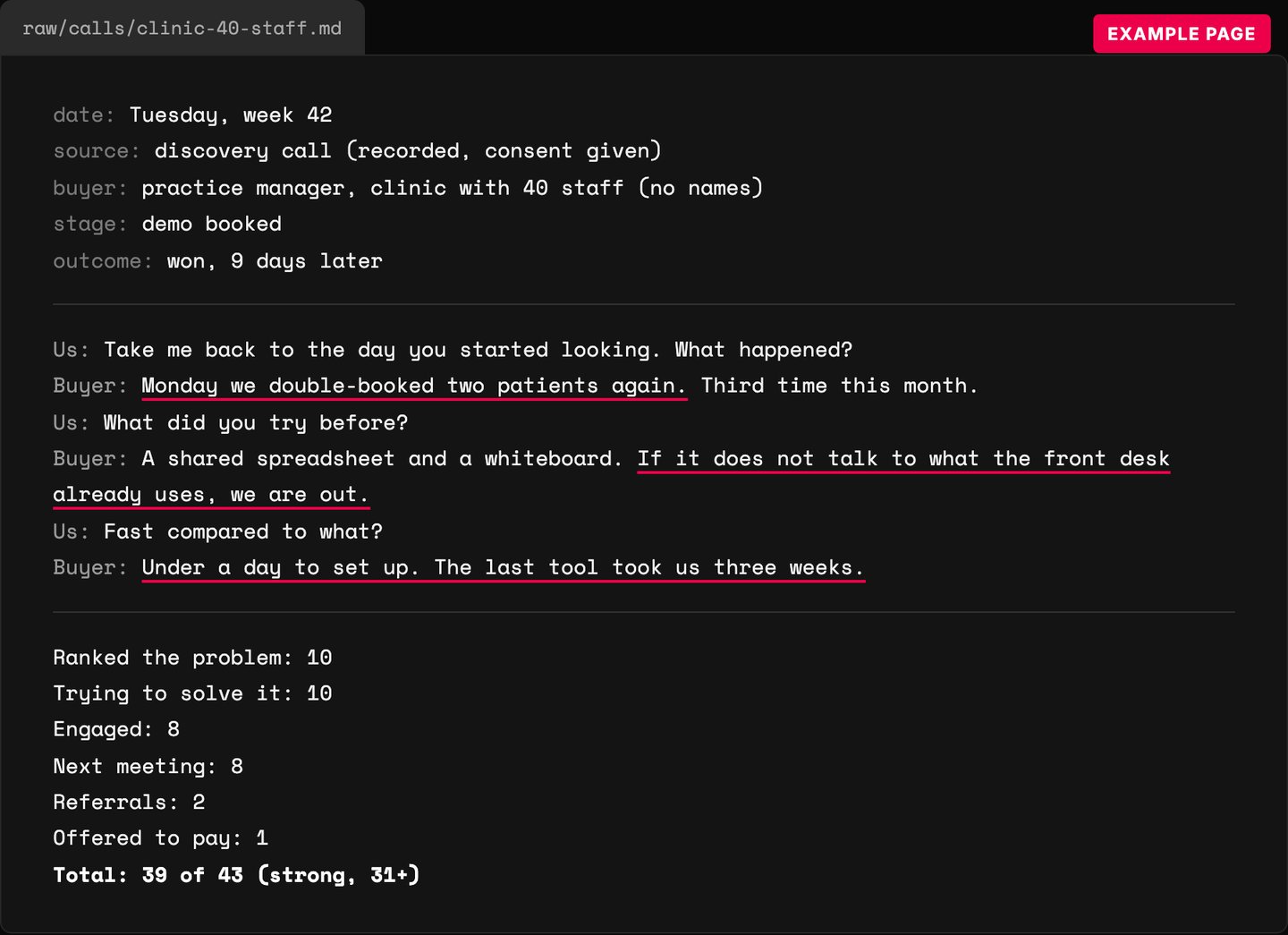
- Role and size, never a name. Personal details are stripped before saving.
- The outcome on every file is what lets the memo split won from lost.
- The trigger event: the day looking turned into buying.
- A vague word unpacked into a number against the old way.
- Same score on every call, so strong and weak calls can be compared.
Example page built for this article with a made-up clinic. The scoring weights and the 31-of-43 line come from Lean Analytics (Croll and Yoskovitz); using them on sales calls is our adaptation. The questions follow the switch interview in section 4.
The Quote-or-Cut Rule: no quote, no claim
The Quote-or-Cut Rule is our standard for every line in the memo. Each line carries a receipt: a direct quote with its file path, plus a count where there is one.
No receipt? The line is cut.
AI makes this rule more urgent, not less. A model asked to summarize feedback writes a smooth paragraph whether the evidence is there or not. One AI maker's own guide to reducing made-up answers says to pull word-for-word quotes first, tie each claim to a quote, and drop any claim without one.
So the order never changes: extract, count, split, write, retract. The memo also has a section called What we do not know. A thin week gets to read as thin.
Counts do the other half of the work. "Price came up a lot" turns into a count: 8 of 12 calls, but only 1 of 4 wins. The loudest topic is often not the one that sells.
Distill each call the day it happens. Fifteen minutes of highlighting after a call beats a week of catching up from memory.
Extract quotes before you write a single line
- Extract Copy every quote word for word, with its file path.
- Count How many sources raised each topic, this week and last.
- Split Won, lost and open deals, kept apart.
- Write Each line: the claim, the best quote, the count.
- Retract Check each line against its quote. No match, no line.
Anar's method.
A receipt line can be checked, so it can be acted on
| Opinion line | Receipt line |
|---|---|
| Customers care a lot about price. | Price came up in 8 of 12 calls but only 1 of 4 wins. "We can find the money if it saves the front desk." raw/calls/clinic-40-staff.md |
| People want easier onboarding. | Calendar sync came up in 7 of 12 calls and in all 4 wins. |
| Churn is up because of competitors. | 3 of 5 cancel notes name the same missing report. None names a competitor. |
Example for a made-up scheduling product. The numbers are illustrations, not data.
Fifteen minutes after each talk beats hours at the end
| Synthesize at the end | Distill after each talk |
|---|---|
| Five to seven hours after all the interviews | Fifteen minutes after each interview |
| Memory fades between the talk and the write-up | Highlights made while the talk is fresh |
| Assembly starts from zero | About 80 percent of the work is done before assembly |
Source: a pastor's interview habit described in Building a Second Brain (Tiago Forte). Applying it to sales calls is ours.
The memo: seven parts, one page, one test
The memo is one page with seven parts, in the same order every week. Readers learn where to look, and last week's answer sits in the same spot.
Two parts matter most. The first is talked about vs bought. It compares topics in won deals with lost ones.
That is where the memo starts pointing at money. The second is the one test. It turns reading into a decision, with an owner and a date.
This memo is an input, not the scoreboard. It says what buyers want. The weekly growth cockpit says what your tests did about it.
Keep every old memo in a dated file. In three months you can watch a buyer phrase rise in the memo and then show up in your best headline. The same phrases feed the founder content engine.
The memo lives in your growth repo. Your ad, content and outbound agents read it before they write a word.
One page, seven parts, same order every week
| Part | What goes in it | Example line |
|---|---|---|
| 1. Header | What was read, and what is missing | Read: 12 calls, 63 tickets, 5 cancel notes, 40 new search queries. |
| 2. What changed | Up to three items, each with a quote and a path | Calendar sync: 7 of 12 calls, up from 2 of 10. |
| 3. Buyer words | Exact phrases used by two or more buyers | "what the front desk already uses" (4 calls) |
| 4. Objections | Count this week vs last, best answer heard on a won call | Setup time: 5, down from 9. |
| 5. Talked about vs bought | Topics in won deals vs lost ones | Price: 8 of 12 calls, 1 of 4 wins. |
| 6. What we do not know | Open questions and which input would answer them | Why two lost deals went quiet after the demo. |
| 7. One test | One change, its metric, owner and read date | Homepage headline names calendar sync; demo requests; read Friday. |
Example for a made-up scheduling product. The numbers are illustrations, not data.
Every line in the memo shows its receipt
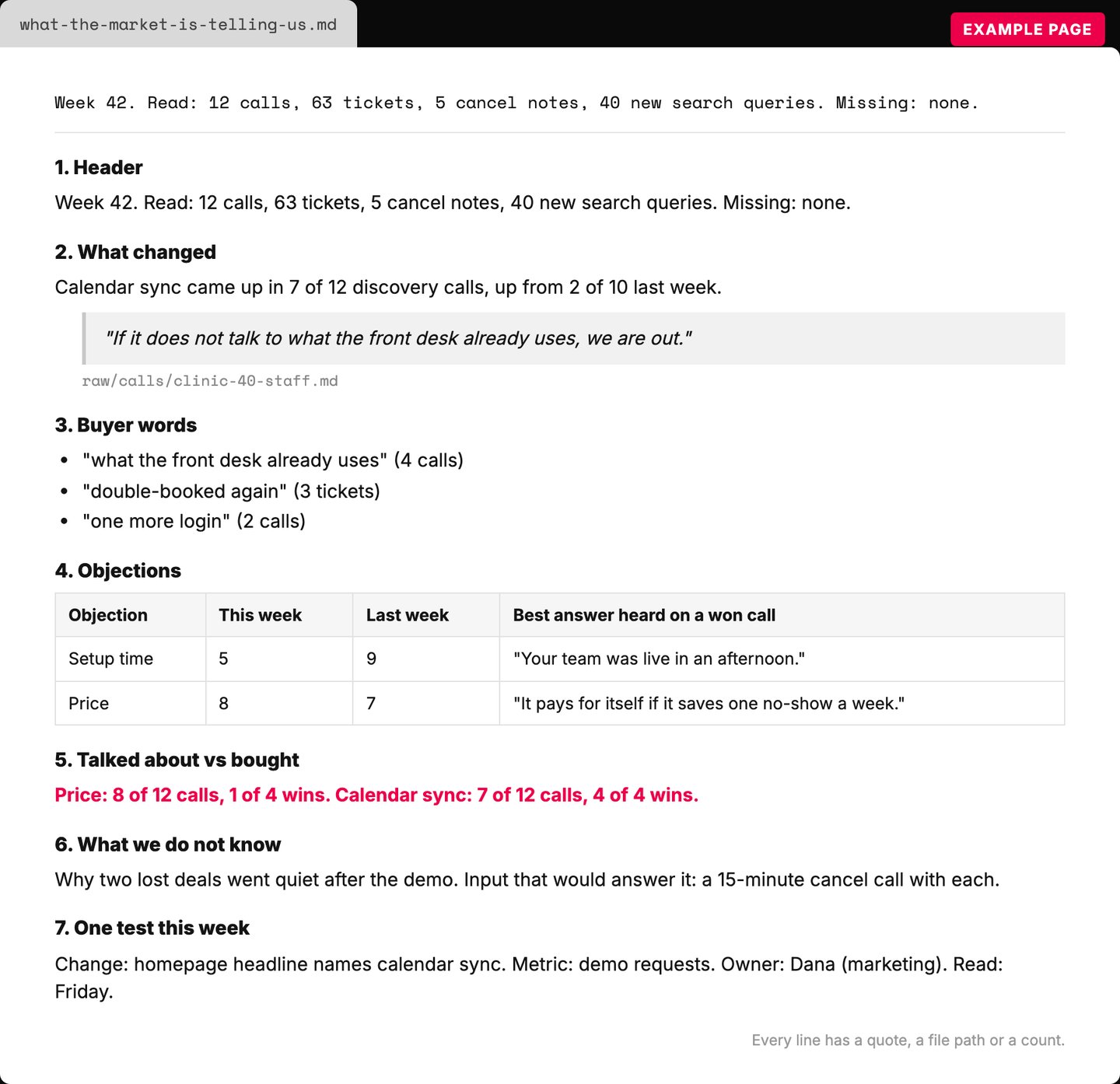
- The receipt: every quote points to the file it came from.
- A count against last week, not 'customers keep asking'.
- The money line: what came up in won deals versus lost ones.
- Gaps are written down, so a thin week reads as thin.
- One test, with a metric, an owner and a read date.
Example page built for this article with a made-up product. The seven parts and the Quote-or-Cut Rule are the method in sections 7 and 8; all numbers are illustrations, not data.
Some quotes should not wait for Monday
A weekly memo is the right speed for patterns. It is the wrong speed for harm.
At Amazon, a support agent once guessed which lawn chair a caller would name before she said it. The chair's packaging failed that often. The agent knew about the defect and had no way to stop it.
Jeff Bezos asked for an Andon Cord for customer service. It became a button that pulls the product from sale and alerts its owner.
Leaders worried agents would press it too often. They did not. The people closest to customers used it well.
Your version is one line in the agent's job: any quote that shows harm happening now goes straight to the owner. For example, a broken checkout, a false claim in an ad, or a safety risk.
Everything else waits for the memo. Patterns can wait a week. A broken checkout cannot.
Patterns wait for Monday; harm goes to the owner now
- Owner today One customer, real harm. Tell the owner now and fix it before Monday.
- Pull the cord Pause the ad, page or flow. The owner fixes it first.
- Log it Raw file only. It surfaces in the memo if it repeats.
- Monday memo Count it, quote it, and propose a test.
Anar's rule, after the Andon Cord for customer service described in Working Backwards.
Run it with AI, starting this week
The prompt below runs the weekly memo in your preferred AI. It asks what you sell, takes your raw files, and writes the seven parts under the Quote-or-Cut Rule. It never invents a quote, and it stops for your approval.
Strip names, emails and phone numbers before raw files go in. Europe's GDPR calls this data minimisation: keep only what the purpose needs. Check call recording consent rules where your buyers are before you record anything.
This week, do three things. Export twenty recent conversations from two sources, say ten calls and ten tickets. Run the prompt, then check every line against its quote yourself.
Pick the one test the memo proposes and give it an owner. Then do it again next week, by hand, before you schedule anything.
An agent that runs every Monday on a prompt nobody checked will be wrong every Monday, on time. Once it holds, write its job spec and schedule it. If your calls, tickets and CRM sit in tools that do not talk, that is CRM and revenue operations work.
Back in that room, five people had five customers. Now they have one memo, and every line shows its work. A claim without a quote is just a rumor wearing a tie.
Paste into your preferred AI with this week's raw files. It asks what you sell, then writes the seven-part memo and cuts any line without a quote.
Act as a careful customer researcher. You write a weekly customer truth memo under the Quote-or-Cut Rule: every line carries a word-for-word quote, its file path and a count, or the line is cut.

Ask me these one at a time, each with its example. If I paste everything at once, skip the questions.
1. What do I sell, and to whom? (Example: "Scheduling software for clinics with 10 to 50 staff.")
2. This week's raw files: call transcripts, tickets, cancel notes, reviews, search queries. One file per conversation, each starting with date, source, buyer role, deal stage and outcome. (Example: "raw/calls/clinic-40-staff.md")
3. Last week's memo, if there is one.

Then work in this order:
1. Use only my files. Nothing from general knowledge.
2. Copy out, word for word, every quote that names a problem, a goal, a competitor, a price, a deadline, or a reason to buy or leave. Keep the file path with each.
3. Rank each quote: what people did (bought, cancelled, searched) above recorded words, recorded words above written feedback, written feedback above survey answers. Mark answers to testimonial requests as "led".
4. Group quotes by topic. Count sources per topic this week and last week, split by won, lost and open deals.
5. Write the memo in seven parts: what was read; up to three changes; phrases used by two or more buyers; objections rising and falling; talked about vs bought; what we do not know; one test with owner, metric and read date.
6. Check every line against its quote. If the quote does not prove the line, delete the line. Move thin points to "What we do not know." Fewer than five conversations: say so in the first line.
7. List apart any quote showing harm now (a broken checkout, a false claim in an ad, a safety risk), with its path, under "Do not wait for Monday."

Rules: never invent a quote, number or customer. No names, emails or phone numbers in the memo. Do not run the test. Stop for my approval.

Filip Kovacevic is the founder of Anar Agency in Phoenix. He spent five years running SEO, Meta ads, email, and content for medical practices across the United States, and now does the same work for healthcare, home-service, legal, and professional-service businesses, alongside AI implementation. More from Filip →
Want the memo running in your company?
Bring the tools your calls, tickets and CRM live in. In 15 minutes we will tell you what the first memo would read, and which test would come out of it.
See how we build them →Want to do this work yourself? See how we train marketing engineers.