What Is a Marketing Engineer? The Definition, the Map, and the Test

A marketing engineer is a marketer who builds systems instead of making every asset by hand. They connect customer data, decision rules, AI agents and automations, so the marketing runs every week and learns from its own results. A person still checks any decision that would be costly to get wrong.
What is a marketing engineer?
Two marketers work at the same company. Both are busy all week.
One ships forty ads. The other ships one script that reads every sales call and drafts next week's ad angles from what buyers said.
Next Tuesday, the first one starts from zero. The script is already running.
That gap is the whole job. A marketing engineer is a marketer who builds systems instead of assets.
Search the term and you get three jobs mixed into one answer. The oldest is a hardware title: the technical marketing engineer who writes datasheets and demos chips to other engineers.
The second is the GTM engineer, a title Clay says it coined for the person who builds the outbound machine for sales. The third is the one this guide defines.
It is a marketer first. The building is how the marketing gets done.

An asset needs you next week. A system does not
| Asset | System |
|---|---|
| Forty ads, made by hand | A script that drafts next week's angles from sales calls |
| A report typed every Monday | A memo that builds itself from the data |
| Starts from zero next Tuesday | Already running next Tuesday |
| Judged by how much shipped | Judged by what buyers did |
Anar's definition, used across this guide
Marketing engineering started as a way to make decisions
Marketing engineering began as an academic idea: make marketing decisions with data, models and judgment, not gut feel alone.
Gary Lilien and Arvind Rangaswamy put the term on a textbook first published 1998, as the history of the field shows. Their later edition defines it as a systematic way to turn data and knowledge into better decisions. The work runs on a model, with a person in the loop the whole time.
They sort every decision into three modes. Conceptual marketing runs on a manager's mental model alone. Marketing engineering adds a model and keeps the judgment.
Automated marketing hands the whole call to a system. So which calls should a machine make alone?
The textbook answers in a footnote. Automate when a wrong decision is cheap, like a product recommendation or a keyword bid.
Keep a person in the loop when a wrong call is expensive, like a positioning strategy. Or catastrophic, like heart surgery.
We run that rule on every AI system we build. It is the best governance rule we know, and it fits in one sentence.
Notice what the 1998 marketing engineer did. They decided. They did not build pipelines.
Marketing engineering sits between gut feel and full automation
- Conceptual marketing The manager decides from a mental model alone. No support system.
- Marketing engineering Data and a model inform the call. The manager's judgment stays in the loop.
- Automated marketing A system makes the whole decision. Right only when a wrong call is cheap.
Principles of Marketing Engineering and Analytics, Lilien, Rangaswamy and De Bruyn, 3rd edition, chapter 1
The cost of a wrong call decides who makes it
The textbook's rule, with marketing examples that are our reading
| Cost of a wrong call | Textbook example | Marketing example (ours) | Who decides |
|---|---|---|---|
| Cheap | Product recommendations, keyword pricing | Tagging a ticket, a bid change inside a cap, an internal draft | The system, with spot checks |
| Expensive | Positioning strategy | A new price, a claim in an ad, a message to the whole list | A named person approves first |
| Catastrophic | Heart surgery, aircraft maintenance | A health or money claim to a regulated audience | A person decides; the system only advises |
Principles of Marketing Engineering and Analytics, Lilien, Rangaswamy and De Bruyn, 3rd edition, chapter 1 footnote. Marketing examples are Anar's
Marketing engineering is a 1998 term about better decisions
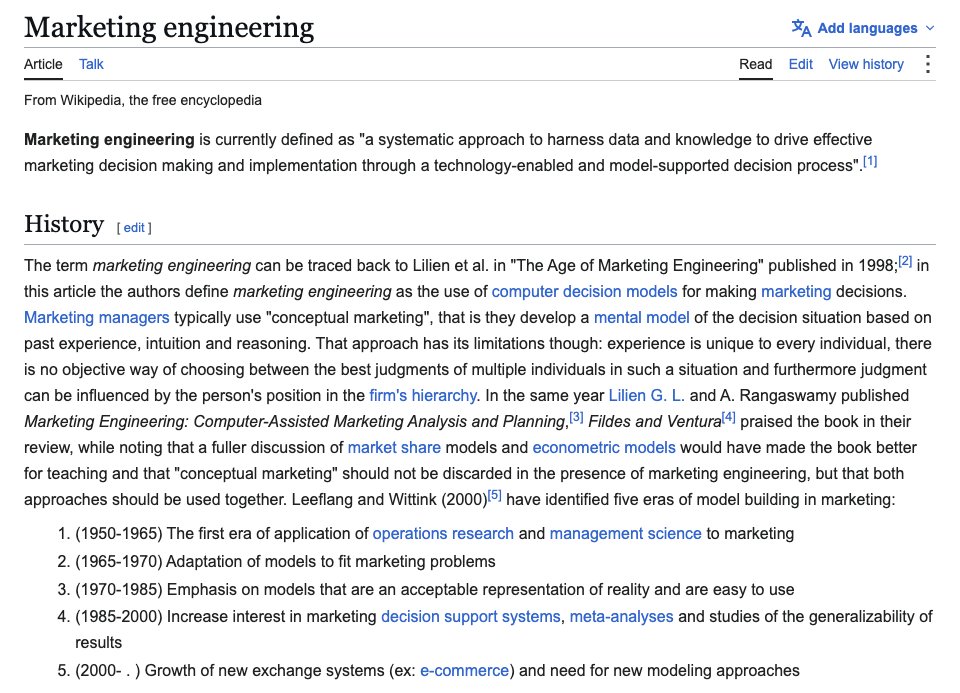
- The formal definition: decisions made with data, models and a person in the loop.
- The term dates to 1998, from marketing professors Gary Lilien and Arvind Rangaswamy.
- Conceptual marketing is gut feel and experience alone. Marketing engineering adds a model.
- Companies have tried to engineer marketing decisions since the 1950s.
Screenshot of Wikipedia, Marketing engineering, taken 2026-10-18
Look at what a person shipped this week and ask one question: will it do useful work next Tuesday without them? An ad, a post or a hand-built report fails; it is an asset, and someone has to make the next one. A script that reads every sales call, a pipeline that refreshes the numbers, a test that cuts losing ads on a written rule: those pass; they are systems.
Then two checks. Does it read its own results and change? Does a named person approve every call that is costly when wrong?
A marketing engineer is the person whose week mostly passes all three.
How the role grew from decision maker to system builder
The role grew in three steps: specialists who shaped other people's work, marketers who shipped code, and now marketers who build agents.
In High Output Management, Andy Grove describes an Intel marketing engineer whose job was pricing a product line. Price too high, and hundreds of salespeople can't win business. Price too low, and the company gives money away.
Grove counted specialists like that as managers, even with nobody reporting to them. His rule: your output is your team's output plus the output of the teams you influence. Activity is not output.
The second step came from growth teams. Sean Ellis started out selling print ad space and knew nothing about software, as he tells it in Hacking Growth.
At a gaming site, he and the engineers built one of the first embeddable game widgets. Other websites ran the free game and got 50 cents for each new player.
It spread to 40,000 sites. That is code used as a marketing channel, years before anyone called it growth hacking.
The third step is now. The textbook's 2017 edition predicted analysis without an analyst, and agents that both analyze and act.
It also explained why earlier waves faded. The models were fine. Companies had no technology to build them into daily work.
That excuse is gone. So today's marketing engineer is both people: the decision maker from 1998, plus the builder of the system that makes the decision every week.
The marketing engineer grew from decision maker to system builder
- First attempts 1950s Companies try model-based marketing decisions. The wins fade with no technology to keep them running.
- Output, not activity 1983 Grove's High Output Management defines a manager's output as the output of the teams they run or influence.
- The term 1998 Lilien and Rangaswamy publish Marketing Engineering: decisions made with data, models and judgment.
- Code as a channel Around 2000 Free game widgets on other people's websites bring in players at 50 cents each.
- The prediction 2017 The textbook's third edition foresees analysis without an analyst, and agents that act.
- The builder Today AI coding agents let a marketer build those systems, with a person checking the costly calls.
Principles of Marketing Engineering and Analytics, Lilien, Rangaswamy and De Bruyn, 3rd edition; High Output Management (Grove); Hacking Growth (Ellis and Brown)
A free game widget became a channel on 40,000 sites
- paid to a website for each new player 0.5
- websites running the free game 40000
- gamers on the site at its IPO 5.2
Hacking Growth, Sean Ellis and Morgan Brown: Ellis's own account of the Uproar widget
Why the job exists: nobody owns the whole chain
Most marketing teams are split by channel, and nobody owns the path a buyer actually walks.
Clayton Christensen's team tells a hospital story in Competing Against Luck. Back in 1952, surgeon Dwight Harken watched patients survive hard operations, then die in recovery on general wards.
Every department did its job. The patient's job, getting through recovery, had no owner. His answer became the intensive care unit.
Swap patients for leads and you have most marketing teams. The ads hit their numbers, the CRM is clean, and sales follows its script.
And the leads still die in between. Who owns that gap? Usually, nobody.
It is a relay team where every runner wins their leg, and the baton still hits the floor.
Conway's law says a system copies the communication lines of the team that built it. Split marketing by channel, and you get channel-shaped systems that never talk to each other.
A marketing engineer owns one stream of buyer work, from first signal to closed sale, across the channel lines. That is the job description in one line.
Channel owners hit their numbers while leads die between them
| Channel owner | Stream owner (marketing engineer) |
|---|---|
| Owns ads, or email, or the CRM | Owns one buyer stream, first signal to closed sale |
| Hands work off at the channel edge | Builds across the edges, no hand-off |
| Judged on the channel's own numbers | Judged on what buyers did at the end |
| Systems shaped like the org chart | Systems shaped like the buyer's path |
Our reading of Team Topologies (Skelton and Pais) and Conway's law, applied to marketing teams
The five layers a marketing engineer builds
Every marketing system we build has the same five layers: signal, memory, decision, action and feedback. A marketing engineer owns all five for one stream.
We built this map from the textbook's chain of data, information, insight, decision and action. Then we added a feedback step, because the textbook's response models depend on it.
Signal is what buyers say and do, captured on purpose. Calls, tickets, reviews and closed deals get read every week by a customer truth system. Lead quality flows back to the ad platforms through server-side conversion tracking.
Memory is one shared set of company facts that every person and every AI reads. Offers, prices, proof, banned claims. It lives in a growth repo, not in someone's head.
Decision is where data turns into a call: which angle wins, what to spend, what to stop. Each test gets a written finish line before launch, as the creative testing engine sets out.
Why so strict? Ron Kohavi and his co-authors report that only about one third of ideas tested at Microsoft improved the metric they aimed at. At Bing and Google, success rates ran closer to 10 to 20 percent.
Guessing is not a strategy. It is a habit with a budget.
Action is the work that ships: agents and automations that draft ads, pages, emails and outreach. Each one gets a written job spec, and the cost of a wrong call sets how much a person checks.
Feedback closes the loop. A weekly growth cockpit memo says what changed, why, and what we do next.
Every marketing system has five layers, and the last one feeds the first
- Signal What buyers say and do, captured on purpose
- Memory One set of company facts every person and AI reads
- Decision Rules and tests that turn data into a call
- Action Agents and automations that ship the work
- Feedback A weekly read of results that changes the next decision
Anar's map, built on the data-to-implementation chain in Principles of Marketing Engineering and Analytics, Lilien, Rangaswamy and De Bruyn, 3rd edition
Each layer has its own job and its own chapter in this guide
| Layer | What it holds | Where the idea comes from | Read next |
|---|---|---|---|
| Signal | Calls, tickets, reviews, deal stages | Jobs theory: the struggle behind a purchase | Customer truth system |
| Memory | Offers, prices, proof, banned claims | Information turned into shared knowledge | Growth repo |
| Decision | Test rules, budget rules, finish lines | Decision models plus judgment | Creative testing engine |
| Action | Agents and automations with job specs | Automate only when a wrong call is cheap | Agent job spec |
| Feedback | A weekly memo: change, cause, call | Response models adapt to observed results | Growth cockpit |
Anar's map. Roots: Principles of Marketing Engineering and Analytics, Lilien, Rangaswamy and De Bruyn, 3rd edition; Competing Against Luck and Demand-Side Sales 101 for the signal layer
Most tested ideas fail, even at the best-run companies
Share of tested ideas that improved the metric they aimed at
- Microsoft (one third) 33
- Slack monetization tests 30
- Bing and Google (10 to 20) 20
Trustworthy Online Controlled Experiments, Kohavi, Tang and Xu, citing Kohavi et al., Manzi and Mosavat. Bing and Google bar shows the top of the 10 to 20 percent range
What a marketing engineer is not
A marketing engineer is not marketing ops, not a developer on loan, not a GTM engineer and not a prompt writer. Each of those is a real job. Each one owns less.
Marketing ops keeps the machine running: the CRM, the forms, the integrations. A marketing engineer builds a new machine that changes what the team does next week.
A developer on loan builds what the ticket says. A marketing engineer writes the ticket, because they know what a bad ad looks like.
A GTM engineer builds the outbound and enrichment machine for sales. A marketing engineer may build that too, but owns the stream from first ad to closed deal.
And the person who makes forty ads a week with AI? Faster assets. Still assets.
How to hire a marketing engineer and get an expensive intern, in four easy steps. Step one: post the title and list every tool you have heard of.
Step two: hand them a ticket queue. Step three: judge them on posts published and hours logged.
Step four: wonder why the hell nothing runs when they take a week off. Congratulations, you paid engineer money for a content mill.
Grove's output rule is the fix. Judge them on what the teams around them now produce, not on how busy they look.
Four nearby jobs, and what each one owns
| Role | Owns | Judged on |
|---|---|---|
| Marketing ops | Keeping the CRM, forms and integrations running | Uptime and clean data |
| Developer on loan | Building what the ticket says | Shipping the ticket |
| GTM engineer | The outbound and enrichment machine for sales | Meetings booked |
| Prompt writer | Making assets faster with AI | Volume shipped |
| Marketing engineer | One buyer stream, built as systems | What buyers did, week after week |
Anar's definitions
The Next-Tuesday Test: does the work run without them?
The Next-Tuesday Test asks one question about this week's work: will it do useful work next Tuesday without the person who built it?
An ad fails it. So does a post, a deck, or a report someone typed by hand.
Each one is an asset, and someone has to make the next one. A script that reads every call passes. So does a test that cuts losing ads on a written rule.
Passing is not the finish line. We add two checks.
First, does it read its own results? A system that never learns is a faster habit, not a better one.
Second, does a person check the calls that are costly when wrong? That is the textbook's footnote, turned into a rule.
Then treat it as a program, not a project. In the textbook, the president of ABB says its marketing engineering work had to be a program, never a one-off project.
The same chapter cites a review of more than 2,000 model projects. Over 95 percent of the effort often went into everything around the model: finding the problem, managing data, changing habits, rolling it out.
That matches what we see. The model is the easy part. The harness around it is the job, as what an agent harness is explains.
Want to score whole teams instead of one week? The marketing engineering audit does that in 20 questions, and how to measure a marketing engineer grades each system on what buyers did.
Only work that runs without you and learns counts as a system
- Analysis A smart report someone runs by hand. Automate the run.
- System Runs next Tuesday and gets better. This is the job.
- Asset An ad, a post, a deck. Someone makes the next one.
- Autopilot habit Runs, but never learns. Add a feedback step.
Next-Tuesday Test, Anar
Most of the work is around the model, not in it
- model projects reviewed 2000
- years those projects spanned 25
- of effort that often went to problem finding, data, change and rollout 95
Principles of Marketing Engineering and Analytics, Lilien, Rangaswamy and De Bruyn, 3rd edition, chapter 9, citing Sinha and Zoltners
Run the Next-Tuesday Test on one week in four steps
- List what shipped Everything from the last five working days, one line each.
- Ask the Tuesday question Will it do useful work next Tuesday without its builder? Yes is a system.
- Run both checks Does it read its own results? Does a person approve the costly calls?
- Pick the next system The asset you rebuild most often, with the most hours behind it.
Next-Tuesday Test, Anar
Run the Next-Tuesday Test on your own week with AI
The prompt below runs the Next-Tuesday Test on one week of work. It works on your own week too.
Paste it into your preferred AI and list what was shipped. It sorts each item into asset or system, runs both checks, and names the one system to build next.
This week: run it on your last five working days. Then pick the asset you rebuild most often and turn it into a system.
Next Tuesday, run the test again. One passing system beats five half-built ones.
Want the full path? How to become a marketing engineer in 30 days turns this into a plan, and what a marketing engineer does all day shows the weekly loop.
Rather have the first system built for you? That is our marketing engineering work.
Remember the two marketers? On Tuesday, one of them makes ad number forty-one.
The other one's script already ran. Anyone can carry buckets. A marketing engineer builds the pipe.
Paste into your preferred AI. It asks what was shipped, sorts assets from systems, runs both checks, and names the next system to build.
Act as a careful reviewer of marketing work. Use only the rules below and my answers. Never invent an item or a number; if something is missing, ask me.

Ask one at a time, show the example, and wait:
1. Whose week is this, and what is their role? (Example: me, in-house marketer)
2. List everything they shipped in the last five working days, one line each. (Example: 12 ads, a weekly report built by hand, a script that tags new reviews)
3. For each item: who has to touch it for it to happen again next week? (Example: the report needs me every Monday)
4. Which items read their own results and change what they do? (Example: none)
5. Which items reach customers or spend money, and who checks them first? (Example: the ads, I check them)

Rules:
- Asset: it needs a person to happen again. System: it does useful work next Tuesday without the person who built it.
- Learning check: a system passes only if it reads its own results and changes what it does next.
- Approval check: cheap mistakes (a tag, an internal draft, a small bid change inside a cap) may run alone. Costly mistakes (a price, a claim, a message to the whole list, positioning) need a named person to approve before anything ships.
- A system that spends money or speaks to customers with no approver fails the approval check, even if it runs.
- Pick the next system from the asset that gets rebuilt most often and takes the most hours.

Show your sorting, then use exactly this format:
ASSETS:
SYSTEMS:
FAILS THE LEARNING CHECK:
FAILS THE APPROVAL CHECK:
SYSTEMS AS A SHARE OF ITEMS SHIPPED: (count them, do not estimate)
NEXT SYSTEM TO BUILD:
WHO APPROVES ITS OUTPUT:
NEXT THREE ACTIONS:
Two of seven items are systems, and one still fails the approval check
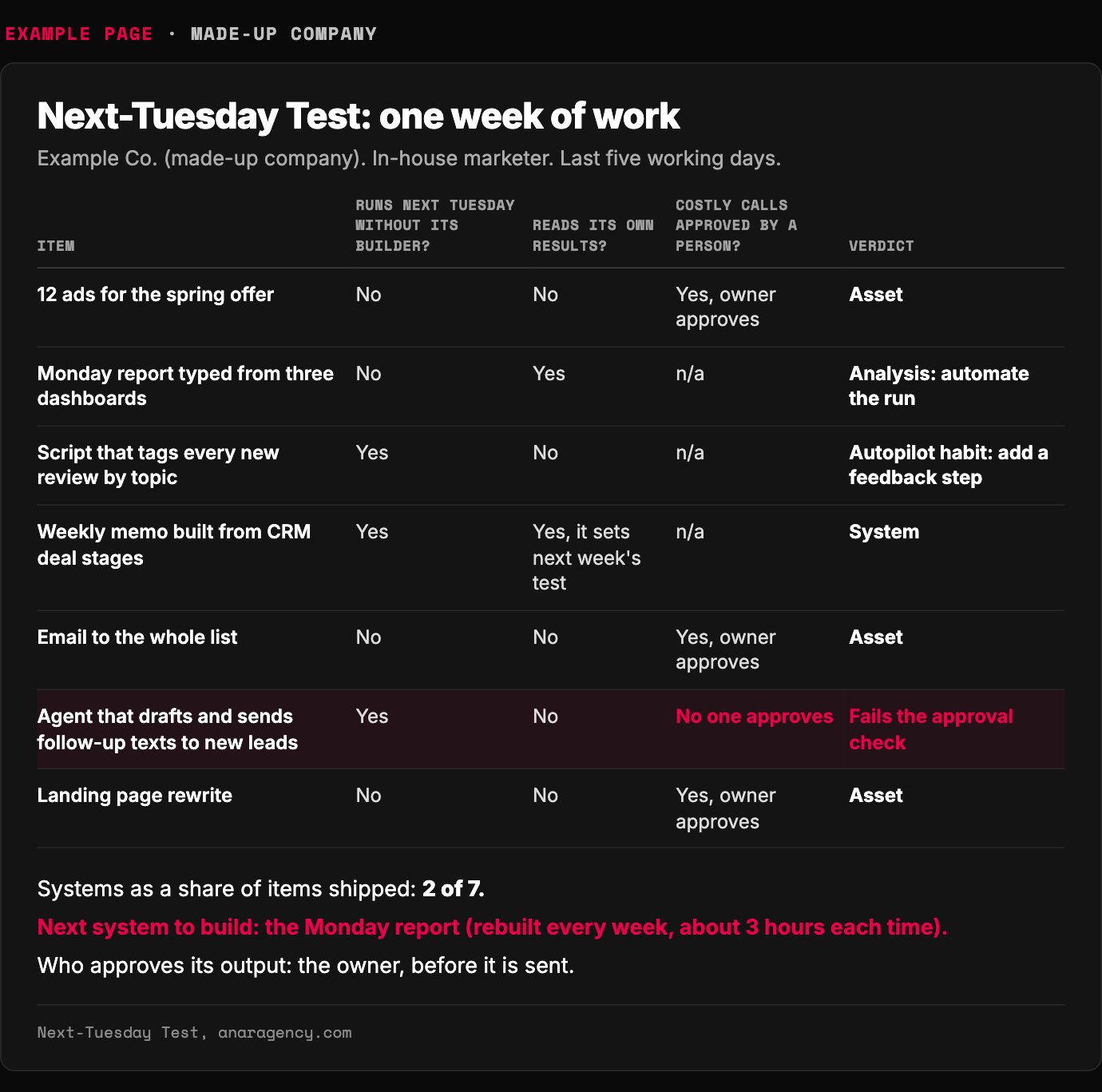
- It runs on its own, but texts customers with no approver. That fails, even though it is automated.
- This one passes all three: it runs, it learns, and nothing costly ships without a person.
- Running alone is not enough. A system that never reads its results is a habit on autopilot.
- Build next where the same asset gets rebuilt most often.
Example page built for this article with a made-up company

Filip Kovacevic is the founder of Anar Agency in Phoenix. He spent five years running SEO, Meta ads, email, and content for medical practices across the United States, and now does the same work for healthcare, home-service, legal, and professional-service businesses, alongside AI implementation. More from Filip →
Want the systems without the hire?
Bring one number you want to move. In 15 minutes we will tell you which system we would build first and how you would know it worked.
See how we build them →Want to do this work yourself? See how we train marketing engineers.