The Growth Repo: How to Give Every AI the Same Company Memory

A growth repo is one shared folder of plain text files that holds what your company knows about selling: customer words, voice, offers, settings and test results. Every AI tool and every teammate reads it before working. Sort files by where they are going, give each an owner and a date, and check what changed every Friday.
Why does your AI forget your business every Monday?
Monday, nine in the morning. Someone on your team opens an AI chat and asks for ten posts about your product.
The AI has never heard of you. It does not know which post booked calls last month. It does not know the objection sales heard four times last week.
So it writes ten average posts. Your colleague keeps one. Next Monday, it starts from zero again.
The model is fine. The memory is missing.
A growth repo fixes that. It is one home for everything your company has learned about selling, kept as plain text files that every AI tool and every person reads before they work.
Chats forget when you close them. Files do not.
The method fits in four moves. Sort files by where they are going. Put your settings in first.
Give every file an owner, a date and a reason. Then check what changed every Friday.
Most AI advice is about better prompts. Our take: a prompt that has to explain your whole company every time is a symptom, not a skill.

The difference is not the AI. It is what the AI reads first
| Chat with no repo | Chat that reads the repo |
|---|---|
| Re-explain the company every time | Points at three files and starts |
| Generic posts in the average voice | Posts in the founder's words, with the buyer quote behind each |
| Suggests ad angles you already tested | Skips every angle in the experiment log |
| Forgets the fix you made last week | Follows the correction rule you added |
| Output you cannot check | Every claim points to a file you can open |
Anar method
What is a growth repo, and why does a marketing engineer build it first?
A growth repo is a shared library of plain text files that describes your market, voice, offers, settings and results. Repo is short for repository: a folder that can keep every version of its files.
Clever? Not even a little. It is notes, kept in one place, in a format any tool can open.
The format is the whole trick. Files written in Markdown, the headings-and-bullets style you already type in chat apps, open in every editor and every AI tool. Switch tools next year and the memory comes with you.
The idea is older than AI. Gary Lilien and Arvind Rangaswamy coined the term marketing engineering for managers who decide with data, models and judgment together.
In their textbook, they pictured companies keeping a library of models in the data warehouse. Any manager could then ask why a promotion paid off in one city and flopped in another.
Today's marketing engineer goes one step further. They build the library, and the agents that read it. That is why the repo comes first in the marketing engineer's job.
Every agent you build later is only as good as what it can read. An agent with no memory is a stranger with a keyboard.
A growth repo holds what you know about selling, and nothing you cannot afford to lose
| Goes in | Stays out |
|---|---|
| Customer words, each with its source | Passwords, keys and logins |
| Founder voice: words to use and avoid | Raw customer records with names, emails, phone numbers |
| The offer and every claim you may make, with proof | Claims nobody can source |
| Settings: tracking events, naming rules, live prompts | Big files better kept in their own tool (video, design files) |
| Experiment log and correction rules | Drafts nobody owns |
Anar method; the stays-out list follows the data rules in our customer-data guide
Every Friday, open the list of what changed in the growth repo this week: the commit list in version control, or the files sorted by date in a shared folder. Count three kinds of change only: a new customer quote with its source, a test result written into the experiment log, and a rule added after someone fixed an agent's work. One or more means the company learned something this week.
None means the marketing ran and the memory did not move. Two empty weeks in a row means the repo has no owner; name one before you add another file. The check takes about fifteen minutes: read the changes, write one line about what the team learned, and pick the stalest file to fix first next week.
Sort every file by where it is going, not where it came from
The usual mistake is sorting by source. You get a folder for call notes, one for survey exports, one for old decks.
It looks tidy. It helps nobody launch anything.
Tiago Forte argues the opposite in Building a Second Brain: organize notes by the outcome they will help you reach. He calls his setup a production system, not a filing system.
His placement rule is four questions, asked in order. We use it for every new file in a growth repo.
In a repo, a project is anything with an end date and a result: a launch, a campaign, a site rebuild. A standing job never ends, but it has a standard to keep: customer truth, founder voice, the offer, outbound, experiments.
Reference is everything else worth keeping: competitor notes, swipe files, research. The archive is finished work.
Keep it three levels deep at most: top folder, sub-folder, file. Three levels is enough for thousands of notes.
When a project ends, move its whole folder to the archive. When a new one starts, search the archive first.
Why bother? Because last year's launch brief already holds half of the next one. A folder called Misc is where good work goes to die.
Four questions decide where every new file goes
- Which live project will this help soonest? A launch, a campaign, a rebuild: anything with an end date. File it there.
- If none: which standing job? Customer truth, voice, offer, outbound, experiments, settings. No end date, but a standard to keep.
- If none: which reference topic? Competitor notes, swipe files, research you may need later.
- If none: archive it. Finished or paused work. Search here first when a new project starts.
Adapted from Tiago Forte, Building a Second Brain (the PARA placement checklist)
Example: a starter tree, three levels deep at most
| Top folder | What lives there | Example file |
|---|---|---|
| projects/ | Work with an end date | projects/spring-launch/brief.md |
| jobs/ | Standing jobs with a standard | jobs/customer-truth/memo.md |
| jobs/ | jobs/voice/voice.md | |
| jobs/ | jobs/experiments/log.md | |
| jobs/ | jobs/settings/tracking-events.md | |
| reference/ | Worth keeping, not in use | reference/competitors/notes.md |
| archive/ | Finished projects, moved whole | archive/fall-webinar/ |
| (top level) | The front door every tool reads first | AGENTS.md or README.md |
Example tree for a made-up company; rename folders to fit yours
Put the settings in first, then the words
Here is a finding most marketers have never heard. The Accelerate research team studied more than 23,000 survey responses from software teams.
Keeping settings under version control was linked to fast, stable delivery. That link was stronger than for keeping the code there. In their data, the old belief that settings matter less than code did not hold up.
That is software, not marketing. Our reading: the same thing happens in ad accounts and funnels.
Your copy is visible. Your settings are not. Think tracking events, link naming rules, automation steps, audience definitions and the prompts your agents run.
Change one quietly and nobody can say what broke. Engineers call this configuration drift: two setups that should match slowly stop matching.
A settings file with a dated history ends that argument in one screen. Without it, you get three people and three memories.
So the first files in our repos are not essays. They are the dull ones: the event list, the naming rules, the live prompts.
Dull files save launches.
Put the dull files under version control before the essays
- 1. Tracking settings The event list and what fires each one
- 2. Naming rules Campaign, link and file naming
- 3. Automation steps What each automation does, in order
- 4. Live prompts The exact text your agents run today
- 5. Voice, offer and memos The words come after the settings
Our marketing reading of Accelerate's finding on configuration vs code (software teams)
When a setting changes quietly, nobody can say what broke
| Setting | What goes wrong without a dated history |
|---|---|
| A tracking event renamed | Reports drop to zero and the team blames the ads |
| A link naming rule changed | Two months of results land in the wrong campaign |
| An automation step removed | Leads stop getting the follow-up and nobody notices |
| A prompt edited by hand | Output quality shifts and no one can find the old text |
Illustrative examples of configuration drift in marketing work
Give every file a front page: owner, date and reason
Every file in a growth repo starts with the same four lines. Who owns it, when it was last checked, where its facts came from, and why it exists.
The last line is the one people skip. Big mistake. It is the one that matters most.
Andy Grove, who ran Intel, made the point in High Output Management. A procedure is worth the real thinking behind it, not its wording. So keep questioning it, even after it becomes the standard.
A rule without its reason gets obeyed forever or deleted in a panic. Neither ends well.
One owner per file. Not a committee.
Anyone can suggest a change; the owner decides. Treat each file like a garden you tend, not a gate you guard.
The experiment log gets more fields, one line per test. Record the owner, start date, days run, the one change, the hypothesis, the result, and the decision with its reason.
That reason turns a list of tests into a memory. It is also why testing one variable at a time pays off twice: once in the test, and again a year later when someone asks why.
Corrections get the same treatment. When someone fixes an agent's work, the fix becomes a dated rule with its reason, and the agent's job spec points to it.
Four lines at the top of every file
| Line | Example |
|---|---|
| Owner | Owner: Dana (head of marketing) |
| Last checked | Last checked: the date of the last review |
| Sources | Sources: 6 sales call transcripts, 40 support tickets |
| Why this file exists | Why: drafts kept opening with a question; the founder rejected four in a row |
Anar method; one owner per file follows Team Topologies' single-owner rule
One line per test, ending in the decision and why
- Owner and start date Who ran it and when it began
- Days run and the one change One change per test, so the result means something
- Hypothesis What you expected, written before the result
- Result The number that moved, or did not
- Decision and why Keep, kill or retest, with the reason
Fields adapted from Kohavi, Tang and Xu, Trustworthy Online Controlled Experiments (institutional memory)
A finished repo file: four lines on top, then rules anyone or any AI can follow
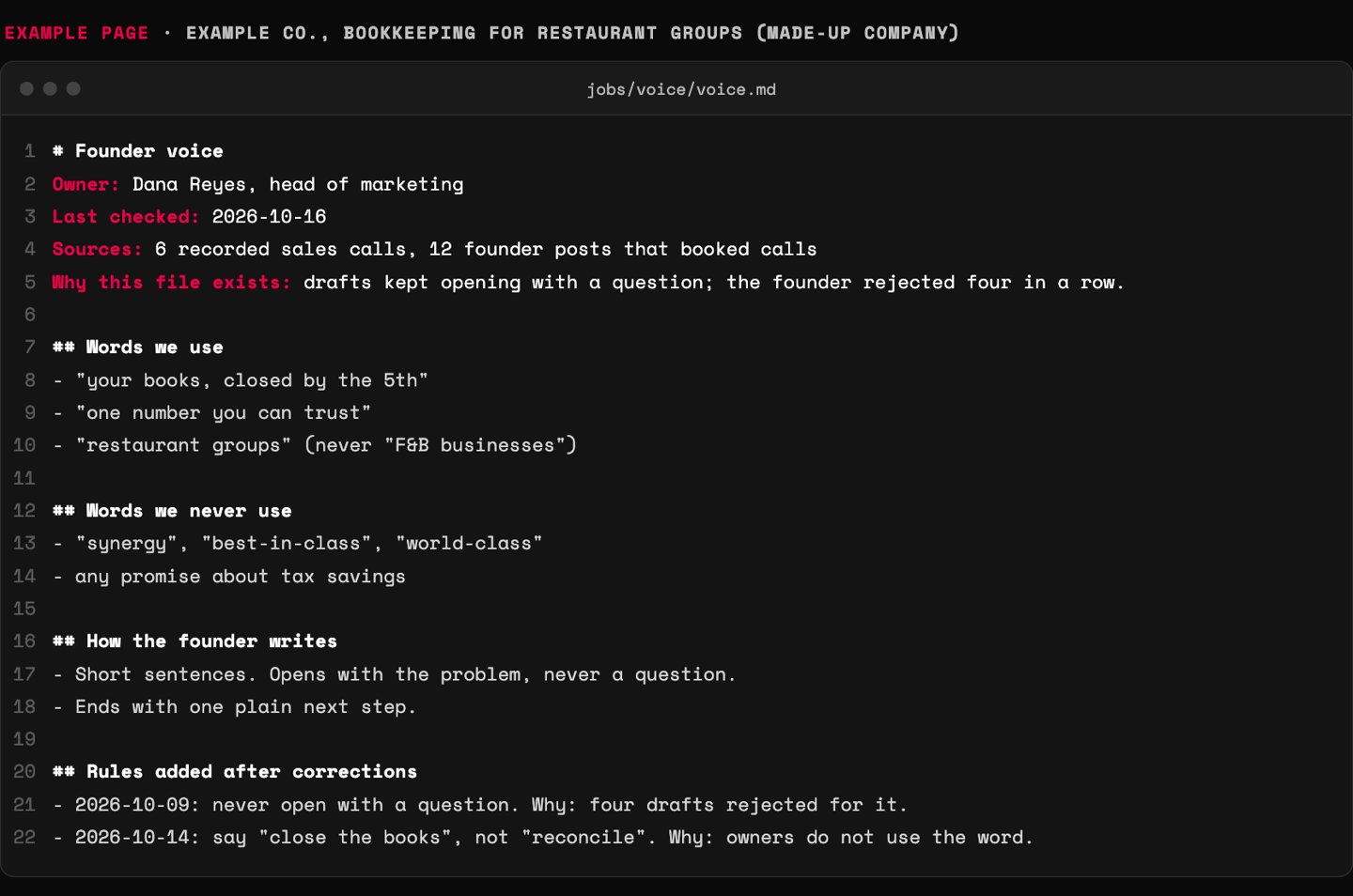
- One owner per file. Others suggest; the owner decides.
- A date tells every reader, and every AI, how fresh this is.
- The reason behind the rule. Without it, rules get obeyed forever or deleted in a panic.
- Every fix to an agent's work becomes a dated rule with its reason.
Example page built for this article with a made-up brand
Record the work, then file it. Do not write the manual
Most company wikis die the same way. Someone spends a week writing perfect instructions. Nobody opens them.
Mike Michalowicz tells this one on himself in Clockwork. He spent four hours writing a fifteen-step shipping procedure for used books, pictures included. His intern came back with questions within minutes.
Then the postal service and Amazon changed their websites, and every picture went stale. He switched to recording himself doing the job instead. Now whoever does the task records a new version when the process changes.
How to build a wiki nobody opens, in four easy steps. Step one: write every procedure from memory, in one sitting.
Step two: cover every exception you can imagine. Step three: add screenshots of tools that redesign every quarter.
Step four: announce it in a meeting and never touch it again. Congratulations, you built a damn expensive tombstone.
David Jenyns saw it happen at agency scale in SYSTEMology. A Google Ads agency owner wrote hundreds of procedures and pinned the index to his office wall. It bombed: staff could not follow it, and digital marketing changed too fast to keep it current.
So we capture. We do not write.
Record the screen while the person who does the task best talks through it. Turn the transcript into a short file in the repo.
Short means short. If a file needs its own table of contents, it is two files.
Then test it like a stranger would. If finding a file takes more than a minute, the folder is broken, not the person.
Recording the real task beats writing the manual
| Write the manual | Capture the task |
|---|---|
| Written from memory, steps get skipped | Recorded while doing the real task |
| Tries to cover every exception up front | Covers what actually happens |
| Goes stale when a tool redesigns | Current owner records a new version |
| Long, so nobody opens it | Short file, findable in under a minute |
Adapted from Mike Michalowicz, Clockwork, and David Jenyns, SYSTEMology
From one recording to a file that stays current
- Record Day 1 The person who does the task best does it on screen and talks through it.
- Transcribe and trim Day 1 An AI tool drafts a short file from the transcript; the doer edits it.
- File it Day 2 Front page on top, placed with the four questions, findable in sixty seconds.
- Re-record Next change Whoever does the task now records the new version.
Anar method, built on the capture approach in Clockwork
Where should a growth repo live: a shared folder or version control?
Start with whatever your team will actually open. A shared drive folder is fine for the first month.
Jenyns would push you toward a dedicated systems tool instead of a drive. His reason holds: knowledge stored everywhere is stored nowhere.
Our call differs on one point. For a library that people and AI tools both read, plain text files beat any single vendor's app, because every AI tool can read a text file.
Move to version control when either of two things is true. More than one person edits the files, or an automation writes to them on a schedule.
Git, the most common version control system, saves a snapshot of every file each time you commit. To commit is to save a named change, and the free Pro Git book explains it in plain words.
Keep changes small and merge them the same day. A branch is a side copy where a change waits. In the Accelerate data, the strongest software teams merged theirs within a day.
Our marketing version of that rule: no draft sits on the side for weeks. Edit, check, merge, done.
The repo holds how a task is done. Your task tool holds who does it and when. Link the file inside the task, so done means done the way the file says.
Two things never go in. Passwords and keys live in a separate file the repo is told to ignore, and raw customer records stay outside it, as our guide to customer data and AI explains.
Move to version control when people or automations start writing
- Version control now A scheduled job edits files; you need to see and undo every change.
- Version control now Many hands and machines. History and small same-day merges matter most.
- Shared folder is fine One owner, one editor. Sort by date on Friday.
- Version control soon Two editors overwrite each other. Move before the first lost edit.
Anar rule
The Weekly Diff: one Friday check that keeps the repo alive
A repo nobody updates is worse than no repo. It hands every agent last quarter's truth with full confidence.
The Weekly Diff is our Friday check. A diff is the list of changes between two versions of a file.
Open the list of what changed this week. In version control, that is the commit list. In a plain folder, it is the files sorted by date.
Count three kinds of change only: a new customer quote with its source, a test result written into the log, and a rule added after someone fixed an agent's work.
One or more means the company learned something. None means the marketing ran and the memory did not move.
Is one empty week a problem? No. Two in a row means nobody owns the repo, so name an owner before you add another file.
The whole check takes about fifteen minutes. Read the changes, write one line about what the team learned, and pick the stalest file to fix first next week.
That one line feeds the growth cockpit, the Monday memo that decides what to test next. The new quotes come from the customer truth system.
Fifteen minutes on Friday keeps the memory moving
- Open the change list Commits, or files sorted by date
- Count three kinds Quote with source, test result, correction rule
- Write one line What the team learned this week
- Pick the stalest file It gets fixed first next week
Anar method
The numbers behind the Friday check
- kinds of change that count 3
- empty weeks in a row = no owner 2
- to run the check 15
- most it should take to find any file 60
Anar rules; the sixty-second findability rule is from Mike Michalowicz, Clockwork
Seven changes this week, and only three count as learning
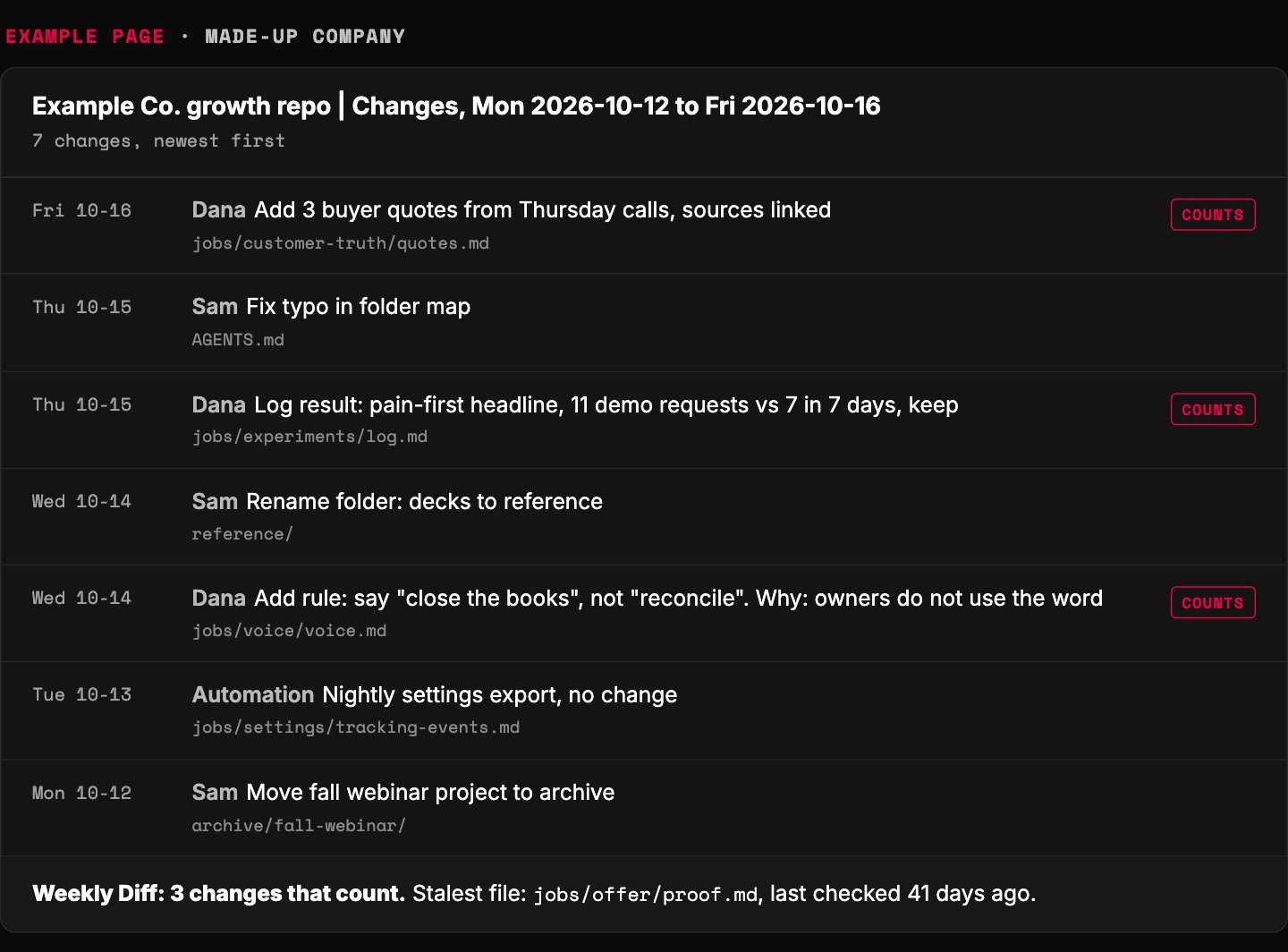
- Counts: a new customer quote with its source.
- Counts: a test result written into the log, with the decision.
- Counts: a rule added after someone fixed an agent's work.
- Housekeeping is fine, but it does not count as learning.
- One line for the team, and the stalest file gets fixed first next week.
Example page built for this article with a made-up brand
Run it with AI
The prompt below plans your first growth repo. Paste it into your preferred AI and answer six questions.
It returns a folder tree, five day-one files with their front pages, the settings to version first, and your Friday check. It never invents facts about your business. If a fact is missing, it writes TODO and asks.
Tool file names change. The box below lists the current ones, so the method can stay the same.
This week: first, run the prompt. Second, create the five day-one files and put one owner on each. Third, put the Weekly Diff on Friday's calendar.
Want to see the same pattern running a whole agency? Read how we run an agency as marketing engineers.
Want the career path that starts here? Read how to become a marketing engineer in 30 days.
Prefer to have it built inside your company? That is the work in our marketing engineering engagements.
A chat is a conversation. A repo is a memory. Build the memory, and Monday stops starting from zero.
Paste into your preferred AI. It asks six questions, then drafts your folder tree, day-one files, settings list and Friday check.
Act as a marketing engineer helping me set up a growth repo: one shared home of plain text files that every AI tool and teammate reads before working. Use only my answers. Never invent a fact about my business; if one is missing, write TODO and ask.

Ask one at a time, with the example, and wait:
1. What we sell, to whom. (Example: bookkeeping for restaurant groups)
2. Where our marketing knowledge lives now. (Example: a shared drive, call recordings, one person's head)
3. AI tasks we repeat weekly. (Example: posts, ad angles, follow-up emails)
4. Live projects with an end date. (Example: spring launch)
5. Settings we change often. (Example: tracking events, link naming rules, reused prompts)
6. Who edits, and does any automation write files? (Example: two people, no automation)

Rules:
- Place each file by where it is going: live project, else standing job, else reference, else archive. Three levels deep at most.
- Day one is five files: front door (what we sell, folder map, hard rules), customer truth memo, voice, experiment log, settings.
- Every file opens with: Owner, Last checked, Sources, Why this file exists. One owner per file.
- Experiment log line: owner, start date, days run, the one change, hypothesis, result, decision and why.
- No passwords, keys, or customer names, emails or phone numbers in the repo.
- A shared folder is fine to start. Move to version control when 2+ people edit or an automation writes.
- If you can browse, check which instruction file my AI tools read first.

Output exactly:
FOLDER TREE:
DAY-ONE FILES (front page + first lines):
SETTINGS TO VERSION FIRST:
WHERE IT LIVES:
OWNERS:
FRIDAY WEEKLY DIFF: count new quotes with a source, new test results, new correction rules. Zero two weeks running = name a new owner.
NEXT THREE ACTIONS:

Filip Kovacevic is the founder of Anar Agency in Phoenix. He spent five years running SEO, Meta ads, email, and content for medical practices across the United States, and now does the same work for healthcare, home-service, legal, and professional-service businesses, alongside AI implementation. More from Filip →
Want to build this on real client work?
Our training runs four weeks: an audit, a growth repo, one working machine, and a case study with results. You leave with a repo you built and the numbers to show for it.
See the training →Want the repo and its first system built inside your company? See how we build them.