Sell Outcomes, Not Features: Give Half Your Copy to the Result

Selling outcomes means spending at least half your copy on where the buyer ends up and how that feels. Features and benefits come second, as support. Then test the offer: would the buyer give up almost anything for this outcome?
If yes, money is an easy trade. If no, change the offer before you change the words.
Sell outcomes, not features: give half your copy to the result
For example, picture a sales page for an ads course. It says "you" 256 times and "I" only 86 times. Good start.
Then it explains the market. It introduces the author. Then module one, module two, module three.
Every line is true. Not one line says where the buyer ends up.
So the buyer has to connect the dots alone. Most won't.
This guide shows how to sell outcomes, not features. You will measure your page, find the real outcome, and test the offer with one question.
A feature is what is in the product. A benefit is what that feature does. An outcome is where the buyer ends up, and the feeling that place stands for.
Most pages give the outcome about a tenth of the words. We give it half or more.
This guide is not for you if your page already sells the outcome and buyers still say no. Then the problem is often the audience or the offer, so start with the six checks that show why an offer is not selling.
A features page makes the buyer do the work; an outcome page does it for them
| Features page | Outcome page |
|---|---|
| Opens with the market and the author | Opens with where the buyer ends up |
| Lists module one, two and three | Shows what life looks like after module three |
| About 10 percent of the words on the outcome | Half or more of the words on the outcome |
| The buyer connects the dots alone | The page connects the dots for them |
Our comparison. Split figures are the rules of thumb in this guide, not a measured study.
What is the difference between features, benefits and outcomes?
Features are what is in the product. Benefits are what each feature does for the buyer. The outcome is the result the buyer wants and the core feeling it stands for.
Most copy stops short of that last part. It names the result and skips the feeling.
Take a course that trains people for jobs at game studios. The obvious outcome is the job.
Is the job what they buy? Not really. The job is a result; the feeling under it is accomplishment, and the whole page should carry that feeling.
Cars work the same way. Nobody buys four wheels and an engine. They buy a way to get somewhere, and what the car says about them.
That second part is a status symbol: a thing people can see that shows where you stand.
So you can show an outcome two ways. Describe the feeling directly. Or start with a thing people can picture, then turn to what it really gives them: pride, calm, respect.
We cover how symbols carry meaning in brand symbolism.
Features prove it. Benefits explain it. The outcome sells it.

Features prove it, benefits explain it, the outcome sells it
- Feature What is in the product. Example: 40 coding lessons.
- Benefit What the feature does. Example: you learn to code a game.
- Result What the buyer gets. Example: a job at a game studio.
- Outcome The core feeling the result stands for. Example: accomplishment.
Our model. The game-studio course is an example.
The result is what they get; the outcome is how it feels
| The offer | Feature | Benefit | Outcome |
|---|---|---|---|
| Game-studio career course | 40 coding lessons | You can build a game | Accomplishment |
| A car | A big engine | Gets you there fast | What the car says about you |
| A weight-loss plan | A daily routine | Pounds come off | In control, the body you had at 24 |
Examples for illustration. Features and benefits invented to show the layers.
The Trade-Anything Test checks an offer before you rewrite a word. Write the outcome as the feeling under the result and put it at the top of the page. Point every line at it: about 30 percent features, 20 percent benefits, 50 percent or more outcome.
Then ask: would the buyer give up almost anything for this? If yes, money is an easy trade. If no, change the offer: more outcome, less input, a simpler process, and at least 3 to 1 output to input.
Most pages give the outcome a tenth of the copy. Give it half
On a typical sales page, about 40 percent of the copy is features and about 50 percent is benefits. Roughly 10 percent is the outcome.
Our target flips that. About 30 percent features, about 20 percent benefits, and 50 percent or more on the outcome.
These are rules of thumb, not a lab study. They work because of how people read.
Most people scan a web page instead of reading it. In one well-known test, 79 percent of users scanned and only 16 percent read word by word.
A reader who scans never links module three to a better life. You have to make that link for them.
Why do so many pages get this backward? Because copywriting is usually learned as features and benefits. Those are easy to list; the outcome takes thinking.
For example, one supplement company had a strong copywriter whose copy was clean and well built. Almost every paragraph was a feature or a benefit. The fix was not a new writer; it was a new mix of features, benefits and outcome.
Reviewing someone else's page? Say what works first, then show the split. Nobody writes well after being torn apart in front of a client.
While you are there, run a second count. Search the page for "you" and for "I" and "we". You want far more "you".
Move the outcome from about 10 percent of the copy to half
Share of a sales page's copy by type: a typical page against our target
- Typical: features 40
- Typical: benefits 50
- Typical: outcome 10
- Target: features 30
- Target: benefits 20
- Target: outcome 50
Rule of thumb from reviewing sales copy, not a measured study. Target outcome share is a floor: 50 percent or more.
Most people scan a page, so the outcome has to be easy to find
- of test users always scanned a new page 79
- read it word by word 16
Source: Nielsen Norman Group, How Users Read on the Web.
Eight paragraphs, and only one is about where the buyer ends up
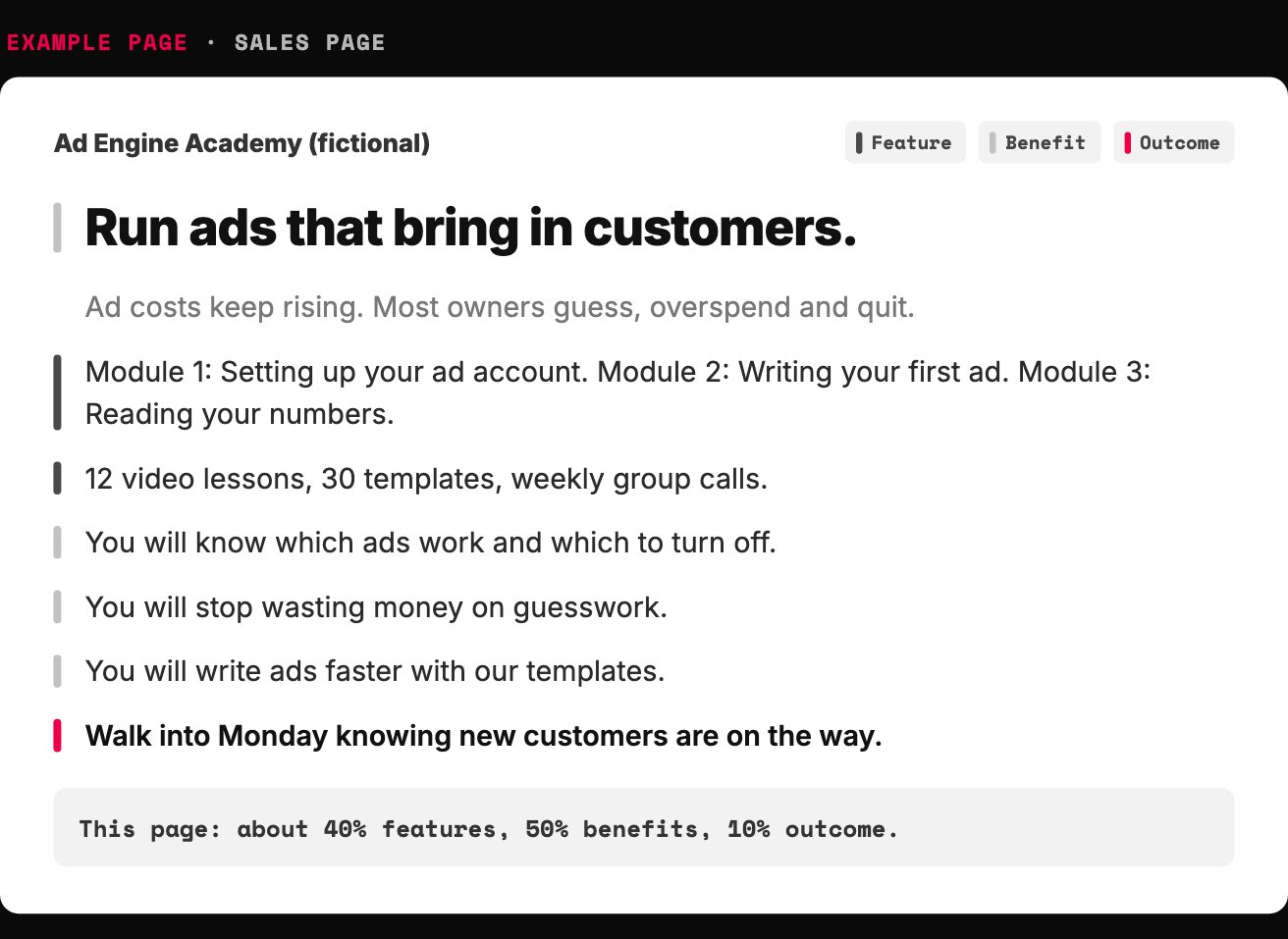
- Features: what is in the course. Easy to list, easy to skip.
- Benefits: what the features do. Better, but still about the course.
- The outcome: where the buyer ends up. One line out of eight.
- About 10 percent outcome. Our target is half or more.
Example page built for this article with a made-up brand
Find the outcome under the result: three lists
To find the outcome, write three lists. The primary outcome, the secondary outcomes, and the hidden payoffs.
The primary outcome is the main result the buyer wants. Secondary outcomes are the extras that come with it.
A hidden payoff is the feeling a person gets without noticing it. Psychology has a close cousin of this idea, called secondary gain.
We treat the hidden payoff as the real reason people buy. They feel it long before they can explain it.
Smoking shows how strong a payoff can be. Many older smokers started as teenagers, when a cigarette meant being cool and fitting in.
Campaigns like the Marlboro Man tied that feeling to a cowboy. Each cigarette hands back a little of the old feeling.
Feelings help memories stick. The most vivid memories tend to be emotional ones, so strong outcome copy often reaches back to a time the buyer remembers.
For example, a weight-loss page can promise pounds lost. Or it can promise the body you had at 24, and feeling in control again.
The second one is the outcome. The first is a number on a scale.
One warning. Some payoffs touch old pain, like hurt that sits behind a weight problem. Write those with care, or leave them out.
Three lists take you from the result to the feeling under it
- 1. Primary outcome The main result the buyer wants, in their words.
- 2. Secondary outcomes The extras that come with it.
- 3. Hidden payoffs The feeling they get without noticing. Usually the real reason they buy.
Our method.
A number on a scale is a result; feeling in control is the outcome
| Result | Outcome |
|---|---|
| Lose 20 pounds | Feel in control of your body again |
| Get a job at a game studio | Know you made it |
| Quit smoking | Feel free, not just less sick |
Examples for illustration.
The Trade-Anything Test: would they give up almost anything for this?
The Trade-Anything Test is a one-question check on an offer, run before you rewrite any copy.
Step 1: write the outcome at the top of the page, as the feeling under the result. Step 2: check that every section points at it.
Step 3: ask whether the buyer would give up almost anything to get that outcome. Step 4: if yes, keep going. If no, change the offer, not the words.
Why does it work? If people would trade almost anything for a result, they will trade money for it. Money is the easy part.
Be honest: the question is a stretch. Nobody gives up their family for a coaching program.
But dig deep enough, down to accomplishment or control or feeling young again, and people trade a lot. Time, habits, comfort and cash.
For example, people pay around $400,000 for a supercar. They are not paying for metal; they are paying for what the car says about them.
Back to the ads course page. Read it top to bottom and ask the question.
Nobody trades anything for module three.
Four steps test an offer before you touch the copy
- 1. Write the outcome At the top of the page, as the feeling under the result.
- 2. Check every section Does it point at that outcome? Cut or rewrite the ones that do not.
- 3. Ask the question Would the buyer give up almost anything to get this?
- 4. Act on the answer Yes: keep going. No: change the offer, not the words.
The Trade-Anything Test, as set out in this guide.
A no means the offer needs work, not the headline
| If the answer is yes | If the answer is no |
|---|---|
| Money is the easy trade | No wording will make them trade money |
| Spend half the copy on the outcome | Go deeper: find the feeling under the result |
| Then tighten features and benefits | Or change the offer: more outcome, less input, fewer steps |
Our decision rule.
Outcome first: half the page is now about where the buyer ends up
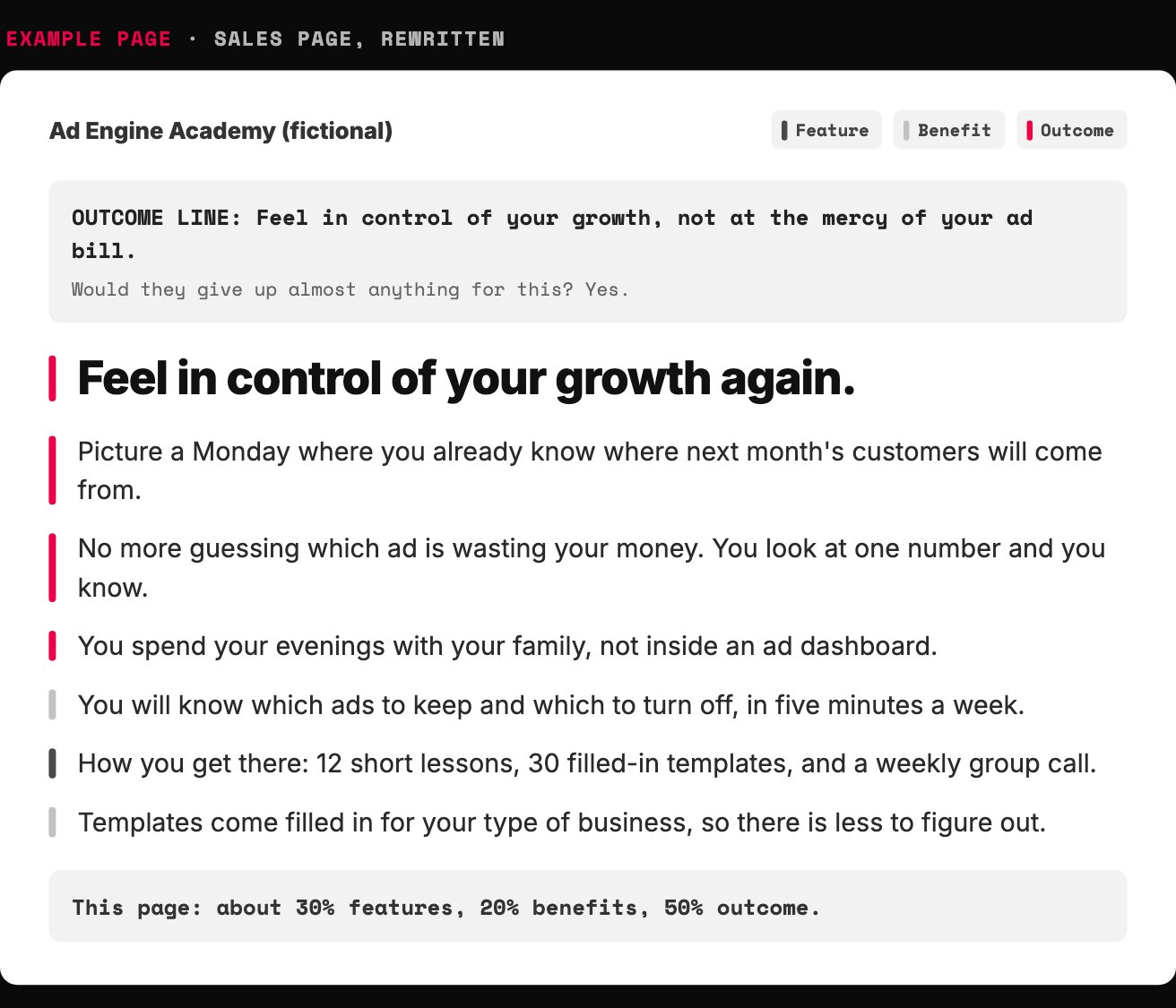
- Write the outcome first, as a feeling. Every section points at it.
- The Trade-Anything Test. A no here means change the offer.
- Half the page is now about where the buyer ends up.
- Features still appear, as support for the outcome.
- Less input from the buyer. That raises the value without touching the price.
Example page built for this article with a made-up brand
How do you make an offer worth more without cutting the price?
Turn three dials: maximize the outcome, minimize the input, and simplify the process. The price can stay where it is.
Input is everything the buyer has to put in. Hours, effort, decisions, things to learn.
People take the path of least effort whenever they can. So every hour you take off their plate adds value.
The check is a ratio. For every unit the buyer puts in, they should get at least three back.
Below 3 to 1, why would anyone bother? Picture a lottery where a $50 ticket wins $75. Nobody would line up.
Our take: the ratio has to be real. A fake 100 to 1 promise is how scams sell. The buyer's real average return, the expected value, is a loss.
The less the buyer has to do, the more you can charge. That is why a done-for-you service costs more than a course on the same topic.
Simplify means fewer steps between saying yes and getting the result. Every step you cut is one less place to quit.
Need the price itself? Read how to price your product from your buyer's income.
Below 3 to 1, nobody bothers
Output for every unit of input the buyer puts in
- $50 ticket that wins $75 1.5
- The minimum we use 3
- A strong offer 5
Worked example: $75 / $50 = 1.5. The 3 to 1 minimum is our rule; 5 to 1 is an illustration.
Raise the value of an offer without touching the price
| Dial | The question | Example |
|---|---|---|
| Maximize the outcome | Can the result be bigger, faster or more certain, and still true? | Add the setup the buyer would struggle with |
| Minimize the input | What hours, decisions or learning can you remove? | Templates filled in for them, not blank ones |
| Simplify the process | How many steps sit between yes and the result? | One onboarding call instead of five forms |
Our framework. Examples for illustration.
Pick the format by how much the buyer has to do
Pick the format by how much work the buyer puts in. Three formats cover most offers.
Done for you sits at the top price. You bring the time, skills and experience, and the buyer brings money and little else.
Done with you sits in the middle. Think coaching and group programs. The buyer does some of the work and learns as they go.
Do it yourself sits at the bottom. Think a course, a book or software. The buyer does all of the work.
As you move up, the buyer does less and an expert does more. So the outcome tends to rise, and the price can rise with it.
Offer not selling at its price? Try the next format up before you cut a dollar.
Same goal. Different work. Different price.
The less the buyer has to do, the more the format can cost
- Do it yourself Course, book or software. The buyer does all the work. Lowest price.
- Done with you Coaching or a group program. The buyer does some work and learns.
- Done for you An expert does the work. The buyer brings money. Highest price.
Our format ladder.
Where people get stuck selling outcomes
Stuck 1: good copy, wrong audience. The sign: you rewrite the page and sales barely move.
For example, one large company's high-ticket offer turned 43,200 ad clicks into 11 sales. That is about 0.025 percent, and more clicks would not fix it.
The cause was fit: the price did not suit the people clicking. The fix: check the offer first, then the audience, then the market.
Stuck 2: weeks spent hunting for a big idea. The sign: nobody cares until you find a clever angle. The cause: the product cannot deliver an outcome worth describing, so you are inventing one.
Fix the product. Not the headline.
Stuck 3: promising what you do not control. The sign: buyers blame you for results that depended on them. Be careful which outcome you promise, because buyers will hold you to it.
Describe the outcome the work is built for. Then say plainly what you control and what the buyer controls.
The law backs this up. The FTC's advertising guide for small businesses says claims must be truthful and backed by evidence, and we cover the rules in FTC compliance for marketing claims.
How to write a page nobody buys from, in four easy steps:
1. List every module. Call it value.
2. Spend three weeks hunting for a big idea.
3. Promise a result that depends on the buyer. Act surprised when it does not happen.
4. When sales stall, rewrite the headline. Then rewrite it again, because hell, it worked so well the first time.
Example: 43,200 clicks, 11 sales, and no copy fix in sight
- Ad clicks 43200
- High-ticket sales 11
- Clicks that became sales 0.025
Example from another business. Not our result, and not verified by us. 11 / 43,200 = 0.025 percent.
Three stuck points, and which one to fix first
| Stuck point | The sign | The fix |
|---|---|---|
| Good copy, wrong audience | Rewrites barely move sales | Check offer, then audience, then market |
| Hunting a big idea | Nobody cares without a clever angle | Fix the product, not the headline |
| Promising what you do not control | Buyers blame you for their part | Say what you control and what they control |
Our diagnosis.
Audit your sales page with AI: the copy-paste prompt
Paste the prompt below into your preferred AI, then paste your page. It measures the split, names the outcome, runs the Trade-Anything Test and checks the ratio.
It will not invent results. Every claim it writes uses only the proof you give it.
When it rewrites your subheads, make them carry the feeling too. Our guide to emotion-first subheadings shows how.
Want the theory behind the feeling? Read how words become pictures become feelings.
Paste into your preferred AI with your page copy. It asks three questions, then gives you the split, an outcome line, a yes or no, and a rewrite.
Act as a conversion copy editor. Audit one sales page with the Trade-Anything Test.

Ask me one at a time, with the example:
1. Paste the page copy. (Example: all the text from my course sales page)
2. Who buys it? (Example: owners of small gyms)
3. What results have buyers actually had, and what proof do I have? (Example: 3 clients added 20 members each in 90 days, written permission to quote them)

Then do this, and show your work:
- Label every sentence: feature (what is in the product), benefit (what a feature does) or outcome (where the buyer ends up, and the feeling that stands for). Report the split in percent. Target: about 30 features, 20 benefits, 50 or more outcome.
- Count "you" against "I" and "we". Flag it if "you" is not far ahead.
- List the primary outcome, the secondary outcomes and the hidden payoff (the feeling under the result). Write one outcome line for the top of the page.
- Trade-Anything Test: would this buyer give up almost anything for that outcome? Answer yes or no, and why.
- If no, suggest offer changes, not word changes: more outcome, less input from the buyer (hours, decisions, things to learn), fewer steps. Estimate output to input. Flag anything under 3 to 1.
- Say which format fits best: done for you, done with you, or do it yourself.
- Rewrite the opening and one section around the outcome line.

Rules:
- Use only results and proof I gave you. Never invent numbers, testimonials, deadlines or scarcity.
- Describe the outcome the offer is built for. Never guarantee it. Say what the buyer must do.
- Treat painful payoffs (weight, money, family) with care and respect.

Output:
Split: features % / benefits % / outcome %
You vs I and we:
Outcome line:
Trade-Anything Test: yes or no, and why
Output to input: about X to 1
Format:
Rewrite:
Next three actions: 1. 2. 3.
Run it this week
1. Paste your best-selling page into the prompt. Write down the split.
2. Put the outcome line at the top of the page. Rewrite or cut every section that does not point at it.
3. Ask the question out loud. If the answer is no, fix the offer before you touch the copy.
Remember the ads course page? It talked to the buyer the whole way. It just never told them where they would end up.
Once the page sells the outcome, build a stronger offer under it with how to create an offer from principles.
Features get scanned. Outcomes get bought.

Filip Kovacevic is the founder of Anar Agency in Phoenix. He spent five years running SEO, Meta ads, email, and content for medical practices across the United States, and now does the same work for healthcare, home-service, legal, and professional-service businesses, alongside AI implementation. More from Filip →
Talk it through in 15 minutes
Bring one question from this article. We will tell you what we would do, whether or not you hire us.
Book a 15-Min Chat →