How to Write Subheadings: Emotion First, Claims Down
To write subheadings for a sales page, make each one a feeling or a question that only the paragraph below can answer. A scanner reads it, cannot make sense of it alone, and reads on. Then turn your biggest claim down to a smaller true number, so the people you pulled in believe it.
A buyer who reads only your subheads reads 1 percent of your page
A buyer opens your sales page. She reads the headline. Then her eyes slide down the subheads, one after another, all the way to the price.
She never reads a paragraph. She reaches the order button, shrugs and leaves.
She did not reject your argument. She never saw it.
Most advice on how to write subheadings says to make each one sum up its section, so a scanner gets the gist. On a sales page, that advice lets the scanner skip your whole argument.
We fix it with one edit, the Subhead Pass. Emotion first: every subhead carries a feeling or a question that its paragraph must answer. Claims down: your biggest claim gets smaller and truer, so the people you pulled in believe it.
A buyer who reads only the subheads reads about 1 percent of the case
A long sales letter, and the share of it that lives in the subheads
- Words in a long sales letter 10000
- Words in all of its subheads 100
- Share of the argument a scanner reads 1
Worked example: 100 divided by 10,000. Typical sizes for a long letter, not a measured page.
Why summary subheads let scanners skip the sale
Most visitors scan. In a classic Nielsen Norman Group study, 79 percent of test users always scanned a new page. Only 16 percent read word by word.
So for most buyers, the subheads are the whole page. A crosshead is a subhead inside a long piece of sales copy.
Now do the math on a long sales letter. Say it runs 10,000 words. Add up every word in its subheads and you might reach 100.
That is 1 percent of the argument. A buyer who reads only the subheads decides on 1 percent. Would you sign a lease after reading 1 percent of it?
Summary subheads are built for exactly that buyer. Each one says what its section holds, so nobody has to open it.
A theme-park fast pass lets you skip the line. That is great on a ride. A summary subhead is a fast pass that lets buyers skip your argument.
Even the researchers behind the F-shaped reading pattern call that kind of skimming bad for users and for businesses. A summary subhead gives away the ending, so nobody reads the rest.
Most people scan a new page; few read every word
Share of test users in a web reading study
- Always scanned a new page 79
- Read word by word 16
Source: Nielsen Norman Group, How Users Read on the Web (Jakob Nielsen, 1997), read 2026-10-17.
A summary subhead lets the scanner skip; a pull subhead sends her in
| Summary subhead | Pull subhead |
|---|---|
| Says what the section holds | Points at something only the section explains |
| Makes sense on its own | Needs the paragraph to make sense |
| Buyer reaches the price having read about 1 percent | Buyer reaches the price having read the case |
| Right for help pages and lookups | Right for sales letters, scripts and long emails |
Our comparison.
The Subhead Pass is one edit of a long sales page. Write the offer down first. Rewrite every subhead so it carries a feeling or a question that only its own paragraph answers, and close that loop in the same section.
Turn the biggest claim down to a smaller true number, or set it beside a figure the buyer trusts, and never name the doubt. Point pain at the group, and lift the reader before the price.
Write each subhead so it only makes sense after the paragraph
Write each subhead so a scanner cannot understand it alone. She stops, wonders what it means, and drops into the paragraph to find out.
Here is the difference. A giveaway subhead says what the section hands over: "That is why we built this checklist for you." Nothing is left to find out.
A pull subhead points at something she has not read yet: "And that is what we want to hand you." Hand you what? She has to read to know.
Three kinds of pull work well. The first is an unnamed thing, like the "that" above. The second is a reason still to come, like "So why are we telling you this?"
The third is a feeling, like "Here is the part that bothers us most." What bothers them? She goes back into the copy to find out.
Each one opens a small question. The paragraph under it must answer that question, and fast.
For example, one sales video and long letter written this way converted at about 6 percent. Its writer says it worked because buyers read the whole argument before the offer. We have not seen the data.
The goal is not a clever subhead. The goal is a buyer who reads 9,000 of your 10,000 words.
And short copy is not the cure. Copy is rarely too long. It is usually too boring.
Real pull subheads make the scanner ask a question; the giveaway answers it
| The subhead | What the scanner thinks | What she does next |
|---|---|---|
| "Blueprint of sorts that he followed step by step." | A blueprint for what? | Reads on |
| "And today, that's what I want to give you." | Give me what? | Drops into the paragraph |
| "So why I'm sharing this with you" | Why are you? | Reads the reason |
| "And here's the bit that disturbs me most." | What disturbed you? | Reads to find out |
| "That's why I'm giving you this blueprint." (the giveaway) | Got it | Skips ahead |
Example subheads from one sales video and letter that converted at about 6 percent, by its writer's account. Example numbers from other businesses. Not our results, and not verified by us.
Same paragraphs, two kinds of subhead: only one makes a scanner read
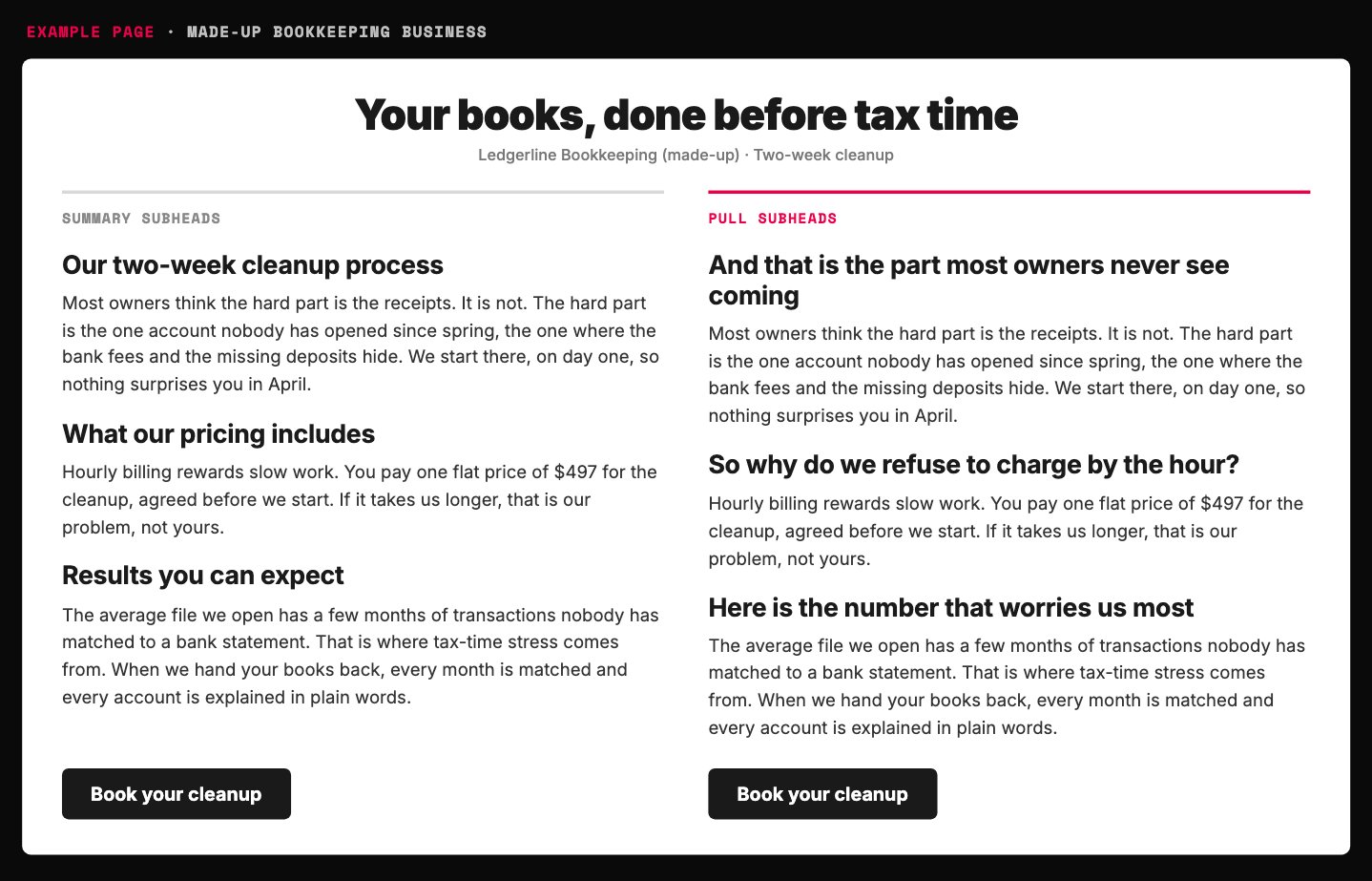
- A summary. The scanner gets the gist and skips the paragraph.
- What part? She has to read the paragraph to find out.
- A reason still to come. The paragraph pays it off in three lines.
- A feeling. Worry pulls her back into the copy.
- Same page, same offer. Only the right column gets its argument read.
Example page built for this article with a made-up brand
Put the feeling in the subhead, not the facts
Emotion first means the subhead makes the reader feel something before it tells her anything. It might be worry, curiosity, relief, or a small itch to know more.
Facts in a subhead answer the question. Feeling keeps it open.
Why does this matter so much? Because a reader who stops reading starts thinking about other things. She remembers the laundry.
She does not come back.
Feeling comes from true detail, not from adjectives. For example, one page for retirees asked how many cups of tea they get from one tea bag. Many retirees reuse tea bags, so readers nodded before the next line.
Before each subhead, ask one question. What would this reader need to hear from us to believe the next part? It is not about what we want to tell her.
Then write the subhead that makes her want that answer. How words turn into pictures and feelings is in desire is a gap.
One loaded word can sour a whole section. "Sorry" from an expert sounds like guilt, and "share" feels warmer than "show". More in what not to say in copy.
Facts in a subhead answer the question; a feeling keeps it open
| Fact subhead | Feeling subhead |
|---|---|
| Our cleanup takes two weeks | The two weeks that change how tax time feels |
| We reconcile every account | Here is the account that worries us most |
| Pricing starts at $497 | Why we refuse to charge by the hour |
Invented bookkeeping examples to show the shape. Not from a real page.
When should a subhead just be a label?
Use a plain label when the reader came to find a fact. Use a pull subhead when the reader must follow an argument to decide.
Public writing guides say the opposite, and they are right for their kind of page. Nielsen Norman Group asks for meaningful subheads, not clever ones. Its advice on headlines says a heading must make sense when it stands alone.
That fits help pages, pricing tables, menus and search results. A person hunting for a refund policy wants "Refunds", not a riddle.
A sales letter is different. Nobody lands on it to look up a fact. They land on it to decide, and the decision needs the argument.
This guide uses plain takeaway headings on purpose. You came to learn a method, and you may want to jump to a step.
Our rule: use labels when people look things up, and pull subheads when you need to persuade.
Aim for top right on a sales page and bottom left on a help page
- Dramatic summary Still a fast pass. It feels good and gives the answer away.
- Pull subhead The goal on a sales page. The scanner has to read to understand it.
- Label Right for help pages, pricing tables and menus.
- Riddle No feeling and no sense. Cut it.
Our model.
Match the subhead to the reason the reader came
| Page | Why the reader came | Subhead style |
|---|---|---|
| Help article | To find one fact | Plain label |
| Pricing table | To compare options | Plain label |
| A guide like this one | To learn a method and jump to a step | Plain takeaway |
| Long sales letter | To decide whether to buy | Pull subhead |
| Video sales script, on-screen titles | To decide whether to buy | Pull subhead |
| Long sales email | To decide whether to click | Pull subhead |
Our rule. Label advice: Nielsen Norman Group, How Users Read on the Web and Headings Are Pick-up Lines.
Is a pull subhead just clickbait?
It is clickbait only when the paragraph fails to pay it off. Clickbait is a headline built to get a click, often by promising more than the page delivers.
A loop is a question the reader wants answered. A pull subhead opens one, and the next few lines close it.
The common failure is the dropped loop. A page's opening mentions a team of prize-winning scientists, and they never appear again.
The reader notices. Then she stops trusting every other subhead.
How to lose a scanner in four easy steps:
1. Sum up every section in its subhead, so nobody needs to read it.
2. Promise a secret. Deliver advice from a fridge magnet.
3. Mention the prize-winning scientists once. Never again.
4. Write "I know this sounds too good to be true" and hope like hell.
Every loop you open is a small debt. Pay it back in the same section.
Every loop a subhead opens must close in the same section
- Open The subhead raises a small question.
- Read The scanner drops into the paragraph.
- Close The paragraph answers it, fast.
- Trust She trusts the next subhead enough to stop again.
Our model.
Turn your biggest claim down, not up
Claims down means smaller claims, not claims moved lower on the page. A smaller true number often earns more belief than a huge one.
For example, one copy coach did about 3,500 copy reviews in a year, but on stage she gave a smaller, exact count: 968. A precise 968 sounds counted. A big 3,500 sounds like a boast.
The smaller number must still be true. Saying less than you could is called understatement. It works because the reader can tell you held back.
Buyers also judge a number against one they already know. Psychologists call this anchoring.
For example, one fund's buyers compared every result with big funds earning about 13 to 15 percent a year. The fund could show trades that returned 1,000 percent. Those charts would have scared its buyers off as too risky.
So the page showed results of 15 to 20 percent, close to the number buyers trusted. Money and health claims carry extra legal rules. A smaller claim is not automatically a legal one.
Public research agrees. In the same Nielsen Norman Group study, plain, objective wording scored 27 percent better on usability than boastful marketing copy. Users trusted a site less when they could see it exaggerate.
One more rule: never write "this sounds unbelievable." The reader was not thinking it. Now she is.
If a claim seems to need that line, go back up the page. Find why it sounds hard to believe, and fix it there with detail or proof. The FTC expects ad claims to be truthful and backed by evidence anyway.
How to stack that proof is in the proof stack. The rules on claims that get sellers in trouble are in the FTC risk drivers.
Plain, objective wording beat boastful copy by 27 percent
Usability gain over a boastful marketing version of the same facts
- Boastful copy (the baseline) 0
- Objective language 27
- Scannable layout 47
- Concise text 58
- All three combined 124
Source: Nielsen Norman Group, How Users Read on the Web (Jakob Nielsen, 1997), read 2026-10-17. Measures usability, not sales.
Two claims that were turned down to be believed
| The case | Could have said | Said instead | How sure |
|---|---|---|---|
| One copy coach's year of reviews | About 3,500 reviews | 968 reviews, a true but smaller number | Example; her own count |
| One fund selling to hedge-fund buyers | Trades that returned 1,000 percent | Results of 15 to 20 percent, near the 13 to 15 percent buyers trusted | Example; not verified |
Example numbers from other businesses. Not our results, and not verified by us.
Most people scan, and they trust a page less when it exaggerates
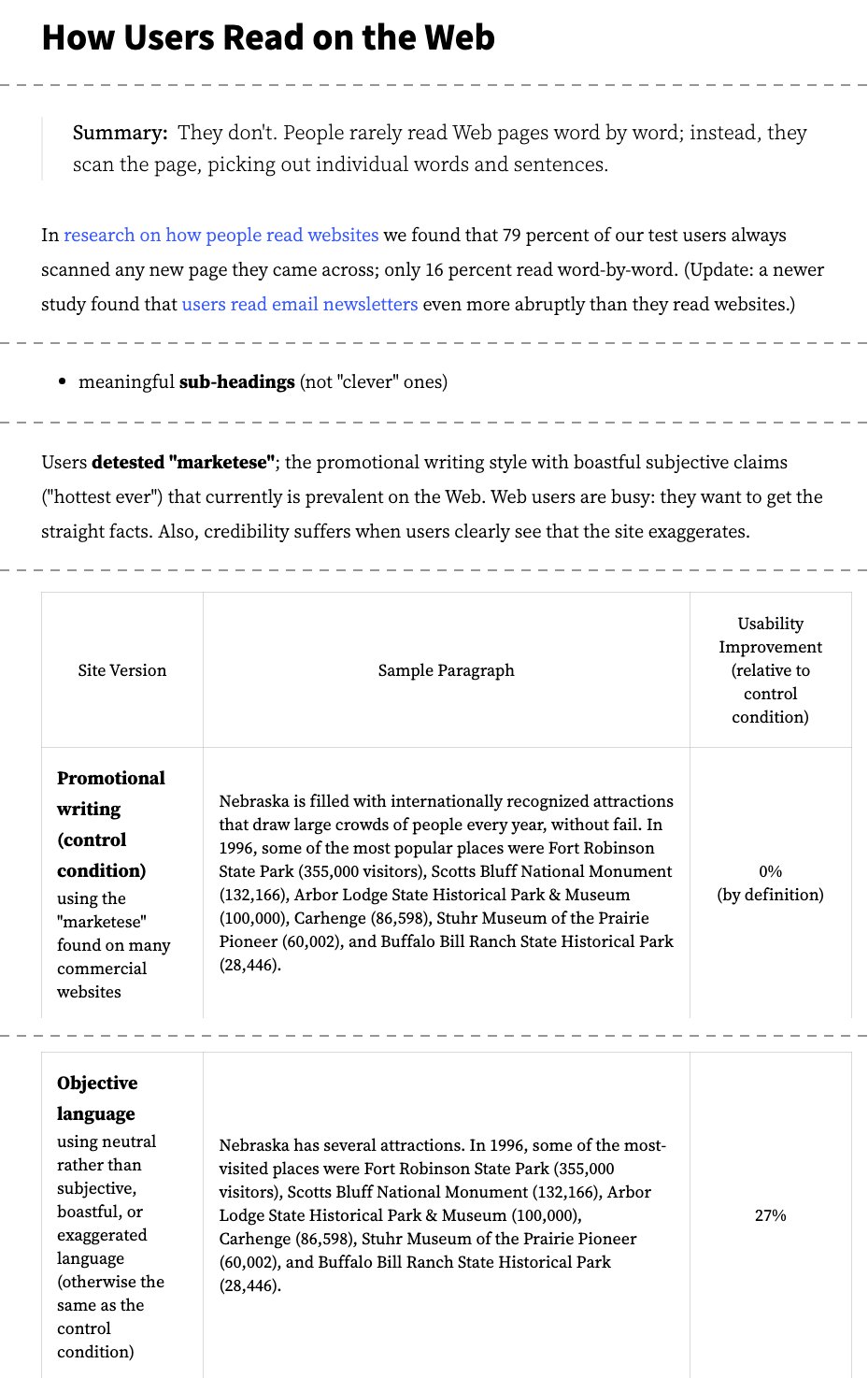
- Most people scan. For them, your subheads are the page.
- Right for pages people search for facts. Sales pages need subheads that pull.
- Big claims cost trust. Turn them down.
- Plain, objective wording: 27 percent better usability than boastful copy.
Screenshot of Nielsen Norman Group, How Users Read on the Web, taken 2026-10-17
Keep the feeling honest, and lift the reader before the price
Emotion first does not mean pain first. Point a painful line at the group, not at the reader.
Compare two lines. "You are hiding from your own books." "Many owners at this stage avoid their books for months."
The second line lets her decide if she is one of them. The first one starts a fight.
Go easy on shame. A reader who feels judged gets defensive, then leaves.
Mood can rise and fall across the page. But it must climb before the offer.
Make her feel so good that she needs nothing, and she will not buy. Make her feel hopeless, and she will not buy either.
Aim for the middle, and end the section before the price on hope. If you interrupt someone's day, you owe them a way out of the problem.
The doubts she will not say out loud need answers too. That method is in assumptive questions.
Point the painful line at the group, not at the reader
| Aimed at the reader | Aimed at the group |
|---|---|
| You are hiding from your own books. | Many owners at this stage avoid their books for months. |
| You are embarrassed by your numbers. | Plenty of owners feel a knot in the stomach before tax time. |
| You keep putting this off. | Most people put this off until a deadline forces it. |
Invented examples to show the shape.
Mood can dip in the middle, but it must climb before the price
- Recognition Opening She sees her own situation.
- The low point Middle What the problem costs, aimed at the group.
- Hope Before the price A way out exists, and it works for people like her.
- The way out The offer Read by someone who feels it could work.
Our model.
Run the Subhead Pass in seven steps
The Subhead Pass is one edit of a long sales page. It covers the subheads, the biggest claim and the mood before the price.
1. Write the offer down first. Every subhead points toward it, so the page never wanders off.
2. Copy every subhead into a list. Read the list alone, top to bottom.
3. Mark every giveaway. Any subhead you understand without its paragraph is a giveaway.
4. Rewrite each giveaway as a pull. Use an unnamed thing, a reason still to come, or a feeling.
5. Check that every loop closes. Answer each subhead in its own section, or cut it.
6. Turn the biggest claim down. Use a smaller true number, or set it beside a figure the buyer trusts, and delete any "sounds unbelievable" line.
7. Lift the section before the price. End it on hope, not on the problem.
Video scripts get the same pass. The on-screen titles in a video sales letter are subheads too.
Seven steps from a page people skim to a page people read
- 1. Write the offer down Every subhead points toward it.
- 2. List the subheads Read them alone, top to bottom.
- 3. Mark the giveaways Any subhead that makes sense without its paragraph.
- 4. Rewrite as pulls An unnamed thing, a reason still to come, or a feeling.
- 5. Close every loop Answer each subhead in its own section.
- 6. Turn the claim down Smaller and true, or beside a trusted figure. No "sounds unbelievable".
- 7. Lift before the price End the last section on hope.
The Subhead Pass, in seven steps.
Run the Subhead Pass with AI
Paste the prompt below into your preferred AI. It asks for your offer, your reader, your subheads and your biggest claim. Then it rewrites the subheads and turns the claim down.
It never invents a number. When it needs one, it asks you.
Long ads get scanned the same way. See why long ads still convert.
Paste into your preferred AI. It asks for your offer, reader, subheads and biggest claim, then rewrites the subheads and turns the claim down.
Act as a sales-page editor. Run the Subhead Pass on my page.

Ask me one at a time, with the example:
1. What is the offer at the end of the page? (Example: a $497 bookkeeping cleanup, done in two weeks)
2. Who reads it? (Example: owners of small trade businesses who do their own books)
3. Paste the page, or just its subheads in order.
4. My biggest claim, and the true number behind it. (Example: "saves 11 hours a month"; true range 6 to 14)

Then edit:
1. Page type first. If readers come to look up a fact (help page, pricing table, policy), keep plain label subheads and stop.
2. List every subhead alone. Mark any that a scanner understands without the paragraph below. Those are giveaways.
3. Rewrite each giveaway so it points at something only its paragraph explains: an unnamed "that", a reason still to come, or a feeling. Never say what the section hands over.
4. Each subhead must be answered in its own section. If a loop never closes, cut it.
5. Find the biggest claim. Offer a smaller true version, or set it beside a figure the buyer already trusts. Never invent a number. If you need one, write [CONFIRM: what you need].
6. Delete any line like "sounds unbelievable" or "too good to be true". Name the earlier line that should prove the point instead.
7. Pain lines point at the group ("many owners at this stage"), not at "you". No heavy shame.
8. The section before the price must end on hope.

Output:
A. Each subhead: old, new, and the paragraph that answers it.
B. The claim: old, turned down, and the proof it needs.
C. Lines to delete, and why.
D. Every [CONFIRM] item, numbered.Do this on one page this week
1. Pick your longest sales page. Copy its subheads into a list.
2. Run the prompt. Rewrite every giveaway and one claim.
3. Read the new list alone. If it makes you want to read the paragraphs, ship it.
Remember the buyer who slid down your subheads to the price? Next time, each subhead stops her and sends her into the paragraph.
Want a second pair of eyes? Send us the page.
A good subhead opens the door. It never gives the tour.

Filip Kovacevic is the founder of Anar Agency in Phoenix. He spent five years running SEO, Meta ads, email, and content for medical practices across the United States, and now does the same work for healthcare, home-service, legal, and professional-service businesses, alongside AI implementation. More from Filip →
Talk it through in 15 minutes
Bring one question from this article. We will tell you what we would do, whether or not you hire us.
Book a 15-Min Chat →