How to Write a Hook: Change Plus Hope in Four Questions
To write a hook, find a belief your buyers hold that is wrong, prove it, and show why that is good news. A good hook holds two things: a change and hope. Four questions find it: what are they stuck on, what keeps them stuck, what has to break, and what lets them move.
How do you write a hook people remember?
June 1995. A man on trial tries on a leather glove in front of the jury. It does not seem to fit.
Later, his lawyer gives the jury one line: "If it doesn't fit, you must acquit." Acquit means find him not guilty. Decades on, people still quote it, as the record of the trial shows.
That line is a hook. It works not because it rhymes, but because it changed what a whole room believed.
Most advice on how to write a hook stops at the first line of an ad. Make it bold, add a number, ask a question.
Our take: that advice fills the feed with bold lines nobody remembers. Bold is not the point.
Here is the short version. A hook is the main idea of your whole campaign, and it shows the reader that something they believed is wrong.
Then it shows them why that is good news. You find it with four questions, and you cheaply test different ways to say it.
A hook is the campaign's main idea, not a clever first line
| What most people call a hook | What a hook is |
|---|---|
| The first line of one ad | The one idea every ad, email and page repeats |
| Bold words and a number | A belief the reader held, shown to be wrong |
| Written in a rush before launch | Found with four questions, before any copy |
| Judged by how clever it sounds | Judged by cost per click against other openings |
Our method
A hook is the main idea of the whole campaign, not just the first line
A hook is the one idea your whole campaign repeats. The ads, the emails, the video script and the sales page all circle it.
Outside marketing, people call this an advertising campaign. It is one idea, said a hundred ways.
Why does that matter? Every sale follows a short chain. People notice something, then they pay attention, then they find a reason to pay you.
The hook is what makes them notice. It only works if the same idea runs through every step after that.
So the opening line of an ad is not the hook. It is one way of saying the hook.
Change the opening and keep the idea, and you have a new ad. Change the idea, and you have a new campaign.
There is a bonus. Once you have the hook, the rest of the copy gets easier, because every line has one job: support the idea.
The short line under your offer is the tagline. It is the hook, cut down to fit on a sticker.
Every piece of the campaign says the same hook
- Ad openings Ten ways to say the hook before 'See more'
- Headlines The hook, shorter
- Emails Subject lines and stories built on the same idea
- Video script The first seconds say the hook out loud
- Sales page The headline repeats it; the body proves it
- Tagline The hook cut down to a sticker
Our method
One hook, said in the ad, the email and the page
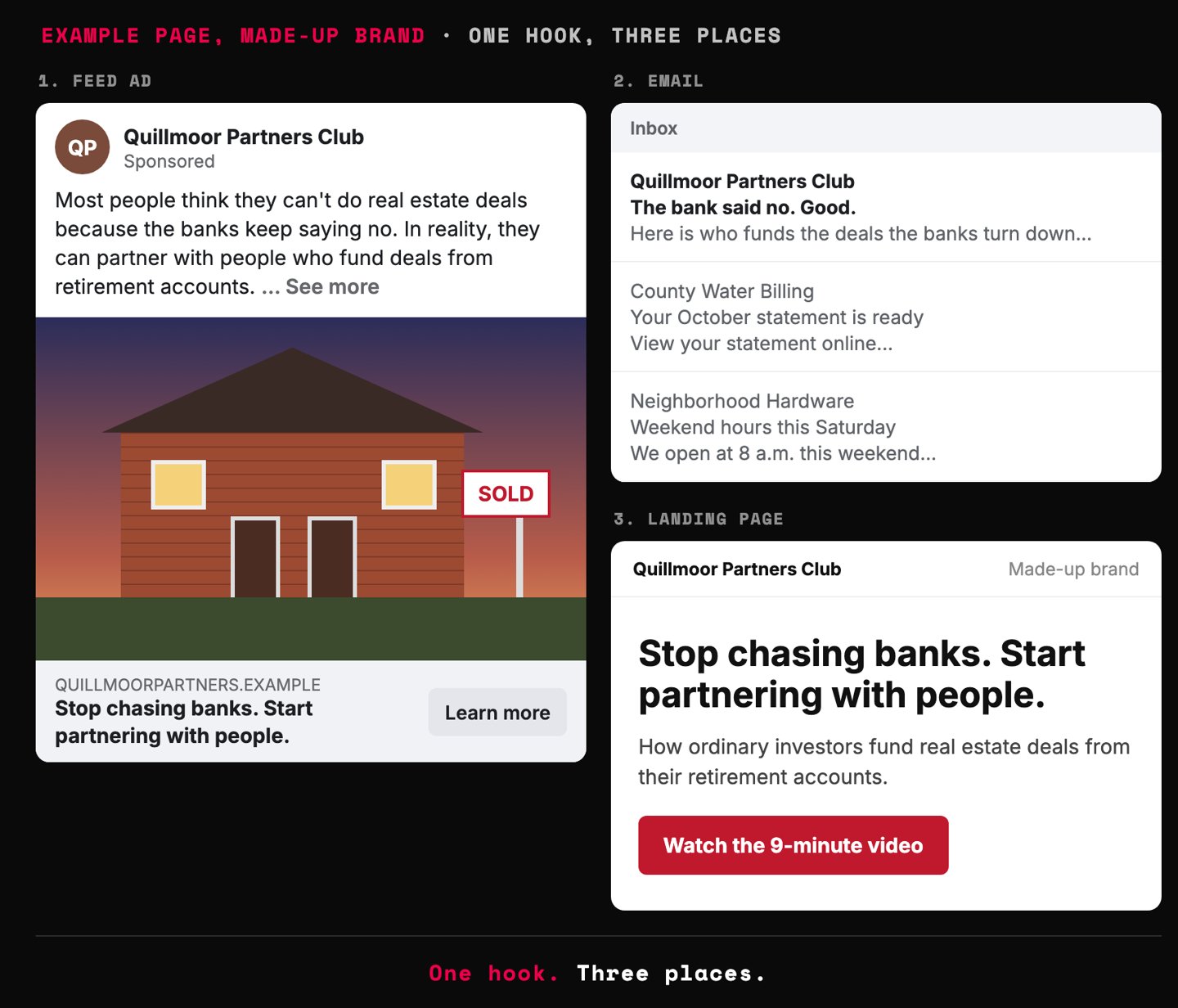
- The ad opening says the hook out loud: the stuck belief, then the new way.
- Same idea in the email subject line.
- The page headline is the tagline. Same idea again.
- The tagline sits under the offer everywhere it runs.
Example page built for this article with a made-up brand (Quillmoor Partners Club).
The Four-Question Hook finds the main idea of a campaign. Answer four questions in writing: what is your buyer stuck on, what belief keeps them stuck, what has to break (provable with outside evidence), and what new combination lets them move. Turn the answers into one plain sentence that names the stuck belief, then the new way.
Check that it holds a change and hope. Then say it five or ten ways and test the openings against each other on cost per click.
Every hook needs two things: a change and hope
A good hook holds a change and hope. The change is something different from what the reader assumed.
The hope is what could be, should be or can be because of that change. A hook needs both, every time.
Why change? People notice difference. Anything that stays the same fades out, which is why camouflage works.
Psychologists call the head-turn toward something new the orienting response. The odd item in a list is the one people remember, called the von Restorff effect.
Why hope? Change without hope is just bad news. People already weigh bad news heavily, a pattern called negativity bias.
Give them bad news with no way out and they scroll on to protect themselves. Can you blame them?
You have seen the hopeless version: "AI will replace copywriters in two years, so buy my AI course."
It takes away your future, then asks for your card. That is not a hook. That is a threat with a checkout page.
Hope is not hype either. Nobody needs a promise that it "spits cash on demand." Grown buyers roll their eyes at that.
Hope only needs the reader to see that the change opens a door. Our guide to why all content is about change goes deeper on the change part.
Only change plus hope makes a hook
- Empty promise Sounds nice, says nothing new. Scrolled past.
- Hook Something they believed is wrong, and that is good news.
- Wallpaper Nothing new, nothing to gain. Invisible.
- Bad news Something changed and it hurts. They look away.
Our method
Find the one argument your market agrees on, then break it
The strongest change is a break in what the whole market believes. Every market is held together by one argument. Everyone repeats it, and it keeps people stuck.
Online courses repeat "you need a webinar." Copywriters repeat "raise the conversion rate." Dieters repeat "count your calories."
Break that argument with proof, and the market asks a new question: what do we think now? Whoever answers first owns the conversation.
The glove did exactly that. The jury believed something simple: the glove found at the scene was his, so it should fit him.
Then it did not seem to fit. The argument fell apart in front of them.
Your break must be provable with outside evidence. Without proof, you are just disagreeing to get attention. Buyers spot that fast.
Take the argument that you must raise the conversion rate, the share of visitors who buy. Cut your price in half and more visitors will buy. You will also make less money, and one line of math proves it.
For example, one retirement-planning business ran an ad that broke its market's belief that safe, low-return savings build wealth. The ad said the real risk was lost years, not lost money.
The business reports its monthly revenue went from about $40,000 to $112,000. The new ad opening was the only change.
We go deeper on this in argue against the story your market believes.
Every market repeats one argument. The hook breaks it with proof
| Market | The argument everyone repeats | The break, with proof |
|---|---|---|
| Online courses | You need a webinar | A webinar that worked for someone else came with their list, offer and budget |
| Copywriting | Raise the conversion rate | Cutting the price raises conversion and lowers profit |
| Retirement planning | Safe, low-return savings build wealth | Low returns can cost years you cannot get back |
| Real estate investing | Only banks fund deals | Some retirement accounts can buy real estate |
| A murder trial, 1995 | His glove, so it must fit | It did not seem to fit, in front of the jury |
Examples. Trial facts: Wikipedia, O.J. Simpson murder case
Example: one new ad opening, $40,000 to $112,000 a month
One retirement-planning business's monthly revenue, before and after an ad that broke its market's argument
- Before the new opening 40000
- After the new opening 112000
Example: the business's own reported numbers, not our data and not verified by us
How to write a hook: answer four questions in writing
Here is the method we use. Answer four questions, in order, in writing. Keep the answers plain.
What are they stuck on? Use the word stuck, not problem. A problem is a thing they have; stuck is a state they are in, and states can change.
What keeps them stuck? A belief they hold to be true. Answer it the way they see it, not the way an expert would.
What has to break for them to move? The one part of that belief you can prove wrong with outside evidence.
What new combination lets them move? The new mix, like a new partner or a new tool, that makes the break useful.
Then turn the four answers into one plain sentence. Paste them into your preferred AI and ask it to explain the idea simply, in one sentence. Then ask for a short tagline to put under your offer.
Notice what the sentence does. It names the stuck belief out loud. Readers have to see their own belief before they can watch it break.
For example, take a real estate investing offer. Stuck on: they cannot get deals funded. What keeps them stuck: the belief that only banks fund deals.
The break: some retirement accounts can buy real estate, which anyone can check. The new combination: partner with ordinary people who invest that way.
The sentence: "Most people think they can't do real estate deals because the banks keep saying no. In reality, they can partner with people who fund deals from retirement accounts."
The tagline is short: "Stop chasing banks, start partnering with people." Seven words. It fits on a sticker.
Four questions, in order, in writing
- 1. What are they stuck on? Use 'stuck', not 'problem'. Stuck is a state, and states can change.
- 2. What keeps them stuck? The belief they hold to be true, in their words.
- 3. What has to break? The part of that belief you can prove wrong with outside evidence.
- 4. What lets them move? The new combination that makes the break useful.
- Then: one sentence, one tagline Name the stuck belief, then the new way. Cut it down for the tagline.
Our method
The four questions, run on two hooks
| Question | The glove | Real estate offer |
|---|---|---|
| Stuck on | The jury believes he is guilty | They cannot get deals funded |
| What keeps them stuck | His glove was found at the scene | The belief that only banks fund deals |
| What has to break | The glove did not seem to fit him | Some retirement accounts can buy real estate |
| What lets them move | If it doesn't fit, you must acquit | Partner with people, not banks |
| The line | "If it doesn't fit, you must acquit." | "Stop chasing banks, start partnering with people." |
Trial facts: Wikipedia, O.J. Simpson murder case. Real estate: example offer
What makes a good hook? One the reader cannot argue with
A good hook is one the reader cannot reject in their head. Small word choices decide that.
Skip yes-or-no questions. Ask "Is your bathroom safe?" and most people think "yes" in half a second, then scroll on.
Ask how they would know instead. "How would you know if your bathroom was safe?" A how-question has no quick answer.
Soften the absolutes. "All diets fail" invites "not mine." "Diets often fail" lets the reader nod.
Small words like often and can are hedges. They keep the door open without sounding weak.
Use -ing verbs for the stuck state. "Struggling" says it is happening now. "Struggled" says it is over.
Call people out by their situation, not a label. "For anyone whose back pain keeps coming back" beats "Attention, seniors."
Our take: most hooks die from one lazy word, not a lack of genius.
For the words that match where your buyer is, see before-words and after-words. For the beliefs that stop a sale, see the three beliefs that stop a buyer.
Small word changes stop the reader from thinking 'not me'
| Easy to reject | Hard to reject |
|---|---|
| Is your bathroom safe? | How would you know if your bathroom was safe? |
| All diets fail. | Diets often fail, and here is why. |
| People who struggled with back pain | For anyone still struggling with back pain |
| Attention, seniors | For anyone whose back pain keeps coming back |
| Spits cash on demand | Here is what changed, and why it helps you |
Example lines written for this article
A how-question gives the reader no quick way out
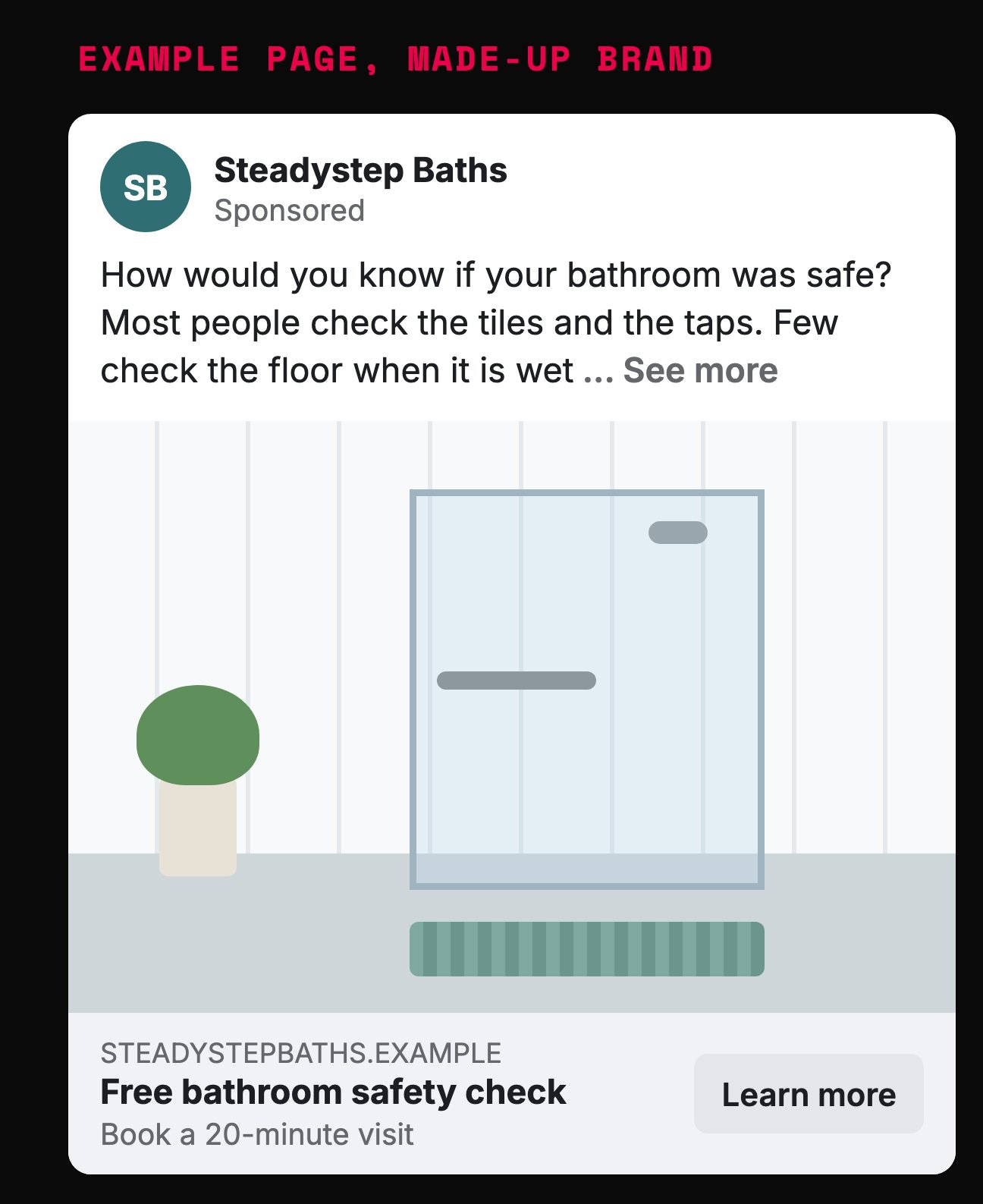
- A how-question. A yes-or-no question gets a quick answer and a scroll.
- It names what the reader already does, then shows the gap.
- Everything above this cut is the opening. Test ten versions of it.
- The headline repeats the same idea. No countdown, no fake scarcity.
Example page built for this article with a made-up brand.
Make ten hooks from one by changing what they are stuck on
One method can give you a whole list of hooks. Keep the market. Change only the answer to the first question.
Different groups in the same market are stuck on different things. Some owners are stuck on ads that get likes but no sales. Others cannot write copy at all.
Ask your preferred AI: "If someone is stuck on this, what else could they be stuck on?" Then run the four questions again for each answer.
Each answer becomes its own ad, email or video. Same method. New hook.
You can stretch it further. Ask what the next ten problems are after this one.
That list can become an email series, or a whole line of offers.
Then say each hook five or ten ways. Same idea, new words. That is how one campaign fills a month of ads without going stale.
Example: one market, three stuck points, three hooks
Same audience: owners who run their own ads. Only the first answer changes.
| Stuck on | What keeps them stuck | Hook idea |
|---|---|---|
| Ads get likes but no sales | "I need a bigger budget" | Likes come from the wrong people. More budget buys more of them. |
| Cannot write ad copy | "Good copy takes talent" | Good copy starts with four written answers, not talent. |
| Every test burns money | "Testing is expensive" | Ten openings can be tested for the price of one ad. |
Made-up example to show the method
How many hooks should you test? About ten, against each other
Test about ten openings at once and judge them against each other on cost per click. The opening is the text people see before the post cuts off.
Build ten ads in one ad group. Same image, same headline, same body. Only the opening changes.
Show them only to people who do not know you yet, in the feed. Leave out anyone who already knows you: site visitors, page fans, your email list.
Why so strict? People who already know you make a weak opening look strong. Then you spend more on the wrong one.
Stop each ad at 1,500 impressions with an automatic rule. An impression is one time the ad is shown. Spend flows to the ads still running until all ten are off.
The budget is simple math: openings times 1,500, times your cost per thousand impressions, divided by 1,000. Ten openings at $30 per thousand comes to $450.
Spread it over three to four days, about $150 a day. Start all ten together, once every ad is approved.
Better still, run two rounds. Stop each ad at 750 impressions, then turn them back on and run to 1,500.
Two rounds spread the spend across days. One lucky Tuesday cannot pick your winner.
Then keep the two or three with the lowest cost per click. Is that certainty? No, it is picking the best horse to bet on, cheaply.
Tight budget? Test five openings, or stop at 1,000 impressions each. Do not go much below 500 impressions.
Video works the same way. Keep a video that sells, and film five to ten new opening shots for it.
When a winning ad stops working as well, keep the body and write new openings and images. For example, one advertiser kept a single body copy running for months that way.
For the full method of testing one thing at a time, see one variable at a time. To read every number after the click, see reading ad data.
Example: ten openings cost about $450 to test at $30 per thousand impressions
Test budget = openings x 1,500 impressions x cost per thousand impressions / 1,000
- 3 openings 135
- 5 openings 225
- 8 openings 360
- 10 openings 450
Method math at an example $30 cost per thousand impressions. Use your own recent figure
Two rounds over about four days, then keep the best
- Ten ads, one ad group Before launch Same image, headline and body. Start them together once all are approved.
- Each ad to 750 impressions Round 1 An automatic rule turns each one off as it gets there.
- Back on, each to 1,500 Round 2 A second rule stops them again. If two are close, run them to 3,000.
- Keep the best two or three Day 3 to 4 Lowest cost per click wins. Roll them out with your best images and videos.
Our method
Where people get stuck writing hooks
Four stuck points come up again and again. Each has a symptom, a cause and a fix.
Flat answers: the hook reads like a summary, because the answers to the four questions were generic. The fix is to answer in the buyer's words, from where they stand.
The big-idea hunt: weeks of brainstorming, and no ad goes live. The fix: look at the product, say plainly what it does, and run the four questions on that.
Testing hooks before the offer works: every opening loses, because no opening can rescue an offer that does not sell. Prove the offer first, as in how much to spend on ads for a new offer.
Picking a winner after one sale: one or two sales is not enough data. Judge openings on cost per click, against each other.
How to waste a good offer in four easy steps. Step one: hunt for a big idea for three months. Step two: write ten bold first lines about nothing.
Step three: ask your buyers yes-or-no questions, so they can say no. Step four: test it all on your warm list and call the winner genius.
Congratulations. You built a hell of an expensive guess.
Four ways hook writing goes wrong, and the fix for each
| Stuck point | Symptom | Fix |
|---|---|---|
| Flat answers | The hook reads like a summary | Answer in the buyer's words, from where they stand |
| The big-idea hunt | Weeks of brainstorming, no ad live | Say plainly what the product does, then ask the four questions |
| Hooks before the offer | Every opening loses | Prove the offer and the body first |
| Winner off one sale | Today's winner loses tomorrow | Judge openings on cost per click, against each other |
Our method
Test openings third, after the offer and the body work
- 1. The offer Does anyone buy it at all?
- 2. The body copy Does one version sell at a cost you can live with?
- 3. The openings Which of ten ways to say the hook gets the cheapest clicks?
- 4. The audiences Which groups meet your cost target? Keep every one that does.
Our method
Write your hook with AI
The prompt below runs the whole method. Paste it into your preferred AI and answer six questions.
It gives you a hook sentence, a tagline and ten openings to test. It never invents proof; if your break has no evidence, it says so.
This week: first, run the prompt on your best-selling offer. Second, pick the hook that names a belief your buyers really hold. Third, test ten openings against each other.
Want a second pair of eyes? Send us your four answers. You are not signing up for anything.
The glove line still works for one reason. It showed a room full of people that their argument did not fit.
Every market has a glove that does not fit. Find yours.
Paste into your preferred AI. It asks six questions, then gives you a hook sentence, a tagline, ten openings and a test budget.
Act as a direct-response copywriter helping me find the hook for one offer. Use only my answers and these rules. Never invent proof, results or numbers; if something is missing, ask me.

Ask one at a time, with the example, and wait:
1. What do you sell, and to whom? (Example: a meal-prep service for busy parents)
2. What is your buyer stuck on, in their words? (Example: 'we eat junk because there is no time to cook')
3. What belief keeps them stuck? (Example: 'healthy dinners take hours')
4. What has to break, and what outside evidence proves it? (Example: a full dinner made in 15 minutes, shown in our timed recipe videos)
5. What new combination lets them move? (Example: dinners that arrive half-made)
6. My cost per thousand impressions, if I know it. (Example: $30, or I don't know)

Rules:
- A hook holds a change (something the buyer believed is wrong) and hope (what can be better because of that change). Check both.
- If answer 4 has no outside evidence, stop and tell me the break is not proven yet.
- Hook sentence: name the stuck belief, then the new way, in words a 12-year-old understands.
- No yes-or-no questions. No hype words. No fake scarcity. No promised results. Use 'often' or 'can' where an absolute would make the buyer think 'not me'.
- Write 5 other things this market could be stuck on, with one hook sentence for each.
- Write 10 openings (the lines before 'See more') that say the main hook 10 different ways.
- Test budget = 10 x 1,500 x answer 6 / 1,000, spread over 3 to 4 days. If answer 6 is unknown, tell me to check my recent cost per thousand impressions first.

Show your work, then use exactly this format:
HOOK SENTENCE:
TAGLINE:
CHANGE AND HOPE CHECK:
OTHER STUCK POINTS AND HOOKS:
10 OPENINGS:
TEST BUDGET:
NEXT THREE ACTIONS:

Filip Kovacevic is the founder of Anar Agency in Phoenix. He spent five years running SEO, Meta ads, email, and content for medical practices across the United States, and now does the same work for healthcare, home-service, legal, and professional-service businesses, alongside AI implementation. More from Filip →
Talk it through in 15 minutes
Bring one question from this article. We will tell you what we would do, whether or not you hire us.
Book a 15-Min Chat →