How to Write an Email Sequence Where Each Email Pulls One Lever
Write each email to do one job, with one link. Pick the job from six: show a person like the reader, explain the real cause, teach one step, show where they stand, show what waiting costs, or make the offer. Cut every email from one long article.
In one test, a single link got 50% more clicks than two.
One link got 50% more clicks than two
A science magazine emailed its readers about the new print issue. Then someone had a friendly idea: add a second link, to the issue before it.
Why not? The readers were already there.
The team at Behavioral Scientist tested it. The email with one link got 50% more clicks on the link that mattered.
The bonus link was not a bonus. It was a thief.
This guide shows how to write an email sequence where every email pulls one lever. A lever is the single job an email does: tell a story, explain a cause, teach a step, place the reader, price the wait, or make the offer.
You cut every email from one long article you already wrote. So the research happens once.
The magazine test is reported in Writing for Busy Readers by Todd Rogers and Jessica Lasky-Fink, two researchers who run field tests on real messages. It is the cleanest proof we know for one rule.
One email. One job. One link.
Fewer links and fewer ideas won each of these field tests
- more clicks on the main link after the second link was cut 50
- more money raised after half the paragraphs were cut 16
- more survey replies after two warm sentences were cut 6
Source: Rogers and Lasky-Fink, Writing for Busy Readers (2023), field experiments reported in chapter 4.
What is a one-lever email?
A one-lever email is an email built to do exactly one of six jobs, with exactly one link. We call the jobs levers, because each one moves the reader a different way.
Reporters learn to ask who, what, when, where, why and how. We use the same six words as the jobs.
Who shows a person like the reader and what happened to them. Why explains the real cause of the problem. How teaches one step the reader can use today.
Where shows the reader where they stand right now. When shows what waiting costs. What makes the offer: one thing, one next step.
Can a single email touch two levers? Yes, in one supporting line. A how email can open with one sentence of story.
But one lever leads, and the link serves that lever. If the link points somewhere else, the email has two jobs.
Our test for any draft: name its lever in one word. Need two words? Cut until you don't.
Each lever is one job, and each job gets one link
| Lever | The one job | Where its link goes |
|---|---|---|
| Who | Show a person like the reader and what happened | The full story |
| Why | Explain the real cause of the problem | The cause section of your pillar |
| How | Teach one step they can use today | That step, in full |
| Where | Show where the reader stands now | A short self-check |
| When | Show what waiting costs | The cost math |
| What | Make the offer | The booking or buy page |
Anar's One-Lever Email method.
A five-job email splits the reader; a one-lever email points them
| Five jobs in one email | One lever |
|---|---|
| A story, a tip, a stat, an offer and a webinar | One how: the single step from the pillar |
| Four links plus social icons | One link, to that step |
| The reader picks what matters, often nothing | The reader knows the one thing to do |
| A click tells you little | A click tells you the step landed |
Example.
A five-job email: five ideas and a pile of links fighting for one reader
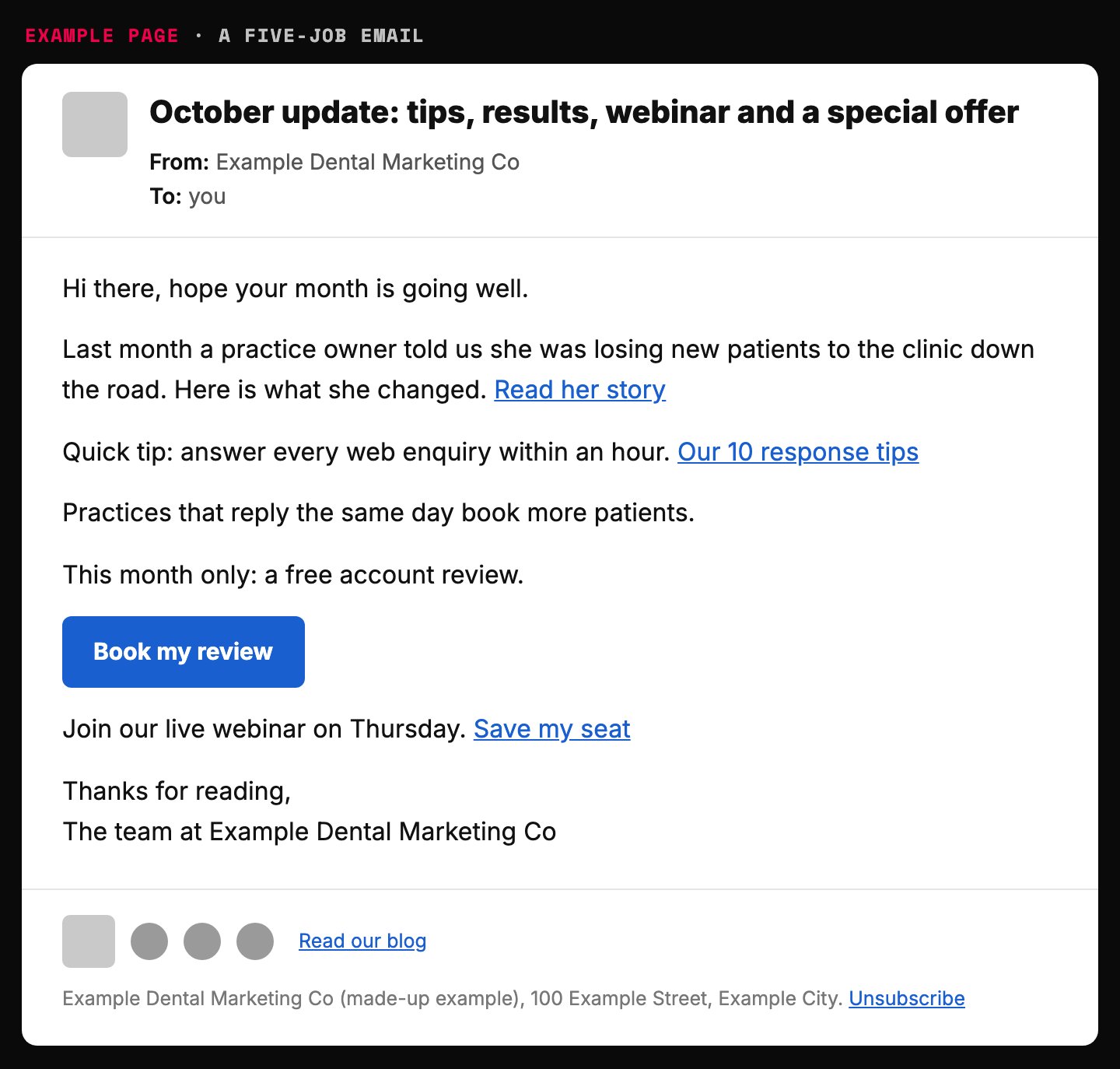
- Four jobs before the email even opens.
- Link 1 of 4 in the body. Each one competes with the others.
- The link that pays the bills is buried third.
- These count as links too. Only the unsubscribe link and the address must stay.
Example page built for this article with a made-up brand
Each email does one of six jobs, its lever: who (a person like the reader), why (the real cause), how (one usable step), where (where the reader stands), when (what waiting costs), and what (the offer). One lever, one link. Cut the whole sequence from one pillar piece, send weekly, make every fourth email the offer, and change one thing per send so every test teaches you something.
Why does one idea per email beat five?
One idea per email wins because readers skim, and every extra idea competes with the one you need. The field tests are blunt about it.
A political campaign sent a fundraising email to 776,145 people. The researchers deleted every other paragraph, almost at random, so the short version kept about half the ideas.
Most people who read both said the short one flowed worse. It raised 16% more money.
A school district texted 22,694 parents about a one-minute survey. Dropping two warm, caring sentences got 6% more replies.
A weekly economics newsletter carried anywhere from ten to thirty papers. When the count doubled, each paper got about 30% less press coverage, by the economists' own study.
Readers did not read more. Each paper just got less attention.
That fits what is known about working memory: people hold only a few things in mind at once. Research on choice overload is more mixed, so we lean on the email tests, not the theory.
How to bury your best idea in four easy steps:
1) Open with a story, then a tip, then last month's results.
2) Add a second link, as a bonus.
3) Put the offer in every email, just in case.
4) Ask the team which version reads better, and send that one.
That is not a newsletter. It is a junk drawer with a logo.
Step 4 is the sneaky one. The authors showed people both versions from four of their field tests, and most guessed the longer message would win. The guess was wrong all four times.

Every test here cut ideas or links, and every cut won
| Test | What changed | Result | How sure |
|---|---|---|---|
| Magazine promo email | Second link removed | 50% more clicks on the main link | Field test |
| Fundraising email, 776,145 people | Every other paragraph deleted | 16% more money | Field test |
| Text to 22,694 parents | Two warm sentences dropped | 6% more replies | Field test |
| Economics newsletter | Twice as many papers listed | About 30% less coverage per paper | Published study |
Source: Rogers and Lasky-Fink, Writing for Busy Readers (2023), field experiments reported in chapter 4. Newsletter row: Lusher, Yang and Carrell, NBER working paper 29153.
How to write an email sequence from one pillar article
To write an email sequence, start from one pillar: a long article, video or talk that already holds your best thinking on one problem. Then cut it into levers.
Step 1: list every idea in the pillar. Write one line per idea. Most long articles hold far more than six.
Step 2: give each idea a lever. The customer story is a who. The root cause is a why, and each step of the method is a how.
The self-check is a where. The cost of doing nothing is a when. Your service is the what.
Step 3: keep one idea per email. Pick the strongest idea for each lever and park the rest. Parked ideas become next month's emails.
Parking a good idea hurts. Do it anyway.
Step 4: give each email one link. It points to the one place that lever needs: the full story, the cause, the step, the self-check, the cost math or the booking page.
Step 5: write the subject line from the reader's side. Rock the Vote tested this on 19,990 people. "Want to attend free events?" got nearly four times the volunteers that "Volunteer with Rock the Vote" got.
Their volunteers did see the shows for free, so the promise was true. Keep yours true too, or the open turns into an unsubscribe.
Step 6: end with a P.S. that repeats the one point. In Building a StoryBrand, Donald Miller puts a closing note on every nurture email, since some readers read only that line.
Make it the line you would keep if you could keep only one. For more on subject lines that make the reader picture the gain, see how words become pictures.
Six steps turn one pillar into a sequence
- List every idea One line per idea in the pillar.
- Give each a lever Story is who, cause is why, each step is a how.
- Keep one per email Park the rest for next month.
- One link each It goes where that lever needs it.
- Subject from the reader's side What they get, never what you want.
- Close with the one point Some readers read only the last line.
Anar's One-Lever Email method.
The reader's-side subject line won nearly four to one
| Writer's side | Reader's side |
|---|---|
| "Volunteer with Rock the Vote" | "Want to attend free events?" |
| Says what the sender wants | Says what the reader gets |
| The baseline | Nearly 4x the volunteer sign-ups |
Source: Rock the Vote email test, 19,990 people, as reported in Writing for Busy Readers (2023).
Six emails cut from one article, written out
Here is the method run on one pillar: our guide to calling new leads back fast. Each email below does one job and carries one link.
Who. Subject: "The clinic that called back in four minutes." Opening: "Picture two clinics running the same ads on the same street, with very different results."
Why. Subject: "It is not the leads." Opening: "Most leads that go cold were warm when they arrived, and they cooled while they waited."
How. Subject: "One change for this week." Opening: "Send a text alert for every new enquiry to the person who will call."
Where. Subject: "Which of these is you?" Opening: "Three kinds of practice: calls back the same hour, the same day, or whenever someone gets to it."
When. Subject: "What a slow week costs." Opening: "Count last month's enquiries, then count the ones that never reached a call."
What. Subject: "If you want us to set it up." Opening: "We install the alert, the call script and the follow-up for you, and here is what that costs."
Look at what is missing. No email tells the story, explains the cause and sells the offer at once. Six emails, six jobs, one pillar.
These lines are examples we wrote for this guide. Write yours from your own pillar, in your own words.
Six emails from one pillar, one job each
| Lever | Subject line | The one link |
|---|---|---|
| Who | The clinic that called back in four minutes | The full story |
| Why | It is not the leads | Why leads cool while they wait |
| How | One change for this week | How to set up the text alert |
| Where | Which of these is you? | A three-question self-check |
| When | What a slow week costs | The missed-call math |
| What | If you want us to set it up | The booking page |
Example written by Anar from its speed-to-lead guide.
The same pillar as a how email: one idea, one link, one closing line
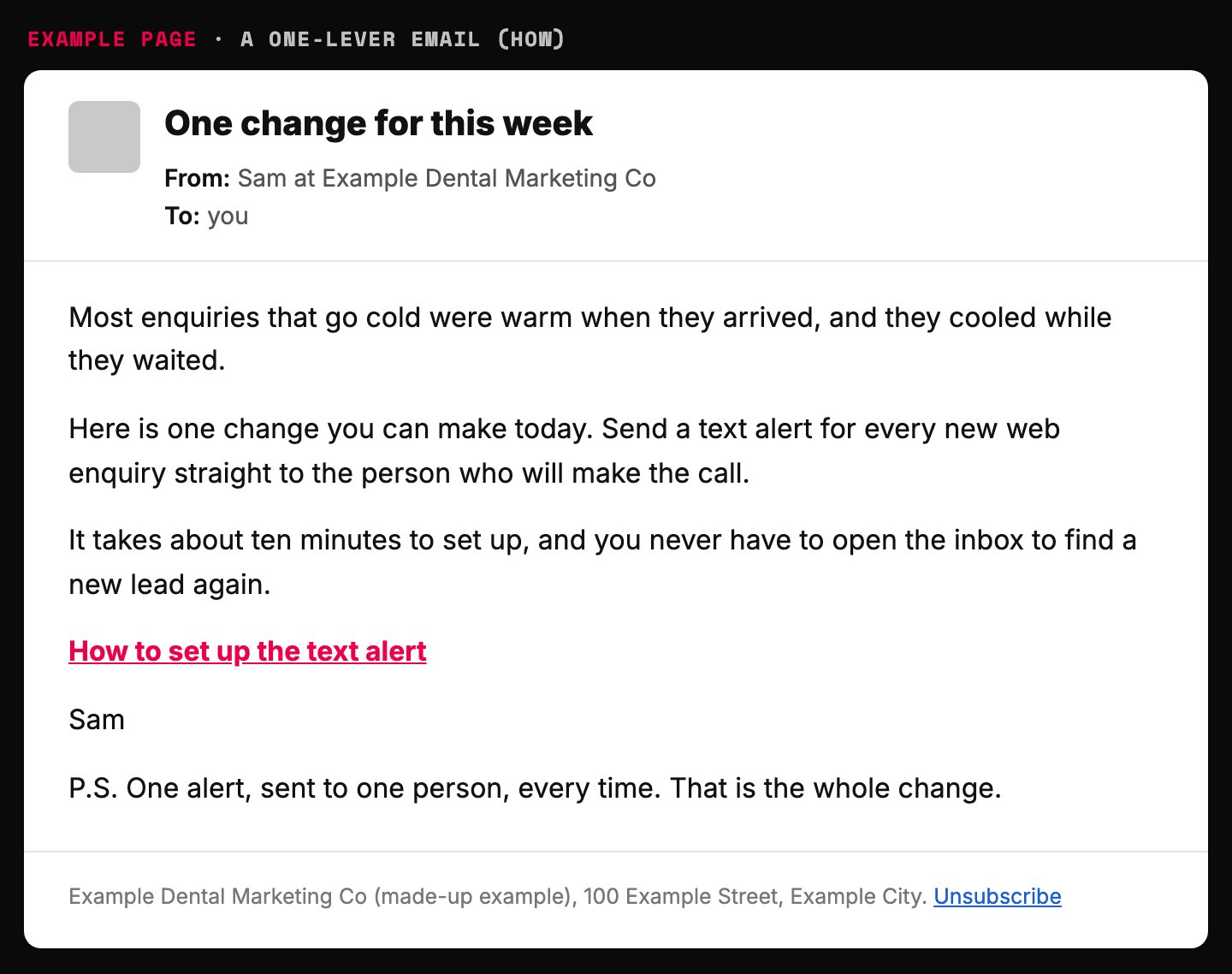
- Written from the reader's side: what they get this week.
- One idea, the single step from the pillar.
- The only link. It goes to that step.
- The last line repeats the one point for readers who skip to it.
Example page built for this article with a made-up brand
Send one email a week, and make every fourth one the offer
Send one email a week, and make every fourth one the offer. The other three give real help with no pitch.
In the same book, Miller suggests a sales email about every third or fourth send. We like the rhythm because it stops the what lever from crowding out the other five.
So a first pass through one pillar runs eight weeks. Who, why, how, then the offer.
Then where, when, a second how, and the offer again.
Why not daily? Because past a point, more messages stop working.
In a trial in Kenya with 431 patients, weekly text reminders raised the share who stuck to their treatment by 32%. Daily texts did no better than no texts at all.
In a get-out-the-vote study, voters got up to ten mailers. The first five each raised turnout, and the last five added nothing.
Those are health and voting messages, not sales email. Our reading is simple: every list has a ceiling, and you find yours by testing.
Vary the subject line every week. In a study of weekly course update emails, a subject that never changed taught students the email was safe to skip.
One more rule decides when to split. If several facts are about the same event, like a booking time, an address and what to bring, keep them in one email.
If the asks take different effort, split them. People do the easy one and forget the hard one.
One pillar, eight weeks, and the offer every fourth send
- Who Week 1 A person like the reader.
- Why Week 2 The real cause.
- How Week 3 One step.
- What Week 4 The offer.
- Where Week 5 A self-check.
- When Week 6 What waiting costs.
- How Week 7 A second step.
- What Week 8 The offer again.
Anar's plan, using the one-offer-in-four rhythm from Building a StoryBrand.
Weekly reminders helped; daily reminders did nothing
Extra share of patients who stuck to treatment, compared with no reminders
- Weekly text 32
- Daily text 0
Source: Pop-Eleches et al., AIDS (2011), 431 patients in Kenya, 48 weeks. A health study, not marketing email.
Change one thing per send, or you learn nothing
Change one thing per send and you learn what worked. Change three and you learn nothing.
Mike Michalowicz tells this on himself in Clockwork. He tried every fix at once on a sputtering lawnmower, and it ran worse. A repair shop fixed it in thirty minutes.
His rule: turn one dial at a time. Email works the same way.
Rewrite the subject, the story and the link in one send, and a better click rate tells you nothing. Which change did it? Nobody knows.
One-lever emails make testing easy, because each email already has one job. An A/B test sends two versions to random halves of the list; change only the subject, the opening line or the link text.
Then judge each lever by its own number. A who email earns replies. A how email earns clicks on the step, and a what email earns booked calls or sales.
Watch unsubscribes on every send. Lean Analytics scores a campaign as the revenue it added, minus what it cost, minus the value of the people who left.
Small list? Our rule: under about 1,000 people, a split test mostly measures luck. Judge by replies and sales across four or five sends instead.
It is the same discipline as testing one variable at a time in ads. One dial, one answer.
Judge each email by the number its job should move
| Lever | The number that says it worked |
|---|---|
| Who | Replies |
| Why | Clicks to the cause |
| How | Clicks on the step, or "done" replies |
| Where | Self-checks finished |
| When | Clicks to the cost math |
| What | Booked calls or sales |
| Every send | Unsubscribes |
Anar's rule. Campaign score: revenue added, minus cost, minus value lost to unsubscribes (Lean Analytics).
Change three things and a win teaches you nothing
| Three changes in one send | One change per send |
|---|---|
| New subject, new story, new link | New subject only |
| Clicks rise | Clicks rise |
| Nobody knows why | The subject did it |
| Next send is a guess | Next send keeps the subject and tests the opening |
Example.
Where one-lever sequences go wrong
Most one-lever sequences break in one of four ways. Each has a clear sign and a small fix.
The email feels thin. The cause is a small idea, not a single one. Tell the idea with a story and a step, and one lever fills a whole email.
Clicks fall even with one link. Count again. A clickable logo, three social icons and a "read our blog" line are five more links.
Keep the parts the law asks for. The CAN-SPAM rules require a working unsubscribe link and your postal address, and Google's sender guidelines ask bulk senders for one-click unsubscribe.
Those do not count against you. Every other extra link does.
Every email sells. The what lever has crept into all of them. Go back to one offer in four, and let the other three earn the open.
The list feels cold after you cut the warm lines. Short is not always the goal. The same researchers worked with a school district that kept its longer, warmer message, because rebuilding trust with parents mattered more than survey replies.
If warmth is the job, warmth is the lever. Just make it the only one.
A bonus link is a tax on the link that matters. Stop paying it.
Four ways a one-lever sequence breaks, and the fix
| Sign | Cause | Fix |
|---|---|---|
| The email feels thin | A small idea, not a single one | Tell it with a story and a step |
| Clicks fall with one link | Logo, icons and footer links count too | Keep only the unsubscribe and address |
| Every email sells | The offer crept into all of them | One offer in four sends |
| The list feels cold | Warm lines cut when warmth was the job | Make warmth the one lever |
Anar's fixes. The legal footer items are from the FTC CAN-SPAM guide.
Run it with AI this week
The prompt below runs the whole method in your preferred AI. Paste in your pillar, answer four questions, and get an eight-week plan with one lever and one link per email.
It never invents a result or a number. Where it needs a fact only you know, it writes [CONFIRM].
This week, do three things. Pick one pillar you already published. Run the prompt and send the who email.
Then check your next send against the rule: one lever, one link, the legal footer and nothing else. Delete the damn second link.
For the full welcome sequence, see the nurture email sequence, written out. For more ways to cut a pillar, see one article, twenty pieces, and for why the list pays the bills, see email as a profit center.
The magazine did not need a better second link. It needed the nerve to delete it. Your best email is usually one cut away.
Paste into your preferred AI. It asks four questions, then plans eight emails with one lever and one link each.
Act as an email strategist who uses the One-Lever Email method.

Ask me these one at a time, with the example shown:
1. Paste one long article or transcript of mine on one problem. (Example: "Why new leads go cold.")
2. Who reads my emails. (Example: "Small clinic owners.")
3. My offer and the page where people take it. (Example: "Lead alert setup, [booking link].")
4. My list size. (Example: "800.")

Then do this:
1. List every distinct idea in my piece, one line each.
2. Give each idea one lever: WHO (a person like the reader), WHY (the real cause), HOW (one usable step), WHERE (where the reader stands), WHEN (what waiting costs), WHAT (the offer).
3. Plan 8 weekly emails in this order: who, why, how, what, where, when, a second how, what. Every fourth email is the offer; the other three give help with no pitch.
4. For each email write: the lever, a subject line from the reader's side, the opening line, the one idea, the one link and where it goes, and a P.S. line repeating the point.
5. Check each email: is its lever one word, and is there exactly one link besides the required unsubscribe link and postal address? If not, cut.
6. Name the number that shows each lever worked (replies, clicks, bookings), plus unsubscribes on every send.
7. Suggest one thing to test per send, never more. If my list is under about 1,000, judge by replies and sales over several sends instead of split tests.

Rules:
- Use only ideas, stories and facts from my piece. Never invent a result, number, testimonial or deadline. If something is missing, write [CONFIRM: what you need].
- No fake scarcity. A subject line must promise what the email really gives.

Output: a table of the 8 emails, then the [CONFIRM] list, then the 3 ideas I should save for next month.

Filip Kovacevic is the founder of Anar Agency in Phoenix. He spent five years running SEO, Meta ads, email, and content for medical practices across the United States, and now does the same work for healthcare, home-service, legal, and professional-service businesses, alongside AI implementation. More from Filip →
Talk it through in 15 minutes
Bring one question from this article. We will tell you what we would do, whether or not you hire us.
Book a 15-Min Chat →