How Often to Sell to Your Audience Without Wearing It Out
How often should you sell to your audience? Aim each round of offers at no more than about 5 percent of the people who actually see you. Give everyone else something useful, with no ask.
Only about one person in ten will ever buy, so selling to more drains the audience faster than it refills.
How often to sell to your audience: about 5 percent of it at a time
Picture a list of 2,000 people. You send an offer on Monday, and twelve people buy. Monday worked, so you send it again on Thursday.
Four people buy. Thirty unsubscribe. By the third send, nobody even replies.
That is the problem this guide solves: how often to sell to your audience before it stops listening. The answer is not a day of the week. It is a share of the people.
Here is the short version. Aim each round of selling at no more than about 5 percent of the people who actually see you. Everyone else gets something useful, with no ask.
We call it the Five-Percent Cap. Hold your selling to about 5 percent of your audience at most, so the audience has time to refill.
This guide is for owners who sell to their own list, group or followers. It is not about paid ads to strangers. It takes about nine minutes to read.
The cap sends offers only to the few who asked, and teaches the rest
| Selling to everyone | Five-Percent Cap |
|---|---|
| Every offer goes to the whole list | Each offer goes to about 5 percent, the people who raised a hand |
| Sends again whenever sales dip | Sends again when new people have joined |
| Counts members and followers | Counts the people who actually see you |
| Judges this week's sales | Judges joins, leaves and what each offer earns |
Our comparison and method.
Why does selling more often shrink your audience?
Only part of any audience will ever pay you. Plan on about one person in ten.
Sell to all of that tenth and almost nobody is left to buy. Your organic audience is then dead.
So sell to about half of that tenth. That is 5 percent of the audience, at most.
Why half? You need room for the refill rate. That is how fast new people arrive and old readers warm up again.
Fisheries run on the same idea. The biggest catch a stock can give year after year is its maximum sustainable yield. Take more and next year there is less to catch.
Northern cod fed the east coast of Canada for about 500 years. By 1992 the stock had fallen to 1 percent of its historic level. Nobody planned that; every boat just took a little more.
An audience works the same way. Each offer spends some trust. Teaching refills it.
Repeat the same ask often enough and people stop reacting. Psychologists call this habituation: a response fades when the same signal keeps coming with nothing new attached.
Selling more often does not find new buyers. It asks the same buyers again, and the rest learn to look away.
Example: of 1,000 people who see you, about 100 will ever buy, and the cap is 50
One in ten will ever pay; each round of selling stops at half of that
- People who see you 1000
- Will ever buy (1 in 10) 100
- Most to sell to at once (5%) 50
Worked example: 1,000 x 10 percent and 1,000 x 5 percent. The math is ours.
Give to everyone, sell to the few who ask, then let the audience refill
- Teach everyone
- Hands go up
- Offer to the 5 percent
- New people arrive
Our model of the cap.
The Five-Percent Cap limits each round of selling to about 5 percent of the people who actually see you, because only about one person in ten will ever buy and the audience needs time to refill. Count openers or typical post views, multiply by 0.05, send offers only to recent hand-raisers up to that number, and give everyone else useful content. On public feeds, our own rule is about one ask in twenty posts.
Check joins against leaves every week, and stop when unsubscribes, falling replies or spam reports rise.
Count the people who see you, not the headcount
Five percent of what? Of the people who actually see your posts and emails. Not the number on your profile.
For example, take one online group that grew from nothing. Its owner did not mail another list or borrow its buyers. He posted, and people came.
Today the group has about 52,000 members. Its best posts get about 5,000 to 8,000 views. The recent high was about 10,000.
So its real audience on a good day is closer to 8,000 than 52,000. Five percent of 52,000 is 2,600. Five percent of 8,000 is 400.
That gap is the point. Base the cap on members and you sell to more than six times as many people as you should.
Using views instead of members is our choice. The cap needs a count, and views are the honest one.
Our counts: for an email list, the people who opened at least one email in the last 90 days. For a group or a page, the views on a typical post.
Why a big member count fools people is its own topic: reach is not audience size.
Example: a 52,000-member group reached about 8,000 people on its best posts
Group size against views on the best posts, example numbers from one group
- Members 52000
- Best posts, views (upper end) 8000
- Recent high, views 10000
Example numbers from one group's owner. Their claims, not our data.
Example: using members instead of views would sell to 6.5 times as many people
5 percent of the group's members against 5 percent of its best-post views
- 5% of 52,000 members 2600
- 5% of 8,000 views 400
Worked example from the group above. The math is ours.
Use the people who see you as your audience number
| Where you sell | The count we use | Where to find it |
|---|---|---|
| Email list | People who opened at least one email in 90 days | Your email tool's engagement or segment report |
| Facebook group or page | Views on a typical post | Group or page insights |
| Instagram, LinkedIn, X | Average reach of a normal post | Post analytics |
| Not this | Total members or followers | The number on the profile |
Our rule for which count to use.
Pick your 5 percent from the people who raised a hand
Who gets the offer? The people who already told you they are interested.
A hand-raiser is someone who replied, clicked a link about the problem your offer solves, asked a price, or visited your pricing page. They are not tired of you. They asked.
Step 1: count your real audience. Use openers or typical post views. Example: 1,600 openers on a list of 2,000.
Step 2: multiply by 0.05. That is your cap for this round. Example: 80 people.
Step 3: list your hand-raisers. Put the most recent signal first. Stop when you reach the cap.
Step 4: send the offer to that list only. One offer, one price, one deadline if a real one exists. Everyone else gets your next useful email.
Step 5: wait for the refill. Run the next round when new people have joined and new hands have gone up.
Fewer hand-raisers than the cap? Fine. Send to the ones you have and stop.
Never pad the list with people who never asked.
Is this slower? A little, at first. But the rest of the list never gets a reason to leave.
No small offer for hand-raisers yet? Start with a paid first step.
Five steps from your audience count to an offer list
- 1. Count your real audience Openers in 90 days, or typical post views.
- 2. Multiply by 0.05 That is the most people this round of offers goes to.
- 3. List your hand-raisers Most recent signal first. Stop at the cap.
- 4. Send to that list only One offer, one price. Everyone else gets your next useful email.
- 5. Wait for the refill Next round when new people have joined and new hands have gone up.
Our method.
A hand is a reply, a click or a question, never just an open
| Signal | Where to find it | Counts? |
|---|---|---|
| Asked a price or booked a call | Inbox, DMs, calendar | Yes, the strongest |
| Replied to an email or post | Inbox, comments | Yes |
| Clicked a link about the problem your offer solves | Email tool click report | Yes |
| Visited your pricing page | Site analytics, when tied to a person | Yes |
| Opened every email | Email tool | No, opening is not asking |
| Liked a post | The feed | No |
Our rules.
The cap in an email tool: 1,600 openers, 80 people, hand-raisers only
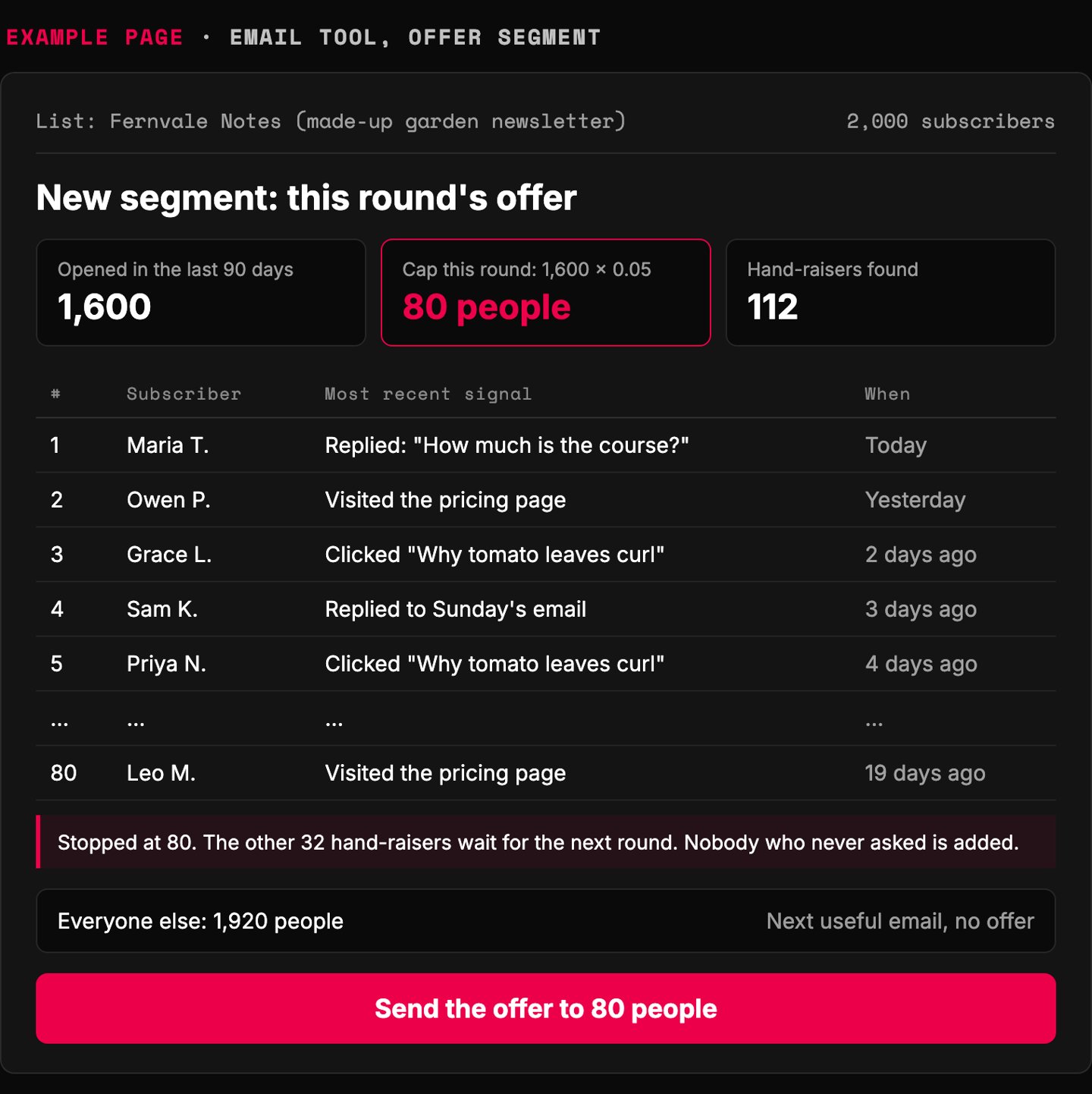
- Step 1: count your real audience, the people who opened in the last 90 days.
- Step 2: multiply by 0.05. This round's cap is 80 people.
- Step 3: hand-raisers only, most recent signal first.
- Stop at the cap. Never pad the list with people who never asked.
- Step 4: everyone else gets your next useful email, with no ask.
Example page built for this article with a made-up brand. The list, names and signals are made up; 2,000, 1,600 and 80 are the article's worked example.
What about offers on a public feed?
On email you can choose who sees an offer. On a feed you cannot. Everyone who sees the post sees the ask.
So we add one more rule for feeds: about one post in twenty asks for money.
Twenty posts, one ask. The other nineteen teach, show or report a change your reader cares about. Our guide to that is all content is about change.
What counts as an ask? A post whose whole job is the link or the price. A post that teaches and then says where to find you is still teaching.
Can you invite hands on a feed? Yes. End a teaching post with one line: reply if you want the details.
The people who reply join your 5 percent.
How to empty an audience in four easy steps:
1. Post the offer every day. Call it consistency.
2. Screenshot every sale and post that too.
3. Email the whole list again, for the people who missed it.
4. When sales drop, sell harder. Then wonder where the hell everyone went.
Selling every day is not a plan. It is a countdown to an empty audience.

A post is an ask when its whole job is the link or the price
| Teaching post | An ask |
|---|---|
| Gives the reader something to use today | Asks the reader to buy or book |
| May end with where to find you | The link or price is the point |
| Goes to everyone | Goes to hand-raisers, or 1 feed post in 20 |
| Refills the audience | Spends some of its trust |
Our definitions.
Give to everyone; ask only the people who raised a hand
- Teach the whole audience Most of what you send and post.
- Answer questions Help the people who asked.
- A rare feed offer About 1 post in 20. Our own rule.
- The 5 percent Where your offers go.
Our model of the cap.
How do you know your audience is refilling?
The cap only works if new people keep arriving. So check the refill every week.
Write down two numbers every Friday: the people who joined and the people who left. Joins should beat leaves.
Attention has to be earned. Marketers call attention you did not pay for earned media: sharing, mentions and coverage you did not buy. There is no shortcut to it.
Respect is part of earning it. Accounts that post nothing but asks for money teach people to scroll past.
If you track one rate, track churn: the share of people who leave in a set period. Rising churn on offer weeks means you are selling to too many people.
Three more signs you are over the cap. First, replies to normal emails fall. Second, each offer earns less than the last from the same list.
The third costs the most: spam reports. Gmail tells senders to keep spam reports below 0.10 percent and never reach 0.30 percent.
Past that line, mail can land in spam for everyone. Your fans stop seeing you too.
So make leaving easy. Gmail says an easy way out can improve open and click rates. Yahoo asks senders to honor unsubscribes within 2 days, and the US CAN-SPAM rules allow 10 business days.
A list that holds on to people who want out is not bigger. It is just angrier.
What to send everyone in between is in lead-first nurture.
Four signs you are selling past the cap
| Sign | What it means | What to do |
|---|---|---|
| Unsubscribes jump on offer days | The offer reached people who never asked | Shrink the next offer list to hand-raisers |
| Replies to normal emails fall | Readers expect an ask in every email | Send two or three useful emails with no ask |
| Each offer earns less than the last | The same buyers are being asked again | Wait for new joins before the next round |
| Spam reports near 0.10 percent | Inbox providers may start filtering you | Stop offers, clean the list, make unsubscribing easy |
Our warning list. Spam threshold from Gmail's email sender guidelines.
Gmail's line: spam reports under 0.10 percent, never 0.30
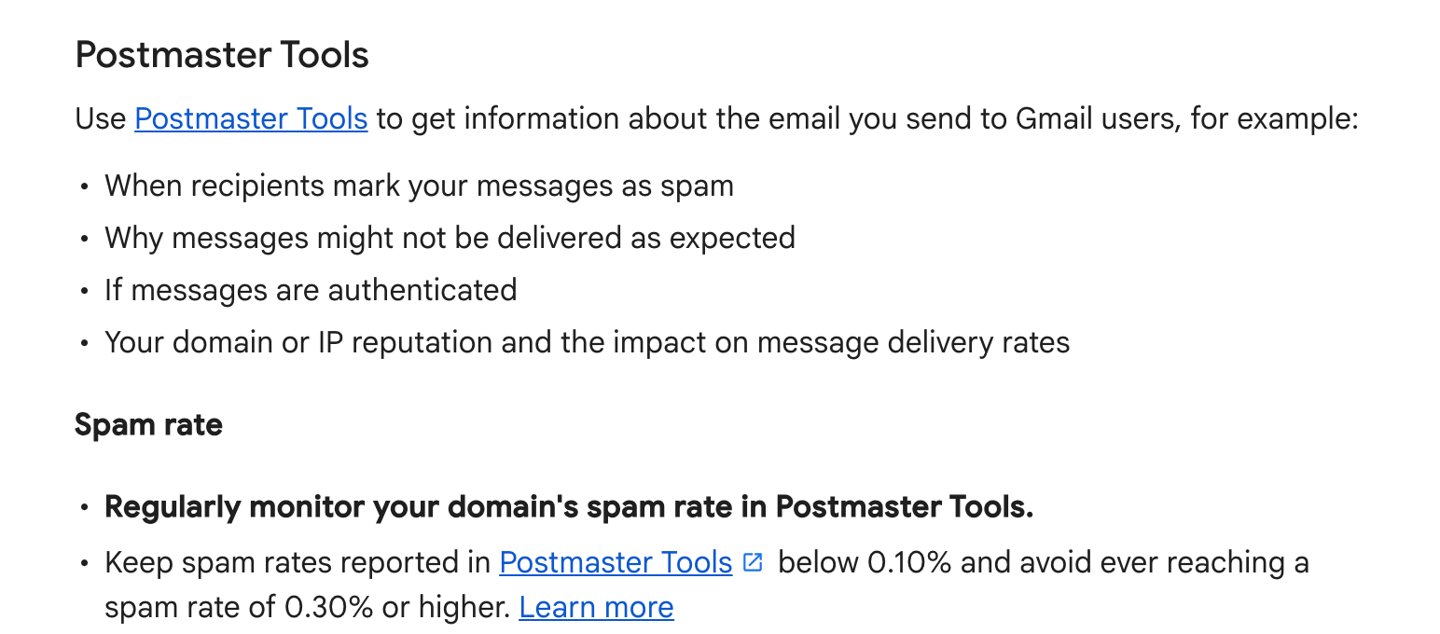
- Spam reports are the costliest sign you are selling to too many people.
- Keep spam reports under 0.10 percent.
- Never reach 0.30 percent. Past that line, mail can land in spam for everyone.
Screenshot of Gmail Help, Email sender guidelines, taken 2026-10-17.
Where people get stuck with the cap
Stuck point 1: the list is too small. Five percent of 300 is 15 people, and that feels pointless.
The cause is a small audience, not a strict rule. The fix is growth first: teach for a month and let hands go up.
Stuck point 2: sales dipped when we sold less. In the first weeks, they can. Fewer offers can mean fewer sales right away.
So judge the cap over a quarter, not a week. Watch the audience size and what each offer earns.
A list is worth what it earns over its whole life, not what it earns this Monday. Marketers call that customer lifetime value.
Stuck point 3: does a follow-up count? No. A reply to someone who asked for a quote is a conversation they started.
Keep that conversation going as long as they are engaged. The cap is for broadcasts, not for answers.
Why does giving first work at all? People tend to return what they receive. Researchers call it reciprocity.
It is also why people stay on lists they chose. Permission marketing is the old name for letting the audience decide what reaches them.
Posting volume has its own rhythm too: why posting volume should rise and fall.
Three stuck points, and the fix for each
| Symptom | Cause | Fix |
|---|---|---|
| 5 percent is only a handful of people | The audience is small; the rule is not too strict | Teach for a month, then count again |
| Sales dipped when we sold less | Fewer offers mean fewer sales at first | Judge over a quarter: audience size and earnings per offer |
| Not sure if follow-ups count | Treating a conversation like a broadcast | Answer anyone who asked; the cap is for broadcasts |
Our guidance.
Plan your next month of offers with AI
Paste the prompt below into your preferred AI. It asks for your real counts. Then it sets your cap, picks who gets the offer, and plans four weeks.
It never invents a number. If you do not know a count, it tells you where to find it and waits.
Need the teaching emails as well? Use the lead-first email sequence.
Paste into your preferred AI. It asks for your real counts, sets your cap, picks who gets the offer, and plans four weeks.
Act as an email and content planner. Plan my next four weeks of selling with the Five-Percent Cap.

Ask me one at a time, with the example:
1. What do I sell, and what does it cost? (Example: a $490 website review)
2. Where is my audience? (Example: an email list and a Facebook group)
3. How many people actually see me? Email: people who opened at least one email in the last 90 days. Group or page: views on a typical post. (Example: 1,600 openers)
4. Who has raised a hand lately, and how? Replies, clicks on a link about the problem my offer solves, price questions, pricing-page visits. (Example: 140 people)
5. How many people joined and how many left in each of the last four weeks? (Example: +60 and -25 a week)

Never invent a count. If I do not know a number, tell me where to find it in my email tool, group insights or inbox, and wait.

Rules:
- Cap: the people who see me (question 3) x 0.05. That is the most people any one round of offers goes to.
- Who gets the offer: hand-raisers only, most recent signal first, stopping at the cap. Opens and likes are not hands. Fewer hand-raisers than the cap? Send to the ones I have and stop.
- Everyone else gets useful content with no ask.
- Public feeds, where I cannot choose who sees a post: at most about 1 post in 20 asks for money. Teaching posts may end with one line inviting replies.
- Refill check: weekly joins must beat weekly leaves. If leaves beat joins two weeks running, skip the next offer round.
- Warning signs: unsubscribes jumping on offer days, fewer replies, each offer earning less than the last, spam reports near 0.10 percent.
- Follow-ups with people who asked me something are conversations, not broadcasts. They do not count toward the cap.

Show your math, then answer:
My cap: [people who see me] x 0.05 = [number]
Offer list: [how many hand-raisers, and which signals]
Refill: [joins vs leaves, healthy or not]
Week by week: what goes to the offer list, what goes to everyone, what goes on the feed
Warning signs to watch: [three, with the number that would make me stop]
Next three actions: 1. 2. 3.
Run the Five-Percent Cap this week
1. Count your real audience: openers in 90 days, or typical post views.
2. Multiply by 0.05. Write that number where you plan your sends.
3. List your hand-raisers. Send the next offer to them only.
4. Every Friday, write down joins and leaves.
Back to the list of 2,000 from the start. Monday's twelve buyers were the people who wanted it. Thursday's thirty unsubscribes were the cost of asking everyone else.
Want the list to carry more of the business? Read email as the profit center, or send us your numbers.
Sell to the five percent. Teach the rest. Let the audience refill.
One week to put the cap in place
- Count Monday Openers in 90 days, or typical post views.
- Set the cap Tuesday Multiply by 0.05 and write it down.
- List the hands Wednesday Replies, clicks, price questions. Stop at the cap.
- Send Thursday The offer to the list; something useful to everyone else.
- Check the refill Friday Joins against leaves. Write both down.
Our plan.

Filip Kovacevic is the founder of Anar Agency in Phoenix. He spent five years running SEO, Meta ads, email, and content for medical practices across the United States, and now does the same work for healthcare, home-service, legal, and professional-service businesses, alongside AI implementation. More from Filip →
Talk it through in 15 minutes
Bring one question from this article. We will tell you what we would do, whether or not you hire us.
Book a 15-Min Chat →