How Often to Post, and Why Your Posts Should Rise and Fall

Post on a steady floor, but change the size of each post in a wave. One short post, two or three medium ones, one long one, then repeat. Post more in weeks with real news and fewer in between, never zero.
Start with three to five posts a week. Judge each post after three days.
How often to post: keep showing up, but change the shape
Touch a sea slug and it pulls in its gill. Touch it the same way again and again, and the pull gets weaker. Soon it barely moves.
Nothing is wrong with the slug. It learned that this touch does not matter.
Your Tuesday post gets the same treatment. Same length, same list in the middle, same hour. By month three your readers have learned it too.
So "how often should I post?" is the wrong first question. The better question: how do you keep showing up without getting tuned out?
Here is our answer. Keep a steady floor of posts, and change their size in a wave. One short post, two or three medium ones, one long one, then repeat.
Let the weekly count rise and fall too. More posts in a week with real news. Fewer in between, never zero.
A flat schedule repeats one shape; the Wave Cadence keeps changing it
| Flat schedule | Wave Cadence |
|---|---|
| Same length every post | Short, medium and long in a wave |
| Same count every week | More in news weeks, fewer between, never zero |
| Readers learn the outline | Readers cannot guess the next post |
| Judged by likes in the first hour | Judged by each post's job, after three days |
Our comparison. The Wave Cadence as set out in this guide.
A post in the same shape every time gets tuned out
Scientists call the slug's lesson habituation. When something harmless happens again and again, the response to it shrinks.
Eric Kandel showed it in this slug's gill reflex. His work on how nerve cells store memory won a Nobel Prize.
People do it too. It is how you stop hearing the fridge.
The web has its own version. Eye-tracking research on banner blindness found that people learn where ads usually sit. Then they stop looking there.
A feed works the same way. If every post has the same outline, readers learn the outline. Then they scroll past it.
The fix is in the same research. Add something new, and the response comes back for a while. Scientists call that dishabituation.
But that comeback does not last. Repeat the new thing often enough and it gets tuned out too. So you have to keep finding new changes.
Our take: most posting advice mixes up two kinds of consistency. Showing up every week is good. Looking the same every week is what gets ignored.
Repeat a thing and the response shrinks; change it and the response comes back
- 1. Same shape, again The response gets weaker each time. Scientists call it habituation.
- 2. Something new The response comes back. That is dishabituation.
- 3. The new thing repeats It fades too. So keep finding new changes.
Source: Wikipedia, Habituation (dishabituation and habituation of dishabituation).
Every flat pattern has a cost
| The pattern | What readers do | The cost |
|---|---|---|
| Always long | Save it for later | Saved, never read |
| Always short | Like it and move on | Seen, then forgotten |
| Same size, same day, same hour | Learn the outline | Tuned out |
Our summary of the three flat patterns.
Repeat a thing and the response shrinks; change it and the response comes back, then fades too
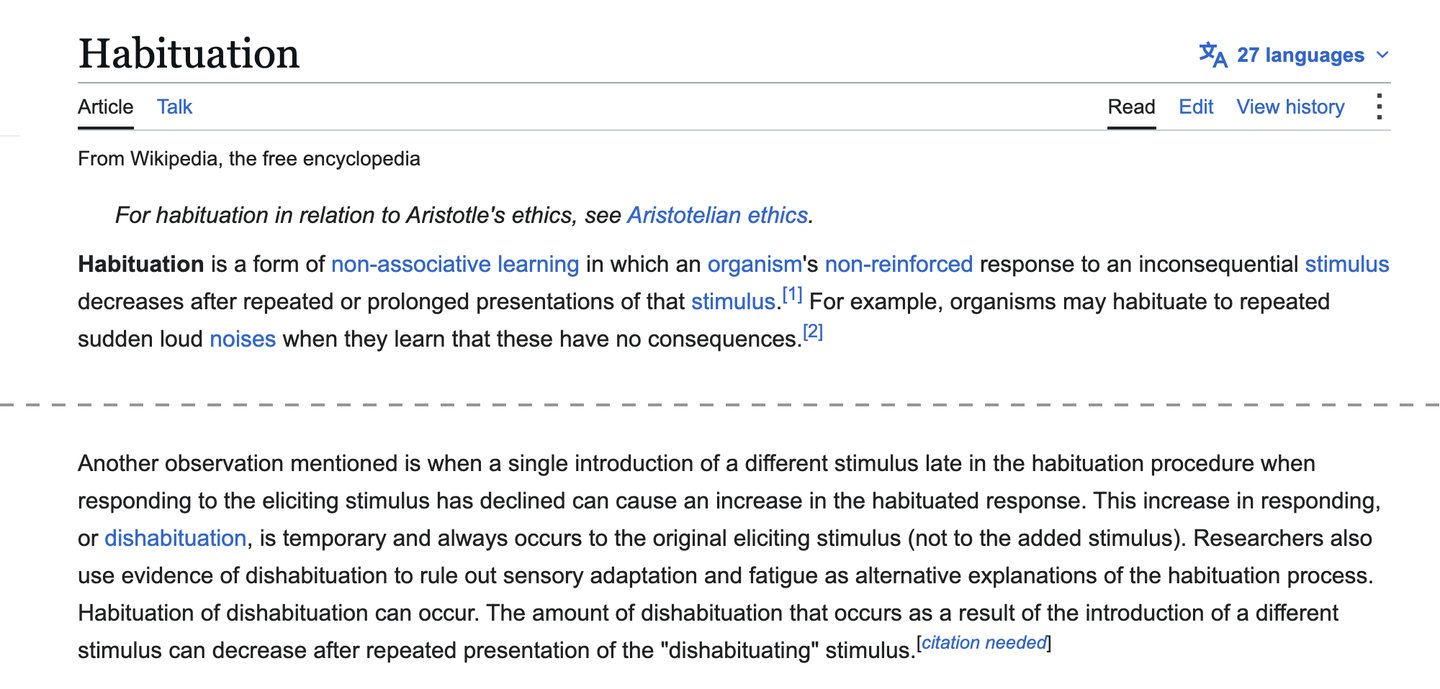
- The same thing, again and again: the response shrinks.
- Only things that seem not to matter get tuned out.
- Add something new and the response comes back.
- Repeat the new thing and it fades too. Keep finding new changes.
Screenshot of Wikipedia, Habituation, taken 2026-10-17.
The Wave Cadence keeps you showing up without turning into background. Change the size of each post in a wave: one short, two or three medium, one long, then repeat, in an order readers cannot guess. Change the weekly count: a floor of two posts, three to five in a normal week, up to seven when there is real news, never zero.
Place each long post after the shorter posts that brought up its topic. Judge every post by its job after three days: short posts by impressions, medium posts by replies, long posts by saves and messages.
Post in a wave: one short, two or three medium, one long
The Wave Cadence is a posting pattern that changes the size of each post in a repeating wave. One short post, then two or three medium posts, then one long post. Then start again.
Short: one thought in two or three lines, under 60 words. It gets read whole, right in the feed.
Medium: one idea, the reason behind it, and one example. About 150 to 250 words.
Long: the full argument with the steps, 600 words or more. The piece people save and send to a friend.
Why not post long every time? People save long posts to read later. Later rarely comes.
Why not short every time? Easy to like. Easy to forget.
The wave fixes both. The short posts keep your name in front of people. The long post gives them a reason to remember it.
Place the long post on purpose. Put it after the short and medium posts that brought up its topic. By then readers already care, so they give it ten minutes.
For example, picture a bookkeeper. Short: "Most small businesses find out their books are wrong in April." Medium: why a monthly check beats a year-end scramble, with one example.
Long: the month-end routine, step by step. All three posts share one topic, so the long one lands on readers who already care.
Do the exact counts matter? Less than you think. What matters is that nobody can guess the size of your next post from your last one.

Example: one turn of the wave, by words per post
Five posts in a row. Short under 60 words, medium 150 to 250, long 600 or more.
- Post 1, short 40
- Post 2, medium 150
- Post 3, medium 220
- Post 4, long 700
- Post 5, short 40
Example. Our working sizes, not a measured rule.
Short, medium, long, then back to short
- Short One thought. Read whole in the feed.
- Medium One idea, its reason, one example.
- Medium again A second idea on the same topic.
- Long The full argument. The post people save.
The Wave Cadence. Two or three medium posts per turn.
One turn of the wave: short, medium, medium, long, then short again
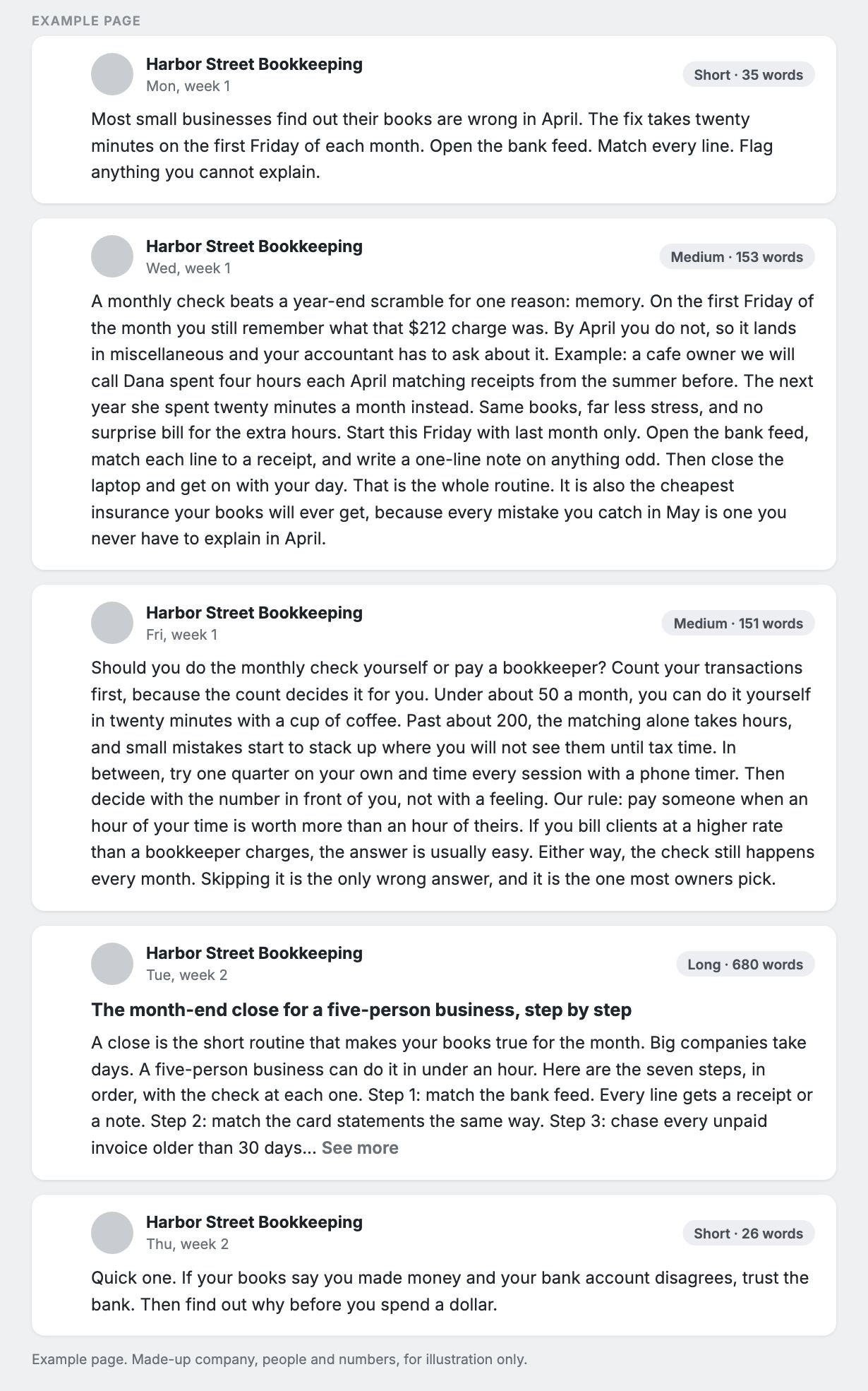
- Short: one thought, read whole in the feed.
- Medium: one idea, its reason, one example.
- The long post comes after three shorter posts brought up the topic.
- Days apart, so each post has time to find readers.
- Back to short. Readers cannot guess the next size.
Example page built for this article with a made-up brand; company, people and numbers are invented. Badge word counts are the real counts of each card's text.
Give each size one job, and judge it by that job
Each size in the wave does a different job. So each one gets judged by a different number.
Short posts win impressions. An impression is one time a person sees your post. People only have so many minutes a day to scroll, so being seen is the scarce thing.
Medium posts teach one idea. They earn replies and questions.
Long posts build depth. They earn saves, shares and the message that says "can we talk?"
Length also fits the reader's mood. A reader who is stirred up and in a hurry wants to know how it works, nothing more. A calm reader wants the deeper why.
The wave gives each of them a post. A flat feed serves one and loses the other.
Why chase impressions at all? A reader who sees your name often thinks of you when the problem shows up. That happens even on a day you did not post.
What goes inside each post is a separate job. That is covered in the six openings: what, why, who, when, where and how.
Each size does a different job, so each gets a different number
| Size | What it holds | Its job | Count this |
|---|---|---|---|
| Short | One thought, under 60 words | Be seen | Impressions |
| Medium | One idea, its reason, one example | Teach one idea | Replies |
| Long | The full argument with steps | Build depth | Saves and messages |
The Wave Cadence.
The wave gives the hurried reader and the calm reader each a post
- Saved for later Rarely read. The usual fate of an all-long feed.
- Read in full The calm reader wants the deeper why. This is their post.
- Read whole The hurried reader wants how it works. Done in ten seconds.
- Liked, then gone Pleasant, but nothing stays unless a long post follows.
Our model of size and reader mood.
Let the weekly count rise and fall around real news
The size of your posts is the first wave. The number of posts each week is the second. Post more in a week when you have something worth saying, and less in the weeks between.
Advertisers have planned this way for decades. One classic schedule is flighting: bursts of ads, with gaps of no ads in between. Another is pulsing: a low steady level, plus heavier bursts at key times.
Pulsing is the model for your feed. A burst stands out because the week before it was quiet.
Same lesson as the slug. Change is what gets noticed. Scientists even have a name for that jolt of attention: the orienting response.
What counts as news? A launch, a finding from your own work, or a rule, price or tool that changed for your buyer. Here is how to find a real change to post about every week.
How long should a burst last? One week is our default. Stretch it to a month and the burst becomes your new normal, which readers tune out.
Watch your market's mood, too. If everyone in your field is talking about one thing this week, that is your burst week. Match the energy that is already there.
Never drop to zero. The low part of the wave is still a post or two a week. Go quiet for a month and your audience finds someone else.
Example: four weeks that rise for news and never drop to zero
- 4 posts Week 1, normal Short, medium, medium, long.
- 7 posts Week 2, news A launch. Short, medium, medium, long, short, medium, long.
- 2 posts Week 3, quiet Short, medium. The floor, not silence.
- 4 posts Week 4, normal Short, medium, long, short. A new order, so readers cannot guess.
Example plan built from the Wave Cadence.
Example: the weekly count rises to 7 for news and falls to the floor of 2
Posts per week in the four-week example
- Week 1, normal 4
- Week 2, news 7
- Week 3, quiet 2
- Week 4, normal 4
Example plan built from the Wave Cadence. Floor 2, normal 3 to 5, burst up to 7.
How often should a business post? Set a floor, then wave above it
A business should post at least twice a week, three to five times in a normal week, and up to daily in a week with real news. That is our starting point to test, not a law.
We do not trust one magic number. The figures passed around are averages of other people's accounts, in other trades, with other readers.
Ad researchers have argued for a long time about frequency, meaning how often one person sees the same ad. One famous paper asked why three exposures may be enough. Nobody has settled it for your feed.
Showing up often does help. People warm to what they see again and again, a pattern called the mere-exposure effect.
But the same research shows a limit. After enough repeats, liking turns back down.
Being seen often is good. Being seen in the same shape every time is not.
Spacing matters too. Feeds are crowded, so a post can keep finding readers for days. Post again too soon and the new post competes with the last one.
For example, one large account saw a post's reach build over three to four days before most of its audience saw it. So wait three days before you judge a post.
Spreading things out also helps memory. Learning sticks better when it is spaced than when it is crammed, a finding called the spacing effect.
Never fewer than 2 posts a week; up to 7 when there is news
| Week type | Posts | When |
|---|---|---|
| Floor | 2 | The least you post, even in a quiet week |
| Normal | 3 to 5 | Most weeks |
| Burst | Up to 7 | A launch, a finding, or a change in your buyer's world |
Our starting point to test. Not a measured finding.
Example: a 30,000-member group reached about 1 in 6 members per post
- Members in one online community 30000
- Impressions on a typical post 5000
- About one member in six 17
Example from another account. Not our data, and not verified by us. 5,000 divided by 30,000 is our math.
Judge the wave per post, after three days
Judge every post by its job, three days after it goes up. Never by likes in the first hour.
How to train your audience to ignore you in four easy steps:
1. Post the same 400-word list every Tuesday at nine.
2. Write only long posts, so everyone saves them and nobody reads them.
3. Go silent for a month. Then post six offers in a day.
4. Check the likes after an hour and panic like hell.
Our take: likes are the cheapest number on the page. They tell you a post was pleasant. They do not tell you it was remembered.
Here is the test we use. Log your last month as it was. Then run four weeks on the wave and compare the two months per post, not in total.
Compare per post because a burst week adds posts, and more posts always raise the total. The fair question is whether each post did its job better.
Compare last month and a wave month per post, not in total
- 1. Log last month Each post: date, size, impressions, replies, saves.
- 2. Run four weeks on the wave Same page, same kind of topics.
- 3. Wait three days per post Then log the same numbers.
- 4. Compare per post Short posts on impressions, medium on replies, long on saves.
Our test for the Wave Cadence.
Count the number that matches the job, three days later
| Size | Count this | Not this |
|---|---|---|
| Short | Impressions | Likes in the first hour |
| Medium | Replies and questions | Total views for the week |
| Long | Saves and messages | How fast it got likes |
The Wave Cadence.
Where the wave goes wrong, and how to fix it
The wave fails in four common ways. Each one has a clear sign and a simple fix.
The numbers rose, then fell again. The wave turned into its own pattern, and readers learned it.
The fix: change the order of sizes, swap one text post for a photo or a short video, and move your posting days.
The long posts get little reach. They went up cold, with nothing before them on the same topic.
The fix: post two short ones on that topic first, then the long one.
Burst weeks bring unfollows. The burst was full of asks.
The fix: use burst weeks to teach, not to sell. Here is how rarely to sell to your audience, and why we favor giving first.
You cannot write a long post every week. Fine. Stretch the wave so the long post comes every second week.
The fix: keep the floor of two posts. The long post can wait. Showing up cannot.
Four ways the wave fails, and the fix for each
| Sign | Cause | Fix |
|---|---|---|
| Numbers rose, then fell again | The wave became its own pattern | Change the order, the format and the days |
| Long posts get little reach | They went up cold | Post two short ones on the topic first |
| Burst weeks bring unfollows | The burst was full of asks | Bursts teach; keep sales posts rare |
| No time for a long post every week | The wave is too tight | Long post every second week; keep the floor of 2 |
Our fixes for the Wave Cadence.
Plan your next four weeks with AI: the copy-paste prompt
Paste the prompt below into your preferred AI. It asks where you post, reads your last ten posts, and asks what news is coming.
Then it builds four weeks of posts, with a size, a topic and the number to check for each one.
It never invents news or results. Short of ideas? Start with a running list of ideas you collect instead of invent, or cut one long piece into many smaller posts.
Paste into your preferred AI. It reads your last ten posts, asks what news is coming, then plans the size, topic and number to check for each post.
Act as a content planner. Build me a four-week posting plan with the Wave Cadence.

Ask me one at a time, with the example:
1. Where do you post, and who reads it? (Example: LinkedIn, owners of small dental practices)
2. Paste your last 10 posts, or list each one's date and word count. (Example: 380 words, posted on a Tuesday)
3. What real news is coming in the next four weeks: a launch, a finding from your work, a change in your buyer's world? (Example: a new service in week 2)
4. How many posts a week can you write without forcing it? (Example: 4)

Never invent news, numbers or results. Use only what I give you. If you can browse, you may suggest one real, recent change in my buyer's world, with its link.

Rules:
- Sizes: short is under 60 words, medium is about 150 to 250, long is 600 or more.
- Size wave: one short, two or three medium, one long, then repeat. Change the order a little between waves so nobody can guess the next size.
- Put each long post after the short and medium posts that brought up its topic.
- Weekly count: a floor of 2 posts, never zero. A normal week is 3 to 5. A burst week is up to 7, only when there is real news.
- Burst weeks teach. Keep sales posts rare.
- Judge each post 3 days after it goes up, never in the first hour.
- Count each post by its job: short posts by impressions, medium posts by replies, long posts by saves and messages.

First, read my old posts. How many are short, medium and long? What is the longest run of the same size in a row?

Then give me:
Old pattern: [counts by size, longest same-size run]
Weekly counts: Week 1 _ / Week 2 _ / Week 3 _ / Week 4 _
Plan: [one line per post: week, day, size, topic, the number I will check]
Long posts: [each topic, and the posts that set it up]
Next three actions: 1. 2. 3.
Run it this week
1. Count the words in your last ten posts. If eight of them are about the same length, your readers have learned your shape.
2. Run the prompt and get your four-week plan.
3. Make your next post a third the usual length. Make the one after it three times as long.
Remember the slug? It never stopped feeling the touch. It stopped caring about a touch that never changed.
Be steady about showing up. Keep changing the shape.

Filip Kovacevic is the founder of Anar Agency in Phoenix. He spent five years running SEO, Meta ads, email, and content for medical practices across the United States, and now does the same work for healthcare, home-service, legal, and professional-service businesses, alongside AI implementation. More from Filip →
Talk it through in 15 minutes
Bring one question from this article. We will tell you what we would do, whether or not you hire us.
Book a 15-Min Chat →