One Article, Twenty Pieces: A Content Repurposing System
A content repurposing system turns one finished article into many smaller pieces. Write a master that answers six questions: what, why, who, when, where and how. Then cut it.
Every piece opens with the what and ends with the how. Change the middle question, number the reasons, size cuts short, medium or long, and make each one stand alone.
Content repurposing system: write one master, then cut it
You spent Saturday writing one good article. You posted it on Tuesday. By the next Tuesday, you were staring at a blank page again.
Charles Dickens made one story last almost two years. His first novel, The Pickwick Papers, came out in 19 issues over 20 months. Only after that was it sold as a whole book.
He wrote one story and got paid for it twice.
A content repurposing system is a way to turn one finished piece into many smaller ones. Ours has one rule. Nothing after the master starts from a blank page.
The master is one long article, video or email about one idea. Every post, email and ad after it is a cut from that master.
Is twenty a magic number? No. It is our planning number for a solid master, and the math is near the end.
A thin idea may give you eight good pieces. That is fine.
Dickens sold his first novel in 19 issues before it was a book
- Issues of The Pickwick Papers, sold one at a time 19
- Months from the first issue to the last 20
Source: Wikipedia, The Pickwick Papers (serialised March 1836 to November 1837), read 2026-10-17.
A master turns every post into a cut, not a fresh start
| Blank-page posting | Master and cuts |
|---|---|
| Every post starts from zero | Every post starts from the master |
| The best article goes out once | The best article feeds weeks of posts |
| Posts drift from topic to topic | Every piece points back to one idea |
| Ideas run out | The cuts are already marked |
Our comparison.
Start with a master piece that answers all six questions
A good master answers six questions about one idea: what, why, who, when, where and how. Reporters know them as the Five Ws and How. Each answer is a piece waiting to be cut out.
Why all six? Each question pulls the reader's mind somewhere different.
What points to a thing they want. Why points back to the cause. How points to the steps.
Who points to people. When points to time. Where points to a place, or to where the reader stands now.
We go deeper on each one in the six questions every post can answer.
For example, picture a wedding photographer. Her master is a guide called "How to choose a wedding photographer." The table below shows her six answers.
Notice that each answer could stand on its own. That is the point.
Write the master first, and write it properly. If the master is weak, twenty weak pieces follow.
Then print it and mark each answer in the margin. That marked copy is your cutting plan.
One master answers six questions, and each answer can become a piece
| Question | Where it points | Example answer: a wedding photographer's guide |
|---|---|---|
| What | A thing they want | Judge a photographer by full galleries, not the best ten shots. |
| Why | The cause | It works because a highlight reel hides the hard parts: dark rooms, fast moments, big family groups. |
| Who | People | Ask couples who married at your venue last year who they hired. |
| When | Time | Start looking as soon as you have a date and a venue. |
| Where | A place | Ask for a full gallery from your venue, or one with the same light. |
| How | The steps | Ask for two full weddings, one in daylight and one indoors at night. Check the family photos and the dance floor. |
Example master written for this guide. Not a real business.
A marked master: six tagged answers, each one already a piece
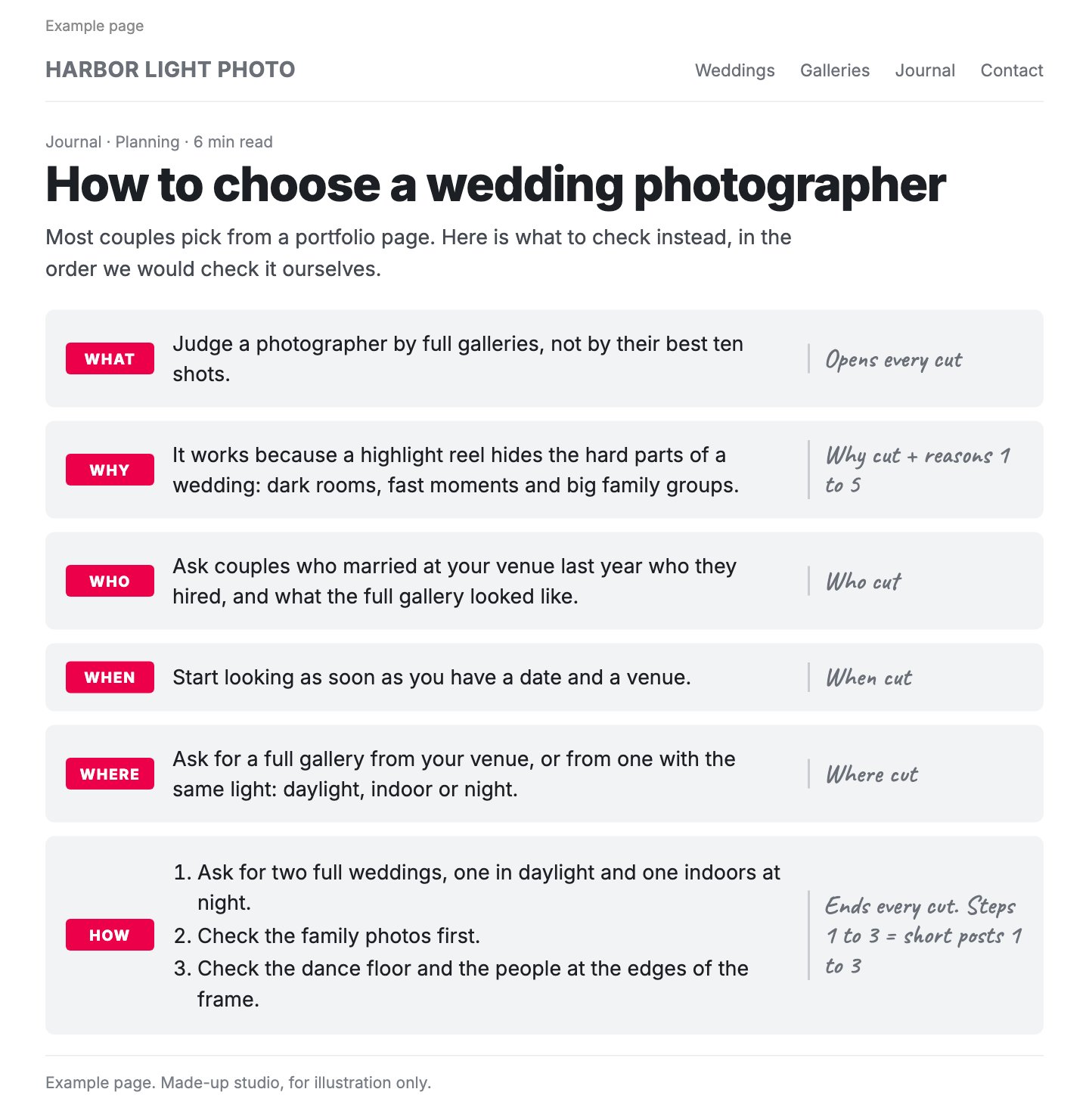
- The what. Every cut opens here.
- The why holds five reasons. That is a five-post series.
- Swap this middle in, and you have the who cut.
- Each step becomes one short post.
- The how always goes last.
Example page built for this article with a made-up brand
The One-to-Twenty is a way to turn one master piece into about twenty smaller ones. The master answers what, why, who, when, where and how about one idea. Every cut opens with the what and ends with the how.
Only the middle question changes. The reasons become a numbered series. Cuts come in three sizes and go out in waves: one short, two or three medium, one long.
Ads get the least how, posts get one step, emails get the full steps. Every piece stands alone. Twenty is our planning number: 15 feed posts, 3 emails and 2 ad drafts.
Keep what first and how last, and change the middle
Every cut opens with the what and ends with the how. Only the middle changes.
That gives you four medium posts from one master. One adds the why. One adds the who.
One adds the when. One adds the where. Same idea, four posts.
Why keep the ends fixed? People skim, so the first line must say what the post is about. Web writers are told to put the most important point first for this reason.
The end matters too. People remember the last part they read. So the last part should be something they can do.
Three questions per post is the minimum: the what, one middle question and the how. Leave a gap, and the reader fills it with a guess. The guess is usually "keep doing what I do now."
Which middle question should you post first? The one your buyer cares about most.
If people matter most to your buyer, start with the who cut. For a travel business, start with the where.
For example, the photographer's who cut could say: "Ask couples who married at your venue last year who they hired. They saw the full gallery, not the ads. Then ask that photographer for one whole wedding, start to finish."
Keep the what and the how; swap the middle to get four posts
| Cut | Opens with | Middle | Ends with |
|---|---|---|---|
| Why cut | Judge by full galleries | A highlight reel hides the hard parts | Ask for two full weddings |
| Who cut | Judge by full galleries | Couples who married at your venue last year | Ask them who they hired |
| When cut | Judge by full galleries | Start as soon as you have a date and a venue | Book your first two calls this week |
| Where cut | Judge by full galleries | Your venue's light: daylight, indoor or night | Ask for a gallery from your venue |
Example cuts from the master above. Every cut answers at least three questions.
Turn the reasons into a numbered series
Most masters give more than one reason. Each reason can be its own post in a numbered series.
For example: "Number one reason couples regret their photographer: they only saw the best ten shots." Then number two, then three, up to five.
Each post still ends with its own how. The number is a label, not a cliffhanger.
Why does a series work? Each post is complete. And the number tells readers there are more, so the next one feels familiar.
Series work for money topics too. For example, a post can show that a $1 million year takes 28 sales at about $36,000 each.
In that post, the $1 million goal is the what. The math is the how.
Five reasons make five posts. You wrote none of them from scratch.
Five reasons in the master become five posts
- Reason 1 They only saw the best ten shots. How: ask for full galleries.
- Reason 2 They never saw a dark room. How: ask for one indoor night wedding.
- Reason 3 They skipped the family photos. How: check the group shots first.
- Reason 4 They never asked other couples. How: ask who married at your venue.
- Reason 5 They waited too long. How: start once you have a date and a venue.
Example series from the master above. Each post ends with its own how.
Size every cut to the wave: short, medium, long
Post in a wave of lengths. One short post, two or three medium posts, one long post, then repeat.
Why not post only long pieces? People save long posts to read later. Later rarely comes.
Short posts get read whole. They keep your name in front of people between the long ones.
Seeing a name again and again builds liking. That pattern is called the mere-exposure effect.
Short: the what and the how, one line each. Pull these from the steps in your master.
Medium: the what, one middle question, and the how. The question cuts and the numbered reasons live here.
Long: all six questions about one big section of the master. Three big sections give you three long posts.
Length also matches the reader's mood. A reader in a hurry wants only the how. A calm reader wants the full why.
The wave gives each of them something. More on timing in the rise-and-fall posting cadence.
Every cut is short, medium or long, and each size has a source
| Size | What it holds | Cut from | In our plan |
|---|---|---|---|
| Short | The what and the how, one line each | One step in the how | 3 |
| Medium | The what, one middle question, the how | The question cuts and the numbered reasons | 9 |
| Long | All six questions | One big section of the master | 3 |
The One-to-Twenty. Post them in a wave: one short, two or three medium, one long.
Give the ad the least how and the email the most
The same structure works in a post, an email, an ad and a video. What changes is how much of the how you give away.
Here is our rule. Give more how when you are building trust. Give less how when you are selling, so the buyer pays for the rest.
Ads sell, so they get the least. The how stays broad: "Here is what you have to do." Then the link.
Posts build trust, so they give one step at a time.
Emails go to people who already know you. They get the most: the full steps from one section.
For example, the photographer's ad could say: "Choosing a wedding photographer? Ask for two full galleries before you book. Here is what to look for."
It is the same idea with fewer steps.
Want your own ad shapes? Rearrange the same six questions. Our three-layer ad is one arrangement.
For the emails, put them in order with a nurture email sequence.
Give less method to sell and more to build trust
- Ad draft Least how: "Here is what you have to do." Then the link.
- Short post One step.
- Medium post One step plus a reason, a person, a time or a place.
- Long post All the steps for one big section.
- Email Most how: the full steps, for people who already know you.
Our rule for the One-to-Twenty.
Make every piece stand alone, like a small free offer
Every piece must work for someone who never sees the master. Think of each one as a small free offer. Its job is to change one thing for the reader.
So each piece answers at least three questions. It ends with a how the reader can use today. And it has no open loops.
An open loop is a line like "Part two tomorrow." It feels like a hook to you. To the reader, it feels like homework.
Google asks a similar question of web pages. Its helpful content guide asks whether a page leaves readers feeling they need to search again.
Would a stranger be glad they saw this one piece? If not, drop it. Our walk-away test shows how to check.
How to turn one great article into twenty pieces nobody reads, in four easy steps:
1. Shrink the whole article into every post. Twenty tiny summaries.
2. End each one with "more tomorrow."
3. Post the same link twenty times with the same first line.
4. Publish all twenty on one day. Then wonder where the hell everyone went.
That is not a system. That is spam with a schedule.
A cut that needs the article to make sense is not a cut
| Leans on the article | Stands alone |
|---|---|
| Opens with "As I wrote last week" | Opens with the what |
| Ends with "Part two tomorrow" | Ends with a how they can use today |
| A summary of everything | One part, done fully |
| Makes sense only to past readers | Makes sense to a stranger |
Our comparison. The stand-alone test from this guide.
Will repurposing content hurt SEO?
No. A post or an email that restates part of your article is not a copy of your page. It lives in a different place, in a different form.
The real duplicate case is the same full text at two web addresses. For that, Google lets you name the main version with a canonical tag. That is a line of code that points to the original.
Even then, Google says most sites will likely do fine without one. It picks the best version on its own.
The bigger risk is thin work. Google's guide warns against content that is mainly summarizing what others say without adding much value.
So every cut must add something: an example, a number or a step. A cut that only says less is not a new piece. It is a shorter copy.
Restating your article elsewhere is fine; thin copies are the real risk
| Case | A problem? | What to do |
|---|---|---|
| A post or email that restates part of the article | No | Nothing. Link back to the article. |
| The same full text at two addresses on your site | Housekeeping | Name the main version with a canonical tag. |
| Twenty cuts that only say less | Yes, a quality problem | Add an example, a number or a step to each cut. |
Source: Google Search Central, canonical URL guide and helpful content guide, read 2026-10-17.
Most sites do fine without a canonical tag; Google picks the best version itself
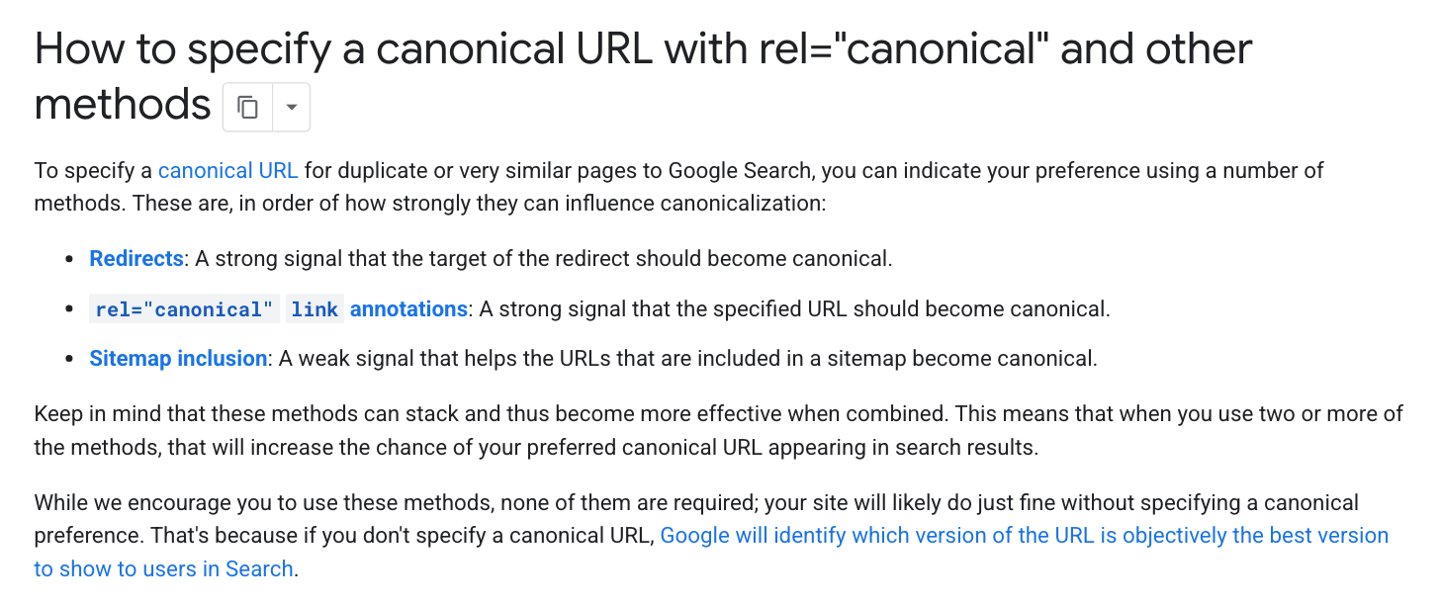
- This page is about true duplicates: the same page at two addresses.
- The canonical tag names the main version.
- Most sites do fine without one.
- If you skip it, Google picks the best version itself.
Screenshot of Google Search Central, How to specify a canonical URL with rel="canonical" and other methods, taken 2026-10-17
How many pieces can one article make? Twenty, in our plan
Our plan gets twenty pieces from one solid master. Twenty is our own planning number, not a rule from anywhere. Here is the math.
Feed posts: 15. Three waves, each with one short, three medium and one long post.
The 3 short posts come from three steps in the how. The 9 medium posts are the 4 question cuts plus the 5 numbered reasons. The 3 long posts cover the master's three big sections.
Emails: 3. One per big section, with the full steps.
Ad drafts: 2. Each opens with the what, uses a different middle question, and ends with a broad how.
Spread them out. At one post on most days, 15 posts fill about three weeks.
People learn better when practice is spread out over time. That is the spacing effect, and your readers learn your idea the same way.
Not everyone sees every post, either. So the third cut of an idea is often the first one someone sees.
Sell only rarely in those twenty pieces. Here is how rarely to sell to your audience.
None of this is new. Magazines made serial fiction popular in the 1800s, and technical writers call it single-source publishing: one source, used in many formats.
Example: one master gives 20 pieces, most of them medium posts
Our planning number, not a rule. A thin master may give eight good pieces.
- Medium posts 9
- Short posts 3
- Long posts 3
- Emails 3
- Ad drafts 2
The One-to-Twenty plan: 3 waves of 5 feed posts, plus 3 emails and 2 ad drafts.
Three waves of five posts fill about three weeks
- Short, medium, medium, medium, long Wave 1 Step post 1, the why cut, the who cut, reason 1, long post on section 1.
- Short, medium, medium, medium, long Wave 2 Step post 2, the when cut, the where cut, reason 2, long post on section 2.
- Short, medium, medium, medium, long Wave 3 Step post 3, reasons 3, 4 and 5, long post on section 3.
- 3 emails and 2 ad drafts Alongside One email per wave. Two ad drafts, each with a different middle question.
Example schedule at one post on most days.
Cut your own master with AI: the copy-paste prompt
Paste the prompt below into your preferred AI, along with your master piece. It marks the six answers and drafts all twenty cuts. It never adds facts that are not in your master.
What to do this week:
1. Pick your best long piece. If it skips one of the six questions, fill that gap first.
2. Run the prompt. Keep only the cuts a stranger would understand.
3. Post the first wave: one short, three medium, one long.
No master yet? Start with a running list of ideas, then grow the best one into a full piece.
Dickens wrote one story and got paid for it twice. You can write one master and post from it for weeks.
Write once. Cut twenty times.
Paste into your preferred AI with your master piece. It asks four questions, marks the six answers, then drafts every cut.
Act as a content editor. Help me cut one finished piece into many smaller ones.

First ask me, one at a time, with the example:
1. Paste your master piece: one long article, video script or email. (Example: a guide called "How to choose a wedding photographer")
2. Who reads it? (Example: engaged couples planning a wedding)
3. What do you sell them? (Example: wedding photography)
4. Where will the pieces go? (Example: Instagram, Facebook, my email list, ads)

Rules:
- Use only facts, numbers and stories that are in my master. Never invent one. If a piece needs something the master lacks, ask me.
- Mark the master's answers to six questions: what, why, who, when, where, how. If one is missing, tell me before you cut.
- Every piece opens with the what and ends with the how. Each piece answers at least three of the six questions.
- Every piece must make sense to a stranger who never sees the master. No open loops like "part two tomorrow".
- Ads give the least how: a broad "here is what you have to do". Posts give one step at a time. Emails give the full steps.
- Each cut must add something: an example, a number or a step. Never just a shorter summary.
- No fake urgency, no made-up threats, no hype. Short sentences, plain words.

Then give me, in this order:
Six answers: [one line each, or MISSING]
3 short posts: [what + how, one line each]
4 question cuts: [what + why / who / when / where + how, under 120 words each]
5 numbered reasons: [a series, under 120 words each, each ending with its own how]
3 long posts: [one per big section of the master, all six questions]
3 emails: [subject line + body, full steps for one section each]
2 ad drafts: [a different middle question each, broad how]
Posting plan: [three waves, each one short, three medium, one long]

Filip Kovacevic is the founder of Anar Agency in Phoenix. He spent five years running SEO, Meta ads, email, and content for medical practices across the United States, and now does the same work for healthcare, home-service, legal, and professional-service businesses, alongside AI implementation. More from Filip →
Talk it through in 15 minutes
Bring one question from this article. We will tell you what we would do, whether or not you hire us.
Book a 15-Min Chat →