Founder-Led Content: How to Turn One Recorded Call Into a Month of Posts
Founder-led content is content built from what a founder already says out loud, on sales calls, in a weekly interview and on podcasts. You record it, pull exact quotes with timestamps, and cut the strongest idea into about twenty posts, clips and emails. The founder approves each piece, so nothing ships that they did not say.
Founder-led content starts on tape, not on a blank page
Last Thursday, the founder was on a sales call. A buyer asked why their last vendor failed. The founder gave a two-minute answer sharper than anything on the company blog.
Then the call ended. The answer was gone.
That is founder-led content at most companies. The best material shows up every week, on calls and in demos. Almost none of it reaches a page.
So why not ask the founder to write more? Because most founders talk far better than they write. A blank page is where good founders go to stall.
A founder content engine is a weekly system that turns what a founder says out loud into posts, clips, emails and sales lines. AI does the transcribing, the quote pulling and the first drafts. Every piece points back to a timestamp of the founder speaking.
We run it on one rule, the Tape-First Rule. Nothing gets drafted that the founder did not say out loud first. No tape, no draft.
The engine is our team version of the CODE method in Tiago Forte's Building a Second Brain: capture, organize, distill, express. Forte built it for one person's notes. A company needs two more steps, an approval and a feedback loop, and most content programs skip both.
Building it is classic work for a marketing engineer, a marketer who builds systems instead of single assets. AI made words cheap. The founder's real words are still scarce.
Six steps turn one hour of founder talk into a month of content
- 1. Capture Record calls with consent, a weekly interview and public talks.
- 2. Store Dated transcripts in one folder, found in 60 seconds.
- 3. Extract Exact quotes with timestamps, tagged by moment type.
- 4. Split One idea a week, cut into about twenty pieces.
- 5. Approve The founder says yes, edit or no on every piece.
- 6. Feed back Log results; the best idea becomes next week's question.
Our method. Steps 1 to 4 follow Tiago Forte's CODE method in Building a Second Brain; approval and feedback are our additions.
What to listen for: four moments buyers remember
The engine listens for four kinds of moment. They come from Bob Moesta's Demand-Side Sales 101, which lists four ways to plant the first thought that starts a purchase.
The four are simple. Ask a good question and leave it open. Tell a story.
Give the buyer a new number to watch. Say the obvious thing nobody else will say.
Moesta also notes that founders often make the best salespeople, because they know the whole business. That is why their unscripted answers beat a content calendar.
Where do you find them? In a founder's normal week.
A buyer's odd question. A deal lost on a Tuesday. A metric the founder checks and competitors ignore.
Can a generic AI draft supply any of them? No, it was never on your calls. It writes the average of everything it has read, and the average is boring as hell.
Tag every moment you pull with one of the four labels. A week of tape with no story and no number tells you what to ask for next time.
Tag every moment as one of four types buyers remember
| Moment | What it sounds like on tape (example) | Best first piece |
|---|---|---|
| An open question | "Why do buyers check references after they sign?" | Short post or ad hook |
| A story | The deal lost on a Tuesday, start to finish | Long post or video clip |
| A new number | "We track days to first reply, not lead count." | Medium post with a chart |
| The obvious, said out loud | "Most free audits are sales pitches." | Short post or email subject |
The four types: Bob Moesta, Demand-Side Sales 101 (four ways to create a first thought). Example lines are made up; the content mapping is ours.
The Tape-First Rule says nothing gets drafted that the founder did not say out loud first. Record one 25-minute interview a week plus consented customer calls, and store the transcripts where anyone finds them in sixty seconds. Pull exact quotes with timestamps, each tagged as an open question, a story, a new number or the obvious said out loud.
Cut the strongest idea into about twenty pieces, each tied to its timestamp, and get the founder's yes on every one. Log what each piece did, mark the best ideas proven, and ask the founder to go deeper on one of them next week.
Record the founder doing the work; never ask them to write
Mike Michalowicz learned this the hard way, as he tells it in Clockwork. He spent four hours writing a fifteen-step procedure for shipping used books. His intern was back with questions within minutes.
Then the postal service changed its website and Amazon changed its system, and the document went stale. His fix was to record himself doing the task and talking it through. Whoever takes the task over records the next version.
He wrote about operations, not content. In our experience the same trick works for content. Capture the founder while they do work they already do.
Record from three places. First, sales and customer calls, with consent. Second, one weekly 25-minute interview where a teammate asks the questions.
Third, anything the founder already does in public, like a podcast guest spot. Add the founder's sent email too. An answer to the same buyer question, written ten times, is already finished content.
The interviewer needs one skill. Ask, then ask for an example.
Ask the same six questions every week, shown in the table below. Four hunt for the four moments. Two catch decisions and the answers the founder keeps retyping.
Recording the work beats writing it down from memory
| Writing it from memory | Recording while doing |
|---|---|
| Four hours for one fifteen-step procedure | The work gets done while it is recorded |
| Missed steps send people back with questions | Shows the steps you would forget to write |
| Goes stale when a website changes | Whoever does the task records the new version |
| The founder stares at a blank doc | The founder talks for 25 minutes |
First three rows: Mike Michalowicz, Clockwork (his used-book shipping procedure). The founder row is our transfer to content.
Six questions, asked the same way every week
| # | Question | What it hunts for |
|---|---|---|
| 1 | What did a buyer ask this week that surprised you? | An open question |
| 2 | Which deal did we win or lose, and what happened? | A story |
| 3 | What number moved, or what do you track that others don't? | A new number |
| 4 | What does our market get wrong? | The obvious, said out loud |
| 5 | What did you decide this week, and why? | A story with a decision |
| 6 | Which question do you answer by email again and again? | A ready-made answer |
Our question set. Question 6 follows Building a Second Brain, which lists answers to common email questions as reusable work.
Is it legal to record sales calls for content?
It depends on where each person on the call is. Federal law, 18 USC 2511, allows a recording when one party to the call consents. Some states require consent from everyone on the call.
The Reporters Committee recording guide sums up the rules state by state. This is not legal advice, so check with your lawyer before you record buyers.
Our habit is one sentence at the start of every call: "We record these so we don't miss anything, and you can say no." Put the same line in the invite.
Keep the most private calls on your own machines. Open-source speech-to-text models can run on a laptop. A transcript that never leaves the building cannot turn up anywhere else.
Store every tape so anyone finds it in sixty seconds
A transcript in someone's downloads folder is not an asset. It becomes one when the next person or agent can find it fast.
Our test is sixty seconds. If anyone needs longer to find a recording, the storage is broken.
So the engine lives in one folder of the growth repo, the shared files every person and agent reads. It holds four things: raw transcripts, a voice file, an ideas log and a results log.
Name every file date first, like raw/YYYY-MM-DD-weekly-interview.txt. A year later, an agent asked for everything the founder said about pricing finds it in one search. So do you.
The voice file stops drafts from sounding like everyone else. Put in ten sentences the founder really said, five words they never use, and three posts they liked next to three they hated.
When a draft drifts, fix the file, not the prompt. One new line in the voice file fixes every future draft at once.
Four files hold the whole engine, each found in 60 seconds
| File | What goes in | Example row |
|---|---|---|
| raw/ | Dated transcripts, with consent noted | raw/YYYY-MM-DD-weekly-interview.txt |
| voice.md | 10 real sentences, 5 banned words, 3 liked and 3 hated posts | Never says "solutions" |
| ideas.csv | Quote, timestamp, moment type, status | "Lost it at the reference check" | 14:32 | story | proven |
| results.csv | Reach, buyer comments, profile visits, inbound messages per piece | Clip 3 | 2 buyer comments | 1 message |
Our layout, inside the growth repo. The 60-second findability test comes from Mike Michalowicz, Clockwork.
Pull exact quotes, never summaries
Ask an AI to write posts from a transcript and it summarizes. It smooths the edges and invents a little. The founder's best line, the odd one, is the first thing it drops.
That is how summaries work. A summary is compression, and compression always drops something. What it drops is often the offhand detail you needed most.
So pull quotes first. Summaries come later, if at all. Quoting first is documented advice for long documents: have the model quote the relevant parts before it does the task.
Forte's book has a clean example of why this pays. A pastor recorded and transcribed his talks with grieving families. He stopped spending five to seven hours at the end and spent fifteen minutes after each talk marking only the parts that moved him.
When he sat down to write, he said, 80 percent of the work was already done. A content engine works the same way.
Every pulled moment gets a row in the ideas log: the exact quote, the timestamp, the moment type and a status. That row is the receipt. A customer truth system runs on the same rule.
If an agent runs this every week, give it a written brief: inputs, schedule, output and what needs approval. Our agent job spec shows the format.

A summary keeps the gist and drops the line buyers remember
| Summary of the call | Exact quote with timestamp |
|---|---|
| "The founder discussed why vendors fail." | "They sold you a dashboard. You needed a phone call." (14:32) |
| Smooths the odd phrasing away | Keeps the founder's own words |
| No way to check it | The founder checks it against the tape |
| Each rewrite loses more detail | The quote is the source, so nothing is lost |
Example lines are made up. Summaries as lossy compression: John Berryman and Albert Ziegler, Prompt Engineering for LLMs.
Fifteen minutes after each talk replaced hours of work at the end
- Before: distilling every interview at the end 5 to 7
- After: marking the best parts right after each talk 15
- Of the work already done when writing began, in his words 80
A pastor's account in Tiago Forte, Building a Second Brain. One person's experience, not a measured study.
Every row in the ideas log is a receipt you can check against the tape
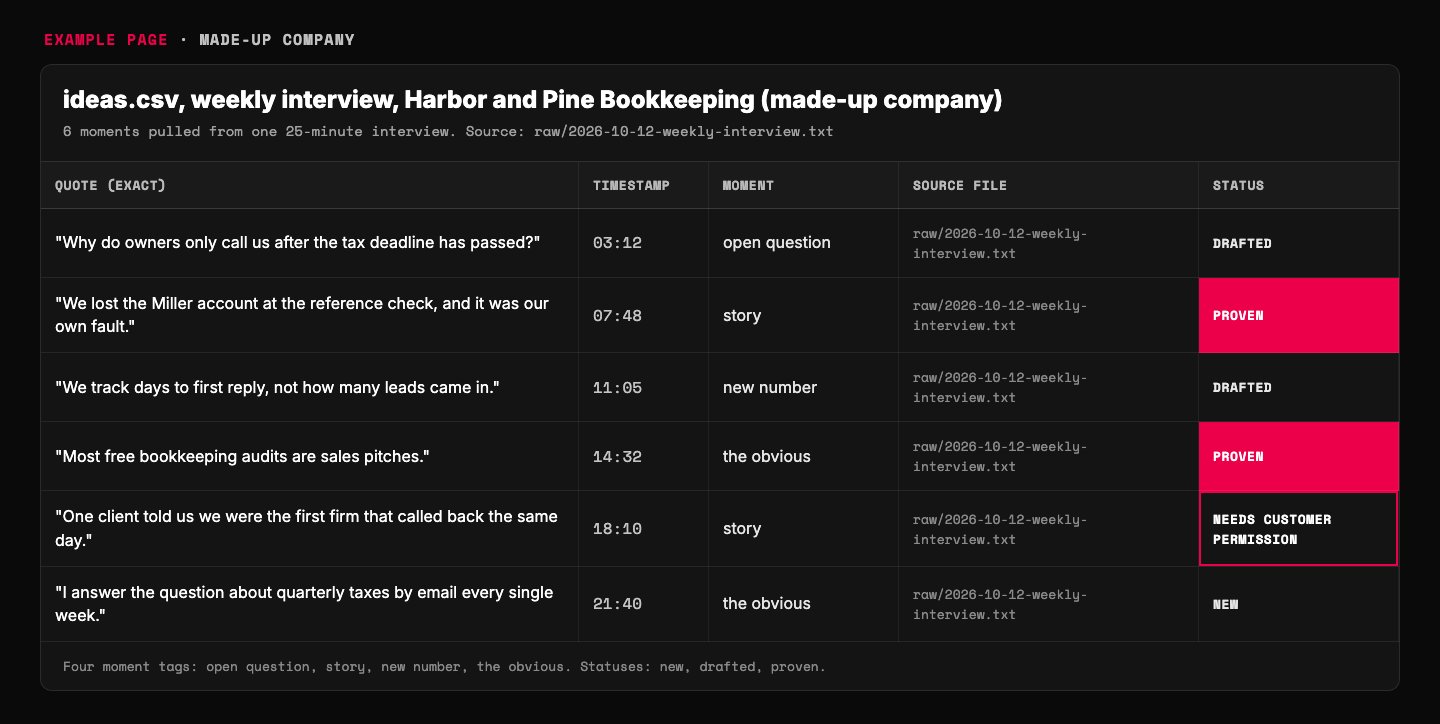
- Exact words only. No summary in this column.
- The timestamp lets the founder check it against the tape.
- Each quote gets one of four moment tags.
- Customer words wait for the customer's yes.
- Proven ideas get a deeper question next week.
Example page built for this article with a made-up brand
Pick one idea a week and cut it twenty ways
Pick one idea from the week's tape. Not the one the founder is proudest of. The one your buyer would act on.
A newspaper shows the discipline. The Deseret News, profiled in Competing Against Luck, might face thirty bills in a legislative season on its front page. It covered only the five that would affect its readers' families.
Then cut that one idea into about twenty pieces. The table below is our starting mix, and One Article, Twenty Pieces teaches the cutting itself.
Why twenty from one? The recording is the expensive part. Spread one recording across many pieces and each piece gets cheap.
Cut the video clips from the recording itself, at the flagged timestamps. A founder saying the line on camera carries more weight than the same line under a stock photo.
Start each clip on the point. No intro. The chart below shows what an intro costs.
Run the three ad hooks through the change plus hope test before you spend on them. Then spread the twenty over weeks, and let the volume rise and fall, as in the rise-and-fall cadence.
Short clips kept far more viewers than long episodes
Share of viewers gone by the halfway point
- Long episode, with intro 40
- Short clip 15
Source: the Gags case in Alistair Croll and Benjamin Yoskovitz, Lean Analytics. The same channel lost 30% of viewers in the first 15 seconds of a 10 to 15 second intro, then removed intros.
One idea, twenty pieces: our starting mix
| Piece | Count | Cut from the tape |
|---|---|---|
| Long post | 1 | The full idea, story first |
| Medium posts | 3 | One supporting point each |
| Short posts | 4 | One sentence the founder said, quoted exactly |
| Video clips | 3 | The sharpest timestamps, captions on |
| Emails | 2 | One list email, one line for a nurture email |
| Ad hooks | 3 | Three angles on the same idea |
| Page and sales lines | 3 | A page line, a cold email angle, a sales answer |
| Article | 1 | Only when the idea carries a method |
| Total | 20 | Every piece tied to one timestamp |
Our starting template. Change the mix to fit your channels; keep every piece tied to its timestamp.
Keep the founder's words, and make them easier to read
Plain words win in a feed. In Writing for Busy Readers, Todd Rogers and Jessica Lasky-Fink cite a study of over 4,000 Humans of New York posts. Each grade level easier to read went with more than 16,000 extra likes.
Another study they cite found tweets with the most common words got about 75% more retweets. Founders already talk in plain words. Drafts are where the jargon sneaks back in.
So the edit rules are narrow. Cut words. Swap long words for short ones, and keep the founder's sentences whole.
Repeat the founder's best line on purpose. Most buyers miss most posts. A line heard five times is finally a line they remember.
Never add a fact the tape does not hold. Every line has to survive the founder's check.
Easier posts earned more likes and more shares
- Likes per grade level easier, Humans of New York posts 16000
- About this many more retweets for tweets with the most common words 75
Studies cited in Todd Rogers and Jessica Lasky-Fink, Writing for Busy Readers: over 4,000 Facebook posts across three years, and hundreds of thousands of tweets. Correlations, not experiments.
Edit every draft toward the founder, never away
| Rule | Why |
|---|---|
| Cut words; swap long words for short ones | Plain writing gets read and shared more |
| Keep the founder's sentences whole | The odd phrasing is the voice |
| Repeat the founder's best line on purpose | Most buyers miss most posts |
| Never add a fact the tape does not hold | Every line must survive the founder's check |
Our rules. The repeat rule follows Donald Miller, Building a StoryBrand: use your one-liner until it feels borderline excessive.
The founder edits; nobody ships a line they did not approve
David Jenyns makes a simple point in Systemology: writing up a system is a two-person job. One person knows the work, and another writes it up. People would much rather edit a draft than face a blank page.
The engine copies that split. The founder talks, then edits. The engine and its owner do everything in between.
Anything under the founder's name gets the founder's yes on each piece. Not a skim of the batch. The post is their reputation, and the draft is a machine's guess at their voice.
Customer words need more care. Ask the customer before you quote them, and keep the quote exact. The FTC's Endorsement Guides say an endorsement must reflect the honest opinion and real experience of the person giving it.
Never let the engine fill a gap with a made-up story. The FTC's rule on fake reviews and testimonials names AI-generated fake reviews as an example.
How to make your founder sound like a press release in four easy steps:
1) Ask them to jot down a few thoughts in a doc.
2) Wait three weeks for the doc.
3) Hand an AI the topic, with no tape.
4) Post the result under their name without asking.
That is not the founder talking. That is a stranger using their name.
Write the approval line down: who approves what, how fast, and what never ships. A one-day turnaround keeps the engine running. A two-week one kills it.
About an hour a week of founder time; the engine does the rest
| Day | Step | Who | Founder minutes |
|---|---|---|---|
| Monday | Record the interview | Founder and interviewer | 25 |
| Monday | Transcribe and file | The engine | 0 |
| Tuesday | Pull and tag quotes | Agent, checked by the owner | 0 |
| Wednesday | Cut twenty drafts | Agent and owner | 0 |
| Thursday | Approve: yes, edit or no | Founder | About 30 |
| Friday | Log results, pick next question | Owner | 0 |
Our working template, not a benchmark. The talk-then-edit split follows David Jenyns, Systemology.
The founder approves each piece against the tape, one at a time
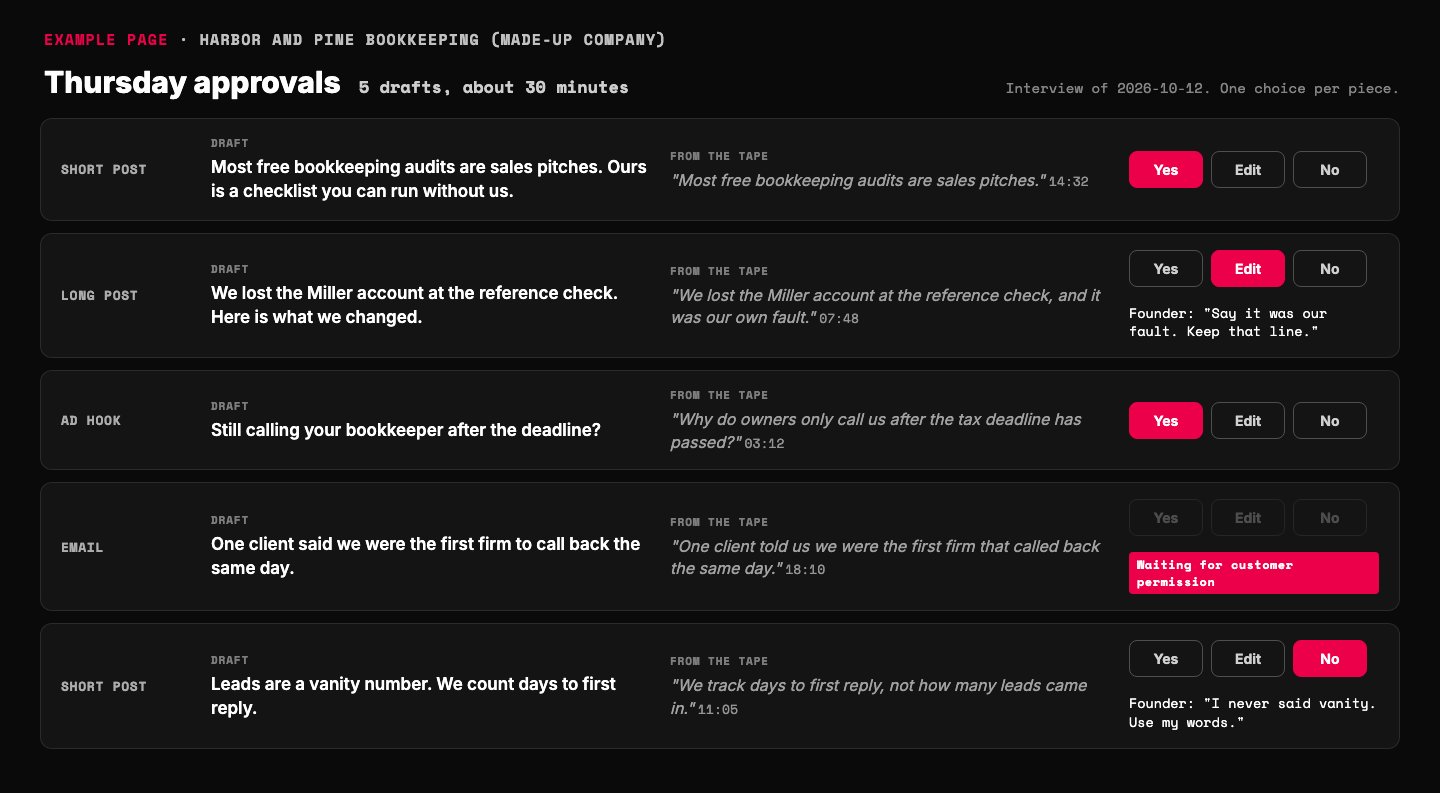
- Every draft sits next to the exact quote it came from.
- Edit means the founder fixes the wording, not the engine.
- Customer words never ship without the customer's yes.
- A word the founder never said is a reason to say no.
- One yes per piece, about 30 minutes a week.
Example page built for this article with a made-up brand
Read what lands, then ask the founder about it next week
A content engine has to read its own results. Without that step it is just a faster way to guess.
Log four numbers per piece in the results log: people reached, comments from people who fit your buyer, profile visits and inbound messages. Buyer comments count more than the raw total.
Ten likes from peers feel nice. Two comments from people who sign contracts are the real signal.
Every Friday, mark the three best ideas as proven in the ideas log. Turn one of them into a deeper question for Monday's interview.
Drop any idea that flops in two different formats, even one the founder loves. After a month, the proven list tells you what your market wants to hear from this person.
This is the Repeat step of our loop. Feed what worked into the next tape, and the founder gets sharper every week.
Where do the numbers live? Platform analytics change often, so those details sit in the dated box below. The weekly read belongs in your growth cockpit.
The best idea each week becomes next week's question
- Record 25 minutes, six questions
- Pull quotes Exact words, timestamps, tags
- Publish Twenty pieces over weeks
- Read buyer signals Comments and messages from buyers
- Ask deeper The proven idea gets a harder question
Our loop.
Run the whole week with one prompt
The prompt below runs one week of the engine on any transcript. Paste it into your preferred AI with the transcript and the voice file.
It asks five short questions first. It quotes before it drafts, ties every piece to a timestamp, and flags every customer quote for permission.
How much founder time does a week take? About an hour. That is 25 minutes talking and about 30 minutes approving.
Paste into your preferred AI with the transcript. It asks five questions, pulls exact quotes, then drafts up to twenty pieces tied to timestamps.
Act as the editor of a founder content engine. Turn one transcript of the founder speaking into a week of drafts, using only words the founder actually said.

First ask me, one at a time, with the example:
1. Paste the transcript, with timestamps. (Example: a 25-minute weekly interview)
2. Who is the buyer? (Example: owners of 10 to 50 person service firms)
3. Where do we publish? (Example: LinkedIn, a weekly email, short video)
4. Paste the voice file, or describe how the founder talks. (Example: short sentences, never says "solutions")
5. Does the transcript quote a customer? (Example: yes, one client at 18:10)

Rules:
- Quote first. List every question, story, number and claim as an exact quote with its timestamp. Never paraphrase inside a quote.
- Tag each quote: open question, story, new number, or the obvious said out loud.
- Pick the one idea this buyer would act on. Say why in one line.
- Draft up to 20 pieces from that one idea. Each piece names the timestamp it came from.
- Never add a fact, number or story the transcript does not hold. Where a piece needs one, write [ASK FOUNDER].
- Mark every customer quote [NEEDS CUSTOMER PERMISSION] and keep it exact.
- Plain, common words. Keep the founder's sentences whole.
- Do not look anything up to fill a gap. The tape is the only source.

Show your work, then answer in this format:
Quote list: quote | timestamp | tag
The idea: one sentence, plus why this buyer cares
Drafts: piece type | text | source timestamp
For the founder: the five drafts to approve first
Next week: one deeper question to ask the founder
What to do this week
1. Book a 25-minute interview with the founder and ask the six questions.
2. Run the prompt on the transcript and pick one idea.
3. Get the founder's yes on five pieces, then publish one.
Remember the two-minute answer from last Thursday's sales call? Next week it is a post, three clips and an email, in the founder's own words.
If you want the engine built inside your company, measured against a number you already track, that is how our marketing engineering engagements begin. Every post it makes should report a real change, the rule in All Content Is About Change.
Your founder is already on the air every week. Somebody just has to press record.

Filip Kovacevic is the founder of Anar Agency in Phoenix. He spent five years running SEO, Meta ads, email, and content for medical practices across the United States, and now does the same work for healthcare, home-service, legal, and professional-service businesses, alongside AI implementation. More from Filip →
Want the engine without hiring for it?
You are not signing up for anything. Bring the founder and one number you want to move, and in 15 minutes we will tell you whether this is the right first system and what the first month would look like.
See how we build them →Want to do this work yourself? See how we train marketing engineers.