How to Write Instructions for an AI Agent: Brief It Like a New Hire

To write instructions for an AI agent, brief it like a new hire with a one-page job spec. Give it eight lines: the job, what starts it, its inputs, the steps, its judgment calls, the output, a check and an owner. Test the page on a stranger first.
Then loosen supervision only as the agent proves itself.
How to write instructions for an AI agent: brief it like a new hire
Picture a new hire's first morning. They get a desk, a login, a manager, and an hour on what good work looks like here.
Now picture what most AI agents get. One line in a chat box: "Do the weekly lead report."
Then everyone acts surprised when it invents a column. That is not a model problem. It is a missing job description.
Most advice on how to write instructions for an AI agent is about clever wording. Ours is about the job. We give every agent a one-page spec, the same page we would hand a person on day one.
The short version: eight lines, one test, and supervision that loosens only as the agent earns it. Below is each part, a worked example, and a prompt that writes your first spec with you.
A prompt asks once; a spec defines a job that repeats
| A prompt in a chat | A Day-One Spec in a file |
|---|---|
| Asks for one result, one time | Defines a job that runs again and again |
| Lives in a window that closes | Lives in a file with a date on it |
| Leaves every decision to the model | Says who makes each decision |
| Judged by how the answer reads | Judged by a check written in advance |
| Corrections vanish with the chat | Corrections become new lines |
Our comparison.
Give the agent a contract for results, not a list of chores
An agent fails the way a bad first hire fails. Nobody told it what result it owns.
Michael Gerber tells the classic version in The E-Myth Revisited. An owner hires Harry, a bookkeeper with twenty-two years of experience, hands him the books, and runs. Gerber calls it Management by Abdication.
It goes badly. Mistakes pile up, the owner storms back in, and he takes the work back himself.
Harry was skilled. He still lacked four things: why the work exists, the result he answers for, the standards he is judged by, and where his job fits.
Gerber's fix is a Position Contract, which he insists is "not a job description." It lists results, standards and a signature.
An agent has the same four needs. A new hire asks about them. An agent guesses.
Here is our test for any handoff. If the work keeps coming back to you for answers, you are still making the decisions. You handed off the work and kept the job.
Harry's four missing needs each have a line in the spec
| What Harry needed | Where it lives in the Day-One Spec |
|---|---|
| Why the work exists | Line 1, the job |
| The result he answers for | Line 1, the job, and line 7, the check |
| The standards he is judged by | Line 5, judgment calls, and line 7, the check |
| Where his job fits | Line 2, the trigger, and line 8, the owner |
Needs from Michael E. Gerber, The E-Myth Revisited. The mapping to the spec is ours.
If the work keeps coming back with questions, you have not delegated
| Deciding | Delegating |
|---|---|
| You hand over a task | You hand over an outcome |
| Every snag comes back to you | Routine snags get answered from the spec |
| You approve each step | You check the result against line 7 |
| Your week stays full | Your week gets lighter |
Deciding vs delegating from Mike Michalowicz, Clockwork. Applied to agents by us.
The Day-One Spec is a one-page job brief that gives an AI agent, an automation or a new hire what they need on the first morning, in eight lines: the job, the trigger, the inputs, the steps, the judgment calls, the output, the check and the owner. It passes the Stranger Test when a smart colleague can run the task from the page without asking a question. Supervision starts at stage one, where a person reads every output, and moves up one stage after ten clean outputs in a row.
Every correction becomes a dated line.
The Day-One Spec: eight lines a new hire would need
The Day-One Spec is a one-page brief that gives an agent what a new hire needs on the first morning. It works for an AI agent, a plain automation or a person.
Lines one to four set up the work: the job, what starts it, what it reads, and the steps. Lines five to eight set the behavior: the judgment calls, the output, the check, and the owner.
Two lines do most of the work. Line five says which decisions belong to the agent and which stay with you. Line seven says how you know it worked without trusting the machine.
Why a page and not a chat? A chat closes. A page lives in a file, carries a date, and gets better every week.
Keep every agent's page in one place, like a shared growth repo, so the next person can find it. Writing one is also the first real task in our 30-day plan to become a marketing engineer.
For example, picture a Monday lead check. The table below fills in all eight lines.
Eight lines that answer a new hire's first-morning questions
- 1. Job One sentence: the result, who gets it, and why.
- 2. Trigger What starts a run: a time, a new file, a form.
- 3. Inputs Every file, export and login, and where each lives. Nothing else.
- 4. Steps Verb plus object, in order. Only the steps a newcomer might miss.
- 5. Judgment calls Each decision, its rule, one good and one bad example, and who makes it.
- 6. Output The exact shape, and the address where it lands.
- 7. Check How you know it worked without trusting the tool.
- 8. Owner Who reads it, approves it, fixes it, and dates each correction.
The Day-One Spec, our framework.
Example: a Monday lead check, written as a Day-One Spec
| Line | What it says |
|---|---|
| 1. Job | Rank last week's new leads so the sales lead knows which ten to call first on Monday. |
| 2. Trigger | The weekly lead export lands in the shared leads folder. |
| 3. Inputs | That export, the one-page ideal-customer description, and last quarter's won and lost list. Nothing else. |
| 4. Steps | Remove duplicates and test entries. Score each lead 1 to 5 against the description. Write one reason per lead. |
| 5. Judgment calls | Scores: the agent decides. A 5 needs two of: right industry, right size, asked for a price. A complaint or a competitor's name: flag for the owner, unscored. Emailing a lead: never. |
| 6. Output | A sheet sorted by score, with name, company, score and reason, saved with the date in the file name. |
| 7. Check | Leads in equals leads out plus removed duplicates. Every 5 quotes the lead's own words. |
| 8. Owner | The sales lead reads the top ten, approves the call list, and adds any correction to the spec with the date. |
Example built for this guide. Not a client system.
A finished spec fits on one page: eight lines and a dated corrections list
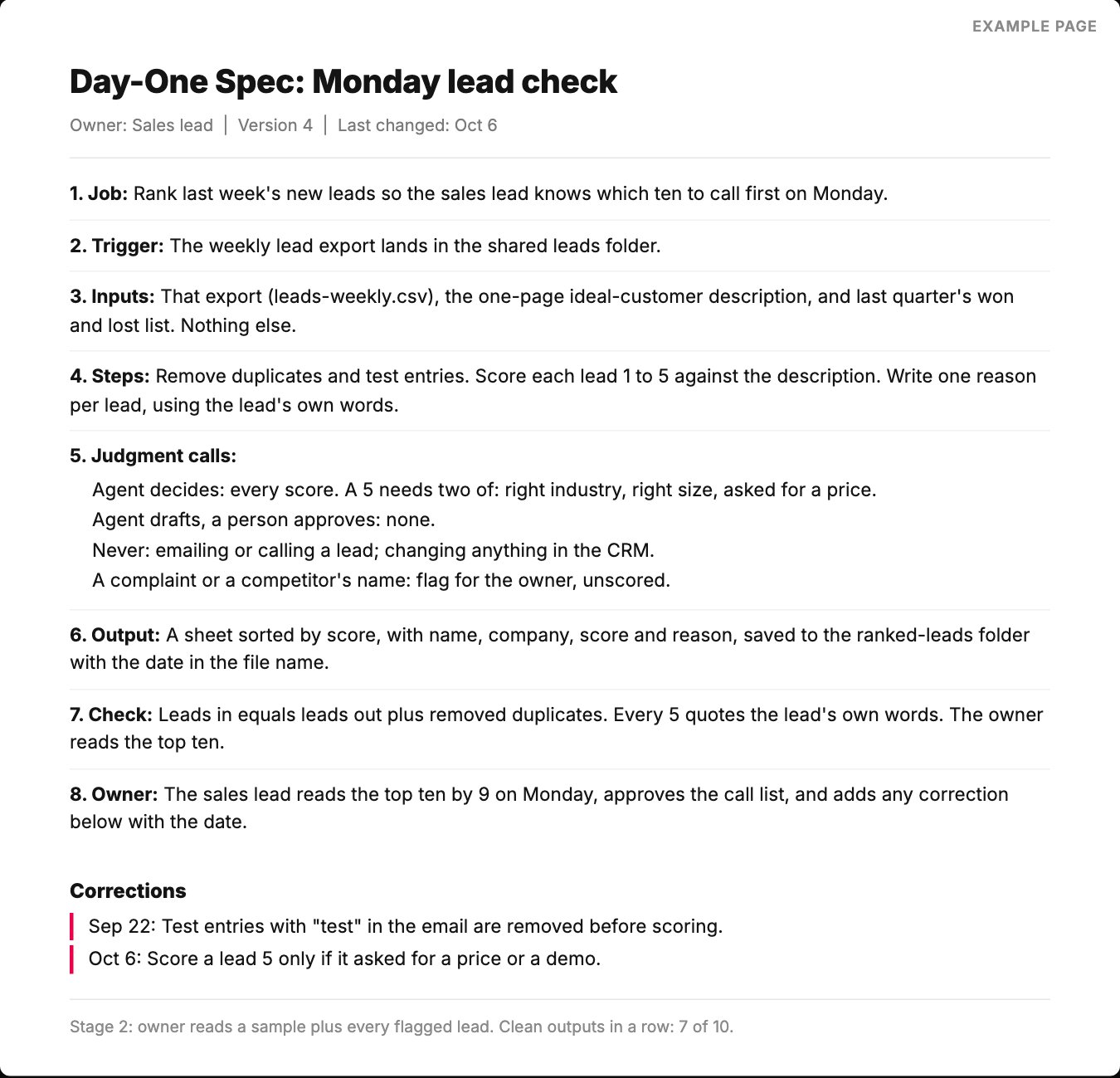
- Line 1 passes the five-second test: the result, who gets it, and why.
- Each decision is sorted: the agent decides, a person approves, or never.
- Anything that reaches a customer stays off the agent's list.
- The check works without trusting the agent: counts must match.
- Every correction becomes a dated line, not a chat message.
Example page built for this article with a made-up team, 2026-10-18. It matches the worked example above. Not a client system; no real names, companies or data.
Line one is the whole job in one sentence
Line one should pass a five-second test. Someone who reads only that line should know the result, who gets it, and why.
The test comes from Writing for Busy Readers. Todd Rogers and Jessica Lasky-Fink ask writers to decide what a reader must take away in five seconds.
Their studies are on human readers. In one, a single highlighted instruction got followed far more often than the same instruction highlighted next to four others.
Applying that to agents is our reading, not their finding. But the logic holds. Five top priorities means no priority.
So one job per spec. If line one needs two goals, you have two agents.
Watch for what the authors call mission creep: a goal that quietly grows while you write. Cut the extra goal and give it its own page.
One highlighted instruction got followed most; five highlights diluted it
Share of readers who followed an instruction buried in a five-paragraph passage
- One sentence highlighted 84
- Five sentences highlighted 65
- No highlighting 55
Todd Rogers and Jessica Lasky-Fink, Writing for Busy Readers. Online study of nearly 1,000 people. Applying it to agents is our inference.
Write only the steps the agent would miss
Short beats complete. A long brief buries the steps that matter.
Atul Gawande learned this from Boeing's checklist designers, as he recounts in The Checklist Manifesto. A good list holds only "the killer items": steps that are dangerous to skip and still get missed.
Boeing's cargo-door checklist even leaves out radioing the tower. Pilots almost never forget it. So it does not belong.
Bad lists try to spell out everything. In Gawande's words, they "turn people's brains off." Bad specs do the same to agents.
Which steps get missed? Test, don't guess. Before one hospital enforced its checklist, doctors skipped at least one of five basic steps in more than a third of patients.
Those were doctors, skipping steps they already knew. Assume your agent will skip them too.
A common rule of thumb caps a checklist at five to nine items, the limit of working memory. Use the same ceiling for your steps.
Then word each line well. Ask for what you want instead of what you forbid, and give the reason. Save "never" for the lines about money and customers.
Doctors skipped known steps until a short checklist made them explicit
One hospital's central-line checklist: five basic steps, nurses allowed to stop a doctor who skipped one
- Patients with at least one of five basic steps skipped, before nurses could enforce the checklist 1 in 3+
- Ten-day line-infection rate before enforcement 11
- The same rate over the following year 0
Johns Hopkins central-line checklist, as reported in Atul Gawande, The Checklist Manifesto.
Ask for what you want, and give the reason
| A wish | A spec line |
|---|---|
| Be thorough. | Check every lead against the ideal-customer page before you score it. |
| Don't be salesy. | Write each reason from the lead's own words, so sales can trust it. |
| NEVER skip anything. | If a field is empty, mark it missing and keep going. |
| Use your judgment on edge cases. | A lead that names a competitor goes to the owner, unscored. |
Wording rules from John Berryman and Albert Ziegler, Prompt Engineering for LLMs: ask for positives, give a reason, avoid absolutes. Examples are ours.
How detailed should an AI agent's instructions be?
Match the detail to the agent's record on this exact task. New task, full detail. Long clean record, the goal and a check.
Andy Grove called this task-relevant maturity in High Output Management. Low maturity gets structure: tell the worker what, when and how. High maturity gets objectives and monitoring.
The key word is task. Grove moved a star sales manager into a factory and watched him struggle, because the work was new to him.
We treat agents the same way. A new input format or a new client resets the clock.
Grove's one fixed rule: monitor enough to avoid surprises. "Delegation without follow-through is abdication."
He also refused to let a new person learn by failing customers. Training is the manager's cost, not the customer's.
So we run three stages. Our rule: move up one stage after ten clean outputs in a row. Drop back one stage after any miss, and restart at stage one when the task or its inputs change.
Trust gets earned ten outputs at a time.
Check early, too. Grove's advice is to review the rough draft, not the polished report. Have the agent show its outline or its scored list before it writes the final piece.
Supervision loosens one stage at a time, and only on evidence
- Stage 1: read everything A person reads every output before anything leaves. Every new task starts here.
- Stage 2: read a sample A person reads a sample, plus every output that touches money or a customer.
- Stage 3: spot checks The agent runs alone on low-risk work. Spot checks go on, and line 5 approvals never go away.
Our rule: up one stage after 10 clean outputs in a row; down one stage after any miss; back to stage 1 when the task or inputs change.
New task, full detail; long clean record, goal and check
| Maturity on this task | Grove's management style | Our agent setting |
|---|---|---|
| Low: new to the task | Structured: tell what, when and how | Full spec, stage 1, a person reads everything |
| Medium: some record | Two-way: explain, support, reason together | Spec plus good and bad examples, stage 2 sampling |
| High: long clean record | Set objectives and monitor | Spec stays, stage 3 spot checks, line 5 approvals stay |
Levels and styles: Andrew S. Grove, High Output Management, after Hersey and Blanchard. Agent settings are our adaptation.
Which decisions can an AI agent make on its own?
Let an agent decide alone when a wrong call is cheap and easy to undo. Keep a person on anything that spends money, reaches a customer, or cannot be taken back.
That rule is older than chatbots. Gary Lilien and Arvind Rangaswamy coined marketing engineering for managers who decide with data, models and judgment. Their textbook says automation fits cheap mistakes, like product recommendations, and human judgment fits expensive ones.
They also expected agents to handle repetitive decisions with inputs that vary, where you can describe the structure in advance. That is still the best test for what to hand an agent.
The role has grown since. Today's marketing engineer also builds those agents. So the job spec is one of the first things a marketing engineer writes.
Line five sorts every decision into three buckets.
The agent decides. The agent drafts and a person approves. The agent never touches it.
Keep its tools as few as the job allows. The OWASP security project calls the opposite excessive agency: more tools, permissions or freedom than the task needs.
A lead scorer does not need the send button. Neither does a report writer. Give it the keys to one room, not the whole building.
Hand an agent the repeating, cheap-to-fix calls; keep the costly ones
- Do it yourself Rare and costly. A spec costs more than it saves.
- Agent drafts, a person approves Repeats, but spends money or reaches customers.
- Just do it Rare and cheap. No spec needed.
- Agent decides alone Repeats and is cheap to fix. Spot checks only.
Our matrix, built on the automation rule in Lilien, Rangaswamy and De Bruyn, Principles of Marketing Engineering and Analytics.
The Stranger Test: check the spec before any agent runs it
Before an agent reads the spec, a person does. We call it the Stranger Test.
Hand the page to a smart colleague who has never done the task. If they can run it without asking you a single question, the spec is ready. Every question they ask becomes a new line.
David Jenyns uses the same pass line for written procedures in SYSTEMology. A procedure is done when someone new can complete the task to a good standard with no help.
Why a person first? A person asks out loud. An agent fills the same gap with a confident guess.
The test catches bloat too. Jenyns quotes Netflix founder Reed Hastings: dummy-proof everything, and only dummies will want to work there. Jenyns wants "less detail than you think you need."
How to train an agent to ignore you in four easy steps:
1. Write "make it good" and call it a brief.
2. Paste forty rules, half of them in capital letters.
3. Correct it in the chat, where the fix dies with the window.
4. Blame the model, buy a new one, and start the whole damn thing over.
That is not automation. It is babysitting with extra steps.

Every missing line shows up as a question from the stranger
| Line | If it is missing, the stranger asks | Typical result in an agent |
|---|---|---|
| 1. Job | What is this for, and who reads it? | Works for the wrong reader |
| 2. Trigger | When do I start? | Runs at the wrong time, or never |
| 3. Inputs | Where is the file? | Uses whatever it can find |
| 4. Steps | What comes first? | Invents its own order |
| 5. Judgment calls | Is this my call or yours? | Makes the call itself |
| 6. Output | Where does it go? | Leaves it in a chat |
| 7. Check | How do I know it's right? | Reports success either way |
| 8. Owner | Who do I tell when it breaks? | Tells no one |
Our test. Every question the stranger asks goes on the page as a new line.
Every question in the margin is a line the spec is missing
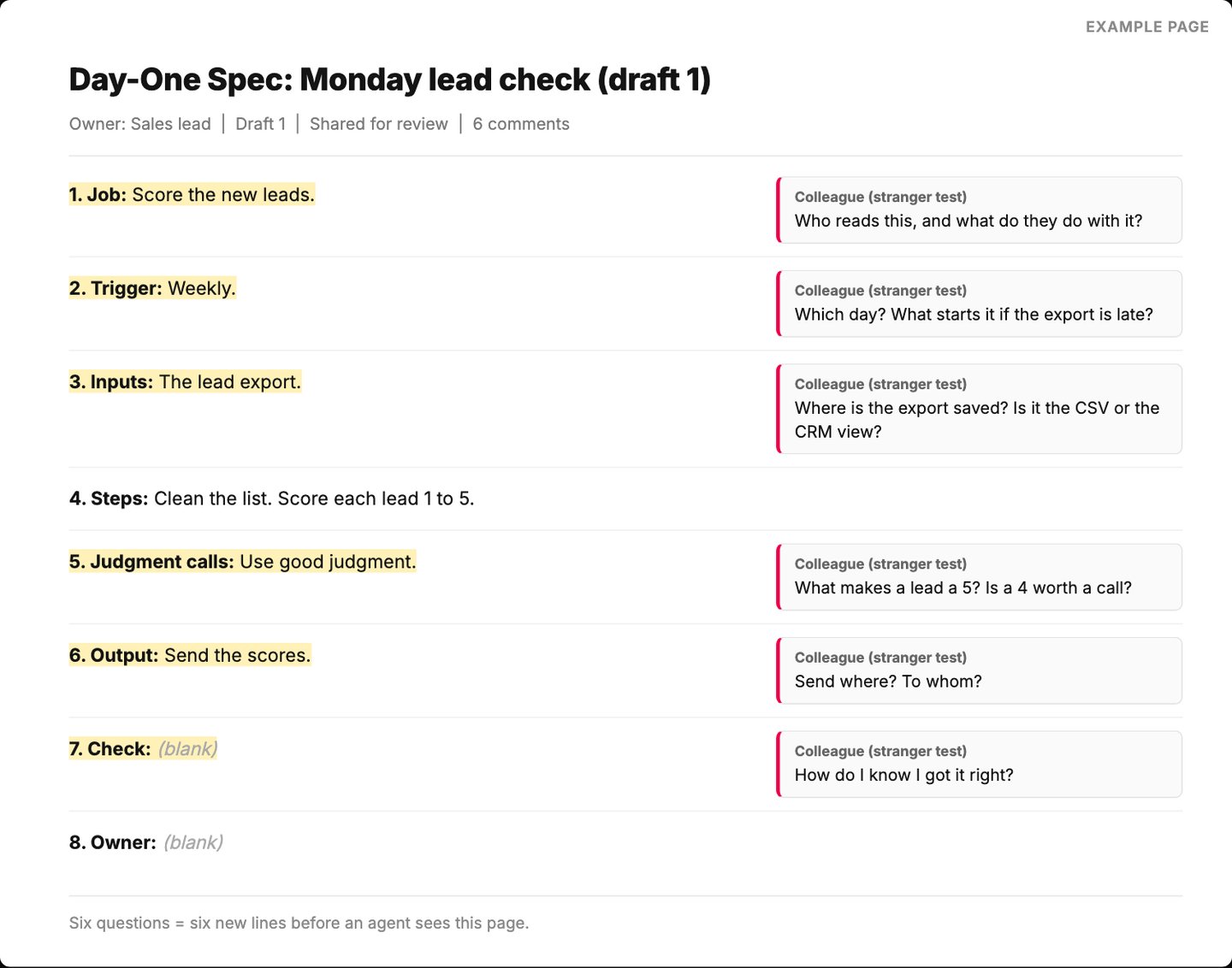
- A task, not a job. No reader, no result, no reason.
- A person asks this out loud. An agent would guess.
- A blank check line means nobody can tell a good run from a bad one.
- The test passes only when the stranger has no questions left.
Example page built for this article with a made-up team, 2026-10-18. The questions match the Stranger Test table above. No real names or data.
Every correction becomes a dated line in the spec
A fix that lives in a chat is gone tomorrow. A fix that lives in the spec runs every time.
Write each miss as one plain sentence, with the date. "Score a lead 5 only if it asked for a price" is a line. "Be smarter about scoring" is a wish.
Good checklists grow this way. One well-known investor built about seventy checks, each from a past mistake, his own or someone else's.
Aircraft makers put a publication date on every checklist for the same reason. They expect it to change.
Then rerun a fixed set of past cases after every edit, so a new line does not break an old one. Our guide on how to evaluate AI agents covers building that set.
Grade the check line on results, not effort. An agent graded on posts published will simply publish more posts. Pick the number that proves the job got done: calls booked from the ranked list, not rows scored.
Each miss becomes one dated line, then the old cases run again
- Run The agent does the job from the spec.
- Read The owner checks the output against line 7.
- Log the miss One plain sentence: what went wrong.
- Add a dated line The fix goes into the spec, with today's date.
- Rerun past cases Old cases must still pass before the next live run.
Our method. Dated revisions as in aircraft checklists; a check built from each mistake as in The Checklist Manifesto.
Does every task need an AI agent?
No. Many tasks need a short script, and some need only a better habit.
John Berryman and Albert Ziegler, early builders of AI coding tools, make the point in Prompt Engineering for LLMs. If a task can run without a language model, they call that fantastic. Models are slower, costlier and less predictable than plain software.
They also warn that an agent's standing instructions are basically a strong suggestion. A sign on the door is not a lock.
So the money and customer lines need a lock in the software, not just a sentence on the page. That lock is what an agent harness adds.
Either way, run the spec by hand first. If a person cannot get a clean result from the page, an agent will not either.
Some tasks fail the hand run for reasons no tool can fix. Those are operations problems dressed up as AI problems.
Write your agent's spec with AI: the copy-paste prompt
Paste the prompt below into your preferred AI. It interviews you about one task, plays the stranger, and returns a finished Day-One Spec.
It never invents facts about your business. When it needs a rule or a number, it asks you.
Read what it returns the way a new hire would. If you have a question, so will the agent.
Paste into your preferred AI. It interviews you, plays the stranger, and returns a finished spec with a supervision plan.
Act as a careful operations manager. Help me write a Day-One Spec: a one-page job brief for an AI agent or automation that runs one repeating task.

Ask me one question at a time, with the example, and wait:
1. The task and the result it produces. (Example: rank last week's new leads so sales calls the best ten first)
2. Who uses the result, and why. (Example: the sales lead, Monday morning)
3. What starts each run. (Example: the weekly lead export lands in a shared folder)
4. Every file, export or login it needs, and where each lives.
5. How I do it today, step by step.
6. Every decision I make along the way, and the rule I use.
7. What the finished output looks like, and where it goes.
8. How I check it without trusting the tool.
9. Who reads it, approves it and fixes it.

Never invent a fact, number or rule about my business. If an answer is vague, ask a follow-up.

Then act as a smart stranger who has never done this task. List every question you would need answered to run it, ask me each one, and add the answers to the spec.

Rules:
- One job. If line 1 needs two goals, propose two specs.
- Keep only the steps a capable newcomer might miss.
- Say what to do, with a reason. Use "never" only for hard limits.
- Sort every decision: agent decides / agent drafts, a person approves / agent never touches it. Anything that spends money, reaches a customer or cannot be undone goes in the last two.

Output:
The spec: Job, Trigger, Inputs, Steps, Judgment calls, Output, Check, Owner, with today's date.
Starting stage: 1, a person reads every output. Move up one stage after 10 clean outputs in a row. Drop back one stage after any miss. Restart at stage 1 when the task or inputs change.
Next three actions: 1. 2. 3.
Write your first spec this week
1. Pick one task you did at least three times last month, with an output you can judge in a minute.
2. Run the prompt, then give the page to a colleague for the Stranger Test.
3. Run the spec on last month's inputs, where you know the right answers, and start at stage one.
Then pick the next one. The Monday growth memo makes a good second spec, because its check line is obvious.
Want to build these on live work, next to people who do it daily? That is the core of our marketing engineer training.
Remember that new hire's first morning? Your agent deserves one too.
The model is the engine. The spec is the steering wheel.

Filip Kovacevic is the founder of Anar Agency in Phoenix. He spent five years running SEO, Meta ads, email, and content for medical practices across the United States, and now does the same work for healthcare, home-service, legal, and professional-service businesses, alongside AI implementation. More from Filip →
Want to learn this on real systems?
Our training is four weeks on live work: an audit, a growth repo, one machine you build and spec yourself, and a case study at the end. Apply and we will reply with the details.
See the training →Hiring for this instead? See how we build these systems for companies.