AI Maturity Assessment: Score Evidence, Then Fix Your Lowest Score

An AI maturity assessment should score evidence, not feelings. Rate six things from 1 to 3: AI workflows, written rules, quality checks, spend tracking, ownership and skills. Count only what you can show, like a review log or a spend report.
Your stage is your lowest score, not your average. Fix that one first.
What an AI maturity assessment should actually tell you
The slide says your company is AI Enabled. The ops lead nods along. Then the person who answers customer emails says nobody has checked the AI drafts in a month.
Same company. Two different answers.
In a bad week, only the second answer matters.
Most AI maturity assessments score how a company feels about AI. We score what it can prove.
An AI maturity assessment is a check of how well a company turns AI into dependable, measured work. Most versions hand you a level from one to five and a badge.
Nice badge. Wrong output.
Here is the right one. Score six capabilities from 1 to 3, using only evidence you can show. Your stage is your lowest score, and the fix for the quarter goes there.
Stages still help when you talk to a board. As a plan, they fail.
A maturity level tells you how you feel; a capability score tells you what to fix
| Maturity level | Capability score |
|---|---|
| One level for the whole company | A score for each workflow |
| Based on what people say | Based on evidence people show |
| Average of everything | Lowest score sets the stage |
| Done once you reach the top | Re-scored every quarter, with a rising bar |
Our comparison, built on the capability argument in Forsgren, Humble and Kim, Accelerate (2018).
Maturity ladders measure arrival, and AI work never arrives
Software researchers settled this argument before AI showed up. The authors of Accelerate, Nicole Forsgren, Gene Kim and Jez Humble, studied over 23,000 survey responses from software teams. Their advice: drop maturity models and score capabilities instead.
They gave four reasons. A maturity model has a finish line, so teams stop improving once they reach it. It also puts every team on the same steps in the same order.
It counts tools installed instead of results, which the authors call vanity metrics. And it stands still while the bar moves, so a score that looked strong one year falls short the next.
Their data covered software delivery, not AI. Our reading: AI adoption has all four flaws. The last one bites harder, because the tools change every few months.
There is a second warning in the book. A Forrester report the authors cite found that companies often overestimate their progress, and executives overestimate it most.
So who should score you? The people closest to the work.
DORA, the research group behind the book, keeps a free catalog of capabilities. It now lists AI ones too, like a clear, well-communicated stance on AI use.
Four ways a maturity ladder misleads an AI team, and what we do instead
| The flaw | What it does to an AI score | What we do instead |
|---|---|---|
| It has a finish line | You reach the top level and stop checking | Re-score every quarter |
| Same steps for every team | Support and finance get the same plan | Score each workflow on its own |
| Counts tools, not results | Licenses bought look like progress | Count only evidence of results |
| The bar never moves | Last year's advanced is next year's normal | Raise the bar for a 3 every year |
The four flaws: Forsgren, Humble and Kim, Accelerate (2018), about software teams. Effects and fixes: our application to AI.
The capability list behind the research is free, and it now includes AI
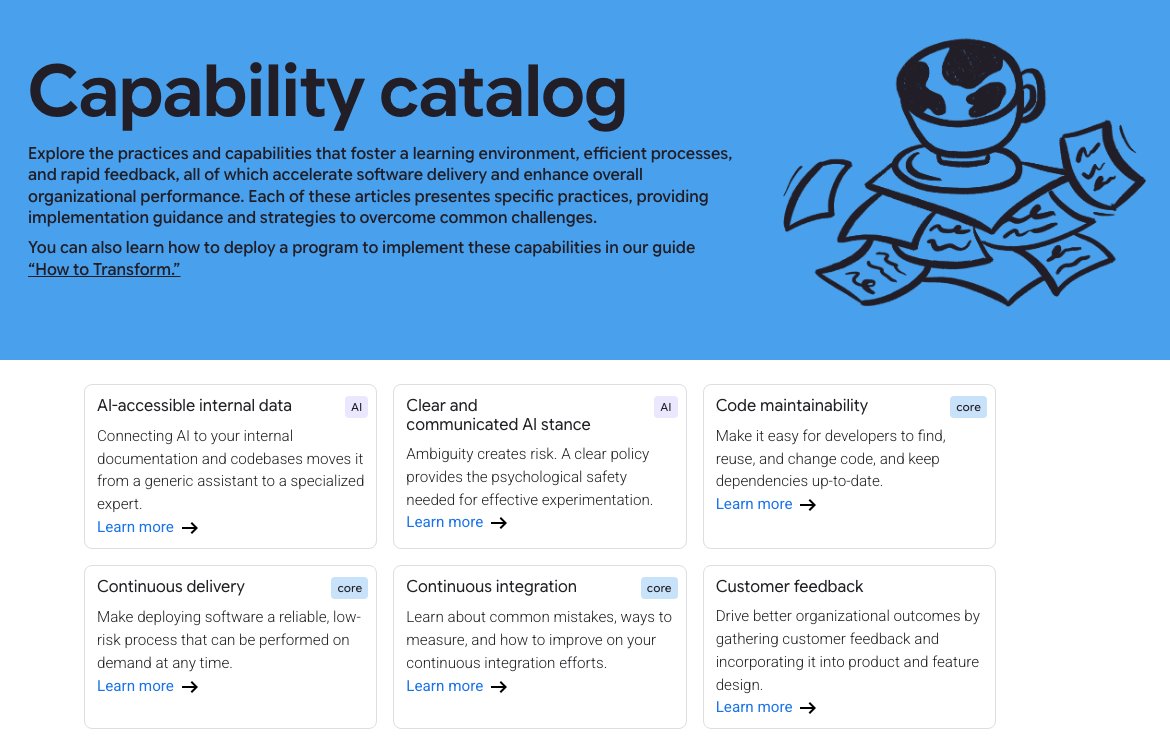
- A free list of capabilities from the research group behind Accelerate.
- An AI capability. This is the policy score in our six.
- Capabilities are things a team can do, not tools it owns.
- Core capabilities come from the original software research.
- Each card explains how to measure and improve one capability.
Screenshot of DORA, Capability catalog (dora.dev/capabilities), taken 2026-10-18
The Lowest-Score Rule is a way to run an AI maturity assessment. Score six capabilities from 1 to 3 for each workflow: workflows, policy, evaluation, spend visibility, ownership and skills. Count only evidence you can show.
The lowest score is the stage, so invest there, not in the capability that demos best. Make one move per quarter, promote a workflow only through a written gate, and re-score every quarter with a rising bar.
Feeling ready is not the same as being ready
Teams overrate their AI skill for the same reason students overrate their test scores. You feel like you know it long before you actually do.
The authors of Make It Stick retell a well-known set of studies by David Dunning and Justin Kruger. Students who scored around the 12th percentile on a logic test believed they ranked near the 68th.
Then it got worse. Shown the answers of stronger students, the weakest group raised their own estimates.
What fixed it? Ten minutes of training in the actual skill.
After that training, their self-ratings got much more accurate.
The lesson for an assessment is simple. A great demo does not make people better judges of their own skill. Practice with feedback does.
The book also offers a better test. Recall that feels easy right after a lesson proves little, while recall that still comes easily after a delay is a good sign.
So we score skills on a real task, done without help, a week after the training. A survey asks how people feel. A task shows what they can do.
The weakest students placed themselves 56 points too high
Logic test, bottom-scoring students: where they actually ranked and where they believed they ranked
- Actual rank 12
- Rank they believed 68
Source: Dunning and Kruger (1999), as reported in Brown, Roediger and McDaniel, Make It Stick (2014).
Keep the three stages as labels for the board
The three stages are still useful words. They give a board a quick shared picture.
AI Literate: people use AI tools on their own, often as shadow AI, and the value leaves when they do. AI Enabled: AI sits inside named workflows with owners, rules and checks. AI First: new work is designed around what AI can do, and people direct and review it.
Almost nobody is fully at AI First. Treat it as a direction, not a destination.
Use the stages to report. Use the six scores to decide.
Three stages are good for reporting, not for planning
- AI Literate People use AI on their own. Usage is high in surveys and invisible in process numbers.
- AI Enabled AI sits inside named workflows with owners, written rules and weekly checks.
- AI First New work is designed around AI capacity. People set direction and review output.
Stage names from our earlier version of this guide. Use them to report; use the six scores to decide.
Score six capabilities on evidence you can show
A capability is something the company can do on demand, with proof. We score six of them from 1 to 3.
They are workflows, policy, evaluation, spend visibility, ownership and skills. The table below shows what a 1, a 2 and a 3 look like, and what evidence to bring.
The evidence rule matters more than the table. A claim with nothing to show scores a 1.
No proof, no points.
The Accelerate researchers used the same trick in their surveys. They never asked teams whether they did continuous integration, because almost everyone claims it. They asked whether automated tests start every time code is checked in.
Ask about behavior, not labels. Skip "do we evaluate AI output?" and ask for last week's review log.
Policy works the same way. A memo nobody has read scores a 1. The one-page rules in our AI governance framework score a 2 once people have read them.
What a 1, a 2 and a 3 look like, and the proof to bring
| Capability | 1: Literate | 2: Enabled | 3: First | Evidence to bring |
|---|---|---|---|---|
| Workflows | People use tools alone | Named workflows with before and after numbers | New work designed around AI | The before and after numbers |
| Policy | An anxious memo | One page on what data goes where, with a named contact | Rules set per workflow, reviewed every quarter | The page, and who has read it |
| Evaluation | Nobody checks | A weekly sampled review with a pass or fail rule | Checks run continuously, like accounting | Last week's review log |
| Spend visibility | A surprise on the card statement | Caps per team, seen weekly | Cost per unit of output for every workflow | The latest spend report |
| Ownership | Nobody | One named person owns AI operations | Every workflow has an owner and an off switch | Names in job descriptions |
| Skills | A few fans | Trained people pass a real task a week later | Hiring and roles plan for AI capacity | Task results, not attendance |
Our method. Not a study result. No evidence means a 1.
Every label question has an evidence question that cannot be bluffed
| Label question | Evidence question |
|---|---|
| Do we evaluate AI output? | Show me last week's review log. |
| Do we have an AI policy? | Who has read it, and when? |
| Do we track AI spend? | What did one support reply cost last month? |
| Is the team trained? | Can they finish this task alone today? |
Our questions, after the survey method in Accelerate: ask about the behavior, never the label.
Score each workflow, not the whole company
Maturity belongs to a task, not to a company. One team can be ready while the team next door is not.
Andy Grove made the same point about people in High Output Management. He called it task-relevant maturity: a person can be highly mature in one job and brand new in another.
His example was a top sales manager moved to run a factory unit. The man did not change, but his results fell until he learned the new work.
Same guy. New job. Rookie again.
Our reading: AI works the same way. Support replies can earn a 3 on evaluation while invoice coding sits at 1.
So give each workflow a rung. AI Engineering by Chip Huyen describes a three-rung ladder Microsoft proposed, called Crawl, Walk, Run.
At Crawl, a person approves every output. At Walk, AI works directly with your own staff. At Run, AI can deal with customers.
The useful part is the gate. Her example: once staff send 95 percent of AI-suggested replies to simple requests without changes, let customers get AI replies for those requests.
Write the gate down before you start. Otherwise the promotion happens on a good feeling and a deadline.
Move a workflow up a rung only when it passes a written gate
- Crawl A person approves every AI output before it goes anywhere.
- Walk AI works directly with your own staff.
- Run AI deals with customers, inside the gate you wrote down.
Crawl-Walk-Run as described in Huyen, AI Engineering (2024), citing Microsoft (2023). Example gate there: 95 percent of AI-suggested replies used without changes.
Example: one company, three workflows, three different stages
| Workflow | Rung | Lowest score | Stage |
|---|---|---|---|
| Support replies | Walk | 2 (evaluation) | AI Enabled |
| Ad copy drafts | Crawl | 1 (policy) | AI Literate |
| Invoice coding | Crawl | 1 (evaluation) | AI Literate |
Example for illustration, not a real company.
How do you run an AI maturity assessment in twenty minutes?
Put four people in a room for twenty minutes, have each score alone, then compare. The four are whoever owns operations, technology and compliance, plus one front-line user.
Each person scores the six capabilities for each workflow, alone, in five minutes. Then everyone shows their numbers and their evidence.
The disagreements are the most useful thing you will get. Look hardest at the gap between the ops owner and the front-line user.
The boss sees the slide deck. The front line sees Tuesday.
How to get a flattering AI maturity score in four easy steps:
1. Survey only the executives. They feel great.
2. Count licenses and call it adoption.
3. Average the six scores so the weak one disappears.
4. Show the board your best pilot and call it a strategy.
Licenses are not a strategy. They are a receipt.
Four people, twenty minutes, one agreed lowest score
- Pick the workflows Minute 0 Up to five that use AI today.
- Score alone Minutes 1 to 5 Six capabilities, 1 to 3, per workflow. No talking.
- Show the evidence Minutes 5 to 15 Each score needs a log, a page, a report or a name.
- Agree the lowest Minutes 15 to 20 Mark the biggest disagreement. Take the lowest score as the stage.
Our method. Not a study result.
Your stage is your lowest score, not your average
Take the lowest agreed score as your stage. The lowest capability is the one that causes the incident or the stall.
For example, picture a company with impressive pilots. It scores 3 on workflows and skills, 2 on ownership and spend, and 1 on policy and evaluation.
The average is 2.0, which reads as AI Enabled. The lowest score says AI Literate. That is a Literate company with expensive hobbies.
Averages make a damn nice slide. Incidents ignore the slide.
Then make one move on the lowest capability, using the table below. For spend, use the caps and weekly report from our token spend method.
One move. One quarter. Then score again, with a higher bar for a 3.
Expect the middle to look worse before it looks better. In one year of the Accelerate data, middle teams broke things more often than the lowest teams. The authors suspect new work was pushing out repair work.
Our reading: your first honest review will find problems that were always there. That is the score working, not failing.
Example: an average of 2.0 hides two scores of 1
One company's six capability scores, 1 to 3
- Workflows 3
- Skills 3
- Ownership 2
- Spend visibility 2
- Policy 1
- Evaluation 1
Worked example from the method, not a real company. Average 2.0 (AI Enabled); lowest 1 (AI Literate).
Your lowest capability decides the one move for this quarter
| Lowest capability | The one move | Proof it worked |
|---|---|---|
| Evaluation | A weekly sampled review of one live workflow, with a written pass or fail rule | A review log for every week of the quarter |
| Policy | One page on what data goes where, with a named contact | Every AI user has read it |
| Spend visibility | Caps per team and a weekly spend report | Cost per output on each workflow |
| Ownership | Name one person and put AI operations in their job description | A named owner and an off switch |
| Workflows | Measure three workflows, then rebuild one with AI inside | Before and after numbers |
| Skills | Make your best user a paid champion with a real mandate | Staff pass a real task a week after training |
Our method. Not a study result.
Four scorers, one evidence column, and the lowest score sets the stage
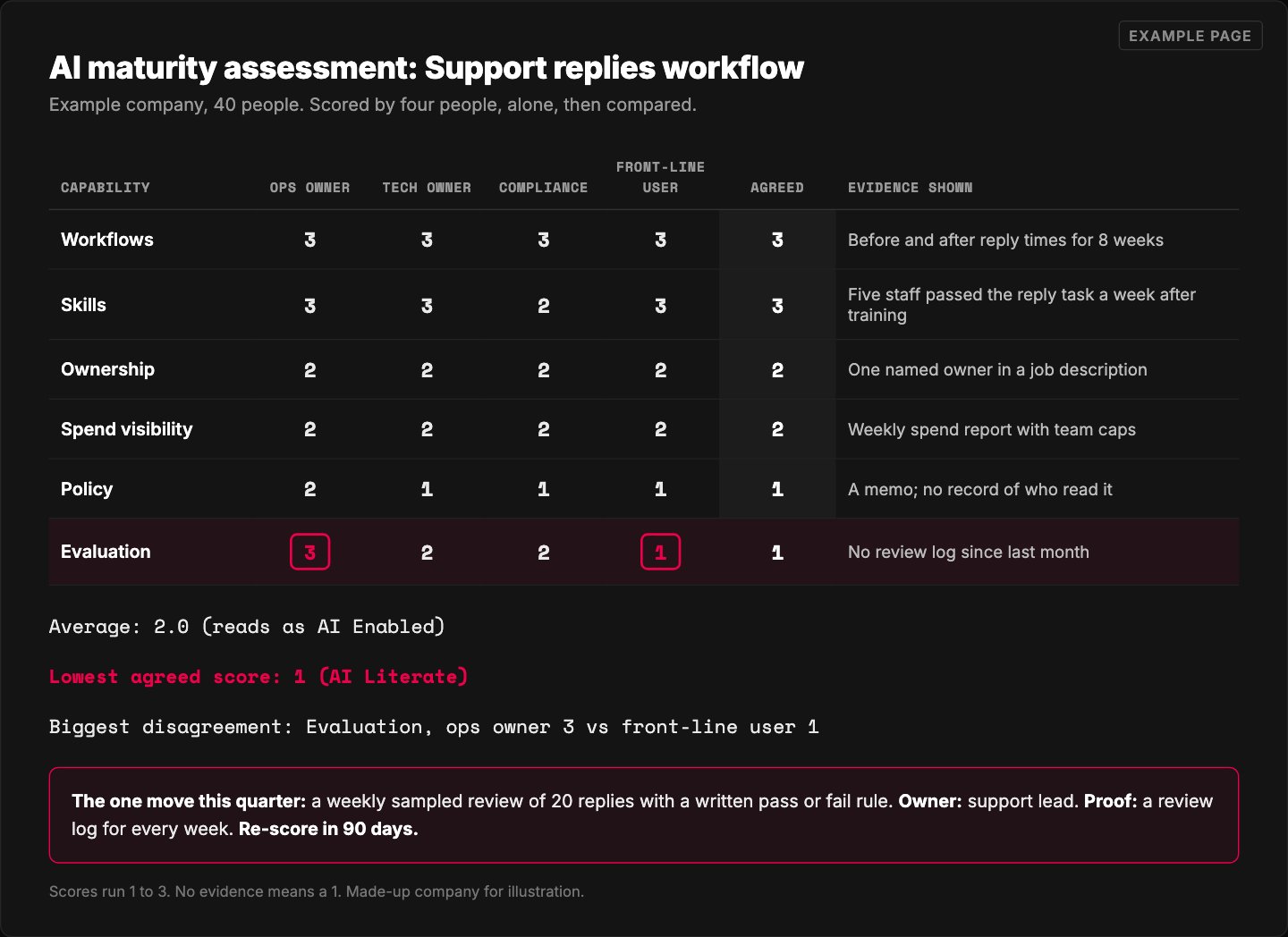
- A two-point gap is the real finding.
- Every score needs something you can show.
- The average flatters.
- The lowest score is the stage.
- One move, one owner, one proof, one quarter.
Example page built for this article with a made-up company. Scores match the worked example above.
Grow capability one team at a time
Do not roll AI out to every team at once. Start with one team working closely with help, then let the rest use what it built.
That is the pattern Manuel Pais and Matthew Skelton set out in Team Topologies. A team should collaborate closely with no more than one other team at once.
The first team works side by side with the platform group and figures out what works. The next team uses the result as a ready service. Later teams adopt an improved version without the close work.
Our reading for AI: one team earns Walk with heavy help. The second team gets the gate, the prompts and the review log as a kit.
Think of a relay race. One team runs the first leg, then hands the next team the baton.
Somebody has to own that kit. Our guide on who should own AI covers the choice.
People need a plan too. Fear of replacement is rational, so answer it with structure, not slogans.
Publish which roles change and how. Train on work time, not weekends. Make the first automations remove drudgery people can see, not jobs nobody mentions.
One team discovers, the next one consumes, the rest adopt
- Team 1: close work Works side by side with the platform group and finds what works. Earns Walk.
- Team 2: ready service Gets the gate, the prompts and the review log as a kit.
- Teams 3 and up: adopt Use a later, better version with no close collaboration.
Pattern: Skelton and Pais, Team Topologies (2019), Figure 8.7, about software teams. Applied to AI rollouts by us.
How is this different from the Microsoft, AWS and Google AI frameworks?
The cloud vendors publish checklists of what to build; our assessment finds what will break first. You can use both.
Microsoft, AWS and Google Cloud each publish a free AI adoption framework. They are detailed, and each leans toward its own platform.
A checklist with forty items invites you to count what you have. Counting feels like progress. It is not a diagnosis.
The staged idea itself is older than AI. The Capability Maturity Model from software engineering measured a company's process, not its tools.
Security analysts hit the same counting trap. In How to Measure Anything in Cybersecurity Risk, Douglas Hubbard and Richard Seiersen build their maturity model around decisions, not tools.
It starts with one question, what should we invest in, and needs very little data to begin. It then climbs to whether each investment works, whether they work together, and whether you catch what is hidden.
Board or regulator asking? The NIST AI Risk Management Framework and ISO/IEC 42001 give you the formal vocabulary. Neither replaces twenty minutes with four people.
Want us in the room instead? Our consultant versus in-house guide explains how we keep the capability with you.
A maturity model that starts with a decision needs very little data
| Rung | Question it answers | Our AI version |
|---|---|---|
| Sparse data analytics | What should I invest in? | Which workflow gets AI next? |
| Functional metrics | Are my individual investments working? | Does each workflow pass its review? |
| Data marts | Are my investments working together? | Do workflows share data, rules and cost reports? |
| Prescriptive analytics | Am I finding hidden threats? | Does monitoring catch failures before customers do? |
Rungs and questions: Hubbard and Seiersen, How to Measure Anything in Cybersecurity Risk, 2nd ed., Figure 10.1. AI version: ours.
Run the assessment with AI: the copy-paste prompt
Paste the prompt below into your preferred AI. It asks which workflows use AI, what evidence you have, and where your scorers disagreed.
It never invents a number. Every score needs evidence you name, and every gate needs a rate you give it.
It returns a stage per workflow, the lowest capability, and one move for the quarter. Want a second pair of eyes? Send us the result.
Paste into your preferred AI. It asks about your workflows and your evidence, then gives each workflow a stage, finds the lowest capability and picks one move.
Act as an AI operations reviewer. Run an AI maturity assessment with the Lowest-Score Rule.

Ask me one question at a time, with the example:
1. Which workflows use AI today? List up to five. (Example: support email replies, ad copy drafts, invoice coding)
2. Which rung is each workflow on? Crawl: a person approves every output. Walk: AI works directly with our own staff. Run: AI deals directly with customers. (Example: support replies are at Crawl)
3. For each workflow, what evidence can I show for six capabilities: workflows, policy, evaluation, spend visibility, ownership, skills? (Example: evaluation: we sample 20 replies every Friday and log pass or fail)
4. Who scored, and where did their scores differ? (Example: ops gave evaluation a 2, the front-line user gave it a 1)

Scoring rules:
- Score each capability 1, 2 or 3 for each workflow, only from evidence I can show: a log, a document, a report, a named owner, or a task done without help a week after training. No evidence means a 1.
- Ask me for the evidence. Never assume it exists, and never invent a number.
- A workflow's stage is its lowest score, not its average. 1 = AI Literate, 2 = AI Enabled, 3 = AI First.
- If two scorers differ by 2 points, flag it as the main finding.
- A workflow moves up a rung only after it passes a written gate, such as the share of AI drafts sent without edits. Ask me for the gate and the current rate. Do not pick a rate for me.
- Choose ONE move for the lowest capability. One move, one quarter.

Show your reasoning, then answer in this format:
Scores: a table of workflows by capabilities
Stage per workflow: [stage, and the score that set it]
Biggest disagreement: [capability, who, why it matters]
Lowest capability: [name]
The one move this quarter: [what, who owns it, the evidence that will prove it]
Promotion gates: [workflow, current rung, gate, current rate]
Re-score date: [90 days from today]
Next three actions: 1. 2. 3.
What to do this week
1. Book twenty minutes with the four scorers. Ask each one to bring evidence, not opinions.
2. Run the prompt with their scores. Mark the biggest disagreement.
3. Pick the one move for the lowest capability and name its owner. Put the re-score date in the calendar.
Remember the person who said nobody checks the AI drafts? That sentence was your real score.
If evaluation is your lowest score, read how to evaluate AI agents next.
A maturity level shows how tall the building looks. The lowest score shows which floor is weak.

Filip Kovacevic is the founder of Anar Agency in Phoenix. He spent five years running SEO, Meta ads, email, and content for medical practices across the United States, and now does the same work for healthcare, home-service, legal, and professional-service businesses, alongside AI implementation. More from Filip →
Talk it through in 15 minutes
Bring one question from this article. We will tell you what we would do, whether or not you hire us.
Book a 15-Min Chat →