AI Consultant vs In-House Team: Who Should Own the Work

Build in-house when the AI work is part of why customers choose you. Buy a ready-made product when the work is routine. Hire an AI consultant or agency only to learn fast, with an end date, a written handoff, and your own person working beside them from day one.
AI consultant vs in-house: the real question is who owns it after
Picture a company that signs a six-month AI retainer. The agency builds four clever workflows. Demo day goes great.
Then the contract ends. Two weeks later a prompt breaks, and nobody inside knows where it lives. The AI walked out the door with the agency.
That is the AI consultant vs in-house decision done backwards. Most people ask which one is cheaper. The better question is who owns the work when the outsider walks out.
You will see it typed as AI consultant vs AI agency, or AI consulting vs in-house development. Same choice underneath. Rent the work, or build the skill.
One thing up front. We sell AI implementation, so read this with one eyebrow raised. We will tell you where hiring your own team beats hiring us.
The short version: own the AI work that makes customers pick you. Buy a product for the routine work. Rent outside help only to learn, with an end date.
Renting is fine. Renting forever is the trap.
Renting the work ends with the contract; building the skill stays
| Renting the work | Building the skill |
|---|---|
| The outsider builds, you watch | The outsider builds with your person beside them |
| Know-how sits with the vendor | Know-how sits with your owner |
| Ends with a renewal | Ends with a handoff |
| Cost grows as you depend on them | Cost falls as your team takes over |
Our comparison.
AI consultant vs AI agency vs AI engineer: what is the difference?
An AI consultant advises. An AI agency builds, and usually runs what it builds for a monthly fee. An AI engineer is one builder, employed or contracted, who needs someone else to own the plan.
An implementation partner is an agency that promises to hand the work over and leave. The labels blur. One firm will use three of them in one proposal.
So skip the label and ask three things. Do you build, or only advise? Do you run it after launch, and for how long?
And the big one: when you leave, what do we own? The answer should list the code, the prompts, the test cases, the documents and the account logins.
Anything missing from that list is something you rent. Forever, usually.
Ignore the label; ask what they build, run and leave behind
| Label | What they usually do | Ask them |
|---|---|---|
| AI consultant | Advises: strategy, vendors, a roadmap. May not build. | What ships, and who builds it? |
| AI agency | Builds and runs workflows, often on a monthly retainer. | What do we own when you leave? |
| AI engineer | One builder, employed or contracted. | Who owns the plan and the tests? |
| Implementation partner | An agency that promises a handoff. | Is the handoff in the contract, with a date? |
Our definitions. Vendors use these labels loosely.
The Build-Teach-Leave sequence rents outside AI help without renting it forever. Sort first: own the AI work that sets you apart, buy routine work as a product, and rent help only to learn. Write the baseline and name your owner, then outsiders and your owner prove two or three workflows under a charter with an end date.
The outsiders switch to teaching while your owner runs the work, and your team scales it, with outsiders back only for spikes.
Sort each AI project first: own it, buy it, or rent help to learn it
Sort the work before you pick who does it. Two questions do the sorting.
Question one: does this work make customers choose you? Think of what a competitor could not copy by buying the same software. That is your core.
Question two: does a product already do it well? Meeting notes, inbox sorting and first-draft copy all have good ready-made tools. Building your own version is a hobby, not a strategy.
Core work gets owned. Routine work that a product covers gets bought. The rest is work no product handles and nobody has proven yet, so you rent help to find out fast.
For example, picture a lender. The AI that reads loan files and flags risk is core. The AI that tidies meeting notes is routine, and a new AI lead follow-up is unknown until someone tests it.
Three projects. Three different answers. One company.
Two questions sort every AI project into own, buy or rent
- Buy the product Routine work with good ready-made tools. Building your own is a hobby.
- Own the edge Your rivals can buy the same product. Own the part that makes you different.
- Rent help to learn Nobody has proven it yet. Rent help with an end date, then buy, own or drop it.
- Own it Core work with no product. Hire the owner first, rent a coach if needed.
Our sorting method.
When does in-house win? When the AI work is how you win
In-house wins when the AI work is part of why customers buy. Then the know-how is the asset. Renting it means someone else holds your edge.
Amazon faced this choice with the first Kindle, as told in Working Backwards. Relying on outside hardware makers looked less risky on paper. They built the team anyway.
Their reasoning had two parts. A vendor who builds your core learns your core, and can sell that learning to your rivals. And the retailers who outsourced their online stores were stuck choosing features from the vendor's list.
The book's verdict: in that case, outsourcing would have cost more in the end. Cheaper on the invoice. Pricier every year after.
Two more books land on the same rule, shown in the table below. Both write about software, not AI. Applying them to AI work is our reading.
Our rule: if the workflow is your product or your edge, hire the owner first. Outsiders can coach. They should never hold the keys.
Own what sets you apart; buy what does not
| Book | What it says | What we take for AI |
|---|---|---|
| Working Backwards (Bryar and Carr) | Amazon built the Kindle team in-house so the know-how stayed inside and could not be resold to rivals. | Own the AI that sets you apart. |
| Accelerate (Forsgren, Humble, Kim) | Strategic software belongs inside; routine software like payroll is better bought as a service. Low performers more often worked on custom software built by another company. | Buy routine AI as a product. Keep strategic builds inside. |
| AI Engineering (Huyen) | If AI threatens the business itself, do it in-house. If it boosts productivity, there are plenty of products to buy. | Existential means own. Productivity means buy. |
Sources: the three books. The first two are about software, not AI; applying them to AI is our reading.
Measure your baseline before anyone outside touches the work
A baseline is today's numbers for one workflow, written down before anything changes. Without one, nobody can prove the AI helped.
Boring? Very. It is also the only proof you will get.
Four numbers are enough. How many times the task runs a month. Minutes per run, cost per run, and how often it goes wrong.
Your own people collect these, not a consultant. They know where the time really goes. An outsider guessing at it is billing you for a tour.
The author of SYSTEMology makes the same timing call about business systems. Early on, he warns against paying a consultant to write up a business they barely know.
Later, once you have a baseline and key numbers, an expert becomes far more useful. Now there is something to measure their advice against.
Writing the baseline often shows the problem was never AI. Plenty of them are operations problems in disguise.
We apply that rule to AI. Baseline first. Outside help second.
Four numbers to write down before any AI work starts
- Runs per month How often the task happens. For example, 300 lead replies a month.
- Minutes per run Time a person spends on one. For example, 6 minutes.
- Cost per run Minutes times the loaded hourly cost, plus any tools.
- Error rate How often it goes wrong. For example, 1 in 20 replies needs a fix.
Our method. Example figures are illustrations, not data.
Write the outside engagement as a team with an end date
The Build-Teach-Leave sequence is our way to rent AI help without renting it forever. Outsiders and your people prove the first workflows together. Then the outsiders teach, and then they leave.
The shape comes from software teams, not AI. Team Topologies calls it an enabling team: specialists who give guidance, not execution, and work with a team for weeks or months, never for good.
Its best case study reads like a contract template. A consulting team mixed its own people with developers from the client's teams. It published a charter with an eight-week window and four metrics.
It spent about a quarter of its time building and the rest teaching. It planned its own exit from the first day. The results after those eight weeks are below.
One warning from the same book stuck with us. In the authors' experience, the effort of learning a new capability gets underestimated by ten to fifteen times. So budget for the teaching, not just the building.
Prove: outsiders and your named owner ship two or three measured workflows against the baseline. Transfer: the outsiders stop building and start teaching, while your owner runs the work.
Scale: your team runs the whole set. Outsiders come back only for a spike, like a hard integration or an audit.
Skipping transfer is the common failure. It is also the most profitable thing an agency can sell you.
A mixed team with an end date moved four numbers in eight weeks
Outside consultants plus the client's own developers, under a published charter
- Lower deployment lead time 72
- More pipeline runs per day 700
- Shorter pipeline run: ten hours to fifteen minutes 98
- Average time to fix a failing build 23
Source: Team Topologies (Skelton and Pais), case study by Robin Weston of a consulting engagement at a large legal organization. A software case, not AI.
Outsiders build first, teach second and leave third
- Baseline and owner Before day one Your people write the four numbers. You name the owner who will run the work.
- Ship two or three workflows Prove Outsiders and your owner build together against the baseline, under a charter with an end date.
- Outsiders teach, owner runs Transfer Your owner does the work while the outsiders review. Code, prompts, test cases, documents and logins move to you.
- Your team runs it Scale Outsiders come back only for spikes: a hard integration, a new market, an audit.
Our sequence. The charter and end date follow the enabling-team pattern in Team Topologies.
Three quarters of the time went to teaching, one quarter to building
- Sharing knowledge 75
- Building solutions 25
Source: Team Topologies, the same enabling-team case. The team's own estimate.
Never rent the owner
Outsiders can add skill. They cannot carry the job. That stays with someone on your payroll.
Hacking Growth makes this point about growth teams: outside specialists can add bench strength, but the core job should never be handed out. The authors write that consultants often lack the authority, time or drive to finish the hard part.
Why does renting the owner get worse over time? It is the trap Thinking in Systems calls shifting the burden to the intervenor. Each time the outsider fixes something alone, your team learns a little less, and you need the outsider a little more.
The way out is the same every time. The helper builds up your team's own ability, then steps away.
How to rent your AI forever in four easy steps:
1. Sign a retainer with no end date.
2. Let the agency hold the logins. Easier for everyone.
3. Skip the handoff. Who has time for paperwork?
4. Renew, because now nobody else knows how any of it works.
That is not a partnership. That is a subscription to your own business.

Every fix the outsider makes alone weakens your team a little
- Outsider fixes it The problem goes away fast.
- Your team learns less Nobody inside practices the skill.
- The next problem lands Your team is less able to handle it.
- You need them more Fees grow and leaving gets harder.
Pattern from Thinking in Systems (Meadows), applied to AI help by us.
Outsiders can add skill; only your people can carry the job
| Outsiders can | Only your people can |
|---|---|
| Bring patterns from other companies | Know why your customers buy |
| Build the first workflows fast | Run them every day after |
| Train your owner | Train the rest of your team |
| Leave on a set date | Answer for it when it breaks |
Our split, following Hacking Growth (Ellis and Brown) on outside experts and growth teams.
An outside AI engagement written to end: an owner, a date, a baseline and a handoff list
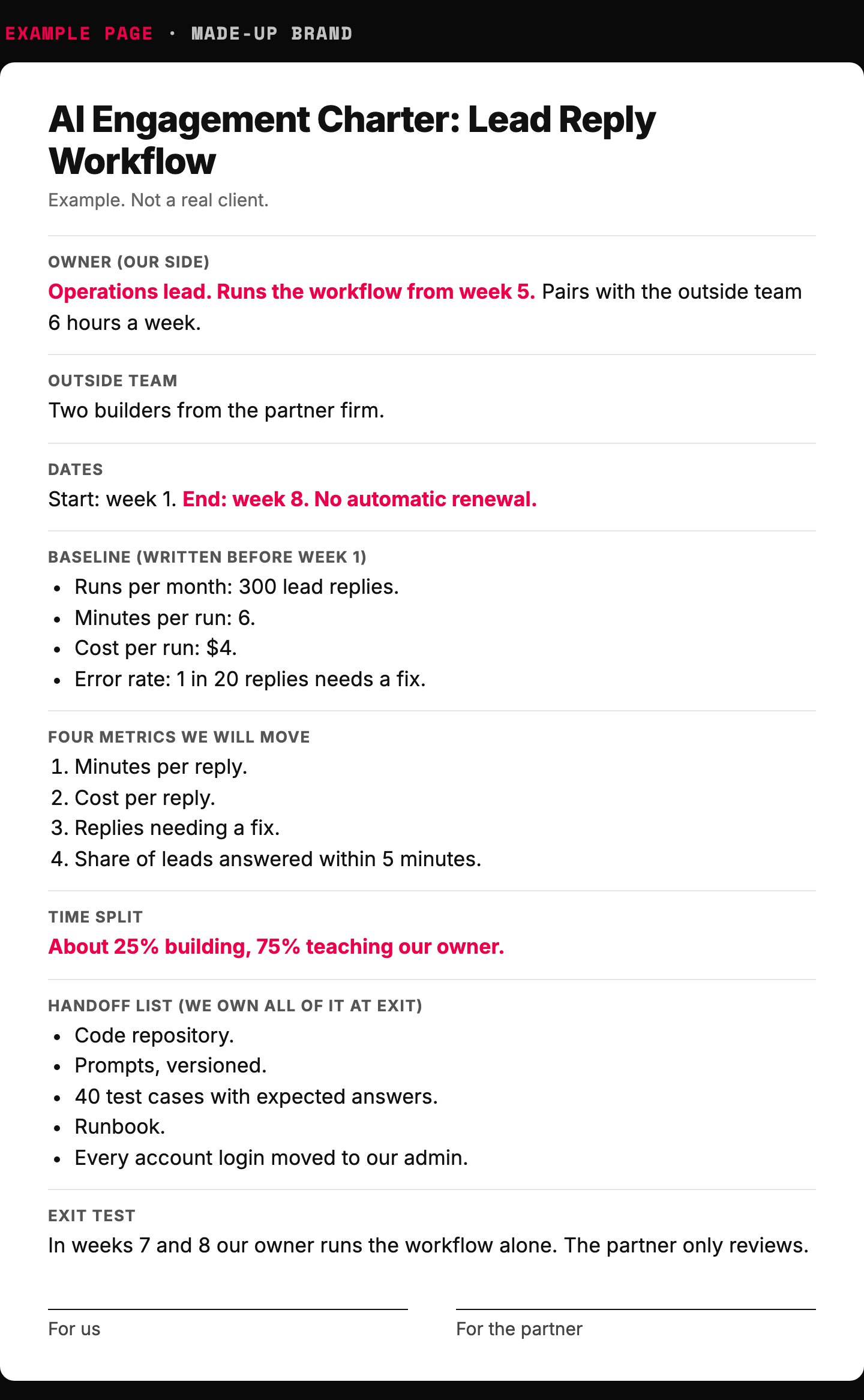
- An end date, in writing. Renting stops on a day you chose.
- A named owner on your payroll from day one.
- Today's four numbers, written before anyone outside starts.
- Most of the outside team's time goes to teaching.
- What you own when they leave. Anything missing here, you keep renting.
Example page built for this article with a made-up brand. The 25/75 split follows the enabling-team case in Team Topologies (Skelton and Pais); baseline figures are the article's illustrations.
Six questions that expose a weak AI partner
You do not need to be technical to vet an AI partner. You need six questions, asked before you sign.
Question 1: What is our baseline, and which number will you move? A strong partner names the number. A weak one names features.
Question 2: Why can our team not do this today, and what would fix that? A plan that never makes your team more able is a plan to keep you.
Question 3: Who on our side will you train, and how many hours a week will that take? Outside teaching often misses how you actually work.
In High Output Management, Andy Grove describes outside consultants who taught a career course at Intel that clashed with how the company really ran. The people who took it came out a little demoralized.
So outsiders train your owner. Your owner, who does the work every day, trains everyone else.
Question 4: What will you refuse to automate? A partner who has never said no has never been careful.
Question 5: When you leave, what do we own? Code, prompts, test cases, documents, logins. In writing.
Question 6: When does this end? A date, a charter and the numbers that prove it worked. Then ask which past client now runs the work without them.
A test case is a saved example with the answer you expect back. A partner with no test cases has not been testing. Our guide on how to evaluate AI agents shows what good ones look like.
Strong partners answer with numbers and dates; weak ones answer with features
| Question | Strong answer | Weak answer |
|---|---|---|
| Which number will you move? | Names one baseline number and a target | Lists features and tools |
| Why can our team not do this today? | Names the gap and how you close it | Says you will not need to learn it |
| Who will you train? | Names your owner and the weekly hours | Says training is optional |
| What will you refuse to automate? | Gives a real example | Says anything can be automated |
| What do we own when you leave? | Code, prompts, test cases, documents, logins | Says it is all in their platform |
| When does this end? | A date in the contract | Talks about a long partnership |
Our vetting questions. Question two adapts the questions Thinking in Systems asks before any outside fix.
Twelve hours of preparing to teach can return two hundred hours of work
Grove's example: four one-hour lectures with three hours of prep each, ten people, a 1 percent gain over their 20,000 working hours a year
- Hours of preparation 12
- Hours of work gained 200
Source: High Output Management (Grove). His worked example, not measured data.
What does an AI consultant cost compared with an in-house team?
An in-house AI team costs more than its salaries. The fair comparison is the full yearly cost of each path, measured against the same baseline.
For a hire, add salary, benefits and payroll taxes, recruiting, tools, a manager's time, and the months before they are useful. Look up current wages for the role on O*NET, the US Labor Department's job database. Your payroll provider can tell you what benefits and taxes add.
Most AI builds need three skills: building, owning the workflow, and handling data. Price all three, even when one person covers two.
For a partner, add the fees, your own staff's hours spent with them, and the cost of the handoff. Then add the cost of leaving. If you cannot leave, that cost has no ceiling.
Contractor or employee? The IRS test decides by how much control you have over the work, not by the job title. Get it wrong and the cheap contractor gets expensive.
Adding up every line like this is called total cost of ownership. Our take: advice is cheap per hour and expensive per result, because advice alone ships nothing. A hire is the biggest fixed cost, and the only one that compounds.
The AI usage bill is the same on both paths, and it scales with use. Put it on one line per workflow with our guide to controlling AI token spend.
Then compare cost per run against the baseline. The cheaper path is the one that moves your number, not the one with the smaller invoice.
Price both paths in full, then compare against the same baseline
| Cost line | In-house team | Outside partner |
|---|---|---|
| Pay | Salary, benefits, payroll taxes | Fees |
| Getting started | Recruiting, and the months before they are useful | Your staff's hours briefing them |
| Ongoing | Tools, training, a manager's time | Your owner's hours working beside them |
| AI usage | Same on both paths | Same on both paths |
| Leaving | Notice, and the know-how walks out | Handoff work, or no exit at all |
| Upside | Skill compounds every year | Patterns from other companies |
Our checklist. Look up current wages on O*NET; ask your payroll provider what benefits and taxes add.
The wage line of your in-house cost starts on a free government page
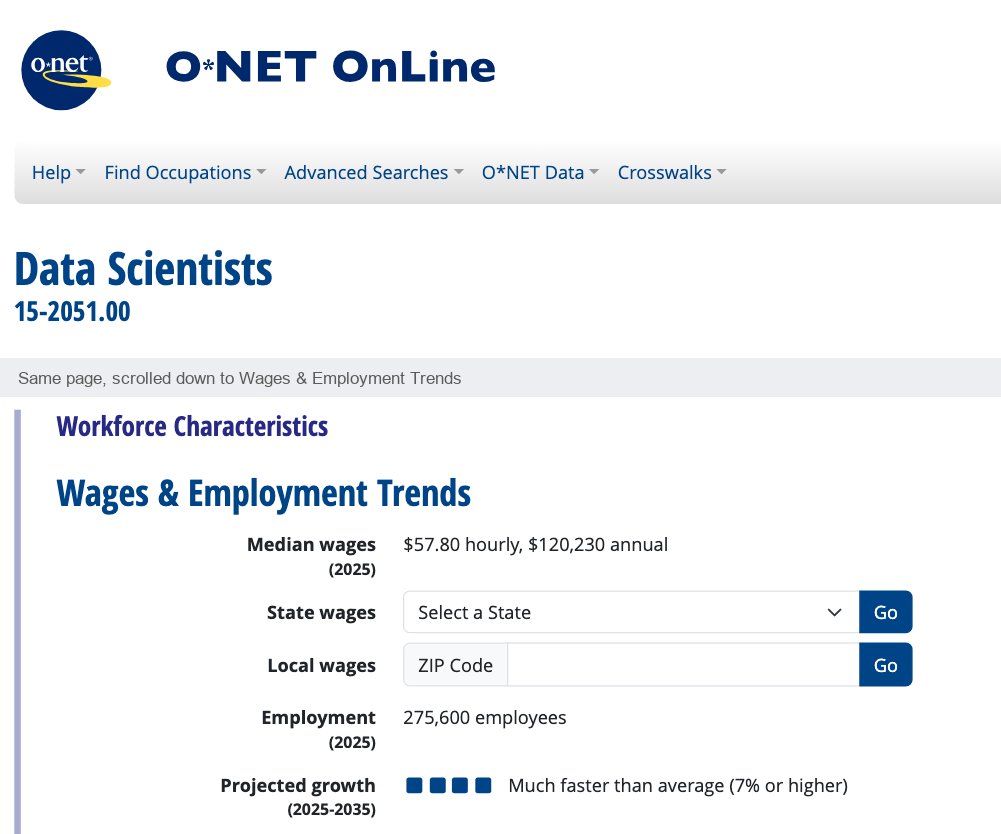
- Search any role here. Pick the one closest to the hire you are pricing.
- The national median salary. This is the first line of your in-house cost, before benefits and taxes.
- Pick your state. Local wages can differ a lot from the national figure.
- Fast growth usually means a harder, slower hire. Budget the months before they are useful.
Screenshot of O*NET OnLine, 15-2051.00 Data Scientists, taken 2026-10-18: median wages (2025) $57.80 hourly, $120,230 annual; projected growth (2025-2035) much faster than average.
Sort your AI projects with this prompt
Paste the prompt below into your preferred AI. It asks about each project, sorts it into own, buy or rent, and drafts the terms for anything you rent.
It never invents a wage or a fee. It asks you, or looks up the current figure if it can browse, and tells you which it used.
It still needs your baseline. No numbers in, no answer out.
Rules about risk and data still apply on every path. Whoever builds it, the decisions in our AI governance framework have to be made, and the NIST AI Risk Management Framework is the public reference most reviewers use.
Paste into your preferred AI. It asks about each project, then gives a decision, an owner, a baseline and the terms for anything you rent.
Act as an AI operations advisor. For each AI project I list, decide whether we should own it in-house, buy a ready-made product, or rent outside help to learn it.

Ask me one question at a time, with the example:
1. What is the project, in one sentence? (Example: AI that drafts replies to new leads)
2. Does it help customers choose us over a competitor? (Example: no, every firm in our market replies to leads)
3. Does a ready-made product already do it well? (Example: yes, our CRM has a reply feature)
4. Today's baseline: runs per month, minutes per run, cost per run, how often it goes wrong. (Example: 300 a month, 6 minutes, $4, 1 in 20 wrong)
5. Who on our team would own it? (Example: our operations lead)
6. The yearly salary of the role we would hire, or the partner's fee. (Example: a quote we received)

Never invent a wage, fee or price. If you can browse, look up the current median wage for the role on O*NET and say so. If not, ask me. Report every figure with its source and date.

Rules:
- Helps customers choose us: OWN. Hire or name the owner first. Outsiders may coach, never hold the work.
- Routine, and a product does it well: BUY the product.
- No product covers it, or nobody knows yet if it pays: RENT help to learn, with an end date, a written charter, four metrics against the baseline, our owner paired from day one, and a handoff of code, prompts, test cases, documents and logins.
- No baseline: stop and help me write one first.
- No owner: stop. Nothing gets rented without one.
- Cost: compare the full yearly cost of each path against the same baseline. Hire: salary, benefits and taxes, recruiting, tools, manager time, months before they are useful. Partner: fees, our staff hours, the handoff.

Show your math, then answer for each project:
Decision: own / buy / rent
Why: one line
Owner:
Baseline:
If rent: end date, four metrics, what we own at exit
Next three actions: 1. 2. 3.
What to do this week
1. List every AI project on the table. Run the two sorting questions on each one.
2. For anything you plan to rent, write the baseline and name your owner before the first vendor call.
3. Put the six questions to every partner you are weighing. Get the answers in writing.
Remember the company whose AI walked out with the agency? It did not need a cheaper agency. It needed an owner and an end date.
If you want outside help that is built to leave, here is how we run ours. The next question is who should own AI inside your company.
Rent the scaffolding. Own the building.

Filip Kovacevic is the founder of Anar Agency in Phoenix. He spent five years running SEO, Meta ads, email, and content for medical practices across the United States, and now does the same work for healthcare, home-service, legal, and professional-service businesses, alongside AI implementation. More from Filip →
Talk it through in 15 minutes
Bring one question from this article. We will tell you what we would do, whether or not you hire us.
Book a 15-Min Chat →